 Kerala Backwaters Escape

Religious & Heritage Tour Of South India
Chennai – Kanchipuram – Gangaikonda Cholapuram – Kumbakonam (Navagraha temples) – Thingalur – Tanjore – Trichy
At a glance
Nine planets, nine villages and one river delta. Around the temple town of Kumbakonam, each of the Navagrahas, the nine celestial influences of Hindu astrology, has a shrine of its own, and families from across the world come to pray at all of them in a single circuit. Our Kumbakonam Navagraha temples tour gives that circuit two full days so that nobody has to rush from one sanctum to the next, and it sets the planets beside the royal architecture of the same delta: the three Great Living Chola Temples listed by UNESCO at Gangaikonda Cholapuram, Darasuram and Tanjore.
The week opens in Chennai and Kanchipuram, the old Pallava capital, before the long drive south into the green Kaveri delta, where you stay three nights in Kumbakonam. That base matters, because the nine shrines lie in different directions, and returning to the same room each evening keeps the days calm for older travelers. A night each in Tanjore and Trichy finish the trip with the Brihadeeswarar Temple, the Rockfort and Srirangam. Every kilometer is covered in one private car with an English-speaking chauffeur, and in each town a local guide who understands temple routine takes over at the gate.
Typical travelers on this Navagraha temple tour are Hindu families of Indian origin living in America, Britain, Canada, Australia, Singapore or the Gulf, many carrying a horoscope and a list of pujas suggested by the family astrologer, which our guides help arrange at each temple. Travelers drawn by Chola bronzes and stone carving join it too. Where a sanctum is reserved for Hindus, we tell you beforehand and show guests of other faiths what remains open to them. Between October and March the delta is green and the heat is gentler, and Thursdays or Saturdays bring larger crowds at certain planetary shrines.
A placard with your family name greets you at the exit of Chennai International Airport, held by our airport executive, who walks you to the car and introduces your driver for the coming week. Long-haul flights from Frankfurt, London, Dubai and Singapore tend to arrive in the small hours, and so nothing is scheduled before the afternoon. Use the morning to sleep and to try a first South Indian breakfast of pongal, crisp vada and sambar. Landing in daylight? Mention it when booking and we reserve the room from the morning so you can go straight upstairs.
Your guide meets the family after lunch and spends half an hour going through the plan, the horoscope list if you have brought one and the practical side of temple visits in Tamil Nadu. Shoes are always left outside, usually with an attendant for a small fee. Many temples in the state now ban mobile phones inside and run counters where you hand them in. For men, trousers or a veshti with a shirt; for women, a saree, an ankle-length skirt or a salwar suit with the dupatta over the shoulders; shorts and sleeveless tops stay packed for this week. A few sanctums on the route admit Hindus only, which your guide flags in advance.
Toward sunset you head to Triplicane, an old neighborhood near the Marina, for the Parthasarathy Temple. Its main image shows Krishna as Parthasarathy, the charioteer of Arjuna, with a curled mustache and marks on the face that tradition links to the arrows of the Mahabharata war. The shrine is one of the 108 Divya Desams praised by the Alvar poet-saints, and its origins are traced to the Pallava period. Evening worship here is lively, with a temple band and devotees reciting Tamil hymns. A short walk past the old mansions and tiffin shops of Triplicane rounds off the evening. Overnight in Chennai.
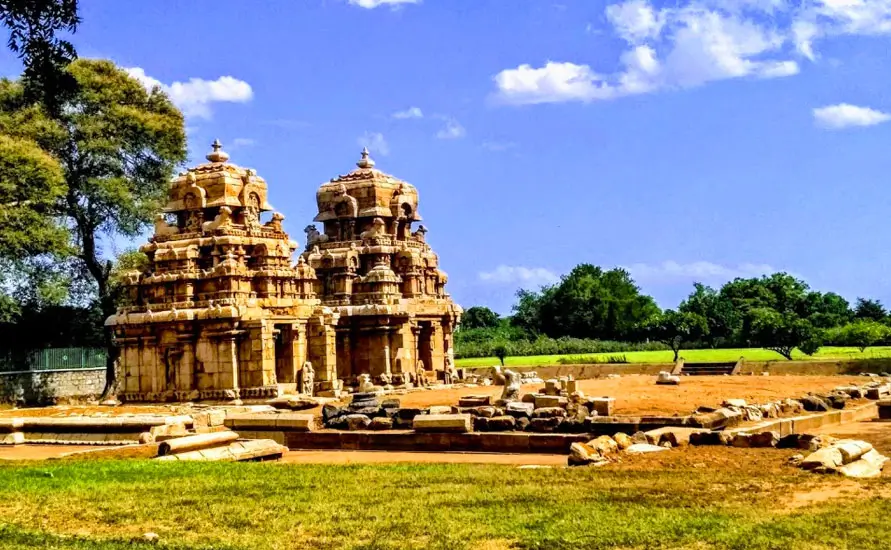
Kanchipuram is one of the seven holy cities of Hindu tradition, and the old saying is that it has a temple on every street. Leaving after breakfast, you reach it in roughly two hours along the Bengaluru highway, with industrial suburbs giving way to paddy and lotus ponds. You begin at the Kailasanathar Temple, which King Rajasimha of the Pallava line had built of soft sandstone around 700 CE. Its small cells around the courtyard are carved with Shiva in many moods, from dancer to ascetic, and traces of old plaster painting still cling to some walls. Few tour buses stop here, so you can linger.
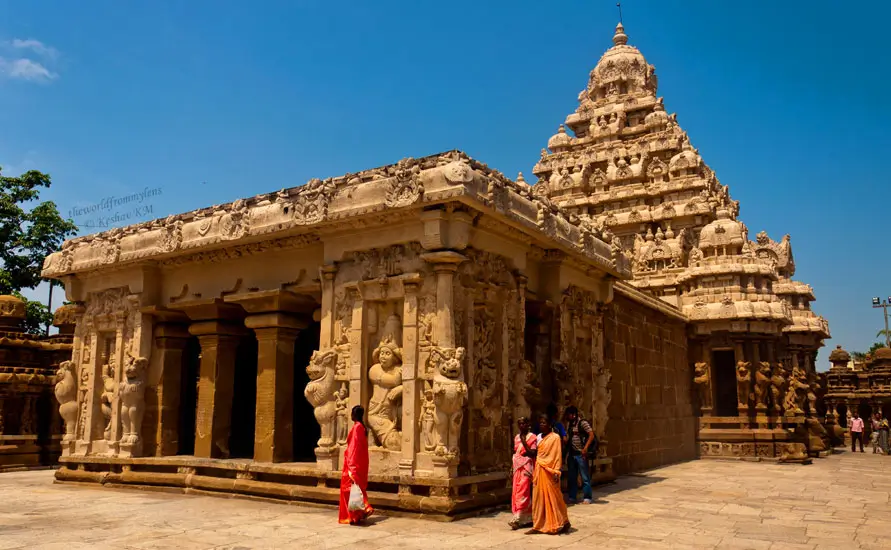
Next comes the Varadharaja Perumal Temple, among the biggest Vishnu shrines in Tamil Nadu and a Divya Desam. In its hundred-pillared hall, sculptors of the Vijayanagara period carved horse riders, hunting scenes and stone chains with loose links cut from a single block. Devotees climb to a ceiling where gold and silver lizards are touched for blessings. The temple tank holds a wooden image of the deity, Athi Varadar, which is lifted out of the water and displayed to devotees once in four decades, the last time in 2019. Visitors of other faiths may usually see the halls and corridors, while sanctum access follows temple rules.
After lunch you watch Kanchipuram silk taking shape at a family loom, where the weaver uses a separate shuttle for the border and joins it to the body of the sari with a tight interlocking weave known locally as korvai. Reading the silk mark tag takes a minute to learn, and buying is purely optional. At around four, when temples reopen, you visit the Vaikunta Perumal Temple, whose cloister walls carry a row of panels telling the history of the Pallava kings in stone. After that the evening is yours, with dinner at the hotel or in one of the town's pure-vegetarian eateries. Overnight in Kanchipuram.
Five and a half hours of road make this the biggest transfer of the week, so it is split into two halves with tea stops in between. The road runs south through Villupuram district and the cashew country around Panruti, and it crosses the Vellar and Kollidam rivers before the land turns into the flat, canal-cut rice fields of the delta. Coffee and lunch are taken at clean roadside restaurants your driver already trusts, and the car is comfortable enough for a grandparent to sleep for an hour. Village potters and wayside shrines appear along this stretch, and the driver will happily pull over if anything catches your eye.
Around midday you halt at Gangaikonda Cholapuram; Rajendra I made it his seat once his troops had returned from the north. The palace has disappeared, yet the temple to Shiva still stands in a wide lawn. A great Nandi of brick and lime plaster faces the sanctum, and close to the gateway you step down into a well through the open jaws of a stone lion, the Simha Kinaru. Inside the halls your guide points out a dancing Nataraja, a graceful Saraswati and the image of Shiva as Ardhanarishvara, half male and half female. Worship continues daily, and the lawns and halls are open to everyone.
Kumbakonam comes into view late in the afternoon, and the same rooms serve for three nights. The town sits between the Kaveri and Arasalar rivers and is ringed by so many shrines that it is often called a temple town. After tea, a short stroll brings you to the Mahamaham tank, whose stone steps and sixteen small pavilions fill with pilgrims every twelve years for the Mahamaham bathing festival, last held in 2016. On normal evenings it is calm, with families feeding fish and boys playing cricket on the bank. Dinner is a Kumbakonam degree coffee and a light meal of dosa or curd rice. Overnight in Kumbakonam.
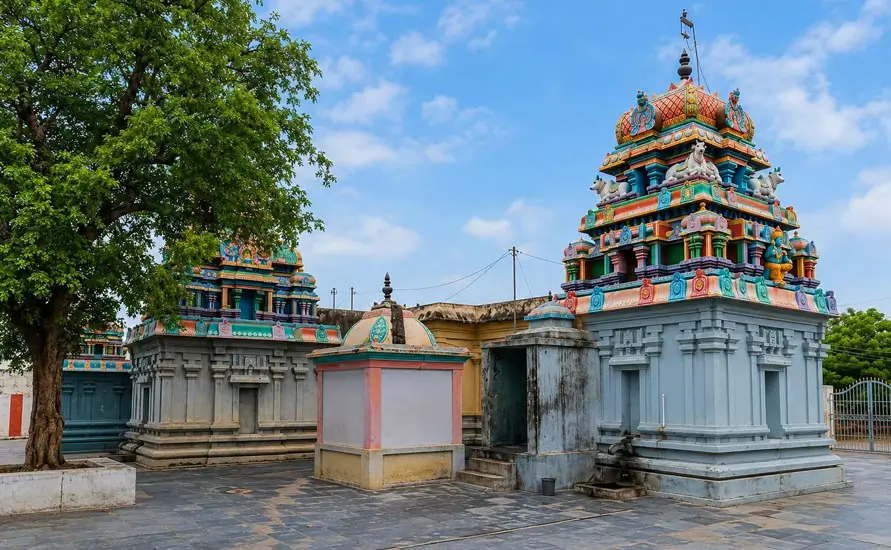
Tradition says the Navagraha circuit should begin with the Sun, so the first stop of the day is Suryanar Kovil, about 15 km north-east of town. It is one of very few temples in India where Surya is the presiding deity, and the shrines of the other eight planets stand around him, each facing a different direction. Your guide explains the custom of walking around the shrines nine times. Just a short drive away is Kanjanur, where Shiva as Agneeswarar is worshipped as Shukra, the planet Venus, and devotees pray here for harmony in marriage. Both temples open early, so you are back in the car by mid-morning.
The road then runs north toward Sirkazhi to Vaitheeswaran Kovil, the shrine of Angaraka, the planet Mars. Here Shiva is honored as Vaidyanatha, the divine healer, and pilgrims bathe in the temple tank and offer salt and pepper in the hope of good health. The town is also known for nadi astrology, in which readers search bundles of old palm leaves for a visitor's life story; your guide explains the practice neutrally and leaves any reading to your own choice. A plain vegetarian meals hall in town serves lunch on banana leaves while the car waits in the shade.
In the afternoon you continue to Thiruvenkadu, the shrine of Budha, the planet Mercury, where a fierce form of Shiva called Aghora Murthy is also worshipped and three temple tanks lie within the grounds. A few kilometers away, close to the old port of Poompuhar, stands Keezhperumpallam, the quiet village shrine of Ketu, where the deity is shown with a serpent body and joined hands. Since the afternoon closure differs from temple to temple, your guide times the visits to fit the opening hours. Some sanctums admit Hindus only, and your guide shows other visitors the halls and courtyards instead. You drive back to Kumbakonam by evening. Overnight in Kumbakonam.
Just 6 km from your hotel, Thirunageswaram is the shrine of Rahu, and the main ritual takes place during Rahu Kalam, the inauspicious window of about ninety minutes that falls at a different time each day. Milk poured over the image of Rahu during abhishekam is said by devotees to turn blue as it flows down. Your guide checks the exact Rahu Kalam for your date so that families who want this ritual can be there in good time. The temple is also a large Shiva shrine with fine halls of its own, and the walk around its corridors takes about half an hour.
From there you drive roughly an hour and a quarter east to Thirunallar, in the Karaikal district of Puducherry, the shrine of Shani, the planet Saturn. Pilgrims bathe in the Nala Theertham tank, linked to the legend of King Nala, and leave their old clothes behind as a sign of letting go of misfortune. Saturdays are crowded, and the Sani Peyarchi festival, held when Saturn moves to a new sign, brings huge numbers. On the way back you visit Alangudi, the shrine of Guru, the planet Jupiter, where the image of Dakshinamurthy draws devotees, especially on Thursdays. Lunch is taken along the route.
After the afternoon rest you complete the Chola part of the day at the Airavatesvara Temple in Darasuram, about 4 km from Kumbakonam and the third member of the Chola trio inscribed by UNESCO. King Rajaraja II ordered its construction in the 12th century, and while it is smaller than Tanjore, its carvers worked at the scale of a jeweler, from finger-high dancers to a front hall built as a chariot, its spoked wheels and prancing horses cut in stone. Your guide shows you the steps at the entrance, which give different notes when tapped. Back in town, you join the evening worship at the Sarangapani Temple, whose own sanctum is shaped like a chariot too. Overnight in Kumbakonam.
On the way out of Kumbakonam you can stop at a Swamimalai foundry, where families of bronze casters follow the lost-wax process that their ancestors used for Chola images: a figure is modeled in beeswax, covered in clay from the riverbed, baked until the wax melts away, and finally poured full of molten bronze. The last planet of the circuit waits on the road west. Thingalur is the shrine of Chandra, the Moon, and its story is tied to Appoothi Adigal, a devotee of the poet-saint Appar, whose son is said to have been revived here. The small village temple is peaceful and seldom crowded on weekdays.
A few kilometers on lies Thiruvaiyaru, a riverside town where the composer Tyagaraja, one of the three great figures of Carnatic music, spent his life and is remembered at a samadhi beside the river. Each January musicians from across the world gather here for the Tyagaraja Aradhana and sing his Pancharatna kritis together. Your guide can play a short recording in the car so that you hear the songs before you see the place. The large Shiva temple of Panchanadeeswarar, named for the five rivers of the area, stands in the same town.
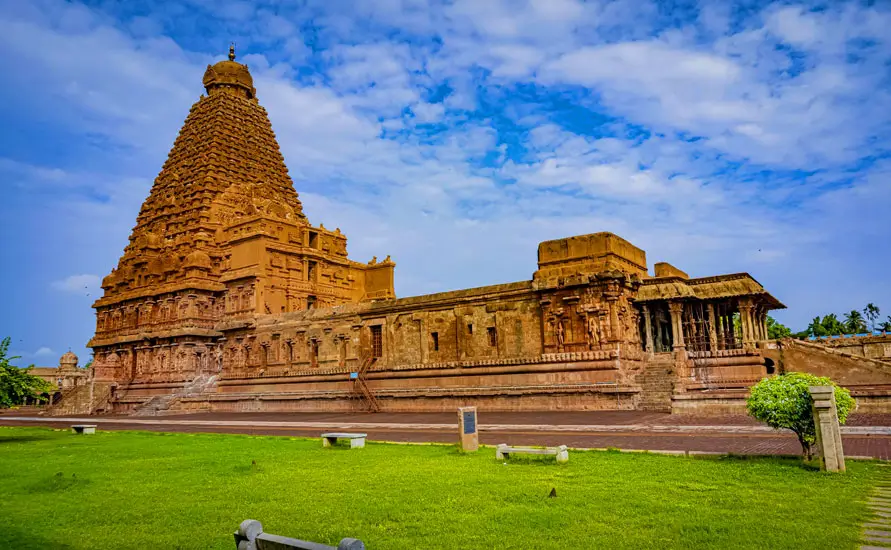
Lunch is in Tanjore (Thanjavur), and you visit the Brihadeeswarar Temple later in the day, when the granite tower turns gold in the late sun. Rajaraja Chola I completed it in 1010; the vimana climbs roughly 66 meters over the shrine and ends in a single enormous domed capstone. The bull Nandi, carved from one rock, lies under a pillared canopy looking toward Shiva, and the corridor walls carry long rows of lingams and old paintings. Guests of any faith may usually walk the courtyard and enter the great hall; access close to the lingam itself depends on the temple's current practice. Stay to watch the lamps lit at dusk. Overnight in Tanjore.
Spend the morning in the Thanjavur Palace, a Nayak-era residence that the later Maratha kings of Thanjavur enlarged. The palace art gallery displays rows of Chola bronze deities, and in the Saraswathi Mahal Library you see some of its large hoard of palm-leaf and paper manuscripts in Tamil, Sanskrit and Marathi. You also meet a painter working on a Tanjore painting, a devotional style that uses gesso relief, gold foil and glass beads to make images of gods glow in lamplight. Many NRI families take one home for the puja room, but there is never any pressure to buy.
An early lunch is followed by the 90-minute run along the Kaveri to Trichy. The city is dominated by the Rockfort, an outcrop of very old rock rising straight from the old town. Some 400 covered steps lead up past the rock-cut Thayumanavar shrine to Ucchi Pillayar, a tiny Ganesha temple perched on the summit, from where you look over the river to the gopurams of Srirangam. The climb is steady rather than steep, but older guests can stop at the midway shrine. Footwear stays at the bottom, and socks make the warm stone easier on the feet.
Later, cross the river to the Srirangam Ranganathaswamy Temple, which many call the biggest temple still in daily worship anywhere. Seven walls nest inside one another, and the outer streets are lived in, with homes, shops and lodges inside the temple boundary. The tallest of the 21 gopurams, finished in 1987, stands about 73 meters high. Guests from other faiths are welcome in the outer enclosures and pillared halls, and only Hindus pass into the innermost shrine, as the temple requires. Dinner is back at your hotel in Trichy. Overnight in Trichy.
Before the flight there is time for one more temple a few minutes from Srirangam: Jambukeswarar Temple in Thiruvanaikaval, where the lingam stands over a natural spring and represents water among the five elemental shrines of Shiva. Your guide brings you to the goddess Akilandeswari's sanctum as well. Families who have completed the nine planets often like to end with this water temple, which many see as a gentle close to the week. You return to the hotel to pack, settle the bill for extras and take a last South Indian lunch before the airport.
Trichy International Airport is about twenty minutes from the city center, with direct flights to Singapore, Kuala Lumpur, Dubai and Colombo and domestic flights to Chennai and Bengaluru for onward long-haul connections. We schedule the transfer so that you have three hours before an international departure. If you need to fly out of Chennai instead, we can book a domestic flight or plan a longer road transfer with a stop at Chidambaram. It has been an honor to share your family's pilgrimage through the planets and the Chola temples; may your travels home be smooth.
Your Journey

N.S. Rathore & Mrs. Omlata Rathore · Managing Director
We still read every enquiry ourselves. Tell us the places you liked and our planners will send a day-by-day route with drive times and a clear price.
Every package can be customised and no pressure to book. A planner from our office replies within 24 hours with a route written for your group.
Fill this in and your planner will send a first draft itinerary.
Explore more
Kerala Backwaters Escape Kerala Backwaters Escape
 Kerala Backwaters Escape
 Kerala Backwaters Escape
 Kerala Backwaters Escape
 Kerala Backwaters Escape
 Kerala Backwaters Escape
 Kerala Backwaters Escape
 Kerala Backwaters Escape
 Kerala Backwaters Escape
 Kerala Backwaters Escape
 Kerala Backwaters Escape
 Kerala Backwaters Escape
 Kerala Backwaters Escape
 Kerala Backwaters Escape
 Kerala Backwaters Escape
 Kerala Backwaters Escape
 Kerala Backwaters Escape