 Kerala Backwaters Escape

Religious & Heritage Tour Of South India
Chennai – Srikalahasti – Kanchipuram – Tiruvannamalai – Gingee – Chidambaram – Gangaikonda Cholapuram – Trichy (Thiruvanaikaval)
At a glance
Earth, water, fire, air and space: Shaiva tradition teaches that Shiva is present in all five, and that each element has its own temple in the south of India. Our Pancha Bhoota Sthalam temple tour takes you to every one of them in eight unhurried days. You stand before the sand lingam of Ekambareswarar in Kanchipuram, the flickering lamp of the air lingam at Srikalahasti, the fire temple under Arunachala hill in Tiruvannamalai, the empty space behind the curtain at Chidambaram and the spring-fed sanctum of Jambukeswarar at Thiruvanaikaval, close to Trichy.
The order follows the road rather than the classical list, so no single drive runs much beyond four hours. Two nights in Tiruvannamalai give time for the Sri Ramana Ashram and the walk around the sacred hill, and an en-route stop at the UNESCO-listed Chola temple of Gangaikonda Cholapuram adds a royal chapter to the devotional one. The same driver and the same air-conditioned car stay with your group from Chennai to Trichy, and at each of these Pancha Bhoota temples a local guide who knows the puja timings, rituals and etiquette walks in with you.
Many of our guests on this route are NRI Hindu families from the US, the UK, Canada, Singapore and the Gulf who want to complete a pilgrimage their parents spoke about, often with grandparents and teenagers in the same car. Foreign travelers with an interest in Hindu philosophy and Dravidian architecture join it too. Inner sanctums at some of the five elements Shiva temples admit Hindus only, and we say clearly at each stop what every guest can see. Pilgrims find the months between October and March kindest on bare feet and stone floors, and we can shape the dates around a festival if you ask early.
Outside the arrivals hall in Chennai, our colleague stands with a card printed with your family name. Many overseas arrivals touch down close to midnight, so the morning is deliberately left open for sleep, a slow breakfast of idli with coconut chutney and time to adjust to Indian hours. Reaching the hotel by road usually needs half an hour, or closer to fifty minutes at busy times. If you land in daylight, early check-in can be reserved beforehand so that nobody waits in the lobby. Families traveling with grandparents tell us this gentle first day makes the week of early temple mornings much easier.
Around midday your tour coordinator joins you over filter coffee for a short briefing. The idea behind the trip is easy to state: Shiva is worshipped in five South Indian shrines as the five elements, and together they are known as the Pancha Bhoota Sthalam. You will see them in road order, beginning with air and ending with water. The coordinator also covers practical rules. Shoes stay outside every temple, mobile phones are banned inside many Tamil Nadu temples and are deposited at counters, and some sanctums admit Hindus only. Men wear trousers or a dhoti, and women a saree or salwar kameez with a dupatta.
When the sun drops lower, the car takes you to Mylapore and its Kapaleeshwarar Temple for your first darshan of the trip. Along the outer corridor stand bronze figures of the 63 Nayanmars, the Tamil poet-saints of Shiva whose hymns, gathered in the Tevaram, praise many of the shrines you will see this week, including all five element temples. Your guide explains how those seventh-century verses are still sung by temple musicians called oduvars at evening worship. You stay for the lamp ceremony, when brass camphor lamps are circled before the deity to the sound of bells and drums. Dinner at the hotel follows. Overnight in Chennai.
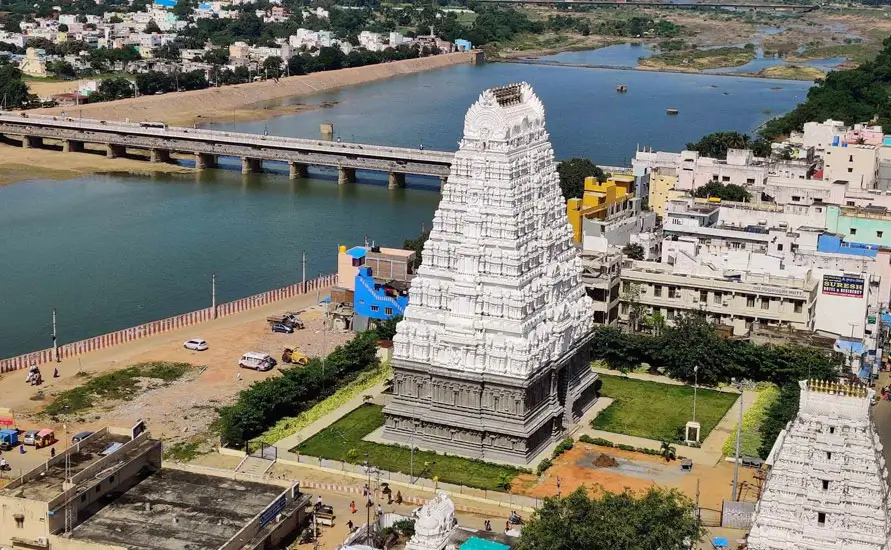
Breakfast is early so the car clears the city limits ahead of the commuter rush. The road heads north-west across the state border into Andhra Pradesh, past the reservoirs that supply Chennai with water and the granite hills around Puttur, and the language on the signboards changes from Tamil to Telugu. Srikalahasti sits on the bank of the Swarnamukhi river at the foot of a rocky ridge, and the town lives almost entirely around its temple. You check in to a simple, clean hotel near the shrine; guests who prefer larger hotels can stay in Tirupati, about forty minutes away, and we can plan either option.
The Srikalahasti temple is the air element of the five, and the sign that devotees look for is the flame of a lamp inside the windowless sanctum that keeps flickering as if moved by a breeze. The name of the town joins three devotees of Shiva from local legend: Sri the spider, Kala the serpent and Hasti the elephant. Ask your guide about Kannappa, a hunter who gave his own eyes to the deity and is honored on the hill above the temple. The tall entrance tower was rebuilt in recent years after the old Vijayanagara gopuram collapsed in 2010.
Srikalahasti is best known among Hindu families for the Rahu-Ketu puja, performed in large halls inside the temple for people whose horoscopes show a difficult position of these two shadow planets. Tickets are bought at the temple counter, a priest leads groups through the ritual, and the whole puja takes around an hour. Many NRI families book it for a child's horoscope or after a recommendation from their family astrologer. Andhra temples ask men to wear a dhoti or trousers with a shirt and women to wear a saree or churidar; jeans and shorts are not appropriate. Rules on entry for non-Hindus are set by the temple and explained by your guide. Overnight in Srikalahasti.
After an early visit for those who wish to return to the temple at dawn, you drive south toward Kanchipuram. You pass Puttur and then Tiruttani, whose Murugan shrine on its hilltop counts among the six abodes of that god; tell us if you would like a short stop for darshan. Beyond Arakkonam the landscape turns into paddy country with irrigation tanks, palmyra palms and villages where houses have kolam patterns drawn in rice flour at the door. You reach Kanchipuram for lunch, a thali of rice, sambar, rasam and vegetables served on a banana leaf, and rest through the hot middle of the day.
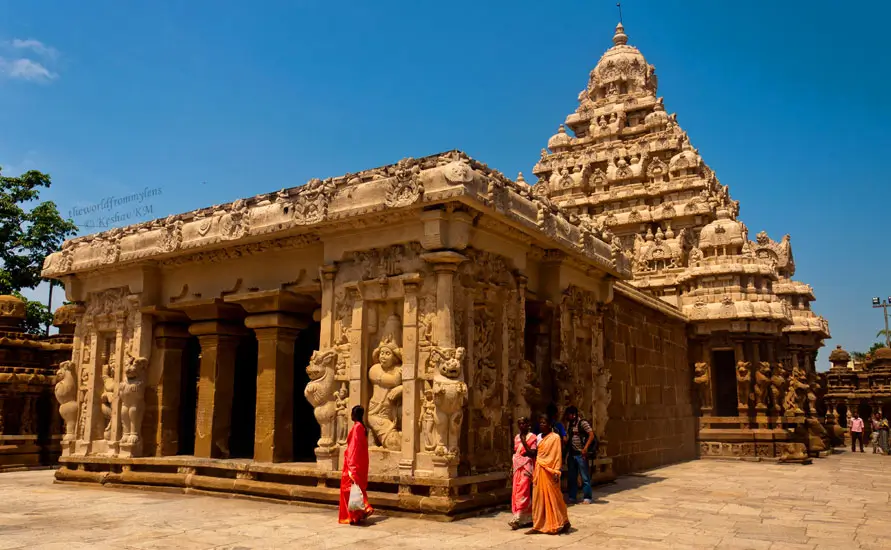
Temples in Tamil Nadu usually close their inner doors from around noon until four, so your guide times the visit to the Ekambareswarar Temple for the late afternoon reopening. This is the earth element, and the lingam is believed to be made of sand, which is why it is anointed with jasmine oil rather than bathed in water. Legend says that Parvati shaped it under a mango tree on the bank of the Vegavathi and held it fast when the river rose. The old trunk of that tree, said to have four branches for the four Vedas, is preserved in the inner courtyard beside a younger tree grown from it.
The southern gopuram of Ekambareswarar rises close to 60 meters and was raised in the Vijayanagara period, and inside the walls a long hall holds rows of carved pillars and a corridor lined with small lingams. At dusk you walk on to the Kamakshi Amman Temple, the seat of the goddess in Kanchipuram, where the shrine holds a Sri Chakra associated with Adi Shankaracharya. Visitors of other faiths are generally welcome in the outer corridors and pillared halls at both shrines, while the sanctums follow each temple's own rules. The evening ends with a quiet walk through lanes where silk saris are sold from family homes. Overnight in Kanchipuram.
Kanchipuram silk is woven with pure mulberry thread and real zari, and many Hindu brides still wear a sari from this town on their wedding day. Before you leave town, your guide brings you into a weaving household or cooperative, where the pit loom is sunk into the floor and two people share the work of lifting the warp and throwing the shuttle for a contrasting temple border. A traditional piece can take a week or more. Shopping is entirely up to you; your guide simply explains how to check the silk mark label and how to tell solid silver zari from cheaper imitations.
The drive to Tiruvannamalai runs south-west through Vandavasi and small market towns, and long before you arrive you see the bare, rounded mass of Arunachala rising out of the plain. For devotees the hill itself is Shiva, and the town grew around the temple at its eastern foot. While the temple doors stay shut for the afternoon, you eat lunch and rest in your room. If you wish, a short visit to the Annamalaiyar market street lets you see stalls selling rudraksha beads, camphor, vibhuti ash and framed pictures of Ramana Maharshi, which pilgrims carry home to family shrines across India and abroad.
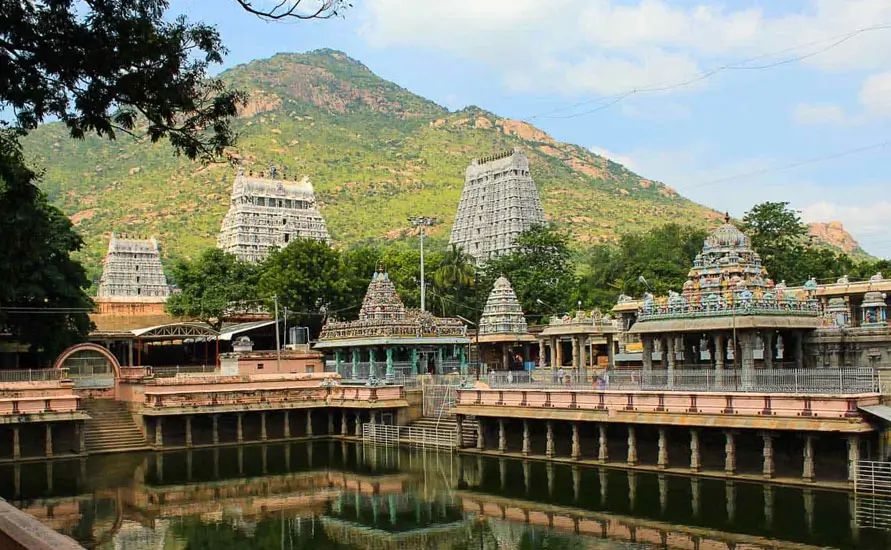
As evening comes you walk through the gates of the Arunachaleswarar Temple, which represents fire among the five and covers an area larger than many Indian villages. The eastern gopuram climbs to about 66 meters, and four huge towers mark the outer walls. Your guide leads you through courtyards to the shrine of Unnamulai Amman and to the underground Patala Lingam, where the young Ramana sat in meditation, before the evening worship at the main sanctum. Every year in November or December the Karthigai Deepam festival lights a giant lamp on the summit of the hill, a sight we can plan around if your dates allow. Overnight in Tiruvannamalai.
Start soon after sunrise with the walk up the hillside path to Skandashram and Virupaksha Cave, where Ramana Maharshi lived for many years before settling at the foot of the hill. Allow thirty to forty-five minutes of climbing on uneven rock steps, carry water, and wear sandals that slip off easily, because footwear is left outside each cave. Both places are kept in silence, and visitors sit for a few minutes before walking on. From the rocks outside Skandashram you look straight down onto the gopurams of the temple and across the town, a view that explains why so many pilgrims call this hill the heart of their stay.
Back down in town, you spend the late morning at Sri Ramana Ashram, which sits about two kilometers from the temple on the road around the hill. Visitors may sit in the old hall where the Maharshi received people, in the samadhi hall, or in the quiet garden under the trees where peacocks wander. Recitations of Vedic hymns and of Ramana's own Tamil verses take place at set hours. Modest clothes, silence inside the halls and switched-off phones are expected, and the bookshop sells his writings in many languages. Meal and accommodation arrangements at the ashram are revised now and then, and we confirm the current position before you arrive.
Late in the afternoon, when the ground cools, many pilgrims set out on girivalam, the 14 km walk around Arunachala in a clockwise direction, traditionally done barefoot. Eight shrines called the Ashta Lingams mark the compass points along the path, and your guide either walks beside you or waits at agreed spots on the road. On full-moon nights very large crowds take part, which some families love and others prefer to avoid. If a full walk is too much for grandparents, the car can follow so that anyone may ride part of the route and visit the lingams by road. Overnight in Tiruvannamalai.
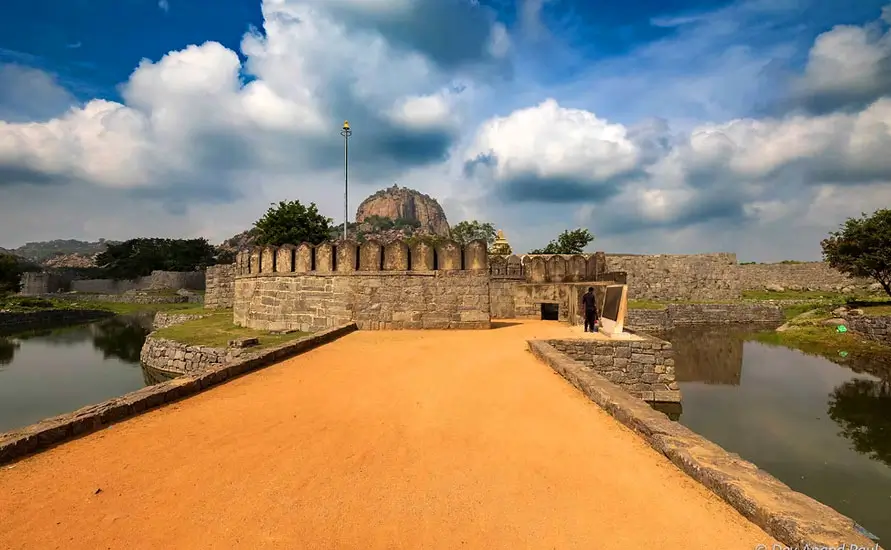
Leaving Tiruvannamalai after breakfast, you stop after about an hour at Gingee, where a chain of fortified granite hills once protected a stronghold held in turn by local Nayaks, the Maratha king Shivaji, the Mughals and later the French and British. Rajagiri, the highest of the hills, is a long climb best left to fit walkers, but the lower fort with its granary, wedding hall and audience hall can be seen on level ground in under an hour. Your guide places the fort in the wider story of the region so that the temples you visit make more sense in their political setting.
The road then runs east toward the coast through Villupuram district and the cashew orchards around Panruti, reaching Chidambaram by lunchtime. The town grew up around one of the most revered temples in Tamil Shaivism, and the university founded here in 1929 gives it a lively student quarter. After lunch you rest at the hotel. For anyone who wants a quiet break from temple halls, an optional rowboat trip through the Pichavaram mangroves, around 16 km away, follows narrow channels under arching roots for an hour or so, with herons and kingfishers in the branches.
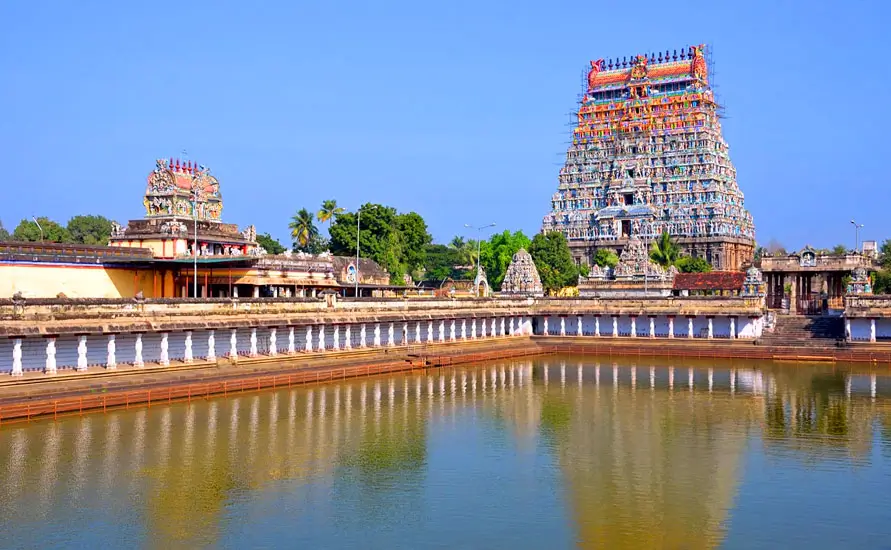
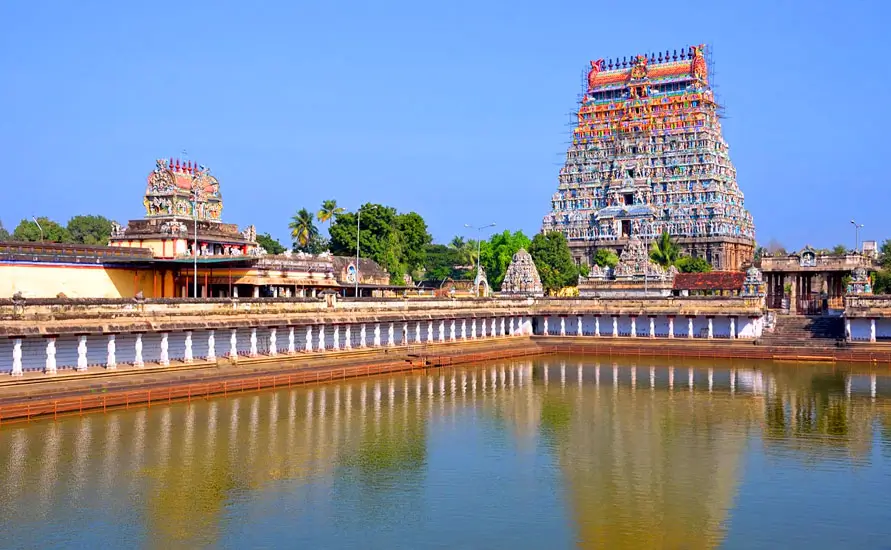
Your first entry into the Chidambaram Nataraja Temple is at dusk, through a gopuram whose inner passage shows, in stone, all 108 karanas, the dance poses set out in the Natya Shastra. The temple is looked after by the Podhu Dikshitars, a hereditary community of priests who perform the rituals in their own tradition. You watch the evening worship before the image of Nataraja, Shiva as the cosmic dancer, and your guide explains the ring of fire, the small drum and the dwarf crushed beneath his foot. Tomorrow morning brings the ritual that reveals the space element. Overnight in Chidambaram.
The morning worship at the Chit Sabha, the hall with its gold-plated roof, is the moment many pilgrims travel here for. During the ritual a priest draws aside a curtain beside the image of Nataraja to show what is called the Chidambara Rahasyam, the secret of Chidambaram: an apparently empty space hung with a string of golden bilva leaves, which stands for Shiva as formless space, the fifth element. Male devotees usually take off their shirts before the inner halls, and the holiest spaces follow the temple's own entry rules. The same complex also holds a shrine of Vishnu as Govindaraja, a rare pairing within one wall.
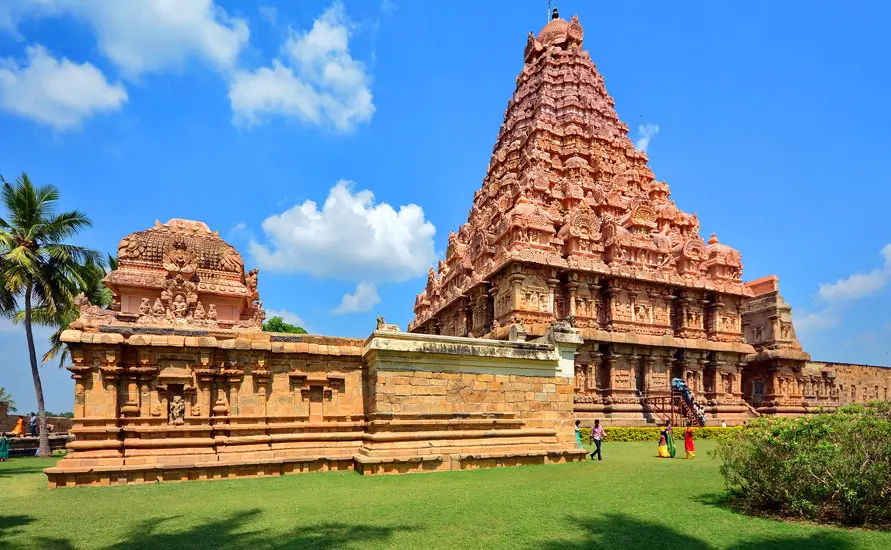
Ninety minutes inland lies Gangaikonda Cholapuram, the capital that the Chola emperor Rajendra I founded around 1025, after his army had marched north as far as the Ganges and brought its water home. Rajendra's Shiva temple, one of the three UNESCO-listed Chola shrines, carries a tower with gently curving sides, quite unlike his father's straight-edged one at Tanjore, and its walls hold a well-loved relief in which Shiva ties a flower garland around the head of his devotee Chandesha. The site is usually quiet, and its lawns make a calm place to rest. Lunch is at a simple restaurant nearby.
Roughly 150 minutes later the car reaches Trichy (Tiruchirappalli), a city laid out along the Kaveri river. At dusk you cross to Srirangam island for a first look at the Ranganathaswamy Temple, with its image of Vishnu lying on the serpent Adisesha, set inside seven concentric walls and 21 gopurams that also enclose shops, homes and whole streets. Non-Hindus may visit the outer enclosures but not the innermost sanctum. Since the water lingam stands on the same island and needs only a few minutes by car tomorrow, tonight ends early with dinner back at the hotel. Overnight in Trichy.
Your last element waits only a few kilometers from the hotel. The Jambukeswarar Temple at Thiruvanaikaval is the water element, and its sanctum sits low enough that a spring keeps the floor around the lingam damp, with water visible in many seasons. The doorway to the shrine is small, so devotees bow as they enter. Within the same walls is the shrine of the goddess Akilandeswari, whose earrings are linked to Adi Shankaracharya. At the noon worship a priest dresses as the goddess to honor her as Shiva's devotee, so families with a later flight sometimes stay for it.
After a final lunch your driver transfers you to Trichy International Airport, about twenty to thirty minutes away, which has direct flights to Singapore, Colombo, Kuala Lumpur and Gulf cities as well as domestic services to Chennai, Bengaluru and other cities. If you would rather fly from Chennai, we can arrange a domestic connection or a long road transfer. Completing the five elements is a milestone for many families, and those who wish to go further often return for the Navagraha temples around Kumbakonam or the six abodes of Murugan. Safe travels, and may the blessings of the five elements go with you.
Your Journey

N.S. Rathore & Mrs. Omlata Rathore · Managing Director
We still read every enquiry ourselves. Tell us the places you liked and our planners will send a day-by-day route with drive times and a clear price.
Every package can be customised and no pressure to book. A planner from our office replies within 24 hours with a route written for your group.
Fill this in and your planner will send a first draft itinerary.
Explore more
Kerala Backwaters Escape Kerala Backwaters Escape
 Kerala Backwaters Escape
 Kerala Backwaters Escape
 Kerala Backwaters Escape
 Kerala Backwaters Escape
 Kerala Backwaters Escape
 Kerala Backwaters Escape
 Kerala Backwaters Escape
 Kerala Backwaters Escape
 Kerala Backwaters Escape
 Kerala Backwaters Escape
 Kerala Backwaters Escape
 Kerala Backwaters Escape
 Kerala Backwaters Escape
 Kerala Backwaters Escape
 Kerala Backwaters Escape
 Kerala Backwaters Escape