 Kerala Backwaters Escape

Religious & Heritage Tour Of South India
Hyderabad (Charminar, Mecca Masjid, Qutb Shahi Tombs) – Bidar – Gulbarga – Bijapur (Gol Gumbaz) – Hubballi – Bangalore – Srirangapatna
At a glance
Five Muslim dynasties shaped the plateau between Hyderabad and Mysore over almost five centuries, and most travelers never see more than the Charminar. Our Islamic heritage tour of the Deccan follows that history in the order it happened: the Bahmani sultans at Gulbarga and Bidar, the Adil Shahis at Bijapur, the Qutb Shahis at Hyderabad, and finally Hyder Ali and Tipu Sultan at Srirangapatna. Along the way you stand under one of the largest domes ever built, listen to a whisper cross the Gol Gumbaz, and pray or sit quietly at living Sufi shrines.
The route is planned for comfort as well as depth. Drives between the old sultanate capitals take between two and a half and four hours on good highways, and the long gap from Bijapur to Bangalore is bridged with a drive to Hubballi and a one-hour domestic flight instead of a full day in the car. Your own air-conditioned sedan or SUV, with the same driver from day one, covers every road leg, while in each city a guide familiar with Persian inscriptions, Deccani building styles and dargah etiquette walks you through the sites. This Deccan sultanates tour spends two nights in Bijapur so the monuments never feel rushed.
The Islamic heritage tour of the Deccan suits Muslim travelers from the UK, US, Canada and the Gulf, NRI families tracing Hyderabadi or Deccani roots, and history lovers of any faith. Dress modestly throughout: shoulders and knees covered for everyone, and a scarf for women at mosques and dargahs. Halal food is easy to find in every city on the route, from Hyderabadi biryani to Bijapur jolada roti. October to February brings the coolest weather on the plateau, and we adjust the plan around Ramzan, Eid or Urs dates if you wish.
Rajiv Gandhi International Airport lies south of Hyderabad at Shamshabad, and a member of our team stands outside the arrivals hall holding a sign with your name. Many flights from Dubai, Doha, London and New York touch down before dawn, so no sightseeing starts before mid-afternoon. Reaching the city center by the PV Narasimha Rao flyover usually takes under an hour, though weekday traffic can stretch it. At check-in our team gives you a printed day plan, help buying a local phone SIM, and a short briefing on prayer times, Friday closures and how mosque visits are handled on this trip, so that you can plan your own salah around the sightseeing.
By late afternoon the heat eases and you drive west toward Golconda for a first, gentle visit to the Qutb Shahi Tombs. The heritage park holds more than seventy structures: the domed tombs of seven Qutb Shahi sultans, their wives and nobles, mosques, a hammam and stepwells, all spread over gardens beneath the fort. Years of restoration have brought back the turquoise and green glazed tiles on several domes and cleared the old water channels. Your guide explains how each sultan built his own tomb during his lifetime, and why the domes sit on square bases ringed by arched galleries rather than on open platforms.
The tomb of Muhammad Quli Qutb Shah, founder of Hyderabad and a poet in Deccani Urdu, is the tallest in the complex, and its terrace gives a view of Golconda's walls turning gold in the evening light. Women should carry a scarf for the small mosques inside the park, and everyone removes shoes at the tomb chambers. The park closes at sunset, so there is time afterward for a first plate of Hyderabadi biryani, with its layered rice and slow-cooked meat, at a well-known family restaurant chosen by your driver. Sleep comes easily after such a long day of travel. Overnight in Hyderabad.
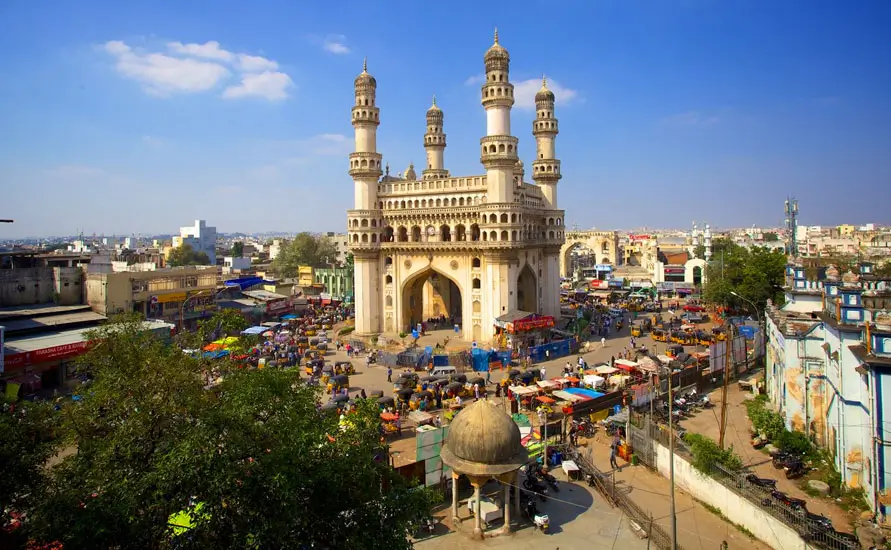
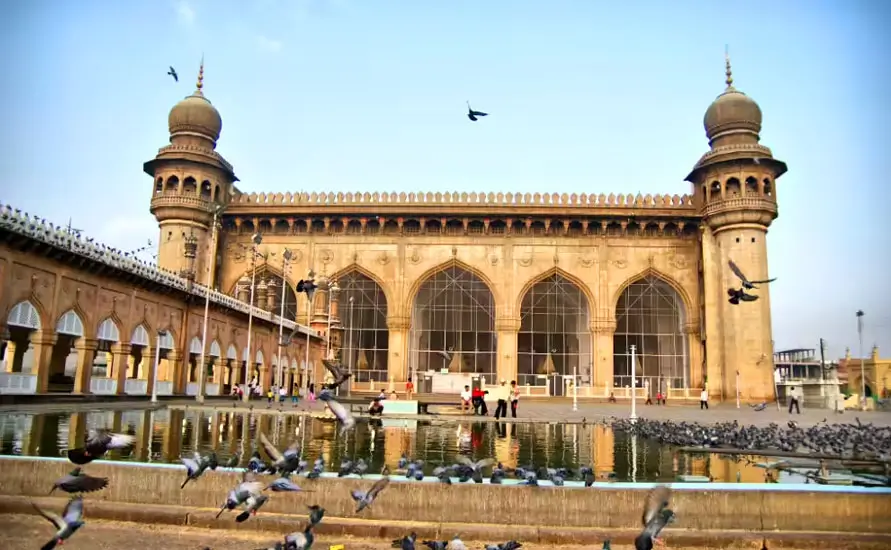
Mornings are the quietest time in the Old City, so you leave soon after breakfast for the Charminar, built in 1591 by Muhammad Quli Qutb Shah to mark the founding of his new capital. Its four minarets rise above a crossroads that still hums with rickshaws, and a narrow stairway leads to the upper gallery, where a small mosque occupies the western side. From there you look straight down onto the domes of the Mecca Masjid, begun in the 1610s and completed under the Mughals. Your guide points out the arches built, according to local tradition, with bricks containing soil brought from Mecca, and the marble graves of the Asaf Jahi Nizams in a side enclosure.
Guests of any religion are welcome in the mosque courtyard outside prayer times, with heads covered for women and shoulders and legs covered for everyone; non-Muslims stay out of the prayer hall during congregational prayer, and the mosque gets very busy before Friday Jummah, which is why this visit is never planned for a Friday midday. Pigeons crowd the courtyard, and the large stone benches beside the pool are said to bring a return to Hyderabad for anyone who sits on them. Next door, Laad Bazaar sparkles with lac bangles set with glass stones, and you can watch a craftsman heat and shape the lac over a small coal stove.
After lunch you visit Chowmahalla Palace, the seat of the Nizams, with its restored Khilwat durbar hall, Belgian crystal chandeliers, vintage cars and courtyards with long pools. The palace and the Salar Jung Museum, where you spend the later afternoon, are both closed on Fridays, so we schedule this day accordingly. The museum holds one of the largest one-man collections in the world, including Persian manuscripts, jade daggers and the Veiled Rebecca marble statue. At the end of the day you stop for Irani chai and Osmania biscuits at an old café near the Charminar, a ritual every Hyderabadi recommends. Overnight in Hyderabad.
Golconda was the fortress that made the Qutb Shahi kingdom rich, because the diamonds from mines along the Krishna River, including the Koh-i-Noor according to popular history, were traded through its gates. You start early, before the sun reaches the granite ramparts, at the Fateh Darwaza, where your guide claps beneath the entrance dome and the sound carries clearly to the hilltop pavilion almost a kilometer away. The climb to the Bala Hisar at the top takes about forty minutes on uneven steps, past grain stores, a royal armory, water tanks and the Taramati mosque. Comfortable shoes and a hat help, and there are resting points for anyone who prefers a slower pace.
At the summit stands the small mosque of Ibrahim Qutb Shah beside a temple to Mahakali, a pairing your guide uses to explain how the Deccan courts employed Hindu ministers and Persian scholars side by side. Looking out from the summit, you can pick out the tomb domes visited last evening and, beyond them, the high-rises of modern Hyderabad. The walk down follows a different path through the old palace quarters, where plaster channels once carried water up to the royal baths by a system of Persian wheels. You have lunch at a restaurant serving Hyderabadi dishes such as mirchi ka salan, bagara baingan and double ka meetha.
In the afternoon you drive across town to the Paigah Tombs at Santoshnagar, the family necropolis of the Paigah nobles, who were related to the Nizams by marriage and commanded the state army. Few foreign visitors come here, yet the marble screens and lime-stucco carvings are among the finest in the Deccan, with flowers, geometric stars and arches cut so delicately that they look like lace. A caretaker opens the enclosure, and photography is usually permitted with respect for the graves. In the evening you are free; during Ramzan your guide can suggest the best places around the Old City for haleem after iftar. Overnight in Hyderabad.
Leaving Hyderabad after breakfast, the highway runs northwest across the state border, and Bidar is roughly three hours away. The town sits on a red laterite plateau and served as the capital of the Bahmani sultans from 1429, after they moved here from Gulbarga, and later of the Barid Shahi dynasty. The landscape changes on the way, from Hyderabad's suburbs to cotton fields, small towns with mosques and temples on the same street, and finally the deep moat of the fort. Hotels in this small city are modest but clean, and after checking in you have lunch before the afternoon visits.
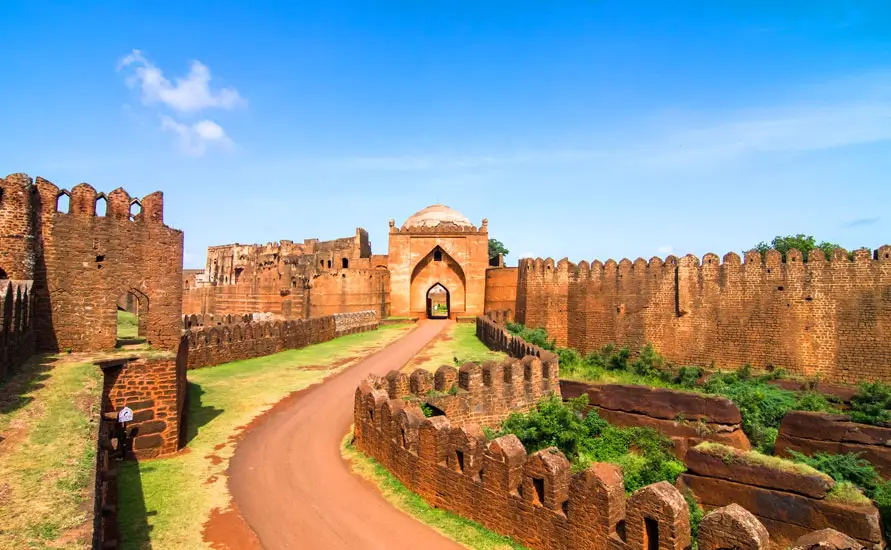
Bidar Fort encloses a full royal city inside walls almost five kilometers long, with a triple moat cut into the rock. Your guide takes you to the Rangin Mahal, where mother-of-pearl inlay on black stone and carved wooden pillars survive from the 16th century, and to the Solah Khamba Mosque, one of the oldest Muslim buildings in the region, with a long hall of sixteen columns. The ruins of the Takht Mahal still carry traces of glazed tiles showing tigers and the rising sun, a Persian royal symbol. Large parts of the fort are open lawns, so a hat and water are useful even in the cooler months.
Toward sunset your guide leads you to the Mahmud Gawan Madrasa, founded in 1472 by Khwaja Mahmud Gawan, the chief minister who had come to the Bahmani court from Gilan in Persia. It was a residential college for Islamic theology, mathematics and astronomy, with lecture halls, a library and student rooms on three floors around a courtyard. One minaret still wears its green and yellow tile casing, and the guide shows you inscriptions from the Quran in Thuluth script along the facade. The building reminds visitors that the Deccan was linked to Persia, Iraq and Central Asia by trade and learning, not only by conquest. Dinner is at the hotel. Overnight in Bidar.
Early in the morning you drive a few kilometers east to Ashtur, where the later Bahmani sultans lie in a row of massive domed tombs. The finest is the tomb of Ahmad Shah Wali, the sultan who moved the capital to Bidar and is still revered as a saint by both Muslims and Hindus of the area; an annual Urs is held here. Inside, the walls and dome are covered with painted calligraphy and floral patterns in red, gold and blue, which your guide lights with a torch so you can read the verses. Visitors remove shoes, women cover their heads, and quiet voices are expected because local families come here to pray.
Returning to the old town, you spend an hour with a family of bidriware artisans, whose craft carries the name of Bidar itself. Artisans cast a dark alloy of zinc and copper, engrave patterns by hand, hammer fine silver wire into the grooves, and then treat the piece with soil from the old fort, which turns the metal deep black while the silver stays bright. Watching a single box take shape explains why genuine pieces cost more than the imitations sold in big cities. Buying anything is entirely optional, and the workshop can send purchases overseas by courier. You can also visit the Gurdwara Nanak Jhira Sahib, linked to a visit by Guru Nanak, where a spring flows below the shrine.
Following lunch, a drive of roughly 150 minutes southwest takes you to Gulbarga, officially renamed Kalaburagi, where Alauddin Hasan Bahman Shah set up the Bahmani capital in 1347. The road crosses dry farmland dotted with neem trees, sugarcane and the occasional ruined watchtower. Check-in is around four, leaving a quiet evening to recover. If you would like to attend the evening qawwali at the dargah of Khwaja Bande Nawaz, your guide can take you after dinner, since performances are often held after the night prayer on Thursdays and during the Urs; women may sit in the separate area set aside for them. Overnight in Gulbarga.
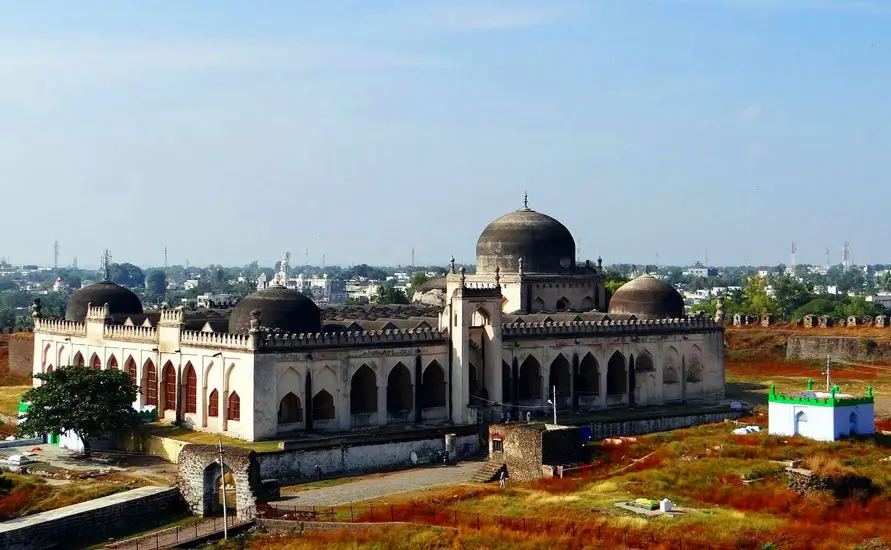
Your morning begins inside Gulbarga Fort, built by the first Bahmani ruler and later strengthened with bastions and a huge cannon still resting on the ramparts. The highlight is the Jama Masjid, completed in 1367, which is unusual in India because it has no open courtyard; instead the whole prayer hall is covered by small domes on a forest of low arches, with one large dome over the mihrab. Light falls through the side arches in long bands, and your guide explains the Persian influence on its design. The mosque is a protected monument and is not used for regular prayer, so visitors may walk through quietly with shoes removed.
Mid-morning you visit the Khwaja Bande Nawaz Dargah, the shrine of Sayyid Muhammad Gesu Daraz, a Chishti Sufi saint who settled in Gulbarga around 1400 and wrote many works in Persian and early Deccani. Pilgrims of all faiths come to offer flowers and a chadar, and the courtyard is lined with sellers of rose petals, attar and prayer caps. Heads must be covered for men and women, and women usually pay respects from a designated area outside the inner tomb chamber, as at many dargahs. Nearby stand the Haft Gumbaz, the seven domed tombs of Bahmani rulers, where the transition from plain early domes to decorated later ones is easy to see.
After lunch the car heads west, a run of some three and a half hours, to Bijapur, today officially Vijayapura, crossing the Bhima River and entering the dry black-soil country of northern Karnataka. As you approach the city, the outline of the Gol Gumbaz appears on the skyline long before the town itself. The Adil Shahi kings governed from here for almost two centuries, until Aurangzeb took the city in 1686, and the old walled city still contains over fifty mosques along with dozens of tombs and palaces. The evening is yours, and the hotel kitchen or a nearby eatery can serve a north Karnataka dinner of jolada roti, stuffed brinjal and fiery peanut chutney. Overnight in Bijapur.
Arrive at the Gol Gumbaz at opening time, before school groups fill the stairs, because the famous whispering gallery works best in silence. The tomb of Muhammad Adil Shah, finished around 1656, carries a dome about 44 meters across, among the largest unsupported domes in the world. You climb seven floors of narrow stairs inside one of the corner towers to reach the circular gallery that rings the inside of the dome. Speak softly near the wall and a companion across the void hears every word; clap once and the sound comes back seven or more times. Your guide also shows you the small museum in the old gateway and the plain graves of the sultan and his family below.
Late in the morning you visit Ibrahim Rauza, the tomb and mosque of Ibrahim Adil Shah II, a ruler known for his love of music and his tolerance, who wrote songs in praise of both the Prophet and the goddess Saraswati. The two buildings face each other on a raised platform, and their stone screens, chains carved from single blocks and Arabic inscriptions are cut with great precision. A popular local story says the builders of the Taj Mahal studied it. Midday means lunch and some shade back in your room, since the plateau sun is strong even in winter.
In the afternoon you visit the Jama Masjid of Bijapur, begun under Ali Adil Shah I and still an active mosque; its prayer hall is marked into more than two thousand prayer spaces, and the gilded mihrab is shown if prayer times allow. Visitors dress modestly, women cover their heads, and non-Muslim guests stay at the back during prayer. You then see the Malik-e-Maidan, a great bronze cannon with a muzzle shaped like a lion's open mouth swallowing an elephant, and the Bara Kaman, an unfinished tomb of tall arches. The day ends on the ramparts of the Upli Buruj watchtower as the sun drops. Overnight in Bijapur.
Bijapur and Bangalore are more than 500 km apart, which would mean nine to ten hours in a car, so we split the distance. After an early breakfast you drive south for about four hours to Hubballi, crossing the Krishna River near the Almatti dam and passing sunflower and jowar fields. Hubballi airport has regular one-hour flights to Bangalore, and your driver brings you to the terminal with time to spare. If scheduled flights from the new Vijayapura airport or from Belagavi suit your dates better, or if you prefer the overnight train, we can arrange either and adjust the plan.
On landing at Kempegowda International, a Bangalore-based driver collects you for the drive south into town, usually sixty to ninety minutes depending on traffic. After a morning of driving and flying, nothing else is scheduled; you might walk to a nearby café or simply rest at the hotel. Bangalore grew from a mud fort built by Kempe Gowda in 1537 and later passed to Hyder Ali and Tipu Sultan, which is why tomorrow's sightseeing continues the Deccan Muslim story in a very different, modern city. Overnight in Bangalore.
The morning starts in the old pete area of Bangalore, the trading quarter that grew around the original fort. First comes what remains of Bangalore Fort: a stone gateway and a stretch of wall from Hyder Ali's rebuilding, a little Ganapati shrine tucked within the ramparts, and a plaque recording the British attack of 1791. Close by on foot is Tipu Sultan's Summer Palace, which Tipu completed the year the fort fell to the British, built almost entirely of teak, with carved columns and arches painted in faded floral designs. It was used as a court and residence during the hot months, and the ground floor now holds a small exhibition on Tipu's life, his rockets and his conflicts with the East India Company.
From there you continue to the Jamia Masjid at City Market, a mosque of white granite that ranks among Bangalore's biggest, with tall minarets above one of the busiest crossings in Bangalore. Men may join the prayer if timings allow, and other visitors can usually see the courtyard with permission, dressed modestly with shoes removed. Next on the list is the Hazrat Tawakkal Mastan Dargah in Cottonpet, the shrine of an 18th-century Sufi saint linked by local tradition to Hyder Ali's time, where an annual Urs draws people of all communities. Lunch is at a restaurant serving Bangalore's own style of biryani and kebabs.
Afternoon is set aside for Lalbagh Botanical Garden, laid out on Hyder Ali's orders and widened by Tipu, who had saplings sent from Persia, Afghanistan and France. Look for the old trees from that era, the rose garden and the rock outcrop at the edge of the garden, a gneiss outcrop counted by scientists among the oldest rocks on Earth. Twice a year, around Republic Day and Independence Day, the glasshouse hosts a large flower show that fills the city. Evenings here are best spent on Commercial Street, or in Frazer Town, whose Mosque Road fills with food stalls in Ramzan. Overnight in Bangalore.
Setting off early on the access-controlled Bangalore–Mysore expressway, you cover the distance to Srirangapatna in roughly 150 minutes. The town stands on an island in the Kaveri River and served Hyder Ali and then Tipu Sultan as their capital until May 1799, when East India Company forces breached the ramparts and Tipu fell fighting near a gateway. Begin at the Daria Daulat Bagh, the wooden pleasure palace Tipu completed in 1784 amid lawns lined with cypress trees. Every wall is painted, and the long west mural shows the Battle of Pollilur of 1780, in which Hyder Ali and Tipu routed a Company force. Because the museum shuts every Friday, this day is always set on a different weekday.
Next you visit the Gumbaz, the white domed mausoleum that holds the graves of Tipu Sultan, Hyder Ali and Tipu's mother Fakhr-un-Nisa. The doors are inlaid with ivory, the inner walls painted in the tiger-stripe pattern that Tipu used as his emblem, and a small mosque stands beside the tomb. Visitors leave shoes outside and women cover their heads; quiet prayer by Muslim visitors is common. Your guide then shows you the Masjid-e-Ala, the Jama Masjid built by Tipu in 1787 with two slender minarets, and the marked spot near the Water Gate where his body was found after the battle.
Post-lunch stops include the broken ramparts, Colonel Bailey's dungeon, where captured Company officers were chained to the walls, and the Ranganathaswamy Temple, a large Vaishnava shrine that Tipu protected and endowed, a detail that surprises many visitors and shows how complex his rule was. Non-Hindu visitors may enter the outer areas; the inner sanctum is generally for Hindu worshippers, as decided by the temple. Before dusk, a short drive leads to the Sangam at the island's eastern tip, where the river's two arms rejoin and families perform rites on the bathing steps. You check in to a riverside resort for a peaceful final night. Overnight in Srirangapatna.
After breakfast and perhaps a last walk by the river, your car heads back east toward Bangalore for the flight home. Reaching Kempegowda International can take close to four hours because the airport lies on the far, northern side of the city, so we leave early enough to have you at the terminal three hours ahead of departure. If you have time to spare, a stop at Channapatna for its painted lacquer wooden toys is easy to add on the way. Travelers on a midnight flight can request an airport-side day room, or stay an extra night in Mysore, both at extra cost.
These eleven days traced Deccan Muslim rule from the Bahmani court at Gulbarga to Tipu Sultan's final battle on the Kaveri, by way of mosques, madrasas, Sufi shrines and royal tombs that few foreign travelers reach. Many guests return for a second trip covering Hampi and the Adil Shahi monuments around Badami, or the Mughal heritage of Delhi and Agra, and our team is happy to put that together. Safe travels, and may the Deccan call you back one day.
Your Journey

N.S. Rathore & Mrs. Omlata Rathore · Managing Director
We still read every enquiry ourselves. Tell us the places you liked and our planners will send a day-by-day route with drive times and a clear price.
Every package can be customised and no pressure to book. A planner from our office replies within 24 hours with a route written for your group.
Fill this in and your planner will send a first draft itinerary.
Explore more
Kerala Backwaters Escape Kerala Backwaters Escape
 Kerala Backwaters Escape
 Kerala Backwaters Escape
 Kerala Backwaters Escape
 Kerala Backwaters Escape
 Kerala Backwaters Escape
 Kerala Backwaters Escape
 Kerala Backwaters Escape
 Kerala Backwaters Escape
 Kerala Backwaters Escape
 Kerala Backwaters Escape
 Kerala Backwaters Escape
 Kerala Backwaters Escape
 Kerala Backwaters Escape
 Kerala Backwaters Escape
 Kerala Backwaters Escape
 Kerala Backwaters Escape