 Kerala Backwaters Escape

Religious & Heritage Tour Of South India
Chennai – Kanchipuram – Swamimalai – Darasuram – Nachiarkoil – Tanjore – Karaikudi – Athangudi – Madurai – Padmanabhapuram – Balaramapuram – Trivandrum
At a glance
Sari borders woven with real silver-gilt thread, temple bronzes poured into clay molds and floor tiles set by hand without a kiln: South India still makes many of the objects it uses every day. Our Handloom and Crafts Heritage Tour South India follows those workshops across two states, beginning in the silk-weaving town of Kanchipuram, continuing to the bronze-casting village of Swamimalai to Tanjore, the Chettinad mansions of Karaikudi, the tie-dye lanes of Madurai and the cotton looms of Balaramapuram near Trivandrum. Each stop pairs a working studio with the temple, palace or museum that shaped the craft.
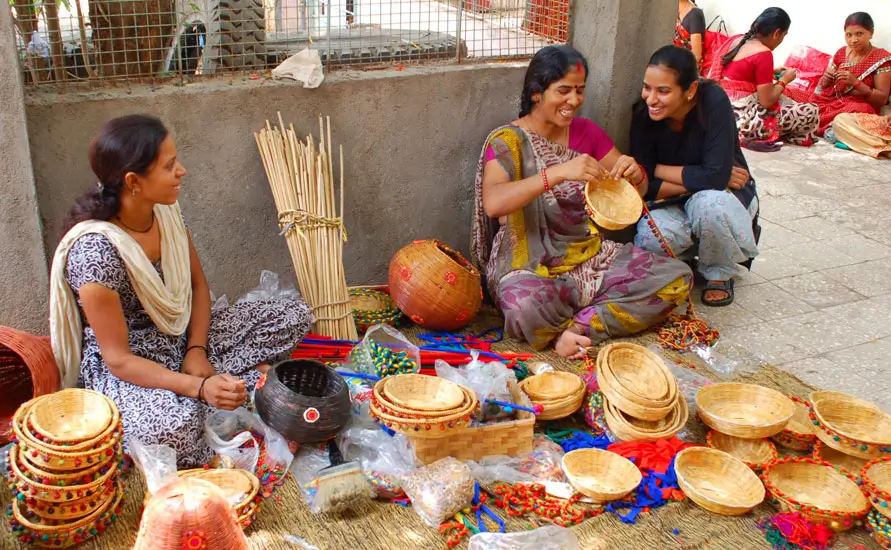
Over twelve days you spend time with weavers, metal casters, painters, tile makers and dyers in family units and cooperatives rather than in showrooms. Visits are arranged in advance so that artisans can show each stage of their work and answer questions through your guide, and nobody expects you to buy. Your own driver handles every road leg in an air-conditioned car, two-night stays in Chennai, Kanchipuram, Swamimalai and Trivandrum keep the pace steady, and a licensed guide who knows the craft families meets you in each town.
This South India crafts tour suits designers, textile collectors, art students and craft-minded guests from North America, the British Isles, the Continent and Oceania, along with NRI households curious about where their wedding silks and puja lamps actually come from. October to March brings drier roads, cooler afternoons and the busiest workshop calendar. Most temple visits involve removing shoes and covering shoulders and knees, and we note on each day where non-Hindu guests may or may not enter, because every temple sets its own rules.
Just beyond the customs hall a placard printed with your family name marks your welcome: one of our Chennai staff will be holding it, and your car is parked a short walk away. Long-haul services from Frankfurt, London, Dubai and Singapore mostly land well after dark, which is why nothing is booked until lunchtime. If you plan to reach the room before the standard afternoon check-in, tell us when you book and we will hold it from the night before. Over coffee in the lobby your tour manager walks you through the workshop schedule, explains how to pay artisans directly if you buy anything, and, if requested, supplies a prepaid local SIM.
Around four o'clock the car drops you in Mylapore, a centuries-old district of Chennai where the trades that serve the temple are still practiced in the open. Brass and bell-metal shops stack oil lamps, puja plates and water pots in tall towers, and garland makers on the pavement tie jasmine, marigold and rose into long strings faster than you can follow. Your guide shows you how a five-faced kuthuvilakku lamp is assembled from separate cast pieces, a useful preview of the foundries you will meet near Kumbakonam next week. The area is crowded but safe to walk, and short breaks for sweet filter coffee keep the pace easy.
As the sun drops you enter the courtyard of the Kapaleeshwarar Temple, its gopuram crowded with plaster figures repainted in bright enamel every few decades by specialist craftsmen. Visitors of all faiths are usually welcome in the outer corridors, though the sanctum is reserved for worshippers, and footwear goes into the free racks beside the gate. You then call at the government handloom cooperative showroom nearby, where fixed prices and printed tags give you a baseline for the silk and cotton you will see later. Dinner is a light South Indian meal of dosa and vada at a long-running vegetarian restaurant before an early night. Overnight in Chennai.
Your first appointment is at the Government Museum in Egmore, open since 1851, whose bronze holdings rank among the best South Indian metalwork collections in the world. The bronze gallery holds Chola-period images of Nataraja, Parvati, Rama and the saint-poets, most of them cast between the 10th and 12th centuries using the same lost-wax method that Swamimalai families still follow. Your guide points out the small details that separate a masterpiece from a routine casting: the curl of a finger, the balance of the raised foot, the flame ring around the dancing Shiva. Fridays and some public holidays see the doors shut, and our planners slot the visit around that.
Lunch is followed by roughly sixty minutes on the coastal highway to DakshinaChitra, a living-history center where village houses from the five southern states have been reassembled side by side. Original beams, roof tiles and carved doors were numbered, carried here and rebuilt, so a few steps take you from a Chettiar trader's pillared hall to the timber rooms of a Kerala Syrian Christian family. Resident artisans often demonstrate pottery, palm-leaf basketry, glass painting or puppet making in the shaded workshops. The center is closed on Tuesdays, and on that day we swap the order with tomorrow's drive.
Late in the afternoon there is usually time for a short hands-on session, such as block printing a cotton napkin or shaping a small clay lamp on the potter's wheel, and the staff are patient with complete beginners. The craft shop at the exit sells work by the artisans you have just watched, with the maker's name on many of the labels. On the drive back into the city your guide talks through what to look for tomorrow in Kanchipuram, including the difference between a handloom and a power-loom silk and how the Silk Mark label works. For dinner, choose between the hotel restaurant and a fish grill close to Besant Nagar beach. Overnight in Chennai.
After breakfast you leave Chennai on the Bangalore highway and reach Kanchipuram by mid-morning. The town has woven silk for many centuries, and its saris hold a Geographical Indication tag, which means only fabric made here with the approved materials and methods may carry the name. Your guide, who grew up in a weaving family, leads you into a narrow lane where the clack of shuttles comes from almost every doorway. Inside a typical house the loom sits in a shallow pit in the floor, with the weaver seated at ground level and the jacquard cards hanging from a frame above, each punched card controlling one line of the pattern.
Your Kanchipuram silk weaving tour continues with the steps that come before the loom. In one courtyard skeins of mulberry silk are dyed in steel vats and hung to dry in deep magenta, peacock blue and mango yellow. In another room a woman winds zari, the silver thread dipped in gold, onto bobbins, and your guide shows a simple scratch test that separates pure zari from the cheaper tested variety. Then comes korvai, the interlocking method where a contrasting border is joined to the sari's main field by hand on every single pass of the shuttle, slow work that needs a second pair of hands at the loom.
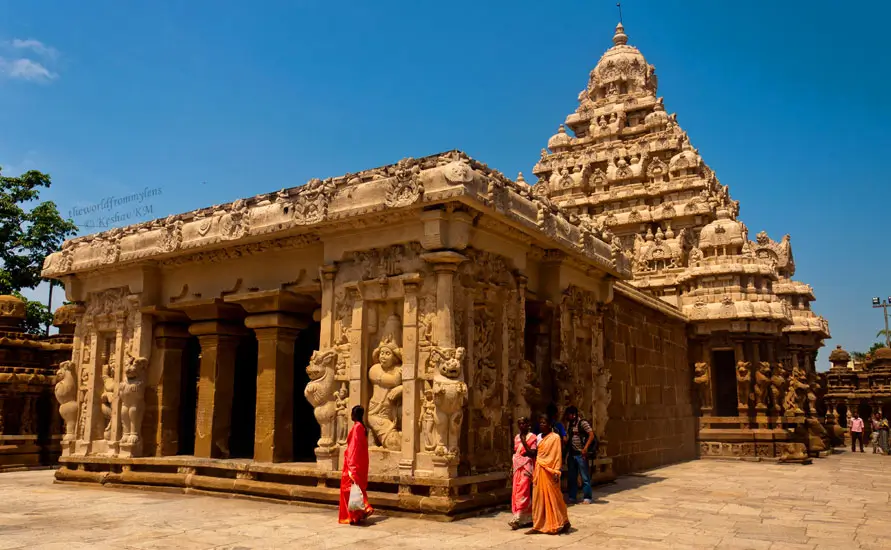
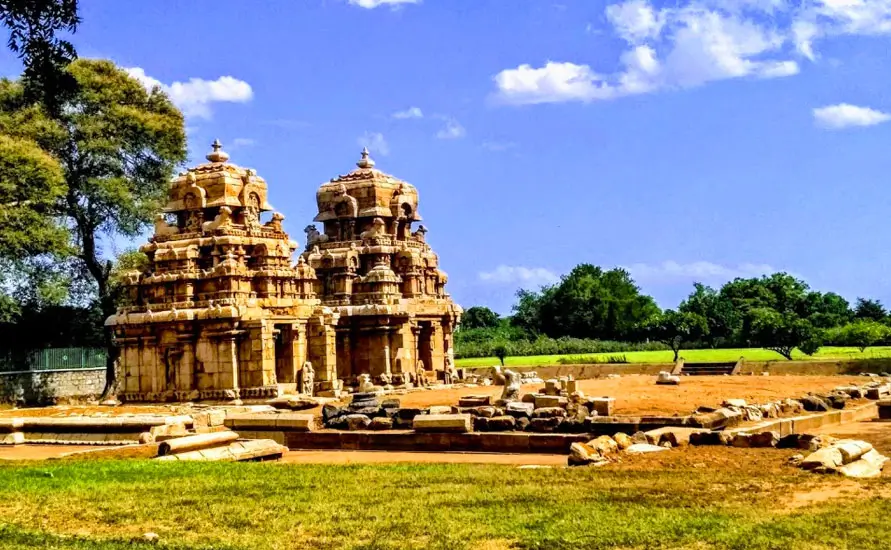
Afternoons are reserved for the 8th-century Kailasanathar Temple, the oldest standing structure in town, whose sandstone walls carry carvings that some weavers still copy into their temple borders. A quiet hour here suits photographers, because the light comes low across the small shrines lining the outer wall. Check-in is at a modest heritage property just outside the center, and the evening is yours. Anyone keen to commission a piece can be taken to a weavers' cooperative society, where a sari is commissioned to your chosen colors and shipped abroad once finished, which usually takes several weeks. Overnight in Kanchipuram.
Kanchipuram is as famous for its temples as for its looms, and the two are closely tied. Soon after sunrise you walk into the Ekambareswarar Temple, where Shiva is honored as the element earth, making it one of the five Pancha Bhoota Sthalams. Its southern gopuram rises about 59 meters, and a very old mango tree behind the main shrine is believed to give fruit of four distinct flavors, one on each branch. Guests of other faiths are normally free to walk the outer halls and courtyards, the innermost shrine stays reserved for Hindu worshippers, and staff at the doorway indicate where to stop. Morning is the coolest and calmest time to go.
Across town in Vishnu Kanchi stands the Varadharaja Perumal Temple, among the Divya Desams sung by the Alvar poet-saints. Its hundred-pillared hall carries carved horses, warriors and a well-known stone chain whose links were carved from one solid piece, and your guide shows how these motifs reappear on sari borders sold in the shops outside. Mid-morning you spend time at a weaving cooperative, where members share yarn, dyes and a common sales counter. A manager explains how the cooperative system protects weavers' wages and keeps the craft alive as younger people look for other work, and you can see finished saris folded and tagged before they go to market.
The afternoon is unhurried. After a vegetarian lunch on a banana leaf, there is a choice: a rest in your room or a return to a family loom to watch a single sari grow by a few centimeters over an hour, which says more about the labor involved than any price tag. Toward dusk, if energy allows, call at the Kamakshi Amman Temple, where the goddess is worshipped seated in a yoga posture and the evening lamps draw local women in fresh silks. Dinner tonight is at the hotel, and your driver checks the car and the route for tomorrow's longer drive south to the Kaveri delta. Overnight in Kanchipuram.
Departure is around 7:30 am, heading south through Vandavasi and the inland roads toward the Kaveri delta. No other leg on this itinerary is as long, so your driver builds in two comfortable stops: one for coffee and idli at a roadside canteen and one for lunch near Chidambaram or Kumbakonam, depending on traffic. The landscape slowly changes from dry scrub and granite hills to flat green paddy, banana groves and irrigation channels lined with palms. Your guide uses the time in the car to tell the story of the Chola kings, who ruled from this delta for about four centuries and paid the artists whose descendants still work in the villages ahead.
By mid-afternoon you reach Swamimalai and settle into a heritage village resort, where the cottages are built in the style of old Tamil agraharam houses with tiled roofs and wooden pillars. The village sits on the Kaveri, about 8 km from Kumbakonam, and is best known for its family bronze foundries, many run by sthapathis who trace their craft back over many generations. Before dinner you can walk to the Swaminatha Swamy Temple, counted among Murugan's Arupadai Veedu shrines and raised on an artificial mound reached by sixty steps, where Murugan is said to have explained the meaning of Om to his father Shiva.
Evenings at the resort are quiet, with oil lamps along the paths and the sound of temple drums drifting from the village. Many guests choose a short bullock-cart ride along the paddy embankments or stay on the veranda with ginger tea and a book. Your guide joins you after dinner to prepare for tomorrow's foundry visit, with a set of photographs showing each stage of casting, so you will know what you are looking at when the clay molds go into the fire. The hosts can also arrange a Carnatic music recital in the courtyard with a day or two of notice. Overnight in Swamimalai.
The morning belongs to the foundries. In a Swamimalai bronze casting workshop you see the whole lost-wax process laid out, from start to finish, on the floor of one family courtyard. The sthapathi first models the figure in a mixture of beeswax and resin, following proportions set out in the old Shilpa Shastra texts. The wax is then coated in layers of fine alluvial clay from the Kaveri bed and left to dry in the sun. When the mold is fired, the wax melts and runs out, and molten alloy of copper, brass and small amounts of other metals is poured into the empty cavity. The cast is finished with chisels and files over weeks.
After lunch a ten-minute drive takes you to Darasuram. Its Airavatesvara Temple, raised in the 1100s under Rajaraja Chola II, completes the trio that UNESCO groups as the Great Living Chola Temples. The stone here is carved more finely than in many larger temples, with palm-sized panels of drummers and dancers around the plinth, and the entrance pavilion takes the form of a chariot pulled by stone horses. A set of steps at the entrance once produced musical notes when tapped, and your guide can point them out. Entry is open to everyone regardless of faith, and the late-afternoon light is gentle on the pale stone.
Heading home, you pause in Nachiarkoil, a small temple town known for brass lamps made by sand casting rather than lost wax. Families here pour molten brass into molds packed with local sand, then polish and assemble the parts by hand, producing the tall annam lamps topped with swans that light many South Indian homes during festivals. You can watch a casting if one is planned that day, and buying directly from a workshop is easy if a lamp catches your eye. The Nachiarkoil temple itself is known for a stone Garuda carried in procession, and your guide explains the legend behind it. Overnight in Swamimalai.
Barely an hour's drive separates Swamimalai from Tanjore, which served the Cholas as their capital and later passed to Nayak and then Maratha kings, all generous patrons of painters, musicians and instrument makers. First comes the Brihadeeswarar Temple, consecrated around 1010 during the reign of Rajaraja Chola I, and which remains the grandest of the three UNESCO Chola sites. The granite vimana climbs to roughly 66 meters, while a monolithic Nandi bull kneels under a separate canopy, gazing toward the shrine. Your guide explains how the builders raised such weight without modern cranes, and reads you parts of the Tamil inscriptions around the plinth that name the dancers, lamp keepers and goldsmiths paid by the temple.
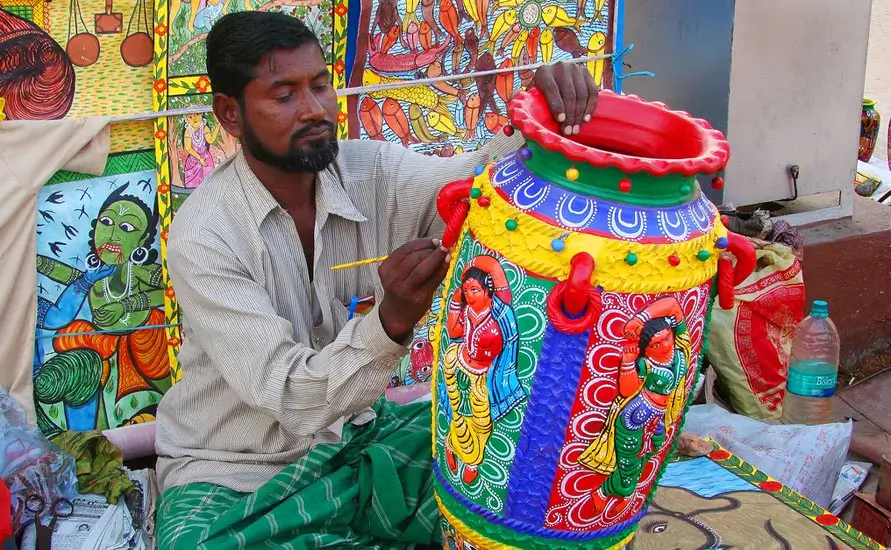
Late morning you spend at a Tanjore painting workshop, where artists build up a picture of Krishna or Ganesha in layers. The board is first covered with cloth and a paste of chalk and tamarind-seed glue, then raised areas are shaped by hand to give jewelry and crowns their relief. Gold foil is pressed over these raised parts, and colored glass or stones are set into them before the painting is filled in with bright, flat colors. The artist will show you the difference between real 22-carat foil and imitation gold, which matters if you consider buying. A small piece can take a week, a large one several months.
Later you head to the Thanjavur Royal Palace, begun by the Nayaks and extended by the Marathas, whose gallery displays Chola metal images and granite carvings beneath tall arches. Next door, the Saraswathi Mahal Library holds a vast archive of palm-leaf and paper manuscripts, many acquired by Serfoji II, a Maratha ruler with a passion for books. You then stop at a family workshop making the Thanjavur veena, the stringed instrument carved from a single block of jackwood, where the maker tunes a finished piece and plays a few notes. Dinner is at your hotel, with the temple tower lit up in the distance if your room faces it. Overnight in Tanjore.
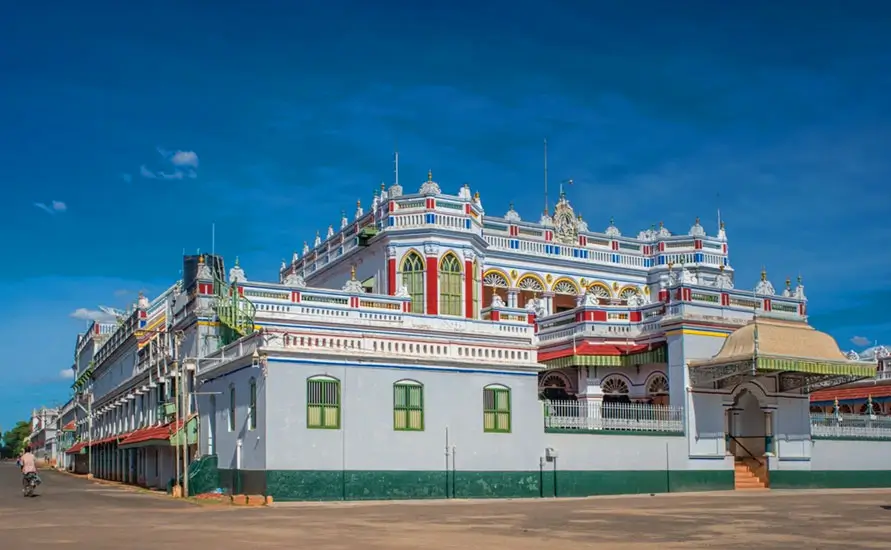
Leaving the delta behind, you drive south through Pudukkottai into Chettinad, where Nattukottai Chettiar families built banking networks reaching across Southeast Asia while the British ruled India. Profits came home as palatial houses fitted with teak columns shipped from Burma, imported marble floors, mirrors from Europe and courtyards wide enough for whole family weddings. Tonight's base is a restored mansion hotel close to Karaikudi; the rooms open onto a central courtyard and the walls are finished with a lime-and-egg plaster that still shines after a century. Lunch is a Chettinad meal of pepper chicken, kuzhi paniyaram and banana-flower curry.
In the afternoon you drive to Athangudi, a village that gave its name to the handmade cement tiles seen on Chettinad floors. In a small workshop a craftsman lays a glass plate in a metal frame, pours colored cement into the pattern using thin brass stencils, then adds a dry backing layer of sand and cement and presses it. The finished Athangudi tiles are not fired in a kiln but cured in water tanks and dried in the shade, which gives them their soft, cool surface. Owners usually let visitors try one pour, and you can order a set to ship home if you have a project in mind.
Around five o'clock you stroll the lanes of Kanadukathan with your guide to see mansion facades and, where owners allow, a courtyard or two inside. Plenty of these homes are locked up for months at a time, their owners returning from Chennai or Singapore just for weddings and the Pongal festival. Back near Karaikudi you call at a small unit weaving kandangi saris, the heavy cotton saris with wide contrasting borders and bold checks once worn by Chettiar women, which also carry a Geographical Indication tag. The evening is free at the mansion, where the evening meal comes to the long dining table under ceiling fans and portraits of the family who built it. Overnight in Karaikudi.
Before leaving Chettinad, your guide takes you to the antique lanes of Karaikudi, where dealers sell carved doors, brass vessels, enamel tiffin boxes and old wooden toys removed from mansions over the years. Bargaining is normal, and your guide will tell you which items can legally leave India, because antiques over a hundred years old need an export certificate. You then drive west to Madurai, a city whose history runs back more than two thousand years, arriving around noon. Post-lunch, a Nayak-period palace near the river now serving as the Gandhi Memorial Museum tells the story of the independence movement and of homespun khadi cloth in clear English panels.
Mid-afternoon you meet a family of Sungudi artisans from the Saurashtra community, whose ancestors came from Gujarat several centuries ago and settled here under the Nayak kings. Their craft is a form of tie-dye in which hundreds of tiny knots are tied into cotton or silk by hand before dyeing, leaving small dots that form circles, waves and temple patterns when the cloth is opened. You see the tying, the dyeing and the drying, and if you like you can tie a small sample yourself. Your guide also takes you past the hand-block printers and tailors' lanes around the temple, where clothes can be stitched to measure overnight.
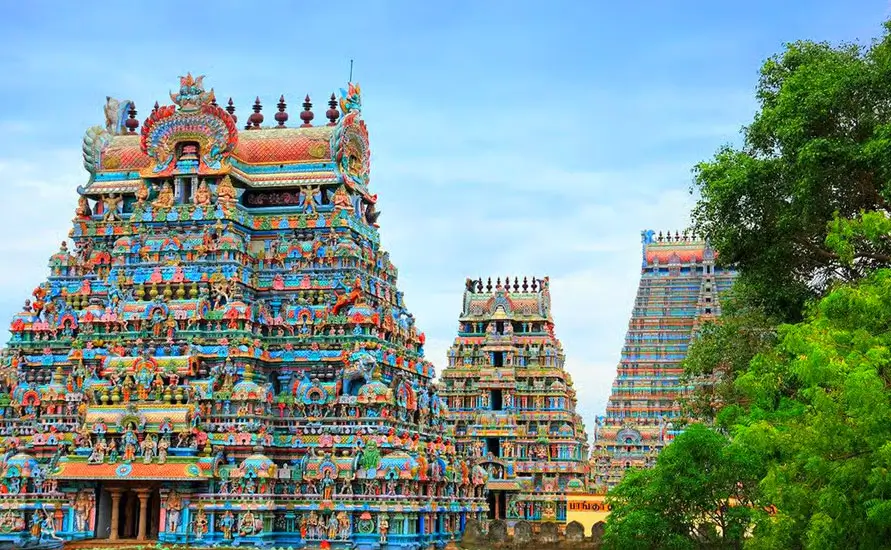
At dusk you walk barefoot into the Meenakshi Amman Temple, where fourteen towers carry thousands of plaster figures repainted at intervals by teams of temple artists. Mobiles and cameras go into deposit lockers at the gate; non-Hindu guests are welcome in the long corridors and pillared halls, though the two main sanctums remain off limits. Inside, the Thousand Pillar Mandapam doubles as a small art museum, and a set of slender stone columns nearby gives out separate musical tones when tapped. If you have energy left, wait until roughly 9 pm for palliyarai, when priests bear Shiva in a palanquin to rest beside the goddess. Overnight in Madurai.
An early start after breakfast takes you south on the national highway past Virudhunagar and Tirunelveli, through flat country where wind turbines stand in long lines on the plains. Highway conditions are fair, with a coffee halt on the way and lunch near Nagercoil, where the Western Ghats rise suddenly on your right. Near the southern tip of India, the landscape turns green again, with coconut palms, rubber trees and laterite walls, a sign that you are close to the Kerala border. Your guide uses the drive to introduce the Travancore kingdom, whose kings shifted their court from Padmanabhapuram up the coast to Trivandrum around 1795.
Early afternoon brings you to Padmanabhapuram Palace, the earlier royal residence of Travancore. Though it lies in Tamil Nadu today, it is managed by the Kerala government and is one of the best surviving examples of traditional Kerala wooden architecture. The carved rosewood ceilings, the council chamber with its mica windows, and the glossy black floors, polished from a recipe of lime, charred coconut husk and plant extracts, show how much skill the palace carpenters and masons had. Footwear stays at the gate, and because the palace shuts every Monday, a Monday arrival means we visit on another day.
Roughly ninety minutes of driving then separates you from Trivandrum, also known as Thiruvananthapuram, the capital of Kerala. Hotel check-in comes in the late afternoon, leaving the evening for rest after a long road day. For those wanting a short walk, your guide suggests a loop past Kuthiramalika, the old horse-carving palace, and along the East Fort walls toward Padmanabhaswamy, where the gopuram is lit in the evening. Dinner might be a Kerala meal of appam, stew and fish curry with coconut, a change in flavors from the Tamil kitchen you have eaten so far. Overnight in Trivandrum.
A 30-minute drive south of the city leads to Balaramapuram, the handloom village behind Kerala's off-white kasavu fabric. In the early 19th century the Travancore court invited families of weavers from Tamil Nadu to settle here and produce fine cotton for the royal household, and many of their descendants still work in the same lanes. Your Balaramapuram handloom visit starts with yarn being sized with rice starch and stretched out along the street to dry, then moves into a house where a weaver works on a pit loom, adding a narrow gold zari band to the edge of a set mundu, the two-piece garment worn at Onam and weddings.
The weavers will explain how thread count, border width and the purity of the zari affect the price, and how to spot a genuine Balaramapuram piece, which carries a Geographical Indication tag. You also see the cooperative society where weavers bring their cloth for checking and sale. Buying directly here supports the families who make the fabric, and a set mundu or a simple kasavu stole packs flat and makes an easy gift. Heading north again, there is a stop at a Kerala mural painting studio, where artists work with natural pigments in the red, ochre and green palette found on the walls of old Kerala temples.
After lunch comes the Napier Museum, an Indo-Saracenic hall of banded brick and gabled roofs filled with bronzes, carved ivory and a temple chariot, and close by the Sree Chitra Art Gallery with oils by Raja Ravi Varma, the Kilimanoor-born painter whose lithograph prints of gods still hang in countless Indian homes. Both are closed on Mondays. The Padmanabhaswamy Temple is open to Hindus only and keeps a strict dress code, so non-Hindu guests view the gopuram from the tank and the lanes outside. Your last stop is the state handicrafts emporium for fixed-price coir, rosewood and brass work. Overnight in Trivandrum.
After breakfast you have time to pack your silks, bronzes and lamps carefully, and your guide can help wrap fragile pieces or arrange courier shipment for heavy items such as tiles. Your driver then takes you to Trivandrum International Airport, usually about 20 to 30 minutes from the city, timing the drive so you arrive three hours before an international departure. Should your flight be a late one, a day room or a Kovalam beach night can be added for a supplement. Our local staff wave you off at departures.
Over twelve days you have watched silk, bronze, brass, paint, cement and cotton turn into objects that South Indians use at weddings, festivals and daily worship. Direct services link Trivandrum with Gulf hubs and Singapore, from where connections reach the US, Europe and Australia. Many guests who take this South India crafts tour come back for a second trip focused on Kerala mural painting, Mysore inlay or the weaving towns of Andhra Pradesh, and our team can map that out whenever you are ready. Safe travels home.
Your Journey

N.S. Rathore & Mrs. Omlata Rathore · Managing Director
We still read every enquiry ourselves. Tell us the places you liked and our planners will send a day-by-day route with drive times and a clear price.
Every package can be customised and no pressure to book. A planner from our office replies within 24 hours with a route written for your group.
Fill this in and your planner will send a first draft itinerary.
Explore more
Kerala Backwaters Escape Kerala Backwaters Escape
 Kerala Backwaters Escape
 Kerala Backwaters Escape
 Kerala Backwaters Escape
 Kerala Backwaters Escape
 Kerala Backwaters Escape
 Kerala Backwaters Escape
 Kerala Backwaters Escape
 Kerala Backwaters Escape
 Kerala Backwaters Escape
 Kerala Backwaters Escape
 Kerala Backwaters Escape
 Kerala Backwaters Escape
 Kerala Backwaters Escape
 Kerala Backwaters Escape
 Kerala Backwaters Escape
 Kerala Backwaters Escape