 Kerala Backwaters Escape

Religious & Heritage Tour Of South India
Bangalore – Shravanabelagola – Halebidu – Karkala – Moodabidri – Mangalore
At a glance
Few regions hold as much Jain history in so small an area as southern Karnataka, where monks, merchant families and royal patrons built hilltop shrines and pillared halls for well over a thousand years. Our Jain heritage tour of South India follows that story from Bangalore to the Arabian Sea coast. You climb to the 57-foot Gommateshwara statue at Shravanabelagola, study the polished pillars of the Halebidu Jain basadis, and finish in the coastal belt of Tulu Nadu, where Karkala and Moodabidri keep living Digambara traditions in daily worship.
The pace is gentle on purpose. Hill climbs are planned for cool early mornings, long drives are broken with temple stops, and you spend two nights in four of the five overnight bases, which leaves time for prayer, puja or quiet reading in the basadis. The same driver and cooled sedan or SUV stay with your group all the way from Bangalore to Mangalore, and regional guides with a sound grasp of Jain history and architecture join you in each region. Pure Jain meals without onion, garlic or root vegetables can be arranged at most stops if you tell us in advance.
This Jain pilgrimage tour of Karnataka is planned for Jain families from the US, UK, Canada, Kenya and the Gulf, for NRIs tracing community roots, and for any traveler with a serious interest in Indian religion and art. Non-Jain visitors are welcome at every site on the route, provided they follow temple customs on dress, leather and silence. October to February brings dry, mild weather; the coast is humid from March, and the monsoon (June to September) makes the ghat roads slow and the granite steps slippery.
Past customs and the baggage belts at Kempegowda International Airport, a colleague from our Bangalore desk waits just beyond the arrivals barrier holding a board marked with your surname, then wheels your trolley out to the car park. Many flights from the US, Europe and the Gulf reach Bangalore in the small hours, so no sightseeing is fixed for the first half of the day. The drive into the city runs about an hour, often longer in morning traffic, and our colleague spends that hour going through a printed plan, local SIM card advice and a short note on what Jain temples expect from visitors. Check-in at the hotel is normally from 2 pm, with early access available if booked ahead.
Mid-afternoon brings a relaxed tea-table briefing with the guide who will travel west with you. Over tea, the talk covers the basics that shape the next ten days: the difference between Digambara and Svetambara traditions, why the figure of Bahubali matters so much in Karnataka, and how the Ganga, Hoysala and coastal Bhairarasa rulers all became patrons of Jain monks. Questions about Jain diet on the road, puja timings and what to wear are welcome. Families traveling with older parents can also discuss the steps at Shravanabelagola and Karkala, so the guide can plan rests and assistance where needed.
Around five o'clock the car heads into Chickpet, the crowded wholesale market district of old Bangalore, where Jain merchant families from Rajasthan and Gujarat settled generations ago. Among the textile shops and brass dealers stand several Jain temples, including a marble Svetambara temple dedicated to Adinatha, with carved pillars, painted ceilings and a calm prayer hall above the noise of the street. Leather belts and wallets should be left in the car, shoes go at the entrance, and photography inside the sanctum is usually not allowed. Dinner can be a pure vegetarian thali at a Marwari-run restaurant nearby. Overnight in Bangalore.
Start the morning at Lalbagh Botanical Garden while the air is still cool and walkers are out on the paths. Hyder Ali ordered the first plantings in the 1760s, and the grounds spread across a dome of bare grey gneiss, some of the oldest exposed rock in the subcontinent. A small stone tower on top of that dome marked one edge of the town that the chieftain Kempe Gowda planned in 1537, and your guide traces how his walled settlement spread into today's technology capital. The flower beds, old trees and lake make a quiet place to adjust to Indian time before the road trip begins.
Next comes the Government Museum on Kasturba Road, one of the oldest museums in South India. Its sculpture galleries hold stone images from Karnataka's Jain sites, including seated and standing tirthankaras and inscribed slabs, and seeing them close up helps you recognize the symbols you will meet at every basadi: the lion of Mahavira, the serpent canopy of Parshvanatha, the bull of Adinatha. Mondays are normally a closing day here, and we swap the program around on that weekday. Nearby, the red-brick Attara Kacheri, now the High Court, and the green expanse of Cubbon Park show the colonial side of the city.
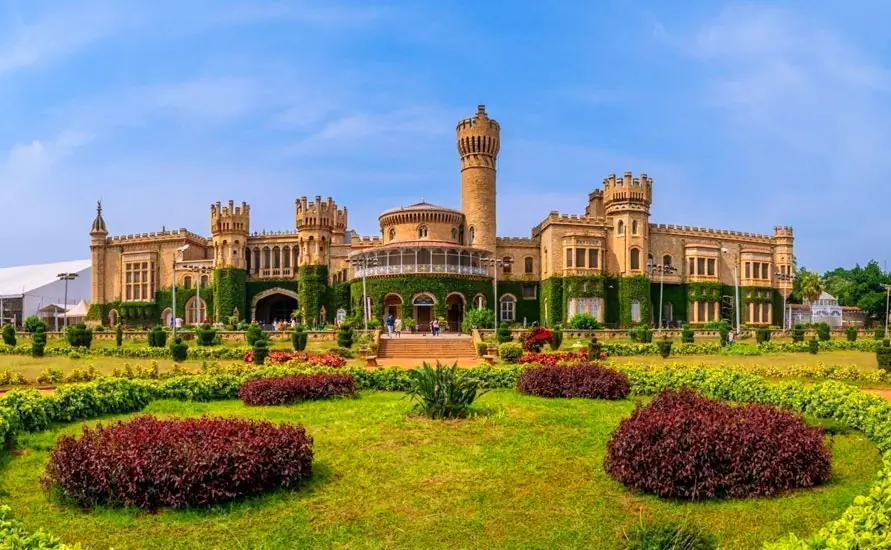
After lunch the Wadiyar family's Bangalore Palace is next, a turreted residence from the 1880s modeled loosely on Windsor, with carved teak staircases, Victorian paintings and the stuffed heads of animals shot on royal hunts. An audio guide is available in English. Later on you may prefer a nap, or a short trip with your guide to the Jayanagar shopping streets selling Mysore silk, sandalwood carvings and puja items. In the evening, many Jain travelers like to eat dinner before sunset, so let the hotel know by midday and a plain vegetarian meal can be on the table before dark. Pack light for tomorrow's climb. Overnight in Bangalore.
Leaving soon after seven, the car takes the Mangalore highway west, past coconut farms, sugarcane fields and the granite hills that rise out of the Mandya plains. About 20 km before Shravanabelagola, a short detour brings you to Kambadahalli, a village with one of the oldest Jain monuments in the state. Its Panchakuta Basadi, built in the Ganga period around the 10th century, has three shrines grouped around one hall and two more added later, with stepped towers in the Dravida style. A tall Brahmadeva pillar stands at the entrance, and the village name itself comes from that pillar, kamba meaning column.
Arrival in Shravanabelagola is around midday, and tonight you stay in a modest but well-kept lodge close to the hills, because the town has no large hotels of its own. The name refers to the white pond of the shramanas, or Jain ascetics, and the large Kalyani tank still lies between the town's two hills. Vindhyagiri carries the great statue and Chandragiri holds the older cluster of temples. In the afternoon, when the rock begins to cool, your guide leads you up the gentler path on Chandragiri hill, about 200 steps, with views over the tank and the white shrine-topped summit opposite.
Tradition holds that Acharya Bhadrabahu came here with his disciples in the 3rd century BC, and that the Mauryan emperor Chandragupta followed him, renounced his throne and ended his life through sallekhana, the Jain practice of a slow, voluntary fast. The Chandragupta Basadi with its carved stone screens and the small cave of Bhadrabahu are both on the hill, along with hundreds of old inscriptions cut into the rock, some among the earliest written examples of the Kannada language. Visitors walk barefoot on the hilltop, and socks help on hot stone. You descend at dusk as the evening lamps are lit in the town basadis. Overnight in Shravanabelagola.
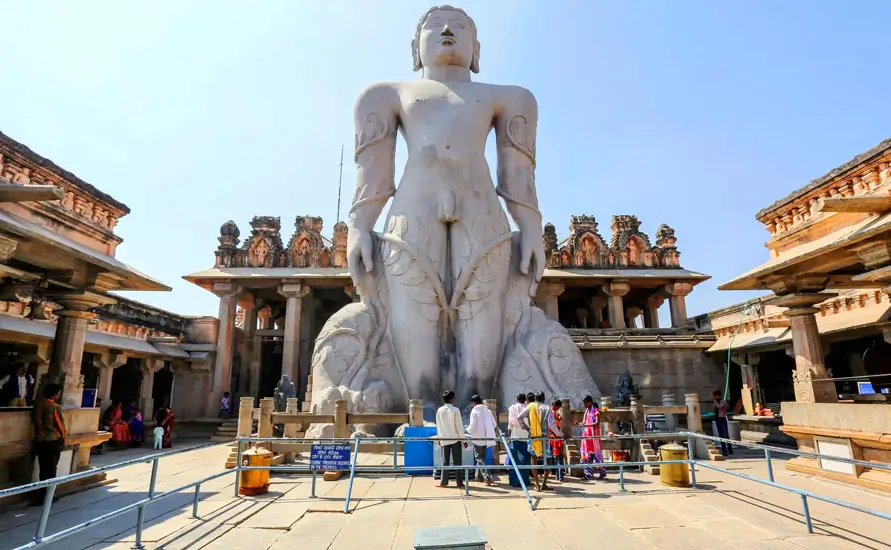
The climb up Vindhyagiri begins at first light, when the granite is cool and the hill is filled with the sound of devotees reciting prayers. Around 600 steps are cut directly into the bare rock, and shoes must be left at the bottom; thick cotton socks are allowed and recommended. For travelers with knee or heart concerns, a doli (a cane seat on two poles, lifted by a pair of bearers) is the usual alternative, and your guide books it the evening before. Most visitors take 30 to 45 minutes with short pauses. At the top, through a gateway and a walled courtyard, the face of the Gommateshwara statue comes into view, calm and enormous against the sky.
The image of Bahubali was carved from a single granite boulder around 981 AD on the orders of Chavundaraya, who commanded the army of the Ganga king Rachamalla, and stands about 57 feet high. The prince is shown in kayotsarga, the standing posture of meditation, so still that creepers wind around his arms and legs and anthills rise at his feet. Every twelve years, the Mahamastakabhisheka sees the statue bathed from a scaffold with milk, saffron, sandalwood paste and flowers; the last one was in 2018. Daily worship continues at the feet of the statue, and visitors may join the queue for darshan quietly. Photography is generally allowed in the courtyard but not of priests during rituals.
Breakfast waits at the hotel once you are down, and then a short walk leads to the Bhandara Basadi, raised in 1159 by a senior Hoysala administrator, with a long row of 24 tirthankara images in one hall. The Jain Math nearby, the seat of the local Bhattaraka, has old wall paintings of Jain stories in natural colors. In the afternoon you drive about an hour north-west to Hassan, a practical base with a wider choice of hotels for the Hoysala sites. Your evening is open; ask the front desk at check-in if you want dinner served before sunset in keeping with Jain custom. Overnight in Hassan.
Halebidu, about 30 km from Hassan, was Dorasamudra, the capital of the Hoysala kings, until Malik Kafur's forces sacked the city around 1311. Most visitors come only for its great Shiva temple, but a few hundred meters away stand the Halebidu Jain basadis, three temples in a quiet walled compound that many tours skip. The Parshvanatha Basadi, built in the 1130s, is the finest, with a tall black stone image of Parshvanatha under a seven-hooded serpent and lathe-turned pillars polished so finely that they reflect your face. The Adinatha and Shantinatha basadis complete the group, and the caretaker will often light the lamps for visitors.
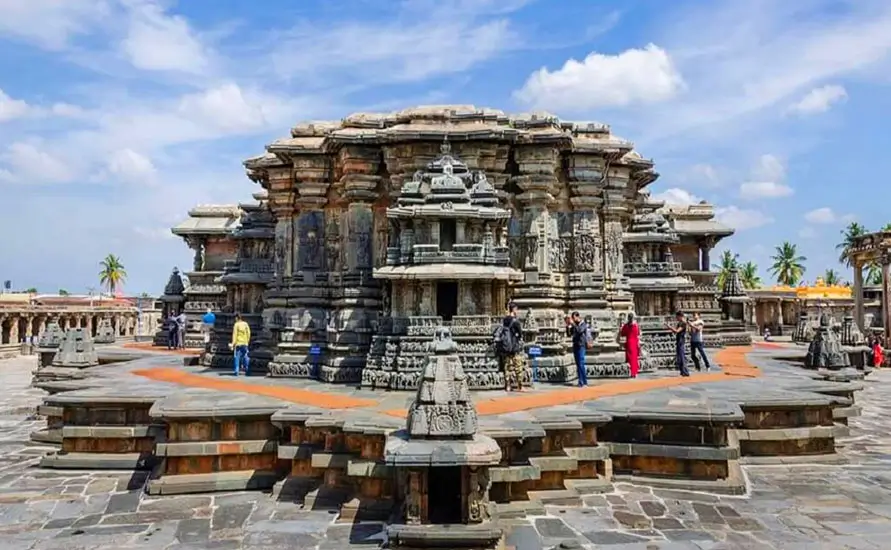
Your guide explains why these Jain temples stand next to Hindu ones. The early Hoysala rulers were patrons of Jain monks, and even after King Vishnuvardhana turned to Vaishnavism, his queen Shantala Devi and many court officials continued to build basadis. Then you walk to the Hoysaleswara Temple, where twin sanctums share one raised platform and the outer walls carry band after band of carved processions, from charging war elephants at the base to gods and dancers higher up, cut in a fine-grained chloritic schist. Together with Belur and Somanathapura, the site was inscribed by UNESCO in 2023 under the joint title Sacred Ensembles of the Hoysalas.
After lunch, a 16 km drive takes you to Belur and the Chennakeshava Temple, consecrated in 1117 and still in daily worship. Its bracket figures of dancers, musicians and huntresses, known as madanikas, are among the best-known sculptures in India, and your guide shows you the small details, such as the tiny insect on a fruit and the ring that can still turn on one figure's finger. Non-Hindu visitors are welcome in the hall, while the sanctum follows temple rules. Shoes stay at the counter and shoulders should be covered. You return to Hassan in the late afternoon for a quiet evening. Overnight in Hassan.
Today the road leaves the Deccan plateau and drops down to the coast, so an early start is wise. You drive past Belur and through the coffee country of Mudigere, then take the Charmadi Ghat, a winding road with hairpin bends, mist in the forest and long views over the Western Ghats. Road conditions can change after heavy rain, and our drivers know when to choose an alternative route through Shiradi Ghat. Stops for tea and a short walk at a viewpoint keep the drive comfortable. The total driving time is about six hours, broken by a long midday halt at Dharmasthala.
Dharmasthala is a temple town where the Shiva shrine of Manjunatha is served by Madhva priests and managed by a Jain family, the Heggades, a mix that says a great deal about the religious life of coastal Karnataka. On Ratnagiri hill above the town stands a 39-foot granite Bahubali, carved in the 1970s and installed in the early 1980s, reached by a short flight of steps. Its kitchen serves free meals to many thousands of pilgrims daily, and visitors may watch the huge vessels and the volunteers who keep them going. Inside the Manjunatha shrine men normally go bare-chested, and weekend queues stretch for hours, so many of our guests spend their time at the hilltop statue rather than in the line.
In the late afternoon you continue through Belthangady and the rubber and areca nut plantations of Tulu Nadu to Karkala, a small town that was the seat of the Bhairarasa chiefs, Jain rulers who built many of the monuments you will see tomorrow. You check in to a comfortable mid-range hotel, the best available in town. Should you still feel fresh, the Hiriyangadi quarter close by has a slender monolithic manastambha, a pillar of honor standing in front of a basadi, its carved top catching the last light. Dinner can be a simple Udupi-style vegetarian meal. Overnight in Karkala.
Climb the rock hill known as Gomateshwara Betta before breakfast, when the stone is cool and the town is waking. A flight of steps cut into the granite leads to the Karkala Bahubali, a 42-foot monolith set up in 1432 under Veera Pandya Bhairarasa, the second tallest Bahubali of its period in Karnataka after Shravanabelagola. The face here is a little softer and the shoulders broader, and your guide can compare the two carving styles. Raising a statue this size onto a hilltop without modern machinery is itself a remarkable feat, and the guide describes the ramps and rollers historians believe were used.
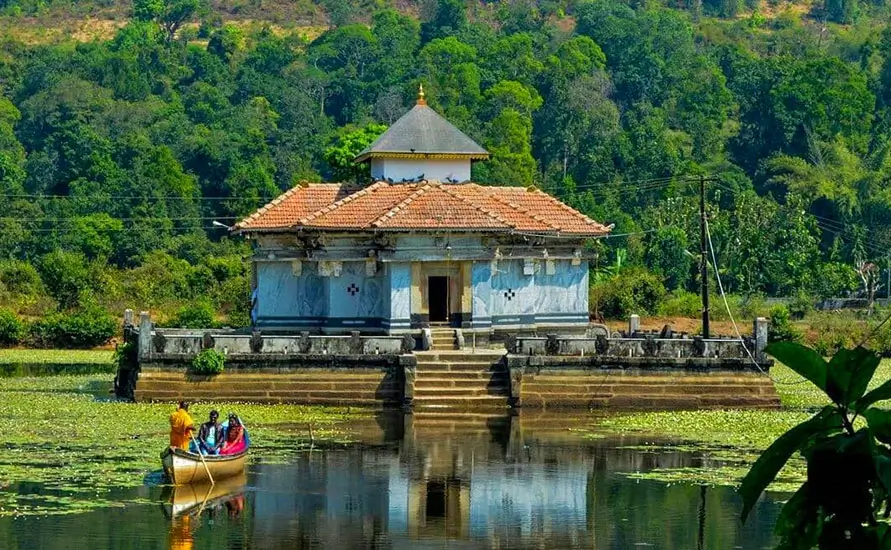
On the smaller hill facing it stands the Chaturmukha Basadi, built in 1586 and named for its four identical entrances, one on each side, each opening onto images of tirthankaras. More than a hundred stone pillars hold up the roof, and the symmetry is easiest to appreciate as you walk around the outside. After breakfast, you drive about 26 km toward Hebri to Varanga, where the Kere Basadi stands on a small island in the middle of a lotus-filled lake. A boatman rows you across in a few minutes, and the four-sided shrine, dedicated to Neminatha and other tirthankaras, is a peaceful place to sit.
Back in Karkala after lunch, you visit a few of the town's smaller basadis and, if you wish, the Venkataramana temple in the market, which belongs to the local Konkani-speaking Hindu community and shows how faiths share the same streets here. The afternoon is left open for rest, puja or a walk around the Anekere tank. In the evening your guide can arrange a conversation with a local Jain family or a temple caretaker, subject to availability, to hear how the community keeps its festivals, fasts and rituals going in a small coastal town. Remember to carry a scarf and avoid leather items again tomorrow. Overnight in Karkala.
Bags go into the car straight after breakfast for the run to Venur, a quiet village on the banks of the Phalguni river, about an hour away by country roads. Its 35-foot Gommateshwara was set up in 1604 by Timmanna Ajila, a local Jain chief, and stands in a walled enclosure surrounded by palms rather than on a hill. Two old basadis stand close by. The site sees few visitors, which makes it one of the calmest stops of the trip, and the riverside setting is very different from the granite summits of Shravanabelagola and Karkala. From Venur the road continues about 20 km to Moodabidri.
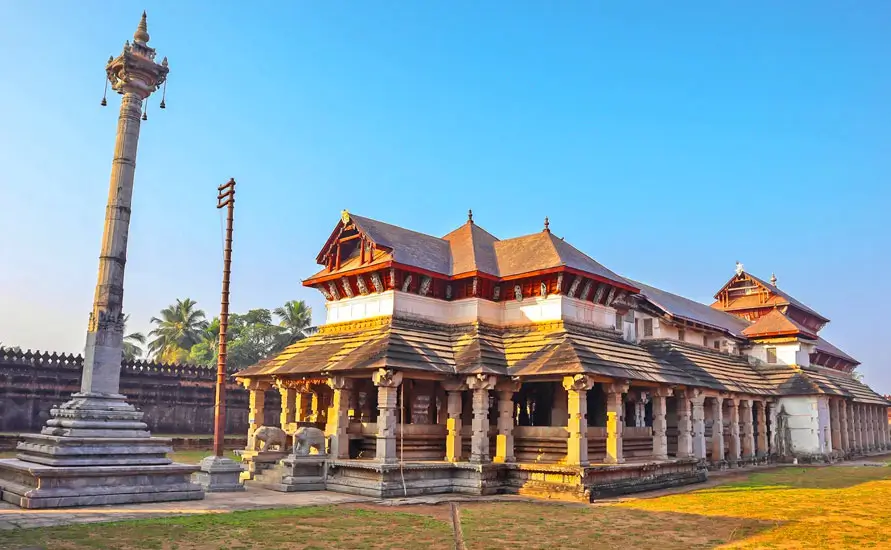
Moodabidri, often called the Jain Kashi of the south, has 18 basadis within a small area. The most famous is the Moodabidri thousand pillar basadi, the Saavira Kambada Basadi, built in 1430 and dedicated to Chandraprabha. It is said that no two of its carved pillars are alike, and the sloping tiled roofs show how temple builders adapted to heavy coastal rain. The Guru Basadi nearby keeps rare palm-leaf manuscripts of the Dhavala texts, the commentaries on one of the oldest Digambara scriptures, and small images made of precious stones are shown to visitors only on certain occasions. A last call is the Jain Math, where the Bhattaraka, the spiritual head of the local Digambara community, has his seat.
Before leaving town, stop at the Chowta Palace, the old residence of the local Chowta rulers, where carved wooden pillars and ceilings show figures of animals and a famous panel of nine women whose bodies form the shape of an elephant. After a vegetarian lunch you drive about 35 km to Mangalore, the main port of coastal Karnataka, and check in by mid-afternoon. No further visits are planned today. If you would like a sea breeze, the beach at Panambur lies north of the city, and a seaside walk at sunset is a pleasant way to close the Jain section of the trip. Overnight in Mangalore.
Mangalore has been a trading town since ancient times, and its mix of Tulu, Konkani, Kannada, Beary and Catholic communities makes it a good place to end a heritage trip. First on the list is Kadri Manjunatha Temple, built against a red rocky slope in the north of the city, where a seated bronze image of Lokeshwara dated by inscription to 968 AD is among the oldest bronzes in South India. Nine small tanks fed by springs lie above the temple, and caves on the hill are linked to the Nath tradition of yogis. Sandals are handed to the attendant at the gate, and loose clothing that hides the shoulders and knees is the norm.
From Kadri you drive to Lighthouse Hill and St Aloysius Chapel, which belongs to a college run by the Jesuits since Italian priests started it in the 1880s. Its walls and ceiling are covered in paintings by the Italian Jesuit brother Antonio Moscheni, finished around 1899, with scenes from the life of St Aloysius and the Bible arranged across every surface. Photography inside is usually not allowed, and the chapel closes during services. Afterwards, you pass the Mangaladevi Temple, dedicated to the goddess who gave the city its name, and continue to the old port at Bunder, where wooden dhows still load cargo for the Lakshadweep islands.
Lunch is a good chance to try coastal Karnataka cooking. Strict Jain travelers can find a pure vegetarian Udupi thali in town, while others may want neer dosa, a soft rice crepe, with a coconut curry, or the city's well-known fish dishes. The afternoon is free for shopping for cashews, local spices and handloom cotton, or for packing. At Sultan Battery, a small watchtower built in the late 18th century under Tipu Sultan, you can watch the river meet the sea. Your guide finishes the day with a short recap of the sites you have visited and the traditions behind them. Overnight in Mangalore.
Breakfast at the hotel is unhurried, and you have the morning to yourself before checkout. If your flight departs in the afternoon, you could make a short visit to a basadi in the city for a final darshan, or pick up packets of sweets and banana chips for family at home. Mangalore International Airport at Bajpe sits on a plateau north of the city, about 30 minutes away, and serves direct flights to the Gulf plus short domestic hops to Bangalore, Mumbai and Delhi for long-haul links to Europe and North America.
Pickup is set from the airline's latest schedule, checked by our office the same morning, so the counters are reached with time to spare. Over ten days you have stood beneath the great Bahubali images of Shravanabelagola, Karkala and Venur, seen the Hoysala basadis at Halebidu and the pillared halls of Moodabidri, and met a community that has kept its faith alive in this region for more than two thousand years. Should Ranakpur, Palitana or the Dilwara shrines of Mount Abu interest you for another year, simply write to us and a western India route can follow. Safe travels home.
Your Journey

N.S. Rathore & Mrs. Omlata Rathore · Managing Director
We still read every enquiry ourselves. Tell us the places you liked and our planners will send a day-by-day route with drive times and a clear price.
Every package can be customised and no pressure to book. A planner from our office replies within 24 hours with a route written for your group.
Fill this in and your planner will send a first draft itinerary.
Explore more
Kerala Backwaters Escape Kerala Backwaters Escape
 Kerala Backwaters Escape
 Kerala Backwaters Escape
 Kerala Backwaters Escape
 Kerala Backwaters Escape
 Kerala Backwaters Escape
 Kerala Backwaters Escape
 Kerala Backwaters Escape
 Kerala Backwaters Escape
 Kerala Backwaters Escape
 Kerala Backwaters Escape
 Kerala Backwaters Escape
 Kerala Backwaters Escape
 Kerala Backwaters Escape
 Kerala Backwaters Escape
 Kerala Backwaters Escape
 Kerala Backwaters Escape