 Kerala Backwaters Escape

Religious & Heritage Tour Of South India
Chennai – Mahabalipuram – Chidambaram – Gangaikonda Cholapuram – Kumbakonam – Darasuram – Tanjore – Trichy – Bangalore – Shravanabelagola – Belur – Halebidu – Hampi – Pattadakal – Badami – Aihole – Old Goa
At a glance
Six dynasties, four kinds of stone and roughly a thousand years of building sit along this route, and our UNESCO World Heritage Sites of South India tour lets you read them in sequence. You begin with the 7th-century Pallava granite of Mahabalipuram, move to the 11th-century towers of the Great Living Chola Temples, then cross into Karnataka for the soapstone lacework of Belur and Halebidu, the ruined Vijayanagara capital at Hampi and the sandstone shrines of Pattadakal. A final stop at the Portuguese churches of Old Goa adds a seventh listed site before you fly home.
The planning keeps long road days to a minimum. One short domestic flight from Trichy to Bangalore replaces a full day of driving, the Chola leg is broken with a night in Kumbakonam, and Hampi gets three nights so its two very different halves, the royal enclosures and the riverside temples, each get an unhurried day. Your own chauffeur, fluent in English, stays with you for all the driving, in a cooled sedan or SUV,, and an archaeology-minded local guide joins you at each site, ready to explain carving technique as well as legend.
This South India UNESCO tour was shaped for guests flying in from the US, Canada, Britain, continental Europe or Australia, and with NRI parents who want sons and daughters to stand in front of the carvings they only know from school photos. Mornings start early at most sites to beat heat and tour buses, and afternoons usually include a rest. Every element of the UNESCO World Heritage Sites of South India tour is private, which means you can upgrade hotels, slow the pace or add a night anywhere. The Deccan plateau is kindest between October and February.
Look for our Chennai representative holding a sign with your surname once you clear customs; an air-conditioned car then carries you across town to your room. Since most long-haul arrivals from North America and Europe touch down around midnight, we book the room so you can sleep straight through the morning without worrying about the standard check-in hour. Over a late breakfast, your tour manager walks through the next sixteen days, hands over a printed route sheet with site closing days marked, and helps with a local SIM card and currency so the rest of the trip runs without small hitches.
After lunch, a heritage guide takes you to the Government Museum in Egmore, which most visitors skip but which makes an ideal opening for a South India UNESCO tour. Its bronze gallery ranks among the world's great holdings of Chola metal images, including dancing Shiva as Nataraja and graceful figures of Parvati cast nearly a thousand years ago. Seeing them up close, at eye level and well lit, prepares you to recognize the same iconography later in temple niches and at a working foundry. Fridays are the museum's weekly holiday, and on a Friday arrival we reverse the order and see the fort first.
At about four, you set out for Fort St. George, the first English East India Company stronghold in India, founded in 1644 and now home to the Tamil Nadu state assembly. Inside the walls stands St. Mary's Church, dating to 1680 and claimed as the senior Anglican church beyond Suez, whose wall plaques that tell the story of colonial Madras in a handful of names and dates. The small fort museum displays weapons, coins and portraits from the same period. You return to the hotel by early evening for a quiet dinner, giving your body time to settle into Indian time before tomorrow's coastal drive. Overnight in Chennai.
After a slow breakfast, your car rolls down the East Coast Road toward the south, an easy route with casuarina groves, fishing hamlets and glimpses of the Bay of Bengal. Ninety minutes later the road arrives at Mahabalipuram, or Mamallapuram, once the chief harbor of a Pallava dynasty that ruled from Kanchipuram from the 7th century onward. The town's Group of Monuments was inscribed by UNESCO in 1984 and covers rock-cut caves, monolithic shrines, open-air reliefs and structural temples. Check-in is near the beach, and the midday hours are kept clear for lunch and a siesta while the sun is fierce.
At four, your guide is waiting at Arjuna's Penance, which some scholars interpret instead as Ganga coming down to earth, a relief spread across two huge granite boulders almost 30 meters wide. A natural cleft between them once carried rainwater, turning the carving into a working illustration of the sacred river falling to earth. Look for the life-sized elephants, the cat mimicking an ascetic to fool the mice, and the serpent beings rising in the cleft. Nearby, the Krishna Mandapa and the Varaha cave show how Pallava carvers moved from shallow relief to deep, sculptural panels. Up the slope, the rounded rock nicknamed Krishna's Butter Ball balances on a tiny contact point.
As the light softens, you climb the low hill to the old lighthouse and the Olakkaneswara Temple, a small Pallava shrine that once served as a beacon itself, with fires lit on its roof for passing ships. The view takes in the whole archaeological zone, the coastline and the newer lighthouse, which is open to visitors on most days for a small fee. The guide uses this vantage point to explain how the town's monuments were arranged and why many works were left unfinished when royal patronage moved elsewhere. Dinner is free tonight, and the seafood shacks on Othavadai Street are a relaxed choice. Overnight in Mahabalipuram.
An early start rewards you with the Shore Temple in the first light, when its weathered granite turns orange against the sea and the site is almost empty. Rajasimha, as King Narasimhavarman II was known, commissioned it early in the 8th century, and its blocks were cut, stacked and fitted rather than hollowed out of a cliff, a big step for builders in the south. Two towers rise over separate Shiva shrines, with a reclining Vishnu tucked between them. Salt winds have rounded many of the carvings, and the protective groyne and casuarina screen around it show how much effort goes into keeping the ocean at bay.
After breakfast at the hotel, you walk among the Pancha Rathas, five free-standing shrines each sculpted from a single ridge of granite, which local tradition later linked to the Pandava brothers of the Mahabharata. Each tries out its own roof, one copying a village hut, one a barrel vault, another a stepped pyramid, and the guide explains how these experiments shaped Dravidian temple design for centuries. Life-sized stone animals, including an elephant, a lion and Nandi the bull, stand among them. Later, you visit a family of stone carvers who still work granite with chisels and hammers in workshops along the town's main roads, many trained at the local government sculpture college.
After lunch you head five kilometers up the coast to Saluvankuppam and the Tiger Cave, a rock-cut stage whose opening is ringed with snarling yali heads that look like big cats. Excavations near here after the 2004 tsunami uncovered a brick Murugan temple from the Sangam age beneath a later Pallava granite shrine, a reminder that the coast holds older layers than any guidebook lists. The site is quieter than the main zone and good for photography. Between December and January, dancers perform Bharatanatyam and other classical styles against Arjuna's Penance during the Mamallapuram Dance Festival, and we can reserve seats if your dates match. Overnight in Mahabalipuram.
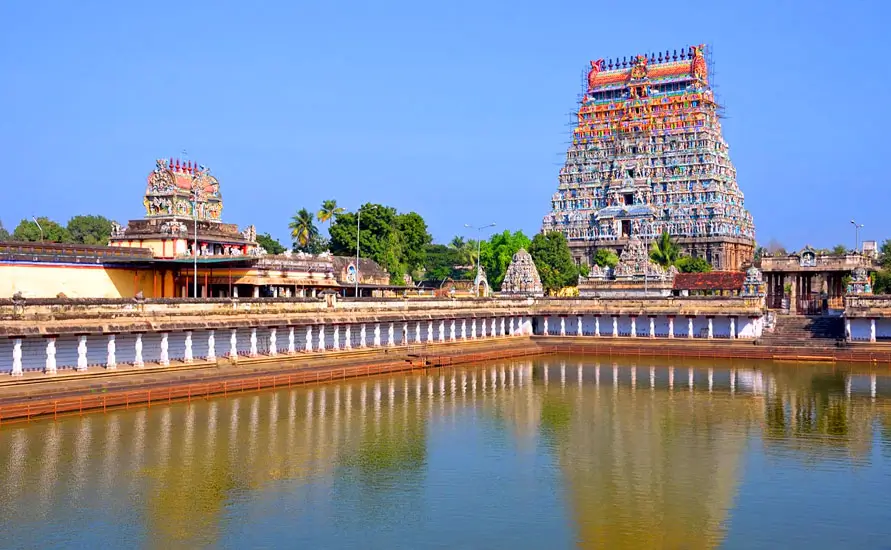
Rather than driving straight to Tanjore, we split today's distance with two worthwhile stops. You set off after an early breakfast and follow the coast past Pondicherry to Chidambaram, around four hours away, where the Nataraja shrine venerates the dancing form of Shiva and links him to akasha, or space. Its gold-roofed inner hall is the ritual heart of Tamil Shaivism. Rules on access are set by the temple's hereditary priests, but guests of any faith can generally wander the outer mandapas and study the east and west gopurams, where the 108 karana poses of classical dance are carved in labeled panels.
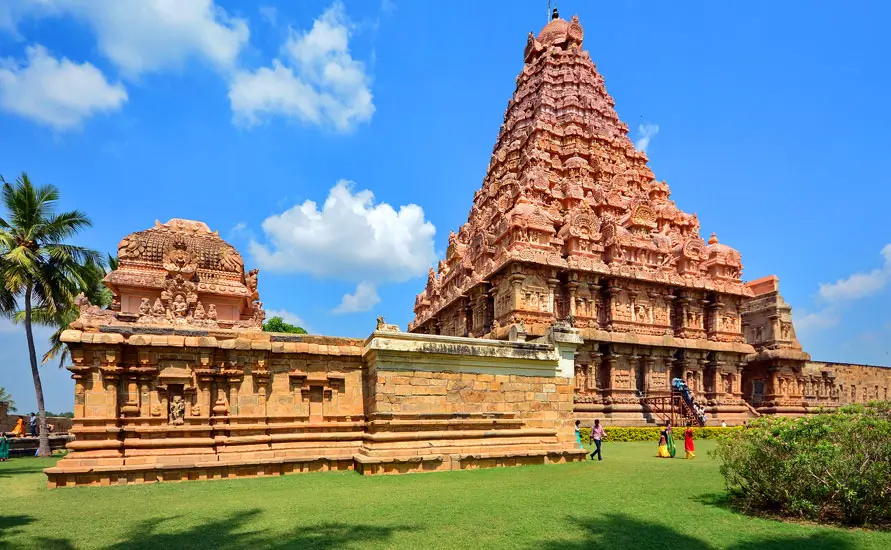
After a simple South Indian lunch, you continue about an hour inland to Gangaikonda Cholapuram, your first look at the Great Living Chola Temples group. Rajendra I built the town and its temple around 1035 to celebrate an army campaign that reached the Ganges, and tradition says water from the holy river was poured into the lion-guarded well that still stands in the courtyard. The vimana is a little lower than Tanjore's and gently curved in profile, which many visitors find more graceful. Seek out the north-side panel of Shiva honoring the devotee Chandesha by tying a floral band around his hair, a scene experts place at the very top of Chola sculpture.
The town was the Chola capital for more than two centuries, yet today only the temple and a few mounds remain among the rice fields, so the site rarely feels crowded and the afternoon light on the granite is gentle. A further hour of driving ends in Kumbakonam, a temple town in the Kaveri delta known for its large tanks, betel leaf markets and strong degree coffee made with fresh milk. Arrival is by late afternoon, leaving daylight for a stroll to the Mahamaham tank, scene of a huge ritual bath that comes round once in twelve years. Overnight in Kumbakonam.
Five minutes from Kumbakonam, the Airavatesvara Temple at Darasuram opens early, and the morning hours here are quiet and cool. Rajaraja II raised it around 1150, making it the smallest yet most detailed member of the Great Living Chola Temples. The name comes from Airavata, the white elephant of the god Indra, believed by devotees to have prayed to Shiva on this ground. Your guide points out the front pavilion shaped like a chariot, its stone wheels drawn by rearing horses, and the entrance steps that produce musical tones when struck, although striking them is now discouraged to protect the stone.
Look closely at the base panels, some barely the size of a postcard, which show dancers, musicians, wrestlers and stories of the 63 Nayanmar saints in lively detail. Afterward, you drive about fifteen minutes to Swamimalai, a village famous for lost-wax bronze casting. In a family workshop, artisans shape the image in wax, cover it with clay made from fine Kaveri river silt, melt the wax out and pour molten metal into the cavity. You can watch the stages, ask about the proportions set down in old manuals and, if you wish, order a piece to be shipped home, without any pressure to buy.
Post-lunch, an hour's drive takes you to Tanjore, spelled Thanjavur on official maps, the capital of the Chola emperor Rajaraja I. You check in and rest before an evening visit to the Brihadeeswarar Temple, when lamps are lit, devotees arrive after work and the tower glows against a darkening sky. This first visit is for atmosphere rather than detail; your guide saves the architecture lesson for tomorrow morning. Wear loose clothing that hides shoulders and knees, and hand your footwear to the attendant outside. For dinner, try a Thanjavur vegetarian spread laid out on a fresh banana leaf. Overnight in Tanjore.
Return to the Brihadeeswarar Temple after breakfast, when the sun picks out every molding on the vimana and your guide can work through the building piece by piece. Completed around 1010, the vimana climbs to about 66 meters, crowned with a granite capstone that tradition says weighs about 80 tonnes, raised by a long earthen ramp. There is no granite quarry nearby, so every block was hauled across the delta. Inscriptions around the base list donations, temple staff and the names of hundreds of dancers who served here, giving one of the clearest pictures of how a medieval Indian temple was run day to day.
The giant single-stone Nandi under its canopy came centuries afterward, under the Nayak rulers, and the cloister walls around the courtyard are lined with lingas and later paintings. Your guide will also address the widely shared myth of a shadowless tower at midday, which the pavement at noon quickly disproves, and explain why this temple remains a living place of worship rather than a museum. Non-Hindu guests can usually enter the main courtyard and halls, while the sanctum is for worshippers; as everywhere on this route, the rules are set by the temple, and photography inside the shrine is not allowed.
After a rest comes the Thanjavur Royal Palace, a Nayak-built complex that the Marathas took over in the 17th century. In its art gallery, bronze and stone images rescued from village shrines line long halls, while the Saraswati Mahal Library is where Serfoji II, a Maratha prince tutored by a German Lutheran missionary, stored his Sanskrit and Tamil palm-leaf bundles next to the European atlases he ordered by ship. Opening days vary between sections, so we check them before your visit. Toward evening, there is time to visit a small studio painting Tanjore-style gold-leaf icons, or to shop for a handmade veena keepsake. Nothing else is planned after that. Overnight in Tanjore.
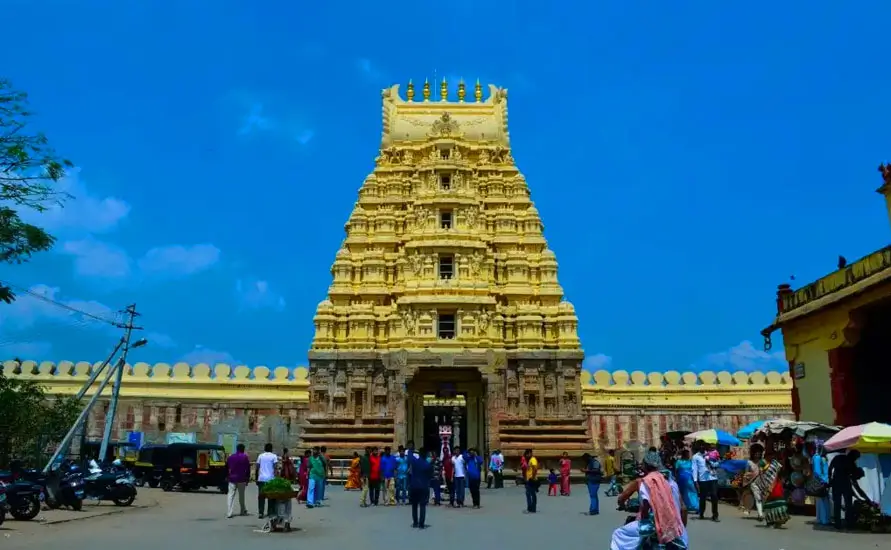
Check out after breakfast and drive west to Trichy, or Tiruchirappalli, along the Kaveri. On an island between two arms of the river stands Srirangam, home to Sri Ranganathaswamy, a contender for the title of the world's biggest working Hindu temple, enclosed by seven concentric walls and crowned by 21 gopurams. It is not a UNESCO site, but it shows how a Chola-era temple can grow into an entire walled town, with homes, shops and schools inside its enclosures. Anyone may stroll through the outer prakarams and their colonnades, although temple custom keeps the garbhagriha for Hindu worshippers.
A paid rooftop viewpoint, when it is open, gives a clear look over the gilded inner shrine and the forest of towers, and your guide helps you pick out the thousand-pillar hall with its carved rearing horses. Afterward, if time allows, you can drive past the Rock Fort, where steps climb a huge outcrop to a small Ganesha shrine and a view over the city. You eat lunch at a riverside restaurant in town. Your guide also uses the morning to sum up the Chola leg of the trip, linking what you saw at the three listed temples with the later growth visible here.
In the afternoon, the driver takes you to Trichy airport for an economy flight of about an hour to Bangalore, replacing what would be a nine-hour drive. Schedules on this route change seasonally, and if no suitable direct flight is running on your date we arrange a convenient alternative. On landing at Kempegowda International Airport, a new Karnataka-based driver and car take over for the remaining ten days, and the ride to your hotel may run past an hour if city traffic is heavy. The evening is free to rest, perhaps with dinner at one of the city's craft brewpubs. Overnight in Bangalore.
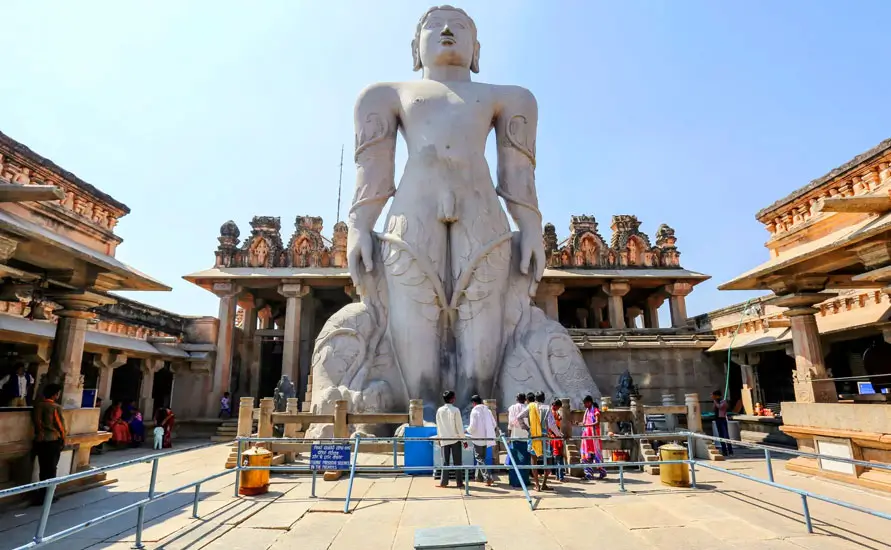
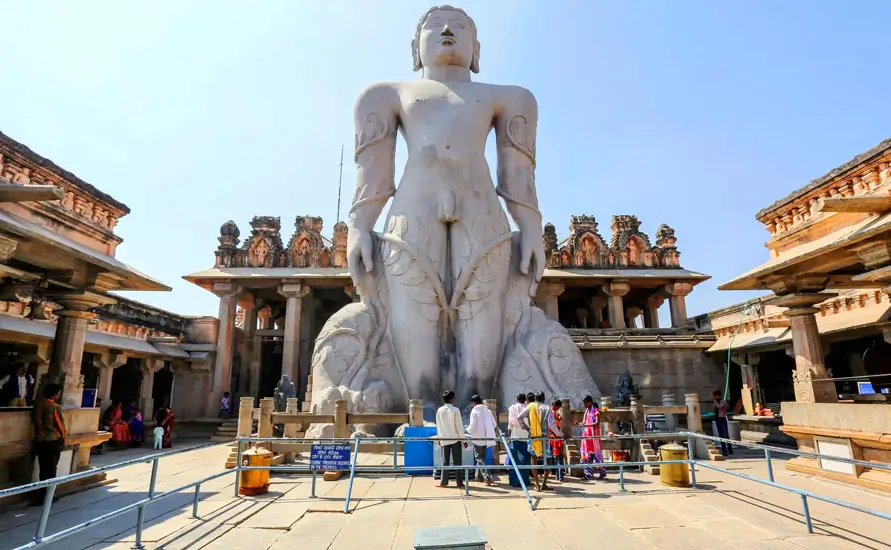
Breakfast is early, then the car points west across the Karnataka plateau, through coconut groves, granite hills and ragi millet fields. After about three hours you reach Shravanabelagola, a leading Digambara Jain pilgrimage town. The colossal statue of Gommateshwara, also known as Bahubali, stands about 17 meters tall on Vindhyagiri hill and was shaped out of one granite mass around 981 CE. The approach is a barefoot climb of over 600 rock-cut steps, so an early arrival is important before the stone heats up; socks are allowed and help a great deal.
At the summit you look down on the town tank and the smaller Chandragiri hill opposite, covered with old basadis and inscriptions. The Jain link matters for the rest of today and tomorrow, because the Hoysala rulers you will meet at Belur were patrons of both Jain and Hindu faiths, and King Vishnuvardhana's queen Shantala was a devoted Jain. Older visitors who prefer not to climb can stay in the lower town, where the guide shows the Bhandara Basadi and the matha with its painted murals. A Jain-style lunch, without onion, garlic or root vegetables, is easy to arrange here if you would like to try it.
After a further two and a half hours, passing Hassan, you pull into Belur, a small town on the banks of the Yagachi river. We usually book a quiet stay in the Belur area or among the nearby coffee estates toward Chikmagalur, where evenings are cooler and you may hear birdsong rather than traffic. After check-in, your guide runs through a short introduction to the Sacred Ensembles of the Hoysalas, inscribed by UNESCO in 2023 and covering Belur, Halebidu and Somanathapura, so you arrive at the temples tomorrow knowing what to look for. If you are staying on a coffee estate, ask for a cup brewed from its own beans. Overnight near Belur.
Start at the Chennakeshava Temple in Belur, dedicated in 1117 under King Vishnuvardhana and still used for daily worship. One popular reading links its founding to a victory over the Cholas at Talakad, which makes a neat bridge from the Tamil temples you saw last week. Hoysala carvers worked in chloritic schist, a soapstone that cuts easily when fresh and turns harder on exposure to air, making possible the jewel-like detail around the star-shaped platform. The guide leads you around the base, layer by layer, and then to the bracket figures of celestial dancers known as madanikas, including the famous Darpana Sundari, the lady holding a mirror.
Inside, the lathe-turned pillars of the hall are so finely finished that they catch the light like polished metal, and the Narasimha pillar among them is crowded with miniature figures. Non-Hindu guests are usually welcome in the main hall, but the sanctum is for worship and photography rules are set by the temple. After lunch, you drive about 16 km to Halebidu, the old capital Dorasamudra, where the Hoysaleswara Temple has twin shrines dedicated to Shiva. Bands of carving wrap its outer walls: elephants form the lowest row, and above them come lions, cavalry, scrollwork and episodes from the Ramayana and Mahabharata, with no two elephants said to be exactly alike.
Halebidu was sacked by the army of Malik Kafur in 1311, and the temple was never finished, so you can see some panels still in rough-cut stage beside completed work, an unusual chance to understand how carvers planned each band. The small archaeological museum on the grounds, closed on Fridays, holds sculptures recovered from the area. Close by, the Jain basadis at Bastihalli are often deserted and have polished black pillars that reflect your torchlight. If you have energy left, the Kedareshwara Temple nearby is another fine Hoysala shrine. Back at base before dusk, the evening stays free. Overnight near Belur.
No day on this itinerary covers more distance than this one, so the timing is set carefully. You leave soon after breakfast and drive northeast across the open plateau, with plenty of comfort breaks at clean highway restaurants. Roughly halfway, around three and a half hours out, the road passes Chitradurga, where a massive fort climbs a cluster of granite boulders in seven concentric rings of walls. It was built over several centuries by local chieftains and later strengthened by Hyder Ali and Tipu Sultan, and its gates, granaries and temples make a good leg-stretch in the late morning. Wear comfortable shoes for the uneven stone paths.
Locals still honor Onake Obavva, who, legend says, struck down intruders one by one at a small crevice in the ramparts using only a rice pounder; that crevice carries her name today. After lunch in Chitradurga town, you continue for about three hours toward Hampi, as the landscape changes to rust-colored boulder hills, sugarcane fields and banana plantations along the Tungabhadra. These boulders are some of the oldest exposed rocks on the planet, and the way they balance and split shaped both the legends of the area and the layout of the city you will see over the next two days.
Expect to pull in around five and settle into a hotel in Kamalapur, Hospet or a quiet boutique stay near the ruins, depending on your preference. If you are not too tired, catch the sunset from a nearby rock for a preview of temple towers rising among the boulders. Your Hampi guide stops by for twenty minutes to sketch out a plan that works around the heat and site timings, and to explain that the ruins of the old capital spread across some 25 square kilometers. Dinner is at the hotel, with an early night recommended before tomorrow's start. Overnight in Hampi.
Hampi, or Vijayanagara, ruled over much of the peninsula from 1336, until the joint forces of four Deccan sultans defeated it near Talikota in 1565, after which the city was looted and abandoned. Foreign visitors of the time compared it to Rome in size. Today, you focus on the Royal Centre, the zone of palaces and court life. You start at the Mahanavami Dibba, a towering stone stage for the nine-night royal festival, its sides alive with hunts, dancers and visiting merchants, and then walk to the green-stone stepped tank, which lay buried until archaeologists cleared it in the 1980s.
Next comes the Zenana Enclosure, with the two-story Lotus Mahal blending Hindu and Islamic arches in a cool pavilion, and the Elephant Stables, eleven chambers under alternating domes, each chamber designed for one royal animal. Your guide talks through the stone aqueducts and channels supplying the palaces, a reminder that this was a carefully engineered city rather than a random cluster of temples. The Hazara Rama Temple, the private shrine of the kings, has outer walls carved with continuous panels from the Ramayana, read like a picture book. Bring a hat, sunscreen and water, as there is little shade in the Royal Centre.
After lunch and a rest, you visit the Archaeological Museum at Kamalapur (shut on Fridays), home to a large floor model of the whole site, along with sculptures, coins and hero stones found in the area. Seeing the model after a morning on foot helps you place each ruin in its context. Toward five, the Queen's Bath shows a bare exterior hiding a decorated arcade around a sunken pool, and the underground Shiva temple, often partly flooded. The day ends with sunset from a quiet rocky ridge chosen by your guide, away from the crowd on Hemakuta hill. Overnight in Hampi.
Today belongs to the Sacred Centre by the river. Begin with the Virupaksha Temple, which predates Vijayanagara rule and remains the one big Hampi temple where daily puja never stopped. Morning pujas bring drums and conch shells, and non-Hindu guests can usually watch from the courtyards. In a small chamber behind the sanctum, light through a thin gap in the wall casts an inverted picture of the great east gopuram onto the facing wall, a natural pinhole camera that your guide will help you find. Afterward, a walk up Hemakuta hill shows clusters of early shrines and a wide view over the bazaar street.
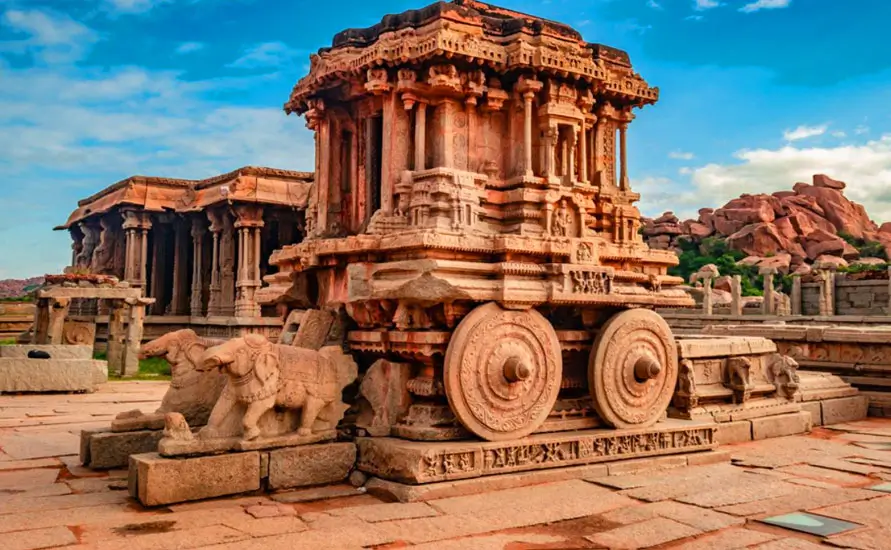
Around ten, the car takes you toward the Vittala Temple; private vehicles stop short, and electric shuttles run the final kilometer. Its pillared halls are carved with musicians and rearing mythical animals, and some slender pillars once rang with notes when tapped, though touching them is no longer allowed. Out in the courtyard waits the stone chariot, a Garuda sanctum disguised as a wooden processional car, which Indians carry in their wallets because it decorates the 50-rupee note. Nearby is the King's Balance, where rulers were weighed against gold and grain to be given away on festival days.
After lunch, the riverside path between Vittala and the Achyutaraya temple passes boulders carved with Vishnu images and offers fine views of the Tungabhadra. Depending on water levels and local rules, you may be able to take an optional ride in a round coracle boat, woven from bamboo and sealed with tar, which is the traditional way to cross here. Before returning to the hotel, you stop at the giant monolithic Lakshmi Narasimha image and the Badavilinga beside it, a linga about three meters tall standing in flowing water. The evening is free for a last dinner in Hampi, and your guide can recommend a simple local thali. Overnight in Hampi.
Leaving Hampi after breakfast, you drive northwest for about three and a half hours to Pattadakal, with a short break at Ilkal, a weaving town known across Karnataka for its handloom saris with a red pallu attached to the main fabric by an interlocking weave. A brief visit to a family loom is easy to arrange and makes a nice contrast with the stone of the past week. The road then crosses the black-soil country of Bagalkot district, where cotton, sorghum and sunflower fields stretch to the horizon. You arrive in Pattadakal around lunchtime and eat at a simple roadside dhaba or a packed lunch from the hotel.
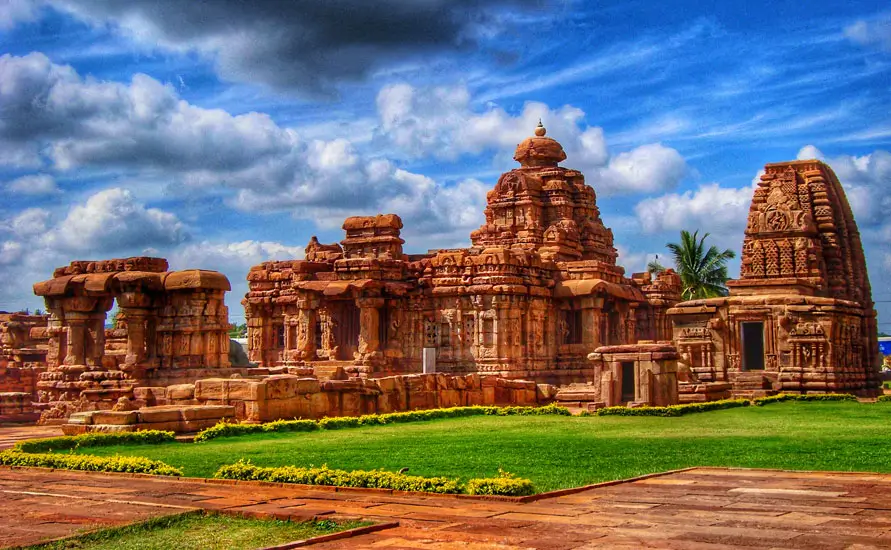
Pattadakal, on the banks of the Malaprabha river, was where the early Chalukya kings were crowned during the 7th and 8th centuries, earning UNESCO listing in 1987. What makes it special is the variety: curvilinear nagara spires and terraced Dravida vimanas rise almost shoulder to shoulder, and your guide will walk you through the differences in base, wall and roof. Pattadakal's own Virupaksha Temple, the biggest of the group, went up around 745 at the order of Queen Lokamahadevi in honor of King Vikramaditya II's capture of Kanchipuram from the Pallavas, the dynasty whose carvings you saw in Mahabalipuram.
That link is one of the best moments of the trip, because Chalukyan sculptors are thought to have borrowed ideas from the Pallava temples of Kanchipuram after the conquest. The Mallikarjuna temple next door, built by a second queen, mirrors its plan on a smaller scale, while the Papanatha Temple mixes both styles in one building. A short distance away stands a Jain temple from the 9th century. Half an hour by road then brings you to Badami, a small town below red sandstone cliffs, where you stay two nights. Overnight in Badami.
Badami, known in inscriptions as Vatapi, served as the first Chalukya seat of power, and its four cave temples are cut into the cliff above the Agastya lake. You climb the steps in the cool of the morning to see Cave 1, with an 18-armed Nataraja, and Cave 3, dated by an inscription to 578 and dedicated to Vishnu, whose forms include the man-lion Narasimha and the dwarf Vamana stretching out his leg to cross the universe. Cave 4 is Jain, with seated tirthankaras. Watch your bags, as the resident monkeys are bold, and keep any food out of sight. Badami is on the tentative UNESCO list rather than the main one.
After the caves, you walk along the lake to the Bhutanatha temples, whose reflections on the water are especially lovely in the morning light, and visit the small archaeological museum, closed on Fridays. Then you drive about an hour to Aihole, which textbooks describe as a laboratory of early Indian temple design, where more than a hundred temples and ruins are scattered around a village. The apsidal Durga Temple, with its rounded back and pillared veranda, is the most famous. Your guide also shows you the Lad Khan Temple, one of the earliest, and the rock-cut Ravanaphadi cave, whose dancing Shiva panels are among the finest of their age.
Climb the short hill to the Meguti Jain Temple, where an inscription composed by the poet Ravikirti in 634 records the victories of King Pulakeshin II, including his defeat of the northern emperor Harsha, a rare dated text that historians still use. The view from the top covers the whole village and the plain beyond. Once back in Badami, the remaining light allows a stroll through the narrow lanes of the old town toward the north fort, with its watchtowers and early temples. Eat at the hotel tonight and pack ahead of tomorrow's long transfer to the coast. Overnight in Badami.
Today is mostly a road day, as you leave the Deccan plateau for the Konkan coast. The drive heads west through Bagalkot district toward Belagavi, a former British cantonment town where a lunch stop splits the drive, then descends the Western Ghats by one of the forested ghat roads into Goa. In the monsoon months the hills are covered with waterfalls, and in winter the air smells of cashew and wood smoke. On the bends, the driver keeps a steady pace and pulls over at safe lookouts if you want photos.
By five or so you are in Goa, checking in at a restored colonial-era hotel or a Portuguese-style guesthouse in or near Panaji, the state capital, which puts Old Goa just 20 minutes away for tomorrow. The evening is free, and the riverside promenade along the Mandovi is a pleasant place to walk while fishing boats and river cruises pass. Goan cuisine, with its fish curries, pork vindaloo and bebinca layered dessert, offers a complete change from the vegetarian thalis of the past weeks. Overnight in Goa.
The seventh UNESCO stop of your trip, the Churches and Convents of Goa, sits in Old Goa, where Portuguese viceroys governed and whose 16th-century population, some say, matched Lisbon's. Start inside the Basilica of Bom Jesus, finished in 1605; its unplastered facade of laterite stone hides a gilded interior. A silver casket holds the relics of St. Francis Xavier, the Jesuit who died on Shangchuan, an island off southern China, in 1552, and they are displayed publicly only once every decade or so. The basilica is an active church, so arms and legs should be covered and voices kept low during services.
Opposite rises the Se Cathedral, among Asia's biggest church buildings, with a famous bell known as the Golden Bell for its rich tone. Next door, the Church of St. Francis of Assisi has painted panels on its walls, and the adjoining Archaeological Museum, closed on Fridays, shows a gallery of viceroy portraits alongside Hindu and Jain sculpture found in the area. Afterward you walk up to the ruined tower of St. Augustine, the remaining fragment of what was once a vast church. In laterite and lime plaster, these buildings round out your survey of building materials, from Pallava granite to Hoysala soapstone and Chalukya sandstone.
Post-lunch, a guided stroll through Fontainhas, Panaji's Latin quarter, takes you past ochre, blue and green houses with clay-tile roofs, windowpanes of translucent shell and hand-painted azulejo name plates. You can stop at a bakery for a Goan sweet, visit a small art gallery or simply sit at a café and watch the street. Above the square, the white Immaculate Conception Church and its crisscrossing flights of steps makes a good photograph in the late light. Tonight, mark the end of the tour over a fish thali or a chicken xacuti at a small Goan-owned eatery. Overnight in Goa.
Afternoon or evening flights leave the morning open for a walk along the river, a visit to a spice farm or a final look at the market. Our driver picks you up from the hotel and takes you to the airport, about 45 minutes to Dabolim or about an hour to Mopa, timed to give you three clear hours before an overseas flight and two before a domestic one. Most long-haul connections from Goa run via Mumbai, Delhi or the Gulf hubs, and we will have confirmed which airport your airline uses before you arrive.
Over seventeen days, your UNESCO World Heritage Sites of South India tour has covered seven listed sites across Tamil Nadu, Karnataka and Goa, from the Pallava shoreline to the Portuguese churches, with the Chola, Hoysala, Vijayanagara and Chalukya monuments in between. If you would like a day-use room for a late flight, or an extra night on a Goa beach before heading home, tell us when booking so we can set it up for an added charge. We hope you return home with a clearer picture of how South India built its temples and cities. Safe travels.
Your Journey

N.S. Rathore & Mrs. Omlata Rathore · Managing Director
We still read every enquiry ourselves. Tell us the places you liked and our planners will send a day-by-day route with drive times and a clear price.
Every package can be customised and no pressure to book. A planner from our office replies within 24 hours with a route written for your group.
Fill this in and your planner will send a first draft itinerary.
Explore more
Kerala Backwaters Escape Kerala Backwaters Escape
 Kerala Backwaters Escape
 Kerala Backwaters Escape
 Kerala Backwaters Escape
 Kerala Backwaters Escape
 Kerala Backwaters Escape
 Kerala Backwaters Escape
 Kerala Backwaters Escape
 Kerala Backwaters Escape
 Kerala Backwaters Escape
 Kerala Backwaters Escape
 Kerala Backwaters Escape
 Kerala Backwaters Escape
 Kerala Backwaters Escape
 Kerala Backwaters Escape
 Kerala Backwaters Escape
 Kerala Backwaters Escape