 Kerala Backwaters Escape

Religious & Heritage Tour Of South India
Madurai – Rameswaram – Dhanushkodi – Tiruchendur – Kanyakumari – Suchindram – Padmanabhapuram – Trivandrum
At a glance
Ask a Hindu grandmother in Houston or Leicester which South Indian temples she most wants to see, and two names come up again and again: the island shrine where Rama worshipped Shiva, and the cape where three seas meet below the temple of the virgin goddess. Our Rameswaram and Kanyakumari pilgrimage tour links them in eight days, starting under the gopurams of Madurai and ending at the Vishnu shrine of Trivandrum. Along the coast you also stand on the ruined sandbar of Dhanushkodi and pray where surf breaks below Murugan's shrine at Tiruchendur, one of his six sacred abodes.
Two nights each in Madurai and Rameswaram mean the important rituals are never squeezed: the early crystal-lingam darshan, the bath under the 22 sacred wells and the night ceremony at Meenakshi's shrine. The drives are planned for daylight, and the longest, along the shore from Rameswaram to Tiruchendur, takes about five hours with tea stops. One English-speaking chauffeur and one cool, air-conditioned car belong to your group from start to finish, and licensed guides handle each major temple visit, so the family can concentrate on prayer and the views rather than tickets and queues.
Most travelers on this Rameswaram temple tour are Indian-origin families based in America, Canada, Britain, Australia, Malaysia or the Gulf, frequently three generations together, who want to fulfill vows or perform rites for ancestors at Rameswaram. Visitors of other faiths who love sea coasts and temple architecture come too. Several sanctums on the route, including those at Rameswaram and Trivandrum, admit Hindus only, and strict dress codes apply, so we explain each one before you arrive. October to March brings calmer seas for the Vivekananda Rock ferry and easier heat for barefoot temple walking.
Most international travelers reach Madurai on a connecting flight from Chennai, Bengaluru, Mumbai or a direct service from Colombo, Dubai or Singapore. Our local manager stands at the exit with a printed name card, loads the bags and presents the chauffeur who will look after the family until Trivandrum. The airport sits about 12 km south of the old city, and the ride in takes twenty-five minutes on a quiet day. Rooms are held for you from the afternoon, and anyone arriving at dawn can sleep straight away if the booking starts from the night before.
After lunch and some rest, your guide comes to the hotel to talk through the week. Temples in Tamil Nadu shut their inner doors for a few hours at midday, phones are banned inside many of them and must be handed in at counters, and shoes are always left outside. Men should pack trousers or a veshti and a shirt, women a saree, a salwar suit or an ankle-length skirt with a top that covers the shoulders. Several sanctums on this route admit Hindus only. Families who plan rites for ancestors at Rameswaram can tell the guide now, so priests are arranged in advance.
Toward evening your first sight is the Thirumalai Nayak Palace, completed around 1636 for King Thirumalai, whose patronage shaped much of Madurai's temple city. Its courtyard is ringed by enormous round pillars joined by stucco arches, and the throne hall rises under a high painted dome. You then walk the Chithirai streets, the four square roads that circle the Meenakshi Temple and set the pattern of the old town. Jasmine sellers, brass shops and tailors who stitch clothes in an hour line the way, and your guide points out the gopurams lit against the dusk. Dinner is at the hotel. Overnight in Madurai.
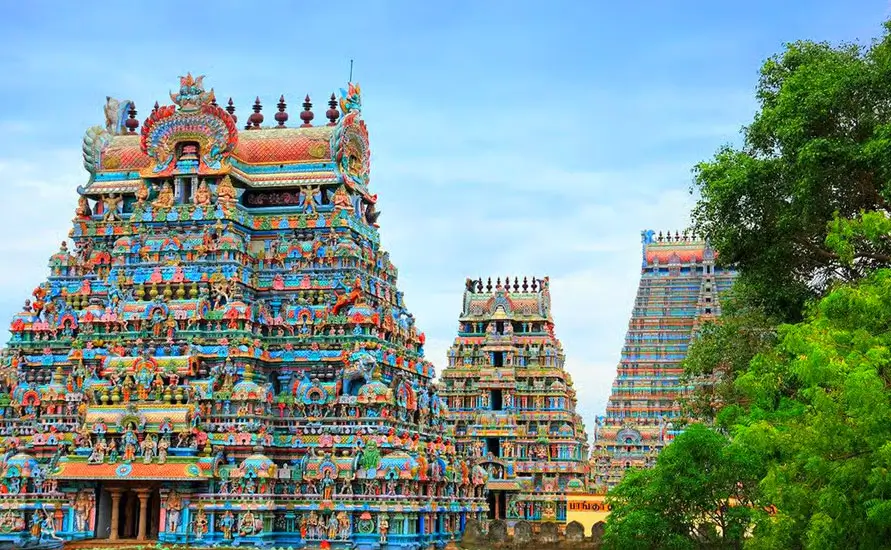
Arrive at the Meenakshi Amman Temple early, while the floors are cool and the crowds thin. Fourteen gopurams guard the complex, the tallest on the south side standing about 52 meters and painted with hundreds of figures from Hindu stories. Leave phones and cameras with the driver or at the deposit counter, because neither may be carried in. The first stop is the Golden Lotus Tank, which legend ties to the Tamil Sangam poets, whose compositions were judged on its waters, after which Hindu members of the family queue for darshan of the goddess and of Shiva as Sundareswarar. Temple rules keep the two inner sanctums closed to non-Hindus, who spend that time with the guide in the painted corridors.
Within the walls, a museum now fills the Thousand Pillar Hall, displaying of bronzes, ivory and painted cloth, and each of its carved columns shows a different figure from myth, from musicians to warriors on rearing horses. Near the eastern side the musical pillars give a different note when tapped. After lunch you rest, then drive to the Koodal Azhagar Temple, a Divya Desam of Vishnu whose tower carries three shrines stacked one above another, showing the god standing, seated and reclining. If time allows, the Gandhi Memorial Museum in a Nayak-era palace displays, among other relics, the simple cotton dhoti from his final day, still marked by that tragedy.
Families who want to see the Meenakshi Temple at night return at about 9 pm for the palliyarai ceremony, the closing ritual of the day. Priests lift the sacred sandals of Sundareswarar into a small silver palanquin and bear them to Meenakshi's chamber for the night, while drummers, nadaswaram players and lamp bearers walk ahead. Anyone may watch the procession from the corridors, and many find it the most moving moment of their stay in the city. You return to the hotel well before midnight, because tomorrow's road leads to the sea and an island temple. Overnight in Madurai.
Leaving after breakfast, the car runs south-east across dry, flat country of palmyra palms and thorn scrub through Manamadurai and Ramanathapuram, once the seat of the Sethupathi rulers who guarded the pilgrim route to the island. The last stretch reaches the coast at Mandapam, and then the road climbs onto the Pamban bridge, about 2.3 km of concrete over the sea. To one side runs the new vertical-lift railway bridge opened in 2025, with its lifting span for passing boats, beside the old cantilever bridge of 1914. Your driver can stop at the viewpoint so everyone can take photographs of the blue water below.
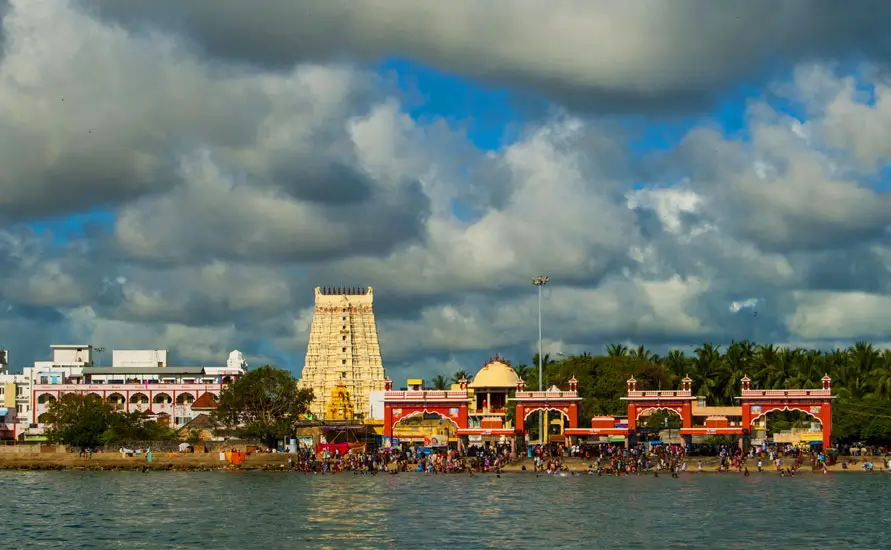
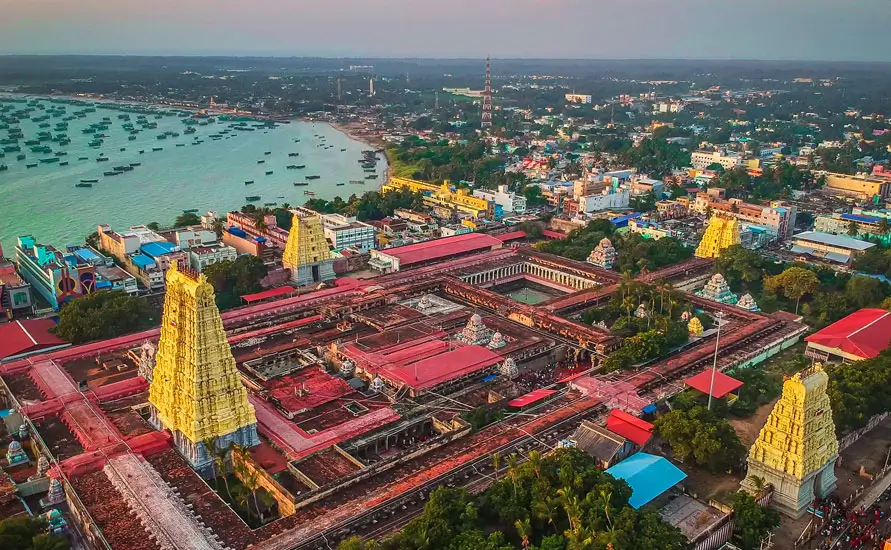
Rameswaram is an island town, and almost everything in it turns toward the Ramanathaswamy Temple. The Ramayana tells that Rama worshipped Shiva here after returning from Lanka, and the temple holds two lingams: one shaped by Sita from sand and another brought by Hanuman from the Himalayas, which by tradition is worshipped first. It is one of the twelve Jyotirlingas and one of the Char Dham, the four great pilgrimage seats of India. Many families from the north carry Ganga water to pour over the lingam here, then take sand from Rameswaram back home to Varanasi.
After check-in and a rest you walk to the temple in the early evening, when lamps line the famous corridors. Their rows of carved granite pillars run for well over a kilometer in all, and the outer third corridor, with roughly 1,200 pillars, is usually counted the longest of its kind in India. Your guide explains the routine for tomorrow's bath at the sacred wells and the dress rules, which are strictly enforced: full-length trousers or a veshti plus shirt for men, while women choose a saree or a salwar suit with dupatta. Only Hindus may enter the sanctum, while others can walk the corridors. Overnight in Rameswaram.
Devotees who wish to attend the spadika lingam darshan rise very early, around 5 am, when a crystal lingam is shown to pilgrims for a short time before the regular rituals begin. Afterward many walk to Agni Theertham, the shallow sea in front of the eastern gate, for a ritual dip, and then return to the temple for the bath at the 22 theerthams, wells within the complex said to hold water of different tastes. Temple attendants draw buckets from each one and pour them over your head in a fixed order. Wear clothes that can get soaked and bring a full change, since wet clothes are not allowed near the sanctum.
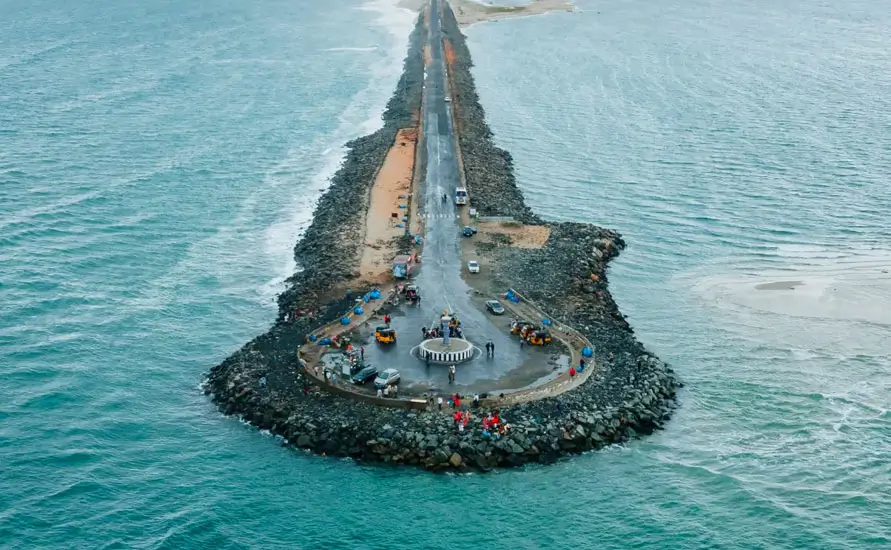
Dhanushkodi, roughly 20 km down the island, is next once breakfast is over. A town with a railway station, church, post office and pilgrim lodges stood here until the cyclone of December 1964 swept it away, and the broken walls still rise from the sand. A good road now continues to Arichal Munai, where the land shrinks to a spit of sand with the calm Gulf of Mannar on one side, the rougher Palk Strait waters on the other, and Sri Lanka only about 30 km beyond. Currents here are dangerous, so swimming is not allowed. Coming back, stop at the Kothandaramaswamy Temple, where tradition places Vibhishana's surrender to Rama.
Afternoon brings a visit to Peikarumbu, where a national memorial remembers Dr. APJ Abdul Kalam, the missile scientist and later President of India who was born on this island, and the small house museum near the mosque street where his family lived. Hindu families who have arranged ancestral rites with a priest may perform them at a quiet spot by the shore or in a hall near the temple, and your guide helps with the timing and the offerings. Before sunset you can return to the temple corridors or rest at the hotel, since tomorrow is the longest drive of the week. Overnight in Rameswaram.
An early start keeps the drive in the cooler hours. Once you are back across Pamban, the route turns south along the coastal highway through Ramanathapuram district, a quiet road with villages of fishermen and patches of thorny scrub where camels are sometimes seen grazing. Beyond Sayalgudi the salt pans begin, and by Thoothukudi, the old pearl-fishing port the Portuguese called Tuticorin, the air smells of the sea. Your driver plans two breaks for tea and a lunch stop in Thoothukudi, and the whole drive takes about five hours with stops, so you arrive at Tiruchendur in the early afternoon.
The Tiruchendur Murugan Temple, dedicated to Subramanya Swamy, stands right on the shore, and waves wash the steps in front of it. It is one of the Arupadai Veedu, the six abodes of Murugan, and the place where he is believed to have defeated the demon Surapadman. Each year in October or November, crowds fill the beach for the Soorasamharam reenactment at the climax of the Skanda Sashti festival. Close to the temple, the small Nazhi Kinaru well gives fresh water only a few steps from the salty sea, and pilgrims bathe there before darshan.
Darshan is planned for the late afternoon. Men usually remove their shirts before entering the inner areas, and women should wear a saree or salwar kameez. Mobile phones must be deposited outside; it was a case concerning this very temple that led the state's High Court to support a ban on phones in temples. Visitors who are not Hindu can watch the evening worship from the halls and walk along the shore. As the lamps are lit, the sound of the waves mixes with the chanting from the shrine, a fine end to the coastal day. Overnight in Tiruchendur.
Families who want one more darshan can attend the early-morning worship at Tiruchendur before breakfast. The drive south then follows a quiet road through red-earth country lined with palmyra palms, which local families tap for sweet sap and palm sugar, and past the wind turbines that crowd the hills near Kudankulam. By late morning the land narrows, the Western Ghats appear in the west, and you arrive at Kanyakumari, the point where mainland India ends. Once bags are in the room, walk with your guide to the Triveni Sangam, the rocky shelf where three bodies of water, the Arabian Sea, the Indian Ocean and the Bay of Bengal, are said to mingle.
The Kumari Amman Temple is dedicated to the goddess as a young virgin who waits on the shore for her marriage to Shiva. Her diamond nose ornament is said to shine so brightly that, in old stories, sailors mistook it for a lighthouse, which is why the eastern door toward the sea is kept closed except on special days. Men remove their shirts before entering, and the temple follows Kerala-style dress rules even though it lies in Tamil Nadu. Temple custom decides how far a non-Hindu visitor may go, and the guide checks the current practice at the gate.
Before sunset, visit the Gandhi Mandapam, built where Gandhi's ashes were kept for public viewing before they were scattered at sea, designed so that a beam of sunlight falls on one spot every 2 October. A short walk leads to the sunset point, where families gather on the rocks and the sky over the western sea turns orange and then purple. Because the cape faces both east and west, the sun both rises and sets over the sea here. Dinner can be a South Indian thali or fresh fish at a local restaurant. Overnight in Kanyakumari.
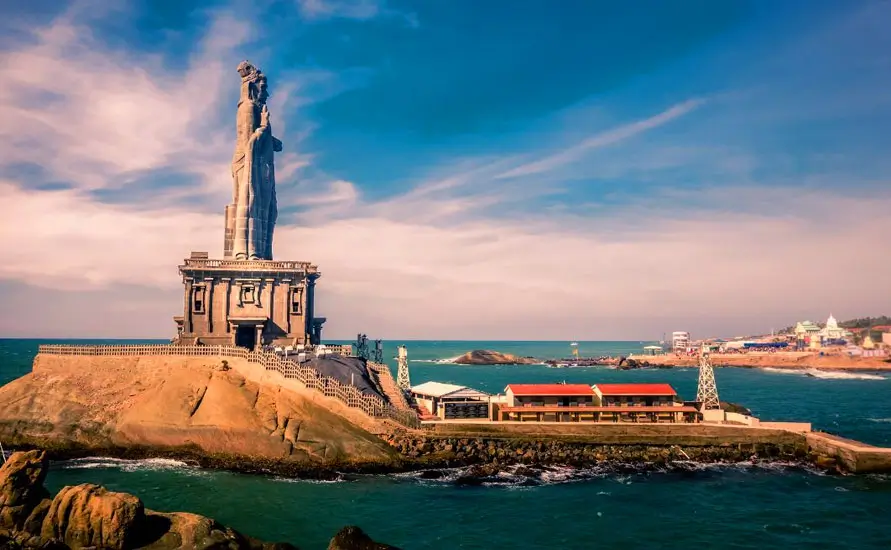
Wake before dawn to see the sun come up out of the ocean behind the rock memorials, and you will share the moment with crowds of pilgrims and honeymooners. Following breakfast, a state-run ferry carries you to the Vivekananda Rock Memorial, on the rock where, as the story goes, the young monk spent three days of meditation on this rock in December 1892 before setting out for the Parliament of Religions in Chicago. Beside it towers the Thiruvalluvar statue, whose 133-foot height echoes the number of chapters in the Tirukkural, and since December 2024 a glass-floored bridge has let visitors stroll between both islets above the waves. Ferry queues can be long, so we go early.
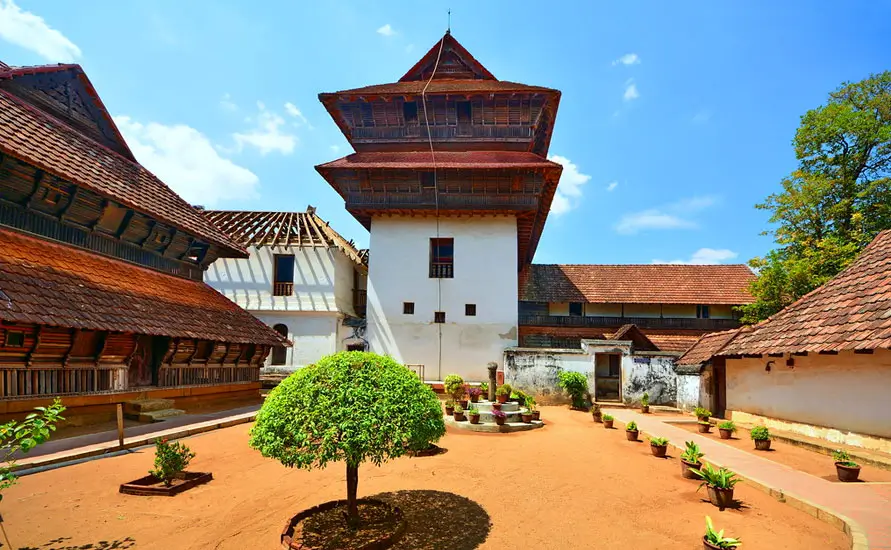
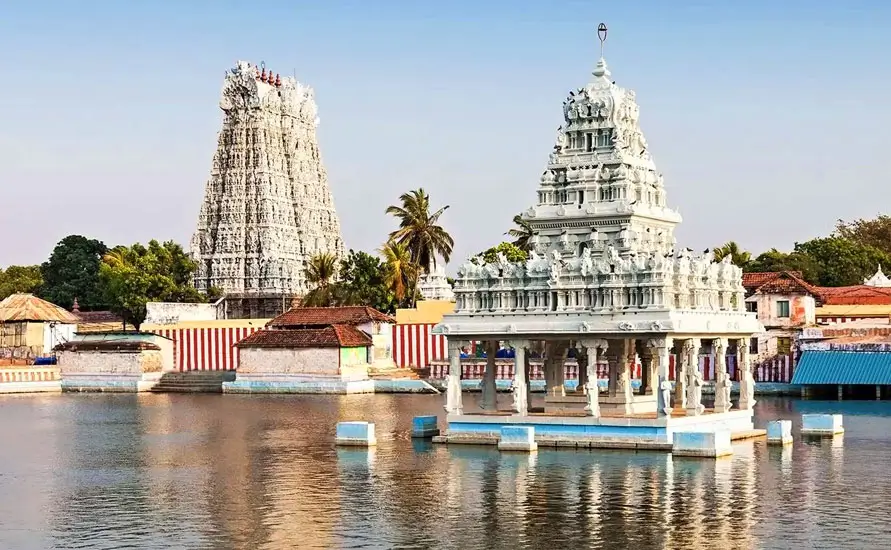
Driving north, you stop at Suchindram, where the Thanumalayan Swamy Temple worships the trinity, Shiva, Vishnu and Brahma, in the form of one lingam. Its halls hold musical pillars carved from single stones and an 18-foot statue of Hanuman, and male visitors go in bare-chested, following Kerala custom. Next comes the Padmanabhapuram Palace at Thuckalay, once the seat of the Travancore rulers and built almost entirely of timber, with carved rosewood ceilings, windows of colored mica and a polished floor said to be made with egg white, lime and coconut. Because it is closed every Monday, we shift your dates or replace it with a stop at a quiet beach if needed.
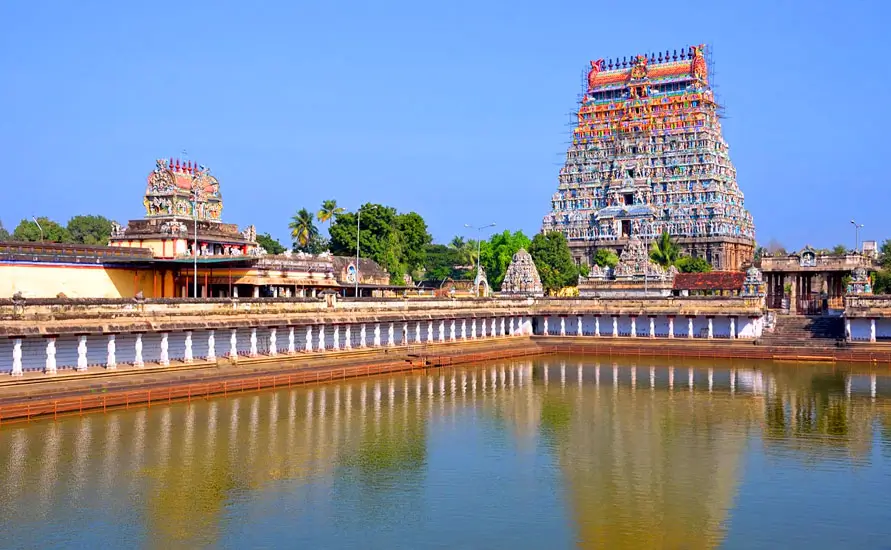
The road crosses into Kerala and reaches Trivandrum, also known as Thiruvananthapuram, by late afternoon. In the evening a short stroll near the East Fort leads around the stepped tank and gopuram of the Sri Padmanabhaswamy Temple, so that you know the way for tomorrow morning. Non-Hindu guests can visit the Kuthiramalika Palace Museum next to the temple, whose upper floors have 122 carved wooden horses supporting the eaves. Small shops in the lanes around the tank sell or rent the mundu and other clothing the temple requires, and your guide can help everyone choose the right size this evening so there is no rush at dawn. Overnight in Trivandrum.
Hindu members of the family visit the Sri Padmanabhaswamy Temple at the first darshan of the morning, when Vishnu, resting on the coiled serpent Anantha, is seen in parts through three separate doorways: first the head and hand, then the navel with Brahma on a lotus, and last the feet. Temple authorities enforce the clothing rules firmly: men go shirtless in a mundu, and women wear a saree or long skirt with a blouse. Phones and cameras are not allowed, and non-Hindus may not enter. Guests who do not go in can enjoy a calm breakfast or a visit to the Napier Museum garden.
Your last ride is short, to Trivandrum International Airport, which is only fifteen to twenty minutes from the temple area and has direct flights to the Gulf, Colombo and Singapore and domestic links to Bengaluru, Chennai, Delhi and Mumbai. Long-haul passengers reach the check-in hall a comfortable three hours ahead. Over eight days you have walked the corridors of Rameswaram, prayed at Murugan's seaside abode and stood where three seas meet. Extra nights at Varkala or Kovalam can be added to the end if you wish to rest by the sea.
Your Journey

N.S. Rathore & Mrs. Omlata Rathore · Managing Director
We still read every enquiry ourselves. Tell us the places you liked and our planners will send a day-by-day route with drive times and a clear price.
Every package can be customised and no pressure to book. A planner from our office replies within 24 hours with a route written for your group.
Fill this in and your planner will send a first draft itinerary.
Explore more
Kerala Backwaters Escape Kerala Backwaters Escape
 Kerala Backwaters Escape
 Kerala Backwaters Escape
 Kerala Backwaters Escape
 Kerala Backwaters Escape
 Kerala Backwaters Escape
 Kerala Backwaters Escape
 Kerala Backwaters Escape
 Kerala Backwaters Escape
 Kerala Backwaters Escape
 Kerala Backwaters Escape
 Kerala Backwaters Escape
 Kerala Backwaters Escape
 Kerala Backwaters Escape
 Kerala Backwaters Escape
 Kerala Backwaters Escape
 Kerala Backwaters Escape