 Kerala Backwaters Escape

Religious & Heritage Tour Of South India
Chennai (Kalakshetra) – Cholamandal – Mahabalipuram – Chidambaram – Gangaikonda Cholapuram – Darasuram – Tanjore – Trichy – Flight to Kochi – Thrissur (Kerala Kalamandalam) – Irinjalakuda – Kochi (Kathakali)
At a glance
Shiva as Nataraja, the cosmic dancer, is cast in bronze, carved on temple towers and danced on stage every evening somewhere in Tamil Nadu and Kerala. Our Classical Dance and Arts Heritage Tour traces that living line from source to performance. You sit in on Bharatanatyam training at Kalakshetra in Chennai, study the Pallava reliefs of Mahabalipuram, read the 108 dance poses carved on the gateways of the Chidambaram Nataraja Temple, and stand under the Chola towers of Tanjore before crossing to Kerala for Kerala Kalamandalam, Koodiyattam and an evening of Kathakali in Kochi.
Thirteen days give the trip room to breathe. Three nights in Chennai, two each in Mahabalipuram, Tanjore, Thrissur and Kochi, and one in the temple town of Chidambaram mean you are rarely in the car for more than four hours. A connecting domestic flight from Trichy to Kochi replaces the long cross-country road. Throughout, a chauffeured air-conditioned car stays at your disposal, and guides with a background in music, dance or art history lead the main visits, translating teachers' explanations so you can follow the finer points.
This South India classical dance tour is planned for dancers, music students, theater lovers and gallery-goers based in the Americas, the UK, continental Europe or Oceania, as well as NRI parents whose children learn Bharatanatyam or Carnatic music abroad. December and January bring the Chennai music and dance season and the Mamallapuram Dance Festival, while February or March may coincide with Natyanjali in Chidambaram. School visits depend on teaching calendars, so we confirm each one before you fly. Temple rules on dress, photography and non-Hindu entry differ from site to site, and each day notes what applies.
Whatever hour your plane touches down, someone from our Chennai desk will be waiting beyond the arrivals barrier, card in hand. Your chauffeur loads the bags, offers a cold bottle of water and sets off for your hotel, normally a forty-minute ride outside rush hour. Overnight arrivals from Europe and the Gulf are common, so the hotel holds your room for an early check-in when booked ahead, and the morning stays free. Before you rest, our tour manager runs through the dance-school appointments for the coming fortnight and the etiquette for watching classes in progress.
Chennai has more performing-arts halls per square kilometer than almost any city in India, and many are run by sabhas, small cultural societies that book Bharatanatyam and Carnatic concerts across the year. In the late afternoon your guide, a trained vocalist, meets you at the hotel and drives with you to Mylapore, where several of these halls sit within walking distance of one another. On the way she explains the difference between a varnam, a padam and a tillana, the pieces you are likely to hear, and why a dancer's ankle bells are tied on only after a short prayer.
Depending on the calendar, the evening brings a full recital, a student debut or a music concert in one of these halls, with seats arranged through our team. December and early January are the peak months, when the city hosts hundreds of performances, but most weeks of the cooler season offer something worth seeing. Before the program starts there is time to walk past the gopuram of the Kapaleeshwarar Temple, lit up at dusk, and to share a plate of crisp dosa at a canteen inside the sabha, a much-loved part of the season. Your chauffeur collects you at the hall door once the last piece ends. Overnight in Chennai.
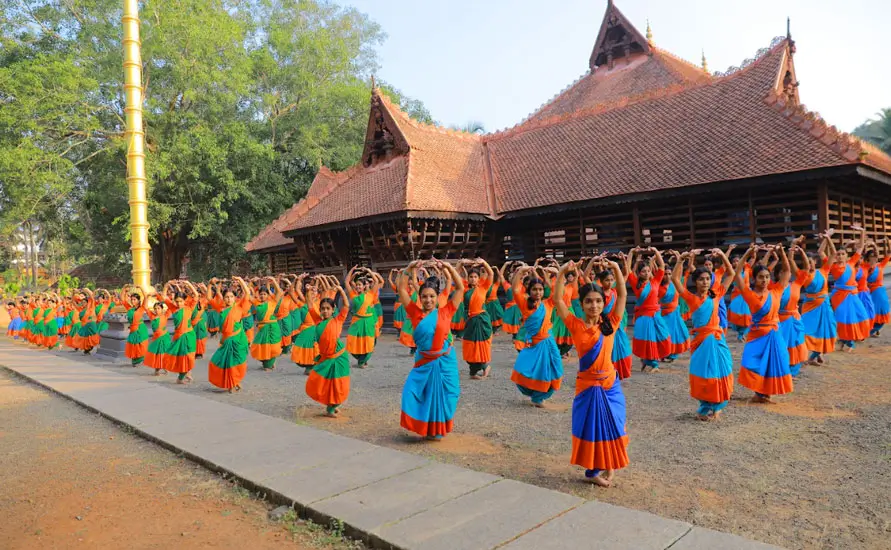
Rukmini Devi Arundale, a dancer and theosophist who helped restore the standing of Bharatanatyam in the 1930s, founded Kalakshetra in 1936. The present campus lies among casuarina and banyan trees at Thiruvanmiyur, close to the sea, and teaching still follows a gurukula pattern in open-sided halls. Your Kalakshetra visit is arranged through the foundation in advance, so a staff member or senior student meets you at the gate. Guests usually sit quietly at one side of the hall, where young dancers repeat adavus, the basic steps, to the beat of a wooden stick on a block, while a teacher corrects the angle of a wrist or the line of a bent knee.
Visitors keep voices low, cover shoulders and knees, and take pictures only with staff permission. Between classes you walk to the Craft Education and Research Centre, where artisans weave saris with temple borders on handlooms and print kalamkari cloth, and your guide shares photographs of costumes and stage designs from Rukmini Devi's dance dramas. Your guide explains how she brought together Sanskrit scholars, musicians and set designers to create a new repertoire, and why the Kalakshetra style is recognized for its clean lines and geometric precision. Classes pause during holidays and exam weeks, and we plan your date around the published calendar.
After lunch you drive to the Theosophical Society in Adyar, where Rukmini Devi grew up in the circle of Annie Besant. Its gardens hold a giant banyan tree, shrines of several faiths and a library, and the grounds are open to visitors at set hours, usually closed on Sundays. The contrast between the quiet estate and the traffic of the city outside is striking. Later on, choose between a siesta and a call on a costume tailor in Mylapore who stitches Bharatanatyam outfits with pleated fans and temple jewelry. Dancers in the group often place an order for a costume to be finished before departure. Overnight in Chennai.
At the Government Museum in Egmore the morning is spent in front of Nataraja himself. The bronze gallery displays several Chola-period images of the dancing Shiva, each with one foot pressing on a dwarf that stands for ignorance, the other leg raised, and a ring of flames around the figure. Your guide explains the meaning of every hand, from the drum that marks the rhythm of creation to the fire that ends it, and shows how a dancer recreates this pose on stage. The galleries also hold Amaravati Buddhist sculpture and a section of musical instruments. The museum does not open on Fridays, so we schedule around that day.
Late morning brings a visit to the Music Academy area on TTK Road, home to one of the most respected stages of the December season. If a lecture or morning performance is scheduled, you can attend; at other times your guide outlines how the season grew from a small conference in 1927 into a festival that now draws listeners from across the world. Close by, you meet a maker of Carnatic instruments such as the mridangam drum and the tambura, who shows how the drumheads are layered with a paste of cooked rice and iron filings to create their ringing tone. Lunch is a simple meal of rice and sambar on a steel plate.
The afternoon is free for rest before the evening, when we arrange either a second recital or a private interaction with a Bharatanatyam teacher at her home studio. The latter is especially valued by visiting students, because the teacher can explain the abhinaya, or expressive side of the dance, in English, and show how a single line of poetry can be danced in several ways. Families with young dancers sometimes book a short private class for the children. Dinner is at a Chettinad restaurant in the city, where the cooks use black pepper, star anise and dried red chili generously. Overnight in Chennai.
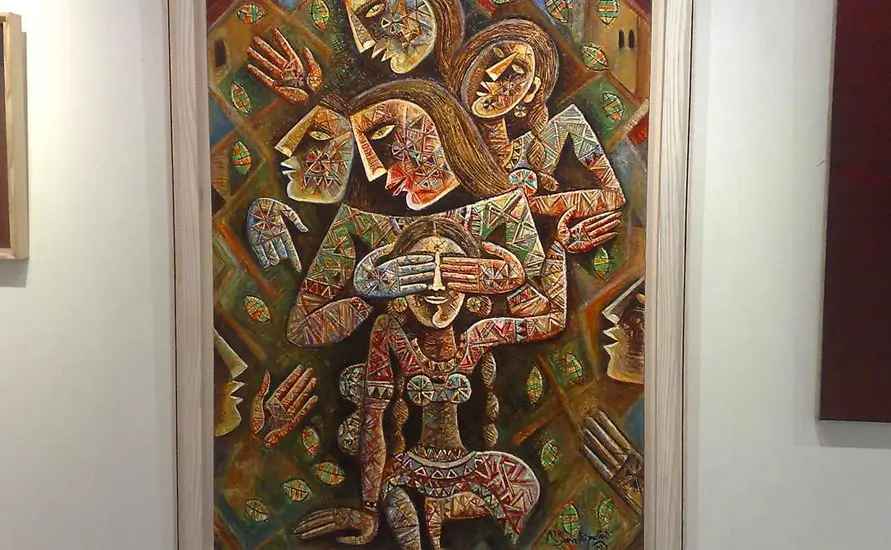
Twenty-five kilometers down the coastal highway, the first stop is Cholamandal Artists' Village at Injambakkam, a cooperative set up in 1966 by painters from the Madras Art Movement. Artists still live and work in its houses, and the gallery shows paintings, metal sculpture and prints by members across several generations. Your guide explains how this group tried to build a modern Indian visual language using temple drawing, folk patterns and calligraphy rather than copying European schools. Some studios open to visitors when the artist is at home, and conversation flows easily over a cup of tea. Works are sold directly at fixed prices.
By early afternoon you reach Mahabalipuram, the port of the Pallava kings, and settle into rooms facing the sea. After a rest, your guide leads you through the stone carvers' lanes that line the main road. Here, families shape granite and soapstone into gods, dancers and animals with chisels and electric grinders, plenty of whom learned their trade at the state-run sculpture college a short walk away. They work to traditional measurement systems, in which the face of a deity is divided into set units, and a master carver can explain how a figure's proportions are fixed before the first blow. Small soapstone pieces travel well in a suitcase.
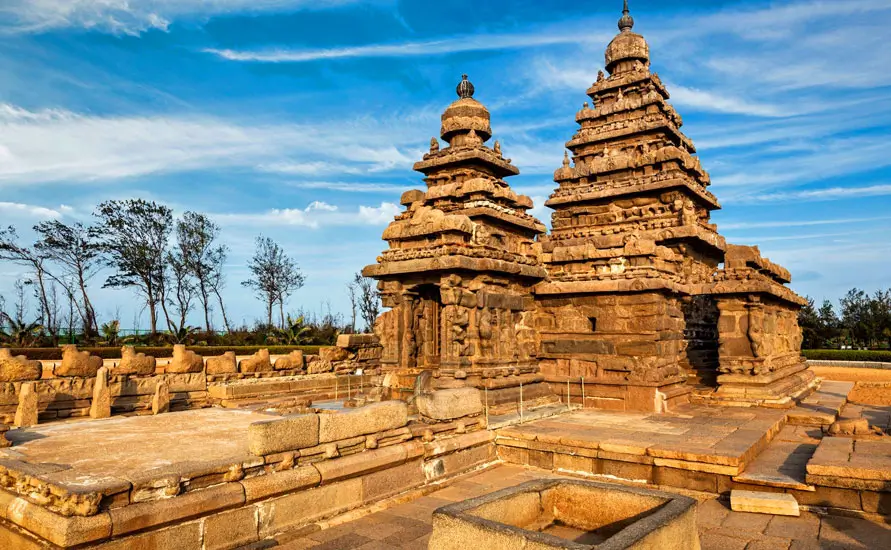
Toward sunset you walk to the Shore Temple, two 8th-century granite towers standing almost in the surf, and watch the light turn the weathered stone gold. If you visit between late December and January, the Mamallapuram Dance Festival may be running, with Bharatanatyam, Kuchipudi, Odissi and Kathakali performed on an open-air stage set against carved rock. Programs and dates are announced each year by the Tamil Nadu tourism department, and we book seats when the schedule allows. Otherwise the evening is free for a grilled fish supper on the beach front, where the restaurants put tables on the sand. Overnight in Mahabalipuram.
Early light is the best time to read the reliefs, and the day begins at Arjuna's Penance, the great open-air carving on two boulders. Look closely at the celestial couples flying toward the central cleft and you can see how Pallava sculptors gave the body the same flexed knees and turned hips that dancers still use. Your guide connects these poses to terms from the Natya Shastra, the ancient Sanskrit text on drama and dance. Steps away, the Krishna Mandapam relief has the young god holding a mountain over his village like an umbrella, with cowherds, a woman carrying pots and a cow licking its calf below, a scene often danced in Bharatanatyam items about the child god.
Around ten o'clock you reach the Pancha Rathas, where five chariot-shaped shrines bearing the names of the Pandava brothers and Draupadi were cut from one sloping outcrop, with a life-size elephant standing beside them. Roof forms vary from shrine to shrine, and together they work like a sample book of early South Indian architecture. Your guide then takes you into a rock-cut cave, the Mahishasuramardini Mandapam, where the goddess Durga rides into battle on a lion on one wall while Vishnu reclines on the serpent on the other. UNESCO bundles these with dozens of smaller carvings under the Group of Monuments at Mahabalipuram listing, and your guide chooses those that relate most to music and dance.
The afternoon is unhurried. You might return to a carving workshop to order a small Nataraja figure, stroll the sand near the fishing hamlet, or book an optional Ayurvedic massage at the hotel. Before dinner, drive a few minutes north to Saluvankuppam, where the Tiger Cave shelters a small Pallava shrine behind a ring of carved lion heads, very peaceful in the last hour of daylight. Your guide uses the evening to prepare you for tomorrow's drive to Chidambaram, with a short reading from the Tamil hymns of the Nayanmar saints who sang about the dancing Shiva in his temple there. Overnight in Mahabalipuram.
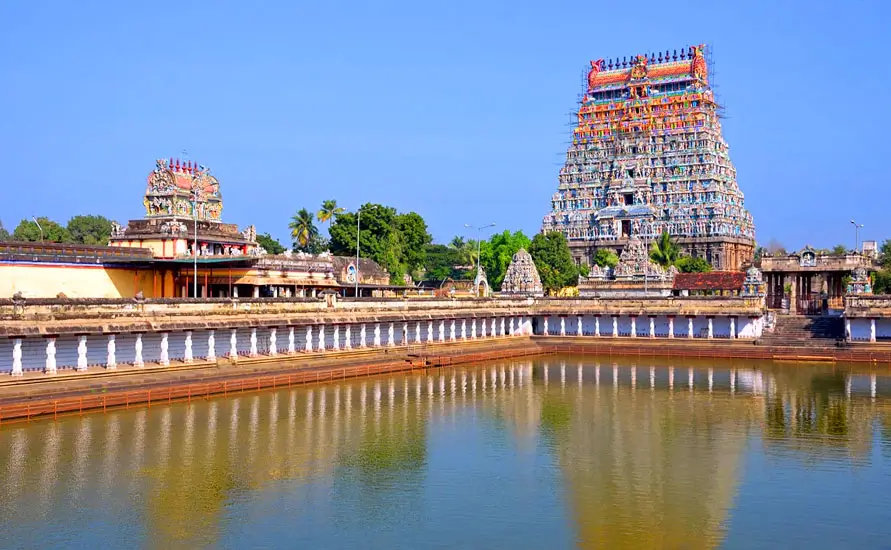
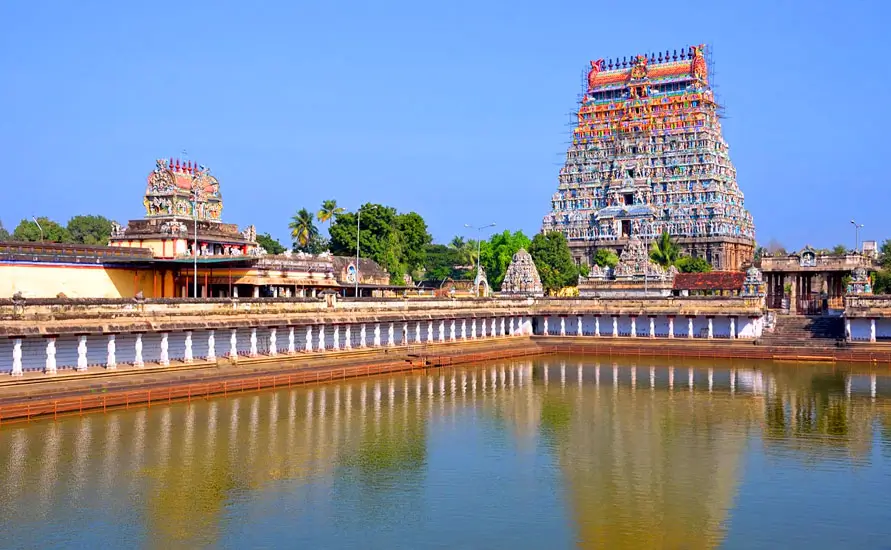
Leaving after breakfast, you roll south past Pondicherry between shrimp ponds, cashew orchards and coconut-thatched hamlets, and stop for coffee in the Union Territory before turning inland toward Chidambaram. For Tamil Shaivites the town is simply Koyil, the temple, because its shrine to Nataraja, lord of dance, ranks first among their holy places. It is also one of the Pancha Bhoota Sthalams, the five temples of the elements, in which Chidambaram stands for space. You check in to a simple hotel near the temple and rest through the hottest hours of the day.
In the late afternoon you enter the Chidambaram Nataraja Temple, which covers about 40 acres and is managed by a hereditary community of priests called the Dikshitars. The tour begins under the eastern gopuram, where the 108 karanas, the movement units listed in Bharata's treatise on performance, are carved in small panels along the passage walls, many labeled with the matching Sanskrit verse in Grantha script. Dancers in the group often try to match the poses on the spot. Inside, the gold-roofed Chit Sabha houses the bronze Nataraja, and next to it is the empty space known as the Chidambara Rahasyam, representing the formless aspect of the god.
Rules for visitors are set by the temple: shoes stay outside, modest clothing is expected, and male visitors are sometimes told to go bare-chested near the inner hall. Non-Hindu guests can usually see most of the complex, but the priests decide which areas may be entered on a given day. Photography is restricted indoors. In the evening you can watch the night puja, when flames are circled before Nataraja while drummers and nadaswaram players fill the hall. Around Mahashivratri in February or March, the Natyanjali festival sees dancers of many styles offer their art inside the temple precincts over several nights. Overnight in Chidambaram.
About an hour west of Chidambaram stands Gangaikonda Cholapuram, which Rajendra Chola I made his capital after his northern campaign reached the Ganges in the 1020s. The capital he founded has vanished, but the temple remains, its tower gently concave in profile and a little shorter than his father's at Tanjore. Among the carvings, your guide shows you a Nataraja panel and the famous scene of Shiva garlanding the devotee Chandesha. The grounds are spacious and usually quiet, so you have time to sketch or photograph. UNESCO added it in 2004 to the Great Living Chola Temples listing.
Continuing south-west across the Kaveri delta, you reach Darasuram near Kumbakonam for the 12th-century Airavatesvara Temple, whose stone plinth is covered in miniature panels of musicians and dancers. Some of the figures are no larger than a matchbox, yet each shows a clear posture, a drum or a flute, and art historians use them to study the instruments of the Chola court. If time allows, your driver can make a brief detour to Swamimalai, where families cast bronze Natarajas by the lost-wax method, so you can see a wax model take shape. Lunch is at a restaurant near Kumbakonam serving a traditional Tamil meal.
You arrive in Tanjore in the late afternoon. This was the court where, in the early 19th century, four brothers known as the Tanjore Quartet arranged the order of items that still forms a Bharatanatyam recital, from the opening alarippu to the closing tillana. Their patron, the Maratha king Serfoji II, also supported Western music and printing, and Tanjore became a meeting point for many art forms. In the evening, your guide arranges a private lecture-demonstration with a local Bharatanatyam dancer, who performs short pieces and explains how the Quartet's compositions are still taught today. Overnight in Tanjore.
Morning sun falls directly on the granite tower of the Brihadeeswarar Temple, consecrated in 1010 as the crowning work of Rajaraja Chola I and the first of the three Chola sites on the World Heritage roll. The vimana above the sanctum reaches about 66 meters, and inscriptions around the base record the names of hundreds of dancers, musicians and craftsmen who served the temple a thousand years ago. Your guide explains that the inner passage around the sanctum holds 81 carved karana poses and rare Chola wall paintings, an area generally closed to the public, and shows photographs so you can picture what lies behind the walls.
By eleven you are inside the Thanjavur Palace, a maze of courtyards, an armory tower and audience halls raised by the Nayaks and greatly extended once the Marathas took over. Its art gallery lines up dozens of Chola metal icons, including several Natarajas and images of the poet-saints, while the Saraswathi Mahal Library displays palm-leaf manuscripts on music, dance and medicine. Next you visit a workshop making the Thanjavur veena, where a single block of jackwood is carved into the hollow body and neck, then fitted with brass frets set in wax. The maker usually plays a short raga to show the instrument's voice.
The afternoon is set aside for a Tanjore painting studio, where painters model jewelry in relief with chalk paste before pressing on gold leaf and setting glass stones, and for a visit to the Schwartz Church, built in the late 18th century and linked to the Danish and German missionaries who taught at the Maratha court. After dark, consider a second look at the Brihadeeswarar Temple, when the granite glows under floodlights and families gather on the lawns. Alternatively your guide can recommend a concert at one of the small music halls in town, where Carnatic music is often performed in the evenings. Overnight in Tanjore.
Breakfast is followed by the 60 km run to Trichy airport, roughly ninety minutes away. There is no direct air service from Trichy to Kochi, so our team books a one-stop routing through Chennai or Bangalore and choose the shortest available routing for your date. Door to door, expect most of the day, layover included. If your morning allows, the driver can make a quick stop at the Rock Fort Temple in Trichy for a view over the Kaveri, though most guests prefer to keep the morning calm before the flight.
Kerala staff greet you at the Nedumbassery terminal for the northbound drive of about 55 km to Thrissur, past rubber plantations, church spires and flooded paddy. Thrissur is known as the cultural capital of Kerala and is home to the Kerala Sangeetha Nataka Akademi, which supports music, dance and theater across the state. The remaining hours of the evening belong to you, and dinner can include Kerala dishes such as avial, olan and pal payasam. Overnight in Thrissur.
An early start brings you to Kerala Kalamandalam, beside the wide, sandy Nila (Bharathapuzha) at Cheruthuruthy. The poet Vallathol Narayana Menon set it up in 1930, at a time when Kathakali was losing royal patrons, and it is now a deemed university. Students live on campus and start training at dawn. On weekday mornings visitors can watch classes in Kathakali, Mohiniyattam, Koodiyattam, Thullal and percussion, held in traditional thatched or tiled halls. We arrange the visit in advance and plan it from Monday to Friday, because classes are not held on weekends and holidays.
Watching a Kathakali class reveals how demanding the art is. Students practice eye exercises, rolling their eyes in circles and figures of eight while a teacher keeps time on a wooden block, then work on the hand gestures that make up the language of the dance. In the Mohiniyattam hall, by contrast, the movements are soft and swaying, inspired by the motion of palm leaves in the wind. You also see the Koothambalam, a performance hall built in the style of a Kerala temple theater, with carved wooden pillars and a raised stage. Your guide explains each art form so you can compare them.
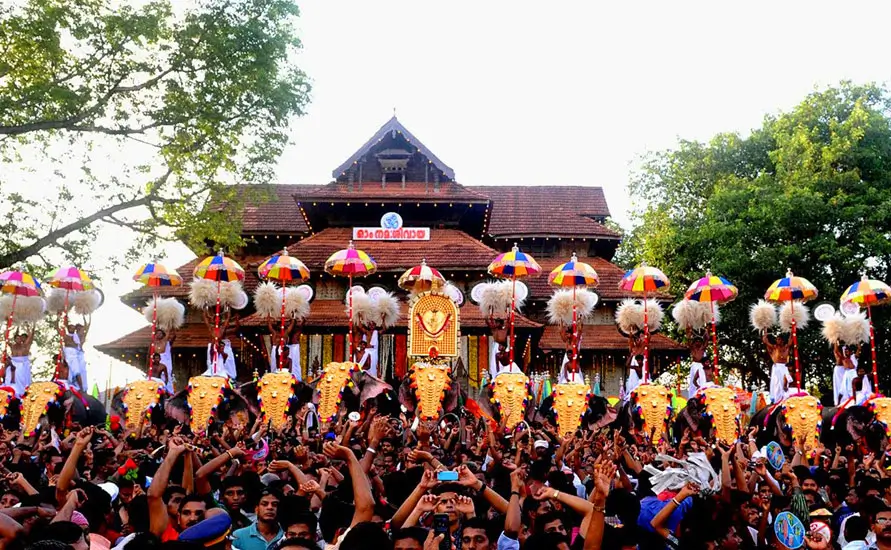
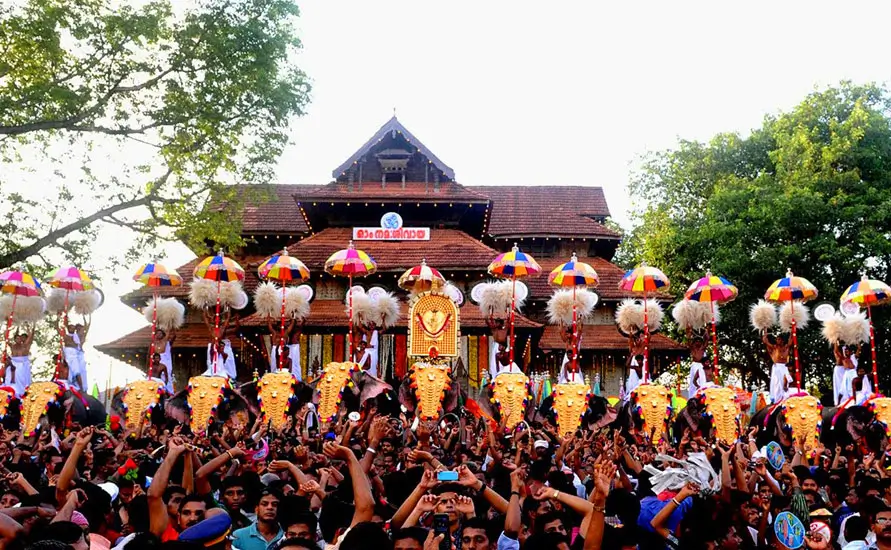
After lunch you return to Thrissur and visit the open ground of the Thekkinkadu Maidan, which surrounds the Vadakkunnathan Temple. Temple custom keeps the shrine itself for Hindu devotees, yet anyone may circle the laterite walls and look up at the four gopurams; each April or May this same ground fills for Thrissur Pooram, with caparisoned elephants facing each other and hours of chenda drumming. Visitors watch from the crowd, and we never arrange close contact with the animals. After dinner, check the Kerala Sangeetha Nataka Akademi listings, as its hall often stages evening programs. Overnight in Thrissur.
About 20 km south of Thrissur lies Irinjalakuda, a small town known for its Koodiyattam gurukulams. Koodiyattam is a form of Sanskrit theater performed in Kerala temples for centuries and recognized by UNESCO as part of humanity's intangible heritage. At a teaching center arranged by us, an actor in partial costume shows how a single line of a play can be stretched over an hour of eye movements, gestures and breath control, accompanied by the mizhavu, a large copper drum. The gurukulam teachers often welcome questions, and the session is held in a small hall with oil lamps on the stage.
Close to the gurukulam rises the Koodalmanikyam Temple, sacred to Bharata, Rama's loyal younger brother, a dedication seldom found elsewhere, and its ten-day utsavam in the Malayalam month of Medam pulls in pilgrims by the thousand. Entry is for Hindus only, but the outer walls and the large tank can be seen from the road. You then continue south to Kochi, around 60 km by road, crossing the Periyar and the busy suburbs of Ernakulam before reaching the old port of Fort Kochi. Hotel check-in is followed by a short break ahead of the evening, which is devoted to Kerala's most famous theater art.
Around five you walk to an intimate Fort Kochi playhouse for Kathakali, arriving early to watch the actors get ready: they grind their own pigments from stone and mix them with coconut oil, and the green face of a noble hero is framed by the chutti, a ridged white border once built up from rice paste and now often cut from paper, which takes the longest to finish. A short introduction explains the main gestures, and the play runs close to ninety minutes, telling an episode from the Mahabharata. Dinner afterwards can be at a seafood place along Princess Street. Overnight in Kochi.
Kerala's theater arts come together in the Kerala Folklore Museum at Thevara, where a timber mansion of three stories displays masks, costumes, musical instruments and stage props from Theyyam, Kathakali, Padayani and other ritual forms. The building itself was put together from the timber of old Kerala homes and temples, and an upstairs auditorium hosts occasional shows. Your guide explains how many of these forms began as offerings in temples and village shrines. In the late morning you visit the Mattancherry Palace whose bedchamber walls carry Ramayana and Krishna murals in mineral and vegetable pigments. The palace is closed on Fridays.
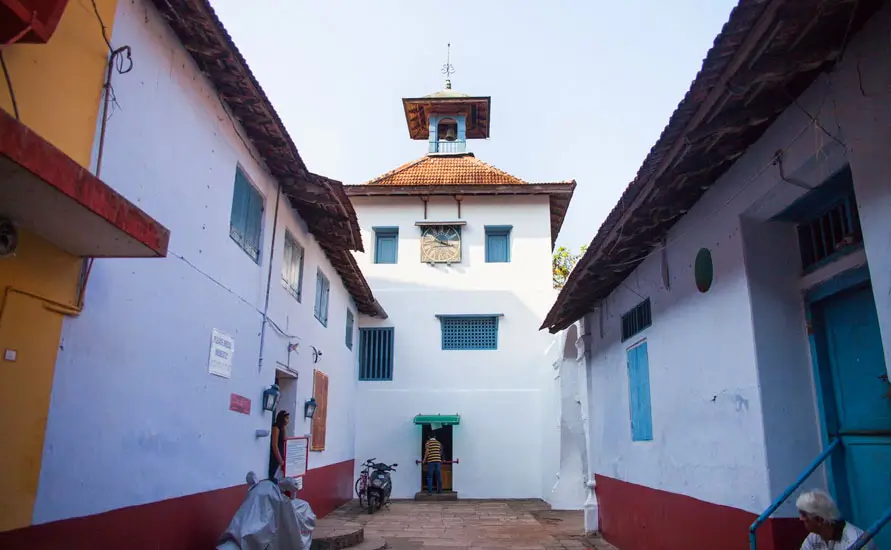
Lunch is in Fort Kochi, after which you have time to walk the lanes of Jew Town and visit galleries showing contemporary Indian art. During the months when the Kochi-Muziris Biennale is on, usually from December into March, many of its venues are in old warehouses along the waterfront, and your guide can help you choose which to visit. Jewish visitors and art lovers alike linger at the Paradesi Synagogue of 1568, paved in hand-painted porcelain from Canton, though Friday, Saturday and Jewish festival closures mean we check it against your dates. By three you are back in your room for a rest before the final evening.
Your last performance is Kalaripayattu, Kerala's martial art, which many historians link to the training of Kathakali performers. Inside a sunken training pit, the traditional kalari, practitioners show flying kicks, crouching lunges and sparring with staffs, daggers and shields, showing the same flexibility that Kathakali actors build in their training. Afterwards there is time for a farewell dinner, with dishes such as karimeen pollichathu, a fish grilled in banana leaf, and appam with vegetable stew. Your guide can also suggest a Mohiniyattam recital if one is being held in the city that evening. Overnight in Kochi.
Your final morning is unhurried, and if you bought costumes, instruments or bronzes, your guide can help arrange careful wrapping or courier shipping. Fort Kochi to Cochin International Airport is a 60-to-90-minute ride, and pickup is timed for you to queue at the airline counter roughly three hours before wheels-up. If you leave close to midnight, a day room or an extra night on the sand at Marari or Cherai is available for a supplement.
Over thirteen days you have followed the dance of Shiva from a Chola bronze in Chennai to the karana panels of Chidambaram and the painted faces of Kathakali in Kochi, with time in the classrooms where these arts are taught today. Many guests return for the December season in Chennai or a Theyyam trip to North Kerala, and our team is glad to shape that next visit. Safe travels home.
Your Journey

N.S. Rathore & Mrs. Omlata Rathore · Managing Director
We still read every enquiry ourselves. Tell us the places you liked and our planners will send a day-by-day route with drive times and a clear price.
Every package can be customised and no pressure to book. A planner from our office replies within 24 hours with a route written for your group.
Fill this in and your planner will send a first draft itinerary.
Explore more
Kerala Backwaters Escape Kerala Backwaters Escape
 Kerala Backwaters Escape
 Kerala Backwaters Escape
 Kerala Backwaters Escape
 Kerala Backwaters Escape
 Kerala Backwaters Escape
 Kerala Backwaters Escape
 Kerala Backwaters Escape
 Kerala Backwaters Escape
 Kerala Backwaters Escape
 Kerala Backwaters Escape
 Kerala Backwaters Escape
 Kerala Backwaters Escape
 Kerala Backwaters Escape
 Kerala Backwaters Escape
 Kerala Backwaters Escape
 Kerala Backwaters Escape