 Kerala Backwaters Escape

Religious & Heritage Tour Of South India
Kochi – Guruvayur – Thrissur – Ettumanoor – Aranmula – Trivandrum (Padmanabhaswamy)
At a glance
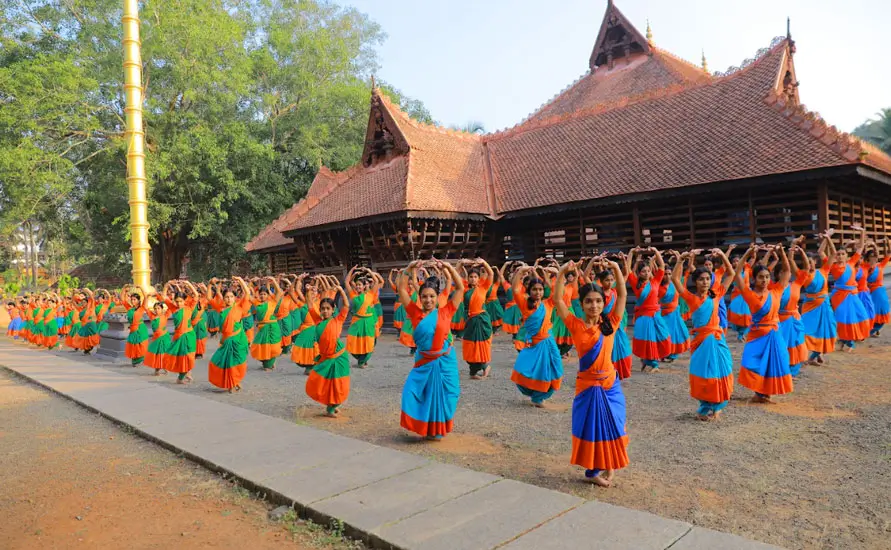
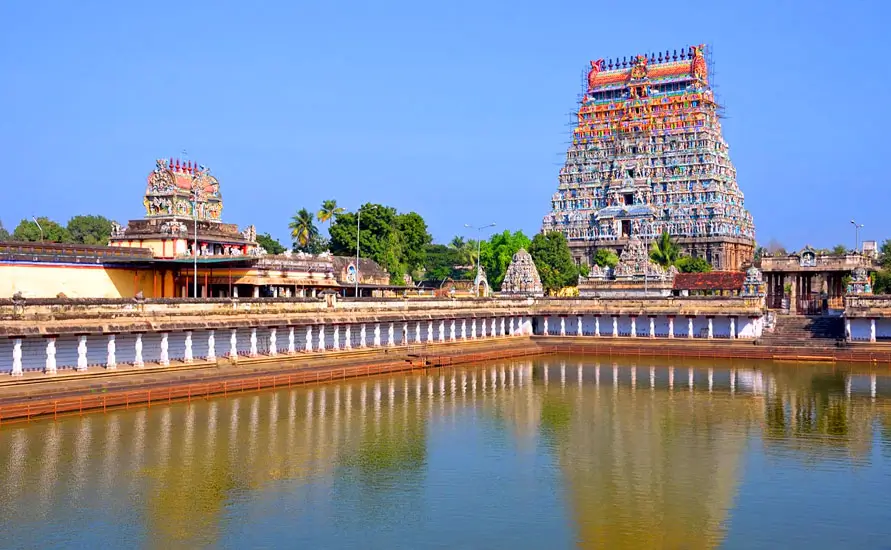
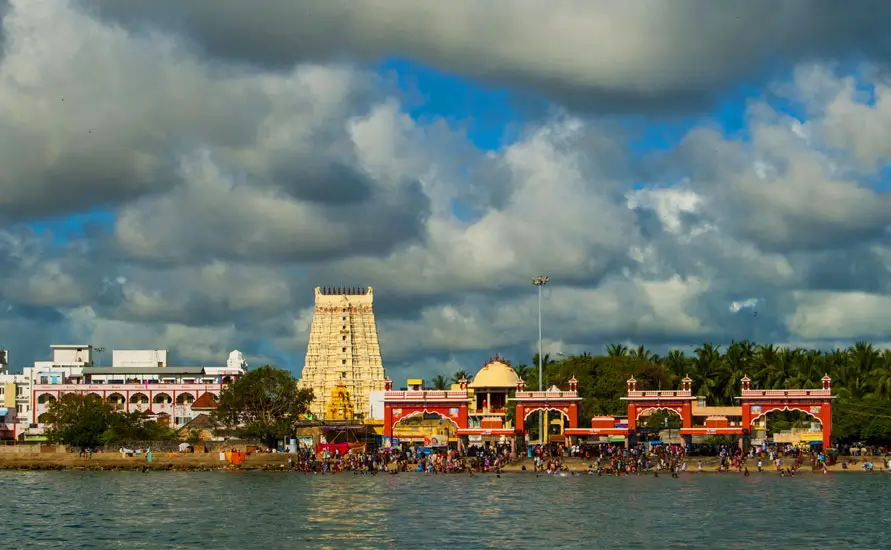
Kerala's temples rarely look like the towering stone gopurams of Tamil Nadu. Copper-clad roofs slope low over wooden shrines, oil lamps line the outer walls by the hundred, and festivals spill out into the streets with chenda drums, tall parasols and caparisoned elephants. Our Kerala temple tour follows this distinctive tradition from Kochi north to Guruvayur and Thrissur, then south through Ettumanoor and the riverside shrine of Aranmula to the Padmanabhaswamy temple Trivandrum, the richest and among the most guarded sanctuaries in the country.
Ten days and six bases keep each drive between one and four hours, which leaves mornings free for the dawn rituals that matter most in Kerala worship. You ride in a reserved, cooled sedan whose English-fluent chauffeur stays with the group throughout, and local guides who grew up around these temples translate the rituals, drumming styles and festival customs into plain language. Kalamandalam, the state's great school of classical arts, and a sacred-feast tradition at Aranmula add the music and food that belong to temple life here.
Our Kerala temple festivals tour suits Hindu travelers and NRI families as well as foreign visitors keen on ritual, music and architecture. Please note that most major Kerala temples, including Guruvayur, Vadakkunnathan, Ettumanoor and Padmanabhaswamy, admit only Hindus inside; your guide always shows non-Hindu guests what can be seen from outside, at festivals and in nearby museums. Festival dates follow the Malayalam calendar, so tell us your travel window and we will match it to Thrissur Pooram, the Ettumanoor festival, the Aranmula Vallasadya season or Attukal Pongala.
Expect a warm, humid welcome on the curb outside Cochin International Airport, where our coordinator greets you by name and loads the bags while you adjust to the tropical air. Instead of heading to Fort Kochi, today the car turns toward Ernakulam and the old royal suburb of Tripunithura, about an hour's drive, close to where you stay for two nights. Flights touching down before sunrise are no problem, because we pay for the previous night and your bed waits. A late lunch of Kerala red rice, sambar and avial gives a gentle start to the cuisine.
At dusk your guide leads you to the Sree Poornathrayeesa temple, dedicated to Vishnu as the protector of the former Kochi royal family. Brass oil lamps covering the outer walls are lit by hand each evening, a sight best seen from the temple grounds. Each November or December, the Vrischikolsavam festival fills these grounds with elephant processions, panchari melam drumming and all-night Kathakali, and the town also hosts Athachamayam, a colorful street parade that opens the Onam season. Only Hindus may enter the inner temple, while everyone can watch the lamps and festival events outside.
Before dinner, the guide sets out the basics you will use throughout the trip. Men wear a mundu, a white or cream wrap tied at the waist, and remove shirts at the inner gateway of most Kerala temples; women dress in a saree, a long pavada skirt and blouse or, where the temple permits it, a churidar. Footwear and phones stay outside. Clapping, pointing feet at shrines and touching ritual items are avoided. Your guide also hands you a booklet listing festivals that fall during your dates, with notes on where non-Hindu guests can watch. Overnight in Kochi.
Morning prayers at the Chottanikkara Bhagavathy temple, around half an hour from your hotel, are a rousing introduction to goddess worship in Kerala. The deity is honored in three forms through the day, as Saraswati in the morning, Lakshmi at noon and Durga in the evening, and a lower shrine, the Keezhkkavu, is linked to traditions of healing troubled minds. Families come from across the state with offerings of red flowers and guruthi, a vermilion-colored water. Entry rules for non-Hindu guests vary and are decided by the temple, which your guide checks at the gate.
Around eleven the car stops at the Hill Palace Museum in Tripunithura, the largest palace complex of the former Kochi rulers, set among terraced lawns. Its galleries display royal palanquins, crowns, temple jewelry, bronze lamps and oil paintings, along with a collection of old manuscripts written on palm leaves, which together show how closely the court and the temples once worked. The museum is closed on Mondays. Lunch is at a vegetarian restaurant run in the traditional Kerala style, with banana-leaf service and three kinds of payasam on festival days.
In the evening you head across the water to Fort Kochi for a Kathakali performance, the dance-drama that grew out of temple ritual arts and still opens with a lamp lit on stage. Instead of watching the make-up from the audience as most visitors do, sit near the front and focus on the drummers: the chenda and maddalam set the emotional pace, and the singers voice every line while the actors stay silent. A short introduction before the show explains the nine emotional states, or navarasas, that each mask color conveys. Overnight in Kochi.
North of Kochi the road follows the coast through Paravur and Kodungallur, home of the Kurumba Bhagavathy temple, famous for its Bharani festival in March or April, before the lagoons give way to coconut farms near Guruvayur. The town lives entirely around one shrine, where Krishna is worshipped as Guruvayurappan, and its streets are lined with sellers of sandalwood paste, butter and bananas for offerings. Arrive by noon and settle into rooms only a few minutes' stroll from the eastern gate, since early-morning darshan is easier on foot and the lanes around the shrine are closed to most traffic at peak hours.
Entry to the Guruvayur temple is limited to Hindus; men go in bare-chested in a mundu while women wear a saree or traditional dress. Non-Hindu guests can stand at the eastern gate to see the tall brass lamp pillar and the daily processions, and in the evening the oil lamps on the outer walls are lit, a fine moment to watch from outside. You also hear how Melpathur Narayana Bhattathiri composed the Narayaneeyam hymn here in the 16th century, and how Krishnanattam, a dance-drama on Krishna's life, is still performed as an offering inside the temple.
In the afternoon visit the nearby Mammiyur Mahadeva temple, which devotees consider essential before or after visiting Guruvayurappan, and the mural painting institute of the Guruvayur Devaswom, where students work on traditional Kerala wall paintings in five natural colors. Watching an artist outline a deity in yellow ochre is one of the quiet pleasures of the day. Please note that we do not include visits to the temple's elephant camp at Punnathur Kotta, in line with our policy of viewing elephants only at festivals, from a respectful distance and never as an attraction in themselves. Overnight in Guruvayur.
Hindu guests can rise around three in the morning, when the temple doors open, for the predawn nirmalyam darshan at Guruvayur, the first viewing of Krishna before the morning bath ritual, while others enjoy a slow breakfast. By eight the car heads inland toward the Bharathapuzha river and Kerala Kalamandalam at Cheruthuruthy, which the Malayalam poet Vallathol Narayana Menon set up in 1930 to rescue Kerala's classical arts. On weekday mornings, roughly Monday to Friday, visitors may watch students practicing Kathakali eye exercises, Mohiniyattam footwork and Koodiyattam gestures in open-sided training halls. Classes pause during holidays and exams.
Your guide introduces you to a teacher or senior student where possible, and explains how a Kathakali artist trains for eight years or more, with daily oil massage to make the body supple. The campus Koothambalam, a theater built in the style of traditional temple playhouses, shows how these arts were once staged only within temple walls. Each teacher sets the camera rule for his own class, so ask before raising a lens. A riverside eatery handles lunch, with tables looking over the wide sandy bed of the Bharathapuzha, serving Thrissur-style fish curry or a full vegetarian sadya on request.
The afternoon drive to Thrissur, about an hour, brings you to the cultural capital of Kerala, a city built around a circular hill crowned by its principal temple. Settle in at your hotel for two nights, then take an early evening stroll along Swaraj Round, the busy loop of road wrapped around the temple hill. Shops here sell temple umbrellas, bell-metal lamps and kasavu-bordered mundus, and small bakeries fry banana chips in coconut oil in front of you. Your guide previews tomorrow and the history of the Pooram festival. Overnight in Thrissur.
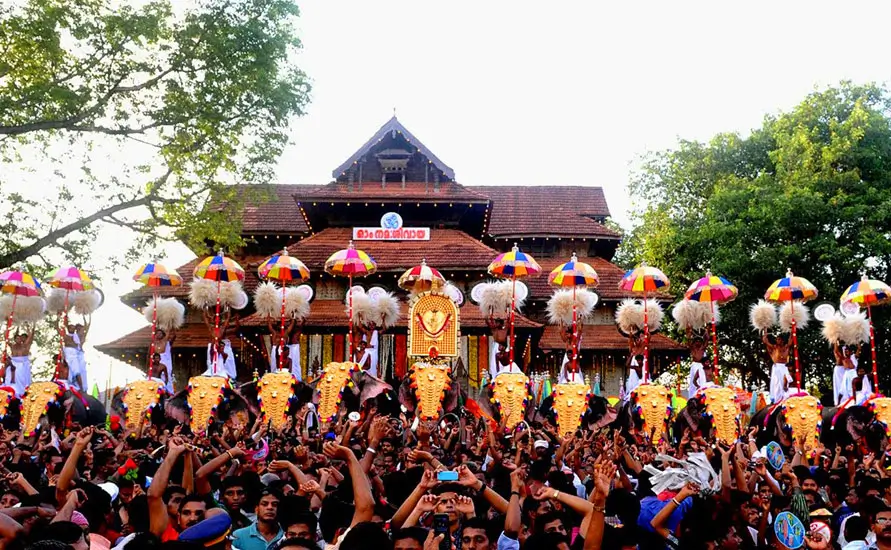
Thrissur's day begins at the Vadakkunnathan temple, a large Shiva shrine whose deity is covered in a mound of ghee built up over centuries of offerings. Inside the walls, which only Hindus may enter, there are fine wood carvings, mural paintings and the courtyard where the famous Ilanjithara Melam drum ensemble performs during Thrissur Pooram. Non-Hindu guests walk the vast Thekkinkadu Maidan around the temple with your guide, who explains how the festival is in fact a contest between two rival temples, Paramekkavu and Thiruvambady, whose processions meet here each April or May.
On Pooram day, the two sides line up on facing sides of the ground with richly decorated elephants and play the Kudamattam, a rapid exchange of colorful silk parasols, while hundreds of percussionists build to a peak. The pre-dawn fireworks have a long tradition too. If your dates match, we arrange a safe spot to watch, with a guide by your side; crowds are very large, so we recommend limited time on the ground. Visits to Paramekkavu and Thiruvambady temples are also possible, with entry rules set by each. Late in the morning you also visit the Puthanpally basilica, notable for its tall Gothic bell towers.
In the afternoon drive about forty minutes south to Irinjalakuda and the Koodalmanikyam temple, a rare shrine that honors Bharata, the loyal younger sibling of Rama in the Ramayana. Its rituals differ from most shrines, with no lamps waved before the deity during the daily worship, and a large tank flanks the shrine. Hindu guests can join the evening prayers, while others view the outer areas. Back in Thrissur, the evening is yours to sample local snacks such as unniyappam, a small sweet rice-flour dumpling, at a shop near the Round. Overnight in Thrissur.
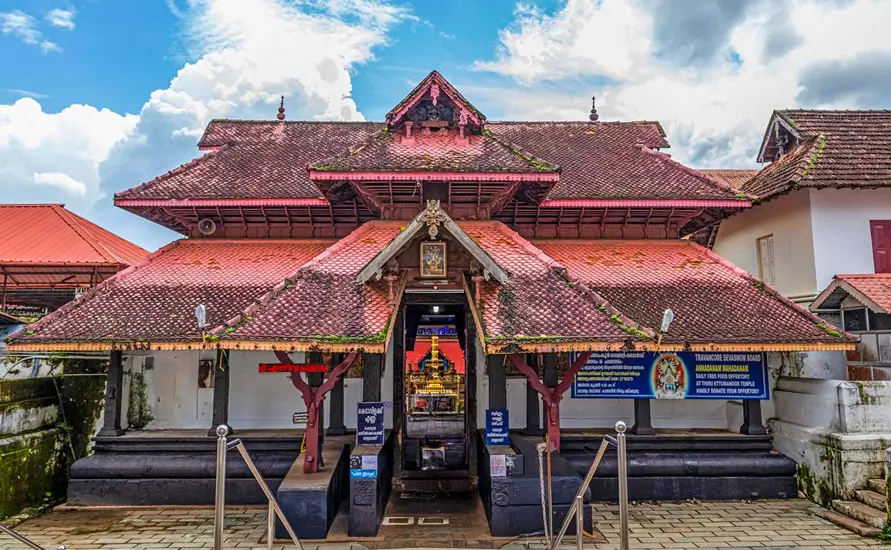
Leaving after an early breakfast, the car bypasses Kochi on the national highway and continues south-east into the Kottayam district, a region of rubber estates, churches and paddy lands, reaching Ettumanoor around noon. The Ettumanoor Mahadeva temple is a classic Kerala shrine with a circular sanctum under a copper roof, and its gopuram walls are known for a mural of Shiva dancing as Nataraja that many consider among the finest in Kerala. Only Hindus may go inside the main enclosure; non-Hindu guests can view the entrance murals and the temple grounds from the gate.
Its great annual festival comes in Kumbham on the Malayalam calendar, usually February or March, and its high point is the display of the Ezhara Ponnana, seven and a half elephant figures cast in gold and kept in the temple treasury, which devotees can see only on that night. Your guide explains the origin of the half-sized figure in local legend. If your dates fall in the festival, we plan the evening around the display and the procession that follows, with the usual note that crowds are dense and patience is needed.
In the afternoon you continue for about thirty minutes to Vaikom, where the Vaikom Mahadeva temple sits beside Vembanad Lake. Vaikom is remembered for the satyagraha of 1924–25, a nonviolent campaign that won the right for people of all castes to walk the roads around the temple, and Gandhi himself visited during the struggle. A small memorial nearby tells this story, which non-Hindu visitors can see freely. You then drive to Kottayam for the night, a short run of about forty-five minutes past rubber smokehouses and the long white facades of old Syrian Christian churches that give the district its character. Overnight in Kottayam.
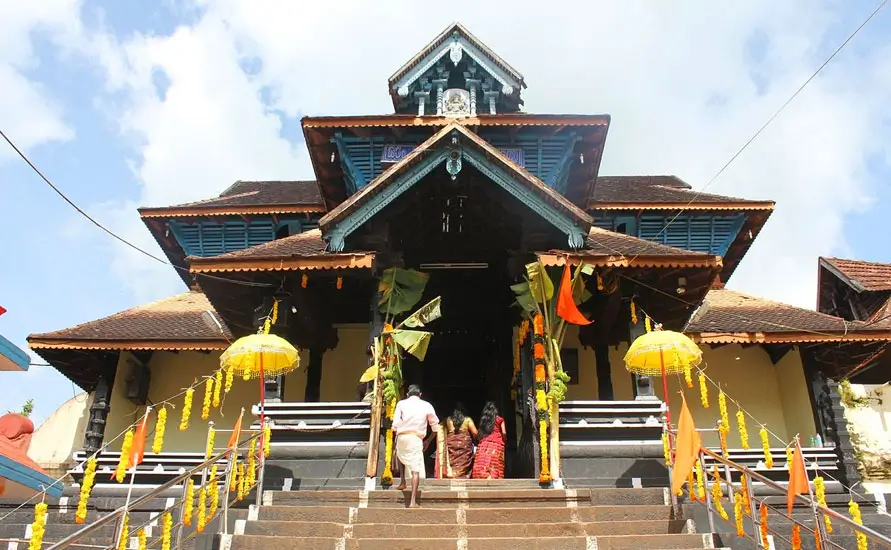
A green, winding road through Changanassery and Chengannur leads to Aranmula on the Pamba River, home of the Aranmula Parthasarathy temple, dedicated to Krishna as Arjuna's charioteer and one of the 108 Divya Desams. The temple's eastern entrance has a flight of eighteen steps and the northern side runs down a much longer flight to the river, and the shrine stands at the heart of a tradition linking dozens of riverside villages. Entry is for Hindus only; other guests see the steps, the gateway and the river ghats from outside with your guide.
From roughly August to October, families who have made a vow host the Aranmula Vallasadya, a sacred feast served to the oarsmen of the village snake boats, with sixty or more dishes laid on banana leaves. The rowers sing vanchipattu boat songs to request dishes, and the hosts answer by serving them. Booking a seat as a guest is sometimes possible through a temple-registered sponsor, and we will try if your dates fit. Around the same season, the Uthrattathi boat race brings the long palliyodam boats to the river in a ceremonial parade rather than a pure contest.
Next comes a family workshop making the Aranmula kannadi, a hand-cast mirror of a secret bell-metal alloy, polished until it reflects from its front face instead of a glass backing. Protected by a GI label, the method survives in only a handful of households. Your host shows the clay molds, the furnace and the slow polishing stages done with fine cloth and oil; buying is entirely optional. Tonight you stay at a simple heritage home near the river, where the hosts cook supper themselves and can explain how the boat festival is prepared. Overnight in Aranmula.
Following the main central road through Adoor and Kilimanoor, the drive south passes small temple towns, cashew factories, laterite-walled compounds and the old Travancore countryside, with roadside stalls selling tender coconuts every few kilometers. Kilimanoor is the birthplace of the painter Raja Ravi Varma, whose gods and goddesses printed in oleograph form now hang in homes across India; you will see his originals in Trivandrum tomorrow. Reaching Trivandrum, or Thiruvananthapuram, by lunchtime, you settle into a hotel near the old fort area for the last two nights, close enough to walk to the Padmanabhaswamy temple at dawn.
After lunch the next stop is the Attukal Bhagavathy temple, a few kilometers south of the center, where the goddess is honored as a form of Kannaki, heroine of the Tamil epic Silappatikaram. Every February or March, during the Attukal Pongala, women from across Kerala cook sweet rice in clay pots on the city streets as an offering, one of the largest gatherings of women anywhere in the world. Rules for non-Hindu guests are set by the temple; on festival days, everyone can watch the street offering respectfully from the sidelines.
Before sunset you can visit Shanghumugham beach, where the Padmanabhaswamy temple deities are carried twice a year for a ritual sea bath called the Aarattu, in a procession led by a member of the former royal family. The route crosses the airport runway, so flights pause while it passes, an unusual sign of how closely faith and the city's daily life are tied. Your guide prepares you for tomorrow's dress code, and if you need a mundu or saree, he takes you to a reliable shop near East Fort. Overnight in Trivandrum.
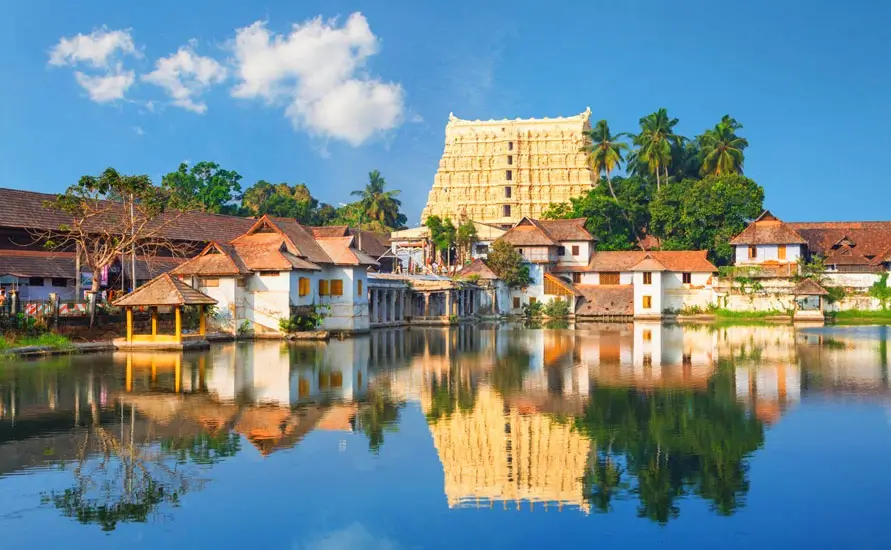
Dawn darshan at the Padmanabhaswamy temple Trivandrum is the high point of the tour for Hindu guests. Vishnu reclines here on the serpent Ananta in a single long image that devotees see in three parts through three doors: face, body and feet. The dress rule is strict: men wear a mundu with bare chest or a shoulder cloth, and women a saree, long skirt and blouse, or a mundu over trousers, which can be rented at the entrance. Phones, cameras and bags go into the lockers. Only Hindus may enter, and the temple may ask for a declaration of faith.
Non-Hindu guests spend this time with your guide at the Kuthiramalika palace museum, a long wooden mansion by the temple pond that Maharaja Swathi Thirunal commissioned during the 1840s; he was a composer and patron of Carnatic music. Its carved wooden brackets show 122 horses, and the halls display royal weapons, Belgian glass and thrones. Later in the morning everyone meets for coffee and a walk past the temple's seven-tiered eastern gopuram, built in a Tamil style rarely seen elsewhere in Kerala. The museum is closed on Mondays, so we adjust the order when needed and keep a quieter alternative ready.
The afternoon visits the Napier Museum, a striped Indo-Saracenic hall of the 1880s under steep Kerala-style gables, and, a few steps across the lawn, the Sree Chitra Art Gallery, where original canvases by Raja Ravi Varma hang alongside Himalayan scenes by the Russian painter Nicholas Roerich; both are closed on Mondays. Then there is time for a last bit of shopping: Balaramapuram handloom kasavu saris, sandalwood figures and brass temple lamps. In the evening, a farewell sadya or seafood dinner can be booked at a family restaurant. The night is free for packing your prasadam, sandal paste and souvenirs carefully in checked luggage. Overnight in Trivandrum.
A free morning allows Hindu guests one more visit to the temple, or a quiet hour on the lawns of the museum grounds. Trivandrum's international airport is only around twenty minutes from East Fort, so departure timing is easy; your driver allows the usual three-hour margin for long-haul check-in, or two before a domestic connection via Chennai, Bangalore or the Gulf. Our coordinator calls to make sure everything has gone smoothly.
Over ten days, you have walked under copper roofs and oil-lamp walls in six Kerala temple towns, heard the drums that drive Thrissur Pooram and learned how a feast becomes an offering at Aranmula. Many guests come back to time a return for a specific festival, and our team keeps a calendar of upcoming dates to help. Namaskaram from all of us, and may the road home be easy.
Your Journey

N.S. Rathore & Mrs. Omlata Rathore · Managing Director
We still read every enquiry ourselves. Tell us the places you liked and our planners will send a day-by-day route with drive times and a clear price.
Every package can be customised and no pressure to book. A planner from our office replies within 24 hours with a route written for your group.
Fill this in and your planner will send a first draft itinerary.
Explore more
Kerala Backwaters Escape Kerala Backwaters Escape
 Kerala Backwaters Escape
 Kerala Backwaters Escape
 Kerala Backwaters Escape
 Kerala Backwaters Escape
 Kerala Backwaters Escape
 Kerala Backwaters Escape
 Kerala Backwaters Escape
 Kerala Backwaters Escape
 Kerala Backwaters Escape
 Kerala Backwaters Escape
 Kerala Backwaters Escape
 Kerala Backwaters Escape
 Kerala Backwaters Escape
 Kerala Backwaters Escape
 Kerala Backwaters Escape
 Kerala Backwaters Escape