 Kerala Backwaters Escape

Religious & Heritage Tour Of South India
Chennai – Kanchipuram – Kumbakonam – Srirangam – Madurai – Srivilliputhur
At a glance
Twelve poet-saints called the Alvars wandered the Tamil country between roughly the 6th and 9th centuries, singing hymns to Vishnu at the shrines they visited. The 108 temples praised in those 4,000 verses, the Nalayira Divya Prabandham, became the 108 Divya Desam, and most of them still stand in Tamil Nadu. Our Divya Desam temple tour links more than twenty of these shrines in eleven days, from Triplicane in Chennai through Kanchipuram and the Kaveri delta to Srirangam, Madurai and Srivilliputhur, the birthplace of the poet-saint Andal.
Temple hours shape every day of this Divya Desam yatra package. Most sanctums open around dawn, close from about 12:30 to 4 pm and reopen until 8 or 9 pm, so drives are placed in the midday gap and darshan in the cooler hours. You spend two nights in each of five bases, which means one hotel change every second day and enough time to attend a morning or evening puja without rushing. One chauffeur and one cool, clean vehicle handle the road from the first temple town to the last, and guides who know the Sri Vaishnava tradition join you at each major temple town.
The trip is designed for Hindu families and NRIs from the US, UK, Canada, Singapore and Australia who want a well-organized Vaishnava pilgrimage in Tamil Nadu, including those bringing parents or overseas-born children. Non-Hindu travelers interested in temple architecture are also welcome, though several sanctums admit only Hindus and each temple sets its own rules. Dress is conservative throughout: men in a veshti or trousers with a shirt, women in a saree, salwar kameez or long skirt. November to February is the most pleasant season, and Vaikunta Ekadasi in December or January brings huge crowds to Srirangam.
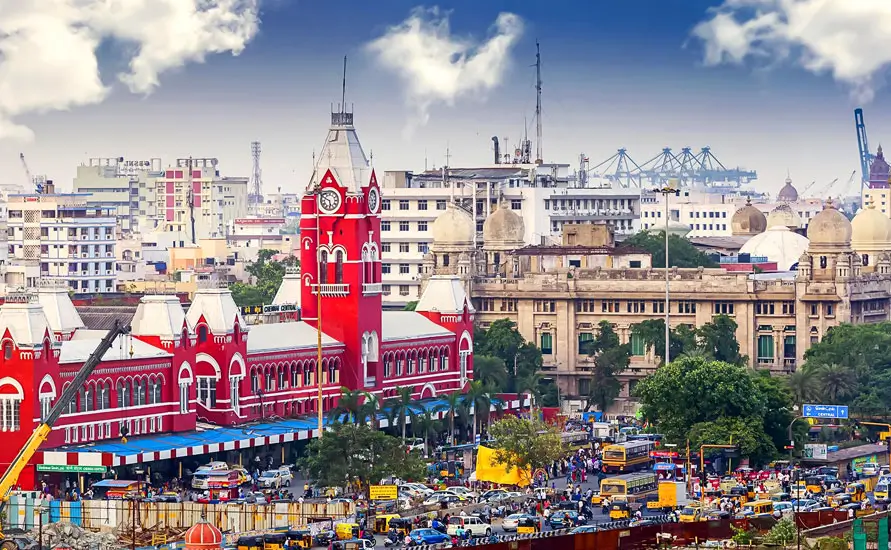
Because most overseas flights touch down at Chennai while the city is asleep, your first morning carries no fixed program whatsoever. Beyond the customs hall, a staff member from our Chennai office raises a name board, steers the bags to the car and sits beside you for the 40-minute ride to the hotel, more if the Guindy junction is jammed. On the way you receive a folder with the day plan, emergency phone numbers and a sheet listing temple dress rules, closing hours and the small courtesies, such as walking clockwise around a shrine, that will matter over the coming days.
In the afternoon your guide meets you for tea and a briefing on the tradition you are about to follow. You hear how the twelve Alvars came from every background, from a king to a woman to a member of a so-called lower caste, and how the 10th-century teacher Nathamuni gathered their hymns again after they had almost been lost. The guide also explains the roles of Ramanuja, the 11th-century philosopher who organized temple worship, and of the thenkalai and vadakalai schools, whose different forehead marks you will soon start to notice on priests and pilgrims.
As the heat eases you drive to Triplicane, an old quarter close to Marina Beach, for darshan at the Parthasarathy Temple, one of the oldest Divya Desams and the only one in the city praised by three Alvars. Here Krishna stands as Arjuna's charioteer, with a moustache and, according to tradition, marks on his face from Bhishma's arrows in the Mahabharata war. The temple holds five forms of Vishnu in separate shrines, and the evening lamps make the stone hall glow. Non-Hindu visitors may see the outer areas, but not the sanctum. Dinner can be a vegetarian meal near the temple tank. Overnight in Chennai.
Morning darshan works best at the suburban temples, so you leave the hotel soon after breakfast and drive west toward Avadi. Thiruninravur, about an hour from central Chennai, is home to the Bhaktavatsala Perumal temple, where Vishnu is worshipped as the protector of his devotees and the goddess as Ennai Petra Thayar, the mother who gave birth to me. The temple tank is large and well kept, and the main gopuram rises above a quiet residential street. Thirumangai Alvar, the most traveled of the poet-saints, praised this shrine, and your guide reads a few lines of his verse in English translation.
From there it is about 30 minutes to Thiruvallur and the Veeraraghava Perumal Temple, where Vishnu reclines with his head resting on his right hand, a pose believed to show him as a healer. Pilgrims drop jaggery and salt into the large Hrithapanasini tank as a prayer for recovery from illness, and new moon days draw thousands of visitors. The temple has wide stone corridors and a busy street of shops selling flower garlands, camphor and brass lamps. Like most temples in Tamil Nadu, the sanctum closes around midday, so the guide keeps an eye on the clock and leads you in well before the doors shut.
Lunch is at a local vegetarian restaurant, and you return to Chennai for an afternoon of rest. Later, if you like, your guide takes you to Mylapore, where the Kapaleeshwarar temple to Shiva shares the streets with the small Adi Kesava Perumal shrine linked to the birth of Peyalvar, one of the first three Alvars. The neighborhood is full of shops selling silk, puja supplies and Carnatic music recordings, and the area around the tank comes to life after dark. Pack an extra veshti or shawl for tomorrow, as several temples in Kanchipuram follow strict dress customs. Overnight in Chennai.
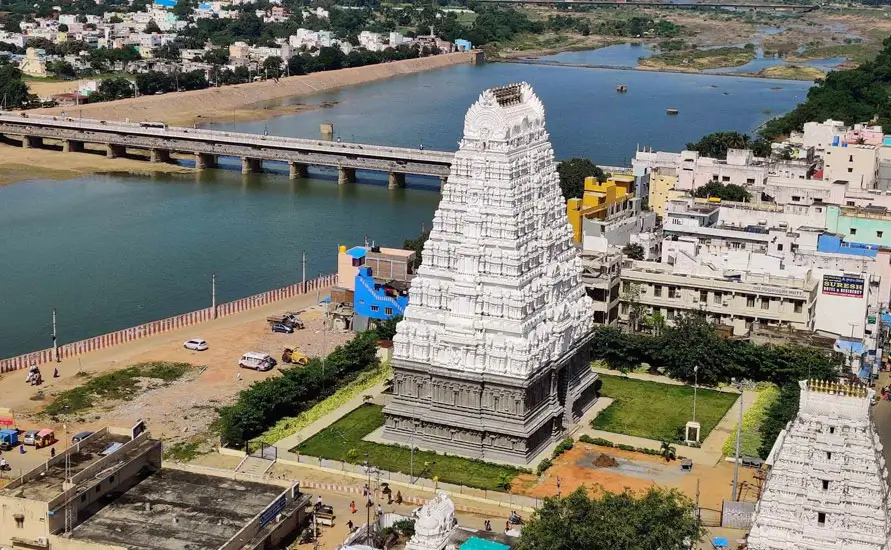
An early start puts you in Kanchipuram before 9 am, while the inner corridors are still cool. The city of a thousand temples counts fourteen Divya Desams within its limits, more than any other town, and is also one of the seven sacred cities named in Hindu scripture. Check-in can wait until the afternoon, since today is spent almost entirely inside temple walls. Your guide explains how Vishnu Kanchi in the east and Shiva Kanchi in the west grew around separate royal and priestly communities, and why the town has drawn Vaishnava scholars since the time of Ramanuja, who studied here.
The great Varadharaja Perumal Temple spreads over about 23 acres, with a hundred-pillared hall whose carvings show horse riders, musicians and stone chains hanging from the roof, all cut from single blocks. Pilgrims climb a few steps to touch the gold and silver lizards carved on a ceiling, believed to remove bad luck. Under the temple tank lies the wooden image of Athi Varadar, brought up for public darshan for 48 days only once every 40 years; the last occasion was in 2019. Non-Hindu visitors can see the hall and corridors, while entry to the sanctum depends on the temple's rules on the day.
When the doors reopen at four, the next darshan is at the Ulagalantha Perumal Temple, where a giant image of Vishnu as Trivikrama, the dwarf who grew to measure the universe in three steps, stands with one leg raised high. Four other Divya Desams are housed inside the same compound, so a single visit covers five sacred places. Close by, the Pandava Thoothar Perumal Temple shows Krishna seated as the peace envoy of the Pandavas, an image about 25 feet high. Lamps are lit around 6 pm, and the evening service with nadaswaram pipes and drums is worth staying for. Overnight in Kanchipuram.
Begin at Thiruvekka, the Yathothakari temple, connected to a well-known story about the poet-saint Thirumazhisai Alvar. When the king banished the saint's disciple, the Alvar left the city and asked Vishnu to roll up his serpent bed and follow; the god obeyed, and returned only when the saint came back. The image here therefore lies with his head on the left side, the reverse of the usual pose. Nearby, the temple pond is said to be the birthplace of Poigai Alvar, the first of the twelve. Your guide shares the verses that begin the Prabandham, sung by the first three Alvars on a rainy night in a small shelter.
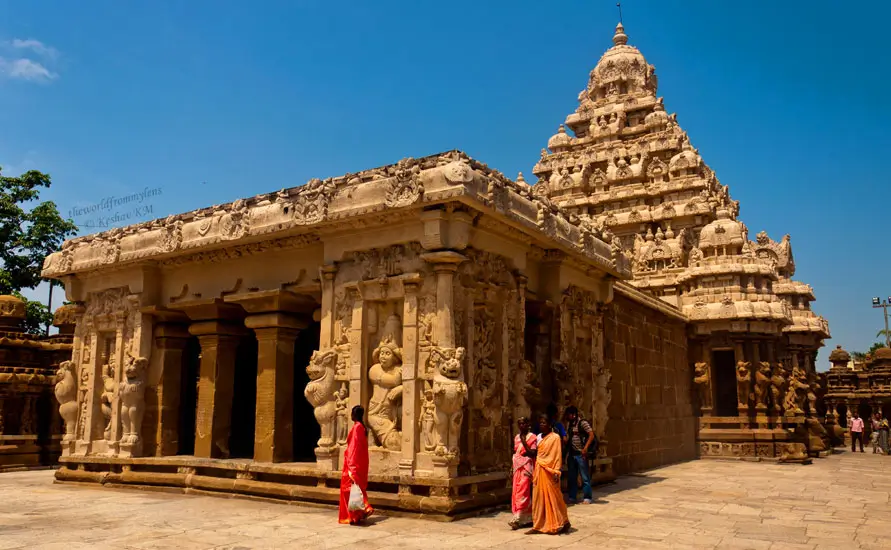
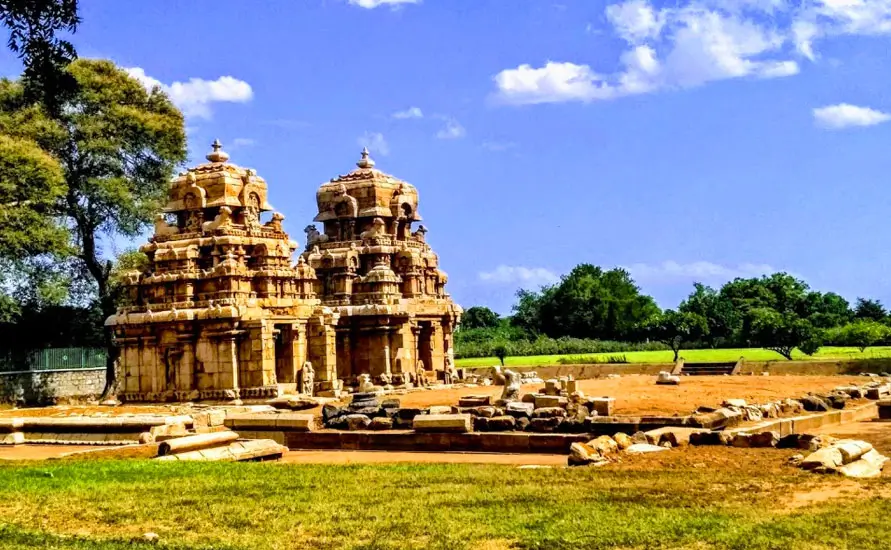
The 8th-century Vaikunta Perumal Temple, built under the Pallava king Nandivarman II, is both a Divya Desam and one of the most important monuments of early South Indian architecture. Its sanctum rises in three stories, each with an image of Vishnu in a different pose, standing, seated and reclining, and the inner walls carry carved panels that record the history of the Pallava dynasty, almost like a stone chronicle. The site is managed by the Archaeological Survey of India and also worshipped in, so a calm visit with the guide's commentary takes about an hour.
Kanchipuram silk is woven with temple motifs such as peacocks, mango buds and gopuram borders, and after lunch a weaving household on a side lane lets you sit beside the pit loom while the shuttle flies. A single saree with pure zari can take two weeks or more, and the guide shows you how to recognize genuine silk and silver-gold thread. There is no obligation to buy. If you have time, a 40-minute drive to Sriperumbudur, the birthplace of Ramanuja, adds an important stop for Sri Vaishnava pilgrims, though it is not itself one of the 108. Overnight in Kanchipuram.
No other day of the yatra covers as many kilometers, so the car pulls away around 7 am with breakfast packed or taken early at the hotel. The route crosses the plains of Villupuram and the Cuddalore district, with paddy fields, cashew groves and roadside shrines to village guardian deities. The halfway stop is Chidambaram, about four hours from Kanchipuram, where you arrive before the sanctum closes for the afternoon. Your driver knows the parking areas near the temple and the best gate to use, which saves a long walk in the heat.
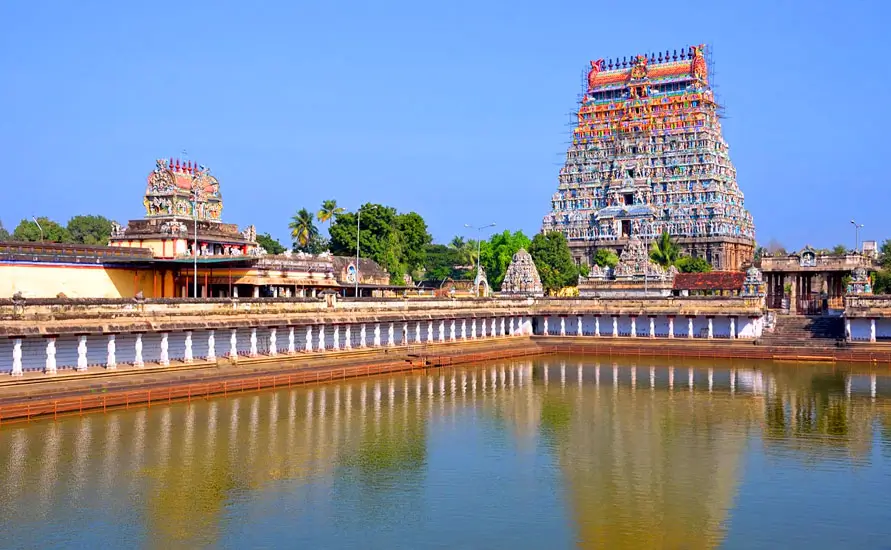
Most visitors know the Chidambaram Nataraja Temple for Shiva as the cosmic dancer, but inside the same compound lies Thiruchitrakoodam, the shrine of Govindaraja Perumal, one of the 108 Divya Desams. From one spot in the hall you can see both Nataraja and the reclining Govindaraja, a rare sight that reflects the long, and sometimes difficult, history of Shaiva and Vaishnava worship side by side. Men are usually expected to remove their shirts in parts of the Nataraja shrine. The guide also points out the dance poses carved on the gopurams, the 108 karanas of classical Indian dance.
Lunch at a plain meals hall precedes a 90-minute run south-west to Kumbakonam, a temple town on the Kaveri delta famous for its Mahamaham festival held every twelve years in the town tank. Check-in around five leaves an hour or two to stretch out after the long road. After dark a stroll with the guide circles the Mahamaham tank and its sixteen small pavilions, then passes stalls piled with betel leaves and brass lamps and the cafés famous for frothy Kumbakonam degree coffee. Dinner is best kept light before an early start tomorrow. Overnight in Kumbakonam.
Ranked by many devotees after only Srirangam and Tirumala, the Sarangapani Temple opens the morning program. Its sanctum is shaped as a stone chariot, with carved wheels and horses on its sides, and the eleven-tiered gopuram is one of the tallest in the delta. Tradition holds that it was here that Nathamuni heard a few verses sung by visiting devotees and set out to recover the full collection of Alvar hymns. Your guide also shows you the separate shrine for the goddess Komalavalli, and points out the small window through which the deity is believed to have arrived from the heavens.
About 8 km away in Thirunageswaram, the Oppiliappan Temple is known for its unusual offering rule: food made for the god contains no salt, linked to a legend in which Vishnu married the daughter of a sage who did not know how to cook with it. The temple is popular for weddings, and you may see a family celebration in the hall. Then you drive about 10 km to Nachiyar Kovil, where the goddess takes precedence over Vishnu in every procession. Its stone image of Garuda, carried out during festivals, is said by tradition to grow heavier as it leaves the shrine, so the number of bearers rises from four to more than a hundred.
Post-lunch, the short hop to Swamimalai brings you to the casting village whose bronze makers follow the madhuchishta, or wax-loss, process laid down in the old Shilpa Shastra manuals. At one family foundry a craftsman models a deity in beeswax blended with tree resin, another packs it in fine alluvial mud, and later the wax is melted out and metal poured into the hollow. A finished image can take weeks to complete, and shipping overseas is possible if you wish to order one. In the evening you return to Kumbakonam, with the option of a second darshan at Sarangapani or a quiet walk by the temple tank as the lamps come on. Overnight in Kumbakonam.
Leaving Kumbakonam after breakfast, you reach Thanjavur in about an hour. On the northern edge of the city, near the Vennaru river, stand the three shrines known together as Thanjai Mamani Koil, a single Divya Desam praised by Thirumangai Alvar and Bhoothathalvar. Legend tells of a demon named Thanjakan who was defeated by Vishnu here and asked that the town be named after him. The shrines are small, quiet and seldom crowded, a good contrast to the large temples elsewhere, and the priests are often happy to explain the rituals if your guide translates.
Since you are in Thanjavur, a stop at the Brihadeeswarar Temple, the 11th-century masterpiece of the Chola king Rajaraja I, is well worth the time even though it is a Shiva temple. Rajaraja's builders raised the granite tower to roughly 66 meters, crowned by a capstone of great weight, while a monolithic Nandi rests under its own pavilion facing the shrine. Its World Heritage listing, shared with two later Chola shrines nearby, comes under the name Great Living Chola Temples. Then, after a meal, the car follows the Kaveri west to Srirangam, around 90 minutes away, the island town between the Kaveri and Kollidam rivers that forms part of the city of Trichy.
Check-in is in the late afternoon, and then your guide takes you to Uraiyur in old Trichy, home of the Kamalavalli Nachiyar Temple. Uraiyur was the early capital of the Chola kings, and the temple marks the birthplace of the Alvar Thiruppanalvar, a singer from a community once kept outside the temple walls, who according to tradition was carried into Srirangam on the shoulders of a priest at the god's command. His story is a touching way to prepare for tomorrow. In the evening you can see the illuminated Rock Fort from across the river. Overnight in Srirangam.
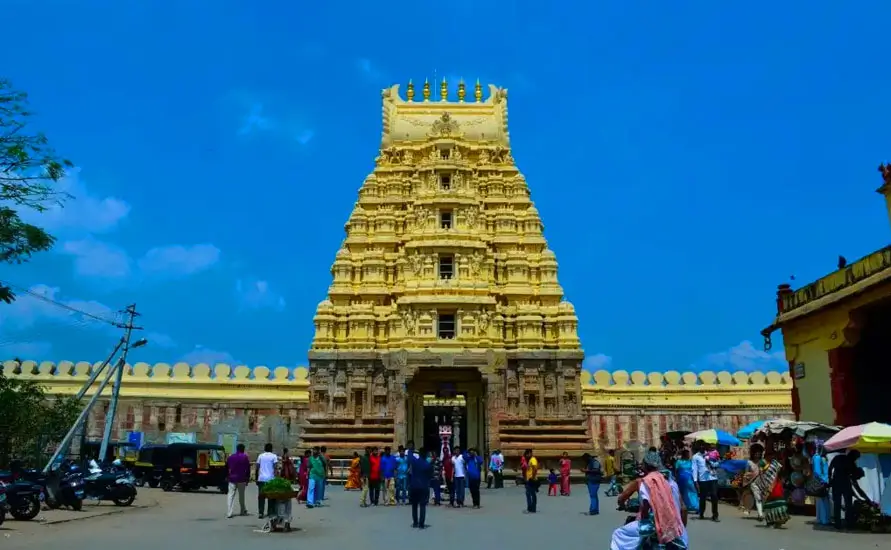
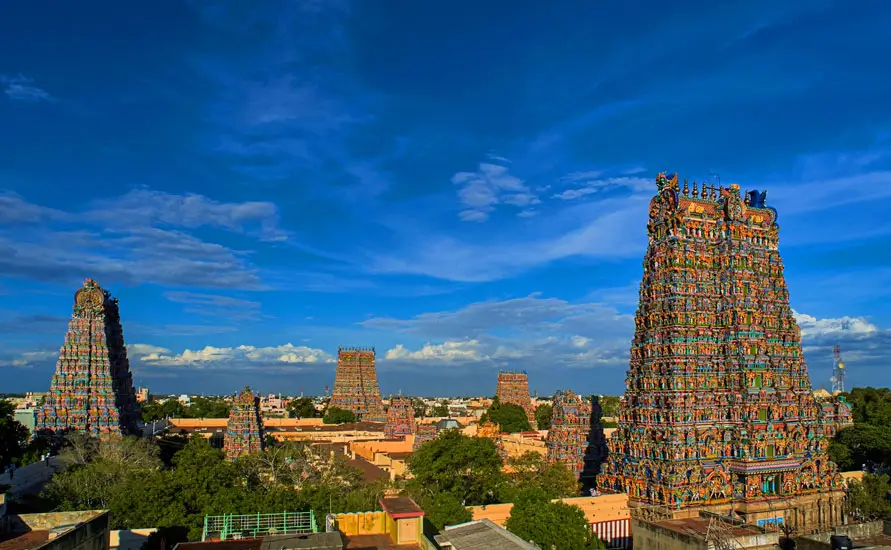
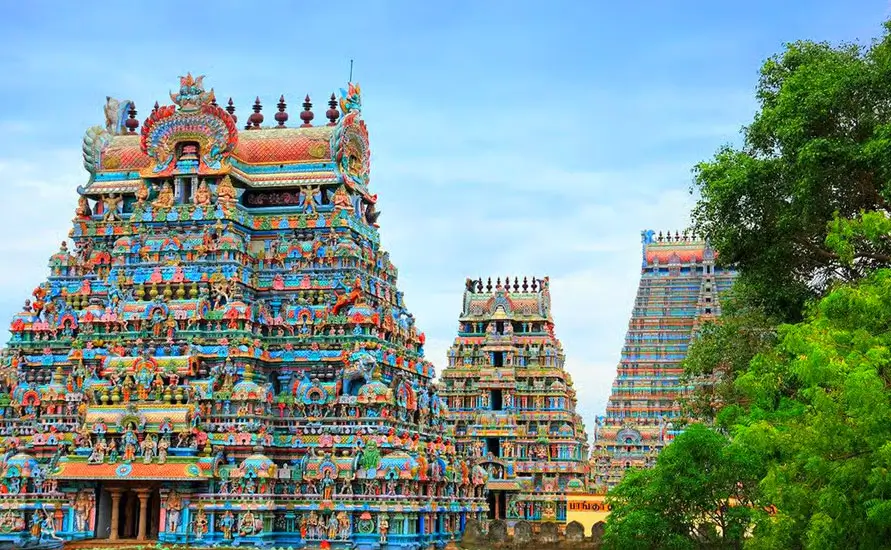
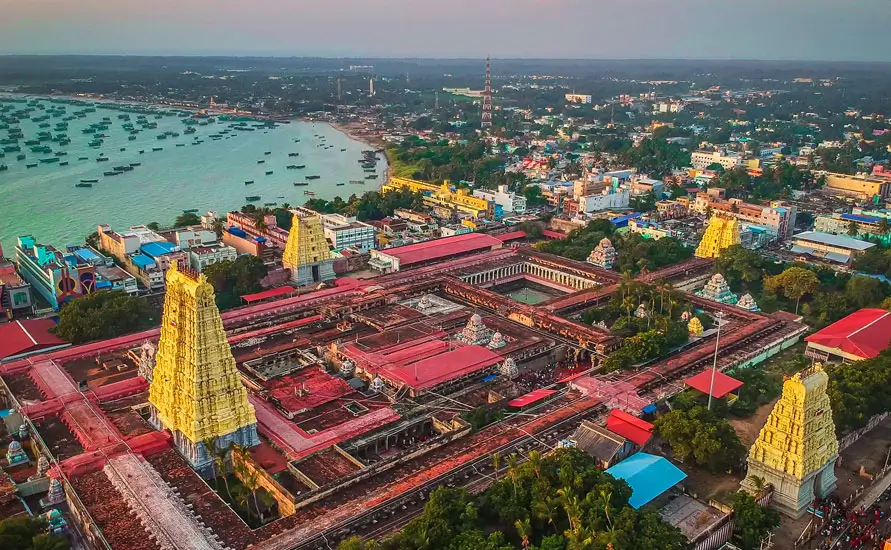
The Srirangam Ranganathaswamy Temple covers about 156 acres and is counted among the biggest temple complexes still in active worship anywhere. Seven concentric enclosures, with 21 gopurams, contain whole streets of homes, shops and restaurants; only the inner rings are purely sacred space. The southern Rajagopuram, completed in 1987, rises about 73 meters, its thirteen tiers visible from the Trichy road long before you reach the island. Arrive around 7 am, as the first services are under way and the granite under bare feet has not yet warmed, then pass gate after gate toward the center.
At the heart of it all, Ranganatha reclines on the many-hooded Adisesha beneath a gilded vimana. The sanctum is open to Hindus only, while non-Hindu visitors can see the halls and climb to a rooftop viewing point for a view of the golden tower. In the Sesharaya Mandapam, Nayaka-era sculptors turned each column into a war horse rearing on its hind legs, and the Thousand Pillar Hall hosts the Vaikunta Ekadasi rituals. In the Udayavar Sannidhi, devotees pay respects to Ramanuja, whose body, according to tradition, is preserved there in a seated position. Phones and cameras may be restricted in parts of the temple, so your guide advises where to leave them.
After the midday break, a 25 km run north reaches Thiruvellarai, where the Pundarikaksha Perumal temple stands on a rocky platform and is said by tradition to be older than Srirangam itself. Just outside the temple walls lies the swastika-shaped stepwell built in the 8th century under a Pallava-period chief, with four wings of steps descending to the water so that bathers on each side cannot see each other. Coming back, those with energy left can add Jambukeswarar at Thiruvanaikaval, where water seeps up around the Shiva lingam of this element shrine. Overnight in Srirangam.
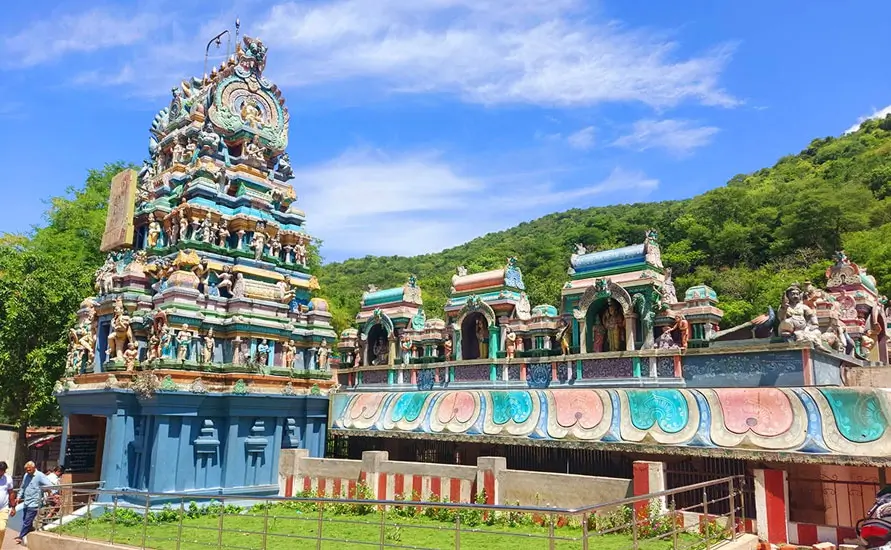
Today's drive follows the highway south through Viralimalai and Melur, passing granite hills and dry farmland that shows a different Tamil Nadu from the green delta. About 21 km before Madurai you turn off for Alagar Kovil, set at the foot of a wooded hill. Here Vishnu is worshipped as Kallazhagar, and every spring during the Chithirai festival the processional image travels to Madurai to enter the Vaigai river, an event that draws enormous crowds. At the gate, the guardian deity Karuppanna Swamy is honored before the 18 steps, and devotees often stop here to tie bells or make vows.
A road climbs the hill to Pazhamudircholai, one of the six abodes of Murugan, and further up is the Nupura Gangai spring, where pilgrims bathe in water believed to flow from the anklet of Vishnu. Monkeys are common along the path, so keep food out of sight. The cool shade of the hill makes this a pleasant stop before lunch. Your guide explains how Alagar Kovil connects the Vaishnava and Shaiva traditions of Madurai, since Kallazhagar is believed to be the brother of the goddess Meenakshi, coming to her wedding with Shiva.
You reach Madurai after lunch and check in to your hotel. Around six, the guide leads the way to the Koodal Azhagar Temple in the old city, famous for its three-tier vimana in which Vishnu appears seated, standing and reclining on separate levels. According to tradition, the Alvar Periyalvar sang his blessing hymn, the Thiruppallandu, at this temple after winning a debate at the Pandya court. The lamps of the evening service make a fitting end to the day, and Madurai's late-night food stalls are a short walk away for those who want a cool glass of jigarthanda before bed. Overnight in Madurai.
A two-hour drive south-west after breakfast leads to Srivilliputhur, a market town with the blue line of the Ghats rising behind it. Here, according to tradition, the Alvar Periyalvar found a baby girl under a tulasi plant in his garden and raised her as his own. She grew up to become Andal, the only woman among the twelve Alvars, and composed the Thiruppavai, thirty verses sung every morning in the month of Margazhi (December to January) in homes and temples across South India. Her devotion to Vishnu was so strong that she is believed to have married the deity at Srirangam.
The Srivilliputhur Andal Temple complex has two parts: the Vatapatrasayee temple, where Vishnu reclines on a banyan leaf, and the Andal shrine built over the site of her birthplace. The main gopuram, about 59 meters high, appears on the official emblem of the Tamil Nadu government. Andal's image holds a parrot made each day from fresh leaves, and the garland she wears is, by custom, later sent to other temples, including Tirumala for its main festival. Your guide shows you the well where she is believed to have looked at her reflection after wearing the garland meant for the god.
Heading back, a detour reaches Thiruthangal, about 25 km away, where the Ninra Narayana Perumal temple stands on a low hill near Sivakasi. You return to Madurai by late afternoon, and close to nine at night the guide walks you into the Meenakshi Amman Temple to watch the palliyarai rite, as Sundareswarar's palanquin is borne to Meenakshi's bedchamber. The inner sanctums are for Hindus only, and phones and cameras have to be handed in at the deposit counters before the security check. Before leaving Srivilliputhur, pick up a box of palkova, the milk sweet the town is known for. Overnight in Madurai.
With an afternoon departure, one last darshan fits in at Thirumohur, about 12 km east of Madurai, where Vishnu is worshipped as Kalamegha Perumal, the dark rain cloud. The shrine of Chakrathazhwar, the personified discus of Vishnu, has a striking image with many arms carved on both sides, and pilgrims visit it to pray for protection. The temple is calm in the morning and rarely crowded, a quiet place to reflect on the eleven days of the yatra before returning to the hotel to pack and check out.
Madurai Airport, some 30 minutes' drive from the old city, links to the big Indian hubs as well as a few direct services to Colombo, Dubai and Singapore. Our team checks the flight time with you the day before and plans the transfer accordingly. Over eleven days you have stood before more than twenty of the 108 Divya Desams and heard the hymns that have been sung there for more than a thousand years. If you wish to continue to Tirumala, the Kerala Divya Desams or Ahobilam on a later trip, we will be happy to plan it.
Your Journey

N.S. Rathore & Mrs. Omlata Rathore · Managing Director
We still read every enquiry ourselves. Tell us the places you liked and our planners will send a day-by-day route with drive times and a clear price.
Every package can be customised and no pressure to book. A planner from our office replies within 24 hours with a route written for your group.
Fill this in and your planner will send a first draft itinerary.
Explore more
Kerala Backwaters Escape Kerala Backwaters Escape
 Kerala Backwaters Escape
 Kerala Backwaters Escape
 Kerala Backwaters Escape
 Kerala Backwaters Escape
 Kerala Backwaters Escape
 Kerala Backwaters Escape
 Kerala Backwaters Escape
 Kerala Backwaters Escape
 Kerala Backwaters Escape
 Kerala Backwaters Escape
 Kerala Backwaters Escape
 Kerala Backwaters Escape
 Kerala Backwaters Escape
 Kerala Backwaters Escape
 Kerala Backwaters Escape
 Kerala Backwaters Escape