 Kerala Backwaters Escape

South India Wildlife Tours
Bangalore – Kabini – Bandipur – Mudumalai – Ooty – Valparai – Chinnar – Munnar – Thattekad – Thekkady – Kochi
At a glance
Most wildlife holidays in India squeeze three parks into ten days and leave you tired. Our South India Wildlife Tour 3 Weeks does the opposite. Over twenty-one days it traces the Western Ghats from the Kabini backwaters in Karnataka, through the tiger forests of Bandipur and Mudumalai, up to the Nilgiri hills, across the Anamalai rainforest at Valparai and on through the Kerala highlands to Thattekad, Periyar and the coast at Kochi. It is the fullest southern circuit we run, designed for travelers who care more about time in the field than about ticking off sights.
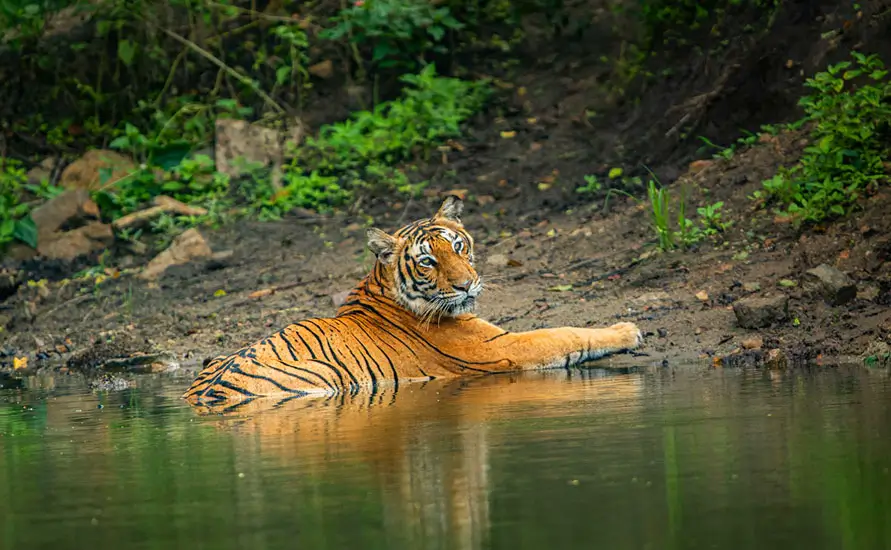
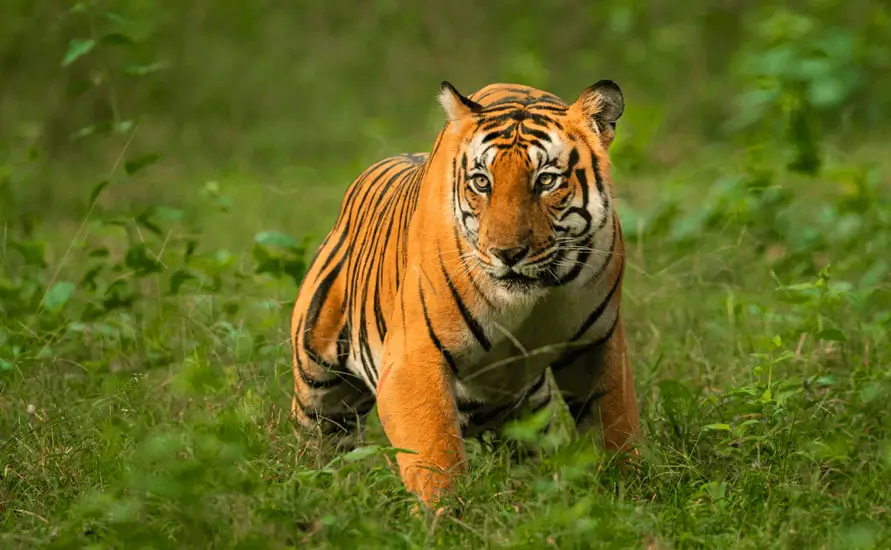
The pace is what sets this south India wildlife tour apart. Long drives are separated by stays of two or three nights, and there are proper rest days at Kabini, Valparai and Thekkady where nothing is scheduled beyond an optional walk. Seven jeep or canter safaris, two boat safaris on the Kabini reservoir, a Periyar lake cruise and guided birding at Thattekad give you repeated chances at elephant, gaur, leopard, tiger, dhole and the endemic primates of the Ghats. No sighting can be guaranteed, but three weeks of patient searching improves the odds a great deal.
This route suits keen birders, wildlife photographers and retired couples from overseas who can spare three full weeks, as well as NRI families returning for a long stay. A private car and driver are with you throughout, naturalists join you in each forest, and the South India Wildlife Tour 3 Weeks ends at Cochin airport with its good Gulf connections. Plan for the dry half of the year, roughly October through May. Eravikulam closes for Nilgiri tahr calving around February and March, so if you travel then we replace that visit with a guided shola walk near Munnar.
Touchdown at Kempegowda International Airport marks the start of three weeks in the forests of the south. A member of our team stands in the arrivals area with your name on a card, steers your bags out and introduces you to the private car that will stay with you as far as Kerala. Bangalore airport sits well north of the city, so the hotel we choose for this first night is close to the terminal, which spares you an hour or more in traffic straight after a long-haul flight. Early check-in can be arranged ahead of time if your plane lands before dawn.
Once you have slept and showered, your tour manager comes by with a printed itinerary, a regional bird checklist and a quick briefing on the weeks ahead. This is the moment to ask about anything practical: SIM cards and mobile data, cash versus cards in rural areas, laundry at the lodges and what to wear on safari. Earthy greens, browns and khaki blend with the forest, while white and bright red stand out and can unsettle animals. A light fleece is worth having for the open jeeps at dawn and for the cold evenings in Ooty and Munnar later in the trip.
For anyone with energy left in the afternoon, the Lalbagh Botanical Garden in the south of the city makes an easy first outing. Begun as a royal garden in the 1760s, it now has two-hundred-year-old trees, a Victorian glass pavilion and a lake where purple herons, cormorants and spot-billed pelicans are often seen. Allow for the drive across town, which can take over an hour each way. Otherwise, rest at the hotel and enjoy a gentle South Indian dinner of dosa or bisi bele bath, a local rice and lentil dish. Overnight in Bangalore.
Leaving after an early breakfast beats the worst of the morning traffic as the car heads south-west toward Mysore and then down to the edge of Nagarhole National Park. Past Mysore the countryside opens into fields of sugarcane, mulberry for silk farming and paddy, and small temples appear at the entrance to every village. The driver keeps a steady pace pausing once for coffee, and you should reach the lodge on the Kabini backwaters around lunchtime. Three nights are reserved at a jungle lodge on the northern bank of the water, all meals provided.
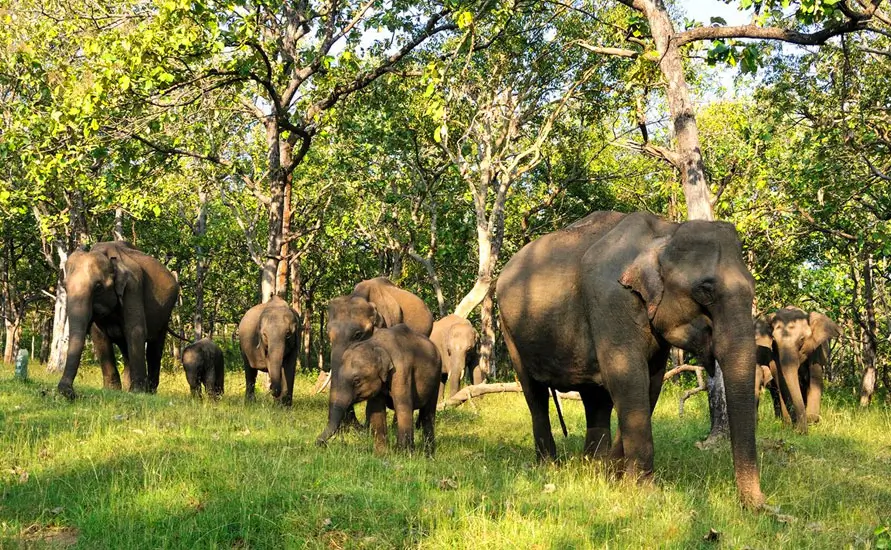
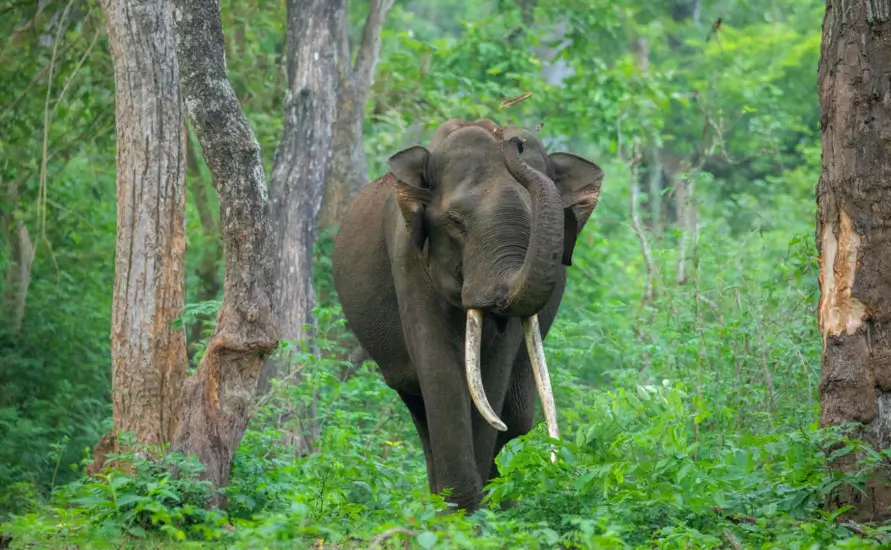
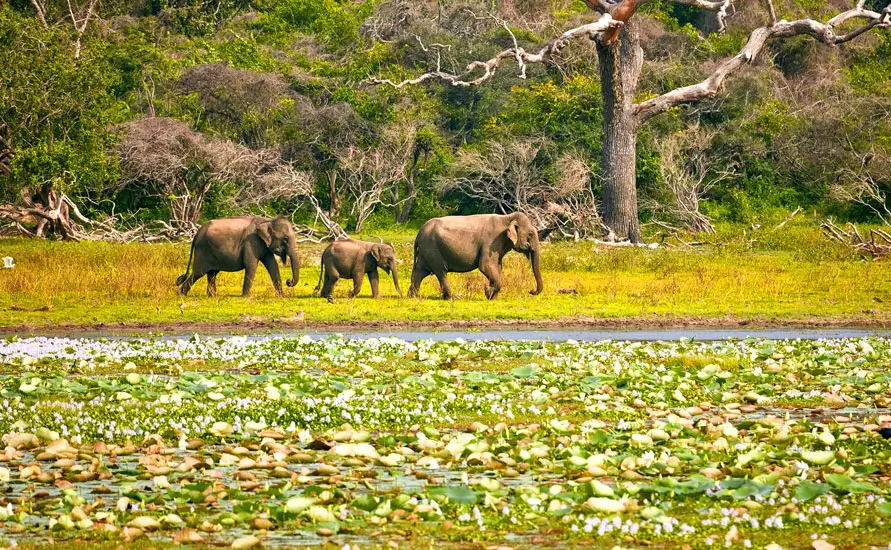
The Kabini dam was completed in the 1970s, and the reservoir it created lies along the southern boundary of Nagarhole. Once the rains end and the level falls, a broad belt of grass appears on the exposed banks, and by February to May it attracts some of the largest elephant gatherings in Asia. Gaur, spotted deer, sambar and wild boar graze the same margins, and the tree line behind them is where leopards often rest. Your naturalist, who stays with you through the Karnataka and Tamil Nadu leg of the trip, introduces the area over lunch with a map of the reserves you will cross.
Late in the afternoon you board a motorboat for the first of two boat safaris on the reservoir. Seen from the water, the shoreline looks very different from a jeep track: elephants wade in to drink and splash, otters fish in the shallows and marsh crocodiles lie motionless on the mud. Birdlife is rich, from ospreys circling overhead to river terns diving and darters spreading their wings to dry on drowned stumps. The boat keeps a steady distance from wildlife and never chases animals along the bank. You return once the light starts to fade over the reservoir, in time for a hot shower before dinner. Overnight in Kabini.
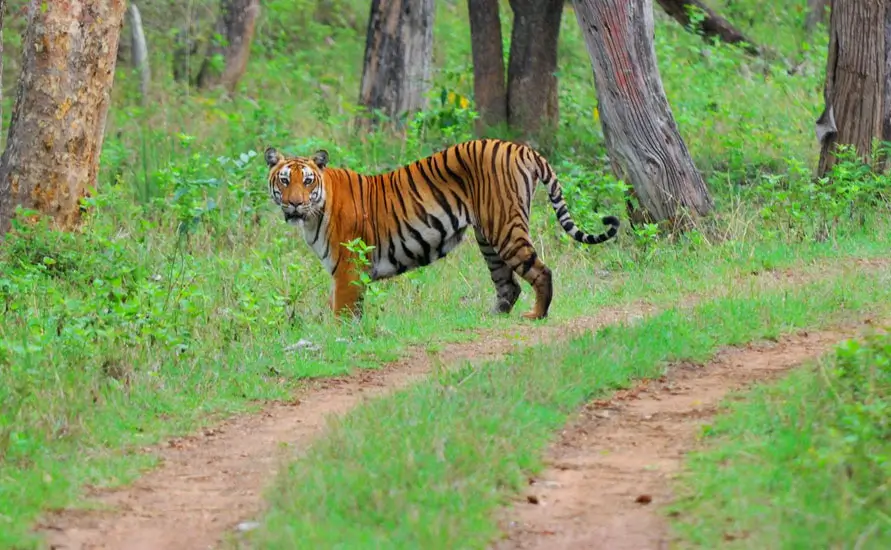
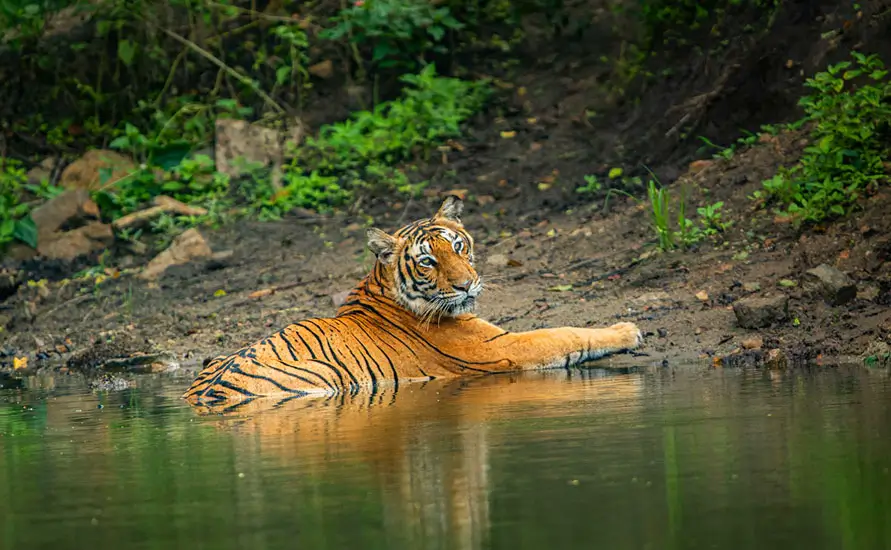
At first light you set out on a jeep or canter safari into the Kabini side of Nagarhole, also called Rajiv Gandhi National Park. Safari vehicles and routes are fixed by the Karnataka Forest Department, numbers are capped each day and no vehicle may leave the track. Moist and dry deciduous trees share this forest, with teak, rosewood and towering silk cotton giving way to grassy clearings known locally as hadlus. Leopards are seen fairly often in this part of the park, and tigers are possible, though both remain a matter of luck. Dhole packs, sloth bears and grey jungle fowl are other regulars.
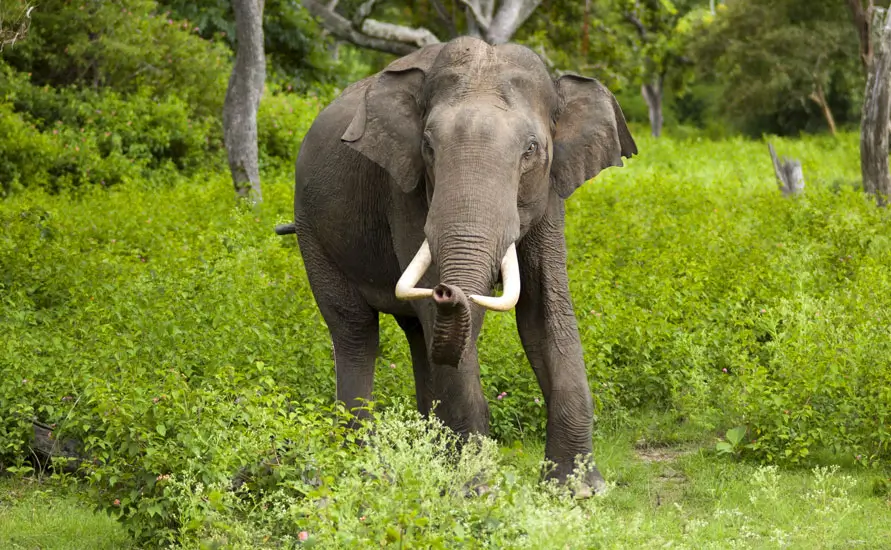
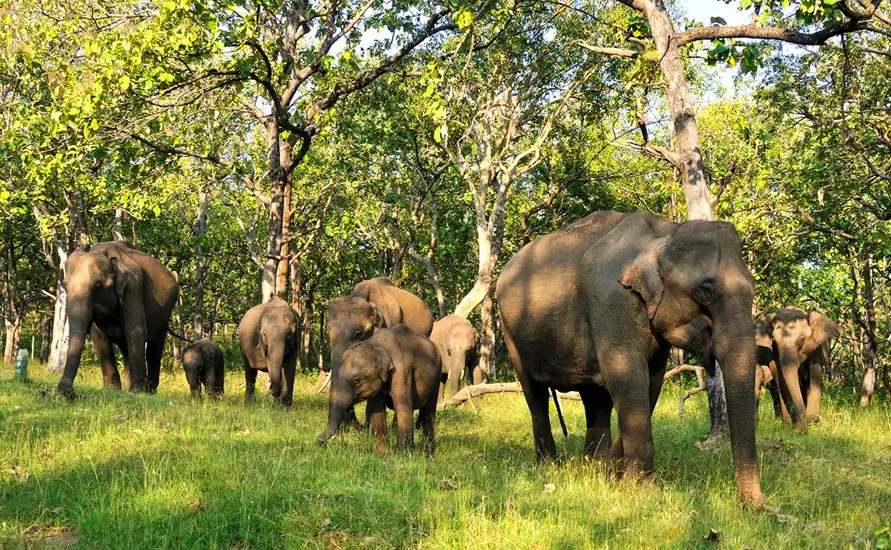
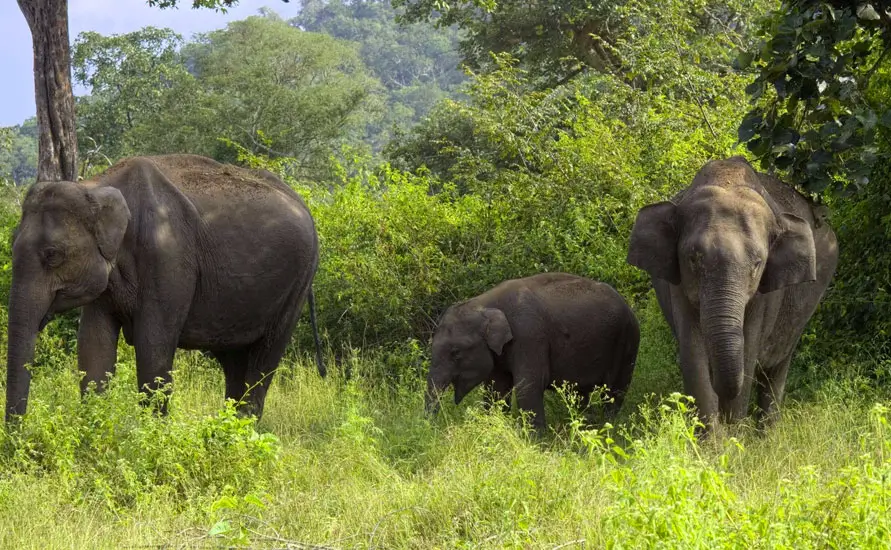
You are back for a late breakfast, and the hours that follow are yours. A hammock, a book and a pair of binoculars are all you need, as the trees around the lodge often hold Malabar pied hornbills, golden orioles, black-naped monarchs and small flocks of hill mynas. If you would like a short nature talk, your naturalist can explain how Kabini's elephant population moves between Nagarhole, Bandipur, Wayanad and Mudumalai over the course of the year, a pattern that makes this region the stronghold of the Asian elephant in India and something you will keep returning to over the coming week.
The second boat safari heads out in the afternoon, this time along a different stretch of shoreline if conditions allow. Late light on the water makes this the best session for photographers, so bring a lens in the 300 to 500 mm range if you have one, along with a bean bag or a soft cloth to rest it on the side of the boat. Herds of elephants with calves often feed on the grass right at the edge of the reservoir, and on lucky evenings a leopard walks the bank or a tiger comes down to drink. Dinner at the lodge is often served outdoors around a fire. Overnight in Kabini.
Today is the first planned rest day, and nothing at all happens before breakfast unless you want it to. Many guests find that one slow morning after the flights and early starts makes a real difference to how much they enjoy the following weeks. Sleep in, take a long breakfast on the deck, or walk the lodge grounds with your camera. A short guided bird walk around the property can be arranged for those who cannot resist, and the lodge staff will point out where the resident spotted owlets roost during the day, often in plain sight in a tree beside the dining area.
Lunch is followed by a quiet hour, and if you have been curious about the lives of people around the reserve, your naturalist can talk about the Jenu Kuruba and Betta Kuruba communities, forest-dwelling peoples who have lived in and around Nagarhole for generations. Many work today as trackers, guides and forest watchers, and their knowledge of animal signs is remarkable. This background helps you understand that the forests on this route are not empty wilderness but shared landscapes, a theme that comes up again in the Nilgiris, at Valparai and in the tribal settlements on the edge of Periyar later in the trip.
Mid-afternoon brings another jeep or canter safari into Nagarhole, on a route allotted by the forest department. Each drive in the same forest shows something new, because animals shift with the time of day and the season. A herd of gaur crossing the track, a crested hawk eagle watching from a bare branch or a family of wild boar rooting in the leaf litter can make a drive even without a big cat. Your naturalist keeps a running list of what you have seen, which by the end of the trip often stretches to several hundred species of birds alone. Overnight in Kabini.
Leaving the reservoir behind after breakfast, the car turns south-east toward Bandipur Tiger Reserve. The road runs through farmland and small towns on the edge of the forest, where low electric fences and trenches show how farmers try to keep elephants out of their crops. Your naturalist explains the conflict honestly: elephants raid fields at night, and farmers lose a season's income in one visit, which is why corridor protection and compensation schemes matter so much here. You reach your forest-edge resort in time for lunch, and the next two nights are again on a full-board basis.
Bandipur lies directly south of Nagarhole, the two parks separated only by the Kabini River and a highway. Its forest is drier and more open than Kabini's, with more scrub, more bamboo and long views through the trees in the hot months. This makes it a good park for watching elephants, gaur and big herds of chital, and for spotting raptors, the shikra and changeable hawk eagle among them. Safaris here leave from the forest department's reception on the main road, and seats in its jeeps and canters are limited, so all drives are confirmed subject to availability.
Your afternoon safari starts in the warm light of mid-afternoon. Watch the tops of termite mounds, where Indian rollers and bee-eaters perch to hunt, and the soft sand of the track, where your naturalist reads fresh pugmarks and elephant dung to judge what has passed recently. Gray langurs and peafowl sound the alarm when something dangerous is on the move, and drivers stop and wait quietly when they hear them. Leopards and tigers are possible, sloth bears less so. Traffic on the highways through the park is stopped at night, so the forest falls quiet early. Overnight in Bandipur.
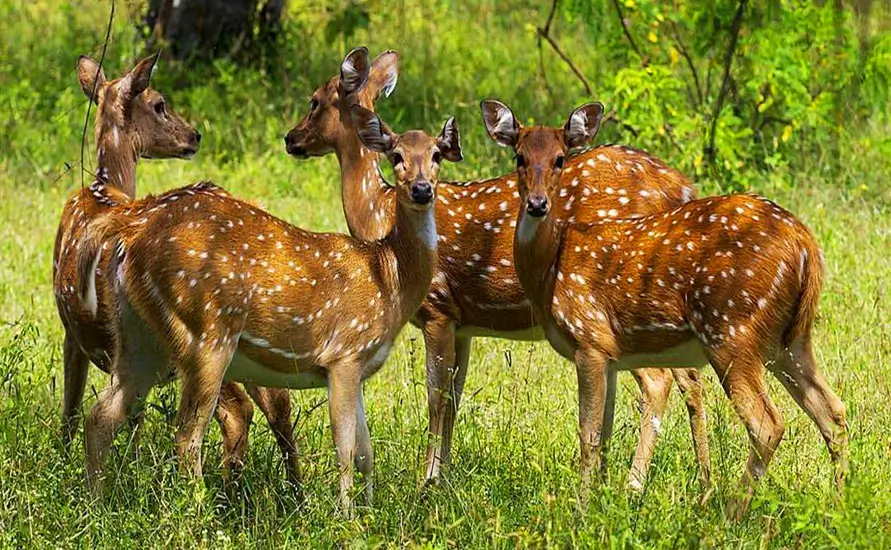
A knock and a tray of coffee come before daylight, and by sunrise you are back at the reception for the morning safari. In winter the grasslands are often covered in a thin mist, and the first rays of sun light up the dew on spider webs between the bushes. Dawn is when Bandipur is most active, with herds of chital moving out of cover to feed, wild boar trotting along the tracks and jungle fowl calling from every direction. Elephant sightings are frequent, and dhole packs, which hunt mainly in daylight, are one of the reserve's specialties for those who are fortunate on the day.
Midday brings time to sort photos, nap or simply sit on the veranda and watch the garden. Many forest-edge resorts here have small waterholes or bird baths within sight of the rooms, and on hot afternoons they attract white-browed wagtails, red-vented bulbuls, purple sunbirds and the occasional jungle babbler troop squabbling at the edge. Your naturalist can also take you on a short guided walk along the resort boundary, outside the park, to look for butterflies such as the southern birdwing, the largest in India, and the blue Mormon, which is often seen feeding on flowering shrubs.
Your second outing of the day heads out on a fresh allocated route where the department allows it. By now your eye has adjusted to the forest, and you will start picking out things yourself: the flick of a sambar's ear in the shade, the shape of a crocodile in a waterhole, or a leopard's tail hanging from a tree. Reserve rules ask visitors to stay seated, keep voices low and never call out to animals, and the drivers here are strict about it. You return to the resort as it gets dark, with time for a warm drink before a dinner of Karnataka dishes. Overnight in Bandipur.
A short morning drive carries you south across the state border into Tamil Nadu and the Mudumalai Tiger Reserve. The highway runs through continuous forest, and the Moyar River marks the line between the two states. Your driver stays alert here, because elephants and gaur often cross the road, and a stop at a safe spot lets you scan the trees for Malabar giant squirrels feeding high in the canopy. You check in to a lodge near Masinagudi, on the reserve's eastern side, where meals are included and the gardens look out toward the Nilgiri escarpment rising sharply behind.
Late morning is spent at Theppakadu, the reserve headquarters on the Moyar, where the forest department runs a long-established camp for working and rescued elephants. You watch from the public viewing area as mahouts bring their elephants to the feeding line and prepare portions of cooked grain and jaggery. Visitors do not ride, touch or feed the animals, and the camp's role today is care and forest patrol work rather than entertainment. Your naturalist explains how orphaned calves are raised here and why some elephants can never return to the wild after years of living alongside humans.
In the afternoon you join a forest department safari through Mudumalai, which is drier on its eastern side and greener toward the west. Spotted deer are common around Theppakadu, and the open grassland near the river often holds gaur and wild boar. Both big cats live here in healthy numbers, but the forest is large and thick, so patience matters more than distance covered. Birdlife includes the Malabar lark, the yellow-footed green pigeon and the brown fish owl, which sometimes perches by the water at dusk. You return to Masinagudi for dinner and an early night. Overnight in Masinagudi.
One more dawn drive in Mudumalai starts the day, again on a route assigned by the department. Morning sessions tend to be the most productive here, as animals are still out in the open until the sun drives them into shade. Watch for the four-horned antelope, a shy and rarely seen species found in the drier forest, and for sloth bears returning late from a night of digging for termites. The calls of the jungle babbler, the rattle of the white-cheeked barbet and the human-like whistling of the Malabar whistling thrush by the streams fill the air as the sun comes up behind the hills.
Nothing else is planned today. The Masinagudi area lies in the rain shadow of the Nilgiris, and from the lodge gardens you can often see vultures riding the thermals overhead. This is one of the last breeding areas in southern India for several vulture species that nearly vanished in the 1990s and 2000s, after a veterinary painkiller used on cattle poisoned the carcasses they fed on. Your naturalist can tell the story of how the drug was banned and how local groups now monitor nests. It is one of the most hopeful conservation stories in India, though the birds remain critically endangered.
Before dinner, a short drive along a village road outside the core zone gives a last look at the dry scrub forest of the plateau, where blackbuck are absent but chital, peafowl and the occasional jackal are common. Elephants sometimes walk through Masinagudi village itself, and people here move about with a calm caution that tells you how normal such encounters are. Use the evening to pack, since tomorrow you leave the lowlands for the hills. Your naturalist from the Karnataka and Tamil Nadu leg hands over to the team in the Nilgiris and Anamalais, and shares a final checklist. Overnight in Masinagudi.
The climb to Ooty is short in kilometers but steep in height. Your driver takes the narrow escarpment road, with its long string of tight bends, at a careful pace and in low gear. Each bend offers a wider view back over the Mudumalai forest and the dry Sigur plateau, and the air cools noticeably as you gain height. Halfway up, the scrub gives way to deciduous trees, then to tea bushes, eucalyptus and finally the open rolling downs of the upper Nilgiris at more than 2,000 meters. Bring a warm layer within reach in the car, as the change in temperature is sudden.
Ooty, officially Udhagamandalam, served the British as the hot-season seat of the Madras government, and its colonial churches, cottages and clubs still show it. For wildlife enthusiasts, though, the real interest lies in the remaining patches of shola forest, a type of stunted evergreen woodland found only in the high valleys of the southern Western Ghats. These pockets, surrounded by grassland, are home to endemic birds such as the Nilgiri flycatcher, Nilgiri laughingthrush and Nilgiri pipit. You check in to your hill hotel by late morning, giving you time for lunch and a rest before going out again.
In the afternoon your local guide takes you for a walk on the edge of a shola patch near the town, keeping to permitted paths. Moving slowly and listening is the best approach, because shola birds are often heard well before they are seen. The black-and-orange flycatcher, another Western Ghats endemic, flits among the low branches, while grey-breasted laughingthrushes call noisily from the undergrowth. Evenings in Ooty can be cold enough for a wood fire, especially from December to February. Dinner is at the hotel, and you can expect a quiet night after a week of early safari alarms. Overnight in Ooty.
The morning starts at Ooty station, where you board the Nilgiri Mountain Railway for the downhill ride to Coonoor. Opened to Ooty in 1908 and now on UNESCO's World Heritage list, the line twists through tea estates, eucalyptus plantations and short tunnels, stopping at small halts such as Lovedale and Wellington. Seats on the toy train sell out quickly in peak season, so we book them as soon as your tour is confirmed, subject to availability. Your car meets you at Coonoor, saving the return trip and leaving the rest of the morning for birds.
Sim's Park in Coonoor is a botanical garden laid out on a steep slope in the 1870s and planted with trees from many parts of the world alongside native species. Its terraces and paths are a reliable place for highland birds, and on a quiet morning you may see the Nilgiri wood pigeon, the small sunbird and the brilliant scarlet minivet. Your guide also knows the trees that flower at different times of year and attract nectar-feeding species. Afterward you drive a short way to one of the viewpoints over the Coonoor gorge, where the hills fall steeply toward the plains of Mettupalayam far below.
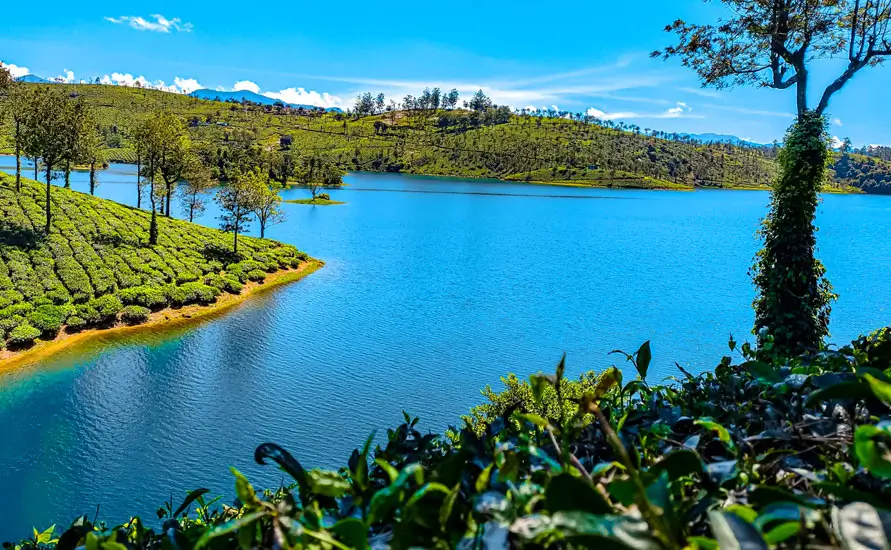
Lunch is at a café in Coonoor, after which the car brings you back up to Ooty through tea country. If you would like to know how Nilgiri tea is made, a short stop at a working tea factory along the road shows the withering, rolling and drying stages, and the tasting room lets you compare different grades. Keep the remaining hours light, since a long drive follows tomorrow. Evening is a good time to buy local eucalyptus oil, cardamom and homemade chocolate, or simply to sit by the lake while mist settles over the ridges. Overnight in Ooty.
This is one of the longest road days of the trip, so you leave Ooty right after breakfast. The descent off the Nilgiris through Coonoor and Mettupalayam is followed by a flat stretch around the western edge of Coimbatore and south to Pollachi, whose markets trade in coconuts, jaggery and cattle. The plains here are dotted with coconut groves, banana fields and wind turbines, and your driver stops for a South Indian lunch in Pollachi to split the day. From there the road heads toward the Anamalai Tiger Reserve, whose forested ridges rise ahead of you on the horizon.
At the foot of the hills lies Aliyar Dam, after which the road climbs the forty hairpin bends of the Valparai ghat, each one numbered on a roadside board. Several viewpoints on the climb look back over the reservoir and the plains, and on the rocky slopes higher up, Nilgiri tahr are sometimes seen grazing near the road. Monkeys gather at some bends because travelers feed them, which harms the animals, so we never stop to feed and ask you not to either. The drive takes about an hour from Aliyar, depending on traffic and how often you stop for the views.
Valparai itself sits at about 1,100 meters on a plateau surrounded by tea and coffee estates, with patches of original rainforest left in the valleys and along streams. Three nights follow in a planter's bungalow or a small resort among the estates, on a breakfast and dinner basis. Elephants often move through the estates at night, and in the evening a local naturalist from the area briefs you on the rules for walking in the region and on recent animal movements. The cool, damp air and the sound of streams make a pleasant change from the dry plains. Overnight in Valparai.
Straight after breakfast, your naturalist leads you to one of the rainforest fragments near Puthuthottam, where a troop of lion-tailed macaques has lived among the trees bordering the estate road for many years. These black monkeys with a silver mane around the face live nowhere outside the Western Ghats and rank among the most endangered primates in India. The troop here crosses the road between tree patches, and canopy bridges of rope have been put up by conservationists to help them avoid traffic. Please keep well back, offer no food and stay on the roadside when they move past.
Valparai is a good place to see how wildlife survives in a working landscape. Since the 1990s, researchers from the Nature Conservation Foundation have studied the rainforest remnants scattered among the tea estates and worked with plantation companies to restore native trees along streams. Your naturalist explains how these fragments act as stepping stones for macaques, hornbills and Malabar giant squirrels, and how the area runs an early-warning system for elephants entering towns at night, with text messages and roadside lights. It is a useful lesson in coexistence, and it makes the morning's sightings more meaningful.
In the afternoon you drive to a viewpoint on the plateau's edge, where the forests of the Anamalai hills stretch toward Kerala. Great hornbills, the largest of India's hornbills, are sometimes seen flying across the valleys with a loud whooshing of wings, and Malabar grey hornbills are common in the estate shade trees. Late in the day, sambar and gaur may come out to graze on the edge of tea fields, while birders can watch for the white-bellied blue flycatcher and the Malabar trogon in the forest patches. You return to your bungalow for a home-cooked dinner. Overnight in Valparai.
Halfway through the trip, this is the second planned day of rest, and the plateau's cool climate is a good place for it. There are no safaris today and no early alarm. Breakfast can be taken late on the veranda, where white-cheeked barbets and greater flamebacks are often heard in the shade trees. For those who want to stretch their legs, a gentle walk through the tea rows with an estate worker or guide shows how the bushes are pruned and how the leaves are plucked. Elephants occasionally pass through the estates, so walks follow advice from the local naturalist on recent movements.
Plantation life has shaped Valparai since the British opened the first estates in the late nineteenth century, clearing large areas of forest for tea and coffee. Many of the workers' families came from the plains of Tamil Nadu generations ago, and the small temples, schools and shops that dot the estates are part of that story. A factory tour to watch green leaf turned into black tea is easy to add, or you can simply rest, read and catch up on your notes. Laundry is easy to arrange today, which is helpful halfway through a three-week trip.
Late in the afternoon, an optional short drive to a stream or forest patch near the town gives a chance to look for the Nilgiri langur, a glossy black monkey with a golden-brown head, and for frogs and butterflies along the water. As evening falls, nightjars begin calling over the tea fields, and the clear sky on a dry night can show a huge spread of stars. Pack your bag before dinner, as tomorrow is a long drive into Kerala. Your naturalist shares a quick overview of what to expect in Munnar and the parks beyond. Overnight in Valparai.
An early start takes you back down the forty hairpins to the plains, and then east and south past Udumalpet, a town surrounded by coconut farms and wind turbines. This is the second long road day, and your driver plans a relaxed tea stop and a light lunch along the way. The route turns west toward the Kerala border, and the hills reappear as a dark wall of hills on the horizon. Watch for the Amaravathi reservoir on the left as you approach the foothills, another dam that has shaped the wildlife and farming of this region.
Crossing into Kerala, the road passes through Chinnar Wildlife Sanctuary, a dry thorn forest that receives only a small share of the monsoon rain, so the landscape here looks almost like a desert compared with Valparai. This is the main stronghold in South India of the grizzled giant squirrel, a greyish, long-tailed squirrel that feeds in the riverside trees along the Chinnar and Pambar rivers. Your guide knows where they are most often seen, and a short stop at a permitted viewpoint gives you a fair chance. Star tortoises, mugger crocodiles and many dry-country birds also live in this sanctuary.
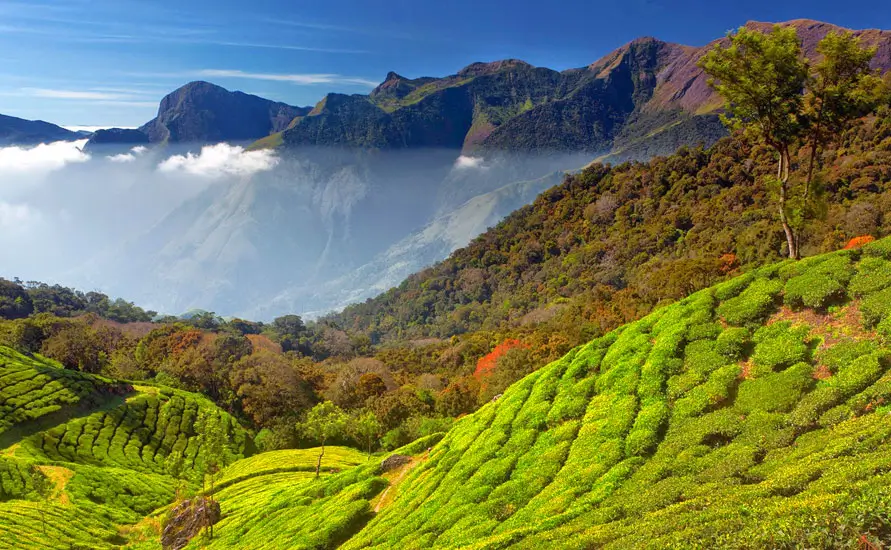
Beyond Chinnar the road climbs to Marayoor, where wild sandalwood grows under guard and old dolmens, prehistoric stone tombs scattered on the hillsides. From there you continue into the tea estates around Munnar, which cover the slopes in neat green rows like a rumpled carpet. A hill resort among the plantations is your base, and you arrive with the evening still free. Munnar can be cool at night and misty in the mornings, so the warm layers from Ooty will be useful again. Dinner is at the resort. Overnight in Munnar.
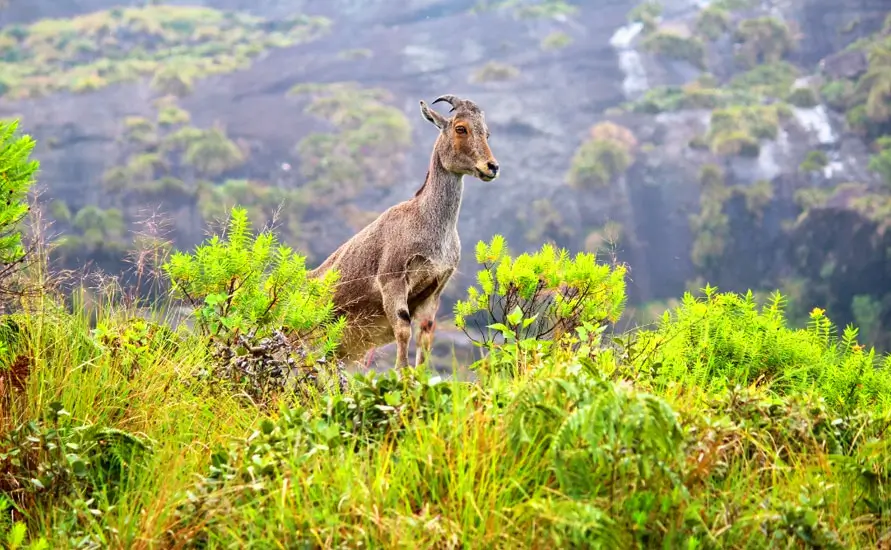
Fifteen kilometers of road separate Munnar from Eravikulam National Park, where more Nilgiri tahr live than in any other single reserve; this stocky mountain ungulate is restricted to the high Western Ghats. Visitors leave their cars at the forest department's entry point and travel by department bus to the Rajamala tourism zone, where a paved path climbs along the slopes. Every year the park shuts while the young are born, normally for part of February and March, and we check the closure window against your dates. Entry tickets are limited each day, so we aim for the earliest time slot to avoid crowds.
The tahr here are used to people on the path and often graze close by, giving good views and photographs without any need to approach them. Please stay on the walkway and do not feed or touch the animals, as forest staff enforce these rules strictly. Above you rises Anamudi, which tops out near 2,695 meters and beats every summit south of the Himalayas, often hidden in cloud by late morning. Roughly every twelfth year the hillsides go purple-blue with neelakurinji blossom, most recently in 2018. In other years the grassland is still worth seeing for its wildflowers and birds.
After lunch, an escorted walk among the tea bushes and along a shola edge gives birders a chance to look for the Nilgiri pipit, the white-bellied shortwing and the Kerala laughingthrush, a Munnar specialty. Your guide also describes how Scottish planters began clearing these slopes for tea in the 1870s, and how plantations replaced much of the original grassland. You can end the day at a viewpoint over the estates or visit the tea museum in town for an overview of the industry. Dinner is at the resort, and you can expect a cold night at this altitude. Overnight in Munnar.
Down from the hills you go after breakfast, following a winding road past cardamom plantations, waterfalls and small towns. The temperature rises as you lose height, and the vegetation changes from tea and eucalyptus to the dense green of the lowland forest. Your driver stops at one of the waterfalls near the road if it is running well, and at a roadside stall for fresh pineapple, which is grown widely in this part of Kerala. You reach Thattekad by lunchtime, and two nights are booked at a simple riverside or forest-edge lodge, where breakfast and dinner are included.
Thattekad Bird Sanctuary, officially the Salim Ali Bird Sanctuary, was declared in 1983 and named after India's best-known ornithologist. Salim Ali surveyed the area in the 1930s and rated it among the finest places for forest birds anywhere on the peninsula. The sanctuary covers a mix of evergreen forest, deciduous patches, streams and the banks of the Periyar River, and more than 300 bird species have been recorded here. It is the best place on this tour for forest birds, and for many keen birders it is the main reason to plan a trip to South India in the first place.
Around four o'clock a specialist birding guide collects you, many of whom in Thattekad come from families who have guided ornithologists for decades. A walk along the forest edge and the river might turn up the Malabar grey hornbill, the white-bellied treepie, the Indian pitta in winter, or a crimson-backed sunbird feeding on flowering trees. Evening is a good time for owls, and your guide may know where a brown hawk owl or a mottled wood owl has been roosting. Playback of bird calls is not used on our walks. Dinner is at the lodge. Overnight in Thattekad.
The best birding at Thattekad happens at dawn, so you set out with your guide shortly after first light. A small entry fee is charged at the sanctuary, and walks follow permitted paths through the forest. The prize for many visitors is the Sri Lanka frogmouth, a nocturnal bird with feathers like dead leaves that roosts motionless by day on low branches. Guides here often know where pairs are roosting, but they move from time to time, so a sighting is likely rather than certain. Other targets include the Malabar trogon, whose male wears a rose-red front, and the black baza, a small crested hawk.
After a late breakfast at the lodge, you can rest during the hot hours or join a short canoe trip on the Periyar River if water levels allow. Seen from the water, the riverbank shows a different set of birds: kingfishers of several species, darters, little cormorants and the occasional osprey. It also helps to know the fruit trees in flower or fruit, where barbets, bulbuls and green pigeons gather. If you are a photographer, ask your guide about hides near fruiting trees or water, which give good views of shy species without disturbing them.
A second walk late in the afternoon covers a different part of the sanctuary or the farmland around it, where open habitat adds new species. The Indian swiftlet, chestnut-headed bee-eater and various raptors are often seen here, and with luck the great hornbill crosses the river. Dusk is again a good time for nightjars and owls, and your guide may take you to a spot to listen for the Sri Lanka frogmouth's calls. Back at the lodge, you can go through your list with the guide, who will often help confirm difficult identifications from your photos. Overnight in Thattekad.
After an early breakfast the route turns south-east, up into the Cardamom Hills toward Thekkady, the town at the entrance of Periyar Tiger Reserve. The road climbs again through rubber and spice plantations, small hill towns and patches of forest, and the air cools as you rise. Your driver splits the drive with a lunch stop and, if you would like, a visit to a spice garden along the road to see cardamom, pepper, nutmeg, cinnamon and cloves growing. Cardamom thrives under the shade of tall trees, and the Cardamom Hills supply a large part of India's harvest each year.
Your rooms for the next two nights are at a resort beside the Thekkady forest, on a half-board plan. Periyar Tiger Reserve was declared in 1978 around a lake created by the Mullaperiyar Dam, finished on the Periyar River in 1895. Today it is widely respected among Indian reserves and is known for its community-based ecotourism, in which local people, many from tribal communities, work as guides and forest watchers. Your guide here comes from one of these programs and knows the forest intimately, from the elephant paths along the lake to the trees where hornbills nest each spring.
Nothing is booked for the afternoon. Stroll through Kumily, the small market town next to Thekkady, where little shops weigh out cardamom pods and peppercorns, or attend an optional evening performance of Kalaripayattu, Kerala's traditional martial art, at a local theater. Birders might prefer to stay at the resort, where the gardens often hold hornbills, flowerpeckers and orange minivets. Your guide also briefs you on tomorrow's activities: the forest department nature walk and the boat cruise on the lake, both booked ahead through official counters and subject to availability. Overnight in Thekkady.
Before sunrise you meet your guide at the forest department's reporting point for an escorted nature walk in Periyar Tiger Reserve. Groups are small, and the trail follows a set route through evergreen and semi-evergreen forest and along the lakeshore. Wear leech socks, which the forest department often provides, especially after rain. On foot you notice things that a vehicle misses: tracks in the mud, scratch marks on trees and the calls of birds hidden in the canopy. Sambar, wild boar, Nilgiri langur and Malabar giant squirrel are common, while elephants and gaur may be seen from a distance.
After breakfast you return to the resort for a rest, and the middle of the day is for a swim or a nap. Periyar also offers other activities run by the forest department, such as bamboo rafting on the lake and longer treks, and these can be arranged on request depending on availability. In the heat of the day, your guide can tell you about the tribal communities of the reserve, including the Mannan and Paliyan people, and their role in protecting the forest. These programs have helped turn former poachers into forest protectors, one of the reserve's most notable success stories.
In the afternoon you board the Periyar boat cruise on the lake, run by the forest department and the state tourism corporation. The lake is dotted with dead tree trunks, the remains of the forest drowned when the dam was built, and these stumps now hold perching cormorants, darters and pied kingfishers. Elephant families often wade in at the shoreline, and gaur, sambar and wild boar graze on the grassy banks. Tigers are present but rarely seen from the boat. Tickets are limited and sold at the boat landing, so we plan ahead to secure your seats. Overnight in Thekkady.
The final drive of the tour brings you down from the Cardamom Hills to the coast at Kochi. The road winds through tea and cardamom estates, then rubber plantations and small towns, until the land levels into the palms and rice land of central Kerala. A lunch break on the road gets you into Kochi in the early afternoon. Tonight's hotel is either in Fort Kochi or across the water in Ernakulam, depending on your preference, for your final night in South India. The humid, salty sea air is a reminder of how far you have come.
In the late afternoon you visit Mangalavanam Bird Sanctuary, a small patch of mangrove forest right in the middle of the city, close to the High Court. Despite its size, it is an important roosting site for herons, cormorants and egrets, which fly in from feeding grounds around the backwaters as evening falls. Your guide explains how mangroves protect the coast from erosion and serve as nurseries for fish, and how Kochi's growth threatens these patches. It is a fitting final stop for a wildlife tour, showing that even in a crowded city, nature finds a place.
After the sanctuary, you can stroll the Fort Kochi seafront, where the Chinese fishing nets stand against the sunset sky. For a farewell meal, ask your guide about a local place serving karimeen pollichathu, where the fish is wrapped in banana leaf with spice paste, or a mild coconut fish curry. This is a good time to go through your checklist one last time and count the species you have seen over three weeks. Many guests find the total surprising, especially for birds. Packing tonight keeps tomorrow morning calm. Overnight in Kochi.
Pickup is timed around your flight, with Cochin International Airport roughly an hour from Fort Kochi depending on traffic. Kochi has good connections to the Gulf and Southeast Asia for flights onward to Europe, North America and Australia. Late flights can be bridged with an extra night or a day-use room on request. Our representative helps with your luggage and waits with you up to the terminal doors, and our team remains on call by phone until you are safely checked in.
Over three weeks you have crossed four protected landscapes, from the dry forests of Karnataka to the rainforests and grasslands of Kerala, with enough time in each place to look closely. That is the idea behind the South India Wildlife Tour 3 Weeks: slow travel that leaves room for both luck and rest. Should you want another trip, the Andaman reefs, the wetlands of Tamil Nadu or the tiger country of Madhya Pradesh would make good next chapters. Thank you for spending these weeks with us, and have a safe flight home.
Your Journey

N.S. Rathore & Mrs. Omlata Rathore · Managing Director
We still read every enquiry ourselves. Tell us the places you liked and our planners will send a day-by-day route with drive times and a clear price.
Every package can be customised and no pressure to book. A planner from our office replies within 24 hours with a route written for your group.
Fill this in and your planner will send a first draft itinerary.
Explore more
Kerala Backwaters Escape Kerala Backwaters Escape
 Kerala Backwaters Escape
 Kerala Backwaters Escape
 Kerala Backwaters Escape
 Kerala Backwaters Escape
 Kerala Backwaters Escape
 Kerala Backwaters Escape
 Kerala Backwaters Escape
 Kerala Backwaters Escape
 Kerala Backwaters Escape
 Kerala Backwaters Escape
 Kerala Backwaters Escape
 Kerala Backwaters Escape
 Kerala Backwaters Escape
 Kerala Backwaters Escape
 Kerala Backwaters Escape
 Kerala Backwaters Escape
 Kerala Backwaters Escape
 Kerala Backwaters Escape