 Kerala Backwaters Escape

Kerala Tour Packages
Bekal – Kannur – Kozhikode – Wayanad – Thrissur – Kochi – Munnar – Thekkady – Kumarakom – Alleppey – Varkala – Kovalam
At a glance
Kerala is a long, narrow state, roughly 580 km from its northern tip to its southern border, and most visitors only ever see the bottom half. A Kerala tour 3 weeks long changes that. You land in Mangalore, just over the border, and begin at Bekal Fort on the Malabar coast, then work your way south through the ritual dance country of Kannur, the old spice port of Kozhikode, the coffee hills of Wayanad and the temple town of Thrissur, before reaching the better-known stops of Kochi, Munnar, Thekkady and the backwaters.
Twenty nights let the pace stay relaxed. Most places get two nights, drives rarely exceed four hours, and the one longer road day, from Wayanad down to Thrissur, is followed by a calm sightseeing day. The southern half covers Fort Kochi, the tea estates of Munnar, the spice farms of Thekkady, a lakeside night in Kumarakom, a private houseboat from Alleppey, and then two beach stops: the laterite bluffs above Varkala, then Kovalam with its lighthouse and sheltered bays, close to Trivandrum airport for your flight home.
Our 3-week Kerala itinerary suits retired couples and slow travelers flying in from the States, Canada, Britain, mainland Europe or Australia, along with NRI families whose grandparents came from Malabar and who want both ends of the state in a single trip. One driver and car handle nearly the whole route, and English-speaking guides join you in each region. Plan for November to March, when the weather is dry and the Theyyam season in North Kerala is at its height.
Your trip begins in Karnataka, at Mangalore International Airport, which has direct flights from Dubai, Abu Dhabi, Muscat, Doha and other Gulf hubs and sits closer to Bekal than any Kerala airport. Our Malabar representative greets you outside the terminal doors, and your luggage goes into the car that will stay with you for most of the coming three weeks. Mangalore's runway is built on a flat-topped hill, so the first scenery is red earth and cashew orchards before the road slopes toward the shore. Inside thirty minutes the state line slips past and you are in Kasaragod, the northernmost district of Kerala, a border district whose bazaars switch easily between Malayalam, Kannada, Tulu, Beary and Konkani.
The coastal highway runs past mosques with green domes, small Hindu shrines, fish auctions and long stretches of coconut groves. Kasaragod has a strong Muslim trading community with family links to the Gulf, and you will notice many homes built with money sent back from Dubai or Doha over the last fifty years. Ask for a pause at any roadside cart selling tender coconuts or sugarcane juice pressed while you wait. The whole transfer to Bekal rarely takes more than ninety minutes, so you should be at your beach resort with the afternoon still ahead and plenty of hours to sleep off the long flight.
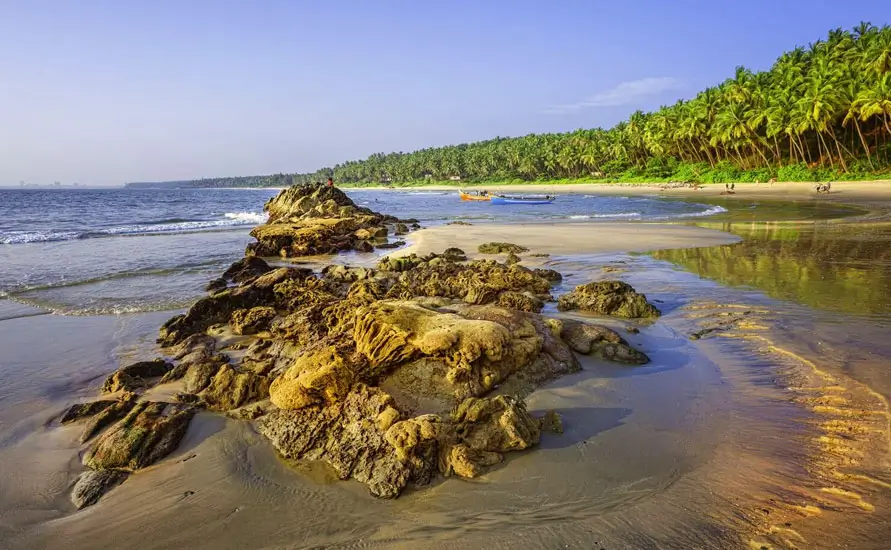
Recover by the pool, or wander barefoot on the sand in front of the resort; beaches up here are long and broad, and on a weekday you may share a kilometer of shoreline with nobody but crabs. Fishermen pull their boats up onto the shore in the late afternoon, and you can watch the catch being sorted into baskets for the evening market. At dusk the dark outline of Bekal Fort shows on the headland to the north. Someone from our office rings your room after dinner to check that everything is in order and to fix tomorrow's pickup time. Overnight in Bekal.
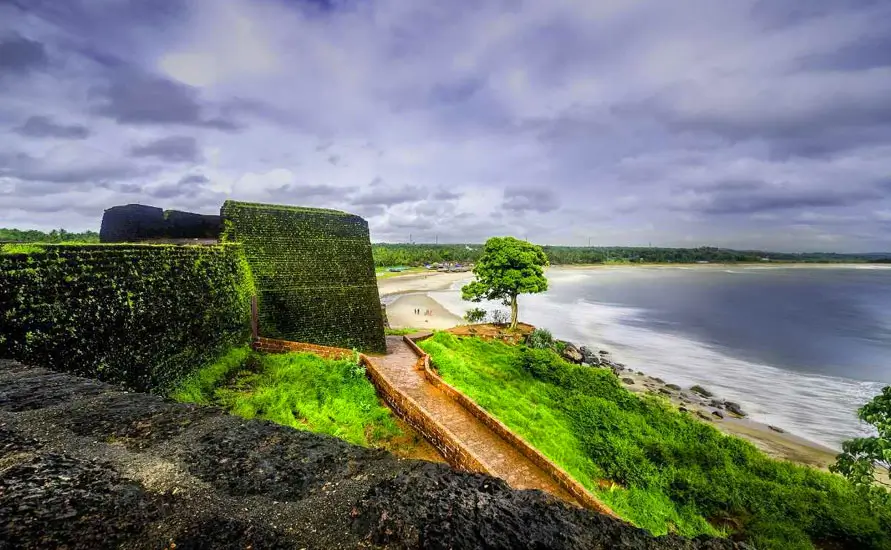
Begin early at Bekal Fort, before the sun gets strong and while the laterite walls still glow a soft orange. Shivappa Nayaka, ruler of the Keladi kingdom based in present-day Karnataka, raised it in the mid-1600s, and at about 40 acres it ranks as the biggest fort anywhere in Kerala, sitting on a headland that pushes into the sea. Seen from the air, its outer wall traces the shape of a keyhole, and the slits in the ramparts were angled so cannon could reach targets near and far. A ramp leads up to the observation tower, where you look down on the waves breaking against the walls and the curve of beach running south toward Pallikere.
Who held the fort next is a story your guide tells well: it passed from the Nayakas to Tipu Sultan of Mysore and and finally, by the 1790s, into the hands of the English Company. Near the entrance stands a Hanuman temple, and just outside the walls is an old mosque said to date from Tipu's time, showing how the communities of this coast have long lived side by side. After a break for tea, you drive about 20 minutes north to Chandragiri Fort, a smaller ruin on a hill above the meeting point of the Chandragiri River and the sea. Its broken walls matter less than the outlook: a wide estuary, sandbars and endless palm crowns.
After lunch you head south to Valiyaparamba, the backwater system of North Kerala, where four rivers feed a long lagoon dotted with small islands. Instead of the busy houseboat routes in the south, you take a two-hour ride on a local country boat or a small motor launch, gliding past coconut farms, mangrove edges and fishermen casting their nets by hand. Very few foreign travelers come here, and children on the banks will often wave as you pass. You return to Bekal around sunset, with time for a swim at the resort or a quiet walk on the beach before dinner. Overnight in Bekal.
Breakfast done, the car turns south into Kannur district, which the British spelled Cannanore and which Keralites still link with three things: handloom textiles, the ritual art of Theyyam, and a long tradition of Kalaripayattu schools. The highway passes through Nileshwar, whose former royal family were patrons of temple arts, and Payyanur, known for its bell-metal craft and the temple of Subramanya. On the way your guide explains the local calendar and how families hold shrine festivals in the dry months, many of which include Theyyam rituals that outsiders are welcome to attend quietly from the edges of the shrine yard.
Kannur appears before noon, and you settle into a heritage homestay or a hotel by the sea. After lunch, a visit to a weaving co-operative shows why Kannur cloth is known worldwide, where workers produce bed linen, towels and fabric on power looms and wooden handlooms for export markets in Europe and the Gulf. Kannur's weaving history goes back several centuries, and the co-operative movement helped many families keep the craft alive. Watching the shuttles race across the warp is oddly calming, and the shop at the entrance sells good-value table linen and cotton towels that pack flat. Prices are fixed and marked, so haggling is pointless.
Travel dates from December through March may give you a first chance tonight to see Theyyam, the ritual performance in which a dancer becomes the vessel of a local deity, wearing huge headdresses, painted faces and costumes made of palm fronds and red cloth. Each village shrine, or kavu, sets its own calendar, with rites that often run through the night or begin before first light, and the dates shift every year, so we check the local schedule in advance and adjust your days in Kannur accordingly. Dress modestly, follow your guide's lead and keep flash photography to a minimum. Outside the season you can visit a Kalari school instead. Overnight in Kannur.
Mid-morning is time for St. Angelo Fort, raised in 1505 on the orders of Francisco de Almeida, who arrived that year as Portugal's first viceroy in the East, with the consent of the local Kolathiri king. The triangular laterite fort was later held by the Dutch, who sold it to the Arakkal family, and then by the British, who made it their main military post on the Malabar coast. Today it is a protected monument with cannon, a moat, a lighthouse view and quiet lawns overlooking Mappila Bay, where colorful fishing boats crowd the harbor. Your guide points out the Dutch painting of the fort, now kept in the Rijksmuseum in Amsterdam.
Close to the bay, a restored durbar hall now serves as the Arakkal Museum, a relic of Kerala's sole Muslim ruling dynasty. Its rulers carried the title Ali Raja for men and Arakkal Beevi for women, and the family followed a matrilineal line of descent, which was common in Kerala but unusual for a Muslim dynasty. The rooms display furniture, old weapons, copper vessels, telephones and portraits; Monday is its weekly holiday. Afterward, your guide may suggest lunch at a local restaurant famous for Malabar biryani, which is cooked with short-grain kaima rice rather than the long basmati used in North India.
Spend the late afternoon at Payyambalam Beach, a long stretch of sand on the north side of town backed by a park and a large sculpture of a mother and child by the Kerala artist Kanayi Kunhiraman. The beach is popular with local families in the evening, and food carts sell grilled corn, spicy peanuts and fresh lime soda. If a Theyyam is scheduled tonight or early tomorrow, your guide will brief you on timings and arrange the car; if not, stay on the sand until dark or order a plate of mussels, Kannur's favorite seafood, at a restaurant facing the water. Overnight in Kannur.
Today's drive covers less than 100 km but packs in a string of interesting stops. First comes Muzhappilangad Drive-in Beach, where the sand is so firm that cars and motorbikes can drive along nearly 4 km of shoreline. Your driver eases the car down onto the hard sand and cruises along the surf line, before you continue to Thalassery, once a British trading post for pepper and cardamom. Here you visit the Thalassery Fort, a square stronghold that English merchants completed in 1708, and walk past the Gundert Bungalow, where a German missionary compiled the first Malayalam-English dictionary in the 19th century.
Thalassery also has a strong claim to be the birthplace of cricket in Kerala, introduced by British officers in the early 1800s, and the town is known for its circus artists, cakes and biryani. A few kilometers further south lies Mahe, a sliver of land that France governed until 1954 and that New Delhi still administers as part of Puducherry rather than Kerala. It has a riverside promenade, the Church of St. Theresa and a French-era feel in its streets, though it is much smaller than Pondicherry. Traffic slows down here because Mahe is known for cheap liquor stores, and you will notice cars from all over Kerala stopping to shop.
The last stop before the city is Kappad Beach, where a simple stone pillar marks the spot where Vasco da Gama and his crew stepped ashore in 1498, ten months after sailing out of Lisbon, and became the first European to arrive in India by an all-sea route. The rocky headland and quiet sand give little hint of how much this moment changed world trade, and your guide explains how the Portuguese arrival affected the Zamorin's kingdom and the spice merchants who ruled the coast. Kozhikode is reached before sunset, leaving the evening for its long city beach, where families gather to eat kallummakaya, fried mussels, from the stalls. Overnight in Kozhikode.
Start the day in Beypore, a fishing port where the Chaliyar empties into the sea, roughly 10 km south of Kozhikode. Its shipyards have built the large wooden sailing ships called urus, or dhows, for more than a thousand years, mostly for buyers in the Gulf, and some builders still work without any written plans. You may see a hull in progress, shaped from huge planks of teak and held together with wooden pegs and iron nails, rising slowly above the riverbank. The craftsmen belong to the Khalasi community, famous for their skill in launching these vessels by hand using ropes and pulleys.
Back in the city, Mananchira Square comes first, a large green park built around an old water tank, followed by the Kuttichira quarter with its wooden mosques, including the Mishkal Mosque, which survived a Portuguese attack in 1510. A short stop at SM Street gives you the chance to taste a few samples of Kozhikode halwa and to pick up banana chips fried in coconut oil. Lunch at a family restaurant serving Malabar dishes such as pathiri, a thin rice flatbread, and chicken curry gives you a full-strength introduction to the local cooking style before you head to the hills.
In the afternoon you leave the coast and climb up the Thamarassery Churam, a ghat road with nine sharp hairpin bends and views over the forested slopes. Traffic can be heavy, so your driver chooses the timing with care. At the top, the plateau of Wayanad opens out, a district of coffee and pepper plantations, paddy fields and forests that border Karnataka and Tamil Nadu. Home for two nights is a farm stay or resort set among shade trees, and the evening is best spent on the veranda with filter coffee grown a few steps from your chair. Nights are noticeably cooler up here, so a light jacket helps. Overnight in Wayanad.
Start with the climb to the Edakkal Caves in the Ambukuthi hills, a hike of around half an hour on a rough slope and then up metal ladders bolted to the rock. The so-called cave is a cleft formed when a huge rock split and a boulder became wedged across the gap, creating a natural chamber. Its walls carry carved figures of humans, animals and geometric symbols, thought by archaeologists to go back to the Neolithic period, as well as inscriptions in old Tamil-Brahmi script added much later. Monday closure and a daily visitor limit mean we go early and never schedule it on the wrong weekday.
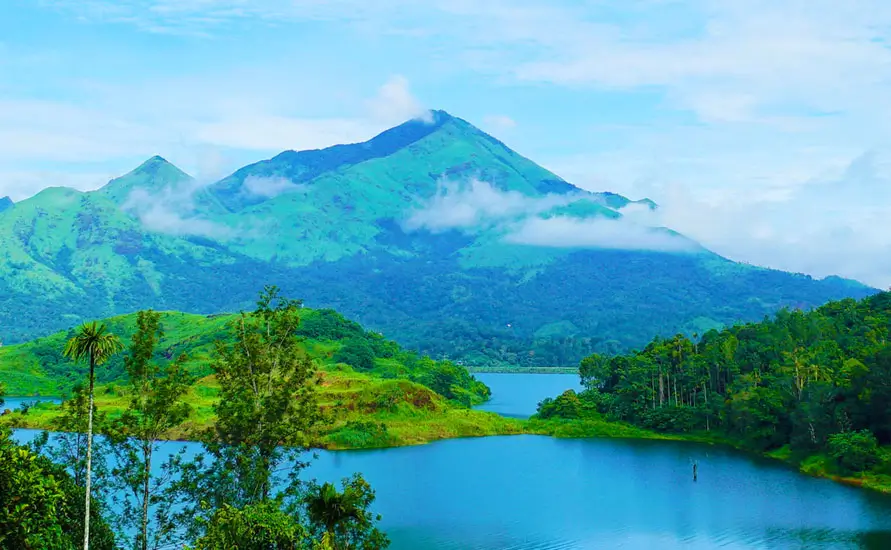
After lunch you drive to Banasura Sagar Dam, the largest earthen dam in India, built across a tributary of the Kabini River. Wooded slopes ring the water, and where the valley flooded, hilltops now poke up as little islands. Speedboats and pedal boats can be hired, and the walkways along the dam crest give long views toward the Banasura hills. Between November and February the coffee bushes you pass on the way carry ripe crimson berries, and harvest crews strip them by hand into sacks; your guide can explain how arabica and robusta are grown differently on these slopes.
If you prefer a quieter afternoon, ask for a guided plantation walk instead, with time to learn about pepper, cardamom and areca nut farming and the work of the tribal communities who have lived in Wayanad for centuries. Hikes up Chembra Peak, known for a small lake in the shape of a heart near the top, need a forest department permit and are sometimes suspended, so we confirm the situation shortly before you travel. Wildlife jeep drives in the Tholpetty or Muthanga sanctuaries can be added if they are open, but sightings of elephants or deer cannot be promised. Dinner tonight is at your resort, where the kitchen may serve bamboo rice or local fish curry. Overnight in Wayanad.
No other drive on this route runs as long as this one, so the car pulls out of Wayanad shortly after breakfast. The drive goes back down the Thamarassery ghat to the coastal plain, then south through Malappuram district, past Kondotty and Perinthalmanna, crossing the Bharathapuzha, the second-longest river in Kerala. Your driver stops for a mid-morning tea break and again for a simple lunch at a clean roadside restaurant. Any small market town on the highway makes a good place to walk around for twenty minutes and buy mangoes, jackfruit chips or sweets for the back seat.
Thrissur comes into view around four or five, and your hotel sits close to the center. The city is called the cultural capital of Kerala because of its temples, festivals and arts schools, and it sits around a large hill crowned by the Vadakkunnathan Temple. Before dinner, wander part of the Swaraj Round, the ring road that circles the temple grounds, where locals walk, shop and sip tea at street stalls. Your guide meets you briefly to go over tomorrow's plans. Overnight in Thrissur.
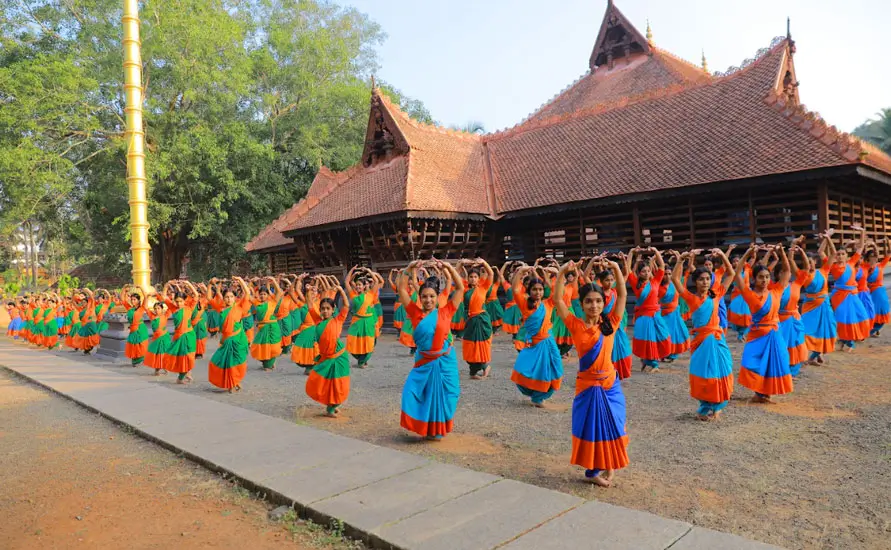
Today's highlight is a visit to Kerala Kalamandalam at Cheruthuruthy, about 30 km north of Thrissur, on the banks of the Bharathapuzha. Set up by the Malayalam poet Vallathol Narayana Menon at a time when Kathakali was fading, it is now the most famous school for Kerala's classical arts, including Kathakali, Mohiniyattam, Kutiyattam and traditional drumming. On weekday mornings, visitors can watch students train in open-sided halls called kalaris, and many begin their practice at dawn with eye exercises and body massage to build flexibility. Classes do not run on weekends or holidays, so we arrange your Thrissur days so that this visit falls between Monday and Friday.
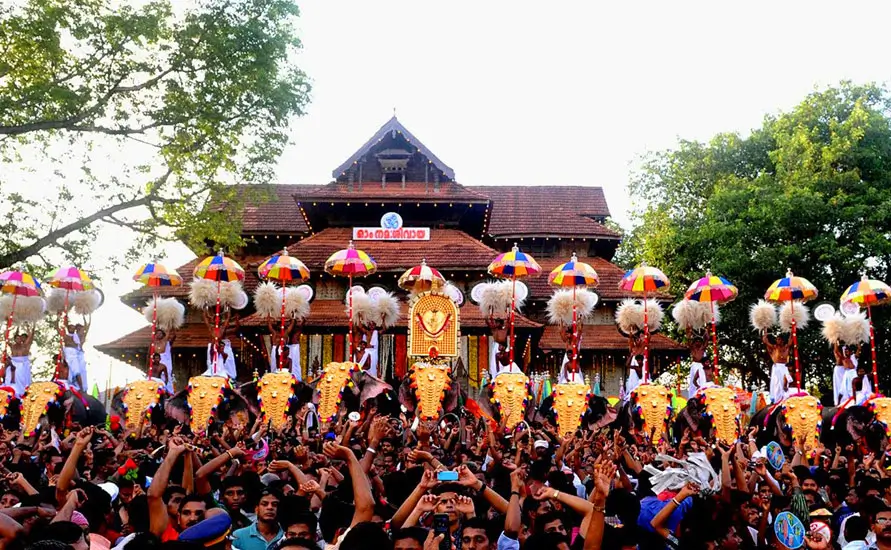
Returning to town, you reach the outer grounds of the Vadakkunnathan Temple, one of the oldest Shiva temples in Kerala, with classic Kerala-style buildings of wood, copper roofs and wall paintings. The shrine itself admits Hindus only, yet the walled compound and the wide Thekkinkadu Maidan around it are open to everyone to walk. This is the stage for Thrissur Pooram, the great temple festival held each April or May, when elephants carrying golden caparisons and parasols line up in rows and drummers play for hours. Your guide shows you where the processions meet and explains how the festival is organized.
In the afternoon you visit the Shakthan Thampuran Palace, a rebuilt palace of the former Kochi rulers that now holds an archaeological museum with bronze sculptures, coins and local artifacts. A short drive away, the Our Lady of Dolours Basilica, often called Puthan Palli, has tall twin towers and a Bible tower, and its Gothic-style interior holds richly painted altars. The church is a reminder of Thrissur's large and old Christian community. For dinner, your guide knows a vegetarian place serving a sadya-style spread on banana leaf, rice ladled out again the moment it runs low. Overnight in Thrissur.
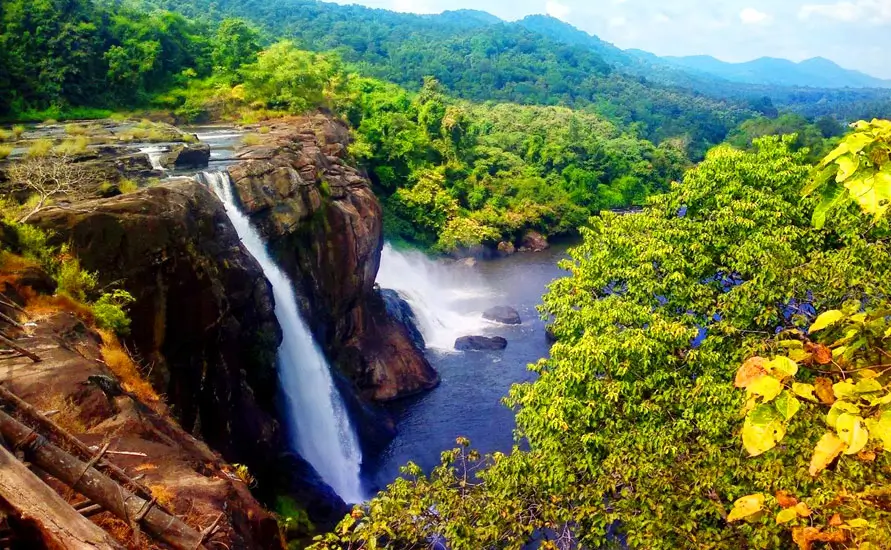
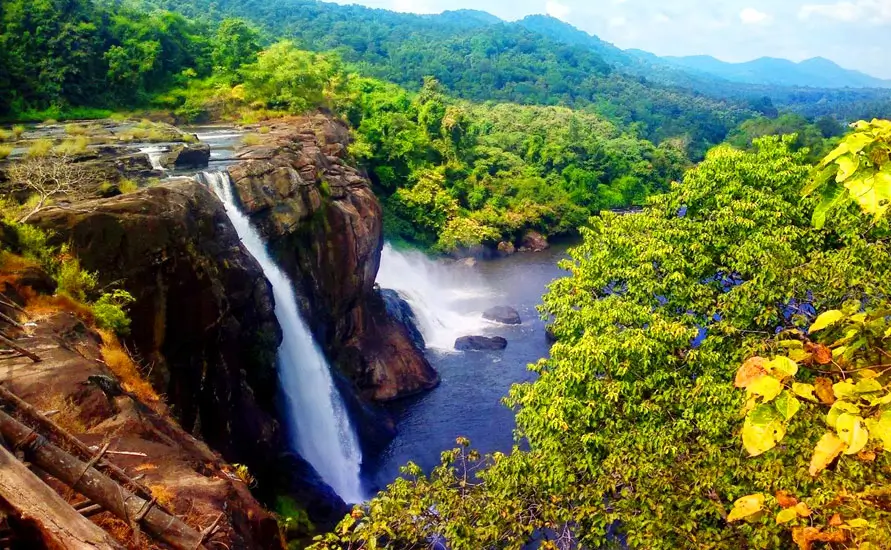
Ninety minutes south-east of Thrissur lies Athirappilly Falls, the largest waterfall in Kerala, where the Chalakudy River spreads across a broad lip of black rock and plunges roughly 25 meters into a wooded ravine. The falls are at their most powerful from July to November, after the monsoon rains, and much gentler by April and May. From the ticket gate a concrete walkway brings you to the upper lookout, and a steeper trail goes down to the base, where the spray fills the air and the sound of the water is loud enough to drown out conversation. The forest around the falls is part of a protected area, so plastic bags are not allowed.
A few kilometers upstream, the smaller Vazhachal Falls tumble over a wide series of rocks, and the road between the two passes through dense forest where hornbills and lion-tailed macaques may be seen by lucky visitors. After a simple lunch near the falls, you drive south through Chalakudy and Angamaly to Kochi, allowing two and a half hours or a little more once city traffic is factored in. The change in scenery is clear as you reach the city, with apartment towers, metro lines and busy roads in Ernakulam before the quieter streets of Fort Kochi on the far side of the harbor. You check in by late afternoon.
Tonight brings a Kathakali performance in Fort Kochi, and it pays to take your seat early, because the actors paint their faces in full view of the audience. Pigments are ground from minerals and plant sources, mixed with coconut oil and built up in layers over more than an hour. The characters are divided into types, with green faces for heroes and kings and red beards for villains, and a brief talk before the play decodes the main mudras the actors use in place of spoken lines. Drummers and singers sit at the side of the stage. Later, walk to a nearby restaurant for a late dinner. Overnight in Kochi.
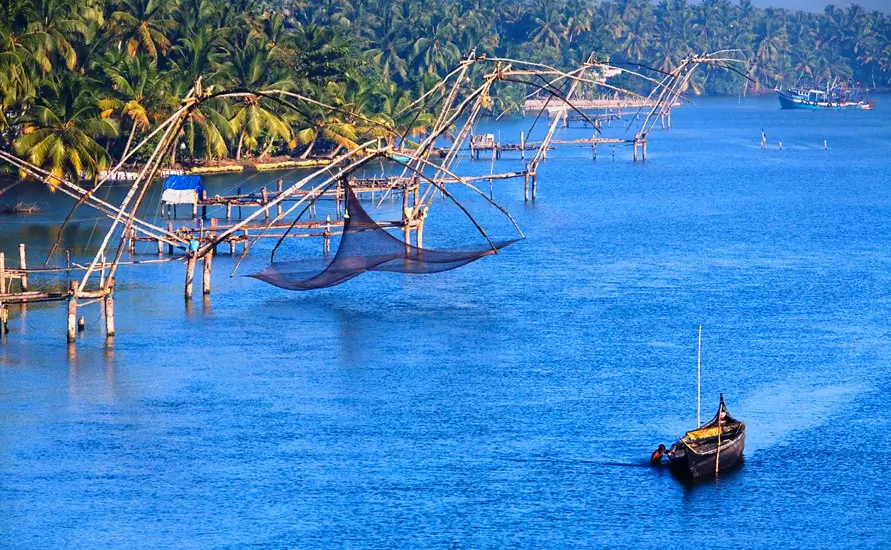
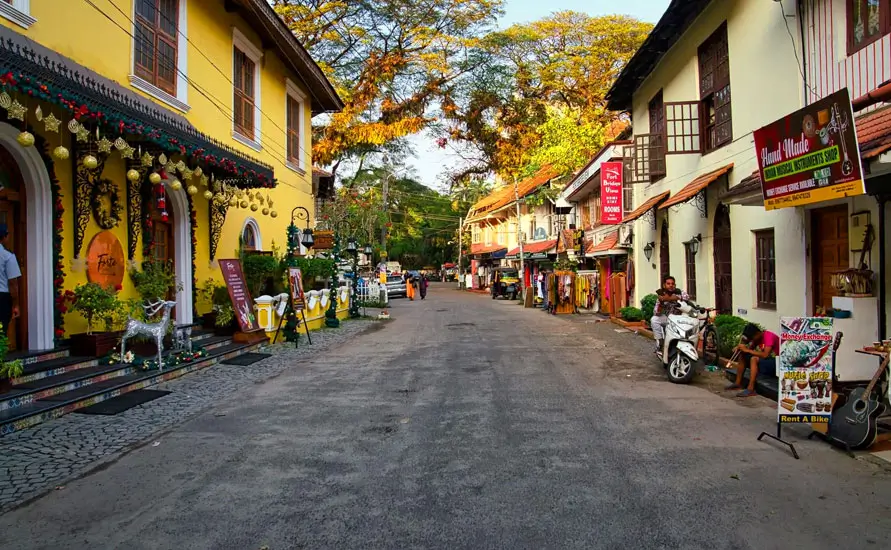
A morning walk in Fort Kochi shows how different trading powers shaped this small peninsula. Your guide leads you past the Chinese fishing nets at the water's edge, where fishermen work the large wooden frames with ropes and stones, and then to St. Francis Church, built by the Portuguese and counted among the earliest European churches on Indian soil, where Vasco da Gama lay for some fourteen years until his son shipped the remains home to Lisbon. You walk down Princess Street with its colonial houses and stop at the Santa Cruz Basilica. Large artworks left behind by the Kochi-Muziris Biennale still decorate many warehouse walls between editions.
In late morning you continue to Mattancherry, where the Portuguese-built Mattancherry Palace keeps its celebrated wall paintings: long Ramayana sequences in earthy pigments, alongside portraits and coronation scenes of the Kochi rajas. Down the street, the Paradesi Synagogue, consecrated in 1568, draws visitors for a floor of blue willow-pattern tiles from Canton and a ceiling hung with glass lamps from Belgium. Timing matters here, because Friday is a no-go for the palace, while the synagogue adds Saturday and the Jewish festivals to its own list of closed days, which is why we fix this day once your dates are known. The surrounding lanes are full of antique dealers, spice warehouses and small museums where you can spend an hour or two browsing.
Later, there is time to rest at the hotel or wander Jew Town for spices, handicrafts and textiles. If you would like to see another side of Kochi, ask for an optional sunset boat ride around the harbor, which passes Bolgatty Island, Vypeen and the busy port. Alternatively, a licensed center in town offers Ayurvedic massage by appointment. For dinner, pick a waterfront kitchen, point at a fish laid out on crushed ice, ask the price per kilo, and decide whether it is fried, grilled or cooked in a coconut gravy. Overnight in Kochi.
Today the sea falls behind you and the mountains take over. Aluva and Perumbavoor pass in a blur of shops and bus stands before Kothamangalam, the final sizeable town ahead of the climb. Here the land becomes greener, with rubber trees, pineapple farms and forests along the Periyar River. Two waterfalls, Cheeyappara and Valara, spill almost onto the asphalt, and your driver stops at both; in the months after the monsoon they are loud and full. Langurs and bonnet macaques hang about the railings, so leave any bananas or biscuits inside the car with the windows up.
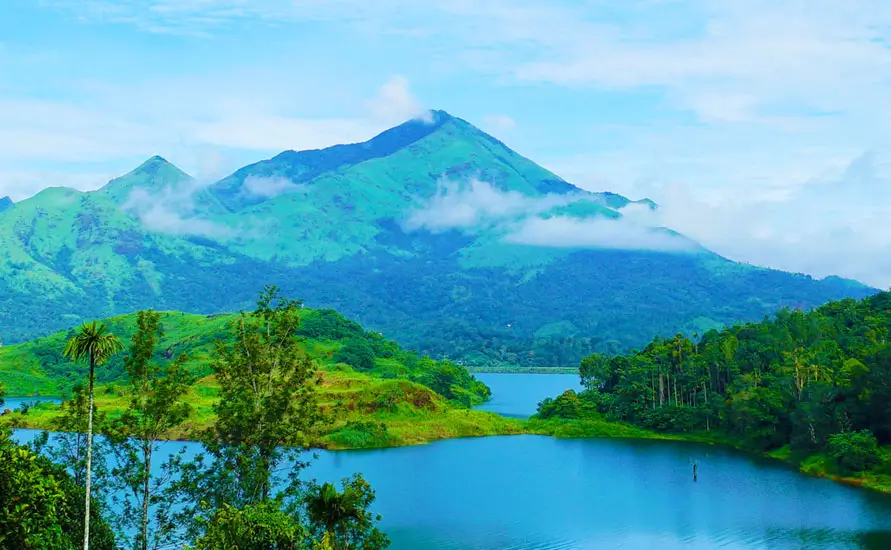
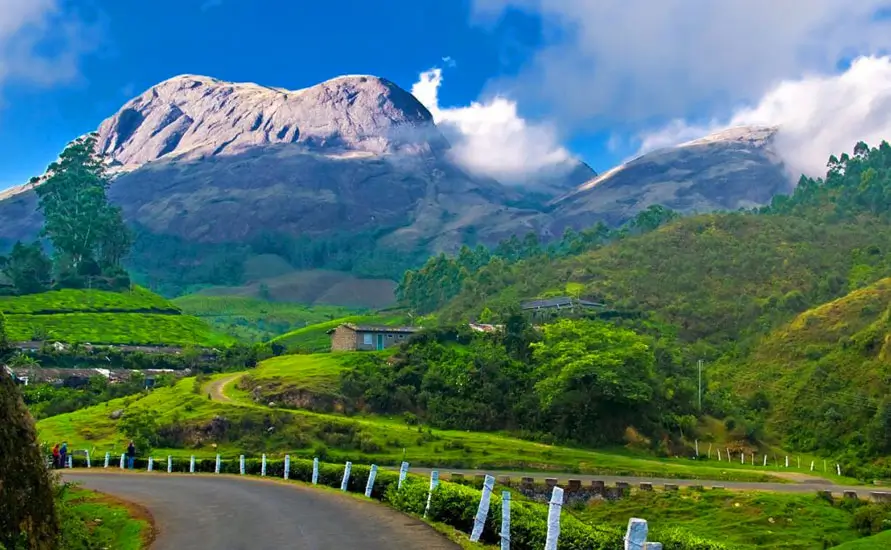
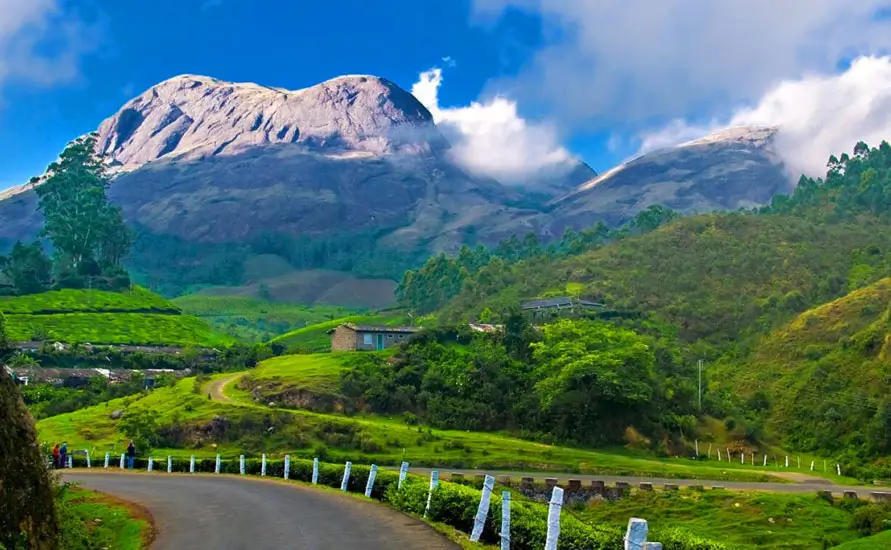
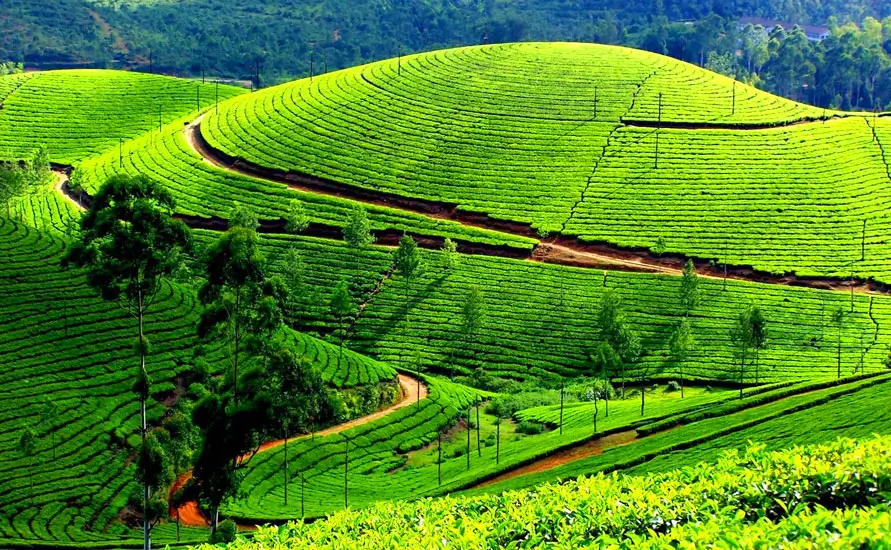
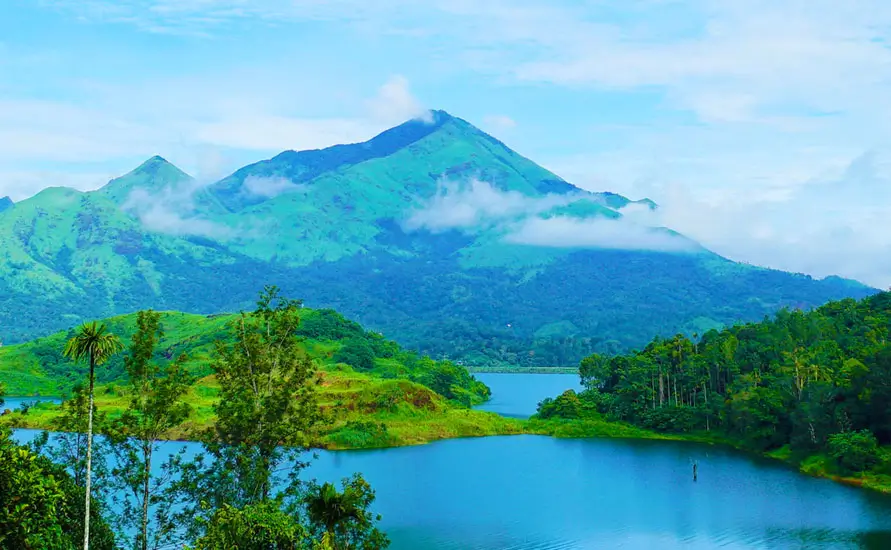
Above Adimali, cardamom and pepper plantations start to appear, and the air begins to cool. Little family farms on the roadside sell cardamom pods, cinnamon bark and cloves by weight, and a few will walk you around the garden for a small fee. Closer to Munnar, the slopes turn into an unbroken sheet of tea, clipped flat on top and following every fold of the ground like contour lines on a map. Victorian-era planters laid out the first estates here, and the town still has their granite churches, low bungalows and company offices. Your resort is ready by early afternoon, and the balcony faces a valley of tea.
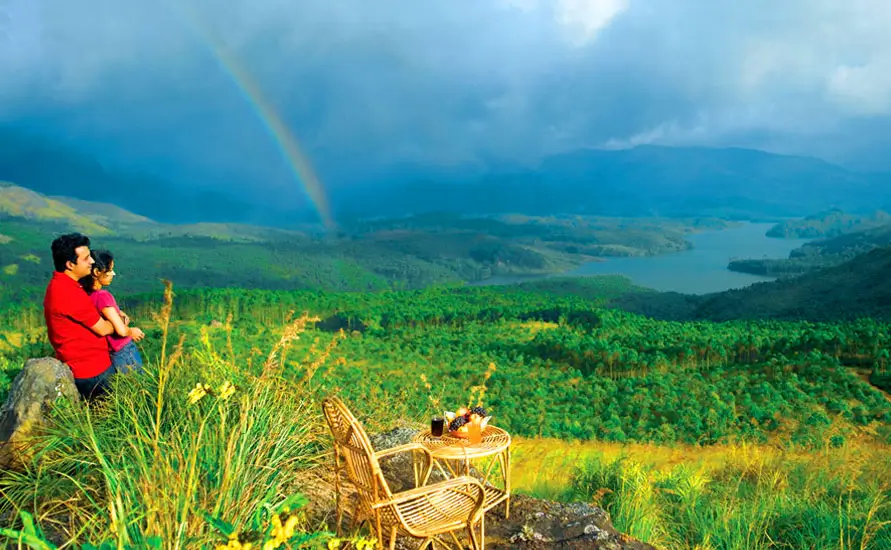
As the shift ends in late afternoon, stroll an estate path near the resort and watch the women pickers carry their bulging bags of leaf to the weighing shed, where each load is noted in a ledger. Low sun across the clipped bushes gives the hills a polished look, and from a higher bend you can follow ridge after ridge into the distance. Winter nights from November to February can drop to around 10°C, so a fleece or sweater earns its space in the suitcase. Dinner is at the resort, where a Kerala fish curry may sit beside pasta on the same menu, and many guests find an early night welcome after the drive. Overnight in Munnar.
Rajamala, the open section of Eravikulam National Park, is the first stop, reached early before queues build at the ticket counter. A park bus climbs from the entry point, after which a tarred walking road follows the slope through grassland where the rare Nilgiri tahr graze so close that a zoom lens is hardly needed. Between February and March the park shuts for calving, and during that window we substitute an extra estate walk or a trip to the small Lakkam waterfall. Once every twelve years the hills turn blue with Neelakurinji blossom; the last show was in 2018, and the next is expected around 2030.
Later in the morning comes the KDHP Tea Museum at Nallathanni, a good place to understand a crop that shaped the whole district. Antique machines, black-and-white estate photographs and a short documentary cover the history, and a compact processing room lets you follow fresh leaf all the way to finished tea. Your guide explains how high-grown Kerala tea tastes lighter than the malty leaf of Assam or the muscatel notes of Darjeeling, and the tasting bar lets you test that claim. Mondays are a closing day, so we time your Munnar sightseeing to fall on another day of the week.
After lunch the road east to Top Station strings together Mattupetty Dam, the lakeside Echo Point and the Kundala reservoir before reaching the rim of the hills at about 1,700 meters. At the lookout the ground simply falls away toward the farmland of Tamil Nadu, and an aerial ropeway once lowered chests of tea from here down to the plains. It is roughly 35 km each way on a winding road, worth it for the cool breeze and the sense of standing at the edge of Kerala. Return to Munnar by early evening and enjoy a warm dinner at the resort as the mist rolls in over the estates. Overnight in Munnar.
Heading south from Munnar, the road threads the cardamom country of Idukki through Devikulam and Poopara, where small tea gardens, spice estates and pockets of forest take turns along the bends. Some of the world's finest green cardamom grows right here, under tall shade trees, and your guide explains why the plant needs dappled light, plenty of rain and careful picking by hand every few weeks. A short pause at the Anayirangal reservoir viewpoint and a tea stop in a small hill town break up the drive. The road is narrow and curved, so speeds stay low and photo stops are easy to fit in.
Thekkady greets you by early afternoon, and your resort lies on the outskirts of Kumily, a lively little town pressed against the Periyar Tiger Reserve and the Tamil Nadu border. After lunch, a farmer or estate guide leads you through a mixed spice plantation, where pepper, cardamom, cinnamon, cloves, nutmeg, vanilla and coffee all share the same plot of land. You learn how each crop is propagated, which ones take years before the first harvest, and how traders from Rome, Arabia and China once came to this coast for exactly these products. A small farm shop sells freshly dried spices at fair prices, and the vacuum-packed bags travel well.
Evening brings a Kalaripayattu demonstration, Kerala's old fighting art, staged in a small sunken pit where performers leap, spin and spar with sticks, swords, shields and even flexible metal blades called urumi. Shows run about an hour, and several venues in Kumily stage them nightly, so seats are rarely a problem. Afterward, take a stroll along Kumily's main street, where shops sell spices, tea, handicrafts and Ayurvedic oils, and the smell of cardamom drifts from every second doorway. Dinner is at your resort, where the kitchen often uses pepper and cardamom from local farms. Overnight in Thekkady.
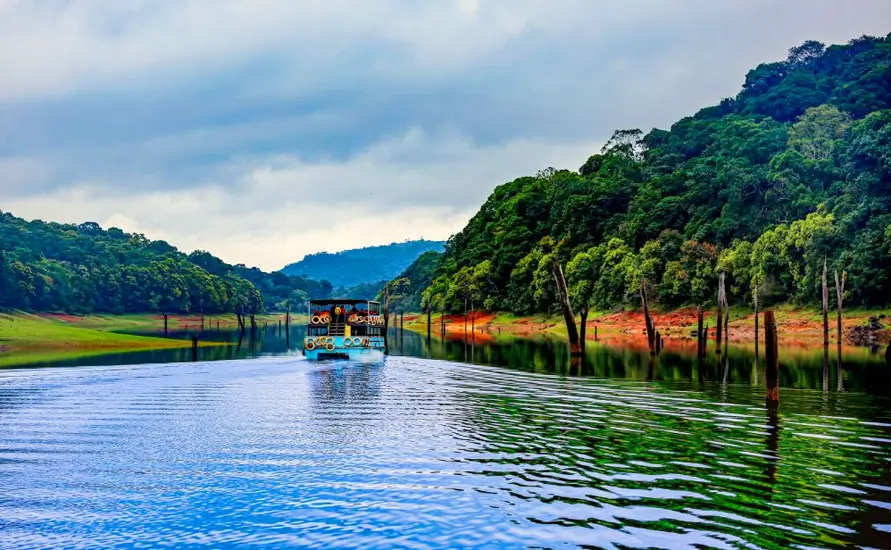
First light is the moment for the Periyar boat ride, a forest department sailing across the reservoir inside the tiger reserve. The water body dates from 1895, when a masonry dam at Mullaperiyar blocked the river, and the gray trunks of trees that died in the flooding still stand in the shallows. Along the banks you might spot elephants, gaur, sambar, wild boar, otters and cormorants, but nothing is guaranteed in a wild forest. Capacity on each sailing is limited, so your driver stands in line for the tickets before dawn. Early departures usually find the lake glassy and the light soft for photos.
Later in the morning, the reserve's eco-tourism wing offers optional programs such as a guided nature walk, bamboo rafting or a longer border hike, each led by trained men and women from the villages around the forest. These programs earn income for families who once relied on the forest for firewood and now help protect it. Prefer something gentler? Your driver can instead head to a tea factory or to the spice auction center near Kumily, where traders bid for the day's cardamom lots on computer screens. Lunch is a simple meal at a family-run eatery in Kumily, rice and curries served on a steel plate.
Leave the afternoon open for rest at the resort, or book an Ayurvedic massage at a licensed center in town, where most treatments begin with a short consultation. Thekkady is also a good place for a home cooking session, where a local family shows you how to grind a masala, season a fish curry and make a simple thoran with coconut and green beans from their own garden. Guests usually eat what they cook at the family table, a relaxed way to meet a Kerala household. Back at the resort, the night sounds of the forest fill the dark. Overnight in Thekkady.
From the hills you drop toward the Kottayam lowlands via Kuttikanam and Mundakayam, where the old planters' bungalows give way to rubber estates. If you pass early enough, you may catch tappers making their spiral cuts in the bark and collecting white latex into coconut-shell cups. As the road levels out, the humidity rises and the landscape turns to paddy fields, canals and coconut palms reflected in still water. A roadside stop for a tender coconut or a glass of tea breaks the drive before you continue to Kumarakom, low-lying islets where the Meenachil River meets Vembanad Lake, a brackish expanse stretching some 90 km from north to south.
Lunch awaits at your lakeside resort, usually a Kerala spread of karimeen fish, red rice and two or three vegetable curries. Nothing is scheduled after that: swim in the pool, sit under a coconut palm with a book, or stroll the gardens, where kingfishers, herons and cormorants fish along the water's edge. Most resorts here have an Ayurveda center with trained therapists, and a gentle full-body massage eases muscles stiff from the hill roads. Late in the day, ask the resort desk for a short country canoe ride through the narrow side canals, where village life carries on much as it has for decades.
As the sun sinks behind the lake, the water turns copper and the fishing canoes paddle home with their nets piled in the bow. Some resorts run a short sunset cruise in a small motorboat; others simply set out chairs at the jetty where you can watch the colors fade. Dinner is often fresh lake fish prepared with kokum, chili and curry leaves, served on the lawn under the stars. Kumarakom nights are hushed apart from frogs and the soft lapping of water against the bank, a good preparation for tomorrow on the houseboat. Overnight in Kumarakom.
Set an alarm for dawn at the Kumarakom Bird Sanctuary, a small reserve of mangroves and old trees along the shore of Vembanad Lake. Soon after sunrise the trees fill with egrets, darters, night herons and kingfishers, and between November and February migrants from northern Asia join the residents. A local birding guide accompanies you on the shaded trails and points out nests you would never spot on your own. Binoculars help, and old sneakers are wiser than sandals, since the trail turns soft after rain. Breakfast back at the resort tastes all the better after the early start.
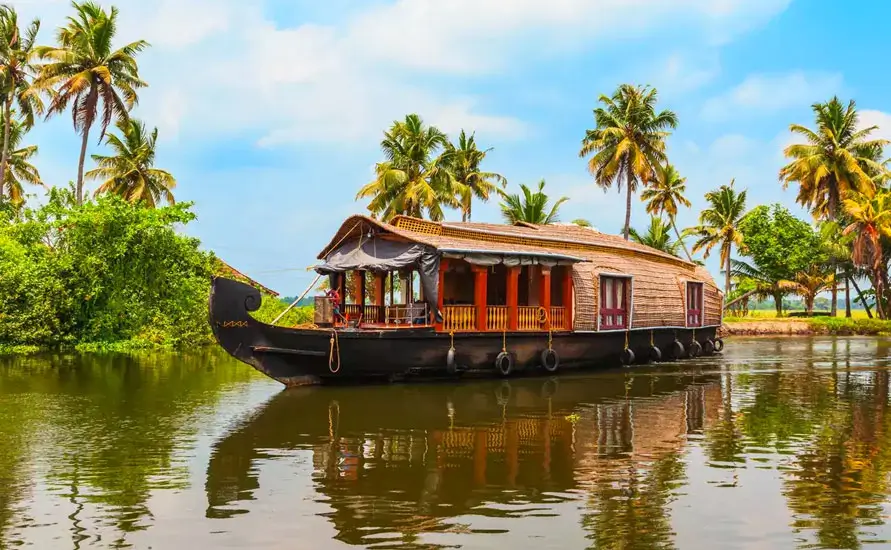
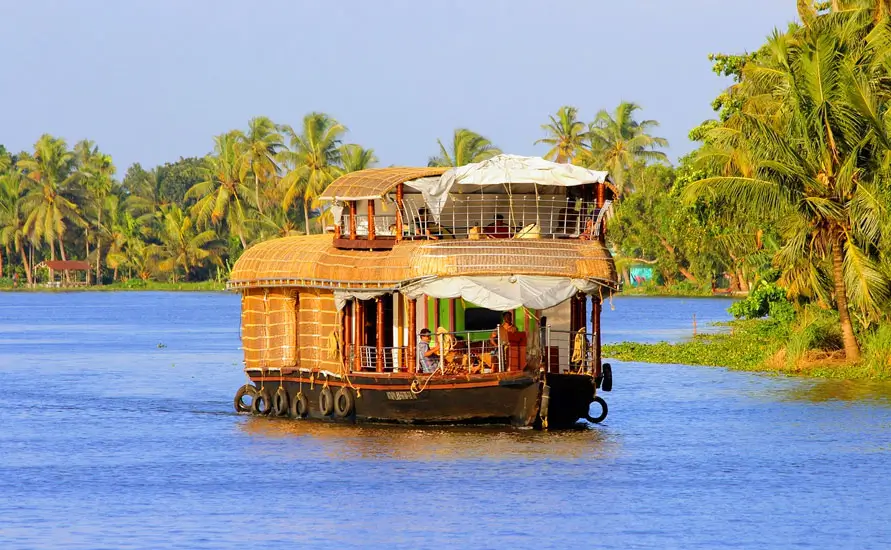
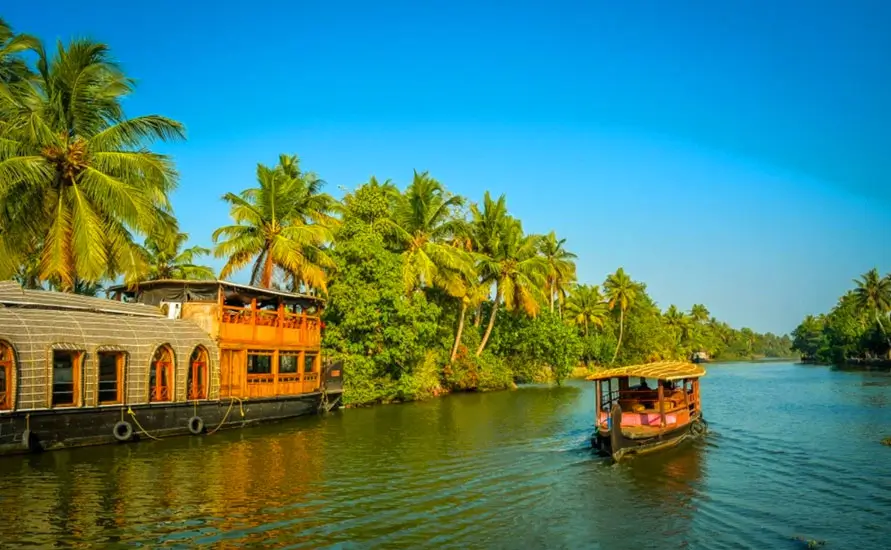
Check out after breakfast and head to the Alleppey houseboat jetty about an hour away, or board directly at Kumarakom if your boat is moored there. Your private Kerala backwaters houseboat descends from the kettuvallam, a broad wooden barge that once ferried rice and spices to the ports, now fitted with bedrooms, a sitting deck and a galley. Three men normally make up the crew, the captain, the cook and a deckhand, and they hand you a chilled lime juice as you step aboard; lunch is served soon after the engines start. Expect Kerala home cooking: fried pearl spot fish, vegetable curries, red rice and payasam made fresh in the boat's small kitchen.
Through the afternoon, the boat drifts through narrow canals and across open lagoons, past villages, white churches, temple steps and Kuttanad rice fields lying lower than the canal itself, protected by mud dikes. Children swim from the banks, women scrub pots on stone steps, and a man in a narrow canoe may be guiding hundreds of ducks downstream with a pole. Kerala rules oblige houseboats to stop moving by early evening, so your captain ties up near a quiet village or paddy field for the night. Walk the embankment with a crew member or simply sit on deck with tea and banana fritters as dusk settles. Dinner is cooked fresh on board. Overnight on the houseboat.
Mornings on the backwaters begin early: kingfishers dive, the first canoes slide past with fishing nets, and mist hangs low over the paddy. Breakfast of appam and egg curry arrives at the table while the boat chugs back toward the landing, and around nine you hand back the cabin and step onto the landing. Your driver is waiting for the run south along the coast through Kayamkulam and Kollam, the medieval port of Quilon, whose harbor handled Chinese junks and Arab dhows centuries before the Portuguese came. With a little spare time, a short stop at the Thangassery lighthouse or the long Kollam beach stretches your legs before the last leg to Varkala.
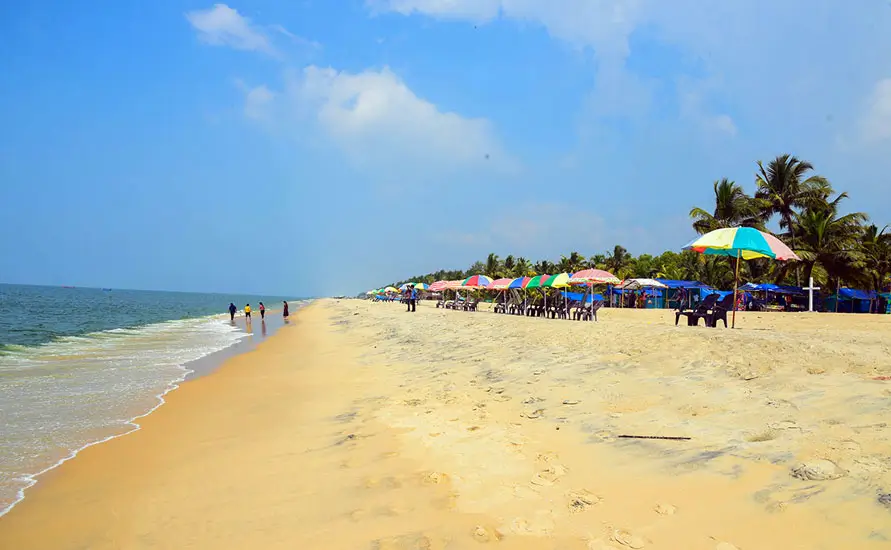
Varkala is reached around lunchtime, and you check in to a cliff-edge resort or guesthouse. The town is known for its tall red laterite cliffs that rise straight out of the beach, their tops lined with small cafés, guesthouses, bookshops and yoga studios. A narrow path runs along the edge of the North Cliff, giving long views over the Arabian Sea and the fishing boats bobbing below. At the foot of the cliffs, Papanasam Beach is sacred to Hindus, who bathe here and offer rice balls for their ancestors in early-morning rites. Calm days allow a swim, yet rip currents form quickly, so stay between the lifeguards' flags.
Late in the afternoon, walk the cliff path while the sun reddens and the cafés switch on their fairy lights. Menus along the cliff mix fresh grilled fish, Kerala curries, smoothies and wood-fired pizza, and the mood is easygoing, with a mix of Indian families and long-stay foreigners. Varkala has many yoga schools and Ayurveda clinics, and tonight is a good moment to book a morning class or a treatment for tomorrow. Eat at the resort tonight or choose a cliff-top terrace, where tables sit right above the sound of the surf. Overnight in Varkala.
Morning starts at the Janardhana Swamy Temple, an old Vishnu shrine on a rise above Papanasam Beach, whose bell is said to have been gifted by a Dutch sea captain. Only Hindus may enter the inner sanctum, but the exterior, the steps and the temple tank are open to view, and your guide tells the legend linking the site to the sage Narada. Nearby, the Sivagiri Mutt is where Sree Narayana Guru is laid to rest, the reformer who challenged caste barriers in Kerala in the early twentieth century and opened temples to all. Pilgrims in yellow robes walk here in large numbers around the end of December each year.
Later, drive about 9 km north to Kappil Beach, where a backwater lagoon runs right alongside the sea and is separated from it only by a strip of sand. It is far quieter than Varkala, with coconut groves and a few fishing hamlets, and a short rowing boat or kayak ride on the lagoon is easy to arrange. After lunch, nothing else is planned, leaving time for swimming, a yoga session, an Ayurveda treatment or a long read in a hammock. After nearly three weeks on the road, Varkala is the place to let the itinerary go slack and simply enjoy the sea air for a while.
Toward sunset, return to the cliff for one more walk and dinner at a restaurant with a view of the water. Many cafés line up tuna, snapper, barracuda and tiger prawns on trays out front, and will grill it or cook it in a Kerala masala of your choice. Some places have live music on weekends, and the small shops along the path sell handloom shirts, silver jewelry, Tibetan crafts and Kerala spices. Back at your room, the steady sound of waves breaking against the base of the cliff makes for easy sleep after a slow and restful day. Overnight in Varkala.
A drive of about ninety minutes south brings you to Trivandrum (Thiruvananthapuram), Kerala's capital and once the seat of the old Travancore kingdom. Your first stop is the Napier Museum, a red, black and white building of 1880 whose sloping roofs mix Kerala, Chinese and Indo-Saracenic ideas, with bronzes, temple carvings and ivory work inside. In the same garden, the Sree Chitra Art Gallery shows canvases by Raja Ravi Varma, a painter from a Travancore noble family whose oil images of Hindu goddesses were printed as posters in millions of Indian homes. Both buildings usually close on Mondays. Your guide outlines how the Travancore rulers governed until they merged with independent India in 1949.
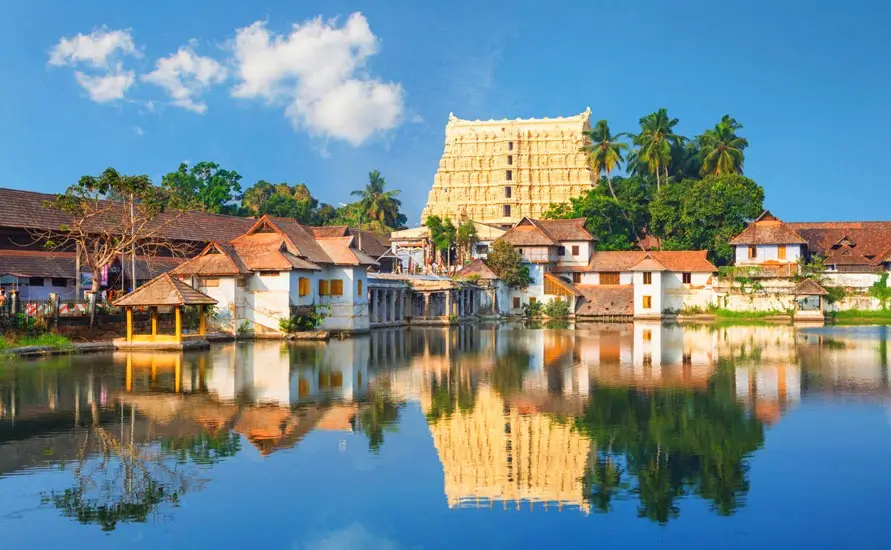
Next comes East Fort and the Sree Padmanabhaswamy Temple, whose deity is Vishnu reclining on the serpent Anantha and famous for the vaults of gold found beneath it in 2011. Entry is for Hindus only, with men in a mundu and women in a sari, but from outside you can admire the seven-tiered gopuram reflected in the Padmateertham tank. A few steps away, the Kuthiramalika Palace Museum is a wooden royal residence whose eaves rest on rows of 122 carved horses. Lunch is at a busy local eatery, and around 2 pm you leave the city for Kovalam, about 30 minutes south.
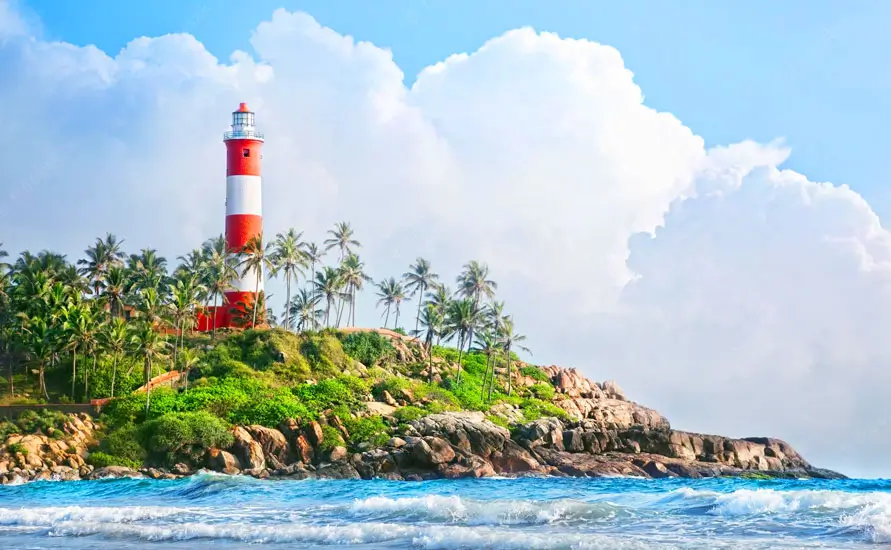
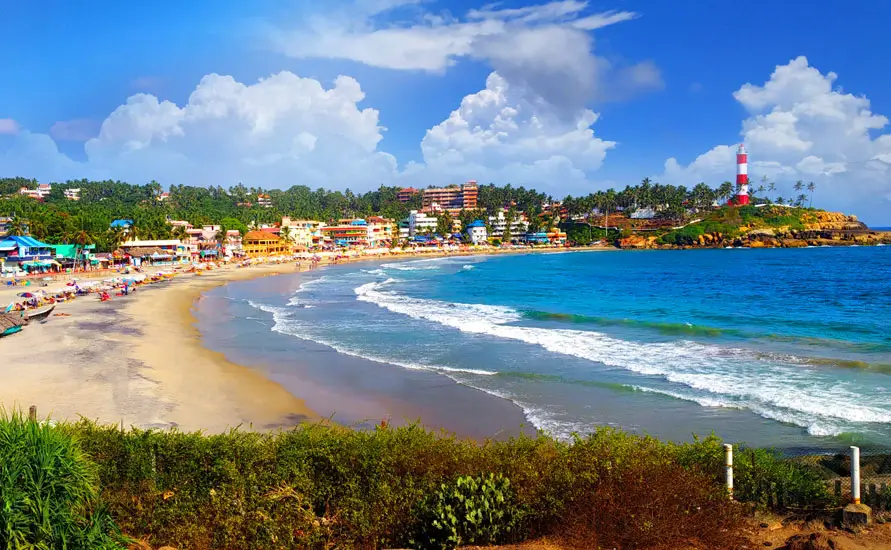
Your Kovalam room faces the sea, so the obvious plan for the afternoon is a swim. The shoreline is divided by rocky headlands into a few crescents, of which Lighthouse Beach is the liveliest, named for the striped tower on the cliff at its southern end. Climb the spiral stairs of the lighthouse in late afternoon for a view along the coast to the fishing harbor at Vizhinjam, or swim in the calmer water close to shore under the lifeguards' watch. For your last evening, reserve a beachfront seafood restaurant and toast the end of three weeks on the road. Overnight in Kovalam.
Take a final dip in the sea or a slow walk along the sand before breakfast, when fishermen haul in their shore nets with long chanting lines. Depending on your flight time, you can relax at the resort or visit the Vizhinjam fishing harbor, where boats unload their catch in the early morning and auctioneers shout prices at the dockside. Our representative collects you from the lobby for the half-hour ride to Trivandrum International Airport, timed to leave a comfortable margin for check-in and security.
Your Kerala tour 3 weeks has run almost the full length of the state, from the forts and Theyyam shrines of Malabar to the tea hills, the backwaters and the cliffs of the far south. From Trivandrum, Gulf carriers, Sri Lankan and Singapore flights, plus Indian hubs, carry you onward to Europe, North America or Australia. We are grateful you chose us for such a long trip and would be glad to plan your next visit, perhaps to Tamil Nadu or Karnataka. Have a good flight.
Your Journey

N.S. Rathore & Mrs. Omlata Rathore · Managing Director
We still read every enquiry ourselves. Tell us the places you liked and our planners will send a day-by-day route with drive times and a clear price.
Every package can be customised and no pressure to book. A planner from our office replies within 24 hours with a route written for your group.
Fill this in and your planner will send a first draft itinerary.
Explore more
Kerala Backwaters Escape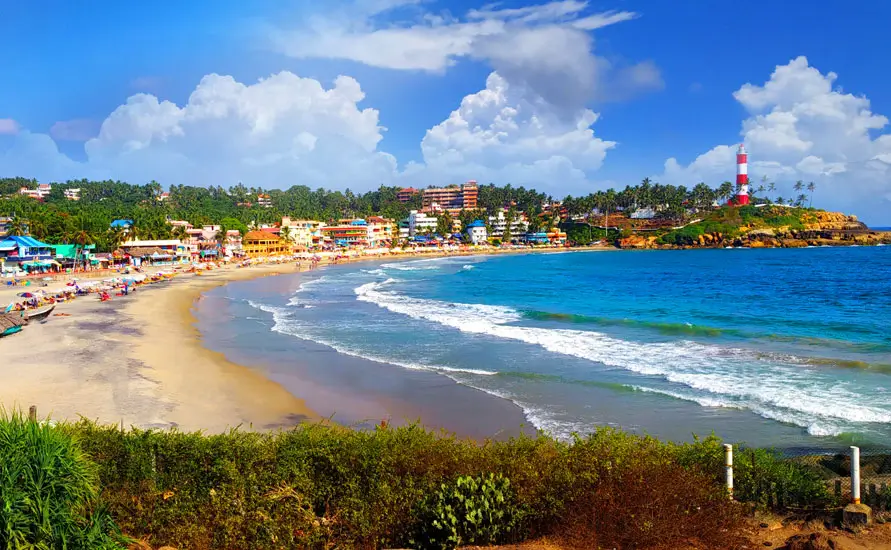 Kerala Backwaters Escape
 Kerala Backwaters Escape
 Kerala Backwaters Escape
 Kerala Backwaters Escape
 Kerala Backwaters Escape
 Kerala Backwaters Escape
 Kerala Backwaters Escape
 Kerala Backwaters Escape
 Kerala Backwaters Escape
 Kerala Backwaters Escape
 Kerala Backwaters Escape
 Kerala Backwaters Escape
 Kerala Backwaters Escape
 Kerala Backwaters Escape
 Kerala Backwaters Escape
 Kerala Backwaters Escape
 Kerala Backwaters Escape
 Kerala Backwaters Escape
 Kerala Backwaters Escape
 Kerala Backwaters Escape
 Kerala Backwaters Escape
 Kerala Backwaters Escape
 Kerala Backwaters Escape
 Kerala Backwaters Escape