
 Kerala Backwaters Escape

Kerala Tour Packages
Kochi (Mattancherry) – Thekkady – Munnar – Kozhikode (Kappad) – Kannur
At a glance
Black pepper once sold in Rome for a price close to its weight in silver, and most of it came from the coast you will travel on this trip. Our Kerala spice route tour follows that trade over twelve days, from the warehouse lanes of Mattancherry in Kochi and the buried port of Muziris near Kodungallur, up into the cardamom and tea country of Thekkady and Munnar, and then north to the Malabar shore at Kozhikode, where Vasco da Gama stepped onto the sand at Kappad in 1498. The trip ends among the sea forts of Kannur.
Roman traders, Arab dhow captains, Chinese junks, Portuguese fleets, Dutch merchants and the British East India Company all came here for the same few plants, and each left something behind: a synagogue, a mosque, a fort, a palace or a recipe. Local guides who know the history well walk you through these layers at every stop, and one chauffeured, air-cooled vehicle shuttles you from site to site. A comfortable train ride covers the long leg from the hills to Kozhikode, saving a full day of mountain driving.
This spice route Kerala itinerary appeals to history-minded guests flying in from America, Britain, the European mainland or Australasia who care as much about old ledgers and forts as about views, and NRI families with roots in Malabar who want to see where the old trading houses stood. Bases change only five times, so unpacking happens rarely. Dry weather lasts from October into March, while December, January and February add the chance to watch Theyyam, the ritual dance of North Kerala, in a village shrine near Kannur. Hotels range from heritage homes to plantation bungalows and quiet beach properties.
Cochin International Airport sits near Nedumbassery, some 40 km north of the old port, and our Kerala host waits just beyond the customs hall with a name card in hand. The ride south into the city passes Aluva and the busy commercial strip of Edappally before crossing the bridges toward Willingdon Island and Fort Kochi, roughly ninety minutes in all. Your heritage hotel stands within a short walk of the harbor. If your plane lands in the dark hours before sunrise, we recommend paying for an early check-in so the room is yours as soon as you arrive, rather than waiting for the afternoon.
Once rested, you meet your spice route guide for tea and a short briefing on the trip ahead. With a simple map of the Malabar coast laid out on the table, the guide sketches how the trade worked: pepper vines in the forested hills, river boats carrying the sacks down to the coast, and foreign ships waiting offshore for the monsoon winds that would carry them home. Names like Muziris, Calicut and Cannanore, which once meant spices to merchants in Venice and Lisbon, will each become real places on your route over the coming eleven days.
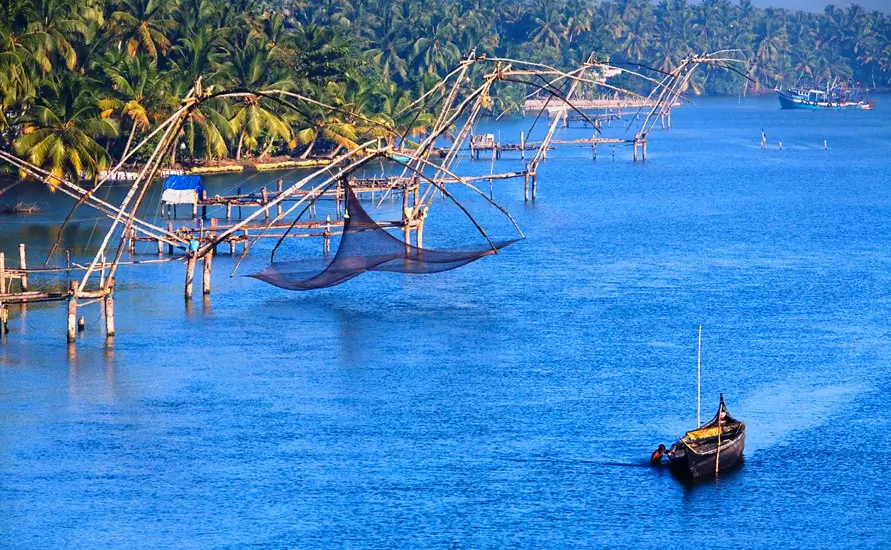
Toward sunset you walk to the harbor mouth, where container ships now follow the same channel that Portuguese caravels used five centuries ago. Fishermen haul up the big shore-operated nets nearby, and gulls and kites circle overhead looking for scraps. The breeze off the Arabian Sea makes this a pleasant hour to be out, and the promenade fills with local families buying snacks from handcarts. Dinner is at a small restaurant your guide recommends, perhaps a pepper fish fry with rice, a fitting first dish for a trip built around that one berry. Overnight in Kochi.
Kochi's role as a spice port took off after a great flood in 1341 silted up Muziris and opened a new harbor mouth here. Mattancherry became the trading district, and your morning walk begins on Bazaar Road, a long street of warehouses with wide wooden doors that open onto the water at the back, so boats could load and unload directly. Inside some of them, workers still sort pepper by hand and spread dried ginger on the floor, and the air is sharp enough to make your eyes water. Your guide explains how grading works and how prices were once set by auction in these very halls.
Up the road stands the Mattancherry Palace, misnamed the Dutch Palace although Portuguese builders raised it around 1555, a present to the Kochi Raja that bought them trading favors. Vegetable and mineral pigments color its wall-to-wall murals, where Rama's exile and Krishna's boyhood unfold panel by panel. Beyond lies Jew Town, whose Paradesi Synagogue, standing since 1568, belongs to one of the oldest Jewish communities in Asia, though only a handful of members remain today. Plan around the weekly closures: no palace entry on Friday, while the synagogue also stays shut on the Sabbath and on Jewish feast days, which we factor in when fixing your Kochi dates.
Lunch can be at a café inside an old spice godown that has been converted into a gallery or restaurant. In the afternoon, a short visit to Fort Kochi takes in St. Francis Church, where the Portuguese admiral, struck down by illness in Kochi on Christmas Eve of 1524, rested until his son shipped the remains to Portugal, and the shoreline where Dutch and British traders later built their offices. If you would like to take spices home, your guide knows the wholesale merchants who sell directly to the public in small vacuum-sealed packs. The evening is yours, with an optional Kathakali show nearby if you wish to book a seat. Overnight in Kochi.
Today is one of the most interesting days on the route, as you drive about 40 km north to the area around Kodungallur, the likely site of the ancient port of Muziris. Greek and Roman writers described a busy harbor here where ships from Egypt traded gold coins for pepper, pearls and fine cloth around 2,000 years ago. The town vanished from maps after the 1341 flood, and its exact location was lost for centuries. Since 2007, digs at Pattanam have turned up Roman amphora shards, beads and pottery from the Mediterranean and Persian Gulf, and your guide shows you the site and explains what the finds mean.
The Kerala government's Muziris Heritage Project has restored a string of historic buildings in the area, and you visit several of them. At Chendamangalam the Paliam Dutch Palace and the nearby Paliam Nalukettu show how the powerful Paliath family, chief ministers to the Kochi rajas, lived and ruled, with exhibits on their dealings with Dutch traders. A short drive away, the restored Chendamangalam synagogue now displays objects and photographs from Kerala's Jewish families. Riverside fragments of Kottappuram Fort, a Portuguese stronghold of 1523 captured later by the Dutch, close the morning's circuit.
Last comes the Cheraman Juma Masjid, said by Kodungallur residents to be among India's earliest mosques, linked to Arab traders who came to this coast in the seventh century. It has been rebuilt over the years, but its prayer hall preserves the style of a traditional Kerala building, with steep clay-tiled eaves and timber carving inside. Non-Muslim guests may look around between prayers, wearing clothes that cover arms and legs. Some museums in the heritage project close one day a week, so your guide sets the order of visits accordingly. You return to Kochi in the late afternoon. Overnight in Kochi.
The spices that made Kochi rich did not grow on the coast; they came from the hills to the east, and today you head up into them. The drive passes through Kottayam district, one of the old Syrian Christian heartlands of Kerala, where rubber has largely replaced pepper on the lower slopes. Beyond Mundakayam the road begins to climb in sharp bends, and the air turns cooler and fresher. Midway, a pause at a hillside chai shop stretches the legs, and on clear days there are views across forested valleys toward the high ridges of the Western Ghats.
You reach Thekkady in the early afternoon and settle into a hotel near the forest edge in Kumily. This town grew up as a trading post for the Cardamom Hills, and even today the main street is lined with shops stocked with pods, peppercorns, cloves and nutmeg brought in from nearby smallholdings. Following lunch, a stroll through the bazaar with your guide reveals how the cardamom trade works now: farmers bring their dried pods to licensed dealers, and much of the crop is sold through auctions held by the Spices Board in this hill district, rather than through the old coastal merchants.
As evening comes, you can visit a small cultural center in Kumily to watch Kalaripayattu, a combat art with roots well over a thousand years deep, which some historians link to the warrior families who once guarded the trade routes through these hills. The performance is fast and acrobatic, with spears, swords, shields and long sticks, and it gives a sense of the physical training that young fighters go through. Alternatively, you can relax at the hotel with a cup of local cardamom tea. Dinner tonight could be a simple meal of rice and fish curry or a vegetarian thali. Overnight in Thekkady.
A morning on a Thekkady spice plantation shows you the plants behind centuries of trade. Your plantation guide walks you through rows of shade trees with black pepper vines wound around their trunks, explaining how a single vine can produce for decades and how the green berries turn black as they dry in the sun. Cardamom grows lower down in the damp shade, its pods hidden at the base of the plant. You also see nutmeg trees, whose fruit splits to reveal the bright red mace wrapped around the seed, as well as cinnamon bark, cloves, allspice and turmeric growing in the ground.
The farmer then shows you how the harvest is handled: cardamom pods dried in heated rooms to keep their green color, pepper spread out on mats, and cloves picked by hand before the flowers open. Ask freely about money matters on a small holding like this, which is a family business for most growers here, often passed down for generations. Prices rise and fall with the international market, and many farmers now grow coffee, vanilla or other crops alongside spices to manage that risk. Lunch is served at the farm or in town.
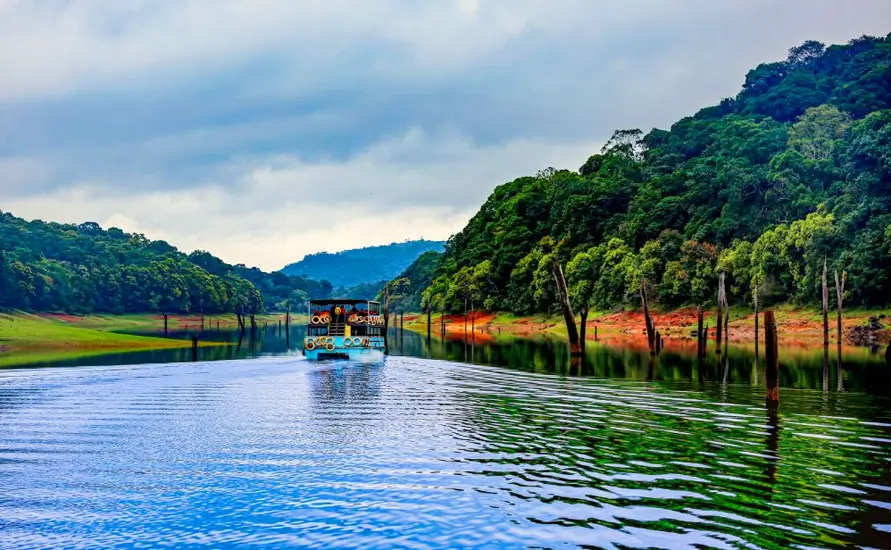
Later, if you wish, a forest department launch carries visitors across Periyar Lake, the reservoir at the center of a large tiger reserve spread over these hills. Elephants, bison, deer and many birds live in the reserve, and some come to the water's edge, though sightings vary and cannot be promised. Those who prefer solid ground can book a trail walk led by tribal trackers trained by the reserve. Both need to be booked on the day through the reserve. The evening is free to enjoy at your hotel. Overnight in Thekkady.
Driving north toward Munnar, you pass through the heart of the cardamom belt, an area known as the Cardamom Hill Reserve, where pods ripen beneath old rainforest trees deliberately spared from the axe for shade. Small towns such as Vandanmedu and Puttady are trading centers for the spice, and you may see sacks of dried pods being weighed at local dealers. The road winds along hilltops, with views across valleys covered in green. Expect a halt or two at hilltop lookouts, and perhaps at a family shop selling homemade chocolate and preserved fruit, a local sideline that grew up alongside the spice trade.
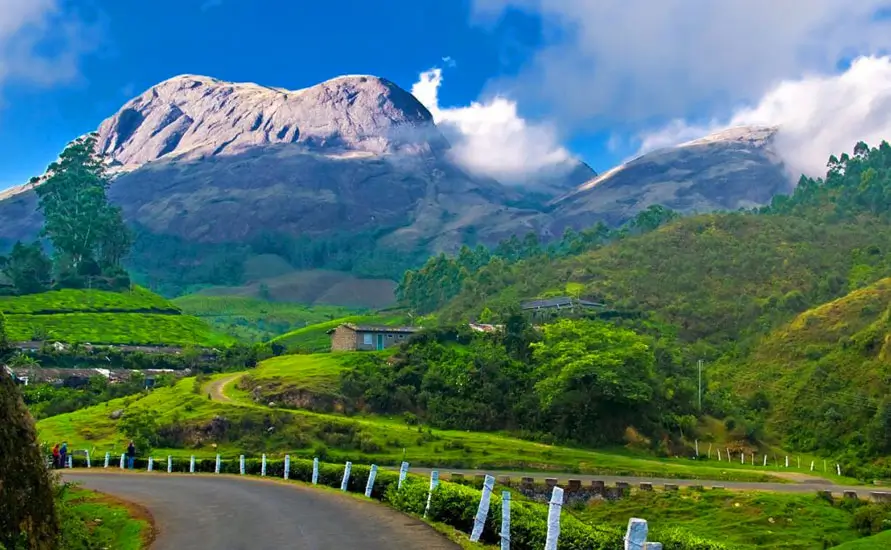
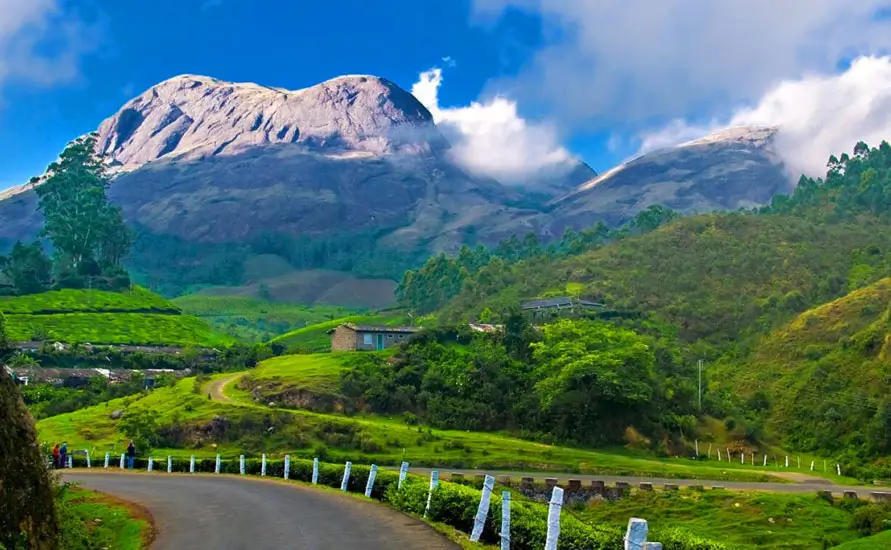
The landscape changes as you get closer to Munnar: cardamom gives way to tea, and the hillsides become an endless pattern of neat green rows. Tea came to these hills later than spices, in the late nineteenth century, when British planters cleared the forest and laid out estates on the slopes. Lunch is at your hotel, and after that the hours belong to you and the cool hill air. At this height nights get crisp, so pack a warm layer whatever the month, and expect the hotel to offer hot water bottles or heaters in the cooler season from December to February.
Later in the day your guide may take you for a gentle walk along an estate road near the hotel, where you can watch tea pickers at work and see the small settlements where estate workers live. Many of them are descendants of Tamil families who came from the plains generations ago to work on the plantations, and Tamil is still widely spoken here. As the light fades, the hills turn shades of blue and grey, and mist often rolls in across the valleys. Dinner at the hotel might include a Kerala chicken curry or a selection of vegetable dishes. Overnight in Munnar.
Morning begins at Eravikulam National Park, rolling upland meadows beneath Anamudi, at 2,695 m the loftiest summit south of the Himalaya. A shuttle run by the forest department carries you up to the visitor area, where a walking path follows the mountainside with wide views over the hills. Herds of Nilgiri tahr, an endangered goat of the southern ranges, often graze near the path, yet there is no guarantee. Calving shuts the park for some weeks each year, normally from February into March, and in that window a tea estate walk takes its place.
Afterward, inside an operating tea factory, your guide follows the leaf through every stage: fresh leaves are withered on long troughs, rolled or cut by machines, oxidized for a set time, dried in hot air, and finally sorted into grades. The smell inside is strong and sweet, and the process is fascinating to watch from start to finish. A tasting table at the end sets several grades in a row, from whole-leaf orthodox to the granular kind used for strong milky chai. Close by, the Kanan Devan company's Tea Museum merits an hour if energy remains, with old photographs and machinery.
Later hours carry no fixed plan. You might choose to visit Mattupetty Dam and the flower gardens on the road out of town, or browse the small shops in Munnar town for tea, spices and homemade chocolates. In the context of the spice route, it is interesting to reflect on how tea took over from pepper and cardamom as the main crop in these particular hills, and how the British trade in tea built on the routes and ports first opened for spices. Eat where you like tonight. Overnight in Munnar.
Driving from Munnar all the way to the Malabar coast would take most of a day on winding roads, so we break it with a train. Breakfast done, you descend the hairpins to Aluva, a rail junction close to Kochi airport, reached in roughly 210 minutes. Here you say goodbye to your car and driver, and our team helps you board a daytime express to Kozhikode, with booked seats in an AC coach. Allow close to four hours on board heading north.
The railway line runs close to the coast for much of the way, passing through Thrissur, Shoranur and Tirur, with views of rice fields, rivers, coconut groves and small towns. At Kozhikode station, our Malabar team meets you with a new car and driver, assigned to you until the final day. You transfer to your hotel, which is close to the beach or the old city, and spend the evening at leisure. Food is Kozhikode's pride, and Malabar biryani at a busy local favorite makes a fine first supper here. Overnight in Kozhikode.
In the morning you drive about 20 km north to Kappad, the quiet shore where the Portuguese captain's ships stood off the beach in May 1498, ten months out of Lisbon, ending Venice's grip on the European pepper supply. A small stone pillar marks the spot, with an inscription recording the event, and the beach itself is calm and fringed with coconut palms. Your guide explains why the Portuguese came here first: Calicut, as the city was then called, was ruled by the Zamorin, whose port was the busiest pepper market on the coast. Historians still debate the exact landing site, but Kappad has long been accepted as the traditional location.
Back in the city, you walk through Valiyangadi, the old wholesale market near the harbor, where spice traders, rice merchants and coconut dealers still work out of old buildings with tiled roofs and wooden shutters. The smells of pepper, turmeric and dried fish fill the air, and porters move sacks on their heads. Nearby, the Kuttichira area is home to the Mishkal Mosque, a fourteenth-century wooden mosque built by an Arab merchant, which shows the traditional Kerala style. Your guide arranges a respectful visit to the outside, and the area's old Muslim homes are interesting to see.
In the afternoon you visit SM Street, short for Sweet Meat Street, a lively shopping lane famous for its Kozhikode halwa, a dense, colorful sweet made with coconut oil and flour. You can taste several flavors and buy some to take home. If time allows, a short drive south to Beypore shows you a yard where craftsmen still build the large wooden dhows called uru by hand, using methods that go back centuries, and many of these boats are still sold to buyers in the Gulf. The evening is free at the beach. Overnight in Kozhikode.
Heading north along the coast, your first major stop is Thalassery, once called Tellicherry and still known around the world for a grade of large, bold black pepper named after it. The British East India Company built Thalassery Fort here in 1708 to protect its pepper trade, and the square fort with its thick walls, said to hide old tunnels, still stands above the sea. You hear how the Company ran Thalassery as its chief settlement on the Malabar coast for most of the eighteenth century, and how local rulers, the French at nearby Mahé and the British all fought over who would buy the harvest from the hill growers.
A short drive away lies the Gundert Bungalow at Illikkunnu, home in the 1840s to Hermann Gundert, a Basel Mission scholar from Germany whose dictionary and grammar gave Malayalam its first modern reference works. The house is now a small memorial museum. Lunch in Thalassery deserves some appetite, since the town is famous for its own style of biryani, made with short-grain rice and spiced chicken or mutton. Later you may also see Overbury's Folly, a seaside park and viewpoint built by a British judge in the nineteenth century, where locals gather in the evening to watch the waves.
Short of Kannur, Muzhappilangad Beach offers something rare in India: a beach firm enough that ordinary cars roll along the tideline, with rocky Dharmadam islet visible offshore. Your driver can take a slow drive along part of it if conditions are suitable. Arrival in Kannur comes before dusk, at a seaside property. Kannur was known to early traders as Cannanore and was an important port for both spices and handloom textiles, which still sell across India today. Fresh mussels, a Kannur favorite known locally as kallummakkaya, are worth ordering at dinner. Overnight in Kannur.
Your last full day begins at St. Angelo Fort, raised in 1505 by the first Portuguese viceroy with the Kolathiri king's consent, then seized by the Dutch in 1663 and sold to the Arakkal rulers before the British arrived. The triangular laterite fort sits on a headland overlooking the Arabian Sea, and walking along its walls you can see across Mappila Bay, a fishing harbor where colorful boats unload their catch each morning. A 17th-century Dutch canvas of this very fort is kept in Amsterdam, proof of how much the place mattered to European merchants.
Next comes the Arakkal Museum, occupying the old durbar hall of the Arakkal rulers, Kerala's lone Muslim royal line, who controlled trade at Kannur and even the Lakshadweep islands for centuries. The museum displays furniture, weapons, letters, royal seals and household objects from the family's long history, including records of the trade they ran with Arab and European ships. A handloom cooperative nearby is the next stop, as Kannur has been a center for cotton weaving since colonial times, and you can watch weavers at work and buy cloth directly from them.
If your visit falls between December and March, the evening or early morning may bring a chance to watch Theyyam, the ancient ritual dance form of North Kerala. Performers, painted and dressed in huge headdresses, are believed to embody the gods during the ritual, which takes place in small village shrines. Dates vary from shrine to shrine, and your guide checks the local calendar and takes you to a performance if one is scheduled. Visitors should dress modestly, stand quietly and follow local instructions. Outside the season, you can see a recorded Theyyam presentation instead. Overnight in Kannur.
Your final morning allows a beach stroll or a quick look at a fish market before checkout. Your driver then takes you to Kannur International Airport at Mattanur, about 30 km away, a drive of roughly an hour. Nonstop services leave here for Gulf hubs, and domestic flights link with Mumbai, Bengaluru and Delhi. Alternatively, if your flight leaves from Kozhikode, the drive to Calicut International Airport takes about three hours, and we can plan the timing for you.
Over twelve days you have followed the pepper, cardamom and ginger trade from the Roman-era port of Muziris to the Portuguese forts of the north, with tea estates and spice farms in between. Kerala's long dealings with the outside world should now feel concrete rather than a line in a textbook. Should Tamil Nadu's temples or the Wayanad hills tempt you next, write to us and we will sketch a route.
Your Journey

N.S. Rathore & Mrs. Omlata Rathore · Managing Director
We still read every enquiry ourselves. Tell us the places you liked and our planners will send a day-by-day route with drive times and a clear price.
Every package can be customised and no pressure to book. A planner from our office replies within 24 hours with a route written for your group.
Fill this in and your planner will send a first draft itinerary.
Explore more
Kerala Backwaters Escape Kerala Backwaters Escape
 Kerala Backwaters Escape
 Kerala Backwaters Escape
 Kerala Backwaters Escape
 Kerala Backwaters Escape
 Kerala Backwaters Escape
 Kerala Backwaters Escape
 Kerala Backwaters Escape
 Kerala Backwaters Escape
 Kerala Backwaters Escape
 Kerala Backwaters Escape
 Kerala Backwaters Escape
 Kerala Backwaters Escape
 Kerala Backwaters Escape
 Kerala Backwaters Escape
 Kerala Backwaters Escape
 Kerala Backwaters Escape Kerala Backwaters Escape Kerala Backwaters Escape Kerala Backwaters Escape Kerala Backwaters Escape Kerala Backwaters Escape Kerala Backwaters Escape Kerala Backwaters Escape