
 Kerala Backwaters Escape

Luxury South India Tours
Bangalore – Coimbatore – Ooty – Bylakuppe – Coorg – Thirunelli – Wayanad – Kozhikode
At a glance
Heat is the one thing many visitors fear about a winter or spring trip to India, and the Western Ghats answer that fear neatly. Our Taj Hill Resorts of South India Tour spends ten nights at altitude or close to it, in four Taj and IHCL hotels chosen for their setting as much as their service. You begin in the garden city of Bangalore, climb to the Nilgiri hills at Ooty, cross into the coffee country of Coorg and finish above a reservoir lake in Wayanad, where mornings often call for a light sweater.
The hotels are the reason for the route. Taj West End has kept its twenty acres of old gardens in the middle of Bangalore since 1887. The Savoy in Ooty is a colonial hill hotel of cottages, fireplaces and croquet lawns. Taj Madikeri Resort & Spa sits inside a large tract of rainforest, and Taj Wayanad Resort & Spa looks over Banasura Sagar from a hill of its own. Each stay lasts two or three nights, so you live in these places rather than pass through them.
Sightseeing on this luxury hill station tour of South India stays light and well spaced: the Nilgiri Mountain Railway, tea and coffee estates, a Tibetan monastery town, an old forest temple and the rock carvings of Edakkal. A private chauffeur-driven car carries you between the hills, a short flight removes the slow road from Bangalore to the Nilgiris, and you leave from Kozhikode (Calicut), the closest major airport to Wayanad. October to May is the best window, with the coolest nights from December to February.
Our airport host waits for you beyond customs at Kempegowda International Airport, loads your bags and leads the way to a chauffeur-driven luxury car with cold towels and bottled water ready inside. Expect roughly an hour on the expressway into town, more in rush-hour traffic, and your host uses it to go through the plan for the next ten days, the hotel confirmations and the best way to reach our team at any hour. Because many long-haul arrivals land well after midnight, we can book your room from the previous evening so that you sleep the moment you reach it.
You spend two nights at Taj West End, which opened in 1887 as a modest boarding house in what was then a leafy British cantonment and grew over the following century into one of the city's grand addresses. The hotel is spread across about twenty acres of mature gardens off Race Course Road, so rooms sit in low wings and garden blocks rather than in a tower. Tiled roofs, gables and carved wooden trim give the buildings a colonial bungalow feel, and many rooms open onto verandas facing lawns where birds are louder than the traffic outside the gates.
After a rest, take the late afternoon slowly with a walk along the garden paths, when the light turns soft and squirrels and koels move through the canopy. Bangalore sits at roughly 900 meters, so evenings are pleasantly mild for much of the year, and this is your first taste of the cooler climate the whole trip is built around. For dinner, the hotel's Blue Ginger serves Vietnamese cooking in a pavilion set among trees and water, a gentle choice for a first night when spicy Indian food may be the last thing a tired body wants. Overnight in Bangalore.
Gardens give Bangalore its old nickname, and your guide starts the day at Lalbagh Botanical Garden soon after breakfast, before the joggers have gone home and before the sun gets strong. Hyder Ali laid out the first garden here in the 18th century, his son Tipu Sultan expanded it, and British superintendents later added the glasshouse modeled loosely on London's Crystal Palace. The park holds very old trees, a lake and a granite outcrop that is among the oldest rock formations on the planet, topped by one of the four boundary towers attributed to Kempe Gowda, who founded the city in the 16th century.
Ten minutes away by car stands Tipu's Summer Palace, a two-story wooden building completed in 1791, with teak pillars, carved arches and faded painted walls. It was a seasonal residence rather than a fortress, and the modest scale says a lot about how the ruler of Mysore used Bangalore as a cooler retreat. Nearby stands the Venkataramana Temple, built by the Wodeyar kings of Mysore. Lunch is followed by Bangalore Palace, a Tudor-style building of turrets and battlements put up for the Wodeyar family in the late 19th century, with hunting trophies and old photographs inside.
Late in the afternoon you pass the granite bulk of the Vidhana Soudha, the state legislature building, and the red Attara Kacheri facing it across the road at the edge of Cubbon Park. Both are seen from outside, as entry is restricted, but your guide explains how this part of the city became the administrative center after independence. Back at Taj West End there is time for a swim in the outdoor pool or a treatment at the spa before dinner. If you want Indian food tonight, the hotel's Masala Klub cooks North and South Indian dishes with a lighter hand than most restaurants. Overnight in Bangalore.
The road from Bangalore to the Nilgiris is long and slow, so we replace most of it with a morning flight of about one hour to Coimbatore, the textile city at the foot of the hills. Your chauffeur from the Nilgiri side meets you at arrivals with the car already cooled. The first hour crosses flat country of coconut groves and spinning mills, and then the road reaches Mettupalayam and starts to climb. Over the next stretch the ghat road gains well over 1,500 meters through a long sequence of hairpin bends, and the air coming through a lowered window turns noticeably fresher with every turn.
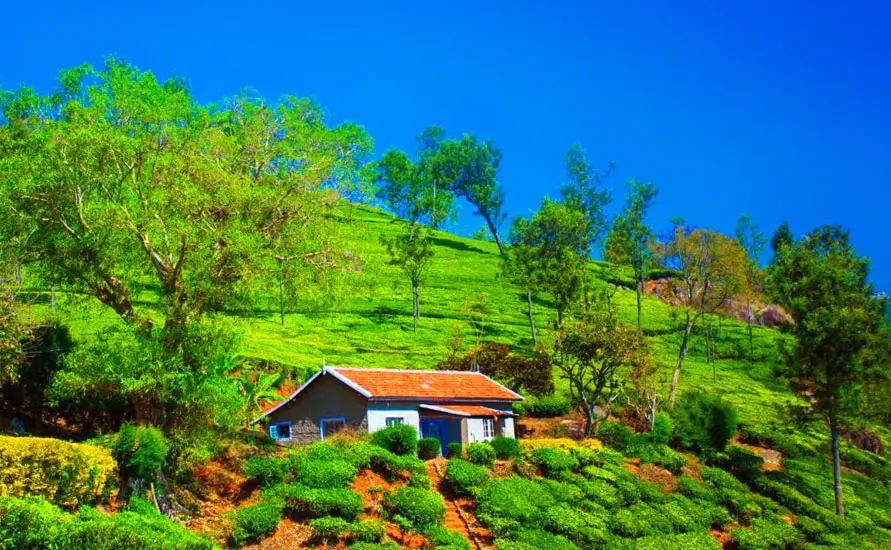
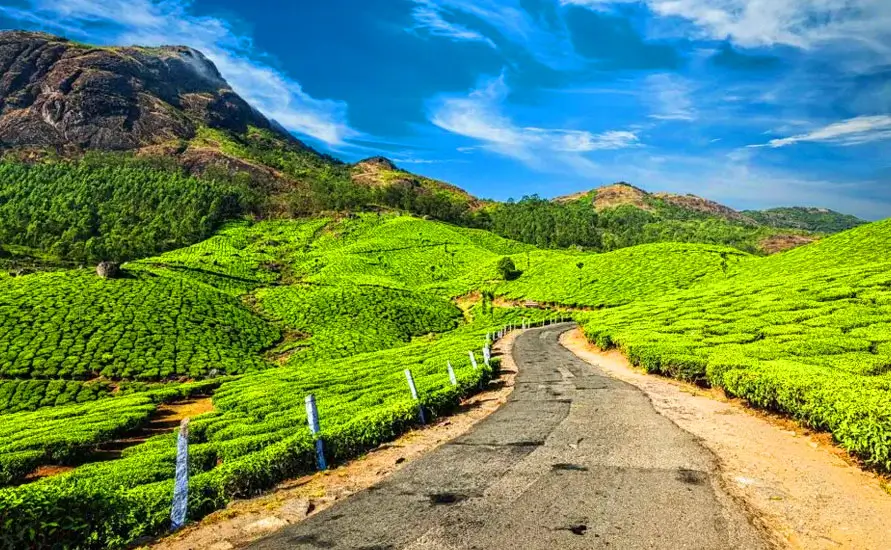
On the way up, the vegetation changes in clear bands, from areca palms and banana groves to eucalyptus, silver oak and then the neat green rows of tea that cover the upper slopes. You pass through Coonoor, the quieter sister town of Ooty, where it is worth stopping for coffee with a view over the valley. By early afternoon you arrive in Ooty, also called Udhagamandalam, which the British developed in the 19th century as the summer seat of the Madras Presidency. At roughly 2,200 meters it is the highest stop of this trip, and nights here can drop close to freezing in January.
Your hotel is the Savoy, an IHCL hotel whose colonial buildings date back to the early 19th century and which keeps much of the feel of an old hill-station hotel. Rooms and suites are spread through low cottages around lawns and flower beds, and many have working fireplaces that staff light for you in the evening. After settling in, take tea in the Tea Lounge, where the leaf comes from a local Nilgiri estate, then walk the gardens before dark. Dinner in the Dining Room can include Badaga dishes from the Nilgiri hill community alongside Anglo-Indian classics. Overnight in Ooty.
After an early breakfast your chauffeur drops you at Ooty station for the ride on the Nilgiri Mountain Railway, the UNESCO-listed line that links Mettupalayam, Coonoor and Ooty. Running downhill from Ooty, the stretch to Coonoor takes a little over an hour and runs through Lovedale, Ketti and Wellington, past eucalyptus woods, vegetable terraces and small stations with painted wooden benches. Seats in first class are reserved in advance, and we book them as soon as the railway opens reservations for your date. Sit on the left side going down for the best views over the valleys, and keep your camera ready at the tunnels.
Your car waits at Coonoor station, so there is no need to ride the train back up the hill. Coonoor stands about 400 meters lower than Ooty and has a softer, greener look, with tea estates running right up to the edge of town. First on the list is Sim's Park, a sloping botanical garden laid out in the 1870s with trees brought from several continents, and then to a working tea estate where you see how the leaf is withered, rolled, dried and sorted. A tasting at the end shows how Nilgiri tea differs from the heavier Assam leaf most Europeans know at home.
In the afternoon the road continues to Dolphin's Nose, a jutting rock shaped a little like a snout, facing a gorge where the Catherine Falls drop down the opposite side of the valley on a clear day. On the way you can stop at Lamb's Rock for another long view toward the Coimbatore plains. Clouds move fast in these hills, so the view can open and close within minutes, and your guide judges the timing rather than racing through a list. You return to Ooty in time for high tea on the Savoy lawns or a gin and tonic in the wood-paneled Canterbury Bar. Overnight in Ooty.
Ooty's Government Botanical Garden is a short drive from the Savoy and looks its best in the first hours after opening, when dew still sits on the lawns. Laid out in the late 1840s on terraced slopes, it keeps a petrified tree trunk that guides date to many millions of years ago, an Italian-style sunken garden and a glasshouse of ferns and orchids. Your guide also points out the native shola trees, the stunted evergreen forests that once covered these hilltops before tea and eucalyptus plantations arrived. A small Toda hut built in the upper part of the garden prepares you for the visit later in the morning.
From the garden you drive to Doddabetta Peak, which tops out at roughly 2,600 meters; from its observation tower ridge after ridge rolls away toward Mysore and the plains of Tamil Nadu. After that comes a short visit to a Toda mund, a settlement of the pastoral Toda people, whose barrel-shaped huts have tiny doorways and whose shawls are embroidered in red and black. Your guide is respectful about photography and asks before pointing a lens at anyone. The Toda keep buffalo herds that are central to their rituals, and a short talk explains their traditions without turning them into a show.
The afternoon is yours. Many guests return to the Savoy for a long lunch and an idle hour by the fire, while others stroll down to St. Stephen's Church, built in the 1820s with timber said to come from Tipu Sultan's palace at Srirangapatna. The croquet lawn, the vegetable garden and a massage at the hotel's Jiva Spa are all close at hand if you would rather not leave the grounds. Ask the hotel about the long-told story that Ooty is where British officers first mixed gin with quinine tonic, then judge the result for yourself before dinner. Overnight in Ooty.
Of all the road days on this trip, today covers the most ground, so the car is packed by eight and the hours are broken up with worthwhile halts. The road descends from Ooty through the steep Kalhatti ghat, a series of hairpin bends that your chauffeur takes slowly, and then crosses the forest corridor of Mudumalai and Bandipur, where spotted deer often graze by the roadside and wild elephants sometimes cross in front of the traffic. Forest rules forbid stopping or leaving the car inside the reserves, and the speed limit is low, which suits wildlife spotting through the glass. Beyond Gundlupet the land opens into sunflower fields and small market towns of the Mysore plateau.
Around lunchtime you reach Bylakuppe, home to tens of thousands of exiled Tibetans and settled in the early 1960s by refugees who followed the Dalai Lama into exile. The center of the settlement is Namdroling Monastery, known locally as the Golden Temple, where huge gilded statues of the Buddha, Padmasambhava and Amitayus fill the main hall and young monks in maroon robes cross the courtyards between classes. Visitors are welcome, with shoes left at the door and quiet voices inside. A simple Tibetan lunch of momos and thukpa at one of the cafés outside the gates makes a pleasant change.
From Bylakuppe it is a little over an hour to Coorg, also called Kodagu, a district of coffee estates, rainforest and pepper vines climbing silver oak. Taj Madikeri Resort & Spa lies near Madikeri inside about 180 acres of rainforest, and its rooms and villas take their design from traditional Coorg homes, built in local stone, wood and earth so that they settle into the slope instead of standing out from it. Many villas have a heated private plunge pool and a deck over the treetops. After a long day, dinner at the resort's all-day restaurant and an early night are the right choice. Overnight in Coorg.
Mist usually fills the valleys around the resort at dawn, and a short guided walk on the forest trails before breakfast is the best way to see it lift. The naturalist points out giant tree ferns, wild pepper, fig trees full of hornbills and the occasional Malabar giant squirrel, a large maroon and cream rodent that leaps between branches. Back at the villa, breakfast can include Coorg specialties such as akki roti and pandi curry, the dark pork dish that the Kodava people prepare for festivals. The resort also offers yoga on a deck facing the hills for anyone who prefers to start the day slowly.
Later in the morning your guide takes you into Madikeri town. Madikeri Fort dates from the 17th century, was strengthened by Tipu Sultan and then passed to the Kodava rajas and the British, and inside its walls stand the old palace and a church now used as a small museum. Nearby, the Omkareshwara Temple, built in 1820, mixes a Kerala-style tiled roof with Islamic-style domes and minarets, an unusual combination that your guide explains. After lunch you drive to Abbey Falls, a short walk downhill through coffee and cardamom to a waterfall that is fullest from July to October and gentler in the dry months.
Sunset belongs to Raja's Seat, whose flower beds and railings sit right at a cliff edge, a spot local lore links with the old rulers of Kodagu and their evening leisure. On clear days you see layer after layer of blue hills fading toward Kerala. The garden is popular with local families at weekends, so your guide finds a quieter spot along the railing. Back at Taj Madikeri, the speciality restaurant serves Coorg and wider South Indian curries, and the bar is warm enough on a cool night to linger over a glass of local coffee liqueur or a single malt. Overnight in Coorg.
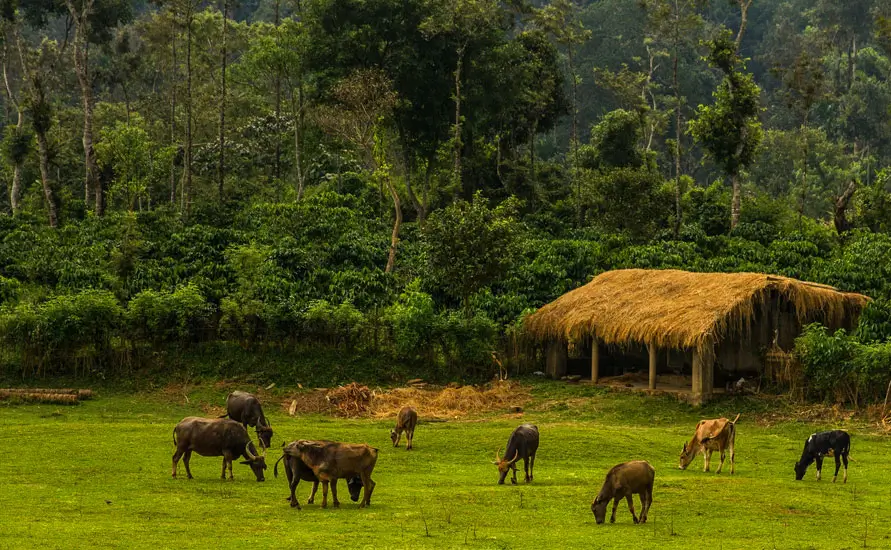
Coffee is the reason modern Coorg exists in its present form, and this morning you visit a family-run estate a short drive from the resort. The planter or his manager walks you through rows of arabica and robusta under a canopy of shade trees, explaining why coffee here grows alongside pepper, oranges and cardamom rather than in open fields. Between December and February you may see the ripe red cherries being picked by hand and spread on drying yards, while in spring the bushes flower white and the estate smells faintly of jasmine. The tour ends with freshly roasted coffee brewed in the estate kitchen.
On the way back, there is an optional stop at the Dubare stretch of the Kaveri River, where a forest department camp keeps retired working elephants and the river runs over wide rocky shallows. Many guests prefer to skip it and return straight to the resort, which is designed for exactly this kind of day. Taj Madikeri has indoor and outdoor heated pools, a gym and an activity center that runs guided walks, birdwatching and short treks on the property. The J Wellness Circle spa offers Indian and Asian therapies, and a long massage after the coffee walk is a good use of the afternoon.
For your last evening in Coorg, ask the resort to arrange a private dinner on one of its open decks or at the outdoor amphitheater, lit by lamps and surrounded by forest sounds. The kitchen can put together a Kodava menu with bamboo shoot curry, kadambuttu rice dumplings and coconut-based dishes if you want to taste local home cooking. Cool nights mean a jacket is welcome after dark between November and February. Before bed, ask your chauffeur to confirm the start time for tomorrow, as the route to Wayanad passes a temple best visited before midday. Overnight in Coorg.
After breakfast you leave Coorg southward through Virajpet and Gonikoppal, where coffee estates gradually give way to the forest of the Nagarhole buffer zone. At Kutta you cross the state border from Karnataka into Kerala, and the scenery shifts again to steeper hills, red earth and houses with tiled roofs. Your chauffeur keeps a steady pace on roads that are narrow in places, and there are short stops for photographs and a coffee at a roadside stall. Wild elephants are sometimes seen along this stretch early in the day, so keep a watch on the forest edge as you go.
Before reaching your resort, you make a detour to Thirunelli Temple, an ancient Vishnu shrine set in a forest valley under the Brahmagiri hills. The temple is built of granite with a tiled roof, and pilgrims walk down to a stream behind it to perform rites for their ancestors. Non-Hindus are usually allowed into the outer areas, and your guide explains the local customs, including the traditional dress expected inside. A short path leads to the stream through trees full of monkeys. The resort is roughly ninety minutes onward at Padinjarathara on the shore of the Banasura Sagar reservoir.
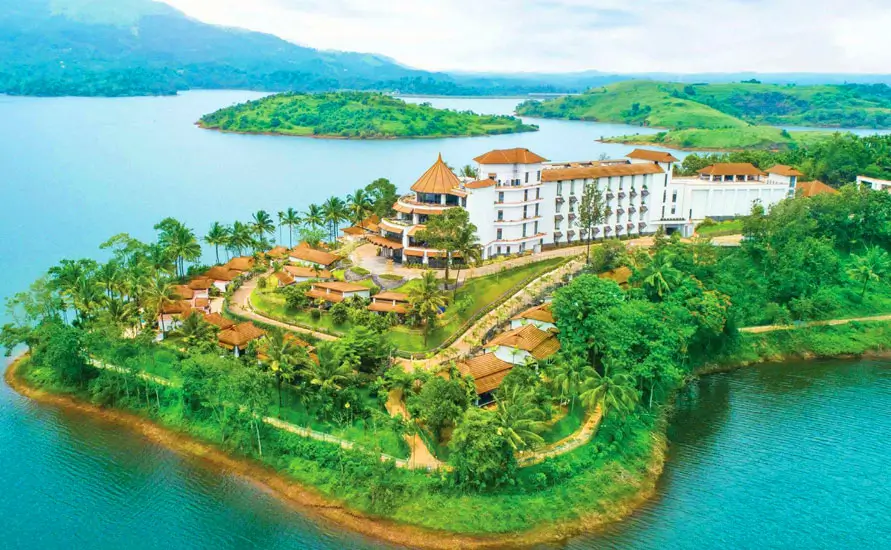
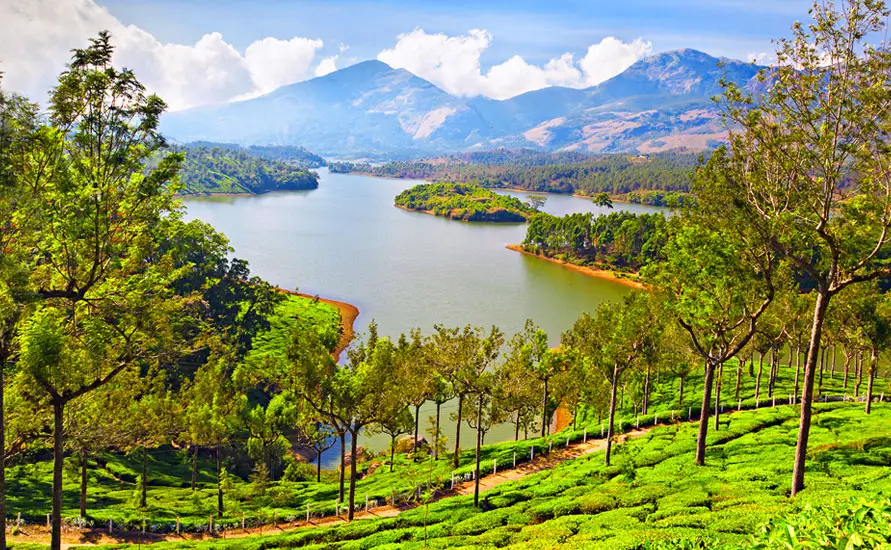
Taj Wayanad Resort & Spa sits on a peninsula hill above Banasura Sagar, with water on several sides and the forested slopes of Banasura Hill rising beyond. Accommodation steps down the slope in tiers, from rooms with lake-facing balconies to cottages built on stilts and lower villas near the water, some with their own plunge pool and deck. Arrive with daylight to spare, because the reservoir glows gold for an hour before dusk. Have a drink at the bar, decorated with brass telescopes and a nautical theme, before dinner at Southern Spice, the resort's South Indian restaurant. Overnight in Wayanad.
Today your guide takes you to the Edakkal Caves, near Ambalavayal, about an hour's drive from the resort. Despite the name, Edakkal is a cleft formed between huge boulders high on Ambukuthi Hill, and its walls carry carved figures, symbols and animal shapes that archaeologists date back several thousand years. The final approach is a steep climb of around thirty to forty minutes on steps and paths, so wear good shoes and carry water. The site is usually closed on Mondays and visitor numbers are capped each day, so we plan the order of the week around it and go early.
Heading back, you pause at Pookode Lake near Vythiri, a forest-fringed natural lake shaped roughly like the map of India, where you can walk the shoreline path or take a short pedal boat out on the water. The surrounding hills are planted with tea, coffee and cardamom, and your guide can stop at a spice shop for fresh pepper and vanilla pods, both grown widely in Wayanad. Lunch is back at the resort or at a local restaurant serving Malabar dishes such as chicken biryani cooked the Kozhikode way, with short-grain kaima rice and fried onions.
Spend the late afternoon at Taj Wayanad, where staff can arrange a private boat outing on the reservoir, a nature walk on the lower promenade or a yoga session in the open pavilion. For a last evening in the hills, book a private dinner on the lawns under the palms, with lamps along the water and the forest dark across the lake. The J Wellness Circle spa runs Ayurveda-based rituals if you want a final massage before the flight home. Pack tonight, since tomorrow's drive to the coast starts after breakfast and descends through a busy ghat road. Overnight in Wayanad.
After a last breakfast overlooking Banasura Sagar, your chauffeur drives you down from the Wayanad plateau via the Thamarassery Ghat, a road of nine hairpin bends with wide views over the Kerala coastal plain. The temperature climbs steadily as you descend, a clear reminder of how cool the last ten days have been. The run to Calicut International Airport usually takes around three hours, but traffic on the ghat can be slow, so we time the departure with a generous margin for international check-in. Daily services link Kozhikode with Dubai, Doha, Abu Dhabi and other Gulf hubs, where most long-haul onward flights connect.
For a late-night departure, we can book a day room in Kozhikode and a short visit to Kappad Beach, where Vasco da Gama landed in 1498. Kannur International Airport, about three hours away by a different ghat road, is an alternative if it gives you better connections, and we choose between the two when booking your flights. Our team stays in touch until you are inside the terminal, and when you feel like returning for the backwaters or the Malabar coast, simply write to us. Safe travels home.
Your Journey

N.S. Rathore & Mrs. Omlata Rathore · Managing Director
We still read every enquiry ourselves. Tell us the places you liked and our planners will send a day-by-day route with drive times and a clear price.
Every package can be customised and no pressure to book. A planner from our office replies within 24 hours with a route written for your group.
Fill this in and your planner will send a first draft itinerary.
Explore more
Kerala Backwaters Escape Kerala Backwaters Escape
 Kerala Backwaters Escape
 Kerala Backwaters Escape
 Kerala Backwaters Escape
 Kerala Backwaters Escape
 Kerala Backwaters Escape
 Kerala Backwaters Escape
 Kerala Backwaters Escape
 Kerala Backwaters Escape
 Kerala Backwaters Escape
 Kerala Backwaters Escape
 Kerala Backwaters Escape
 Kerala Backwaters Escape
 Kerala Backwaters Escape
 Kerala Backwaters Escape
 Kerala Backwaters Escape
 Kerala Backwaters Escape
 Kerala Backwaters Escape
 Kerala Backwaters Escape
 Kerala Backwaters Escape
 Kerala Backwaters Escape
 Kerala Backwaters Escape
 Kerala Backwaters Escape
 Kerala Backwaters Escape