 Kerala Backwaters Escape
Luxury South India Tours
Bangalore – Mysore – Kabini – Coorg – Hampi
At a glance
Karnataka rarely gets the attention Kerala receives, yet few Indian states pack so much variety into one road trip. Our luxury Karnataka tour links a garden city, a royal capital, a tiger forest, misty coffee hills and a medieval ruined metropolis over eleven unhurried days. You start in Bangalore, ride the new expressway to the palaces of Mysore, then spend two nights at a Kabini jungle lodge on the edge of Nagarhole, two more at a Coorg plantation resort, and end with three nights in the granite-strewn ruins of Hampi.
Each stay was chosen for setting rather than brand: a riverside lodge where elephants may cross the reservoir at dusk, a coffee estate whose owners still oversee every harvest, and a Hampi resort modeled on Vijayanagara courtly architecture. Between them, a chauffeur-driven premium SUV handles every road leg, and private guides meet you at each stop. Safaris at Kabini are booked through the lodge and forest department, and sightings depend on nature alone, never on promises.
This Karnataka tour package suits travelers from America, Britain, Europe and Australia who have already seen the Taj Mahal and want a quieter, more varied India, as well as NRI families from Bangalore returning with friends. The drive from Coorg to Hampi is long, and we explain below how we make it comfortable. October through March is the driest window; Coorg's coffee blossom season around March, and green post-monsoon months, each bring their own rewards.
Intercontinental flights into Kempegowda International Airport mostly land before sunrise or around noon, and whichever slot you land in, a Bangalore host is standing beyond the exit barrier with your surname on a tablet screen. Allow about sixty minutes to reach the hotel, since the terminal was built far out on the city's northern fringe, and more at peak commuting time. While the SUV crawls through the traffic, your host talks about how a sleepy cantonment of retired officers turned into India's software hub within one lifetime. Guests touching down at 3 or 4 am can have the room pre-booked for the previous night, so sleep comes first.
After some rest, a short ride brings you to Lalbagh Botanical Garden; Hyder Ali planted it first in the mid-eighteenth century, and and Tipu Sultan enlarged with saplings shipped in from Kabul, Persia and Mauritius. Its iron-and-glass conservatory, a smaller cousin of the one at the Great Exhibition in London, hosts big flower shows twice yearly. Ten minutes on, Tipu's two-story Summer Palace is built entirely of teak and was completed in 1791; its cusped arches still show traces of their original paintwork. Standing on its upper veranda, your guide traces the four Anglo-Mysore wars that made Tipu the most feared opponent of the British in the south.
Bangalore's real strength after dark is its dining. Our team can reserve a modern Indian tasting menu, a Mangalorean seafood house serving ghee roast prawns, or a no-frills darshini where office workers eat crisp masala dosa standing at steel counters. The city also launched India's craft-beer boom, and a rooftop microbrewery is an easy setting for fighting jet lag with a cold wheat ale. Because the plateau lies roughly 920 meters up, nights rarely turn hot, and a light layer is enough between December and February. Ask your host for tomorrow's departure time before heading to bed. Overnight in Bangalore.
Setting off by 8 am keeps you ahead of the morning rush, and the six-lane Bengaluru–Mysuru Expressway turns what used to be a crawl into about 150 minutes of smooth driving. Shortly before Mysore your chauffeur exits for Srirangapatna, a river island wrapped by twin channels of the Kaveri that Tipu held as his capital until it fell to a British assault in May 1799. Your guide walks you along the breached ramparts, to the marked place where the sultan died fighting at the water gate, and down into the vaulted cells where captured British officers spent years in chains. Close by stands the far older Ranganathaswamy Temple, one of the island's main Vishnu shrines.
Daria Daulat Bagh, Tipu's summer retreat, is the next stop. Every inch of its wooden verandas is painted with scenes of war and court life, including a long panorama of the 1780 clash at Pollilur, where Mysore forces routed a British column. Inside, a small gallery displays engravings, coins and clothing from the period. Minutes later you reach the Gumbaz, a white domed tomb rising above cypress-lined lawns, where Tipu rests beside his parents, and whose doors are inlaid with ivory. Lunch follows at a restaurant beside the Kaveri, before you cover the last half hour into Mysore.
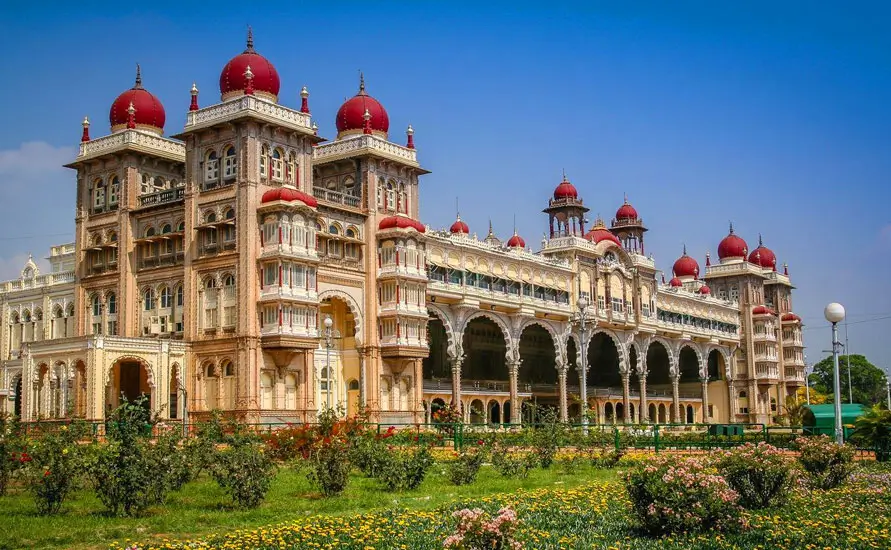
Mysore's two nights are spent at a former royal guesthouse converted into a heritage palace hotel, or at a five-star property facing Chamundi Hill. Arriving on a Sunday or public holiday means your guide can escort you to the grounds of Mysore Palace to watch close to 100,000 bulbs switch on at about 7 pm, outlining every dome and arch for roughly forty-five minutes. Crowds build early near the north gate, so we aim to be in place before dusk. Other evenings are yours for the spa or a quiet hotel dinner, perhaps a royal-style thali ending with crumbly Mysore pak made from gram flour, sugar and ghee. Overnight in Mysore.
Gates open early, so the morning starts inside Mysore Palace before tour coaches arrive. Today's building replaced a wooden palace that burned down in 1897, and the British architect Henry Irwin designed its mix of Hindu, Mughal and Gothic elements for the Wadiyar rulers. Footwear is checked at a counter outside, and cameras stay unused in the state rooms. Your guide leads you into the eight-sided Kalyana Mantapa, the royal wedding pavilion, where peacock motifs fill a ceiling of colored glass made in Scotland, then up to the colonnaded Durbar Hall, which looks out onto the parade ground used every October during Dasara.
Next your chauffeur winds up the road to the top of Chamundi Hill, about 1,060 meters high, crowned by the Chamundeshwari Temple; its goddess killed Mahishasura, the buffalo-headed demon who gave Mysore its name. Devotees often climb a stairway of more than a thousand steps to reach it. Coming back down, you pause at the black granite Nandi, Shiva's bull, carved in the seventeenth century from one boulder and standing almost five meters high, its neck hung with stone bells. Lunch might be at your hotel or a crowded local institution famous for its butter-laden masala dosa.
Afternoon takes you into the old commercial center around Devaraja Market, a long arcaded hall dating from the Wadiyar era. Vendors stack bright pyramids of kumkum and turmeric powder, sell jasmine by the arm's length, and offer six or seven local bananas, including the small, fragrant Nanjangud variety. With your guide you can also visit the government silk factory, whose looms turn out Mysore crepe silk by the meter, or a shop selling pure sandalwood oil. If there is time before sunset, the Jaganmohan Palace gallery shows canvases by the painter Raja Ravi Varma. Kabini is close, so tomorrow begins without hurry. Overnight in Mysore.
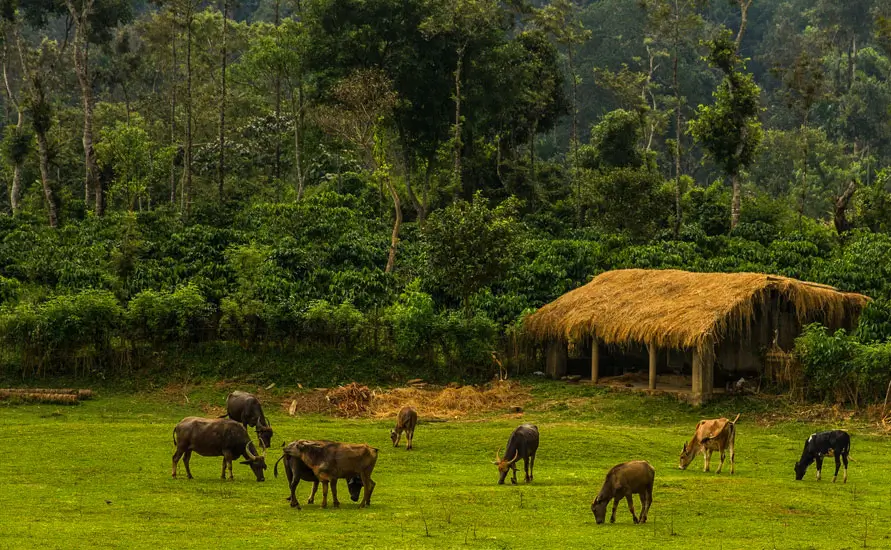
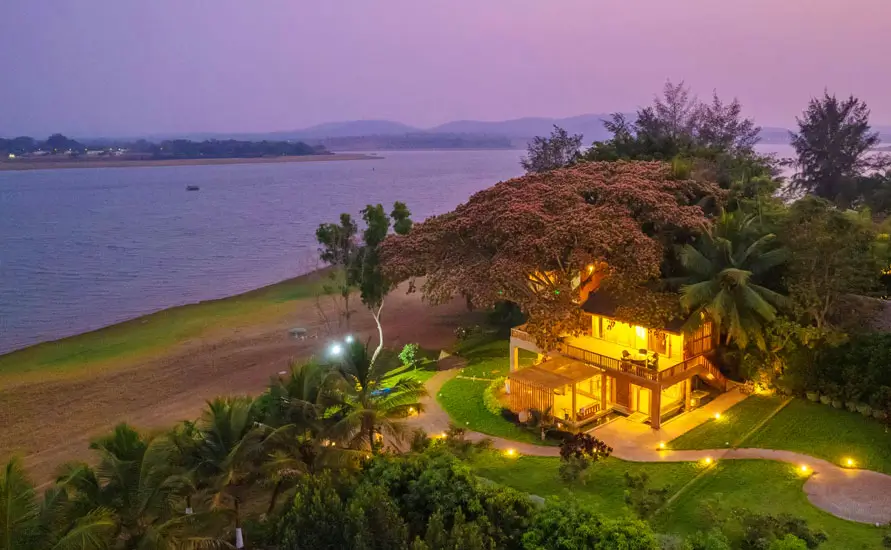
Sugarcane fields, coconut groves and brick-kiln villages line the two-hour road from Mysore to Kabini. Here a dam on the Kabini River holds back a wide lake, and across its water spreads Nagarhole National Park, renamed for Rajiv Gandhi though few people use that name. You reach your Kabini jungle lodge before lunch. Cottages are spread under huge old rain trees along the shore, and a wooden deck looks across the water to the forest. The lodge naturalist meets you after lunch with a short safari briefing: dull, earth-colored clothing, no perfume, no loud talk and no getting out of the jeep inside the forest.
Your first Nagarhole safari leaves in mid-afternoon in an open-sided jeep, rolling along forest roads under teak, rosewood and bamboo. Chital, sambar, gaur, grey langurs and wild pigs are seen on most drives, and Kabini is famed for big congregations of elephants, especially between March and June when the reservoir shrinks and the grass at its edge grows fresh. Leopards and tigers live here too, yet nothing is guaranteed, and a good naturalist reads tracks, alarm calls and bird behavior as carefully as he looks for big cats. The forest department sets the routes, timings and number of vehicles.
You return as daylight fades, with time to rinse off the dust before drinks around the fire pit. Many lodges show a wildlife documentary or invite a researcher to talk about how villages around the park live alongside elephants that raid their crops. Dinner is a buffet of local and continental dishes in an open dining pavilion. After dark the forest stays noisy, with frogs, nightjars and a sambar's alarm call drifting across the water. Lodge staff walk you to your cottage with a torch, and guests are asked not to wander alone at night. Overnight in Kabini.
Tea and biscuits arrive at your door just before six, and soon you are aboard a motorboat for a boat safari along the forested shoreline of the reservoir. The water fans out over old grassland and drowned trees, and from the boat you can watch for elephants grazing at the edge, marsh crocodiles lying on rocks, otters and grey-headed fish eagles watching from bare snags. Soft early light makes this the best photography session of the stay. When the water level falls in the dry season, the open grass draws more animals, though every sighting remains a matter of luck rather than planning.
Breakfast waits on the deck, and nothing is planned until lunch. You could join a short walk with the naturalist around the lodge grounds, sit on your veranda with a book, or watch for Malabar pied hornbills, Indian rollers and white-throated kingfishers from the water's edge. Some lodges also offer a short ride in a coracle, the bowl-shaped bamboo boat that local fishing families still use on the river. Lunch is unhurried, followed by a siesta in the heat of the day, which is also when the forest animals rest in the shade.
Late afternoon brings the second jeep drive, usually on a different circuit from yesterday, with fresh chances for leopards, tigers, dholes and sloth bears. Along the way your naturalist explains how Nagarhole joins Bandipur, Mudumalai and Wayanad in one vast, continuous wildlife landscape, and why that corridor matters for elephants. Back at the lodge, a final evening around the fire is a good time to swap photographs with other guests. Ask the kitchen for ragi mudde, soft finger-millet dumplings swallowed with spicy curry, a staple of rural Karnataka that rarely appears on hotel menus. Overnight in Kabini.
Keen wildlife watchers can book one more dawn drive before checkout, while others linger over breakfast at the riverside. Afterward your chauffeur heads north-west through Hunsur, a market town known for tobacco and silk, toward the green hills of Coorg, which locals call Kodagu. Roughly two hours into the drive you reach Bylakuppe, settled from 1961 onward by Tibetans in exile, where thousands of monks, nuns and families now live. Colorful prayer flags, maroon robes and small cafés selling momos and butter tea make the contrast with the surrounding farm country striking.
The main sight is Namdroling Monastery, home to one of the largest Buddhist teaching centers of the Nyingma school. In its main hall three huge gilded figures, of the Buddha, Guru Rinpoche and Amitayus, rise nearly 18 meters above the prayer benches. If you arrive during an assembly, visitors may take a seat near the doors while rows of young monks chant to drums, cymbals and long copper horns. Footwear comes off at the threshold, and photography rules vary by hall, so check with your guide. A light lunch of thukpa noodle soup is served in the settlement before you drive on into the hills.
As the road climbs, the air turns cooler and the roadside fills with coffee bushes under tall shade trees. Your Coorg plantation resort sits on a working estate, with villas spread over the slopes, many with private plunge pools and views across the valley. Filter coffee brewed from beans grown on the property is waiting when you arrive. The afternoon can be spent at the pool or spa, or on a short walk among the pepper vines with a resort guide. In the evening, try a small glass of homemade wine, made from fruits such as gooseberry or ginger, a Kodava tradition. Overnight in Coorg.
Mist often fills the valleys in the early morning, and that is the best time to head out with the estate planter on a coffee walk. Both arabica and robusta grow in Coorg, and your host shows how they differ in leaf, height, flavor and the care they need. If you come around March, the bushes may be covered in white blossom with a jasmine-like scent; from November to February, workers pick the ripe red cherries by hand. You also learn why pepper vines are wound around the silver oaks that shade the coffee and how the beans are pulped, dried and sorted. A tasting at the estate rounds off the walk.
The Kodavas, the people of Coorg, are famous for their soldiers, their wrap-style dress and generous meals. Lunch today is a Kodava spread served at a family home or prepared by the resort kitchen: pandi curry, pork slow-cooked until nearly black with kachampuli, Coorg's sour black fruit vinegar; kadambuttu, steamed rice dumplings; akki otti, thin rice flatbreads; and bamboo shoot or wild mushroom dishes for vegetarians. Your hosts talk about Kailpodh, the September festival when guns are blessed, and Puthari, the rice harvest feast held in late November or early December, when families gather in their ancestral homes.
Later you drive into Madikeri, the small capital of the Kodagu district. The Omkareshwara Temple, dating to 1820, places a Shiva shrine beneath domes and minarets in a style that surprises many visitors. Abbey Falls, a short drive out of town, flows strongly from August to November and thins out by spring. The day ends at Raja's Seat, a terraced viewpoint where, according to local legend, the kings of Coorg came each evening to see dusk settle over the western ranges. Dinner tonight can come to your villa veranda. Pack tonight, since tomorrow's departure is early. Overnight in Coorg.
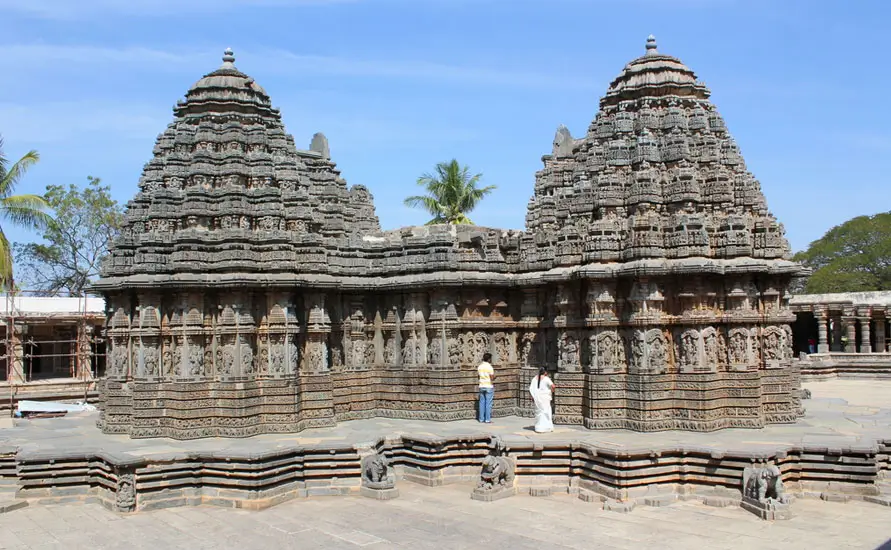
This is the only long road day of the tour, and we plan it with care. Leaving Coorg around 7 am, your chauffeur drives through Kushalnagar and Hassan and then north across the dry plateau of central Karnataka via Chitradurga. Most of the route uses good highways, and the premium SUV keeps it comfortable, with breaks every couple of hours for coffee, stretching and clean restrooms. Lunch is at a reliable restaurant on the way. If you would rather break the trip, we can add a night in Hassan with a visit to Belur and Halebidu, two great Hoysala sites, at an extra cost.
Late in the afternoon the landscape changes as you near Hampi: huge granite boulders piled into hills, banana plantations and green paddy fields along the Tungabhadra River. Your luxury resort near Hampi is designed in the manner of Vijayanagara royal buildings, with courtyards, pools and stone pavilions. After many hours on the road, a massage or a swim is the ideal way to recover. Dinner at the resort can include North Karnataka favorites such as jolada rotti, a thin sorghum flatbread, with a spicy stuffed brinjal curry and peanut chutney powder. Overnight in Hampi.
In the early 1500s, foreign visitors described this city as larger than Rome, and the Vijayanagara Empire ruled most of South India from here until a coalition of Deccan sultans crushed its army in 1565 and the capital was looted. What remains is a vast UNESCO-listed field of temples, palaces and bazaars set among boulders. First comes the Virupaksha Temple, still attended by daily worshippers more than six hundred years on. Its tall entrance tower faces the long colonnade of the old Hampi Bazaar, and inside, your guide points out a small dark room in which light through a narrow opening throws an upside-down image of the gopuram onto a wall.
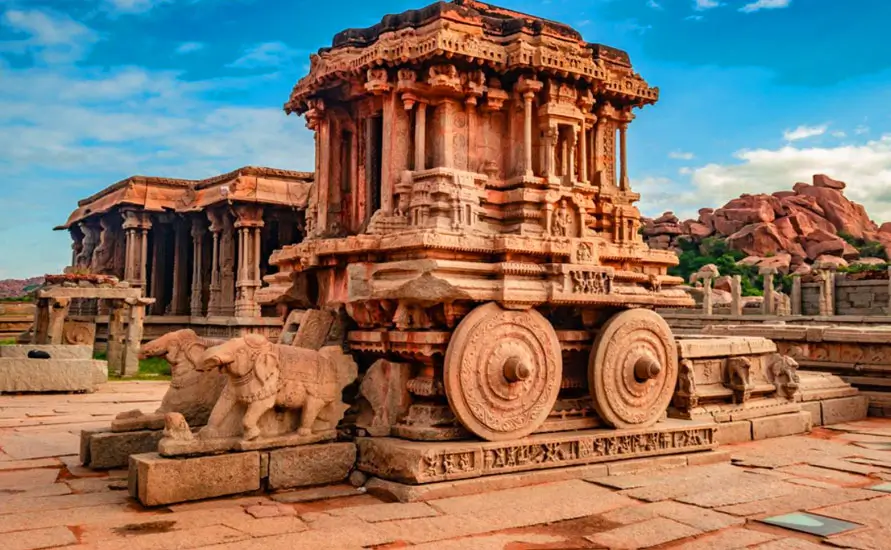
Above and behind it is Hemakuta Hill, a granite slope scattered with small early shrines and wide views over the bazaar and the river. A short drive leads to the giant Lakshmi Narasimha figure, a fierce lion-faced form of Vishnu cut from one boulder, and the Badavilinga, a three-meter Shiva linga whose shrine is always filled with water from an old channel. After lunch you visit the Vittala Temple, the finest building at the site. Its stone chariot is pictured on India's current 50-rupee note, and the slender pillars of its main hall were once tapped to produce musical notes, which is no longer allowed.
Late in the day you go down to the Tungabhadra River for a coracle ride. These round boats are woven from bamboo, sealed with tar or plastic sheeting, and turned with one paddle by boatmen who have done this all their lives. From the water you can spot carvings and small shrines on rocks along the bank that are difficult to reach on land. As the sun sets, the boulders turn orange and pink, and the temple towers stand out against the sky. Dinner back at the resort is relaxed, with a chance to try more local dishes, including fresh rotis and spicy lentils. Overnight in Hampi.
Today focuses on the area where the kings lived, held court and celebrated festivals. You begin at the Mahanavami Dibba, a huge stone platform whose sides are carved with processions of elephants, horses, dancers and hunters, from which the rulers watched the nine nights of Navaratri. Next to it lies a geometric stepped tank of black stone, excavated and restored by archaeologists in the 1980s. Your guide also shows you sections of the stone water channels and aqueducts that fed the royal area, evidence of how advanced Vijayanagara engineering was in its day.
Steps away lies the walled Zenana Enclosure, set aside for royal women, where the two-story Lotus Mahal shows Hindu and Islamic styles side by side in its arches. Next door, the Elephant Stables consist of eleven tall domed rooms, each big enough for a royal elephant and its keepers. The outer walls of the Hazara Rama Temple, the king's private shrine, carry rows of carved panels telling the Ramayana. Before lunch you see the Queen's Bath, a covered pool with arched galleries and projecting balconies. If it is not a Friday, the archaeological museum at Kamalapura has a helpful scale model of the city.
After lunch and a rest, a boat carries you over the Tungabhadra to Anegundi, older than Hampi and identified by tradition with Kishkindha, the kingdom of the monkey god in the Ramayana. Its narrow lanes are lined with old houses, and a women's cooperative here makes bags, mats and baskets woven from banana fiber. Energetic travelers can climb about 575 steps up Anjanadri Hill, the reputed birthplace of Hanuman, for a final sunset over boulders and rice fields. The climb is optional, and your chauffeur waits at the base. A farewell dinner is served at the resort. Overnight in Hampi.
There are two ways back to Bangalore, depending on your onward flight. When schedules allow, the quicker option is a short domestic flight from Jindal Vidyanagar Airport at Toranagallu, about an hour's drive from Hampi. Otherwise your chauffeur drives you straight to Kempegowda International Airport, around six hours on good roads with rest stops. We time the departure so you arrive with a comfortable margin before your international check-in. Flying out near midnight? We can hold a hotel room by the terminal for a few hours, billed separately.
From Bangalore, connections through the Gulf, Europe and Southeast Asia reach most cities in America, Britain and Australia. In eleven days you have seen Karnataka's many faces, from palaces and Tibetan prayer halls to forests, coffee estates and one of the great lost cities of Asia. For a future trip, our team can plan Hoysala carvings at Belur, the beaches of Gokarna or the early Chalukyan cave temples of Badami, Aihole and Pattadakal. Safe travels home.
Your Journey
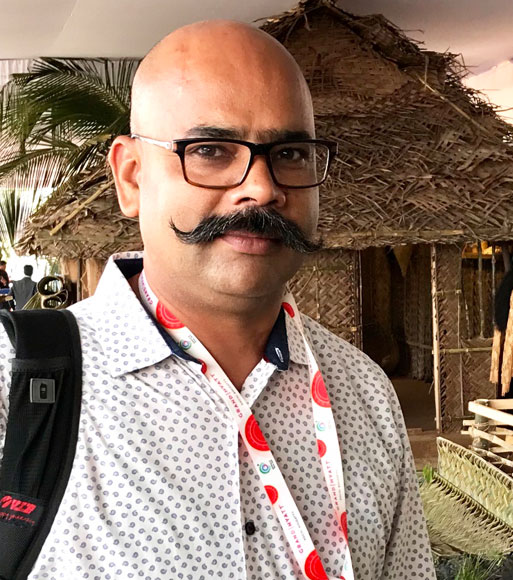
N.S. Rathore & Mrs. Omlata Rathore · Managing Director
We still read every enquiry ourselves. Tell us the places you liked and our planners will send a day-by-day route with drive times and a clear price.
Every package can be customised and no pressure to book. A planner from our office replies within 24 hours with a route written for your group.
Fill this in and your planner will send a first draft itinerary.
Explore more
Kerala Backwaters Escape Kerala Backwaters Escape
 Kerala Backwaters Escape
 Kerala Backwaters Escape
 Kerala Backwaters Escape
 Kerala Backwaters Escape
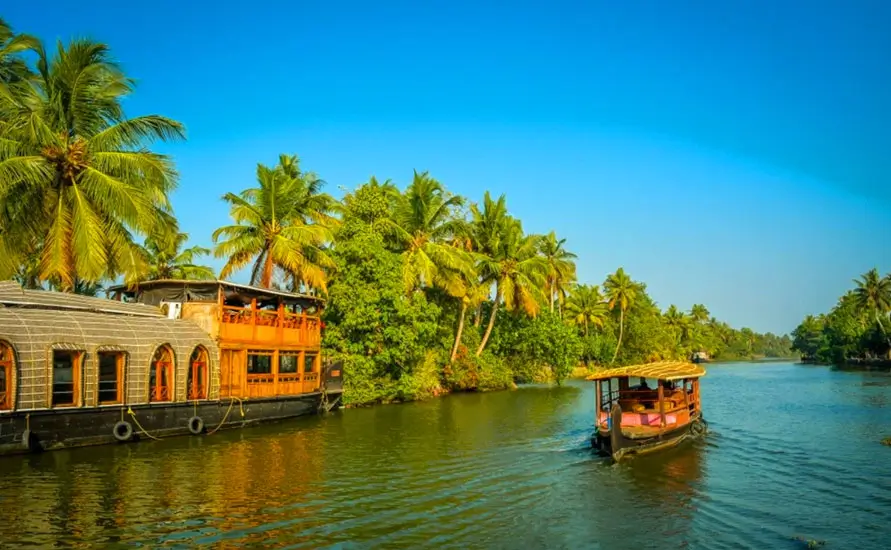 Kerala Backwaters Escape
 Kerala Backwaters Escape
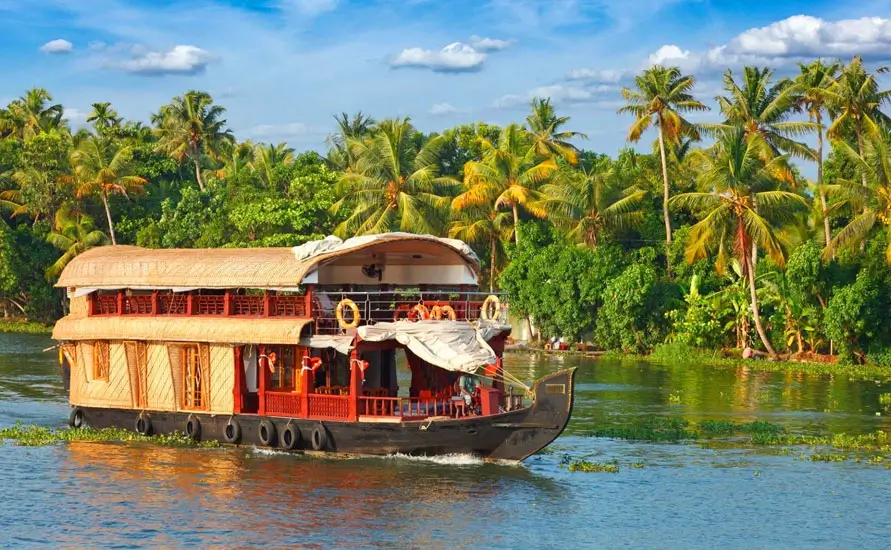 Kerala Backwaters Escape
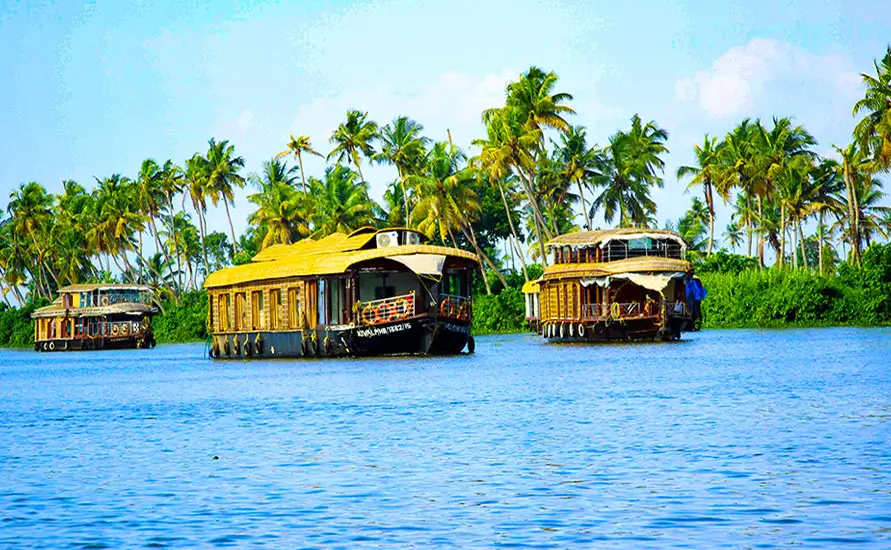 Kerala Backwaters Escape
 Kerala Backwaters Escape
 Kerala Backwaters Escape
 Kerala Backwaters Escape
 Kerala Backwaters Escape
 Kerala Backwaters Escape
 Kerala Backwaters Escape
 Kerala Backwaters Escape
 Kerala Backwaters Escape
 Kerala Backwaters Escape
 Kerala Backwaters Escape
 Kerala Backwaters Escape
 Kerala Backwaters Escape