
 Kerala Backwaters Escape

Luxury South India Tours
Delhi – Jaipur – Udaipur – Ranakpur – Kochi – Kumarakom – Marari
At a glance
Rajasthan was ruled for centuries by Rajput clans who poured their wealth into forts, lake palaces and the workshops that supplied them, and our Oberoi Rajasthan and Luxury Kerala Tour follows that royal thread before switching coasts. After two nights at The Oberoi New Delhi, you settle into The Oberoi Rajvilas in Jaipur and The Oberoi Udaivilas on the shore of Lake Pichola, two hotels designed to feel like the palaces you visit by day. The Taj Mahal is left out on purpose, giving you more time with the craftsmen, courts and lakes of Rajasthan.
In Jaipur you see the mirror halls of Amber Fort and the City Palace, then spend a day with block printers, blue-pottery makers and stone cutters whose families once worked for the court. Udaipur adds the largest palace complex in the state, a boat ride on Lake Pichola and a trip into the Aravalli hills to the marble Jain temple at Ranakpur. Three nights in each Rajasthan city keep the pace gentle and leave room for the pools, spas and long dinners these hotels do so well.
Kerala closes the trip with a quieter kind of comfort. A connecting flight takes you to Kochi, where you stay at Brunton Boatyard and meet the history of the old Cochin royal house, before CGH Earth's Coconut Lagoon in Kumarakom and three slow nights at Marari Beach. This luxury Rajasthan and Kerala tour is fully private, with chauffeur-driven cars and senior guides throughout. It suits couples, anniversary trips and travelers returning to India who already know Agra and want a deeper look at royal Rajasthan.
Customs and immigration at Indira Gandhi International can take a while after a long flight, so our meet-and-assist representative waits right at the exit with your name on a sign, ready to take over the luggage trolley. Your private car is parked close by, and the ride into Lutyens' Delhi is usually under an hour outside rush periods. Your host uses the time to confirm the hotel arrangements across both regions, share local phone numbers for every stage of the tour and note any dietary needs, so the restaurants in Rajasthan and Kerala know your preferences in advance.
The Oberoi New Delhi was rebuilt from the ground up and reopened in 2018, and it now feels more like a calm modern residence than a classic grand hotel. Rooms are finished in pale wood, stone and soft fabrics, and the higher floors face either the greens of the Delhi Golf Club or the tree line around Humayun's Tomb. Bathrooms are large, with deep tubs and separate showers. The service style is quiet and attentive, the kind where a butler remembers how you take your tea after the first morning, which is a gentle way to begin a trip of over two weeks.
Nothing is booked for today beyond rest. For jet lag, a few lengths of the outdoor pool or a short spa massage tend to work better than an afternoon nap that stretches into evening. Later, your driver can take you for a short evening drive along Rajpath, now renamed Kartavya Path, to see India Gate lit up against the dusk sky, with families eating ice cream on the lawns around it. You can then return for a light dinner at the hotel, where the chefs are happy to keep spice levels mild for a first night in the country. Overnight in Delhi.
Today's sightseeing in Delhi is shaped around the theme of the whole trip: royal patrons and the artisans who worked for them. Your guide begins in the south of the city at the Qutub Minar, a fluted victory tower of red and buff sandstone started around 1193 by Qutb-ud-din Aibak, the first sultan of Delhi. At about 73 meters it remains the tallest brick minaret in the world, and its bands of carved Arabic script show how quickly Persian and Indian stonemasons learned from each other. In the same complex stands an iron pillar more than 1,500 years old that has barely rusted.
A short drive brings you to the Mehrauli Archaeological Park, where crumbling tombs, step wells and mosques from several dynasties sit among the trees, and your guide can lead a short walk to the stepwell known as Rajon ki Baoli. After lunch at a garden restaurant nearby, you head to the National Crafts Museum near Pragati Maidan, one of the best places in India to understand the country's living crafts. Village houses from different states have been rebuilt in its grounds, and galleries hold textiles, bronzes, wooden toys and painted ceilings collected from every region.
Most days the museum also hosts visiting craftspeople who demonstrate their work in the courtyard, perhaps a potter from Gujarat, a Madhubani painter or a weaver from the Northeast, and you can buy directly from them. It is useful preparation for Jaipur and Udaipur, where many of these crafts were once supported by the royal courts. By late afternoon the car brings you back to The Oberoi, leaving an hour or two for the pool. If you are hungry for something local, ask the concierge to book a table at one of Delhi's well-known North Indian restaurants, where kebabs and dal makhani are the house favorites. Overnight in Delhi.
The road to Jaipur leaves Delhi through the business district of Gurugram and then follows the national highway south-west into Rajasthan. Plan on five to six hours including a break, and your chauffeur will suggest leaving straight after breakfast to miss the worst of the city traffic. Once the suburbs fall away, the scenery changes quickly: the Aravalli hills appear on the horizon, roadside dhabas serve tea in clay cups, and small forts and temples sit on the hilltops above farming villages. Lunch can be at a heritage property on the way or at the hotel on arrival.
The Oberoi Rajvilas sits on 32 acres just outside the city, and its design draws on the forts and havelis of the region: thick pink walls, domed chhatris, water channels and courtyards planted with fruit trees. On this trip we suggest one of the villas, each surrounded by its own high garden wall, with a private swimming pool, a sunken marble bathtub and an outdoor shower. The luxury tents are a strong alternative if you like the idea of canvas walls with teak floors and a deep freestanding tub. Whichever you choose, peacocks are likely to wake you at dawn.
Take the afternoon to settle in. A walk around the grounds shows how much care has gone into the place: lily ponds, a small organic garden that supplies the kitchen, and an 18th-century-style temple that the hotel has looked after since it opened. The pool is wide and quiet, with shaded loungers and attentive service, and the spa is ideal if the drive left your shoulders stiff. When the light fades, staff light rows of oil lamps along the paths. Dinner can be served in the courtyard or, if you are in a villa, on your private terrace by arrangement. Overnight in Jaipur.
Raja Man Singh I began Amber Fort in the late 16th century, and successive Kachhwaha rulers kept adding to it until the court moved to the plains. An early start means you reach the gates before the queues, with sunlight just touching the walls above Maota Lake. Your guide takes you through the halls of the king and the separate zenana, the women's quarters, where twelve suites were arranged around a single courtyard so that no wife could tell when the maharaja was visiting another. A stop at the Sila Devi temple shows the goddess the Kachhwaha clan still worship.
Near the fort lies Panna Meena ka Kund, a 16th-century stepwell whose crisscross staircases make it one of the most photographed spots in Jaipur, and it rarely gets busy before ten. You then drive down into the walled city to the City Palace, still the home of the former royal family, whose flag flies over the seven-storied Chandra Mahal when the head of the family is in residence. The highlight for many guests is Pritam Niwas Chowk, a courtyard with four doorways, each painted for a different season: the peacock gate for autumn, the lotus gate for summer, the green gate for spring and the rose gate for winter.
After a late lunch, your guide leads a slow walk along the arcaded bazaars of the old city, where each street was given over to one trade when Jai Singh II laid out his new capital in 1727. You pass bangle makers in Maniharon ka Rasta, brass and copper sellers, and sweet shops frying ghewar, a honeycomb-like dessert made for the monsoon festival of Teej. The tour ends below the Hawa Mahal in the soft light of late afternoon. Back at Rajvilas, the evening is quiet, perhaps with a cocktail beside the reflecting pool before a dinner of Rajasthani dishes such as laal maas. Overnight in Jaipur.
Royal patronage turned Jaipur into one of India's great craft cities, and today is devoted to the people who keep those skills alive. You start in Sanganer, a town on the southern edge of Jaipur known for hand-block printing on cotton. In a family workshop you watch printers line up carved teak blocks along a long table, pressing each color in turn, and then try it yourself on a scarf or a napkin to take home. The printers explain how vegetable dyes such as indigo and pomegranate rind are prepared, and why washing the fabric in running water was once essential to the process.
Next is a studio making Jaipur blue pottery, a craft that came to the city from Persia and uses a quartz-based dough rather than clay, so the pieces are fired at low temperatures and painted in cobalt blue and turquoise. After lunch your guide arranges a short visit to a stone-cutting workshop in the old city, where artisans polish emeralds, garnets and other stones on simple wheels, much as their grandfathers did. There is no obligation to buy anywhere today, and your guide is there to help you judge quality and fair prices if you do want to shop.
In the late afternoon you drive up into the hills to Nahargarh Fort, built in 1734 on the ridge that overlooks the Pink City. The views from its ramparts stretch across the rooftops to Jal Mahal and beyond, and as the sun drops the city lights come on one district at a time. Within the fort stands a palace of nine linked apartments that Maharaja Madho Singh II built for his queens, all joined by corridors so he could visit each without being seen. Back at Rajvilas, the kitchen can serve a Rajasthani thali in your villa garden as a last dinner in Jaipur, with dishes like ker sangri and gatte ki sabzi. Overnight in Jaipur.
A morning at leisure in Jaipur is followed by a short domestic flight to Udaipur, which takes around an hour; on some days the schedule may route via Delhi instead. The drive from Udaipur's Maharana Pratap Airport to the hotel takes about 40 minutes and passes marble yards, small temples and the first glimpses of the lakes that gave the city its reputation. Udaipur was founded in 1559 by Maharana Udai Singh II of the Sisodia dynasty after repeated attacks on their old fort at Chittorgarh, and the Sisodias are still regarded locally as the custodians of the city.
The Oberoi Udaivilas is built on the shore of Lake Pichola across the water from the City Palace, on land that was once part of the hunting grounds of the Maharanas. Its domes, colonnaded courtyards and fountains are laid out across some 30 acres, and an adjoining wildlife reserve means spotted deer and wild boar are sometimes seen from the paths. Premier rooms with a semi-private pool are the signature choice, as the water runs right up to the edge of your terrace, while the suites add private pools and wider lake views. Gold-leaf work and hand-painted walls appear throughout the public spaces.
Most guests spend the first evening just watching the lake. Sunset paints the City Palace a warm cream color, the hills behind turn purple, and the bells of nearby temples carry across the water. The hotel's courtyards fill with musicians playing quietly, and staff float lamps on the pools after dark. For dinner, the restaurants focus on Indian and international menus, and a table by the water can be arranged if you mention it at check-in. An early night is wise, as tomorrow begins with the palace while the light is still soft. Overnight in Udaipur.
Most guests reach the City Palace of Udaipur by the hotel boat, a much nicer arrival than the road and a short crossing of Lake Pichola. Started in the 16th century and extended by successive Maharanas over about 400 years, it is the largest palace complex in Rajasthan and stretches along the eastern shore for more than 240 meters. Your guide leads you through its courtyards and galleries, including the Mor Chowk with its glass mosaic peacocks, the Manak Mahal with its mirrored alcoves, and the rooms of the museum that hold the armor and portraits of past rulers.
A short walk uphill from the palace gate is the Jagdish Temple, built in 1651 and dedicated to Vishnu. Its stone platform is lined with carved elephants and dancers, and devotees climb the steep steps to the shrine at all hours. Downhill from the temple, the old-city lanes hold small studios of miniature painters, who still work with brushes made from a few squirrel hairs on paper and silk. After lunch you visit Saheliyon ki Bari, the Garden of the Maidens, created for the ladies of the court with fountains, lotus pools and marble elephants.
In the late afternoon you board a private boat for a sunset ride on Lake Pichola, passing the white walls of the Taj Lake Palace and pausing at Jag Mandir, an island palace where Shah Jahan is said to have stayed as a young prince in rebellion against his father. The palace offers a café where you can stop for a drink before the boatman takes you back across the water. In the evening, the Dharohar folk dance show at Bagore ki Haveli presents Rajasthani dances including the famous pot balancing act, or you can choose a quiet dinner overlooking the lake at Udaivilas. Overnight in Udaipur.
A full-day excursion today takes you north into the green folds of the Aravalli hills, where the road climbs through teak forest, small farms and villages of the Rabari herders, who still wear bright red turbans. Count on roughly 150 minutes in each direction, with a chai break in one of the hill villages. Your destination is the Ranakpur Jain Temple, built in the 15th century with the support of the Mewar ruler Rana Kumbha, and widely regarded as one of the finest temples of the Jain faith in India.
The temple is carved entirely in pale marble and is famous for its 1,444 pillars, each with a different design, so that no two look alike. Light falls through open domes into halls of lace-like stonework, and the central shrine is dedicated to Adinath, the first Jain tirthankara. Non-Jain visitors are generally allowed in from around noon, after the morning prayers. Leather items such as belts, wallets and bags must be left outside, shoulders and knees must be covered, and menstruating women are asked not to enter. Your guide briefs you on all of this in the car so nothing is confiscated at the door.
Lunch is at a country resort near the temple, a simple and pleasant spot after the drive. On the way back to Udaipur, your driver can stop at a stepwell or a village where farmers use bullocks to draw water from deep wells, a scene that is becoming rare. You reach Udaivilas in time for a swim and a late-afternoon spa session if you would like one; the hotel spa, set among courtyards and water features, offers Indian and international therapies. Your last dinner in Rajasthan can be set on the terrace with views across to the illuminated City Palace. Overnight in Udaipur.
Today is mostly a travel day between the two halves of the tour. After an early breakfast, your chauffeur takes you to Udaipur airport for the flight to Kochi, which normally connects through Mumbai, Delhi or Bangalore, since direct services are rare. Allow for most of the day in transit, and we book the connection with the shortest reasonable layover. Lounge access can be added on request, and our team in Udaipur keeps in touch with you throughout the transfer so that any schedule change is handled early.
On arrival at Cochin International Airport, a Kerala host greets you and the drive to Brunton Boatyard in Fort Kochi takes around ninety minutes. The hotel stands on the waterfront of Kochi harbor, rebuilt by CGH Earth in the style of the Victorian shipyard that once stood here, with arched verandas, teak floors and large ceiling fans that recall the colonial era. Rooms are arranged so that each looks over the harbor channel. Dinner tonight could be at the Terrace Grill, where fresh seafood is cooked over coals as the lights of passing boats drift by. Overnight in Kochi.
Continuing the royal thread of the trip, your guide drives you about 30 minutes inland to Tripunithura and the Hill Palace Museum, the former residence of the Maharajas of Cochin. Built in 1865, this complex of 49 buildings is now one of the largest archaeological museums in Kerala and holds crowns, palanquins, oil paintings, coins and royal jewelry. A deer park and herb garden fill the grounds around the buildings. Your guide explains how the Cochin royal family managed relations with the Portuguese, Dutch and British, which shaped the city you see today.
Back in town, the Mattancherry Palace links the story together, since the Portuguese built it for the same Cochin rajas, who later had its royal bedchamber painted wall to wall with episodes from the epics and Puranas. Note that the palace is closed every Friday. A few steps on, the Paradesi Synagogue closes its doors on Friday, Saturday and Jewish festivals, which is why we set the Kochi days only once your dates are fixed. Lunch is at a café in a restored spice warehouse, where you can taste dishes from the Syrian Christian and Jewish traditions of Kerala.
In the afternoon, the Kerala Folklore Museum at Thevara is a good contrast: a three-story building made with salvaged wood and decorated with temple carvings, it displays masks, costumes, musical instruments and theater props from many art forms of South India. Its owner began the collection as an antiques dealer, and the building itself is worth the trip. In the evening, you can watch a Kalaripayattu performance, the ancient martial art of Kerala, in a small arena in Fort Kochi, with demonstrations of swordplay and flexible sticks. Overnight in Kochi.
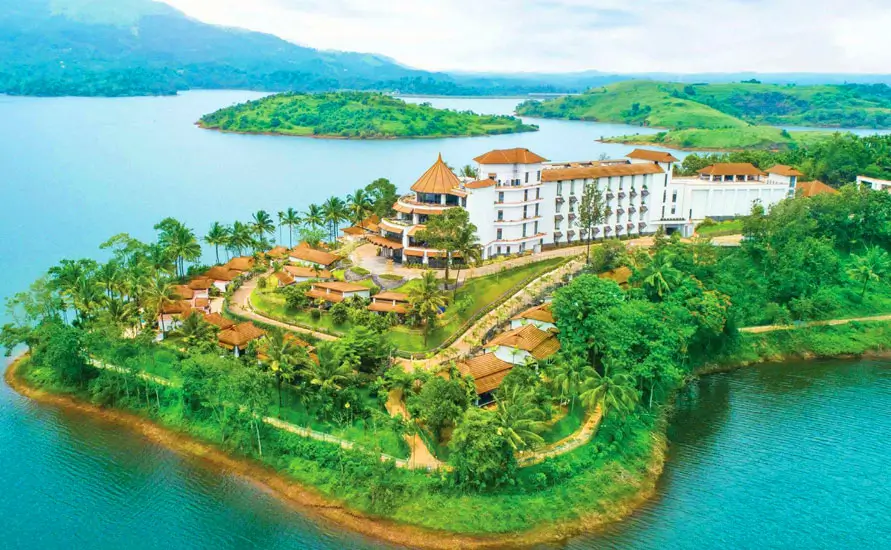
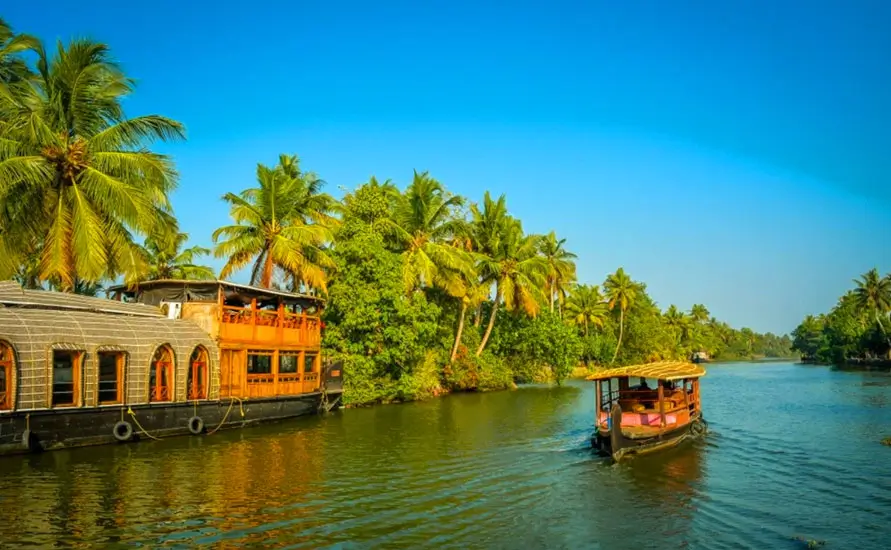
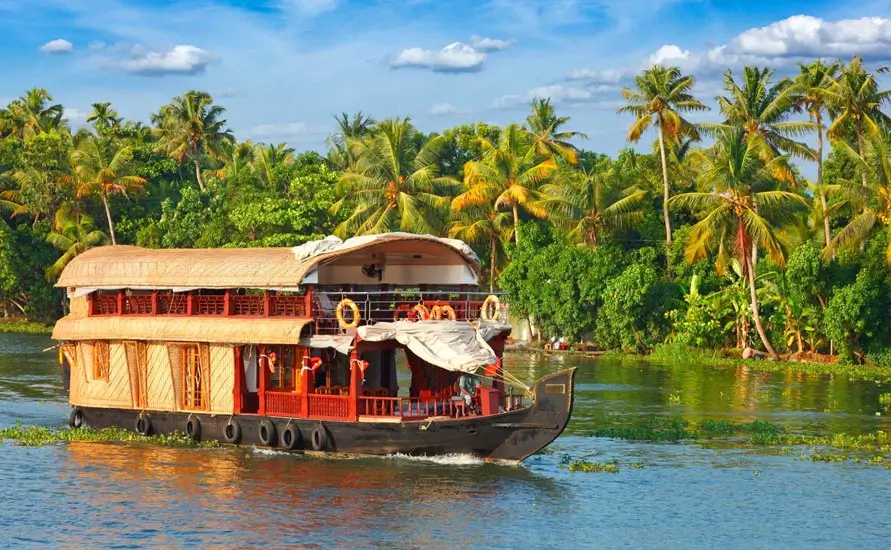
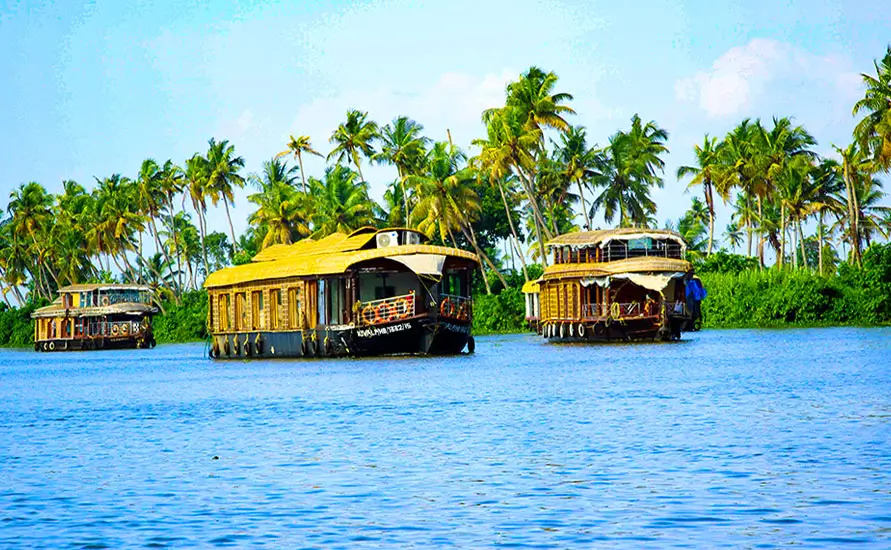
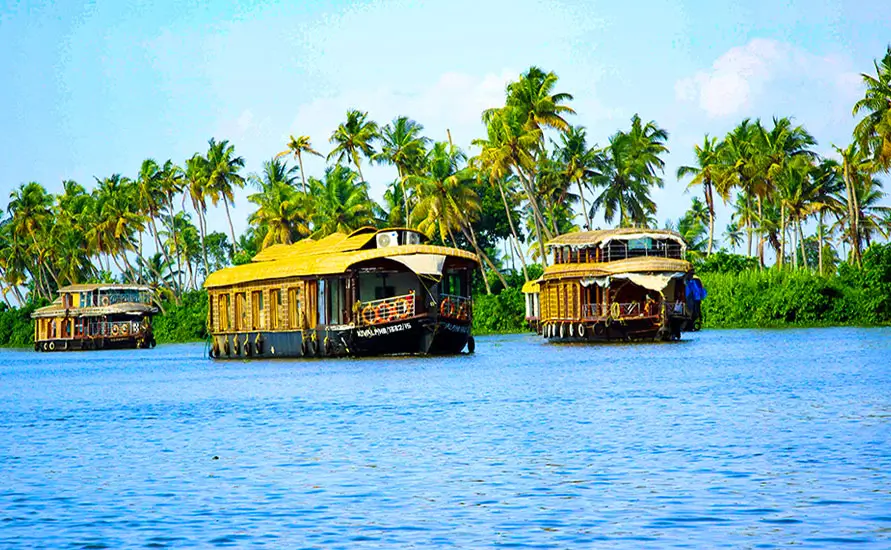
Leave Fort Kochi after breakfast and head south-east toward Kumarakom, a cluster of islands and canals on the eastern side of Vembanad Lake. The road passes through Vaikom, known for its Shiva temple, and fields lined with coconut palms. The final stage is by boat, because Coconut Lagoon can only be reached across the water. Your bags travel with you as the boat moves past fishermen's canoes and clumps of water hyacinth, and staff greet you at the jetty with tender coconut and a sandalwood paste mark on the forehead.
The resort is built from old wooden tharavads, the ancestral homes of Kerala families, which were dismantled and rebuilt here using traditional joinery. On this tour we recommend one of the heritage mansions, two-story wooden houses with a sitting room below and the bedroom upstairs, which suits travelers who like more space and privacy. Rooms have pitched tile roofs and carved wooden ceilings, and the open-air bathrooms are surrounded by greenery. The resort also maintains rice fields and a butterfly garden, and the Ayurveda center offers treatments by qualified practitioners.
Spend the afternoon adjusting to the slower pace. The pool is shaded by coconut palms, and there are hammocks under the trees near the water. Late in the day, you can stroll along the paths that follow the canals and watch kingfishers dive for fish. Evenings at the resort often include a short performance of classical Kerala music or dance on a small stage beside the lake. At dinner, ask for karimeen pollichathu, a lake fish smothered in spiced masala and baked inside a banana leaf, with soft appam and a mild coconut stew on the side. Overnight in Kumarakom.
Straight after breakfast a private motorboat leaves the resort jetty and heads out across Vembanad Lake toward Pathiramanal, a small wooded island in the middle of the water, about half an hour away. Its name is usually translated as "sands of midnight", and the local boatmen have their own stories about how it rose from the lake. Today the island has no residents, and a footpath loops through its trees. Your naturalist carries binoculars and points out cormorants, darters, night herons and egrets roosting in the branches, along with the occasional water snake sunning itself near the shore.
Once lunch is over, a local guide leads you on foot around Aymanam, the riverside village that Arundhati Roy chose as the setting of *The God of Small Things*, winner of the 1997 Booker Prize. Fans of the book often recognize the river, the old houses with tiled roofs and the canals where much of the story unfolds. You follow footpaths between rice paddies and tapioca plots, past small churches and family shrines. Your guide introduces you to neighbors along the way, perhaps a woman spinning coir from coconut husk or a carpenter shaping a canoe from a single trunk, and translates their stories. A roadside tea shop serves sweet milky chai and banana chips fried in coconut oil.
Evening at Coconut Lagoon belongs to you. An Ayurvedic massage at the treatment center is a good option after the walk, or you can simply settle onto the veranda of your mansion and watch the canal traffic drift past. For a special night, the resort can set a candlelit table on a small platform beside the lake, at extra cost, where the sky over Vembanad turns orange and then deep blue. If you have not yet tasted a Kerala sadya, ask the kitchen to prepare one: a vegetarian feast of a dozen or more small dishes served on a banana leaf, eaten with the right hand in the local way. Overnight in Kumarakom.
The resort boat returns you to the mainland after breakfast, and your car takes the road west toward the Arabian Sea through paddy land and canal-side towns. A good stop on the way is Alappuzha itself, where your driver can show you the old trading canals dug in the late 18th century under Raja Kesavadas, the dewan of Travancore, who turned the town into a busy port for pepper, coir and timber. The disused pier and the old lighthouse near the beach recall that era. From there the coast road runs north for about half an hour to Mararikulam, a quiet fishing settlement with a long, unbroken stretch of sand.
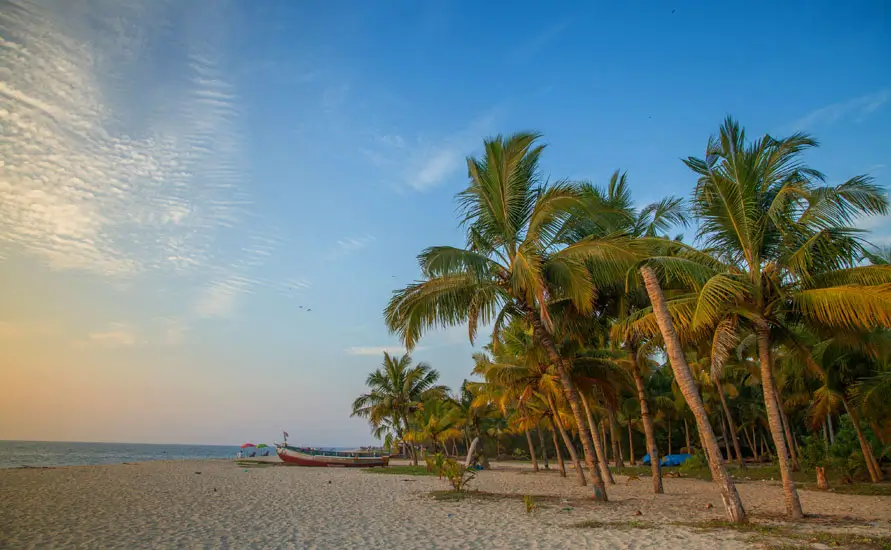
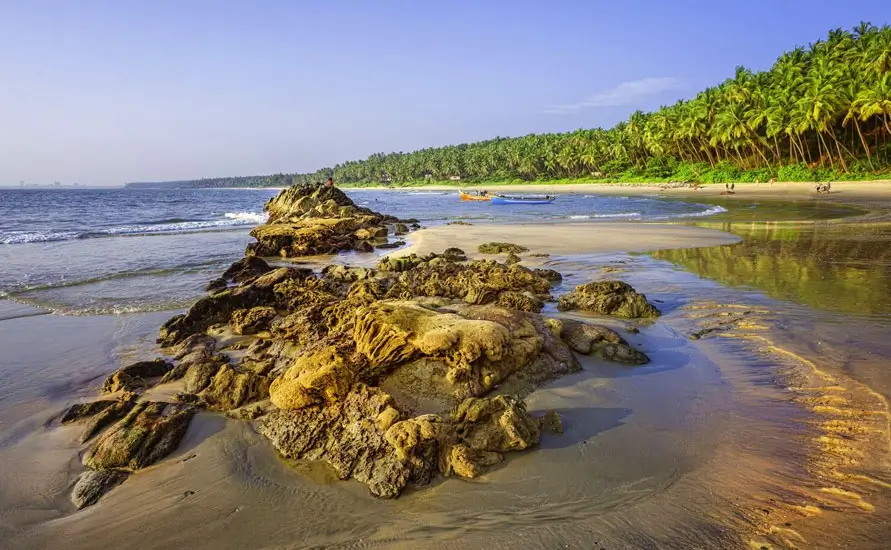
Marari Beach spreads across a large coconut grove behind the dunes, and its villas follow the style of local fishermen's homes: thatched roofs of woven palm, polished floors and open-air bathrooms surrounded by plants. For this trip we suggest a pool villa, which adds a private plunge pool shielded by a garden wall. The resort's organic farm supplies vegetables, herbs and fruit to the kitchen, and the restaurant focuses on seafood bought each morning from the boats on the beach. There is also a large swimming pool, a yoga pavilion and an Ayurveda center, all linked by sandy paths shaded by palms.
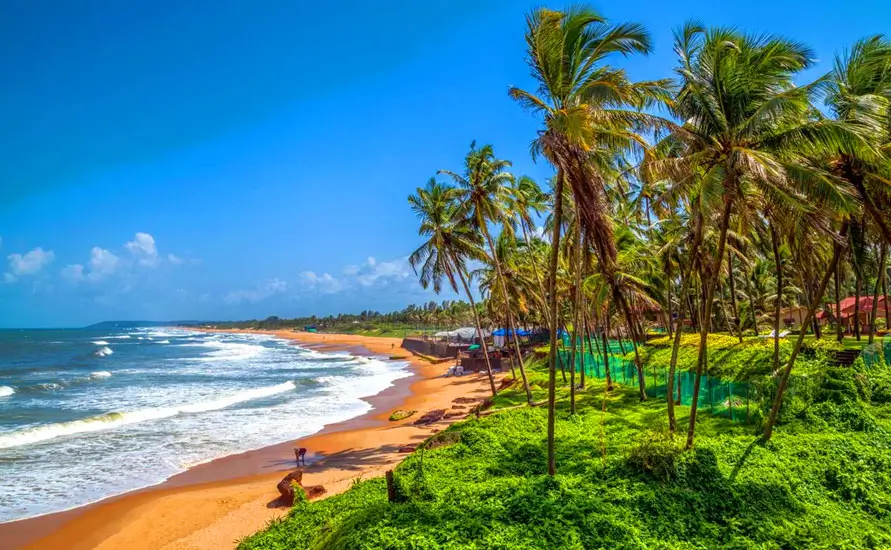
Use the rest of the day to settle into a slower rhythm after so much movement. A walk along the sand reveals how little development there is on this part of the coast, with only fishing boats, nets and a few village homes behind the dunes. The beach faces west, so sunset is the main event of the evening, and staff set up drinks close to the sand as the sky changes color. Sea swimming is possible on calm days, though the surf can be rough and currents strong, so check with the lifeguard before going in. Dinner is fresh fish cooked to a Kerala recipe. Overnight in Marari.
Set an early alarm for one of the best scenes on this coast. With a resort naturalist you walk north along the beach to the spot where the village fishing fleet lands at sunrise. Crews of a dozen or more men row or motor their long wooden boats straight onto the sand and haul them up on rollers, singing as they pull. The catch is unloaded into baskets: sardines, mackerel, prawns and, on good days, tuna or seer fish. Traders hold quick auctions on the spot, and women carry the fish away on their heads to the markets. The crews are generally friendly, but please ask before taking photos.
After breakfast you drive a short way up the coast to Arthunkal, a coastal town known for St. Andrew's Basilica, one of the oldest churches on the Kerala coast. Portuguese missionaries founded it in the 16th century, and today it is a major pilgrimage site, especially during the feast of St. Sebastian in January, when thousands of people gather and some walk all the way from their villages. Your guide explains how Christianity reached this coast very early, long before the Portuguese arrived, and points out how the church combines European façades with Kerala details such as tiled roofs and wooden interiors.
The afternoon at Marari is free. You might book a session at the Ayurveda center, where trained therapists offer traditional Kerala treatments based on herbal oils, or join the evening yoga class in the pavilion. For something more active, the resort lends bicycles for a ride along village lanes to a coir-making yard, where you can watch coconut husks being soaked, beaten and spun into rope by hand. In the evening, ask the staff about a seafood barbecue set up close to the beach, at extra cost, with prawns, squid and fish grilled over coconut husks and served with a fresh green salad from the farm. Overnight in Marari.
After two weeks of forts, palaces, boats and flights, today has no schedule at all, and most guests are glad of it. Sleep late, take a long breakfast under the palms and then spend the morning between your plunge pool, the main pool and the beach. The resort keeps a small reading room stocked with books on Kerala history, food and wildlife, and staff are happy to suggest a title. If the weather is clear, the morning light on the sea is soft and the sand is cool enough to walk barefoot well before the heat of the afternoon sets in, which makes it ideal for a long stroll.
For guests who like a little structure, there are several gentle options. In the kitchen, a chef can show you how a Kerala fish curry comes together with kokum and coconut, and the dish then appears on your lunch table. A walk through the organic farm with a gardener shows how the resort grows its produce without chemicals, using compost and natural pest control. The resident Ayurveda doctor can also arrange a consultation if you are curious about the system. During the afternoon, our team will call to confirm your airport transfer and see if you need anything else arranged for tomorrow, such as a late checkout or an early breakfast.
On your final evening in India, the resort can set up a private candlelit dinner on the beach, at extra cost, with fresh seafood and a menu of your choice. As the sun sets over the Arabian Sea, it is worth thinking back across the route: the stone courts of Jaipur, the mirrored rooms of Amber, the white palaces on the lake in Udaipur, the marble pillars at Ranakpur, the harbor at Kochi and the canals of Kumarakom. Few trips manage to show two such different sides of India, one royal and dry, the other green and coastal, in a little over two weeks. Overnight in Marari.
After breakfast and time to pack, your chauffeur collects you at a time set around your international flight from Cochin International Airport, about two and a half hours' drive to the north. A late-night flight can be paired with extended use of your villa or an airport day room, at extra cost. At the terminal our Kerala team helps unload the bags and walks you to the entrance. Thank you for traveling with us through Rajasthan and Kerala, and we look forward to welcoming you back to India.
Your Journey

N.S. Rathore & Mrs. Omlata Rathore · Managing Director
We still read every enquiry ourselves. Tell us the places you liked and our planners will send a day-by-day route with drive times and a clear price.
Every package can be customised and no pressure to book. A planner from our office replies within 24 hours with a route written for your group.
Fill this in and your planner will send a first draft itinerary.
Explore more
Kerala Backwaters Escape Kerala Backwaters Escape
 Kerala Backwaters Escape
 Kerala Backwaters Escape
 Kerala Backwaters Escape
 Kerala Backwaters Escape
 Kerala Backwaters Escape
 Kerala Backwaters Escape
 Kerala Backwaters Escape
 Kerala Backwaters Escape
 Kerala Backwaters Escape
 Kerala Backwaters Escape
 Kerala Backwaters Escape
 Kerala Backwaters Escape
 Kerala Backwaters Escape
 Kerala Backwaters Escape
 Kerala Backwaters Escape
 Kerala Backwaters Escape
 Kerala Backwaters Escape
 Kerala Backwaters Escape
 Kerala Backwaters Escape
 Kerala Backwaters Escape
 Kerala Backwaters Escape
 Kerala Backwaters Escape
 Kerala Backwaters Escape