 Kerala Backwaters Escape
Golden Triangle Tour With South India
Delhi – Agra – Jaipur – Varanasi – Kochi – Munnar – Alleppey
At a glance
Rivers give this itinerary its shape. The Yamuna slides past the red forts and garden tombs of Delhi and Agra, the Ganga carries pilgrims, boatmen and evening lamps along the ghats of Varanasi, and the slow green canals of Kerala end the trip on a quieter note. Our Golden Triangle with Varanasi and Kerala strings these together over sixteen days: six nights in Delhi, Agra and Jaipur, two in the holy city of Varanasi, then a flight to the far southwest for Fort Kochi, the tea country of Munnar and one night moored on the backwaters near Alleppey.
Long legs are handled by air and rail, never by marathon drives. A fast morning train links Delhi with Agra, a direct or one-stop flight takes you from Jaipur to Varanasi, and a connecting flight through a southern or northern hub covers the 2,000-plus kilometers from the Ganga to the Arabian Sea. On the road, the longest single drive is around five hours. Agra is arranged so your Taj Mahal sunrise visit avoids Friday, the one day it shuts, and Jaipur gets three nights so its craft villages and a home cooking class fit in without a rush.
The Golden Triangle Varanasi Kerala tour is designed for curious adults flying in from North America, Britain and Europe, and for NRI households hoping their US- or UK-raised children will see both the Hindi-speaking north and the Malayali south in a single holiday. It works especially well between October and March, when the plains are dry and mild, the Ganga is calm for boat rides and Kerala's monsoon has passed. Private guides, a dedicated driver in each region and hand-picked hotels keep the details simple, and the final two nights by a beach near Alleppey are left almost entirely free.
Intercontinental flights tend to reach Delhi in one of two windows, late at night and early afternoon, and we shape the first day to whichever one you land in. Once the passport desk and baggage belt are behind you, our greeter is at the exit with a printed sign. The ride to your hotel in the embassy district or near Connaught Place passes the capital's broad, tree-shaded roundabouts, which surprise many first-time visitors who expect nothing but crowds. At check-in you receive a folder with your full itinerary, emergency numbers and the names of the guides who will meet you in each city over the coming sixteen days.
If you landed early enough to rest, your guide calls for you in the late afternoon and takes you to Lodhi Garden, where Delhi's office workers, retired generals and young couples all come to walk. The park wraps around the domed graves of two pre-Mughal dynasties, the Sayyids and the Lodis, who ruled from the 15th to the early 16th century, before the Mughals arrived. Their squat domes and the Bara Gumbad mosque, with its carved plaster ceiling, are far older than anything you will see in Agra. Bring binoculars if you have them, since hornbills, kites and parakeets roost in the neem and banyan trees.
A few minutes' drive away, the Sufi shrine of Hazrat Nizamuddin Auliya draws devotees of all faiths, and after sunset prayers on many nights, Thursdays above all, a party of singers launches into qawwali in the marble courtyard. The lanes leading there are narrow and lined with rose-petal sellers and kebab stalls, so your guide stays close and shows you where to leave your shoes. Women should carry a scarf to cover their heads, and men may be asked to do the same. Eat afterward in Lodhi Colony, where murals from a public street-art project now cover many building walls. Overnight in Delhi.
Shah Jahan's great congregational mosque, the Jama Masjid, opened in 1656 and can hold around 25,000 worshippers in its courtyard of red sandstone. Arrive soon after it opens to visitors, outside prayer times, when the paving is still cool underfoot. Robes are offered at the gate to anyone in shorts or short sleeves. A separate ticket lets you climb the narrow spiral staircase of the south minaret, which rewards you with a view across the rooftops of Old Delhi to the Red Fort and the new city beyond. Note that the climb is steep and dark, and the top platform has low railings.
From the mosque steps, you walk with your guide into Ballimaran, a lane of spectacle makers, shoe stores and perfume sellers where the Urdu poet Mirza Ghalib lived in the 19th century. His restored haveli displays copies of his verses, and your guide reads a couplet or two while explaining how Ghalib witnessed the end of the Mughal court in 1857. Lunch is a plate of slow-cooked mutton nihari or seekh kebabs at one of the old Mughlai eateries near the mosque, each kept going by one family for four or five generations. Vegetarians can instead try chole bhature in a clean, busy cafe nearby.
The afternoon swings to modern Delhi. The Lotus Temple, a Bahá'í temple whose doors opened to the public in late 1986, is built from 27 white marble petals and welcomes people of every religion to sit in silence (no visits on Mondays). Afterward, you visit Dilli Haat, an open-air crafts market where artisans from every Indian state rent stalls on rotation, so you might find Kashmiri papier-mâché, Odisha palm-leaf paintings or Naga shawls in one walk. Prices are fixed in many stalls, and the food court serves regional dishes from Assam to Gujarat. Pack your bags tonight for an early train. Overnight in Delhi.
At Hazrat Nizamuddin station you settle into pre-booked chair-car seats aboard the Gatimaan Express, which touches 160 km an hour on the open stretches, and roughly a hundred minutes later you step off in Agra. Seats are reserved in the air-conditioned executive class, and breakfast is served on board. Your luggage travels separately with the car, so you only carry a daypack. On the few days the train does not operate, or if seats sell out, we switch to the Yamuna Expressway by road, a drive of around four hours. On the Agra Cantonment platform, look for your local guide with a name card near the exit stairs.
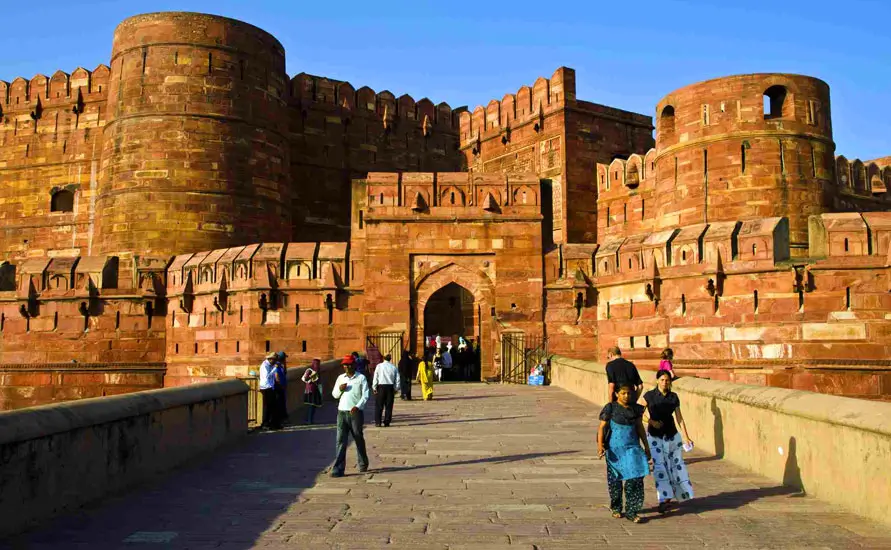
Your first stop is Agra Fort, but today the focus is on the private, inner palace rather than the military gates. In the Khas Mahal, your guide shows you the white marble pavilions where the emperor slept, flanked by two golden-roofed chambers said to have belonged to his daughters, and the sunken Anguri Bagh, a geometric garden once planted with grapevines. From the Diwan-i-Khas terrace you can see the Taj Mahal across the river bend, and a black stone throne carved for Jahangir still sits on the platform. Your hotel check-in follows, followed by a pause through the midday heat.
Later, about twenty minutes up the Mathura road, you reach Sikandra, where Akbar planned his own tomb before his death in 1605. Its gateway is covered with bold geometric inlay in white, black and colored stone, and the grounds are home to blackbuck antelope and langur monkeys that wander freely on the lawns. Unlike the Taj, the tomb mixes Hindu, Islamic, Christian and Buddhist motifs, a reflection of Akbar's open court. Back in the city, ask your guide where to find Mughlai biryani and burrah kebabs, and tomorrow's early start means an early night. Overnight in Agra.
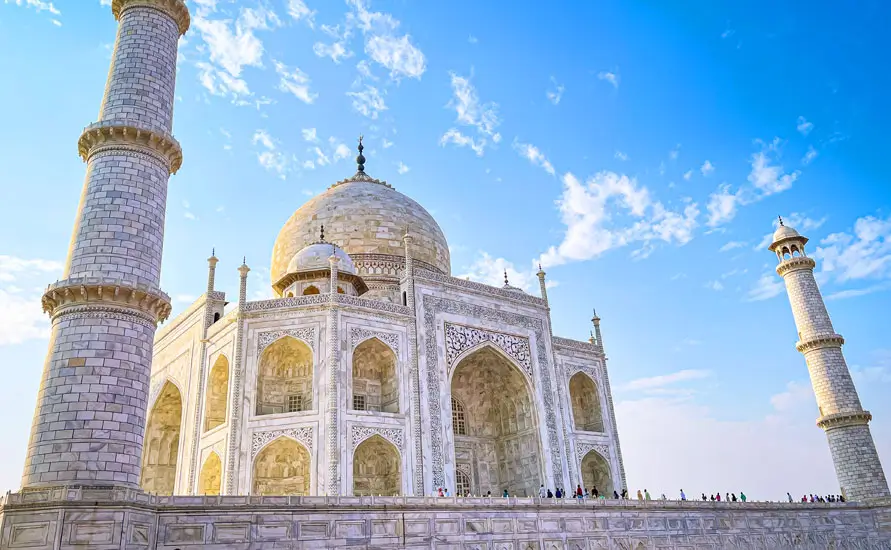
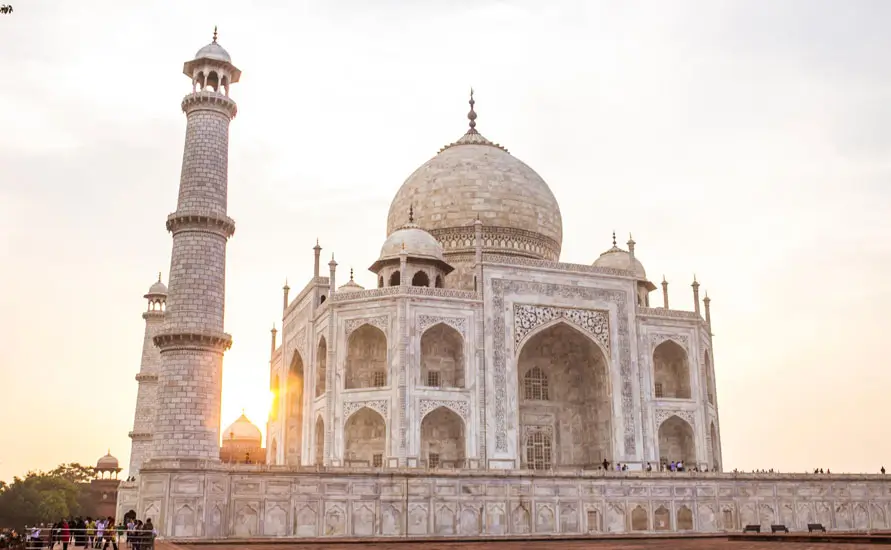
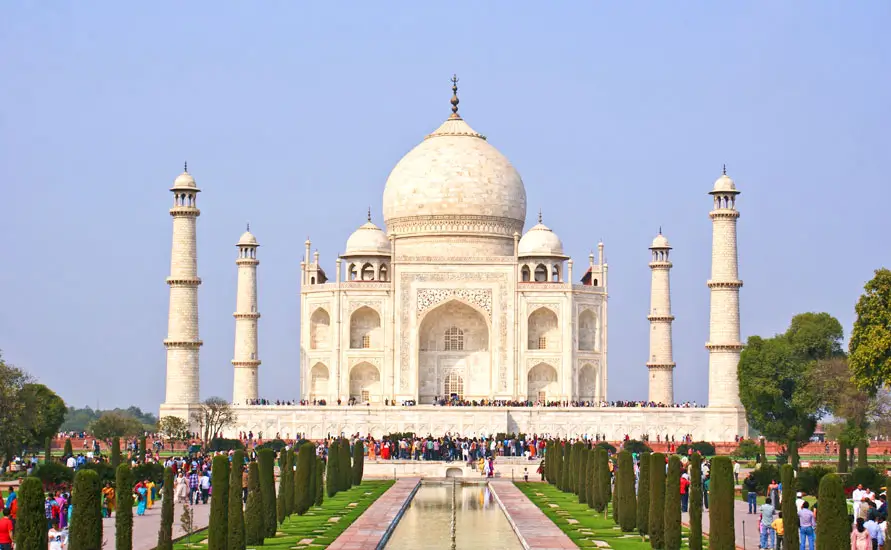
Gates at the Taj Mahal open shortly before dawn, and you should be at the eastern entrance as they do, with only a phone, camera, passport and water bottle; large bags, food and tripods are not allowed. Because the monument closes on Fridays for weekly prayers, this day is always fixed for another day of the week, and if your schedule shifts, we move the Taj to the previous afternoon instead. In the soft early light the dome changes color by the minute, from pearl grey to cream and finally white, and the long reflecting pool is at its stillest before the breeze picks up.
Your guide explains how 20,000 workers, including stone carvers from Persia and Central Asia, spent around two decades on the tomb, and why the inlaid flowers seem to glow when a flashlight is pressed against the marble. After breakfast and checkout, you drive west to Fatehpur Sikri, the walled city where Akbar held court for a little more than a decade. Spend about an hour in its royal enclosure, where the Ankh Michauli treasury and the Anup Talao pool, on which musicians are said to have played for the emperor, are in excellent condition. Shoes come off at the entrance to the Jama Masjid next door.
Instead of the faster highway, your driver takes the road through Bharatpur and Dausa to Abhaneri, where the Chand Baori step well plunges thirteen stories into the ground. Dug by the Nikumbha rulers more than a thousand years ago, it lines three of its walls with roughly 3,500 small zigzagging steps, and the temperature at the bottom is noticeably cooler. The neighboring Harshat Mata temple, though damaged, retains carved figures of musicians and dancers. Continue to Jaipur, about ninety minutes away, where a three-night stay finally lets you empty the suitcase into a wardrobe. Overnight in Jaipur.
A jeep carries you up the cobbled ramp to Amber Fort in the first hour of opening, ahead of the tour buses. Your guide concentrates on the women's quarters, the zenana, where a central pavilion is surrounded by identical apartments for each of the king's wives, designed so the ruler could visit any of them without the others knowing. From there, a short walk leads to the Sheesh Mahal and the Ganesh Pol, the frescoed entrance to the inner palace. If you have the energy, a road continues along the ridge to Jaigarh Fort, where the Jaivana, a giant 18th-century cannon on wheels, still stands on the battlements.
Down in Amber village, a restored merchant mansion now houses the Anokhi Museum of Hand Printing, which lays out Rajasthani textile printing step by step, useful preparation for tomorrow's workshop visits. Labels are in English, and the small shop sells cards and scarves printed on site. Displays show wood blocks, natural dye recipes and finished fabric, and a resident printer often gives a short demonstration. Expect it shut on Mondays and during part of the hot season, so we confirm before your visit. Lunch is a vegetarian Rajasthani meal in Amber's narrow streets, with bajra rotis, kadhi and a spoonful of garlic chutney.
Back inside the walls, the City Palace keeps one wing for the descendants of the Kachwaha kings. Your guide takes you to the Pritam Niwas Chowk, a small courtyard with four painted doorways representing the seasons, including the famous peacock gate for autumn, and the textile gallery with royal robes made for Sawai Madho Singh I, who was around 2 meters tall. Across the road, Jantar Mantar contains nineteen stone astronomical instruments, and with your guide you can find your own star sign on the Rashi Valaya dials. Finish with tea on a rooftop facing Hawa Mahal at sunset. Overnight in Jaipur.
South of the city, the town of Sanganer has been a center of hand printing and handmade paper for centuries. The morning starts in a paper workshop, where cotton rags are soaked, beaten into pulp and lifted from vats on fine mesh screens, then pressed and dried in the sun. Many sheets have flower petals mixed into them. Next door, block printers stamp fine floral patterns in bright colors onto long tables of cotton, a style quite different from the earthier prints of Bagru, and you can watch the washing in the river channels where the cloth is rinsed between colors.
After lunch, the car climbs east of town to Galtaji, a temple complex built into a rocky gorge, where seven sacred tanks are fed by a natural spring. Pilgrims bathe in the pools, and the site is known for the troops of rhesus macaques and langurs that live among the pavilions; keep food out of sight and follow your guide's advice about distance. A footpath climbs to the small Sun Temple on the ridge, with wide views over Jaipur's pink rooftops. Returning, you stop at a lassi shop on MI Road for a thick yogurt drink served in a disposable clay cup.
The evening ends in the home of a local family, where you join a Rajasthani cooking class and then share dinner with your hosts. Typical dishes include dal, a seasonal vegetable curry, puffed rotis cooked on a flat griddle, and a sweet such as churma, and you can ask your hosts to adjust the chili to your taste. Families who host these classes are used to curious questions about weddings, school life and festivals, which makes the meal a relaxed window onto modern India away from the sightseeing. Your driver collects you after dinner. Overnight in Jaipur.
Take breakfast slowly; around mid-morning the car heads to Sanganer airport for your plane to Varanasi, which on most days is either direct or connects through Delhi. The flight is usually in the late morning or early afternoon, and you land at Lal Bahadur Shastri Airport, roughly 25 km northwest of the old town. Your Varanasi guide meets you at arrivals. The difference from Rajasthan is immediate: the land is flatter and greener, the air more humid, and the roads into town are full of cycle rickshaws, bicycles and wandering cows. Your hotel is either near the ghats or in the quieter cantonment area.
Varanasi, also called Kashi or Benares, is among the oldest continuously inhabited cities in the world, and for Hindus, dying here is believed to release the soul from the cycle of rebirth. Your guide uses the afternoon to explain how the city works: its 80-odd ghats, the stone steps leading down to the Ganga, are each linked to a deity, a family or a ritual, and the old town behind them is a maze of lanes too narrow for cars. Around five o'clock you walk toward the river with your guide, since the final stretch must be covered on foot or by cycle rickshaw.
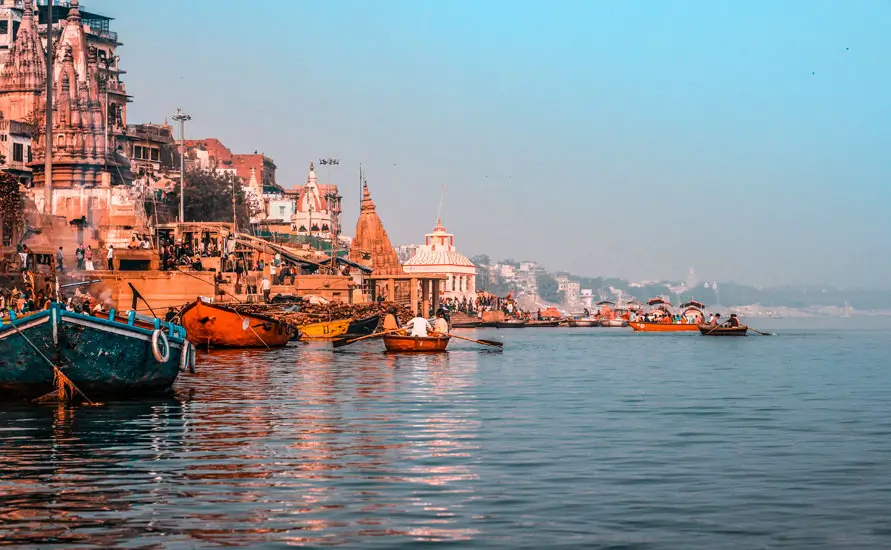
A wooden rowing boat waits for you below Dashashwamedh Ghat, and as it gets dark, you watch the Ganga aarti from the water. Young priests in saffron robes stand on raised platforms, waving multi-tiered brass lamps, conch shells and yak-tail fans in synchronized circles, while bells ring and hundreds of pilgrims sing on the steps. You can buy a small leaf bowl of marigolds with a candle, called a diya, and set it afloat with a wish. The ceremony lasts about forty-five minutes, and your guide makes sure you return safely through the crowds. Overnight in Varanasi.
Before dawn, your guide accompanies you to the river for a boat ride as the sun rises over the far bank, which is left mostly empty because it is considered inauspicious. Along the ghats, pilgrims take their morning dip, wrestlers train at an open-air gym, laundrymen beat sheets against stones and priests set up umbrellas for the day's rituals. Your boatman rows past Manikarnika Ghat, where cremations continue around the clock; photography of the cremation grounds is not permitted, and your guide explains the rituals from a respectful distance. You return through the lanes for a breakfast of kachori, potato curry and sweet jalebi.
Mid-morning, once you have rested, the next visit is to a household of Banarasi silk weavers in one of the city's Muslim weaving neighborhoods. Here, saris are still woven on wooden handlooms using punched-card jacquards, with gold and silver zari threads making patterns of paisley, flowers and birds, and a complex bridal sari can take several weeks to complete. You will see the dyed threads stretched in the lanes outside and hear the steady clack of the looms. There is no pressure to buy, though a silk stole or cushion cover is a lightweight gift, and our guides never take commission on purchases.
In the afternoon you drive about 10 km to Sarnath, where the Buddha gave his first sermon after reaching enlightenment around 2,500 years ago. The large Dhamek Stupa, rebuilt in the 5th century over earlier foundations, still bears carved floral patterns, and monks from Sri Lanka, Thailand, Japan and Tibet walk around it in prayer. The site museum holds the original Lion Capital of Ashoka, the emblem of the Indian republic; it is closed on Fridays, so on a Friday we visit the ruins and the modern Mulagandha Kuti Vihara temple instead. Back in the city, your evening is free. Overnight in Varanasi.
There are no direct flights between Varanasi and Kochi, so today is mostly a travel day, routed through Delhi, Bangalore, Mumbai or Hyderabad depending on the schedule. If your first flight leaves in the late morning, there is time for a short walk to the riverbank for one last look at the ghats, or a visit to the Bharat Kala Bhavan museum at Banaras Hindu University, which has fine miniature paintings and textiles, before heading to Babatpur for the first flight. Our operations desk tracks both flights and will rebook you if a delay breaks the connection.
Touchdown at Cochin International, an airport powered by its own vast solar farm, is usually in the afternoon or evening. A Kerala team member waves you over at arrivals, and the car heads ninety minutes southwest to Fort Kochi, on a peninsula facing the Arabian Sea. The warm, humid air, coconut palms and red-tiled colonial houses feel very different from the north. After check-in, a short evening walk to the seafront, a cup of chai and a light dinner of appam with vegetable stew are all you need before bed. Overnight in Kochi.
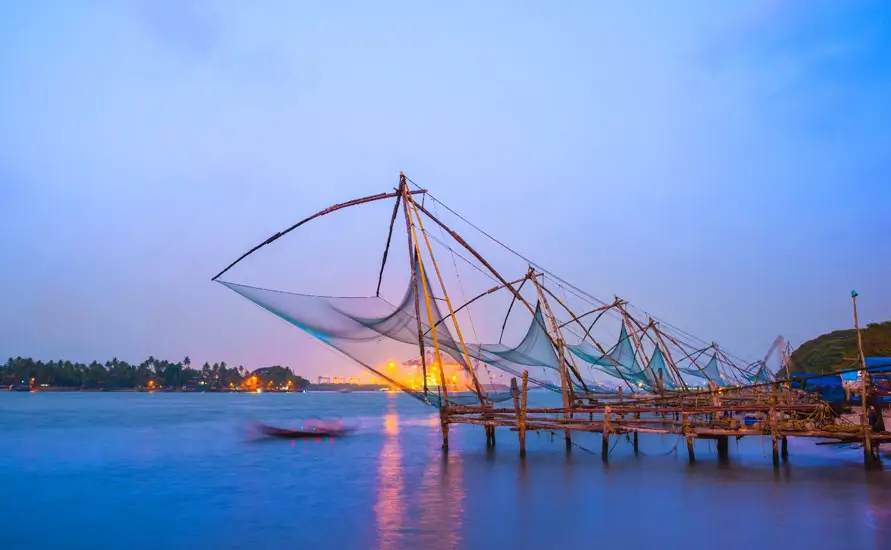
Pepper made Kochi rich, and the morning starts at the waterfront at sunrise, when the fishermen work the Chinese fishing nets. The cantilevered nets, which local lore credits to Chinese visitors of the 14th century, are raised and lowered by teams of four to six men using heavy stones as counterweights. Watch how the catch of sardines, prawns and mullet is sold on the spot to housewives and restaurant owners, who barter loudly over each basket. If you buy a fish, one of the small stalls behind the beach will fry it for you with chili and turmeric for a few rupees.
From the beach, you pass St. Francis Church, a plain whitewashed building of the Portuguese era; a railed-off gravestone inside recalls Vasco da Gama, who fell ill and died here in 1524, and a few lanes away lie the weathered tombs of the Dutch cemetery. A short drive takes you to Jew Town in Mattancherry, where the old spice warehouses still store ginger, pepper and turmeric, and you can watch workers sorting and drying them in the courtyards. Two places in the quarter keep restricted days: the Mattancherry Palace and its Ramayana wall paintings shut each Friday, while the Paradesi Synagogue opens neither on Fridays nor Saturdays, nor during Jewish festivals, and your Kochi program is shuffled to suit.
Your guide also takes you to a small studio where Kerala murals are painted with natural pigments made from minerals and plants, in a palette limited to five colors. After an afternoon rest, you head to a Kathakali theater for the evening show. Come an hour before curtain-up and sit beside the stage while the performers, flat on their backs, have their faces built up in green, red and black, then see them mime an episode of the Mahabharata using only eye movements, facial expressions and hand gestures to the pounding beat of the chenda drum. Shows last about an hour and a half with a short introduction in English. Overnight in Kochi.
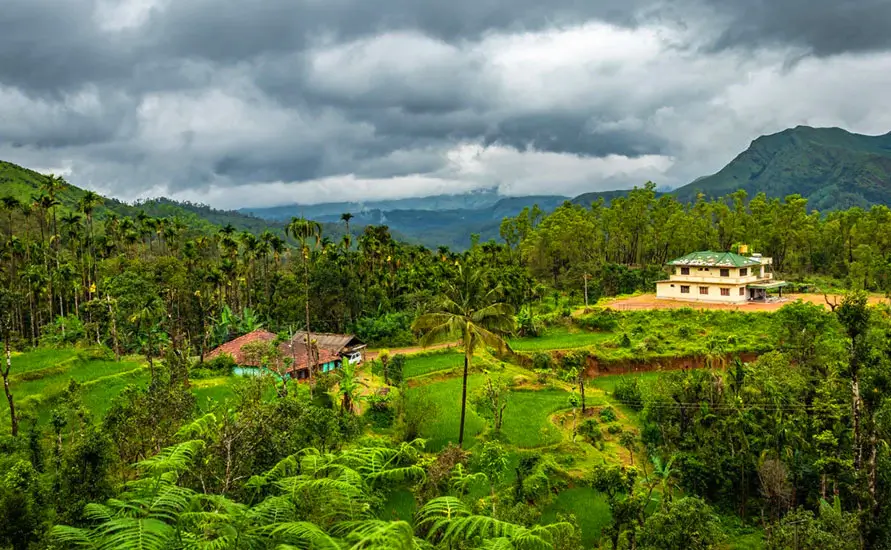
Once breakfast is done, the coast falls behind and the car points east toward the Western Ghats. For the opening hour you roll past latex-tapped rubber trees, pineapple farms and market towns full of hand-painted signboards. Beyond Kothamangalam the gradient increases, and, the scenery opens up with forest, streams and the first views of the hills. Pull-ins at the Cheeyappara cascade and the nearby Valara falls are best between September and December, and a roadside stall sells tender coconuts, hot banana chips and, in season, sticky jackfruit segments. Expect around four and a half hours in total.
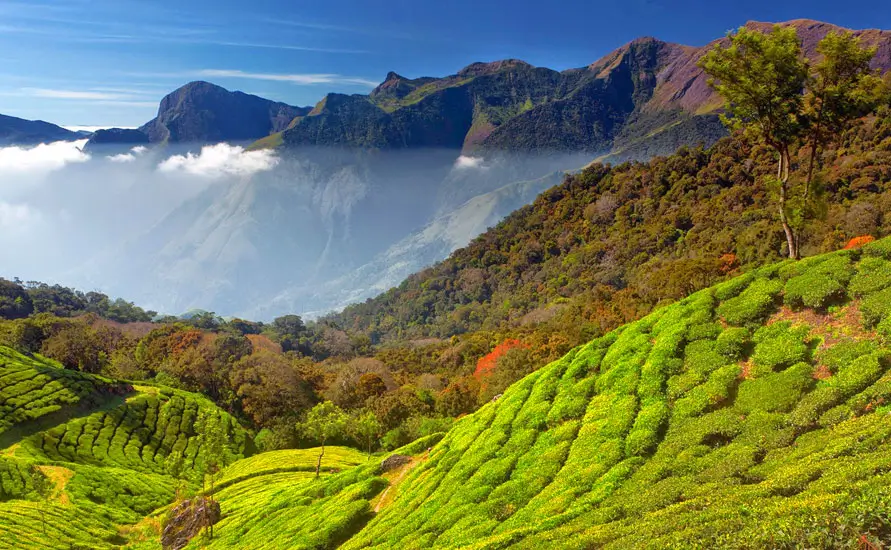
Near Adimali, a short visit to a family-run spice garden shows you how cardamom grows at the base of its plant, how pepper vines climb tall jackfruit and silver oak trees, and how cloves, nutmeg and vanilla are harvested and dried. The guide who leads the walk usually rubs a leaf between their fingers for you to sniff, then explains why the Western Ghats became so important to the spice trade. As you continue to climb, the air grows noticeably cooler, the vegetation changes, and the first neatly trimmed tea bushes appear on the steep slopes, rolling down the hillsides like green carpets.
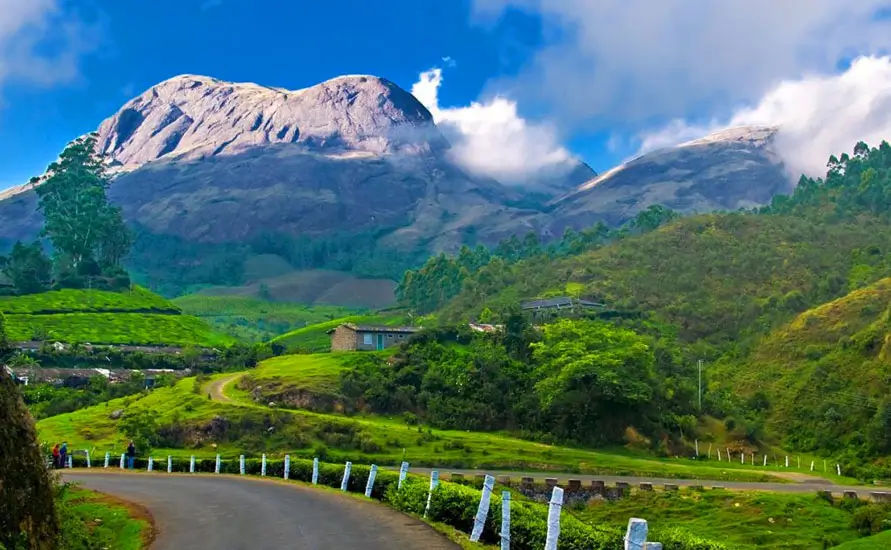
Named for the meeting of three streams, Munnar stands at about 1,600 meters, and its first tea bushes were planted by Scottish-run companies in the closing decades of the 19th century. Mid-afternoon you reach a hillside resort with views across the plantations. Later, an easy stroll on the plantation tracks with your guide gives you the chance to see the tea pluckers, mostly women, working their way through the bushes with baskets on their backs and filling sacks for the factory. Bring a light sweater, since evenings can be chilly from November to February. Overnight in Munnar.
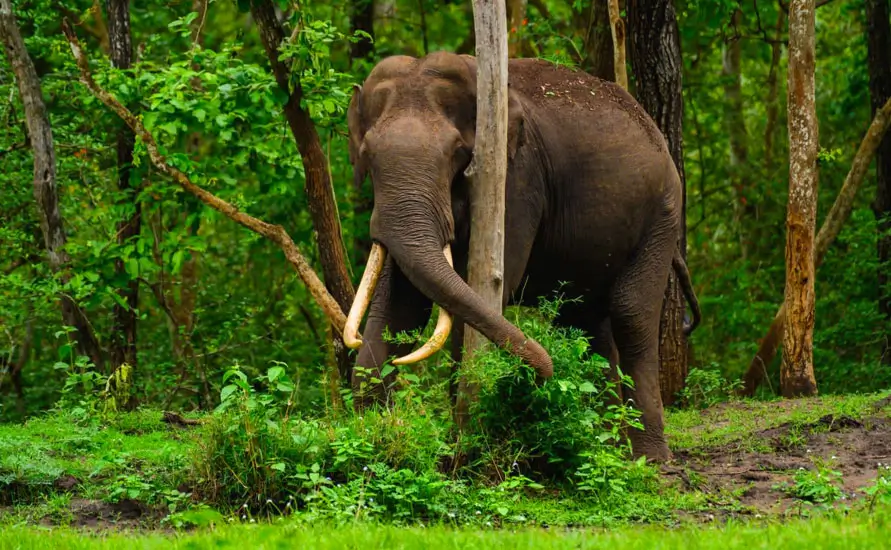
Reach Eravikulam National Park as the ticket counter opens, while dew still lies on the high meadows and the dark shola thickets in their folds; more Nilgiri tahr graze these slopes than anywhere else on earth, the males darkening to a saddle-backed chocolate brown with age. Forest department buses carry visitors up from the entrance to the Rajamalai section, and from there a paved path follows the slope with views toward Anamudi, which at 2,695 meters outranks every other peak in peninsular India. Sightings of the tahr are common but never guaranteed. The park closes for the calving season, roughly from February to March, and on those dates we replace it with a longer tea estate walk.
Back in town, the KDHP Tea Museum tells the story of Munnar's tea industry through old photographs, machinery and a working factory section, where a short demonstration takes fresh leaf through withering, rolling, oxidation and firing. A tasting at the end explains the difference between grades like orange pekoe and broken leaf, and you can buy fresh packets to take home. Lunch is a sadya-style spread on a plantain leaf: red rice, sambar, thoran made with coconut and mustard seeds, a tangy fish curry and payasam, a sweet rice pudding cooked in jaggery and coconut milk.
The afternoon road winds 13 km northeast to Mattupetty Dam, a long reservoir edged with shola and grassland, and on to Echo Point, where a shout across the water comes back from the opposite slope. On the way, you may pass the Indo-Swiss dairy farm, a cattle-breeding project set up with Swiss help. If there is time, you can take a pedal boat or a short speedboat ride on the lake, though both are optional. Back at the resort, there may be a campfire or a Kerala dinner, and you should keep an eye out for the small deer that come out at dusk. Overnight in Munnar.
Breakfast is early and departure prompt, since houseboats begin boarding around noon and the drive down to the backwaters takes about five hours. The road descends through cardamom hills and rubber estates, past churches, temples and mosques standing side by side in small towns, and at last onto the Kuttanad lowlands, rice country farmed a meter or two beneath sea level behind mud dikes. A coffee halt breaks the drive about halfway. Your bags go straight on board, and the car will meet you again tomorrow morning at the jetty, so there is nothing to worry about.
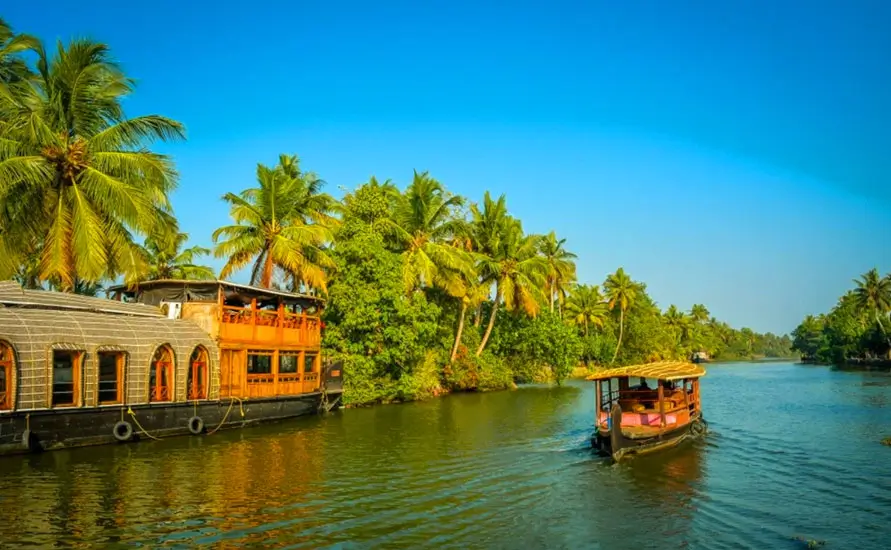
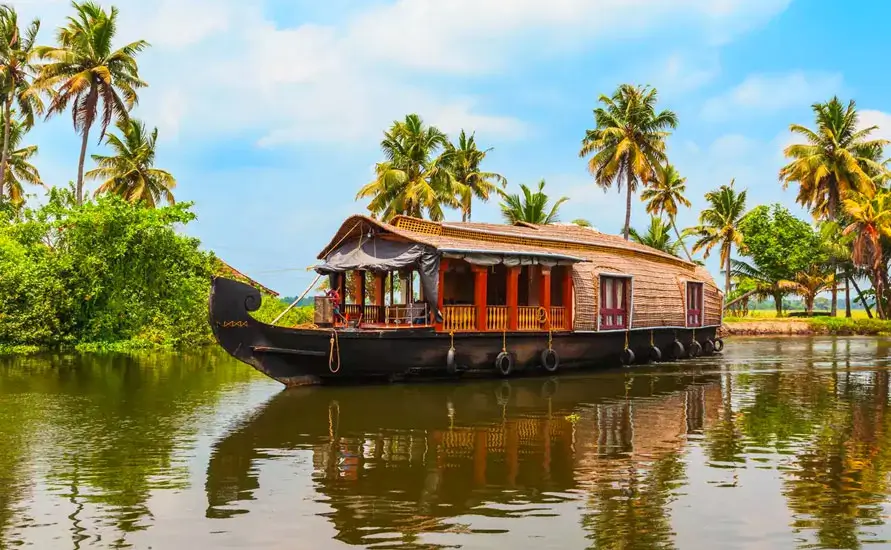
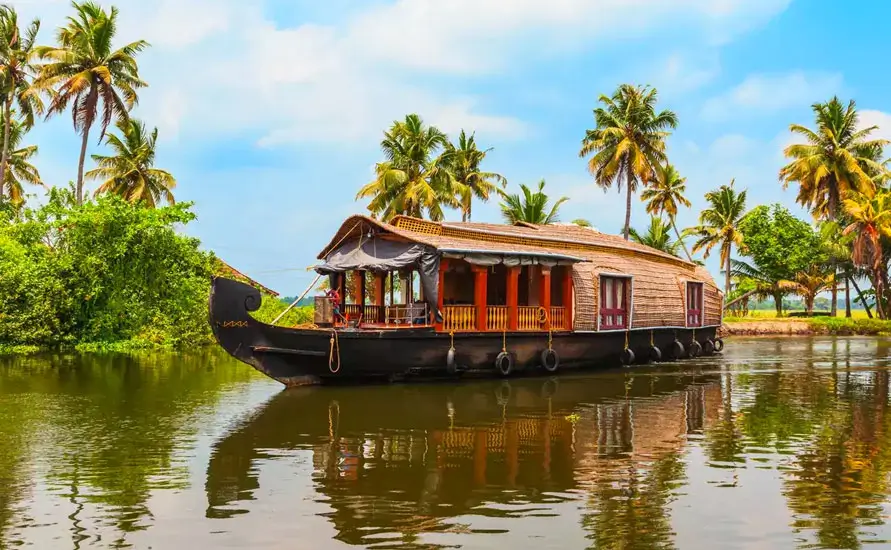
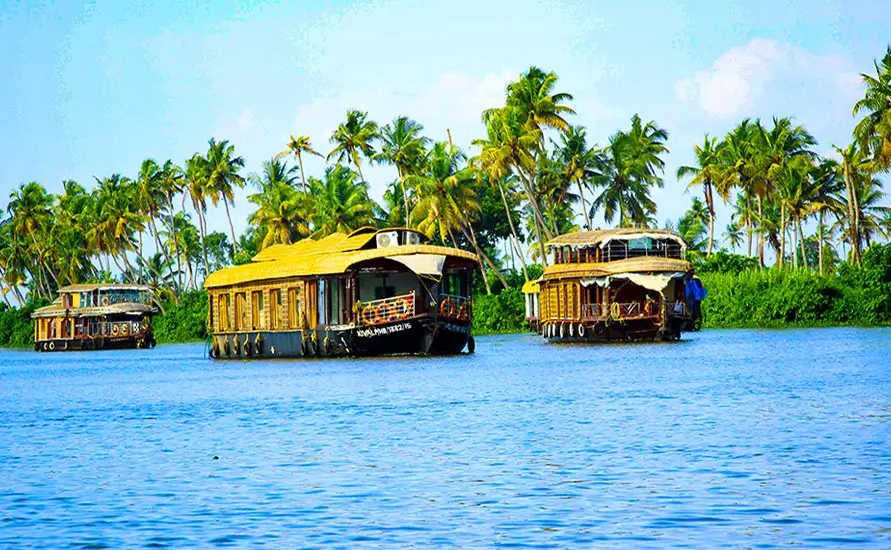
Locally called a kettuvallam, your private Kerala houseboat began life as a rice barge, a long, curved vessel built from jackwood planks held together by coir rope, with a thatched roof of bamboo and palm leaves. Modern versions add cooled cabins with private washrooms, a shaded lounge at the bow and a compact galley at the back, and three crew members handle steering, cooking and everything in between. The first meal arrives once the engine is running; expect karimeen, a flat lagoon fish, coated in red masala and shallow-fried, with rice, vegetables and pickles. Vegetarian menus are prepared on request.
Through the afternoon you drift across open lagoons and down slim channels, past villages where children wave from the banks, women wash clothes on stone steps and ducks are herded along the water by men in small canoes. In the late afternoon, the captain may stop so you can walk along an embankment between the paddy fields. Kerala regulations halt all houseboat movement around sunset, so your boat is tied to palm stumps beside a village bank for the night, and the soundtrack becomes croaking frogs and the splash of a paddle now and then. Dinner is served on deck by lamplight. Overnight on the houseboat.
Wake early to watch the backwaters come to life: canoes carrying children to school, fishermen checking their nets and kingfishers diving from the palms. Breakfast on deck is usually appam or dosa with coconut chutney, or eggs any style on request. You are back at the landing around nine, the standard checkout time, and your driver is waiting with the luggage already loaded. It is a short drive to the coast north of Alleppey, where you will stay for two nights at a beach resort set in coconut groves. Early check-in is subject to availability, but the resort will hold your bags.
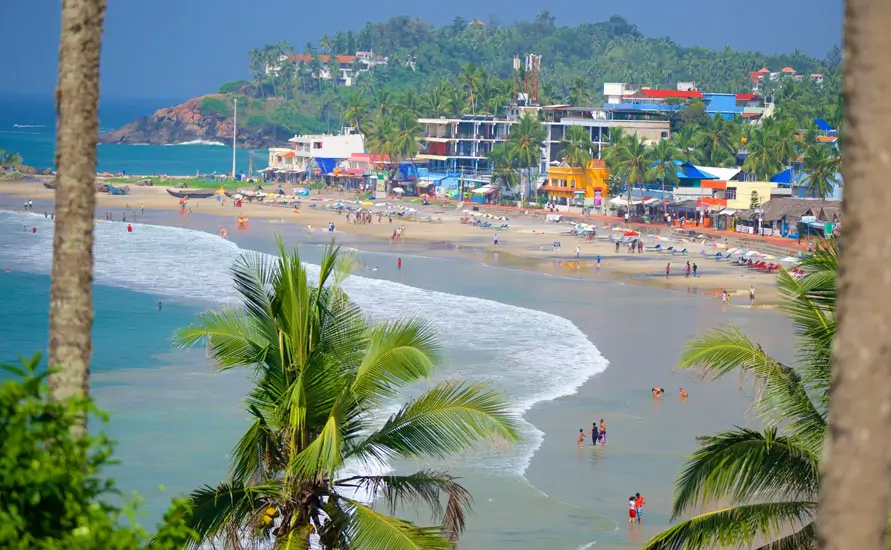
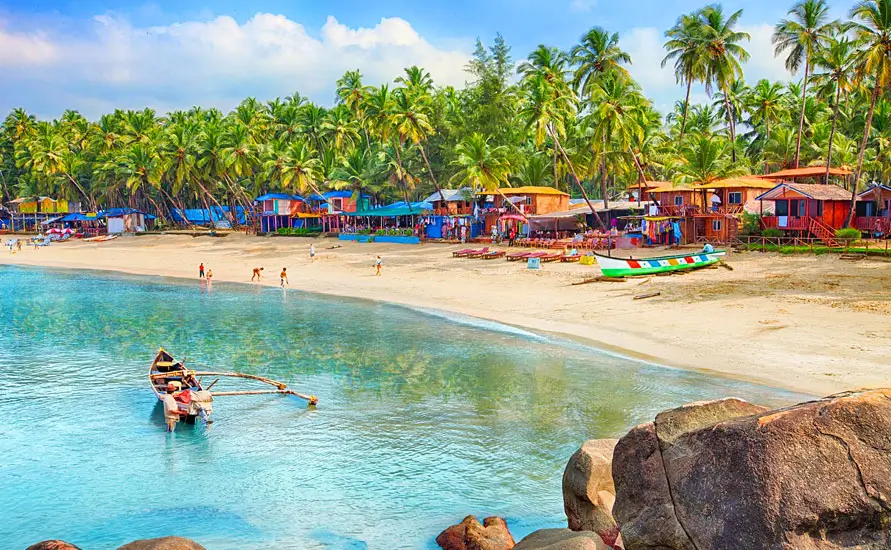
Nothing is scheduled until late afternoon. The beach here is long, clean and lined with fishing boats rather than shacks, and because it is less developed than Kovalam or Varkala, you may share it only with local fishermen mending nets and a few other visitors. Swimming is possible in the calm months from November to March, though the undertow can be powerful, so swim only where lifeguard flags allow. Many travelers spend the afternoon with a book in a hammock, having an Ayurvedic massage at the spa or cycling along the quiet village lanes behind the beach.
In the late afternoon, a resort naturalist takes you on foot into the neighboring fishing village, timed for the hour when the outrigger boats beach and the crews sort sardines and mackerel on the sand. You will see women making coir rope by hand from coconut husks, a traditional Kerala craft, and may be invited into a home for a cup of tea. You also learn about the parts played by the local church, temple and fishermen's cooperative in village life. Dinner can be fresh seafood grilled at the resort, with a squeeze of lime and a cool breeze from the sea. Overnight in Alleppey.
Large houseboats cannot fit into the narrowest canals, so this morning you board a small wooden country canoe, paddled or poled by a boatman, for a two-hour ride through backwaters that are too shallow for engines. The silence is the main attraction: you glide beneath overhanging palms and past homes where families brush their teeth on the water's edge, toddy tappers climb coconut trees to collect sap, and herons wait motionless in the shallows. Your boatman can stop at a small shop for tea and banana fritters, and at a village temple or church if you wish to visit.
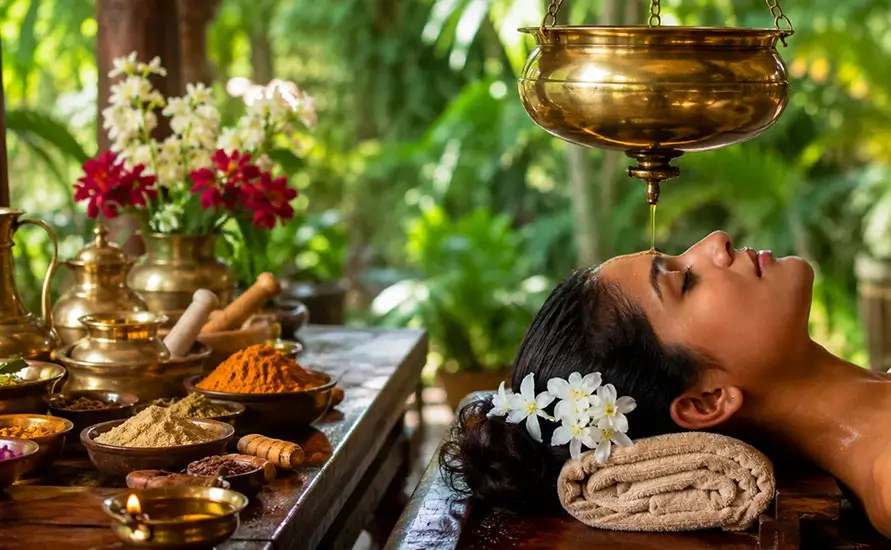
You are back by late morning with the remaining hours unplanned. Many guests use this time for a full Ayurvedic treatment, such as abhyanga, a warm herbal oil massage, or shirodhara, a stream of oil poured gently over the forehead, which should be booked in advance. Others prefer an hour at the stove with the resort chef, picking up the steps for a mild fish moilee or a vegetable avial. If you are curious about local life, a visit to a toddy shop can be arranged, where the mildly fermented palm wine is served with spicy tapioca and fish curry, though it is optional.
In the evening, stroll to the waterline as the Arabian Sea swallows the sun as fishing boats return to shore, a simple and fitting way to end two weeks of travel across India. Use this last night to pack, and pack coconut oil, pickles and bottles in the hold bag, never the carry-on. Expect a call from our office today fixing tomorrow's pickup time for tomorrow, based on your flight schedule, and to answer any last questions. Dinner is a chance to retrace the route from Delhi's tombs to the quiet Kerala canals. Overnight in Alleppey.
Breakfast under the palms is unhurried, and then your Kerala driver loads the car for Cochin International Airport. The road follows the coast north past fishing harbors and over the Vembanad bridges, and the drive normally takes about two hours, though we allow extra time for traffic around the city. Most international departures from Kochi to Europe and North America connect through the Gulf, Singapore or Colombo, and evening and overnight flights are common. With a night departure, keeping your resort room into the afternoon is often possible if we ask ahead.
Your pickup is set so that the check-in hall comes into view three hours before an international takeoff, giving you time to check in, clear immigration and have a meal before boarding. If you would prefer to spend your last hours in Fort Kochi instead, your driver can take you there for lunch and some final shopping on the way to the airport. Our team remains on call throughout the day, and once you are home, we would love to hear what you liked best and what you would change, whether it was the Taj at dawn, the Ganga at dusk or a quiet canal in Kerala.
Your Journey
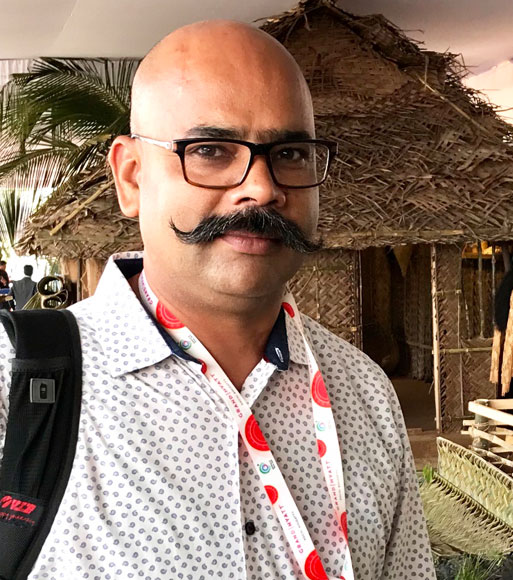
N.S. Rathore & Mrs. Omlata Rathore · Managing Director
We still read every enquiry ourselves. Tell us the places you liked and our planners will send a day-by-day route with drive times and a clear price.
Every package can be customised and no pressure to book. A planner from our office replies within 24 hours with a route written for your group.
Fill this in and your planner will send a first draft itinerary.
Explore more
Kerala Backwaters Escape Kerala Backwaters Escape
 Kerala Backwaters Escape
 Kerala Backwaters Escape
 Kerala Backwaters Escape
 Kerala Backwaters Escape
 Kerala Backwaters Escape
 Kerala Backwaters Escape
 Kerala Backwaters Escape
 Kerala Backwaters Escape
 Kerala Backwaters Escape
 Kerala Backwaters Escape
 Kerala Backwaters Escape
 Kerala Backwaters Escape
 Kerala Backwaters Escape
 Kerala Backwaters Escape
 Kerala Backwaters Escape
 Kerala Backwaters Escape
 Kerala Backwaters Escape
 Kerala Backwaters Escape