 Kerala Backwaters Escape
Golden Triangle Tour With South India
Delhi – Agra – Jaipur – Chennai – Pondicherry – Madurai – Munnar – Alleppey – Kochi
At a glance
Twenty-one days sounds like plenty until you spread a map of India on the table. Our Golden Triangle with South India 3 Weeks is built for travelers who would rather stay put for two or three nights than chase a new hotel every evening. You begin with Mughal Delhi, the Taj Mahal and the pink bazaars of Jaipur, fly the length of the country to Chennai, then roll south through Pondicherry, the temple city of Madurai, the tea slopes of Munnar, a night afloat in Alleppey and the pepper wharves of Kochi. Few itineraries give each region this much breathing room.
Pace is the point of our three-week Golden Triangle tour with South India. Most road legs run between two and five hours, one flight, Jaipur to Chennai, saves two days of driving, and only the Pondicherry to Madurai stretch is a long road day, which we break at the great Chola temple of Thanjavur. Each region comes with its own chauffeured, air-conditioned car (drivers speak English), while licensed city guides take over for the main sightseeing in Delhi, Agra, Jaipur, Chennai, Pondicherry, Madurai, Munnar and Kochi. Free afternoons are built in, so the trip never turns into a march.
We plan this 21-day India tour mainly for American, Canadian, British, European and Australian visitors with three weeks of vacation and a wish to see both the north and the south properly, and for NRI families returning with teenagers who have only heard stories. Each stop includes a local hour: a market, a kitchen, a workshop or a festival rehearsal, depending on your dates. We schedule the Taj Mahal for sunrise and steer clear of Fridays, its weekly closing day. November to February suits the whole route best, though October and March work well with a little more heat.
Whatever time the wheels touch the runway, our Delhi coordinator is in the arrivals crowd at Delhi's Indira Gandhi airport, name card raised, and a cool car is idling in the parking bay. Overseas flights tend to bunch up between late evening and dawn, so plan on sleep first. Hotel rooms are usually ready at 2 pm; if you land before sunrise, pre-booking the room for the previous night guarantees you can collapse straight into bed. Over a cup of masala chai in the lobby, the coordinator sorts out a prepaid phone SIM for you when one was ordered and talks you through the three weeks ahead.
Most guests surface around lunchtime, and the first afternoon is deliberately light. A short drive takes you to Lodhi Garden, a park of lawns and old trees where domed tombs of two fifteenth-century sultan dynasties (Sayyid and Lodi) sit among joggers, picnicking families and dog walkers. Domes of rough stone rise from the grass, and parakeets screech from the treetops. Nearby, the restored Sunder Nursery has Mughal-era pavilions and a lily pond, and few corners of central Delhi let you sit for an hour without a horn in earshot. Your guide uses this easy start to explain how the capital is laid out.
As the light fades, you walk into the narrow lanes of Nizamuddin Basti toward the shrine of Hazrat Nizamuddin Auliya, the fourteenth-century Chishti mystic whose grave draws visitors of every faith. Rose petals and incense fill the alleys, and you remove your shoes and cover your head before entering. On most evenings, and especially on Thursdays, qawwals sit in the courtyard after the sunset prayer and sing devotional songs to harmonium and hand-clapped rhythm, sometimes for more than an hour. The inner tomb room is closed to women, who sit with everyone else in the open courtyard. Dinner afterwards is kebabs or a vegetarian thali near your hotel. Overnight in Delhi.
Old Delhi wakes up slowly, so your guide meets you mid-morning at the edge of Chandni Chowk, the avenue Shah Jahan's daughter Jahanara laid out in the 1650s. The angle today is food and trade. You sample hot jalebis fried in a cauldron at a corner stall that has sold them for generations, taste stuffed flatbreads in Paranthe Wali Gali, and sip a glass of sweet lassi thick enough to eat with a spoon. Between bites, the guide points out a Jain bird hospital, a Digambar Jain temple, a Sikh gurdwara and a Baptist church, all on the same busy street within a few hundred meters.
A cycle-rickshaw then wobbles you past the high red walls of the Red Fort (open to visitors except on Mondays) and across to Raj Ghat, a plain slab of black marble on the riverbank marking the spot of Mahatma Gandhi's cremation in 1948. Shoes come off at the gate, and you pad barefoot across the lawn to the eternal flame. It is a quiet counterweight to the lanes you just left. Lunch is at your own pace, perhaps at a South Indian canteen near Connaught Place, a first taste of the dosas and filter coffee you will meet again in Tamil Nadu.
The afternoon belongs to Humayun's Tomb, the garden mausoleum that introduced the Persian four-part garden to India and gave Mughal builders the template they later perfected in Agra. Walk the water channels slowly and notice how the sandstone is trimmed with white marble, a color scheme you will see grow bolder over the next few days. Before dinner, if you still have energy, swing by India Gate, floodlit after dark, and the domed President's House at the top of the avenue, and stop at a market such as Khan Market for bookshops and cafés. Tomorrow starts early with a train, so most guests settle in for a quiet night. Overnight in Delhi.
For a change from the road, this leg goes by rail. Your driver drops you at Hazrat Nizamuddin station for the morning Gatimaan Express, one of the fastest trains in the country, which pulls into Agra Cantonment roughly 100 minutes later. You sit in reserved, air-conditioned chair-car seats while attendants bring a simple breakfast tray. Suitcases ride in the car, which sets off from Delhi at the same time on the Yamuna Expressway, so you carry only a day bag. If trains are not for you, simply ride along in the car instead; the expressway takes 3.5–4 hours.
On the platform your Agra guide is waiting, and the first stop is Agra Fort, a sandstone stronghold in which three generations of Mughal emperors held court. Stand in the Diwan-i-Khas terrace and look along the river: the Taj Mahal is visible downstream, framed by the marble arches that Shah Jahan saw every day during his eight years of confinement here. The guide also explains the fort's role in 1857, when British troops and civilians sheltered inside during the uprising. Allow about two hours, as the grounds are large and much of the walking is on open courtyards with little shade.
Lunch and a siesta come next. Around 4 pm you head to Itimad-ud-Daulah, which locals nickname the Baby Taj, on the east bank of the Yamuna. Empress Nur Jahan built it in the 1620s for her father, and it was the first Mughal tomb dressed entirely in white marble and inlaid with colored stone, a direct rehearsal for the Taj Mahal. Because it is small and draws few tour groups, you can study the patterns of flasks, cypresses and fruit bowls at leisure. The Taj itself is booked for tomorrow at first light; should either Agra day land on a Friday, we reorder the visits so it is never skipped. Overnight in Agra.
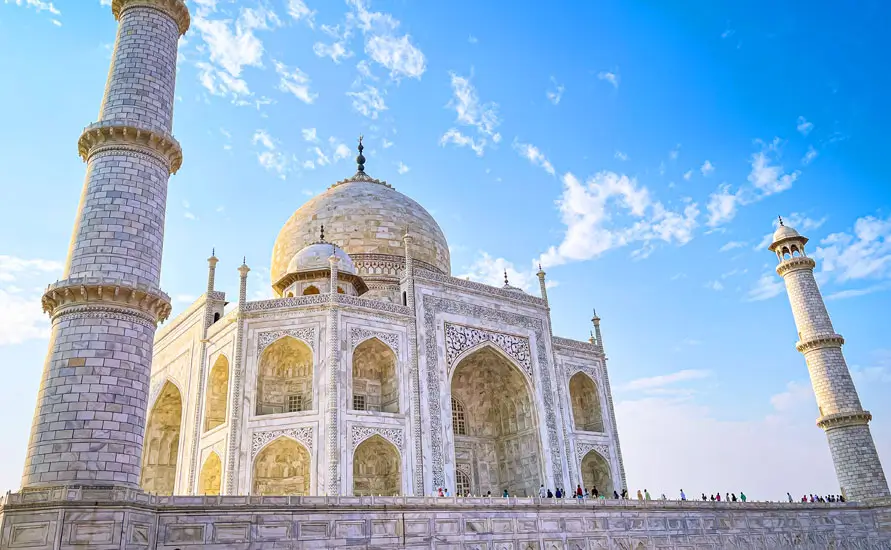
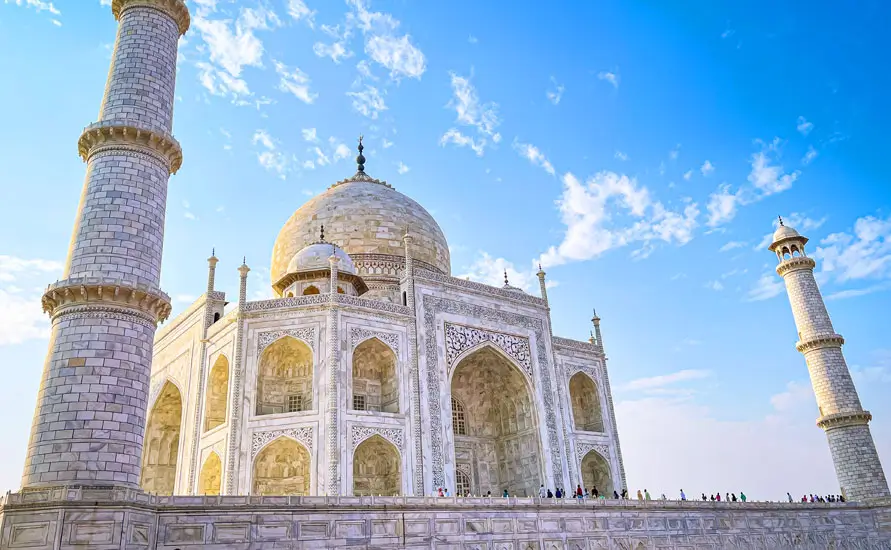
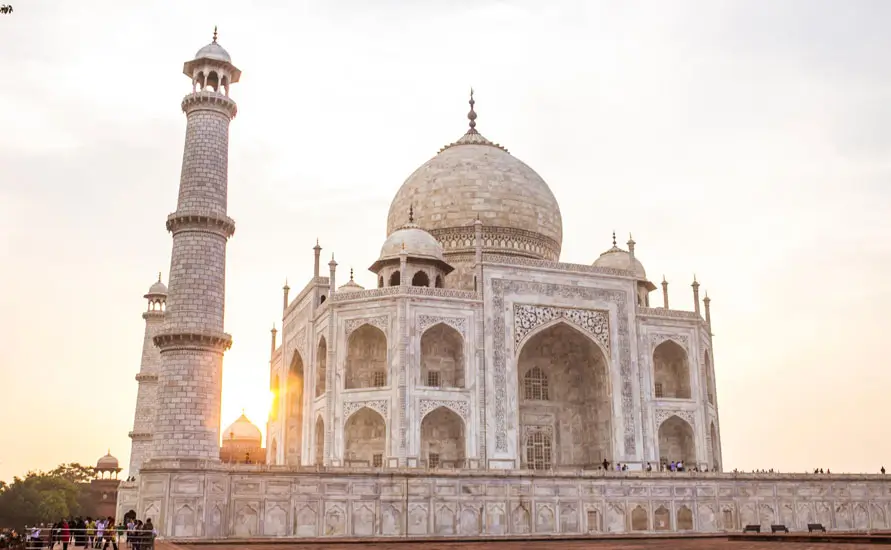
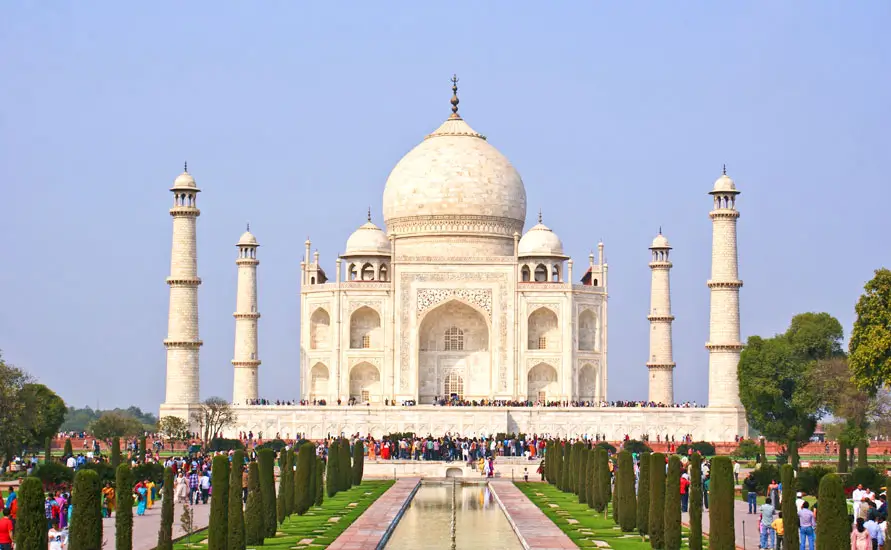
An alarm before dawn is a small price for the Taj Mahal in the first pink light, with the lawns still damp and the crowds not yet arrived. Pass through security with only your phone, camera, water and passport, then walk under the red sandstone gateway, where the tomb appears suddenly, framed perfectly by the arch. Your guide points out how the Quranic inscriptions around the entrance grow larger toward the top, so the letters look the same size from the ground. Inside the main chamber, the tombs of Mumtaz Mahal and Shah Jahan sit behind a marble screen carved so finely it looks like lace.
Breakfast at the hotel is followed by something most visitors skip: a visit to a family workshop where descendants of the Taj's inlay craftsmen still practice pietra dura. You watch an artisan shape a chip of malachite or carnelian against a small spinning abrasive wheel until it fits a hollow in the marble exactly, then fix it with a natural glue. A single tabletop can take months. There is a showroom, but nobody minds if you only watch. Later, your guide can walk you through Kinari Bazaar for petha, the translucent candied pumpkin Agra is known for, sold in dozens of flavors from saffron to rose.
The afternoon is free for rest by the pool or a nap, which you will appreciate after the early start. About an hour before dusk you drive over to Mehtab Bagh across the river, for a rear view of the Taj over the water, with buffaloes grazing on the sandbanks and washermen beating laundry at the river's edge. It is the same building you saw at dawn, yet it looks entirely different in the late light. If you like, your guide can arrange dinner with a local family in Agra, a chance to talk about daily life and try home-style dal and sabzi. Overnight in Agra.
Today has more road than most, so you leave soon after breakfast, but two stops break it neatly in three. The first, Fatehpur Sikri, sits about forty minutes west of Agra on a low ridge. Akbar moved his whole court here in the 1570s and the court packed up again after roughly fifteen years, so the palaces have survived almost untouched by later rebuilding. Your guide shows you the house of his Christian-born wife, painted with faded murals, and the vast Buland Darwaza, a gate of 54 meters climbing above the mosque steps. Touts can be persistent at the gate, but your guide handles them politely.
From Fatehpur Sikri the road crosses into Rajasthan. After lunch at a highway restaurant, a 20-minute side road brings you to Abhaneri village and its Chand Baori, a ninth-century stepwell sinking around thirteen stories into the ground. Some 3,500 narrow steps zigzag down three sides in a dizzying geometric pattern, built so villagers could reach water as the level dropped in the dry months. Visitors cannot walk down the steps any more, but the view from the gallery above is the best part. Next door, the Harshat Mata temple has carved figures of dancers and musicians from the same period.
The last two hours of driving bring you through mustard and millet fields into Jaipur, the capital of Rajasthan, reached around 5 pm. Your home for three nights may be a restored haveli with courtyards and painted ceilings or a modern hotel with a garden, depending on the category you book. There is time for a swim or a short walk, and a sweet shop on MI Road is worth a stop for ghewar, a honeycomb-shaped Rajasthani dessert eaten during the monsoon festivals, or for a plate of pyaaz kachori, flaky pastries filled with spiced onion. Overnight in Jaipur.
Beat the tour buses with an 8 am start for Amber Fort, 11 km up the Delhi road. We skip elephant rides entirely; instead, a jeep climbs to the Suraj Pol, or you can walk the ramp in about twenty minutes. Inside, your guide leads you from the pillared Diwan-i-Am to the private quarters of Raja Man Singh, where twelve queens had separate apartments connected by a single corridor so the king could visit without being seen. In the Sheesh Mahal, the mirror work catches whatever light enters. The views down over Maota Lake and the long serpentine walls are just as memorable.
Below the fort, Panna Meena ka Kund is a compact stepwell whose crisscrossing stairways look like an optical illusion, and then at a café opposite the Hawa Mahal for a coffee with a front-row view of its pink honeycomb façade. The real treat of the day follows: a guided walk through the old Pink City bazaars, laid out in 1727 on a strict grid. Each lane has its specialty, from bangle makers in Maniharon ka Rasta to brass and silver workers, and your guide introduces you to stallholders who are happy to show how a lac bangle is heated, rolled and decorated with glass beads.
Lunch is the Rajasthani classic dal baati churma, the hard baked wheat balls crumbled into lentils and ghee that every local insists you must try once. Afterward, your time is your own. Jaipur is known for precious stones, block-printed cotton, blue pottery and carpets; your guide can recommend fair-priced shops, though you should never feel obliged to buy anything. In the early evening, consider a film at the Raj Mandir Cinema, a 1970s Art Deco movie palace where audiences cheer and whistle at Bollywood heroes. Shows are in Hindi, but the songs and the crowd reaction need no translation. Overnight in Jaipur.
This morning focuses on the city's founder, Sawai Jai Singh II, a ruler who was as interested in astronomy as in politics. At Jantar Mantar, raised between about 1728 and 1734 and inscribed by UNESCO in 2010, the guide shows how instruments such as the Samrat Yantra, a giant sundial over 27 meters high, measured time and the positions of the stars. Children enjoy finding their own birth sign among the twelve zodiac instruments. Next door, the City Palace has a museum of royal costumes, weapons and paintings, and the courtyard with four painted gateways representing the seasons.
Post-lunch, a 15 km hop south lands you in Sanganer, a town of hand block printers and paper makers. Inside a family-run print house, craftsmen lay out long lengths of cotton on padded tables and stamp them, color by color, with carved wooden blocks, while others rinse the finished fabric in the yard and lay it in the sun. You then get the chance to print a scarf or a cushion cover yourself with the craftsman's help, which is harder than it looks. Many shops also sell handmade paper produced here from cotton rags, a traditional craft in the area.
Toward sunset a twisting road climbs the Aravalli ridge to Nahargarh Fort, which Jai Singh II put up in 1734 to guard the new city. From the battlements, Jaipur spreads out below in shades of pink and ochre, and the lights come on one by one as the sun sets behind the hills. A café on the walls serves cold drinks and snacks, but it fills up on Saturdays and Sundays, so timing matters. Tomorrow you fly south, so pack tonight and keep warm clothes handy only for the Munnar hills later in the trip. Overnight in Jaipur.
Rajasthan to Tamil Nadu is some 1,600 km as the crow flies, and a nonstop flight covers it in roughly 150 minutes; one-stop routings via Delhi or Mumbai can double that, so we hold out for a morning nonstop whenever schedules allow. Your Jaipur driver handles the airport run and the luggage trolley. Somewhere over central India the brown fields turn into green paddy and red laterite, and when the cabin door opens in Chennai, humid sea air and the scent of jasmine replace the dry northern breeze. Our Tamil Nadu representative is outside arrivals with a welcome garland of flowers.
Settle into your Chennai hotel, take an hour off, and then head for Mylapore, a district older than the city itself. At lamp-lighting time the Kapaleeshwarar Temple fills with office workers stopping on their way home, mothers with toddlers, and priests carrying brass plates of camphor flame. Visitors of every religion may walk the outer corridors. Notice the stucco gopuram over the eastern entrance, crowded with painted gods, sages and musicians, and the broad stepped tank beside it, where the temple's deities take a ceremonial boat ride during the float festival early in the year. The mood is neighborly rather than grand.
A short stroll away, order a degree coffee at a lane-side café; the waiter pours it between tumbler and saucer in a long arc until the top foams. Then ride to Marina Beach as the sea wind picks up. Hawkers push carts of sundal, warm chickpeas with grated coconut and curry leaves, scooped into cones made from old newspaper, while kids queue for pony rides on the sand. Strong currents make swimming off limits here. Dinner can be a crisp ghee roast dosa or a fiery Chettinad pepper chicken, and your guide will gladly name a favorite place. Overnight in Chennai.
Kanchipuram's temples lock their inner doors from about midday until late afternoon, so you set off at 7:30 am, with idli and chutney packed for the road if breakfast feels too early. The Pallava kings ruled from this city, and devotees still count it among Hinduism's seven holiest. First on the list is Varadharaja Perumal, a Vishnu temple with a sixteenth-century hall whose pillars are carved into rearing horses, warriors and dancers; look up at the corners for granite chains whose links were cut from one stone. Next comes the sandstone Kailasanathar Temple of about 700 AD, ringed with tiny shrines where faint traces of old paint survive.
Silk is the town's second religion. In a weaver's house a pit loom fills most of the front room, the weaver seated in a hollow in the floor, feet working the pedals while his hands throw the shuttle. A younger cousin winds dyed thread onto bobbins, and the border of silver-gilt zari grows by a few centimeters an hour. Wedding saris with temple-tower borders can tie up a loom for a month. Nobody pushes a sale, but if you want one, ask how to tell pure Kanchi silk from blends. Lunch is a Tamil vegetarian spread on a banana leaf in town, eaten with your right hand if you feel brave.
Back in Chennai by mid-afternoon, the Government Museum in Egmore has a gallery of Chola bronzes that curators worldwide envy, including the dancing Nataraja whose pose has become the visual shorthand for Shiva himself. Friday is the museum's day off, and then we substitute Fort St. George, which the East India Company started building in 1644 as its first fortified base in India, together with St. Mary's, a 1680 church that claims seniority among Anglican churches east of Suez; Elihu Yale, whose donations later named a Connecticut college, married there. Whichever version you get, the hotel is reached by around 5 pm. Overnight in Chennai.
Leave Chennai at about 8 am along the East Coast Road, which runs between the sea and lines of new beach houses. Ninety minutes later, just before Mahabalipuram, the car pulls off at Saluvankuppam for the Tiger Cave, a little Pallava shrine framed by a halo of snarling yali heads carved straight out of a beach boulder. Hardly anyone stops here, and you can listen to the waves while your guide explains what these mythical lion-like creatures meant to the builders. In town, the Varaha cave shows Vishnu, in the form of a boar, rescuing the earth goddess from the cosmic sea, and the Trimurti cave honors three gods side by side.
Then the headline sight: the Shore Temple, two granite towers at the tide line, dated to the early eighth century. Walk the outer wall, where a parade of seated Nandi bulls has been rounded by wind and spray into soft, almost abstract shapes. Your guide talks about Mahabalipuram as a working Pallava harbor, with ships sailing to Southeast Asia, and about the temple designs that traveled with them. If you want them, the Pancha Rathas and Arjuna's Penance are minutes away and easy to add. Lunch is grilled kingfish or a simple meals plate at a family restaurant in town.
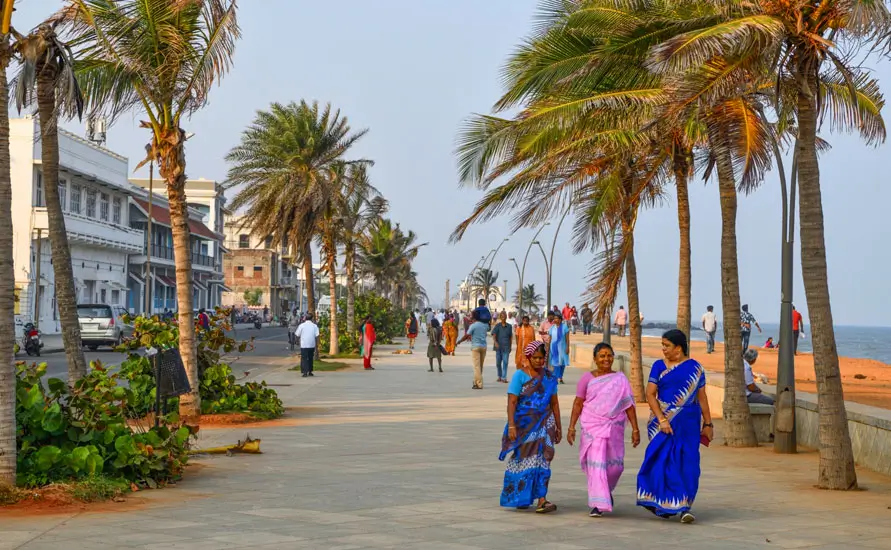
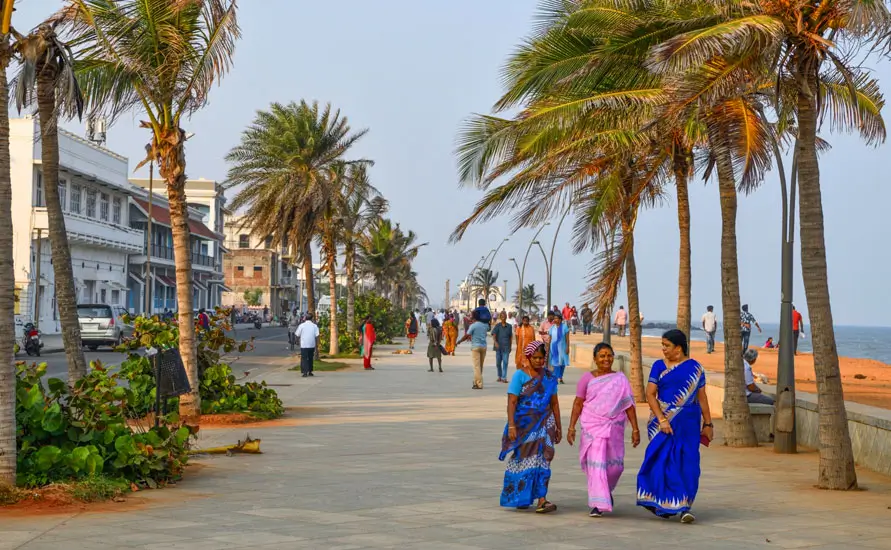
South of town the coast road crosses tidal creeks and passes beached fishing catamarans and roadside sellers of palm sugar, roughly 150 minutes of driving altogether. By late afternoon you reach Pondicherry, and settle into a heritage or boutique property in the old town for three nights. At dusk the seafront Goubert Avenue becomes a pedestrian zone, and half the town seems to turn out: grandparents on benches, couples taking selfies, kids with balloons. Restaurants nearby list French, Creole and Tamil dishes on one menu, and the small scale of the place makes it easy to like at once. Overnight in Pondicherry.
Bicycles are delivered to the hotel at 6:30 am, when the streets belong to joggers, milk vendors and street sweepers. Pedaling slowly, you follow your guide along the straight grid of the French Quarter, past ochre and cream villas whose louvered shutters and iron balconies peek out from bougainvillea. Stops include the old town hall, the Joan of Arc figure facing Notre Dame des Anges, and the walled colonial cemetery near the beach, where gravestones record French officers, merchants and children. Between stops, the talk turns to the French and British fighting over this town in the 1700s. Prefer walking? The same route works well on foot.
Cross the canal and the street plan stays straight, but the houses change: deep thinnai porches, carved wooden pillars and front walls painted turquoise, pink or lime. Each morning the women of the house draw a kolam on the doorstep in rice flour, and at this hour you may see the patterns going down, line by careful line. The Goubert market is next, loud with fish auctions and flower trading. Later you enter the Sri Aurobindo Ashram in silence, phones switched off. Afternoon hours are yours; Rue Suffren and Rue Mission have boutiques selling hand-loomed cotton and leather sandals.
Later, the small Pondicherry Museum displays Roman amphora shards and beads excavated at Arikamedu, a riverside trading post where Mediterranean merchants did business about two thousand years ago; it stays shut on Mondays. For the evening we book a cooking session with a Pondicherry chef, who teaches a Creole recipe, perhaps fish assad, gently spiced and finished with coconut milk, and perhaps a crème caramel that Tamil grandmothers make as readily as French ones. You eat what you cook at a shared table, which is the best way we know to understand how the town's two cultures blended. Overnight in Pondicherry.
Twelve kilometers north, Auroville was founded in 1968 on eroded red wasteland that its first settlers spent decades replanting; today it is a forest town of around three thousand residents from dozens of countries. Start with the visitor center's exhibition and short film, which lay out the idea. A footpath under the trees then leads to the public viewpoint for the Matrimandir, a sphere clad in golden discs. Going inside for silent concentration needs an advance booking and a separate briefing, and places each day are few; flag your interest when you book the tour and we will put in the request.
Residents run several cafés, and lunch at one of them often features produce from Auroville farms. Afterward you visit a pottery studio in the area, where Indian and foreign ceramicists turn stoneware and fire it in large wood-burning kilns. A few studios run short wheel sessions, bookable ahead; others simply let you watch glazing and kiln loading. If clay is not your thing, swap it for an incense maker, a handmade paper unit or a natural dye workshop. The township's bakeries are known for sourdough and cheese, so a picnic supply stop is tempting. Shady red-earth lanes make cycling between workshops pleasant, and bikes can be rented locally.
Around 4 pm, drive south past town to the Chunnambar boat house, where motorboats chug along a palm-lined backwater channel to a long sandbar beach on the open sea. Shacks sell fried fish, cold drinks and coconuts. Swim only where lifeguards indicate and when the flags allow. The last boats return before dark, so the timing is relaxed but not open-ended. Back in town, a final Pondicherry dinner could be on a rooftop terrace in White Town, with the sea breeze for company. Pack tonight; tomorrow's drive is the longest of the three weeks. Overnight in Pondicherry.
We will be honest: this is a long day, and what makes it work is a two-hour break halfway at one of India's greatest temples. Leave at 7 am after an early breakfast. The road runs inland across the Kaveri delta, a quilt of rice fields, irrigation canals, coconut groves and village shrines painted candy colors. Roughly four hours, with a coffee halt, bring you to Thanjavur, the old Chola capital. Dress with shoulders and knees covered, since you will be inside an active temple. Our drivers on this route know the clean rest stops and where the best filter coffee is.
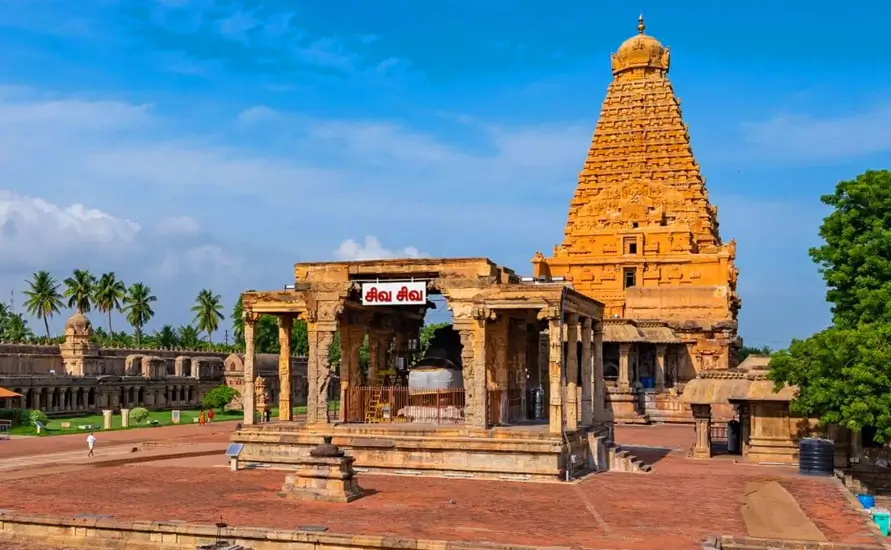
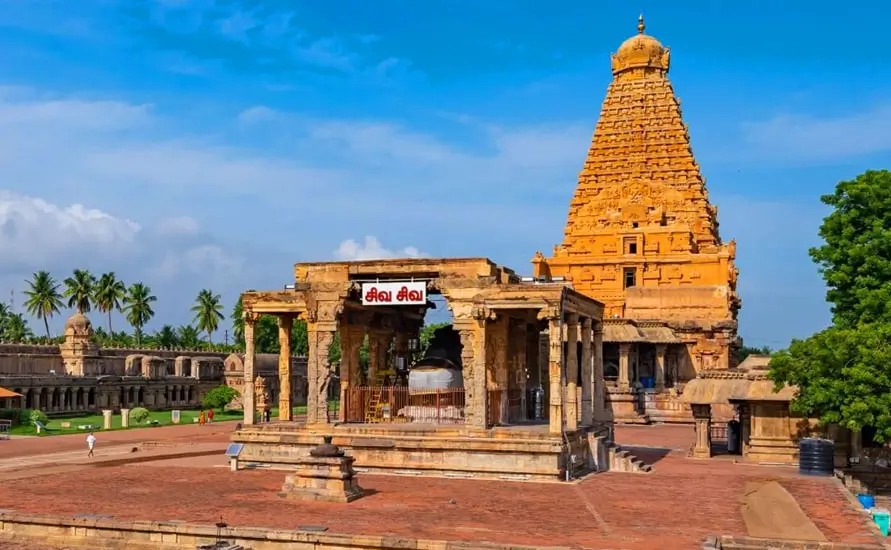
Rajaraja Chola I dedicated the Brihadeeswarar Temple in 1010, and its granite tower, close to 66 meters tall, was the highest in India for centuries. The capstone on top is estimated at about 80 tonnes, and nobody is fully sure how Chola engineers hoisted it. Together with two later Chola temples it forms a UNESCO World Heritage listing, yet worship goes on all day, with priests, pilgrims and schoolchildren sharing the courtyard. Do not miss the monolithic Nandi facing the shrine, the Chola-era paintings in the inner passage, and the Tamil inscriptions running around the base, listing donations of land, cattle and gold.
Lunch is in Thanjavur, and then three and a half more hours south bring you to Madurai. The scenery dries out, with bare granite hills and fields of cotton and millet. You arrive in the early evening, and the hotel is yours for two nights. On a long day like this, most guests eat in, but if you still have legs, ask the driver to stop for jigarthanda; the name means cool heart, and into the tall glass go thickened milk, wobbly almond gum and a pink splash of nannari, all crowned by ice cream. Every famous stall claims to have invented it, and the debate is half the fun. Overnight in Madurai.
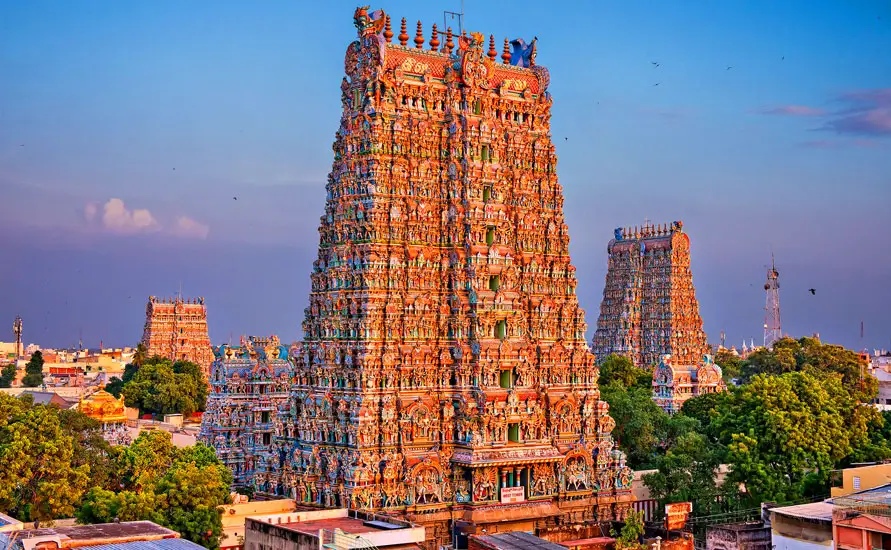
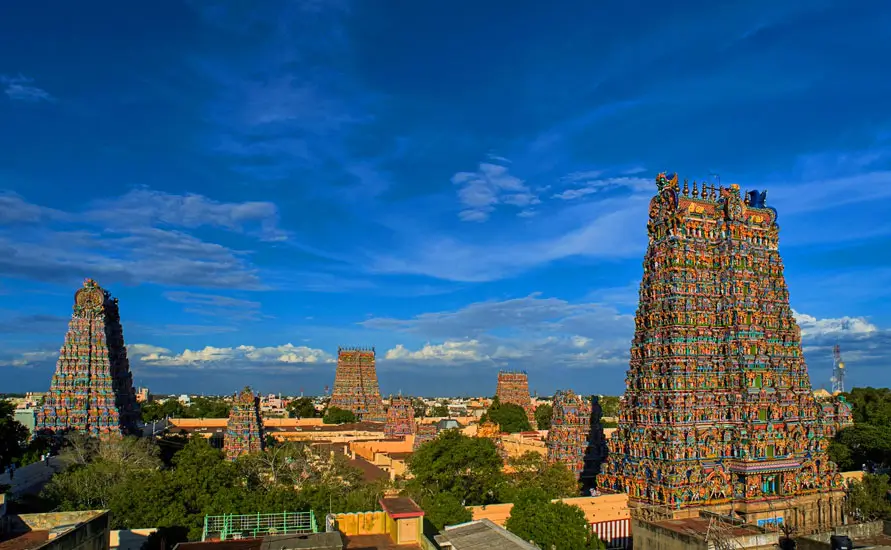
Get to the Madurai Meenakshi Temple by 7 am, when early worshippers outnumber visitors. The complex belongs to the fish-eyed goddess Meenakshi and to Sundareswarar, her husband and a form of Shiva, and its fourteen gopurams are crowded with brightly repainted figures. Mobiles and cameras stay behind in the cloakroom booths near each gate. Non-Hindus may not go into the two inner sanctums, but the pillared corridors, the Golden Lotus Tank and the hall of a thousand carved columns, today a museum of bronzes and carvings, are open to all. Your guide explains the divine wedding that the temple re-enacts each spring during the Chithirai festival.
Mid-morning, the Thirumalai Nayak Palace of 1636 surprises with giant white columns and an arched courtyard that borrow from both South Indian and Islamic design. Afternoon heat sends most people back to the hotel for a rest. Around 4 pm head to the Mattuthavani flower market, where jasmine arrives by the sack from nearby farms and sellers string it into garlands with blurring fingers; Madurai malli jasmine even carries a geographical indication tag. Time permitting, the Gandhi Memorial Museum displays the blood-stained dhoti Gandhi wore at his assassination in 1948, a sobering exhibit that stays with most visitors.
Dinner is early so you can be back at the temple for about 9 pm. The palliyarai ritual puts Sundareswarar to bed: priests carry his image by palanquin to Meenakshi's chamber, behind a band of nadaswaram oboes and thavil drums and devotees pressing close. Stand back and let the regulars have the front. Your guide whispers the meaning of each stop along the corridor, from the offering of milk to the closing of the doors. Many guests rank this short, crowded, intimate ritual as their favorite hour in Tamil Nadu, and it makes a good farewell to the plains. Overnight in Madurai.
Westward today, toward a wall of hills you will see on the horizon within an hour. The plains around Theni are farm country, with vineyards trained on overhead trellises and banana plantations right up to the road. At Bodinayakanur the climb starts in earnest: the Bodimettu ghat road twists through more than a dozen hairpins, and every bend gains height and lowers the thermometer. Your driver pauses at a lookout where the whole Theni valley lies spread below. If curving roads upset your stomach, take something before the climb; the surface is good but the bends are relentless for about an hour.
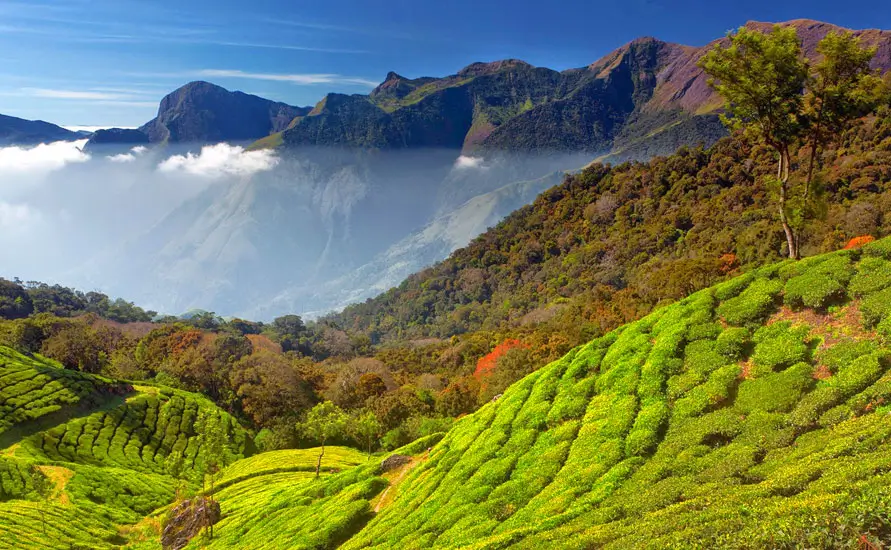
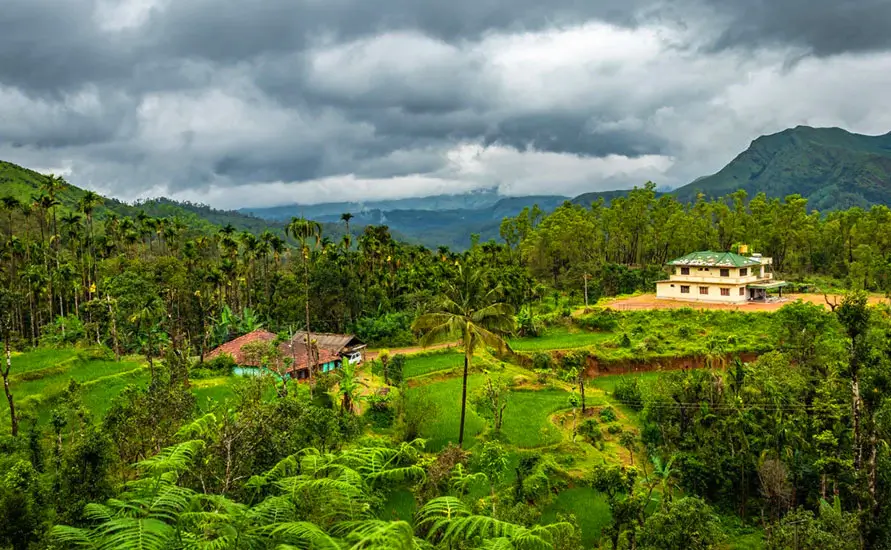
At the Kerala border the scenery switches from scrub to dense green. Cardamom grows here beneath a canopy of tall native trees, its pale flowers and green pods sprouting from runners close to the ground, and a short stop at a small estate lets you see how the pods are dried and graded. Soon the tea starts: clipped bushes contouring every slope, picker paths cutting through them like stitching. You arrive in Munnar by early afternoon and settle into a hill resort or a planter's bungalow on an estate for three nights. Evenings are cool year-round, so bring a fleece.
Take the rest of the day slowly. Many properties include a short naturalist walk along estate roads, a good chance to spot birds like the Malabar whistling thrush, nicknamed the whistling schoolboy, though nothing is guaranteed. British planters of the Kanan Devan concession started felling forest for estates here in the 1870s and 1880s; their stone churches and clubhouses still dot the town. Dinner could be appam with vegetable stew, or a peppery Kerala fish curry. Over tea, your guide goes through the next two days, which can be swapped around depending on clouds, rain and the season. Overnight in Munnar.
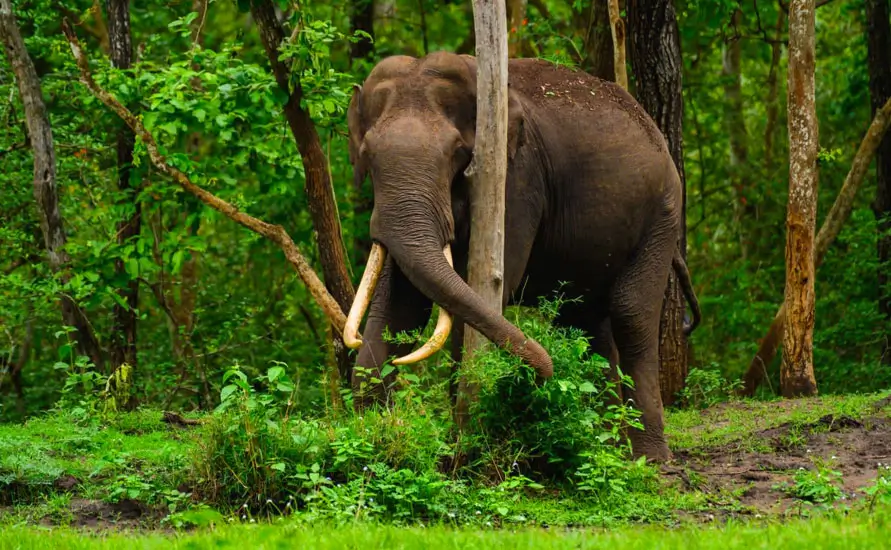
Fifteen kilometers north of town, Eravikulam National Park protects rolling high grassland and the Nilgiri tahr, a stocky, sure-footed mountain ungulate found nowhere outside the Western Ghats. Private cars stop at the entry gate; forest department minibuses shuttle everyone up to the Rajamalai section, where a paved walking road curls along the hillside. Tahr frequently feed within a few meters of the walkers, yet they are wild animals, so we promise nothing. Each year it closes for roughly two months over February and March, when the tahr give birth. When the cloud lifts, look for Anamudi, at 2,695 meters the tallest summit in India south of the Himalayas.
In the afternoon, the Tea Museum of Kanan Devan Hills Plantations tells the Munnar story through sepia photographs, old estate ledgers and a century-old rolling machine. Next to it, a working factory shows the stages: withering the green leaf, rolling and cutting it, letting it oxidize, then firing it dry. The tasting at the end compares grades, from the fine dust used in strong chai to large whole leaf. Your guide talks frankly about the estate workforce, largely women pickers whose families have worked these estates for four or five generations. Town shops sell loose tea, cardamom and homemade chocolate, a Munnar specialty worth taking home.
Later, a spice garden tour shows pepper climbing on silver oak trunks, nutmeg fruits splitting to reveal red mace, and cinnamon bark peeled straight from the branch for you to smell. In the evening, small theaters in town stage short Kathakali and Kalaripayattu shows for visitors on most nights. Kalaripayattu, Kerala's ancient martial art, is the more energetic of the two: flying kicks, long staffs, sword-and-shield bouts and fire tricks at the end. Children usually love it. Your driver collects you afterward for a quiet meal back at your hill resort, where nights are cool enough for a blanket. Overnight in Munnar.
A morning drive east covers the 35 km to Top Station, the rim of the Kerala highlands, where the ground plunges toward Tamil Nadu. En route comes Mattupetty Dam, where pedal boats and motorboats can be hired on the reservoir, and Echo Point, popular with local tourists who yell across the lake and wait for the reply. Further on, Kundala lake sits amid eucalyptus and tea. At Top Station, a short path leads to a cliff-edge lookout over the plains, which on clear mornings stretch far into the haze. Mist often rolls in by midday, so we leave early.
Coming back, your guide leads a walk along the picker paths of a working tea estate. You learn why the bushes are kept at roughly waist level to form a picking table, why only the tender shoot, two leaves and a bud, makes good tea, and how silver oaks are planted to give shade and a windbreak. If a picking team is at work, watch from the path and ask before taking photographs. A picnic lunch at a viewpoint is possible on dry days, or pull in at a simple eatery near town for Kerala parotta with chicken or vegetable curry.
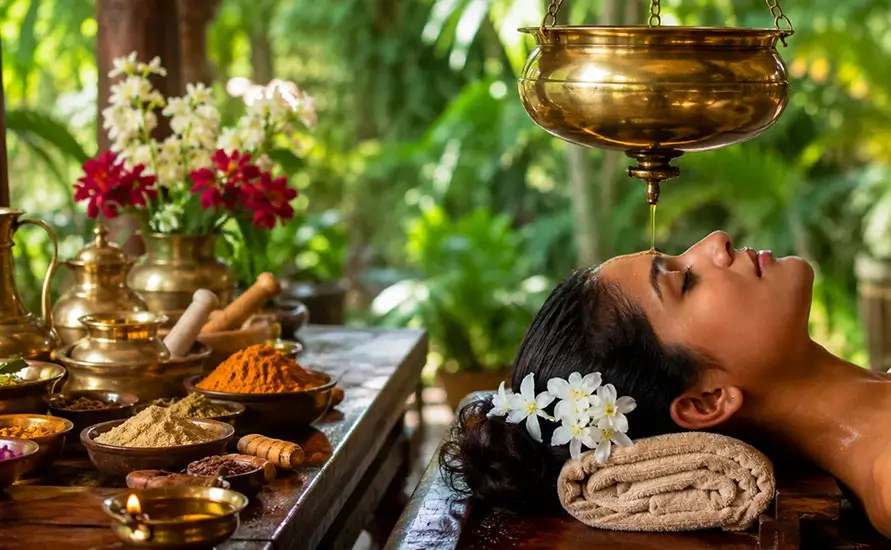
Nothing else is booked for today. Hill resorts usually offer Ayurvedic massages, and an hour of abhyanga with warm herbal oil is a fine way to rest legs that have walked three weeks of monuments. If you would rather see sunrise from Kolukkumalai, among the highest-altitude tea estates anywhere, we can swap this morning's drive for a 4 am jeep ride up a rough track that rattles every bone; the reward is a sea of cloud below. Tonight, pack and ask for an early breakfast, since the houseboat in Alleppey expects you around noon. Overnight in Munnar.
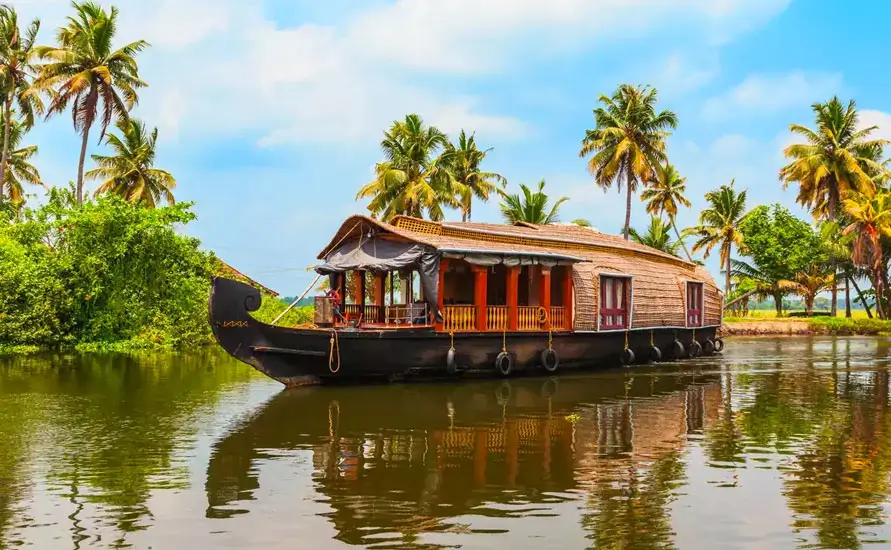
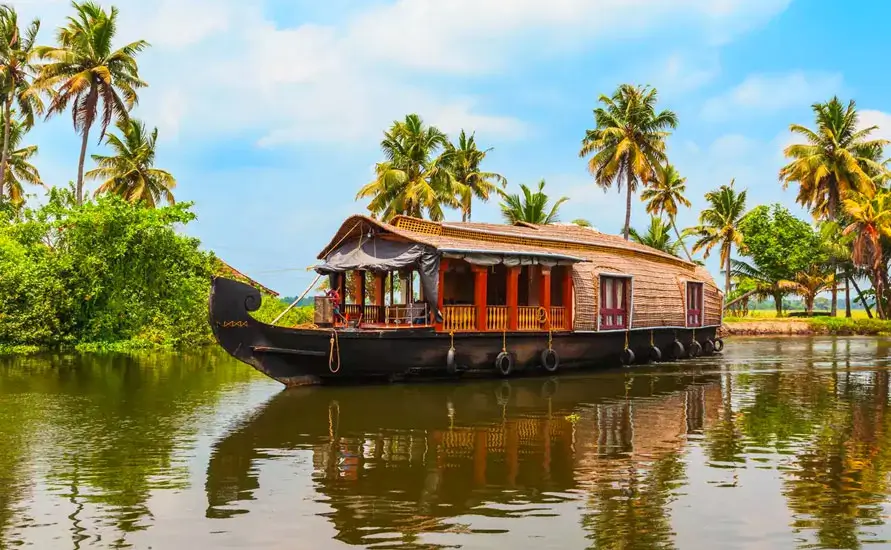
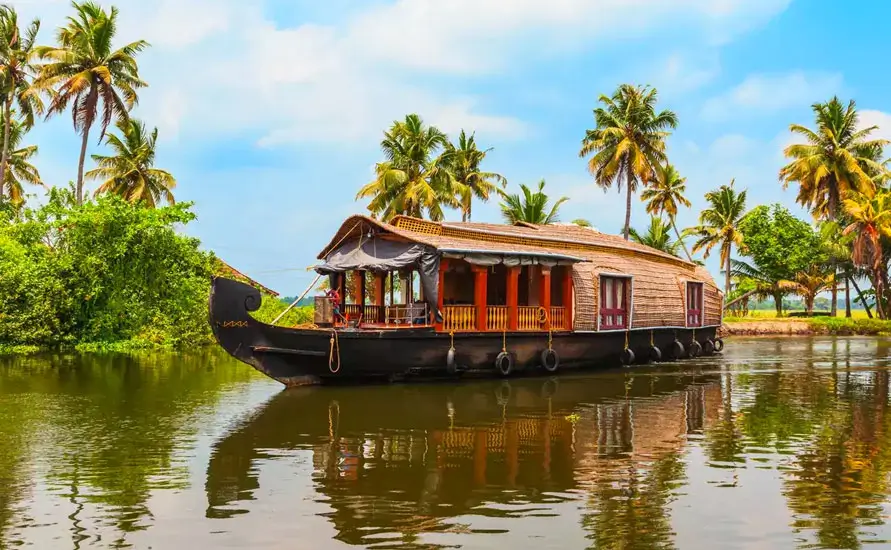
Wheels roll at 7 am, because houseboat boarding in Alleppey is around midday and the road down from the hills is slow. You descend through cardamom, then rubber plantations with collecting cups strapped to the trunks, past waterfalls that roar in the monsoon and trickle by March. Breakfast or coffee is at a roadside stop. Below the foothills, Kerala's lowlands take over: churches with white facades, toddy shops, canals bordered by coconut palms. At the jetty in Alleppey, the crew of your private houseboat, normally three people (skipper, cook, deckhand), help you aboard and show you the cabins.
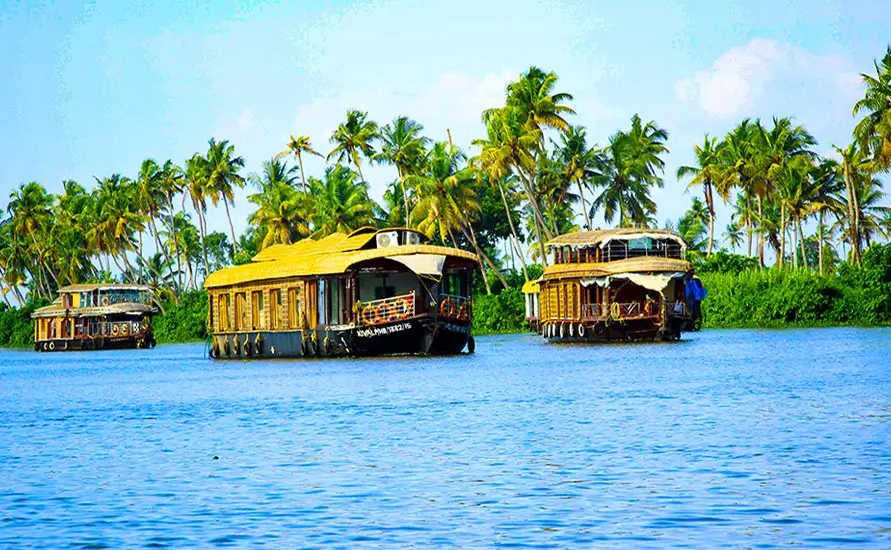
Lunch is served as you push off into the Kerala backwaters, a maze of lakes, rivers and man-made channels running parallel to the coast. Expect rice, a coconut-based vegetable curry, crisp pappadam and fried pearl-spot fish, with the chili dialed up or down on request. Through the afternoon the boat follows waterways where village life is lived at the bank: a fish vendor in a canoe, women scrubbing pots at the steps, a school ferry packed with uniforms. In Kuttanad, farmers grow rice on land reclaimed from the lake below sea level, protected by earthen bunds and pumped dry each season.
Kerala rules bring houseboats to anchor around sunset, so by early evening the captain ties up beside a quiet stretch of paddy or a village path. Hop off with one of the crew to look at a toddy tapper's palm or a small chapel, or stay put upstairs with chai and pazham pori, batter-dipped plantain slices fresh from the pan, as the light fades to copper. The cook prepares dinner in the tiny galley, perhaps karimeen pollichathu wrapped in banana leaf if you ask in advance. After dark the backwater goes quiet apart from crickets, frogs and an occasional splash. Overnight on the houseboat.
Set an alarm for first light: the backwater at dawn, wrapped in thin mist with cormorants drying their wings on posts, is worth the lost sleep. Puttu, a steamed rice cake, with black chickpea kadala curry is a typical breakfast, eaten as the boat heads for the jetty; you disembark around 9 am. Tip the crew if you were happy, as it is customary. Then it is ninety minutes by road to Kochi and two nights at a heritage property in Fort Kochi, the compact peninsula where Portuguese, Dutch and British traders each left buildings behind. Your Kochi guide collects you at about 3 pm.
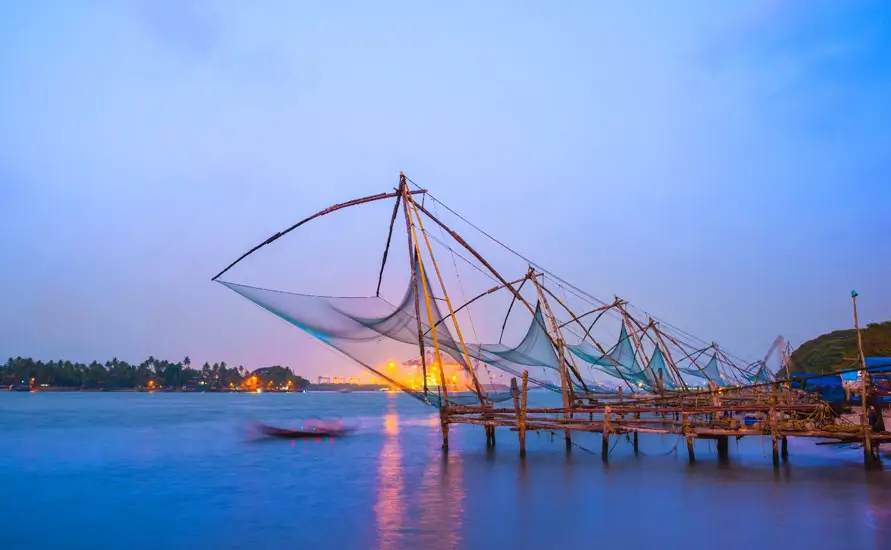
The walk starts at St. Francis Church, a Portuguese foundation of the early 1500s, whose floor kept Vasco da Gama's body for over a decade after the navigator died here in 1524; Portugal eventually reclaimed his bones. A few minutes away on the beach road stand the Chinese fishing nets, cantilevered frames lowered and lifted by crews hauling on ropes against stone weights. Nearby fishmongers sell the catch, and a stall will fry yours. Your guide also shows you the Dhobi Khana, the town's communal laundry, where washermen slap clothes against stone and hang them in rows.
Tonight is Kathakali. Arrive an hour early at the theater to see the performers lying on their backs while artists layer rice-paste ridges and mineral pigments onto their faces, green for heroes, red and black for villains. Before the dance, a narrator demonstrates a handful of mudras and eye movements, enough to follow the plot of an episode from the Mahabharata. The show runs around an hour, accompanied by chenda drums and singing. Afterward, Fort Kochi's restaurants are a short walk away; try fish moilee, a mild coconut curry tinged with turmeric, or a prawn roast. Overnight in Kochi.
Mattancherry is Kochi's old merchant quarter, a short drive from your hotel. The Mattancherry Palace, presented to the Raja of Cochin by the Portuguese around 1555 and patched up a century later by the Dutch, hence its other name of Dutch Palace, keeps some of the best Kerala murals anywhere, including Ramayana panels in earthy reds and yellows. Friday is its weekly day off. Two lanes over, the 1568 Paradesi Synagogue rests its benches on a pavement of painted Chinese porcelain tiles, no two alike, and lit by glass chandeliers; Friday, Saturday and Jewish holidays are its closed days. We arrange this day around both closures, swapping it with yesterday's program if needed.
Jew Town's main street and its offshoots are lined with antique dealers, small galleries and spice warehouses that still smell of black pepper, dry ginger and turmeric. In a couple of the old godowns, workers sift and bag spices by hand much as their predecessors did. Your guide traces the trade that drew Arab dhows, Chinese junks and then Portuguese, Dutch and British fleets to the Malabar coast, and the communities they left behind, from Syrian Christians to Gujarati merchants. During Kochi-Muziris Biennale seasons, warehouses and old mansions turn into contemporary art venues; at other times, a few permanent galleries keep the spirit going.
Your last afternoon in India is unplanned on purpose. Shop for spices, linen or antiques, take a nap, or book an optional evening boat trip around the harbor, which passes container ships, the naval docks and the fishing nets from the seaward side. For the farewell dinner, choose a Kerala vegetarian sadya, a seafood grill by the water, or a Syrian Christian duck roast. Looking back, you have stood beneath Mughal domes, Rajput forts, Chola towers and French shutters, and watched tea pickers and backwater fishermen at work. Not many three-week trips cover that much without feeling rushed. Overnight in Kochi.
From Fort Kochi it is about 45 km north to Cochin International Airport, roughly 90 minutes by road, and your driver picks a start time that leaves a three-hour cushion at the terminal before your international flight. Late-evening flight? We can hold your room until mid-afternoon or book a day room closer to the airport for an extra charge. From Kochi, carriers based in the Gulf and Singapore connect onward to North America, Europe and Australia. Until your boarding pass is printed, our team answers the phone.
Three weeks ago you landed in Delhi to the sound of car horns; you leave from an airport surrounded by coconut palms and solar panels. In between came Mughal tombs, Rajput palaces, Chola granite, French streets, temple drums, tea hills and a night on the water. If another region tempts you next, from the Rajasthan desert to the Himalayan foothills or the Goa coast, write to us and we will start sketching a route. Safe travels, and thank you for spending three weeks with us.
Your Journey
N.S. Rathore & Mrs. Omlata Rathore · Managing Director
We still read every enquiry ourselves. Tell us the places you liked and our planners will send a day-by-day route with drive times and a clear price.
Every package can be customised and no pressure to book. A planner from our office replies within 24 hours with a route written for your group.
Fill this in and your planner will send a first draft itinerary.
Explore more
Kerala Backwaters Escape Kerala Backwaters Escape
 Kerala Backwaters Escape
 Kerala Backwaters Escape
 Kerala Backwaters Escape
 Kerala Backwaters Escape
 Kerala Backwaters Escape
 Kerala Backwaters Escape
 Kerala Backwaters Escape
 Kerala Backwaters Escape
 Kerala Backwaters Escape
 Kerala Backwaters Escape
 Kerala Backwaters Escape
 Kerala Backwaters Escape
 Kerala Backwaters Escape
 Kerala Backwaters Escape
 Kerala Backwaters Escape
 Kerala Backwaters Escape
 Kerala Backwaters Escape
 Kerala Backwaters Escape