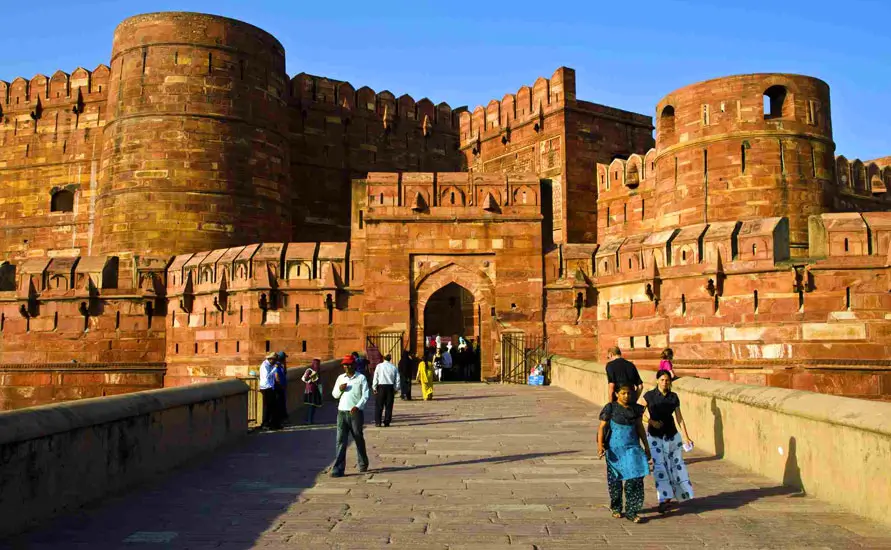
 Kerala Backwaters Escape
Golden Triangle Tour With South India
Delhi – Agra – Jaipur – Goa
At a glance
Two very different Indias sit at either end of this trip, and that contrast is the reason to book it. Our Golden Triangle with Goa opens with the Mughal and Rajput north, where sandstone tombs, marble mausoleums and hilltop forts tell the story of emperors and warrior kings, and closes on the Konkan coast, where whitewashed Portuguese churches, cashew orchards and fish curry lunches set a slower rhythm. The first five nights go to Delhi, Agra and Jaipur, linked by road, then a domestic flight drops you in Goa for four nights by the Arabian Sea.
The northern half moves at a steady clip, so we plan it carefully. Delhi gets two nights, which gives you time to recover from the long-haul flight before the Qutub complex and the spice lanes of Old Delhi. Agra is one night, positioned so that the Taj Mahal at sunrise never falls on a Friday, when the monument is shut. The road to Jaipur passes Akbar's deserted red city at Fatehpur Sikri, and two Jaipur nights leave room for a block-printing village as well as the forts. One car and one driver handle the whole Golden Triangle tour with Goa on the road.
Goa is deliberately light. You stay in one beach hotel on the North Goa coast for all four nights, with one guided day in Panjim and Old Goa, a half day at a spice farm in Ponda and plenty of unplanned hours for the sand and the pool. The Delhi Agra Jaipur Goa tour is shaped for first-timers coming from America, Britain, Australia or mainland Europe, plus NRI families who want the classic sights followed by a genuine rest. Both regions are at their most pleasant between October and March.
Indira Gandhi International Airport is where the trip begins, and a member of our Delhi team stands just past the customs exit with your name printed on a placard. Flights from North America and Europe tend to land either around midnight or in the early afternoon, so we keep the first day loose and adjust it to your arrival time. Reaching your central New Delhi hotel usually needs forty to sixty minutes, more in rush hour. In the car, your host can hand over the prepaid SIM card you ordered, talks you through sensible tipping amounts and goes over the next nine days so there are no surprises.
Once you have showered and rested, a short late-afternoon outing is a gentle way to get your bearings. Connaught Place, the circular colonnaded shopping district designed by British architects and finished in the 1930s, sits at the center of New Delhi and is easy to walk. Its white Georgian arcades now hold bookshops, coffee houses, handloom stores and the government emporium where fixed prices take the pressure off bargaining. Your guide points out how the inner, middle and outer circles were designed, and how the district became the meeting point between the old walled city to the north and the imperial capital to the south.
Only a few minutes away, tucked between office towers on Hailey Road, is Agrasen ki Baoli, a 14th-century step well with 108 stone steps descending to the old water level. It is quiet and cool in the evening, and the long view down its arched walls makes a striking first photograph of India's layered history. When hunger strikes, ask your guide about a nearby north Indian restaurant where a mild butter chicken, dal makhani and fresh tandoori roti make an easy introduction for travelers still adjusting to the time change. An early night pays off, because the next day is long. Overnight in Delhi.
Delhi is coolest before ten, which is why your guide begins at the far south of the city with the Qutub Minar. Begun in the late 12th century under Qutb-ud-din Aibak, the ribbed sandstone shaft climbs 73 meters in five tapering stories and is carved with bands of Arabic calligraphy. Scattered at its foot lie the broken arcades of the Quwwat-ul-Islam, Delhi's first mosque, assembled partly from the columns of older Hindu and Jain temples, and a 4th-century iron pillar whose metal still shows almost no corrosion after some sixteen centuries. UNESCO lists the complex, and gates open at sunrise, so early visitors share it with few others.
Next door, the Mehrauli Archaeological Park is a part of Delhi few visitors see. Footpaths wind past more than a hundred ruined structures, including the tomb of Balban, the domed Jamali Kamali mosque and the Rajon ki Baoli step well, all shaded by thorny kikar trees and visited mainly by birdwatchers and joggers. Along the trail, your guide traces how Delhi was rebuilt as seven or more separate cities over a thousand years, each dynasty moving the center a little further. After the park, a late lunch of kebabs and saffron rice in a South Delhi restaurant gives you a break before the afternoon in the old city.
Old Delhi is a different world from the leafy south. From Chandni Chowk you turn west into Khari Baoli, a wholesale spice bazaar trading since the 17th century, where handcart pullers haul gunny bags of red chili, turmeric, cardamom and cumin down alleys barely wide enough for two people. A narrow stairway leads to a rooftop with a view over the trading houses toward the domes of the Jama Masjid. Cover your nose with a scarf if the chili dust makes you sneeze, and keep a firm hold of your bag in the crowd. A cycle rickshaw ride back through Chawri Bazaar ends the afternoon. Overnight in Delhi.
After breakfast and checkout, your driver heads southeast onto the Yamuna Expressway, the tolled highway that brings Agra within roughly three and a half or four hours of the capital. It slices across the level fields of western Uttar Pradesh, past mustard and wheat fields and brick kilns with tall chimneys, and there are clean rest stops roughly halfway. Your driver knows which ones serve decent tea and clean restrooms. Arrival in Agra comes around lunchtime. We book hotels a few minutes from the Taj Mahal's eastern entrance, so the predawn start tomorrow needs very little driving.
In the afternoon your Agra guide takes you across the river to Itimad-ud-Daulah, the tomb Empress Nur Jahan built for her father between 1622 and 1628. It is often called the Baby Taj, but it came first, and it was the earliest Mughal building to use white marble inlaid with colored stone on such a scale. Look closely along the dado and you can pick out Persian-style wine flasks, cypress spires and fruit bowls pieced together from yellow jasper, red carnelian and banded onyx, a decorative vocabulary that the builders of the Taj would borrow and enlarge a few years later. Because it sees a fraction of the Taj Mahal's visitors, you can study the carving closely and take your time.
As the afternoon fades, cross to Mehtab Bagh, a riverside garden first planted by Babur on the north bank of the Yamuna directly opposite the Taj. From here the mausoleum glows pink and orange as the light fades, reflected in the shallow river, and there is no queue and no security line. Ask your guide about the old legend of a second, black Taj meant for this side of the river, and what archaeologists actually found when they dug the garden in the 1990s. Dinner in Agra is a good time to try Mughlai korma, and a box of petha, the translucent candied pumpkin the city is known for, makes a sweet end. Overnight in Agra.
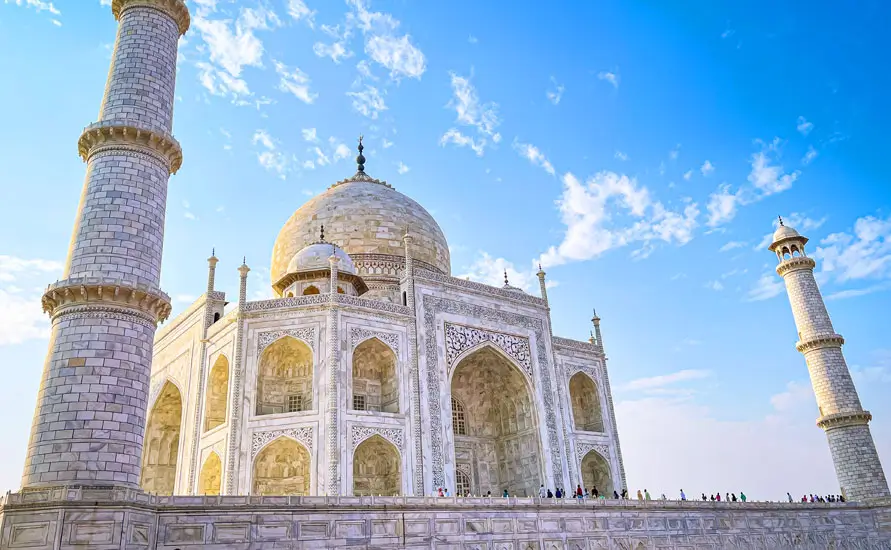
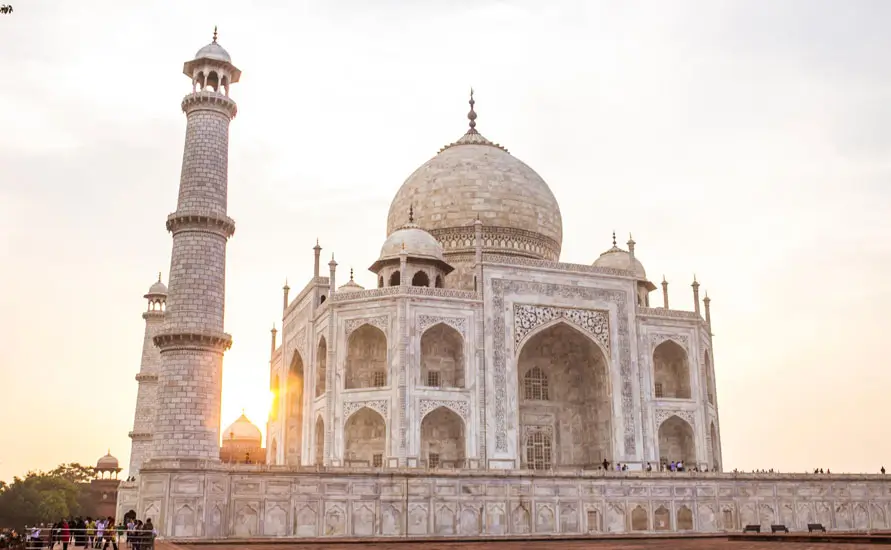
Set your alarm early: ticket gates at the Taj Mahal start letting people in some thirty minutes before first light, and the first hour is when the marble shifts from grey to soft gold and the gardens are calm. Fridays are a weekly closure for the Taj, so we always fix the Agra night to avoid it, and if flight changes push your visit onto a Friday, we swap the evening garden visit and the Taj between the two days. Passing under the great red gateway, your guide explains the Quranic verses that appear to stay the same size as they climb the arch, and why the four minarets tilt very slightly outward, so that in an earthquake they would fall away from the tomb.
Return to the hotel for breakfast, then stop at a family-run marble inlay workshop before leaving town. The craftsmen here descend from the artisans who worked on the Taj, and you can watch them shape slivers of lapis, carnelian and malachite on a grinding wheel spun by hand before fitting each piece into a carved marble groove. There is no obligation to buy, though a small coaster or box makes a lasting souvenir. By mid-morning you are on the road west toward Rajasthan, with the landscape turning drier and the villages painted in more ochre and pink as you cross the state border.
About an hour from Agra, Fatehpur Sikri stands on a rocky ridge. Emperor Akbar built this walled city of red sandstone in the 1570s and abandoned it after barely fifteen years, probably because the lake that fed it ran dry, which is why its palaces, audience halls and five-story Panch Mahal survive in such good condition. Look for the single carved column holding up the Diwan-i-Khas, where tradition places Akbar's seat, and for the latticed marble shrine of Salim Chishti in the mosque courtyard, where visitors still tie red threads to ask for a wish. Continue to Jaipur, arriving by early evening. Overnight in Jaipur.
Rajasthan's capital is best seen in two halves, and the morning belongs to the hills. Eleven kilometers north of the old city, Amber Fort spreads across a ridge above Maota Lake, its ramparts linking to the higher Jaigarh Fort along the crest. We take you up by jeep, avoiding the queue and the old practice of riding elephants, and from the courtyard your guide steers you through the painted Ganesh Pol into the private apartments of the Kachwaha rulers. Inside the Sheesh Mahal, walls and ceiling are set with countless small pieces of convex glass, and your guide will tell you how one flame was once enough to make the whole room glitter like a starry sky.
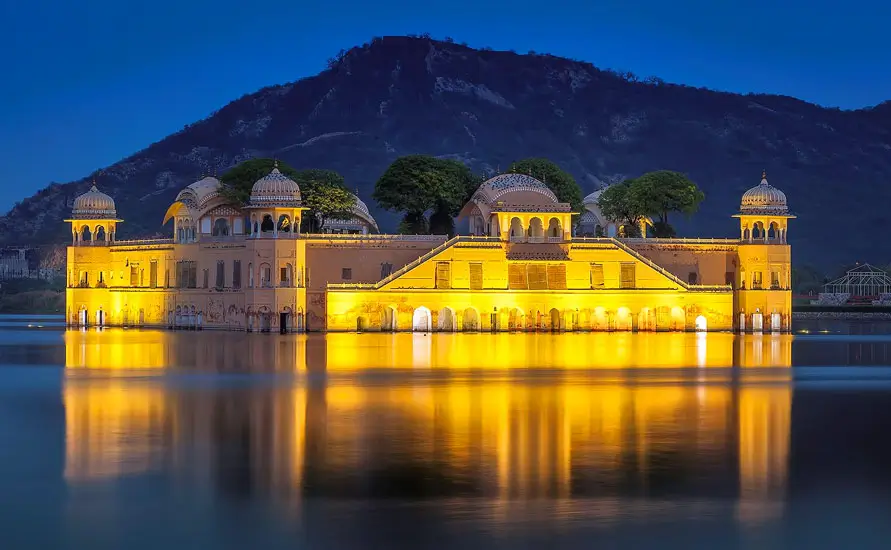
Five minutes below the fort sits Panna Meena ka Kund, a step well of the 16th century whose criss-crossing staircases form a perfect geometric pattern on all four sides. Village women once collected water and gathered here in the shade, and these days photographers crowd its steps by late morning, so arrive in good time. On the way back to the city, your driver pauses beside Man Sagar Lake for a view of Jal Mahal, the Water Palace that appears to drift on the water's surface. Lunch can be a traditional Rajasthani thali, with dal baati churma, ker sangri and a sweet ghevar.
The afternoon is spent inside the walled Pink City, colored a dusty terracotta for the 1876 visit of the future King Edward VII. Part of the City Palace is still lived in by Jaipur's former royal family; the public courtyards hold royal robes, an armory and a pair of huge silver jars that once carried a maharaja's supply of Ganges water on a voyage to England. Next door, Jantar Mantar is the UNESCO-listed observatory that the astronomer-king Jai Singh II raised in stone and brass in the 1720s; the shadow of its giant Samrat Yantra moves about six centimeters a minute, so you can read solar time by eye. End with a photo stop beneath the latticed pink face of Hawa Mahal and a walk through Johari Bazaar. Overnight in Jaipur.
Your final morning in Rajasthan takes you 30 km west of Jaipur to Bagru, a village of the Chhipa printing community where fabric has been stamped by hand for around four hundred years. Unlike the brighter screen prints sold in city markets, Bagru work uses natural dyes such as indigo, pomegranate rind and iron rust mixed with jaggery, and a mud-resist paste called dabu that creates its soft, slightly blurred patterns. A printer shows you how the teak wood blocks are carved, how each color is laid down separately, and how the finished cloth is dried in the sun on open ground at the edge of the village.
You are welcome to try a few stamps yourself on a scarf or a cotton napkin, which you can take home. Back in the city, grab a quick lunch, then head out to Sanganer, where Jaipur's airport is, for the afternoon flight to Goa. Depending on the season and the day of the week, the flight is either direct or connects via Mumbai or Delhi, landing either at Dabolim near Vasco or at Mopa, the airport opened in 2023 in Pernem taluka. We choose the timing to avoid a rushed morning and confirm the final schedule with you once flights open for booking.
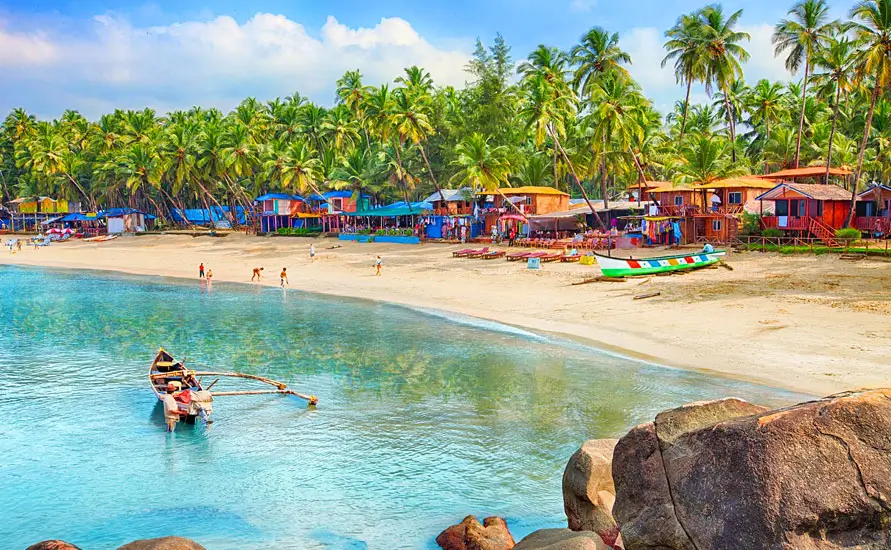
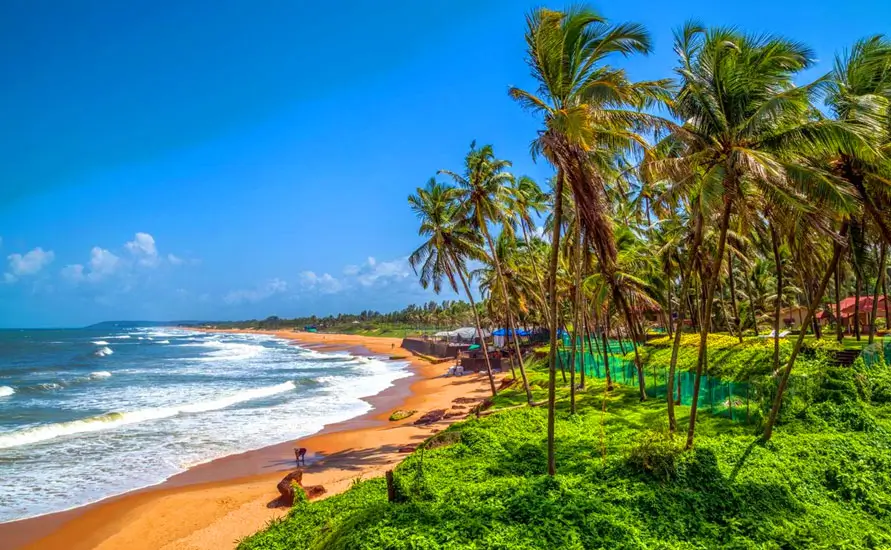
The difference is clear the moment you step off the plane: humid sea air, coconut palms and red laterite earth replace the dry plains of Rajasthan. Our Goa representative is waiting outside the terminal for the drive to your beach hotel on the North Goa coast, which takes forty minutes to an hour from either airport. After four busy days on the road, the evening is entirely yours. Take a walk on the sand at dusk, order a cold drink at a beach shack and try your first Goan dish, perhaps prawn balchão or a mild xacuti. Overnight in Goa.
Goa was a Portuguese colony for over 450 years, until 1961, and that history is clearest in the capital, Panjim. Your guide begins in Fontainhas, the old Latin Quarter, where slim streets are crowded with homes in ochre, cobalt and lime green, finished with red tile roofs, wooden balconies and hand-painted azulejo tiles showing house names and saints. Many families still speak Portuguese or Konkani at home. Climb the zigzag staircase to Panjim's white parish church, first raised in 1541, and stop at a small bakery for a slice of bebinca, a layered coconut cake baked one layer at a time.
Some 10 km up the Mandovi stands Old Goa; in the 1500s it held more people than many European capitals, until cholera and malaria drove residents away by the 1700s. What remains is a cluster of enormous churches and convents that together form a UNESCO World Heritage Site. The Basilica of Bom Jesus holds the remains of St. Francis Xavier in a silver casket, while the huge Sé Cathedral across the lawn houses the Golden Bell. Inside, keep shoulders and knees covered. Your guide also shows you the ruined tower of St. Augustine, standing alone on a hill above the river.
Lunch is a classic Goan fish curry rice, made with coconut, kokum and the catch of the day, served in a family-run restaurant near the river. In the afternoon you can take the short free ferry from Old Goa to Divar Island, where quiet villages, paddy fields and old Hindu and Catholic shrines sit side by side, or simply return to the hotel for a swim. In the evening, a sunset cruise on the Mandovi with live Goan music and folk dances is a fun option, though it can be lively and touristy, so ask your guide which boat suits you. Overnight in Goa.
Inland Goa is a world away from its beaches, and roughly an hour's drive east brings you to the forested hills around Ponda. Here, Hindu families moved their temple images during the 16th-century Portuguese Inquisition, rebuilding their shrines in what was then territory outside colonial control. The Shri Manguesh Temple, dedicated to Shiva, combines a Hindu sanctum with a whitewashed facade and a lamp tower that show clear Portuguese and Islamic influences. Visitors of all faiths may enter the outer hall, but dress modestly and remove your shoes. Your guide explains how Goa's Hindu and Christian communities have shared festivals and food for centuries.
Next comes a guided walk through a working spice farm, where nutmeg, vanilla orchids, cinnamon, pepper vines and cardamom grow beneath tall areca palms. A farmer shows you how each plant is harvested and dried, explains how Goa's spice trade first drew Portuguese ships to this coast, and lets you crush fresh leaves to smell them. Children enjoy the short walk to see cashew trees, whose fruit ripens in spring and is distilled into the local feni spirit. Afterwards, lunch is served buffet style on banana leaves, featuring vegetarian dishes, fish and rice cooked with the farm's own spices.
You return to the coast by mid-afternoon with plenty of time left for the pool or the beach. If the day happens to be a Saturday in the dry season, the Arpora Saturday Night Market is worth an evening visit, with stalls selling handicrafts, clothing and street food, plus live music on a small stage. On other evenings, your driver can drop you in Candolim or Calangute for dinner at one of the seafood restaurants where the day's catch is displayed on ice and grilled to order. Remember to ask for a table outdoors to catch the sea breeze after dark. Overnight in Goa.
Goa's northern coast is defended by a chain of 17th-century Portuguese forts, and a short morning outing with your driver takes in two of them. Fort Aguada, at the mouth of the Mandovi River, was built in 1612 to protect against Dutch and Maratha attacks and to supply fresh water to passing ships from its large cistern. Its whitewashed lighthouse, dating from 1864, overlooks the long sweep of Sinquerim and Candolim beaches. From the ramparts, watch trawlers leaving the river mouth and spot distant cargo ships waiting off the coast for space in the iron ore port at Mormugao.
Further north, the ruined laterite walls of Chapora Fort crown a headland above the Chapora River and the beach at Vagator. The climb is short but steep and uneven, so swap sandals for proper walking shoes, and go before the sun gets strong. The view stretches across the river estuary, with colorful fishing boats moored below and coconut palms reaching toward Morjim on the far bank. If the day is a Wednesday between November and April, your driver can stop at the Anjuna Flea Market, which began with hippie travelers in the 1970s and now sells everything from spices to silver jewelry.
Nothing is planned after lunch, and you have earned it. Spend the afternoon on a sun lounger, book an Ayurvedic oil massage at the hotel spa, or take a cooking lesson to learn how to make Goan pork vindaloo or chicken cafreal at home. In the late afternoon, many beaches in North Goa fill with locals as well as visitors, all gathering to watch the sun set into the Arabian Sea. Use this last evening to pack your bags and enjoy a farewell dinner of grilled kingfish or lobster at a beach shack, washed down with a cashew feni cocktail if you like. Overnight in Goa.
Breakfast is at your leisure, and the hotel's standard checkout is usually around noon. Your driver will collect you at an agreed time for the transfer to Dabolim or Mopa airport, depending on which one your flight departs from. The road takes roughly an hour, and arrive at least three hours early for international departures or two hours for domestic connections. Most travelers from the US and Europe connect through Mumbai, Delhi or one of the Gulf hubs, and we can book the domestic leg as part of your package if needed, so your bags are checked through when the airlines allow it.
Flying out close to midnight? Ask us early and we will hold your room past noon or book a day-use room, leaving space for one more swim and a hot shower before heading to the terminal. Before leaving, you might stop at a local bakery in Mapusa or Panjim for a box of bebinca, dodol or cashew sweets to take home, as they travel well in hand luggage. Someone from our office answers the phone right up to the moment you pass security, and we always welcome feedback about the trip so we can keep improving the way we look after travelers in India.
Your Journey
N.S. Rathore & Mrs. Omlata Rathore · Managing Director
We still read every enquiry ourselves. Tell us the places you liked and our planners will send a day-by-day route with drive times and a clear price.
No ready-made packages and no pressure to book. A planner from our Kochi office replies within 24 hours with a route written for your group.
Fill this in and your planner will send a first draft itinerary.
Explore more
Kerala Backwaters Escape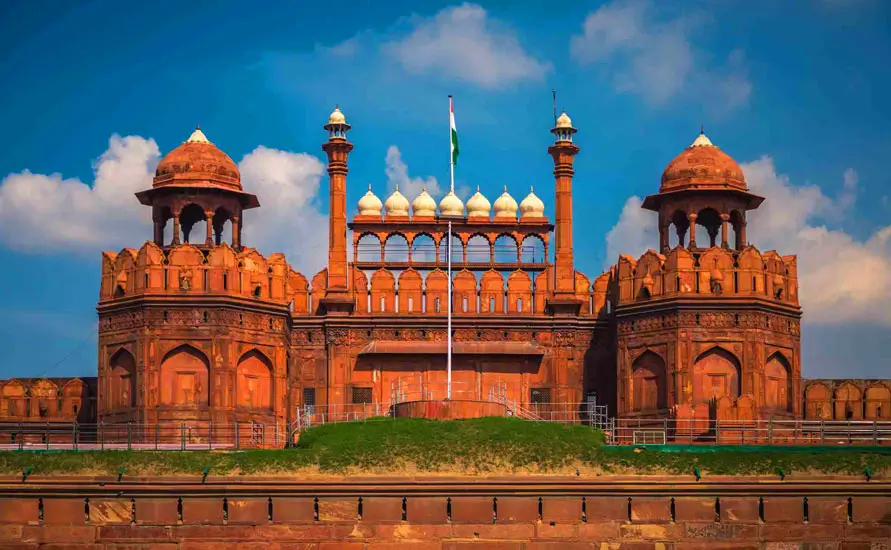 Kerala Backwaters Escape
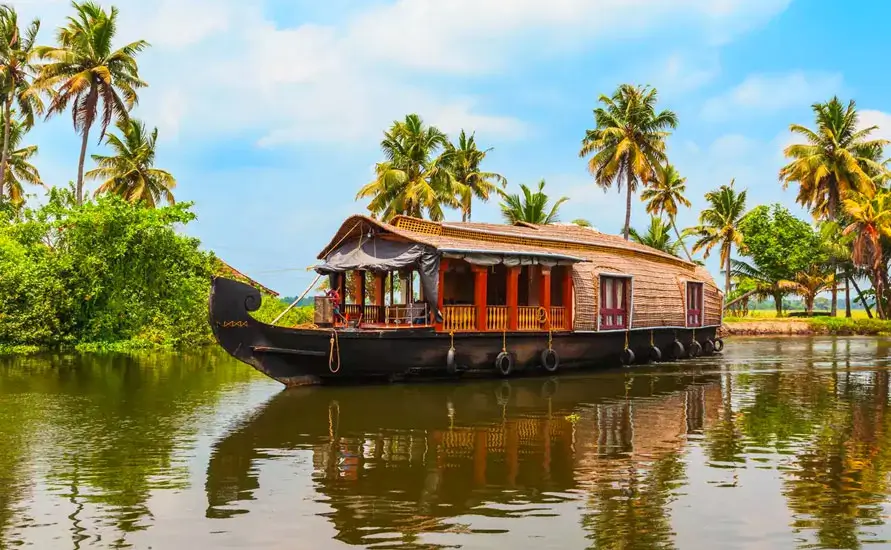 Kerala Backwaters Escape
 Kerala Backwaters Escape
 Kerala Backwaters Escape
 Kerala Backwaters Escape
 Kerala Backwaters Escape
 Kerala Backwaters Escape
 Kerala Backwaters Escape
 Kerala Backwaters Escape
 Kerala Backwaters Escape