 Kerala Backwaters Escape
Golden Triangle Tour With South India
Delhi – Agra – Jaipur – Chennai – Mahabalipuram – Pondicherry
At a glance
Think of this trip as a lesson in masonry. Our Golden Triangle with Pondicherry follows India's builders from the red sandstone of Mughal Delhi and the inlaid white marble of Agra to the rose-washed walls of Jaipur, then flies south to the granite reliefs that Pallava carvers cut into the shore at Mahabalipuram some thirteen centuries ago. The last stop, Pondicherry, adds lime-plastered French villas and a seafront promenade. Few routes show how differently north and south India have shaped their cities, and our route fits the comparison into a nine-day Golden Triangle tour with South India.
The plan keeps road time reasonable. On the Yamuna Expressway, Agra sits less than four hours from Delhi, the Agra to Jaipur leg includes a long stop at Fatehpur Sikri, and a domestic flight from Jaipur to Chennai replaces what would otherwise be two days on the road. In each region you keep one private air-conditioned vehicle and a single English-speaking chauffeur who soon learns your habits, and licensed local guides lead the main visits in Delhi, Agra, Jaipur, Mahabalipuram and Pondicherry, so you spend your energy on the sights rather than on logistics.
This Delhi Agra Jaipur Pondicherry tour is written for visitors flying in from the US and Canada, Britain, continental Europe or Australia who want the classic north Indian highlights without missing the south, and for NRI parents whose kids, born overseas, have never seen either half of the country. The Taj Mahal is visited at sunrise and never on a Friday, when it is closed, and we reorder the Agra days if your dates require it. Between October and March the climate cooperates best, when the north stays dry and the Coromandel heat softens.
Most long-haul arrivals from the Americas and Europe land at Indira Gandhi International Airport around midnight or early morning, and our airport representative stands among the greeters outside Terminal 3, holding up a board with your family name in large letters. Your luggage goes in the trunk of a private, chilled sedan or SUV; allow forty-five minutes to central Delhi at night, double that at the evening peak. Standard check-in is at 2 pm, so if you are landing at dawn we suggest reserving your room from the previous night. A short briefing covers SIM cards, cash machines, tipping and how the next eight days are arranged.
Once you have slept, the afternoon starts gently with a drive through New Delhi, the capital designed by Edwin Lutyens and Herbert Baker in the 1910s and 1920s. Sandstone government buildings line Rajpath, now renamed Kartavya Path, and the avenue runs from the President's House down to India Gate, a memorial arch engraved with the names of soldiers of the British Indian Army killed in the 1914–1918 war. Your driver can pause for photographs, although stopping on the avenue itself is controlled. The broad lawns, ice cream carts and evening strollers give you a first, unhurried look at how locals spend a Delhi evening.
Dusk is a good hour for Gurdwara Bangla Sahib, Delhi's busiest Sikh shrine, with its gold dome reflected in a large holy tank. Everyone covers their head with a scarf, which is handed out free at the gate, and footwear goes into a free cloakroom before you rinse your feet in a shallow channel at the entrance. Behind the prayer hall sits the community kitchen, where volunteers cook and serve free meals to thousands of people every day, regardless of faith. Visitors are welcome to sit on the floor and share the simple dal and roti, or simply watch the rolling pins at work. Overnight in Delhi.
Historians count at least seven Delhis built on this plain, and today's guided tour reads that history in its building materials. You start in Old Delhi, the walled city Shah Jahan called Shahjahanabad, where the Red Fort raises its red sandstone ramparts; the fort shuts on Mondays. A few minutes away stands Jama Masjid, India's largest mosque, its 1650s courtyard framed in red sandstone striped with white marble. Visitors should dress modestly, and robes are available at the gate. Climbing the steps of the east gate gives a good view over the rooftops of the old city and its tangle of wires.
From the mosque a cycle-rickshaw carries you into the lanes around Chandni Chowk, where whole streets specialize in a single trade: wedding cards in one alley, silver in another, spices in Khari Baoli, one of Asia's largest wholesale spice markets. Your guide leads you up a staircase to a rooftop over the spice market for a view of sacks being hoisted by hand. Lunch can be at a long-running Mughlai restaurant near the mosque, known for slow-cooked mutton and fresh breads, or at a vegetarian place serving stuffed parathas. The noise and color of these lanes are part of the day, so wear comfortable shoes.
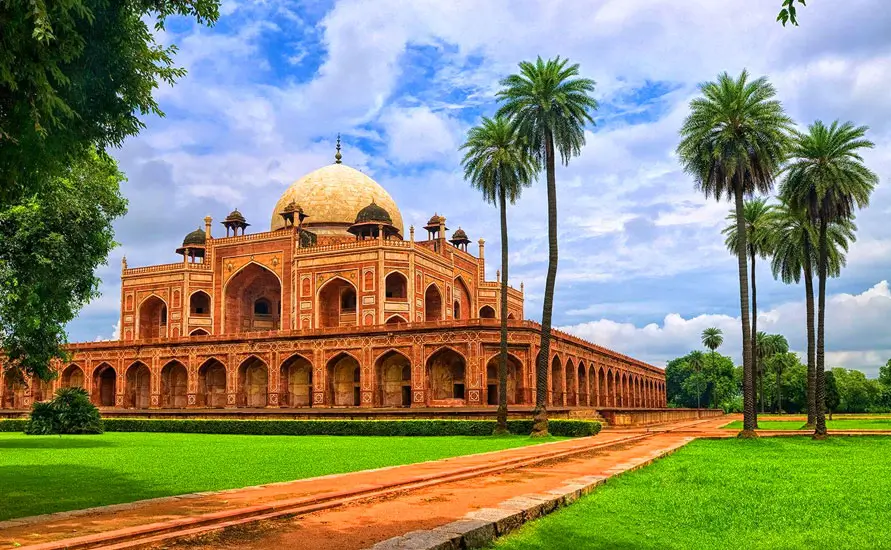
After lunch the car heads south to Humayun's Tomb, finished around 1570, which a Persian architect designed for Humayun, the second Mughal ruler, at the request of his senior widow. Its double dome, raised platform and four-part garden became the model that Agra's builders refined in the Taj Mahal, so seeing it first makes tomorrow's visits easier to understand. The day ends below the Qutub Minar, a fluted tower in alternating red and buff sandstone that was begun in 1193, rises about 73 meters and is wrapped in bands of Arabic calligraphy. In the same courtyard, an iron pillar cast over fifteen centuries ago still shows almost no rust, a puzzle metallurgists have studied for decades. Overnight in Delhi.
After breakfast you leave the capital on the Yamuna Expressway, the six-lane toll road that puts Agra roughly 3.5 to 4 hours away. The landscape flattens into wheat and mustard fields, brick kilns and small villages, and the driver stops at a clean highway café for coffee and restrooms. For travelers who prefer rails, the Gatimaan Express from Delhi's Hazrat Nizamuddin station covers the distance in under two hours and can be booked in place of the car, with the driver meeting you at Agra Cantonment. Hotel check-in is around midday, leaving time for lunch and a rest.
Agra Fort is your first visit, a crescent-shaped citadel on the Yamuna whose red sandstone walls stretch roughly 2.5 km. Akbar's engineers laid it out from 1565 for defense; two generations later Shah Jahan swapped some of the barracks for white marble halls. Your guide shows you the Jahangiri Mahal, with its Hindu-style brackets carved in stone, and the Diwan-i-Am, the pillared hall where ordinary subjects could bring their complaints to the throne. Most visitors fall quiet at the Musamman Burj, the eight-sided marble tower where Shah Jahan, deposed by his son Aurangzeb, lived out his final years with the Taj in view across a bend of the river.
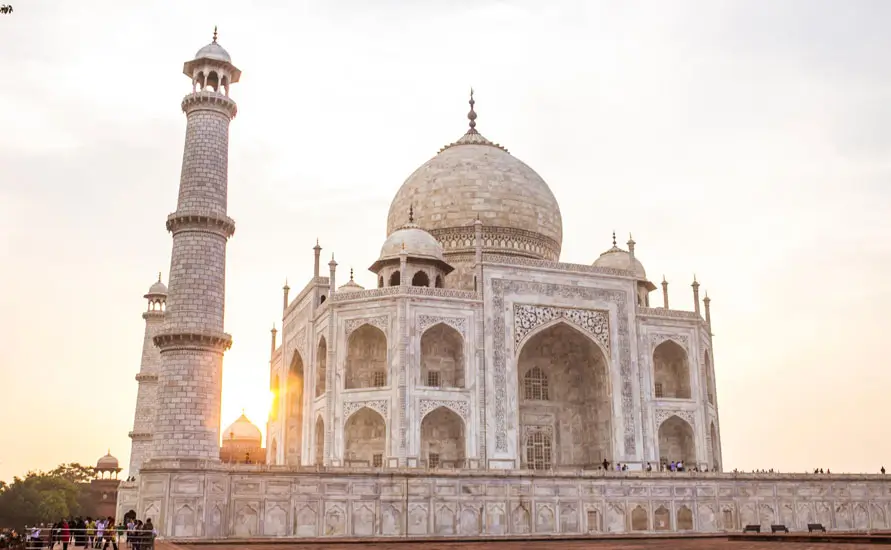
Late in the afternoon the car loops over a Yamuna bridge and stops at Mehtab Bagh, a Mughal pleasure garden lined up axially with the Taj on the opposite shore. From its riverside wall you see the mausoleum from the back, with no crowds in front of you, as the sun drops and the marble changes from white to soft orange. Ask your guide about the black marble twin that Shah Jahan supposedly intended for this bank; excavations here found only garden foundations, so most scholars treat it as legend. The Taj itself waits for tomorrow's sunrise, and if your Agra day turns out to be a Friday, when the monument is closed, we reorder the two days so the visit still happens. Overnight in Agra.
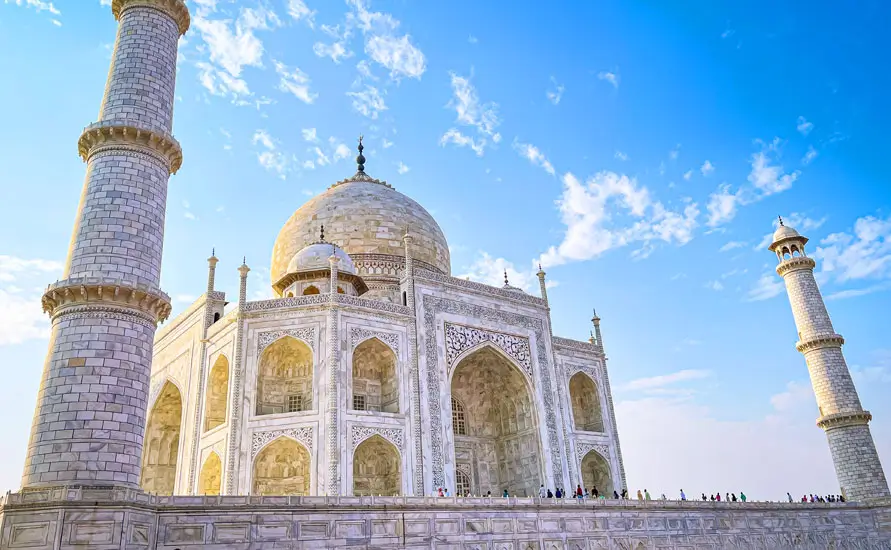
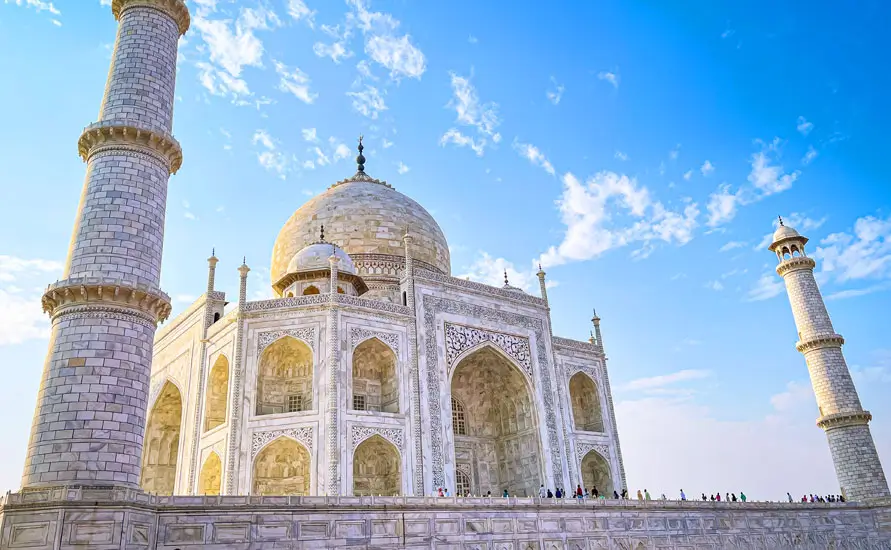
Your guide collects you before first light so you are at the gate when the Taj Mahal opens around sunrise, which is the calmest and coolest hour of the day. Carry only a phone, camera and a small purse; large bags, food and tripods must stay in the car, and battery buggies run the final stretch to the gate. Built between about 1632 and 1653 for Mumtaz Mahal, the tomb is faced with white Makrana marble set with flowers of carnelian, jade, lapis and other stones cut so precisely that the joins vanish. Ask your guide to shine a torch on the inlay; some stones glow from within. The four minarets lean slightly outward, a detail meant to protect the tomb if they ever fell.
Breakfast waits at the hotel when you return, then checkout and a 40 km run west to Fatehpur Sikri. Akbar raised this red sandstone capital during the 1570s in gratitude to Salim Chishti, a Sufi holy man whose prophecy of an heir came true, and left it roughly fifteen years later, probably because water ran short. Inside the palace zone you see the Diwan-i-Khas, whose lone central column flowers into a carved platform, the airy five-tiered Panch Mahal, and the paved Pachisi court, where tradition says living courtiers served as the game pieces. Inside the mosque compound, pilgrims knot red threads onto the pierced marble jali around the saint's tomb and make a wish.
From Fatehpur Sikri the highway continues into Rajasthan, and you still have some four hours of road to Jaipur, broken by lunch at a highway restaurant. If you have energy for one more stop, the Chand Baori stepwell at Abhaneri, with its thousands of narrow steps, can be added for roughly an extra hour. The countryside turns drier: camel carts on the shoulder, yellow mustard in the winter fields and the low Aravalli hills on the horizon. You roll into the city by evening; depending on the category you chose, you sleep the next two nights in an old haveli turned hotel or a modern property. Dinner is at leisure, and your driver will brief you on tomorrow's early start. Overnight in Jaipur.
An early drive of about 11 km brings you to Amber Fort, the hilltop residence of the Kachhwaha rulers before they founded Jaipur. Rather than riding an elephant up the ramp, you go up by jeep or walk the cobbled path, which takes about twenty minutes. Inside, the honey-colored courtyards rise in stages, from the public hall to the Sheesh Mahal, a hall inlaid with countless pieces of convex glass, so that one flame can make the ceiling look like a night sky. Your guide also points out the Ganesh Pol, a painted gateway, and the latticed windows through which the women of the court watched events below without being seen.
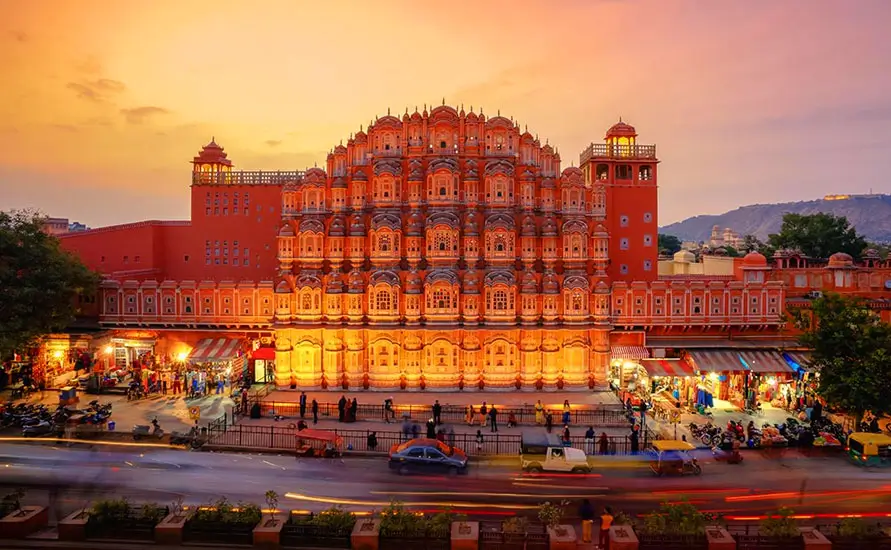
Heading back toward town, the driver pulls over for photographs of the Jal Mahal, a water palace afloat on Man Sagar, and then of the Hawa Mahal, the honeycomb façade of 1799 whose 953 little windows let ladies of the court follow festivals in the street below unseen. Jaipur was founded in 1727 by Sawai Jai Singh II as a planned grid city, and its bazaars were washed in terracotta pink in 1876, when the future King Edward VII came to visit. After lunch it is the turn of the City Palace, where the former royal family still occupies one wing and where you can see two huge silver jars made so a maharaja could take his own holy water to England for Edward VII's 1902 coronation.
Next door is Jantar Mantar, the UNESCO-listed observatory Jai Singh built in the 1720s and 1730s, and the reason Jai Singh is remembered as an astronomer as well as a king. Its instruments are built of stone and plaster at a giant scale, and the largest sundial throws a shadow that moves visibly, allowing local time to be read to within a couple of seconds. Your guide explains how the curved scales tracked stars and planets long before telescopes reached this region. The evening is free; your driver can drop you at Johari Bazaar for jewelry and textile stalls or at a rooftop restaurant facing the old city walls. Overnight in Jaipur.
Before leaving Rajasthan, a short morning stop is worth making if your flight time allows: the Panna Meena ka Kund, a small 17th-century stepwell near Amber whose criss-crossing staircases make a striking pattern in the early light. Then comes an hour-long ride to the airport at Sanganer and your southbound flight to Chennai. Nonstop flights take roughly two and a half hours, while one-stop connections through Delhi or Mumbai take longer, and we choose the best timing for your dates. Below the wing, the dry plains of the north give way to the green deltas and red soil of the south, and the temperature rises noticeably when the doors open in Chennai.
Our Tamil Nadu team meets you at Chennai International Airport and heads down the East Coast Road; Mahabalipuram is roughly 90 minutes away. The road runs between the sea and the Buckingham Canal, past casuarina plantations, prawn farms and new beach villas on the city's edge. Language, script and food all change with the region: signs are now in Tamil, the coffee is filtered and served in steel tumblers, and lunch is likely to be rice with sambar, rasam and curd. Ask for a halt at one of the coconut vendors, who will lop the top off a green nut with a machete so you can drink it straight.
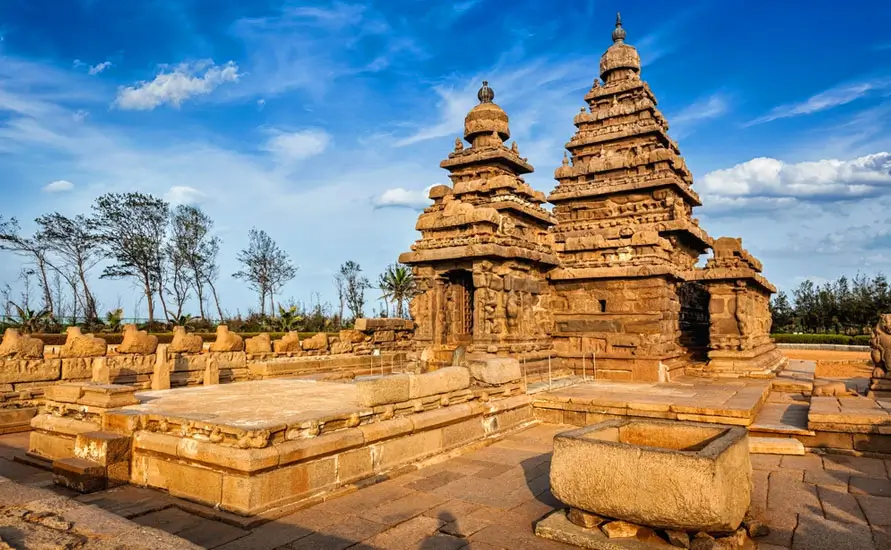
You check in to a beach hotel by late afternoon, and the sea air makes a welcome change after the dust of the north. Toward sunset, walk to the lighthouse and the rock-cut Mahishasuramardini cave beside it, where one wall panel captures Durga, astride her lion, mid-fight with the buffalo-headed Mahishasura. From the hilltop you look down over the town, the catamaran-style fishing boats beached in rows and the Shore Temple at the water's edge, which you will visit in the morning. Dinner can be fresh seafood, grilled to order in a family-run kitchen close to the sand. Overnight in Mahabalipuram.
In the Golden Triangle you saw stone shaped for emperors; this morning you see stone carved straight from the living rock. The port of Mahabalipuram was at its peak while Pallava kings ruled from Kanchipuram, roughly the 7th and 8th centuries, and UNESCO lists its monuments as a World Heritage site. First comes the Shore Temple, commissioned by King Rajasimha in about the early 700s, its two towers worn smooth by salt spray. The Pancha Rathas follow, five shrines carved from a single whaleback of granite, left unfinished and never consecrated, where you can compare early southern temple shapes side by side, from a thatched-hut roof to a stepped pyramid.
Two giant boulders carry the open-air relief called Arjuna's Penance, which some scholars read instead as the Ganges coming down to earth, and your guide will help you find the small details: a skinny cat balancing on one leg and pretending to pray while mice frolic around it, and a pair of elephants with their young. Above it all sits Krishna's Butterball, a round boulder balanced on a slope that seems to defy gravity. Before leaving town you visit a workshop where sculptors still shape granite gods with chisel and mallet, following rules of proportion passed down through families; several younger carvers also hold diplomas from Mahabalipuram's sculpture college, which the Tamil Nadu government has run for decades. Pieces can be shipped home if you buy.
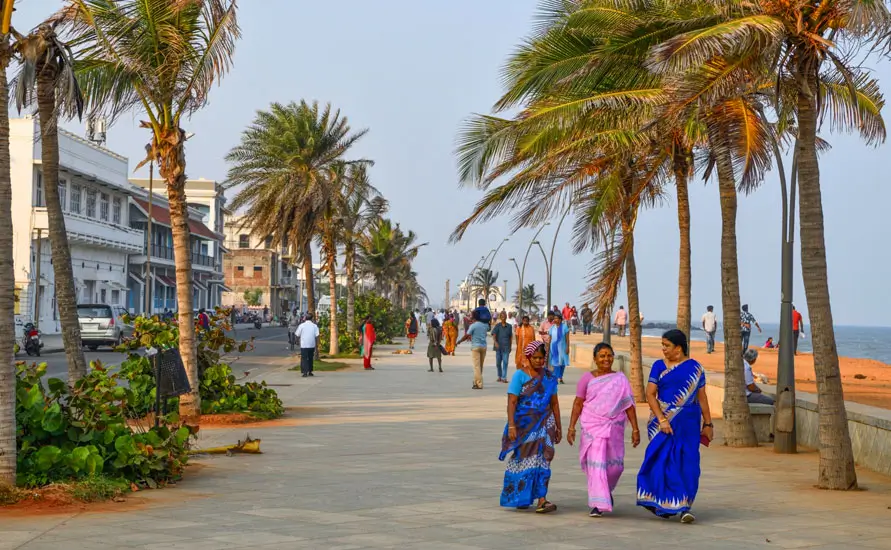
Lunch done, the car keeps to the coast road for some 2.5 hours, passing salt pans, fishing villages and the estuary at Marakkanam. You pull into Pondicherry by mid-afternoon; the room is in a restored heritage house or a small boutique property near the old town. France governed Pondicherry until 1954, and street signs still read rue in French beside their Tamil names. In the evening, join the locals on Goubert Avenue, the seafront promenade that closes to cars at dusk, where families stroll between the old lighthouse, a tall Gandhi statue and the war memorial while vendors sell roasted peanuts. Overnight in Pondicherry.
Colonial Pondicherry was split by a canal, now mostly a drainage channel, and this morning's guided walk crosses it both ways. On the seaward side lies the Pondicherry French Quarter (locals say White Town), where tall lime-plastered houses with green shutters and arched gateways line quiet streets named after French governors. You pass the Lycée Français, the consulate of France and the Notre Dame des Anges church facing the sea. Crossing the canal into the Tamil Quarter, the architecture changes: houses have raised street-side porches known as thinnai, where neighbors once sat to talk, along with carved teak doors and terracotta tile roofs, built for merchants and their families, and many have been restored with help from the local heritage trust.
Next is the Sri Aurobindo Ashram; inside the courtyard, people sit wordlessly beside the samadhi where Sri Aurobindo and the Mother are buried, its marble top hidden under a new design of petals every morning, and cameras must stay put away. A few streets off, the Manakula Vinayagar Temple to Ganesha predates the French town and has painted ceiling panels showing the god in many different forms. Before lunch, stop at a café on rue Romain Rolland or at a bakery selling croissants and baguettes, or choose a Tamil thali served on a banana leaf. Ask your guide where to find the handmade paper and incense from the ashram's own workshops.
Auroville lies about 12 km north, and you go there after lunch; founded in 1968, the township now houses residents of over fifty nationalities. The visitor center screens a brief introductory film, and from there a woodland trail leads to a lookout facing the Matrimandir, a gold-plated sphere marking the center of the township. Access to the meditation chamber inside is by prior booking only and daily places are few, so raise it when we plan your dates if it interests you. Back in town, your final evening could be a farewell dinner of Franco-Tamil cooking, perhaps a coconut prawn curry served with crusty bread. Overnight in Pondicherry.
After a last breakfast by the sea, the final drive goes north to Chennai International Airport, roughly 150 km and 3.5 hours along the coast and through the city's southern suburbs. We set the pickup by counting back from your flight time, giving at least three hours at the terminal and extra slack for weekday traffic. Late-night flyers have time for a stroll on the Promenade or one more coffee in White Town, and a day room at an airport-area hotel can be arranged at extra cost. We remain reachable by phone right up to check-in.
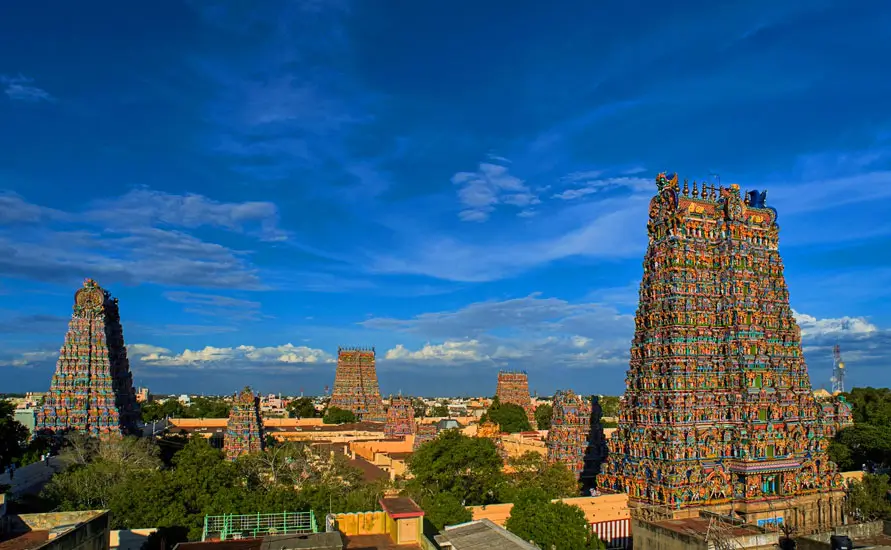
Over nine days you have followed Indian stonework from Mughal marble and sandstone in the north to Pallava granite and French plaster on the southern coast, a contrast few first trips manage to include. From Chennai, nonstop and one-stop services through the Gulf, Europe and Singapore link to North America and Australia. When Kerala's backwaters, Madurai's temple towers or the tea hills of Munnar start calling, tell us, and we will shape a second trip around your dates and pace. Until then, have a smooth flight home.
Your Journey
N.S. Rathore & Mrs. Omlata Rathore · Managing Director
We still read every enquiry ourselves. Tell us the places you liked and our planners will send a day-by-day route with drive times and a clear price.
No ready-made packages and no pressure to book. A planner from our Kochi office replies within 24 hours with a route written for your group.
Fill this in and your planner will send a first draft itinerary.
Explore more
Kerala Backwaters Escape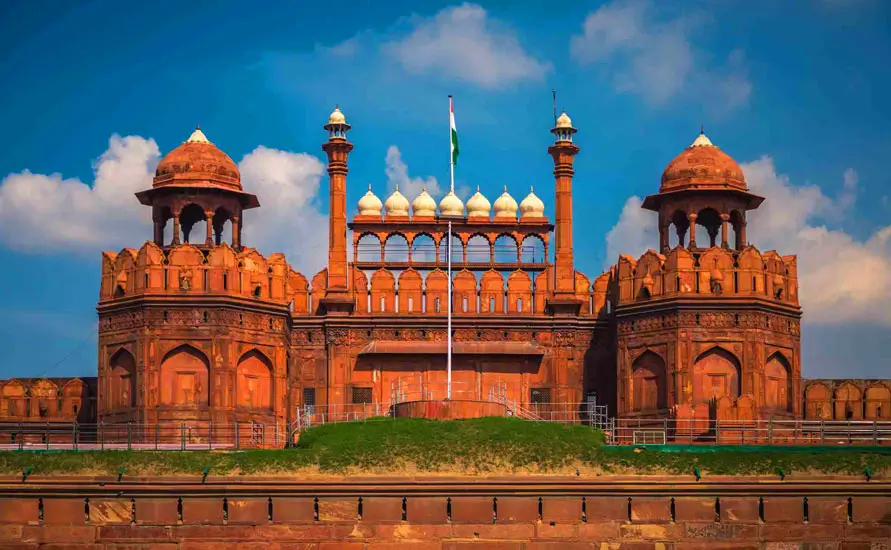 Kerala Backwaters Escape
 Kerala Backwaters Escape
 Kerala Backwaters Escape
 Kerala Backwaters Escape
 Kerala Backwaters Escape
 Kerala Backwaters Escape
 Kerala Backwaters Escape
 Kerala Backwaters Escape