 Kerala Backwaters Escape
Golden Triangle Tour With South India
Delhi – Agra – Fatehpur Sikri – Jaipur – Bangalore – Srirangapatna – Mysore – Somnathpur – Hampi
At a glance
Four royal capitals, two halves of India and one easy loop: the Golden Triangle with Hampi and Mysore pairs the Mughal and Rajput north with the Deccan kingdoms of Karnataka. Delhi, Agra and Jaipur show you how emperors in marble and red sandstone ruled the plains. A short flight south then lands you among the Wodeyar palaces of Mysore and the rust-colored boulder hills around Hampi, where the Vijayanagara kings once held court. Put side by side, the two regions turn a Golden Triangle tour with South India into a vivid lesson in how power was built in stone.
Pacing was planned around comfort. The longest road day is the five-hour run from Agra to Jaipur with a stop at Fatehpur Sikri, the hop from Jaipur to Bangalore is a domestic flight, and the long gap between Mysore and Hampi is covered by an overnight train, so you wake up near the ruins instead of losing a day in the car. You stay two nights in Delhi, Jaipur, Mysore and Hampi, and at every stage your own cooled sedan or SUV, and a driver fluent in English, is parked and ready.
Couples, friends and families who fly over from the States, Canada, Britain, Europe or Australia use this route as a first trip to India, and NRI travelers often pick it to show relatives the south beyond the beaches. The Golden Triangle with Hampi and Mysore works best from October to March, when Hampi's granite landscape is cool enough for walking. Hotel category, pace and extra nights can all be adjusted, and Friday closures at the Taj Mahal are built into the plan.
Touching down at Indira Gandhi International Airport, you clear immigration, collect your bags and walk out to a waiting member of our team, whose placard shows your surname. The drive to your hotel takes between forty minutes and an hour depending on traffic, and during it you are handed a printed twelve-day plan, pointers for getting a prepaid Indian SIM and an emergency number answered day and night. If you arrived on an overnight flight from North America or Europe, nothing at all is planned before mid-afternoon, so the jet lag can win for a few hours. Early check-in is not guaranteed by Indian hotels, so a bed ready at dawn means booking the room for the night before, which we are happy to arrange.
Around four o'clock your guide turns up for a relaxed opening tour of New Delhi, the grand imperial district whose plan came from the drawing boards of Edwin Lutyens and Herbert Baker. You drive past the sandstone domes of Rashtrapati Bhavan, the President's residence, and the curved colonnades of the Parliament district, then stop at India Gate, a war memorial arch carrying the names of more than 13,000 soldiers. In the early evening the lawns fill with local families eating ice cream and children chasing balloons, which gives you an easy look at ordinary Delhi life before the bigger days ahead.
Evening ends at Gurdwara Bangla Sahib, a Sikh shrine with a golden dome and a large sacred pool that draws worshippers from across the city. Visitors of every faith are welcome; you leave shoes at the counter, wash your feet and cover your head with a scarf, which is supplied free at the entrance. Inside, hymns from the holy book are sung without pause, and next door the community kitchen serves a free vegetarian meal to thousands of people a day, cooked by volunteers in huge pots. Your guide can take you into the kitchen to see the bread being rolled by hand. Dinner is at leisure near your hotel. Overnight in Delhi.
Historians count at least seven cities built on the plain of Delhi, and today your guide traces several of them in chronological reverse. The morning begins in Shahjahanabad, the walled city Shah Jahan founded in the 1640s after he moved his court from Agra. Sitting behind a pedaling rickshaw driver, you weave along Chandni Chowk, where silver merchants, wedding-card printers and sweet shops share lanes barely wider than the rickshaw itself. The ride ends at Jama Masjid, the largest mosque of the Mughal era, whose courtyard can hold around 25,000 worshippers. Modest dress is required, and the mosque keeps loose robes by the entrance for anyone in shorts.
From the mosque steps you can see the long red walls of the Red Fort, the palace complex from which the Mughals ruled until 1857; on Mondays it stays shut, and we simply admire the walls and Lahori Gate from the road. After lunch the drive south brings you to Humayun's Tomb, which the widow of Akbar's father commissioned in the 1560s. Its double dome, charbagh garden and red-and-white stone facing inspired the builders of the Taj Mahal, so walking around it today gives you a useful key for tomorrow. Your guide points out the Persian and Indian building traditions that meet in its design.
The day closes at the oldest of the seven cities, the Qutub Minar complex, begun in the 1190s by Qutb-ud-din Aibak after the first Delhi Sultanate was established. The fluted minaret rises 73 meters in five stories of sandstone and marble, decorated with bands of Quranic calligraphy. In the same courtyard rises a Gupta-era iron pillar, roughly sixteen centuries old, whose surface shows almost no corrosion even now. Late afternoon light is soft here, and the lawns are a calm place to sit before you head back through the evening traffic. Overnight in Delhi.
Breakfast is early, and by about eight your car joins the Yamuna Expressway, the fast toll highway that links the capital with Agra in somewhere between three and a half and four hours. There are clean rest stops along the way with coffee and restrooms. Your driver aims to reach Agra by late morning, check you into your hotel and give you time for lunch. A quick word on planning: the Taj Mahal closes every Friday for prayers, so we always set your Agra dates to put the sunrise visit on another day; when the calendar puts your Agra day on a Friday, we reorder things and keep the mausoleum for Saturday's dawn.
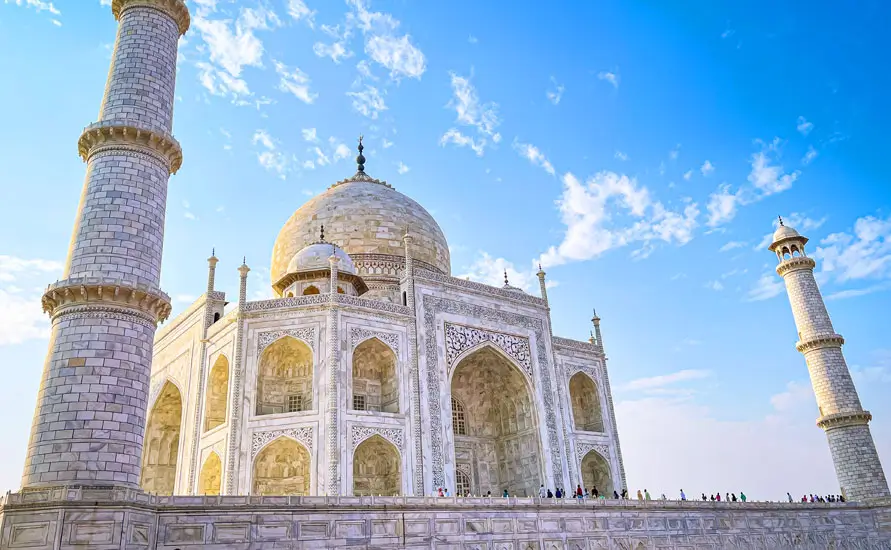
After lunch a local historian-guide takes you inside Agra Fort, a UNESCO site that was the main Mughal residence before Delhi took over. Akbar built its walls of red sandstone in the 1560s, and his grandson Shah Jahan added the white marble halls inside. Many visitors find the Musamman Burj the saddest spot: in this eight-sided marble pavilion, the aging Shah Jahan was kept under guard for eight years, held there by Aurangzeb, with Mumtaz Mahal's resting place in sight across the bend of the river. On a clear day you see the Taj from the same window he did.
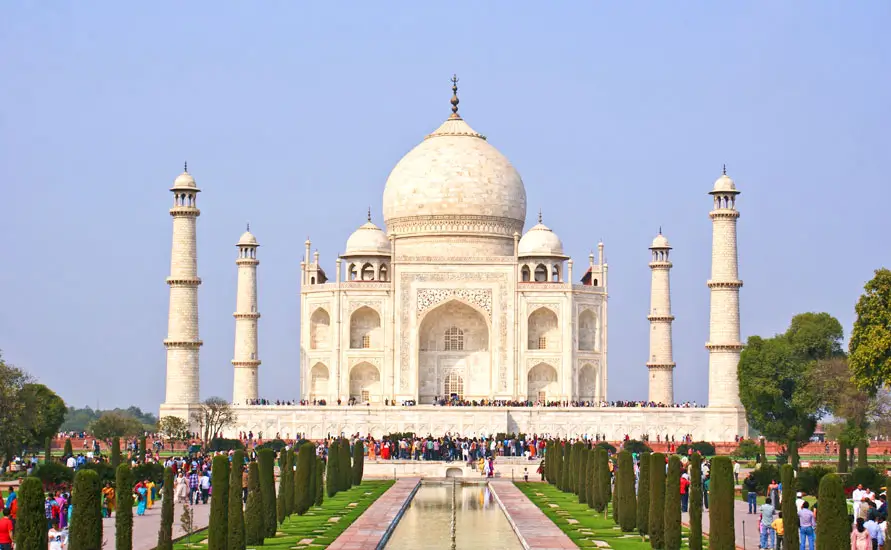
Toward sunset your driver takes the bridge over the Yamuna to Mehtab Bagh, a replanted Mughal garden whose central axis lines up with the Taj Mahal on the opposite shore. Few tour groups come here, and from its riverside wall the mausoleum rises above the water with no crowd in front of it. Your guide explains the theory that Shah Jahan planned a second, black tomb on this side, and why most historians now doubt it. As the light fades the marble turns pink, then gray, and the call to prayer drifts across the Yamuna. Dinner tonight can be Mughlai cooking at a local restaurant your guide trusts. Overnight in Agra.
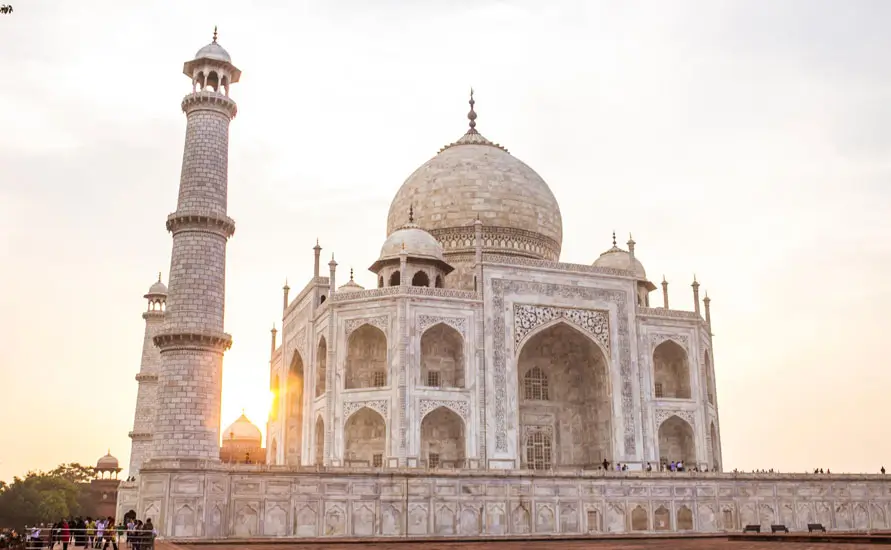
An alarm before dawn is the price of the best hour at the Taj Mahal, and it is worth paying. The gates open around sunrise, and you pass under the great red sandstone gateway at the very moment the first light touches the dome. In the cool air before the crowds, you can follow how the black marble lettering around each arch widens as it climbs, an optical trick that keeps it even to the eye, and the inlaid flowers of carnelian, jade and lapis set into the marble. Shoe covers are given out at the plinth, and security staff turn back food, tripods and big backpacks at the entry.
Breakfast and check-out follow at the hotel, then head west toward Rajasthan. After about an hour you reach Fatehpur Sikri, the city Akbar built in the 1570s after a Sufi holy man promised the childless emperor an heir. Within about fifteen years the court had left again, probably for lack of reliable water, so the courtyards stand empty but remarkably intact. Your guide shows you the Panch Mahal pavilion, the Diwan-i-Khas, whose ceiling rests on one carved lotus-topped pillar, and the white marble tomb of Sheikh Salim Chishti, where visitors still tie threads to the screens.
The road continues through mustard and millet country into Rajasthan, with camel carts sharing the highway near Bharatpur and Dausa. Roughly four hours after Fatehpur Sikri you roll into Jaipur as the light goes golden, and check into a heritage or modern hotel depending on your choice. Tonight stays open: wander the shops near your hotel if you feel lively, or sit by the pool if the road has tired you. The Pink City takes its color from the terracotta wash ordered in 1876 when Albert Edward, later Edward VII, came to town, and the tradition is still enforced by law. Overnight in Jaipur.
Amber was the Kachwaha capital for six centuries before Jaipur existed, and that is where your morning begins, eleven kilometers north of the city. You go up to Amber Fort by jeep or on foot along the ramparts, never by elephant. The fort climbs a ridge above Maota Lake in tiers of yellow sandstone and marble, and the inner courtyards lead to the Sheesh Mahal, whose walls and ceiling carry thousands of tiny convex mirrors that once glittered in the light of a single candle. From the upper terraces the old defensive walls snake away across the Aravalli hills for miles.
Driving back toward the city the car pulls over beside Man Sagar Lake for photos of the half-submerged Jal Mahal, then carries on into the walled old town. Sawai Jai Singh II, who founded Jaipur in 1727, was a keen astronomer, and his observatory, the Jantar Mantar, is now a UNESCO site. Nineteen giant instruments of stone and brass fill the yard, and the tallest, the Samrat Yantra, casts a shadow that moves visibly across its scale minute by minute. Next door stands the City Palace; members of the former ruling family still occupy the seven-story Chandra Mahal while visitors tour the armory, textile gallery and the courtyard of four painted gates.
Save the honeycomb front of Hawa Mahal for late afternoon, the Palace of Winds, when the sun turns its pink stone a deeper shade. The building is only one room deep in places; its 953 small windows let the women of the court watch street processions without being seen. After that, your guide can walk with you through Johari Bazaar for jewelry and Bapu Bazaar for printed cotton and embroidered camel-leather juttis, explaining fair prices and how to bargain politely. Dinner is free tonight, and Rajasthani thalis are easy to find. Overnight in Jaipur.
Your last Rajasthan morning takes you up the ridge to Nahargarh Fort, the Tiger Fort, which Sawai Jai Singh II raised in 1734 to guard his new city. Fewer visitors come up here early, and the walk along the outer walls gives the widest view of the Pink City's grid of streets laid out according to ancient planning texts. Inside, a palace wing holds nine identical apartments built for the queens of Maharaja Madho Singh II, all linked by corridors so the king could visit any of them unseen. Coffee at the small cafe on the walls is a pleasant way to end the visit before you head down for a late breakfast.
By midday you are at Sanganer, Jaipur's airport, checking in for the nonstop flight to Bangalore, which takes a little over two and a half hours. Economy seats carry a standard checked-bag allowance; we will tell you the limit for your airline in advance so there are no surprises at the counter. From the air the landscape changes from the dry, brown Rajasthan plain to the green, rock-studded Deccan plateau. In Bangalore a new driver, who stays with you across Karnataka, waits at the arrivals exit and covers the hour-long run into town, a trip that can stretch longer in evening rush hour.
At roughly 900 meters of altitude, Bangalore usually feels fresher after dark than Jaipur, and the city is known across India for its tech campuses, craft breweries and South Indian breakfast cafes. After check-in your evening is free, and your driver can suggest a nearby place for dosas and filter coffee, or a rooftop for local craft beer if you prefer. We keep tonight light on purpose: tomorrow brings a scenic drive and several stops on the way to Mysore, and a calm evening after the flight helps you start the southern half of the trip rested. Overnight in Bangalore.
Leaving Bangalore after breakfast, you drive southwest on the Mysore highway, a road running past paddy, coconut palms and small towns famous for their roadside idlis and coconut sweets. About 125 km down the highway, the road bridges an arm of the Kaveri and enters Srirangapatna, an island town that served Hyder Ali and later Tipu Sultan as their fortified capital in the late 1700s. Tipu resisted the East India Company through four Anglo-Mysore wars, and his death at the breach of the fort walls in 1799 opened South India to British rule. Your guide shows you the spot by the old gate where he fell.
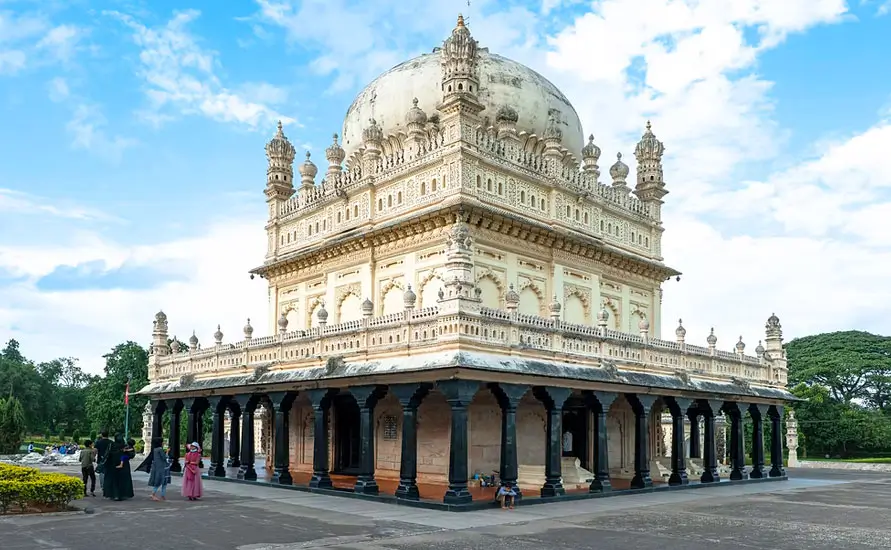
Best of all is Daria Daulat Bagh, a modest teak building where the Tiger of Mysore escaped the summer heat, set in a formal garden. Every surface of its veranda is painted with murals, including a large battle scene recording the defeat of Colonel Baillie's British force in 1780, with soldiers, cavalry and elephants in remarkable detail. A small museum inside displays his clothes, coins and maps. Nearby stand the Gumbaz, the white domed tomb of Tipu and his parents, and the Ranganatha temple that gave the island its name, among the oldest Vishnu shrines in this part of the Kaveri valley.
A short drive of about thirty minutes brings you into Mysore, seat of the Wodeyar dynasty, which held the throne here for over five hundred years. The city is known for its wide avenues, yoga schools and sandalwood products, and it is far more relaxed than Bangalore. After check-in you can take a late afternoon stroll through the old town or rest at the hotel. On a Sunday, you can head to the palace forecourt after dark, when nearly 100,000 bulbs light the facade for about forty-five minutes. Overnight in Mysore.
Cool morning air makes this the ideal hour for the winding road up Chamundi Hill, a granite outcrop on the southeastern edge of town. On the summit, the Chamundeshwari Temple honors the family deity of the Wodeyar rulers, and its seven-story gopuram is visible from much of Mysore. Halfway down, the car stops beside a five-meter Nandi, Shiva's bull, cut out of one boulder in the 1650s and draped with fresh marigolds by pilgrims each day. Some travelers like to walk down the thousand-odd stone steps, a route lined with small shrines, while the car waits at the bottom.
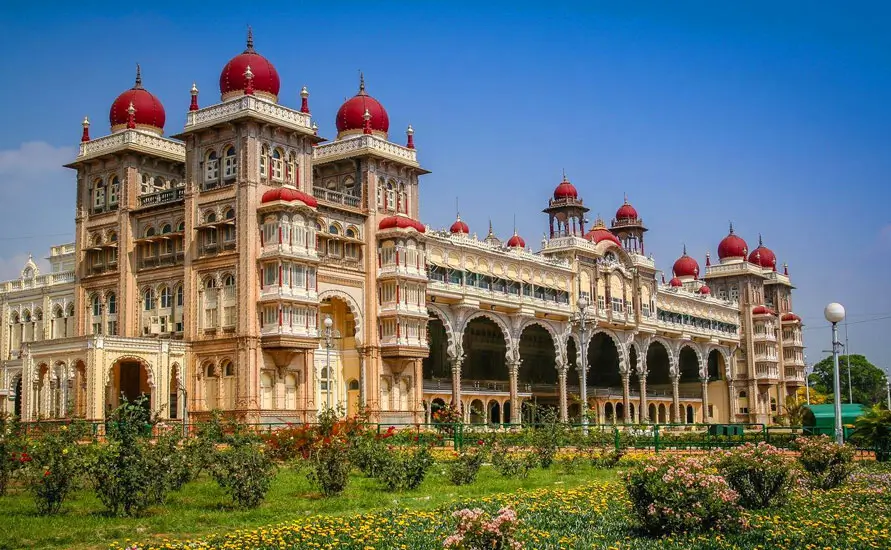
Late morning belongs to Mysore Palace, the Wodeyar family seat, rebuilt in its current Indo-Saracenic style after a fire in 1897. Shoes go in a free locker before you enter, and photography is restricted in some parts of the interior, so your guide steers you to the details worth seeing up close: the peacock mosaic underfoot in the octagonal wedding hall, the stained glass imported from Glasgow, and long painted panels of the city's famous Dasara procession. The palace remains the centerpiece of the ten-day Dasara festival each autumn, when the decorated idol of the goddess is carried through the streets.
After lunch you plunge into Devaraja Market, a roofed bazaar first set up under Chamaraja Wodeyar that remains the liveliest corner of Mysore. Stalls are piled with jasmine garlands, betel leaves, bananas of a dozen varieties and cones of colored kumkum powder used in worship. Nearby you can stop at St. Philomena's Church, whose twin Gothic spires rise above the rooftops and recall Cologne. Before dinner you also have time to visit a government emporium for genuine Mysore silk and sandalwood, both protected by geographical indication labels. Overnight in Mysore.
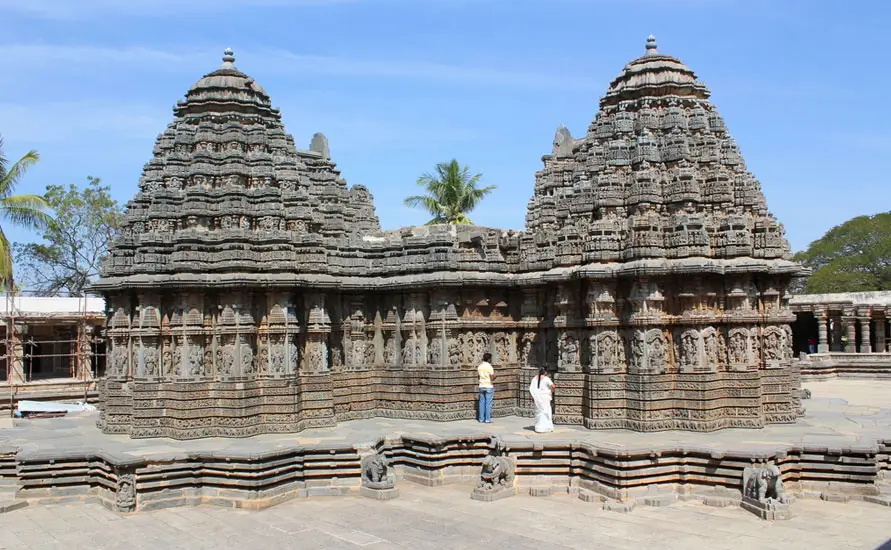
A drive of about one hour east of Mysore takes you through quiet farming villages to Somnathpur, a small hamlet home to the Chennakeshava Temple, raised in 1268 by Somanatha, a dandanayaka or army chief under King Narasimha III. Since 2023 it has been on UNESCO's list together with the better-known shrines of Belur and Halebidu. Its three shrines rise from a star-shaped plinth, and horizontal bands of carving wrap the walls: a row of elephants at the bottom, then cavalry, then curling foliage, then epic scenes, all in a soft green schist that hardens on contact with air. The craftsmen even signed some of the panels.
The temple is no longer in active worship, so you can walk around the inner sanctums and study the carved ceilings, each one shaped like an opening lotus bud. Your guide explains how Hoysala carvers worked the stone while it was still soft from the quarry. After lunch back in Mysore, the afternoon is free to rest, pack or tour the government-owned silk factory on Mananthavadi Road, where jacquard looms turn out the city's famous saris. Many hotels allow a late check-out for a fee, and we can reserve one in advance so you have a room until it is time to leave.
In the evening your driver takes you to the railway station to board the overnight Hampi Express toward Hosapete, the nearest railhead to Hampi. We book a private or shared cabin in an air-conditioned sleeper class, with fresh bedding supplied by the railway, and your driver helps you find the right coach and berth. Indian sleeper trains are a memorable part of the trip for many visitors: chai sellers walk the corridor until late, and passengers settle into their bunks soon after dinner. The train reaches Hosapete early the next morning. Overnight on the train.
Our Hampi driver meets you on the platform at Hosapete and drives you about thirty minutes to your hotel, where a room is held for you from dawn so you can shower, sleep for a while and have breakfast. The approach road gives you your first sight of the strange landscape that made Hampi famous: hills of giant granite boulders balanced on one another, banana plantations, and sugarcane fields cut by irrigation channels. Between the 14th and 16th centuries this was Vijayanagara, the capital of a Hindu empire that controlled most of South India and traded spices and horses with Persia and Portugal.
After lunch the guided walk starts at the Virupaksha Temple, which has never stopped its daily puja, not even after the city fell. Its 50-meter eastern gopuram towers over the old bazaar street, and inside there is a small dark chamber in which a narrow slit acts like a camera lens, casting the gopuram upside down on the stone. Outside, the long colonnaded Hampi Bazaar once held merchants selling pearls, silks and precious stones, according to the accounts of Portuguese visitors. Today it is a quiet street with a few village homes, and in the mornings the temple's devotees bathe at the river ghats nearby.
Toward evening you climb the low granite slopes of Hemakuta Hill, dotted with small temples older than the empire itself. The rock is easy to walk on in good shoes, and the summit view takes in the Virupaksha gopuram, the Tungabhadra River and boulder hills in every direction. As the sun sets, the stone turns copper and gold, and local families come up to watch with you. Your guide explains how the empire fell in 1565, when the combined armies of the Deccan sultans won the battle near Talikota and sacked the city for months. Overnight in Hampi.
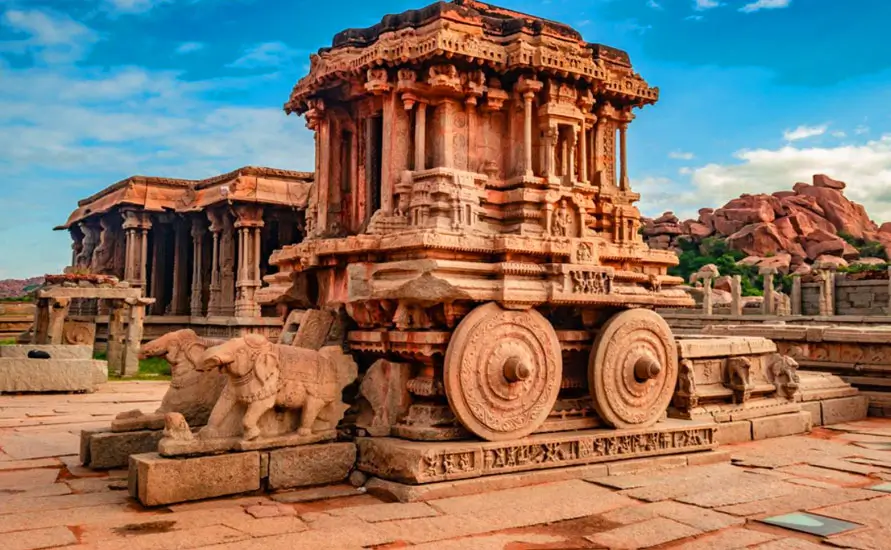
Starting early is the key to a good day at Hampi, because by noon the granite gives off real heat. First comes the Vittala Temple, the showpiece of Vijayanagara craftsmanship, begun in the 15th century and enlarged by Krishnadevaraya. In front of it sits the stone chariot, a small Garuda shrine built in the form of a festival car, the image you will spot on the back of the 50-rupee note. The main hall has slender pillars that hum with different tones when struck; striking them is now forbidden to save the stone, though the science behind the sound is part of the commentary. Battery buggies run between the car park and the temple, about a kilometer apart.
Late morning moves to the Royal Enclosure, the administrative heart of the old capital. Its centerpiece is the Mahanavami Dibba, a carved stone stage from which the kings watched festival parades, and a stepped tank built from neatly fitted green chlorite blocks. Nearby, the Lotus Mahal shows how Islamic arches were blended into Hindu palace design, while eleven domed chambers in a row, the Elephant Stables, housed the state elephants. The Queen's Bath, a plain building outside with a richly decorated pool inside, gives a glimpse of court life. For lunch, a simple village restaurant serves North Karnataka food like jolada rotti, a flatbread of sorghum.
Later you may stay by the pool with a book, or go on an optional trip in a coracle, the circular woven-bamboo boat used here for centuries, guided by a local boatman on a calm stretch of the Tungabhadra. Boats float past riverside shrines and rock carvings that walkers rarely get close to, and kingfishers often perch on the boulders. When the river runs high after the monsoon, the authorities can stop coracle trips for safety. Your final evening is free for dinner and packing, and the hotel can usually arrange a simple thali by lantern light if you ask in the morning. Overnight in Hampi.
Once breakfast is done, the car is loaded for the road to the airport at Hubballi, about three and a half hours west across the Deccan farmland. From Hubballi there are domestic flights to Bangalore, Delhi and Mumbai, for the long-haul leg home, and the departure hour is set so you are never rushing at the counter. If the small airport at Toranagallu near Hampi has a suitable flight on your date, we use it instead to save time on the road.
For a late-night long-haul departure out of Bangalore, we can hold a day-use room near the runway, or simply add one more night in town. Someone from our office is reachable on the phone right up to boarding. We hope the contrast between the Mughal and Rajput courts of the north and the Wodeyar and Vijayanagara capitals of Karnataka gives you a fuller picture of India's history, and that you return one day for the backwaters of Kerala or the temples of Tamil Nadu.
Your Journey
N.S. Rathore & Mrs. Omlata Rathore · Managing Director
We still read every enquiry ourselves. Tell us the places you liked and our planners will send a day-by-day route with drive times and a clear price.
No ready-made packages and no pressure to book. A planner from our Kochi office replies within 24 hours with a route written for your group.
Fill this in and your planner will send a first draft itinerary.
Explore more
Kerala Backwaters Escape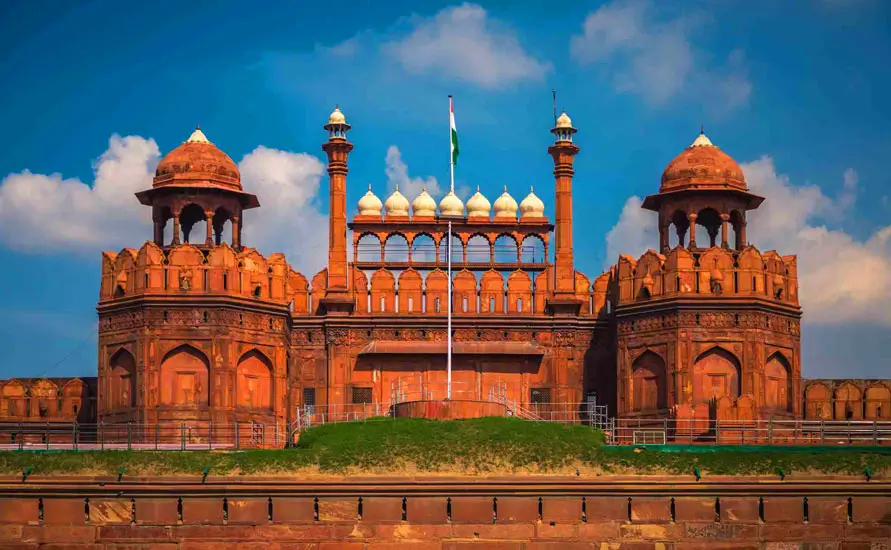 Kerala Backwaters Escape
 Kerala Backwaters Escape
 Kerala Backwaters Escape
 Kerala Backwaters Escape
 Kerala Backwaters Escape
 Kerala Backwaters Escape
 Kerala Backwaters Escape
 Kerala Backwaters Escape
 Kerala Backwaters Escape
 Kerala Backwaters Escape
 Kerala Backwaters Escape
 Kerala Backwaters Escape
 Kerala Backwaters Escape
 Kerala Backwaters Escape
 Kerala Backwaters Escape
 Kerala Backwaters Escape