 Kerala Backwaters Escape
Golden Triangle Tour With South India
Delhi – Agra – Fatehpur Sikri – Chennai – Mahabalipuram – Kochi – Alleppey
At a glance
Marble, granite and water give this trip its three chapters. Our Taj Mahal with Mahabalipuram and Kerala tour skips Jaipur on purpose, trading the usual Rajasthan leg for a slower pace in Agra and an extra coastline in the south. You begin with two nights in Delhi, then spend two more in Agra so the Taj Mahal can be seen at sunrise without any hurry. Flights then carry you to Tamil Nadu for the seventh-century rock carvings of Mahabalipuram, and on to Kerala for the old pepper port of Fort Kochi plus a night afloat on the Alleppey backwaters.
Why leave out the Pink City? Many travelers who write to us have only ten days and would rather add the south than squeeze in a third northern city with another five-hour drive. Removing Jaipur frees a full day for Fatehpur Sikri and the quieter Agra monuments, and it gives Mahabalipuram two nights instead of a rushed stop. Two domestic flights, Delhi to Chennai and Chennai to Kochi, replace long road transfers. This Taj Mahal and Kerala tour works well for foreign first-timers and for NRIs showing relatives both ends of the country in one go.
Between arrival and departure, a personal chauffeur and a cool sedan or SUV stay at your disposal, with licensed local guides in Delhi, Agra, Mahabalipuram and Kochi. Hotels are comfortable four-star or boutique properties, never named here because availability changes by season, and the Kerala finale includes a private houseboat with every meal cooked aboard, followed by a quiet night at a waterside resort near Alleppey. Taj closing days, the Friday shutdown of Mattancherry Palace and the weekend closures of the Paradesi Synagogue are all factored into the order of the days before we confirm your dates.
Touchdown in Delhi is met by a member of our ground team stationed right outside Terminal 3, recognizable by the sign carrying your family name. Within an hour you are in your room at a central hotel, with a cool car and driver parked downstairs for the rest of the day. Many international arrivals reach the city between midnight and dawn, and nobody functions well after that, so the morning is deliberately left blank. Sleep, order room-service breakfast at noon, and only head out once the worst of the jet lag has lifted. Your guide calls first to agree a sensible time.
In the late afternoon your guide introduces you to the city through one of its most welcoming places, Gurdwara Bangla Sahib, the white-domed Sikh temple with a gold-leaf cupola near Connaught Place. Everyone covers the head, removes shoes and rinses their feet in a shallow channel before entering, and scarves are handed out free at the door. Within the prayer hall, ragis with harmonium and tabla chant from the Guru Granth Sahib for most of the day. What stays with most guests, though, is the langar hall behind it: volunteers roll chapatis and stir vats of dal for thousands of people daily, and anyone may sit cross-legged in the long rows and eat.
Just a short walk away lies Connaught Place, the white Georgian-style colonnades built by the British in the 1930s as the commercial center of New Delhi. Its two concentric rings of shops, cafés and bookstores make for a relaxed first stroll, and the inner park fills with office workers after six. Your guide can point you toward a South Indian coffee house for a dosa, a taste of where this trip is heading. Back at the hotel, set your alarm for a reasonable hour, because tomorrow begins in the narrow lanes of the Mughal walled city. Overnight in Delhi.
Breakfast today is eaten in Old Delhi rather than at the hotel. Your guide leads you down Paranthe Wali Gali, a lane off Chandni Chowk where family-run shops have fried stuffed flatbreads since the late 19th century, filled with potato, paneer, radish or even banana. Afterward a cycle-rickshaw weaves through the crush of handcarts and scooters to Jama Masjid, built between 1644 and 1656 and still Delhi's principal congregational mosque. Climb the steps to the great courtyard, where pigeons wheel overhead and the three white marble domes face Mecca, and, if it is open, pay the small fee to go up the southern minaret.
A few minutes east stands the Red Fort, finished in 1648 when Shah Jahan moved the capital here from Agra, and you walk in through the Lahori Gate and the covered Chhatta Chowk bazaar. Inside, your guide explains the halls of public and private audience and the white marble Rang Mahal, cooled in summer by a water channel called the Nahr-i-Bihisht. Be aware the fort locks its gates every Monday, and on that weekday we replace it with the Gandhi Smriti museum, the house where Mahatma Gandhi spent his final months. Lunch follows in Daryaganj, the district that claims to have invented butter chicken.
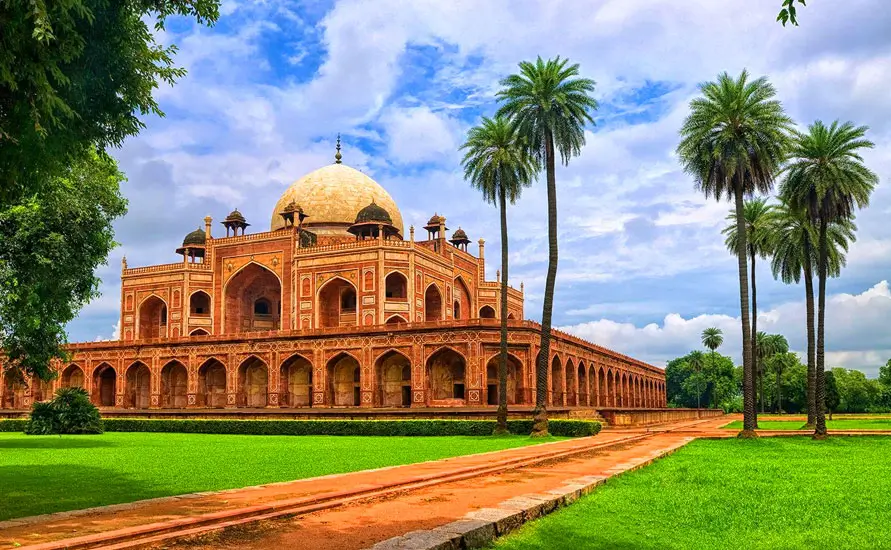
Later in the afternoon the car crosses to the Nizamuddin area for Humayun's Tomb, the first great Mughal garden tomb in India, completed in about 1570 and restored with care over recent decades. Rather than following the crowd straight to the main building, your guide starts at the smaller tomb of Isa Khan next door, which shows the octagonal style of the earlier sultans. On the drive back you pass Agrasen ki Baoli, a stepwell hidden among office towers, and India Gate glowing under floodlights. Pack tonight for the morning drive to Agra and two nights by the Taj. Overnight in Delhi.
Highway driving in India has improved greatly, and the Yamuna Expressway is the best proof. Leaving Delhi after breakfast, your driver joins the toll road at Greater Noida and follows it south almost all the way to Agra, with a coffee halt at a service plaza near Mathura. Budget close to four hours in all, a little more if the exit from Delhi is jammed. Checking in for two nights means no packing tomorrow. Your Agra guide meets you at the hotel after lunch, and because the Taj is reserved for dawn, the first afternoon goes to Agra's smaller marble sights and its living crafts.
Across the river from the main city lies the tomb of Itimad-ud-Daulah, nicknamed the Baby Taj, raised in the 1620s on the orders of Empress Nur Jahan to honor her father Mirza Ghiyas Beg, a Persian noble who rose to become chief minister. Builders here clad a Mughal tomb wholly in white marble for the first time and used pietra dura inlay on a large scale, which is why architectural historians call it a draft for the Taj Mahal. It is small, rarely crowded and sits in a quiet garden on the riverbank. Your guide picks out inlaid stone motifs of rosewater flasks, slender cypresses and fruit bowls around the doorways.
Next comes a small inlay studio run by a family who trace their line to the craftsmen who worked on the Taj still practice marble inlay. You can watch an artisan shape tiny pieces of malachite, lapis and shell on a bow-driven grinding wheel and fit them into channels cut in the marble with nothing more than a fine chisel. A tabletop can take months to finish. Buying anything is entirely optional. In the early evening you may walk through Kinari Bazaar near Jama Masjid of Agra for sweets such as petha, a translucent candy made from ash gourd. Overnight in Agra.
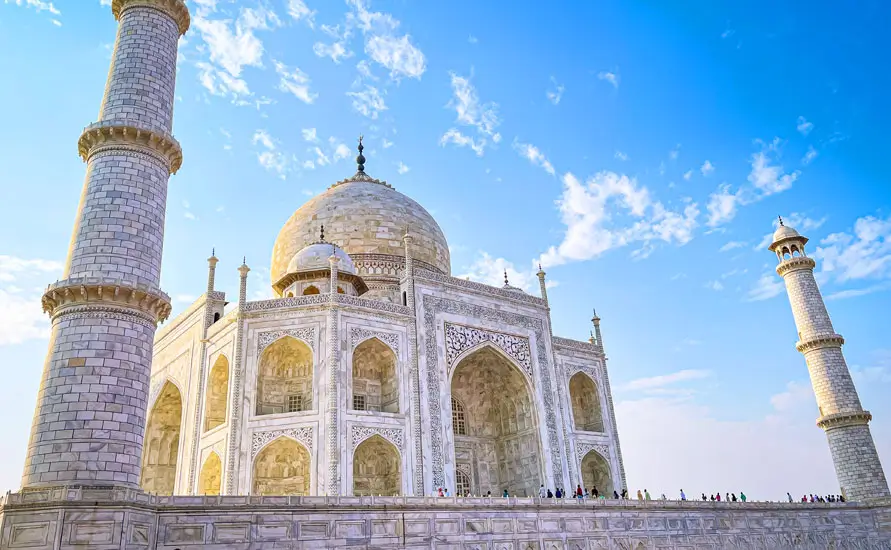
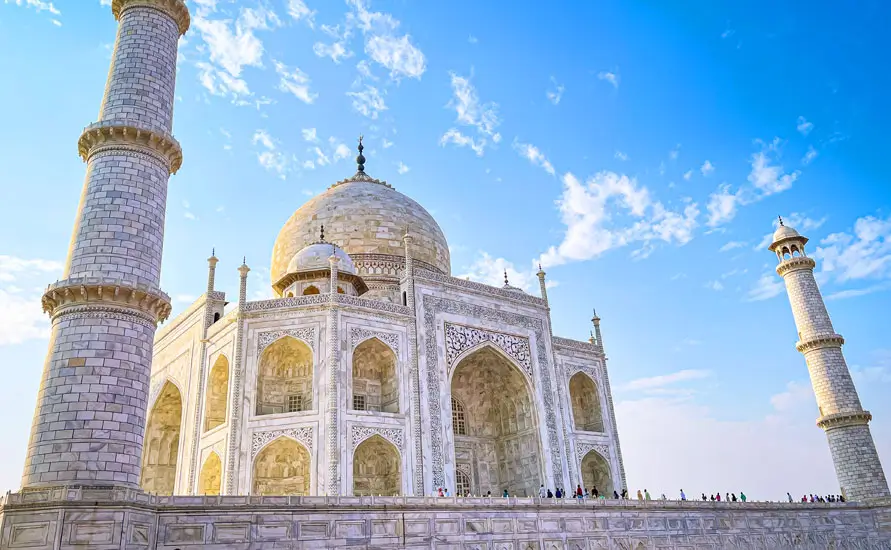
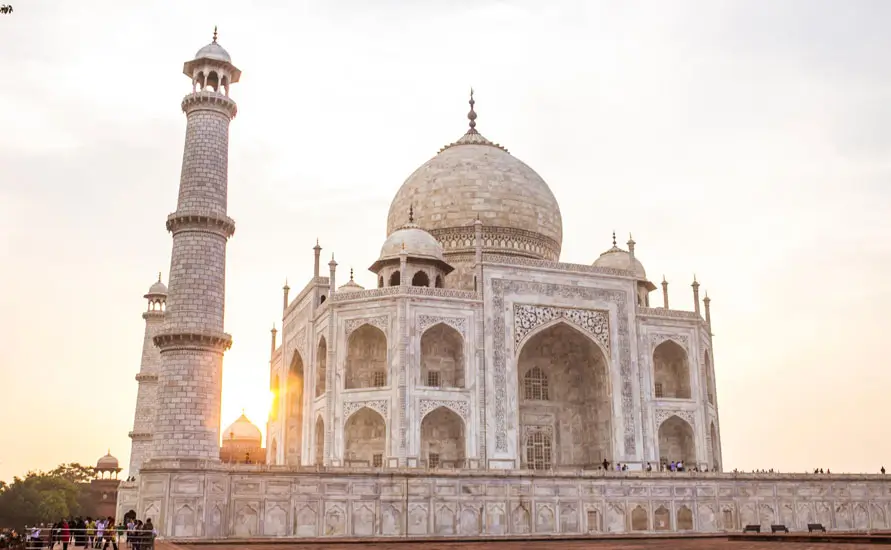
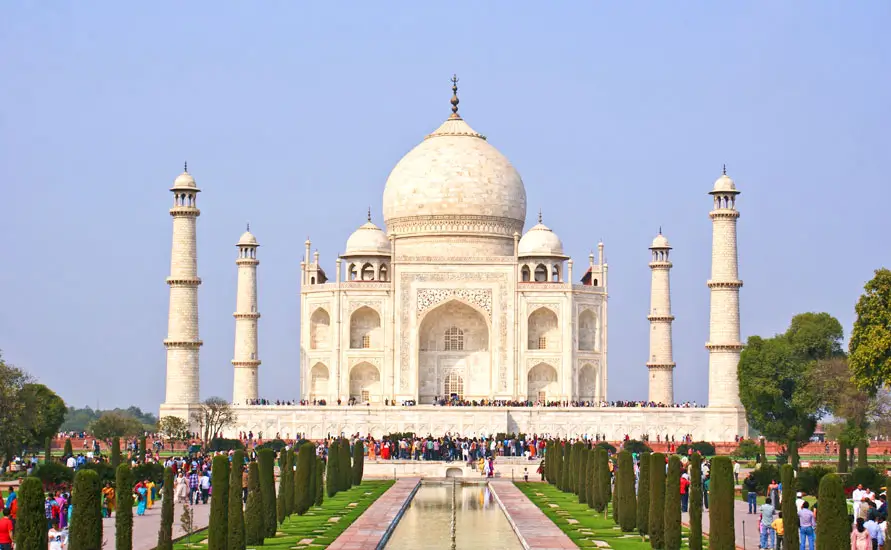
Rising in the dark pays off this morning. Your guide is in the lobby roughly an hour before sunrise and walks you to the east gate, where ticket holders queue for the security check. Step through the red sandstone gatehouse and the Taj Mahal appears framed in its arch, still grey before the sun reaches it, then shifting to pale gold. Early morning is also when the reflecting pools are calmest. The monument is closed on Fridays, and if your dates make today a Friday, the two Agra days are simply swapped, with Fatehpur Sikri moved to the closing day and the Taj to the following sunrise.
After a late breakfast you visit Agra Fort, the fortified palace where the Mughal court lived before the move to Delhi. Your guide concentrates on details often missed: the Anguri Bagh garden with its geometric beds, the Sheesh Mahal bath chambers lined with mirror glass, and the marble balcony from which Shah Jahan is said to have watched elephant fights in the riverbed below. Look across the Yamuna from the Musamman Burj and you see the Taj at an angle you will not get anywhere else, framed between carved pillars, which explains why this view became so linked with the emperor's last years.
With no long drive ahead, the afternoon trip to Fatehpur Sikri is relaxed. The red sandstone city sits about an hour west on the Jaipur road, and you can spend two unhurried hours among its palaces. Akbar's court lived here only about fourteen years before shortage of water and wars in the north-west drew it away, leaving the buildings remarkably preserved. Highlights include Birbal's House, the five-tiered Panch Mahal and the giant Buland Darwaza gateway, 54 meters high. You drive back to Agra at sunset in good time to pack, since tomorrow is a flying day. Overnight in Agra.
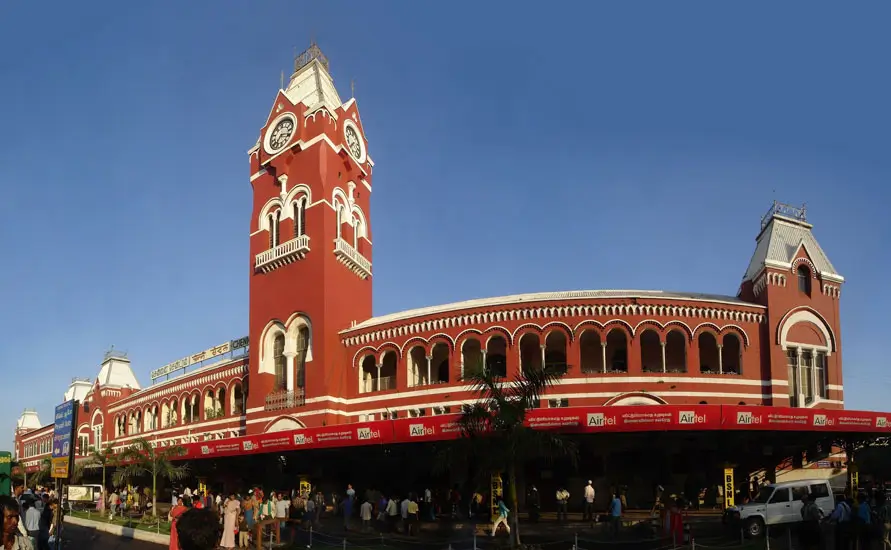
An early checkout takes you back up the Yamuna Expressway toward Delhi's international airport, where domestic flights to Chennai leave throughout the day. Departure from Agra is set by your flight time, with a generous cushion for Delhi traffic. The flight to Chennai takes close to three hours and crosses most of the subcontinent, from the Gangetic plain over the Deccan plateau to the Bay of Bengal. Expect a change of climate on landing, as Chennai is humid most of the year and its temperatures rarely drop much below the high twenties Celsius.
A second chauffeur, this one based in Tamil Nadu, greets you by the arrivals pillars in Chennai and points the car toward the coast. Beyond the city sprawl, ECR, as locals call the coastal highway, threads past casuarina windbreaks, shimmering salt pans, prawn-fry shacks and freshly built weekend villas. Count on roughly ninety minutes to Mahabalipuram, more on a Sunday evening. A beach resort just south of town is home for two nights. Arriving in daylight? Wander down to the sand where fishermen haul their kattumarams, rafts of lashed logs that gave English the word catamaran, above the tideline. Overnight in Mahabalipuram.
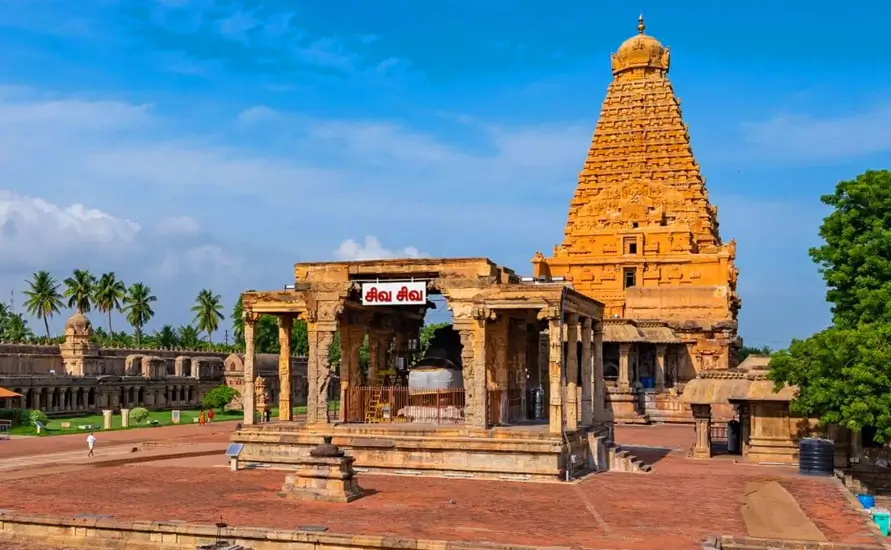
Granite is the theme of the day. Between the 7th and 8th centuries, sculptors working for the Pallava kings carved caves, monolithic shrines and huge reliefs out of the boulders on this stretch of coast, and UNESCO has protected the ensemble since 1984 under the name Group of Monuments at Mahabalipuram. Your guide starts at the Five Rathas, five shrines hewn from one long whaleback of granite, every one shaped like a different kind of temple roof and named, loosely, after the Pandava heroes and their shared wife Draupadi. Free-standing animals guard the group, including a full-sized elephant, a crouching lion and a seated Nandi bull. Early morning light makes the textures of the rock stand out best.
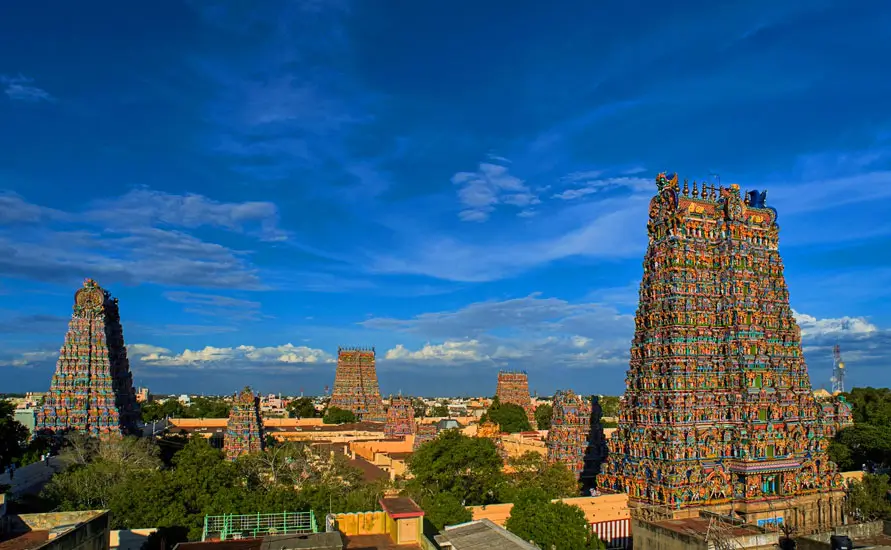
Your next stop is Arjuna's Penance, also called the Descent of the Ganges, a relief carved across two boulders split by a natural cleft where water was once channeled to represent the holy river. Hunt for the sly cat balancing on its hind legs like an ascetic while mice bow to it, and families of elephants walking toward the cleft. Nearby are cave temples with carved Durga and Vishnu panels and a huge round rock perched improbably on a slope, which local children call Krishna's butter ball. Last of the morning's sites is the Shore Temple by the sea, whose weathered spires survived the 2004 tsunami, which briefly exposed buried structures nearby.
Carving never stopped here, and after lunch your guide strolls with you down the road where workshops shape granite deities with chisels and electric grinders, some destined for temples in India and abroad. A state-run sculpture college in town teaches young carvers the old canonical measurements for every limb and crown. About 5 km up the coast is the Tiger Cave, a smaller rock-cut shrine framed by carved lion heads, set in a quiet grove near the beach. Return to your resort for an evening swim and a seafood dinner, perhaps prawns cooked Chettinad style. Overnight in Mahabalipuram.
Mornings in Mahabalipuram start with the call of temple bells and crows, and breakfast can be taken slowly on the resort lawn. Your chauffeur then backtracks up the coast to Chennai airport, with the start time worked out from your flight. If the schedule leaves a spare hour, a detour to the Crocodile Bank set up by herpetologist Romulus Whitaker in 1976 beside the highway shows off gharials, mugger crocodiles and freshwater turtles from several continents. The flight west to Kochi lasts a little over sixty minutes and clears the Western Ghats, the forested wall dividing the two states.
Kerala greets you with a wetter shade of green: rice paddies, rubber plantations and backwater channels glinting under the wing as you descend. A Kochi-based driver takes over at Cochin International, and the ride to Fort Kochi, through Ernakulam's commercial streets and over the Willingdon Island bridges, runs about ninety minutes. Your next two nights are in a heritage-style property on the old peninsula, quite possibly a restored trading house or a whitewashed bungalow with wooden shutters and a courtyard fountain. The pace drops noticeably after the north, and an hour on the veranda with lime soda feels well earned.
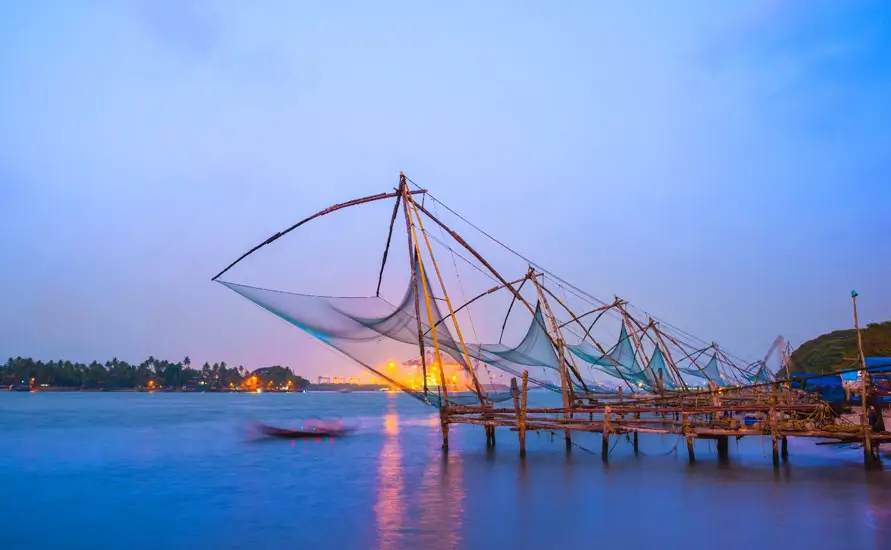
Toward sunset a Kochi guide joins you on the seafront beside the cantilevered Chinese fishing nets, whose teak arms dip and lift as crews of five or six haul on ropes weighted with granite stones. Fish landed here go straight to stalls a few steps away, and for a small fee a café across the road will grill your choice of tiger prawns or kingfish. After dark you take seats for Kalaripayattu, Kerala's ancient fighting discipline of flying kicks, sword and shield work and supple body control, performed in a small sunken arena lit by oil lamps. Overnight in Kochi.
Four flags have flown over this peninsula, those of the Kochi rajas, Portugal, Holland and Britain, and a morning on foot reveals layers of each. Your walk opens at St. Francis Church, first raised in timber by Portuguese friars around 1503; a floor slab inside still marks the spot that held Vasco da Gama's remains from 1524 until his son took them home. A few blocks on, Santa Cruz Basilica glows with pastel murals and stained glass. Your guide threads through Princess Street, past the Dutch cemetery behind locked gates and around the grassy Parade Ground, today an informal cricket pitch.
Mid-morning, a short drive leads to Mattancherry, where the Mattancherry Palace hides wall paintings of the Ramayana in natural ochres, greens and blacks across the walls of the royal bedchamber. Portuguese traders presented the building to the local ruler in the 1550s, and the Dutch renovated it a century later, hence its other name, the Dutch Palace. Around the corner, the Paradesi Synagogue from 1568 has floors of hand-painted Cantonese tiles, each slightly different. Because Friday locks the palace and the synagogue keeps both Friday and Saturday closed, plus Jewish holy days, we slot this walk into a Sunday-to-Thursday date.
Spice traders still run Jew Town, and through the open doors of century-old godowns you can watch women grading black pepper and dried ginger by hand. Between them, antique dealers display temple bells, carved rosewood chests and entire snake-boat prows. After a free afternoon, head back to the theater early for Kathakali, Kerala's mimed dance-drama, because the painting of faces in rice paste, green pigment and lamp soot takes about an hour and is a show of its own. Then the drums start, and the performers retell an episode from the Mahabharata purely through eyes, fingers and footwork. Overnight in Kochi.
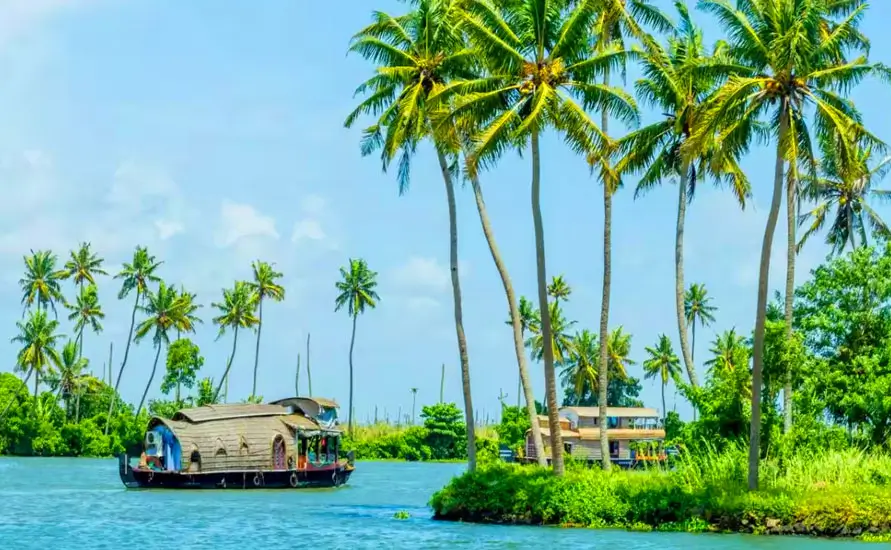
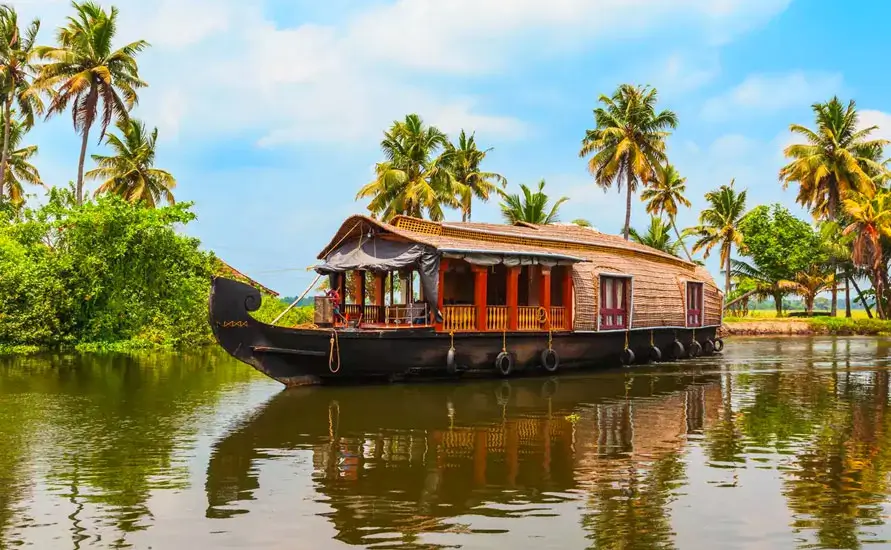
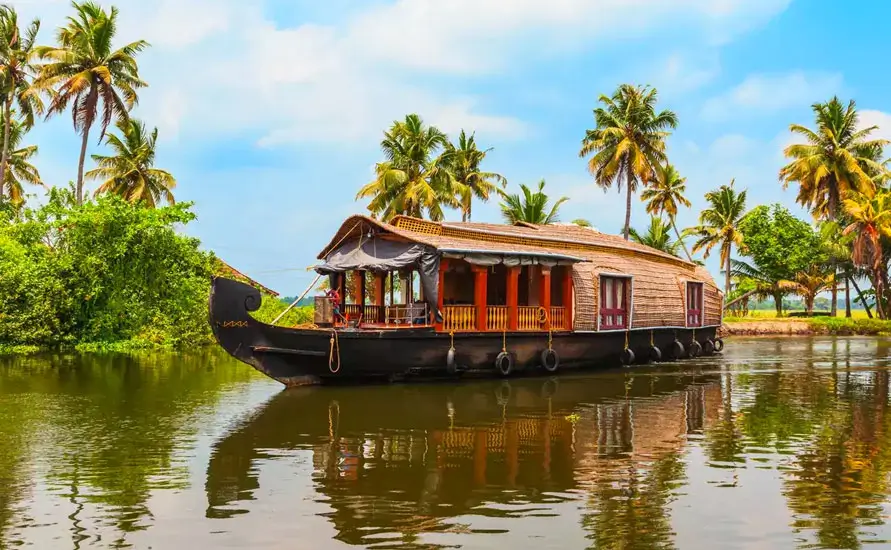
Leaving the peninsula after breakfast, your driver follows National Highway 66 down the coast toward Alleppey, the town now officially spelled Alappuzha, whose canal grid earned it a colonial-era comparison with Venice. In about ninety minutes you pass cashew factories, roadside churches painted in pastels and long lines of coconut palms leaning toward the sea. Boarding normally happens at noon. Your private Alleppey houseboat follows the shape of the old kettuvallam, a cargo barge once built from jackwood planks literally sewn together with coconut fiber, now fitted with bedrooms, a sundeck and a galley kitchen at the stern.
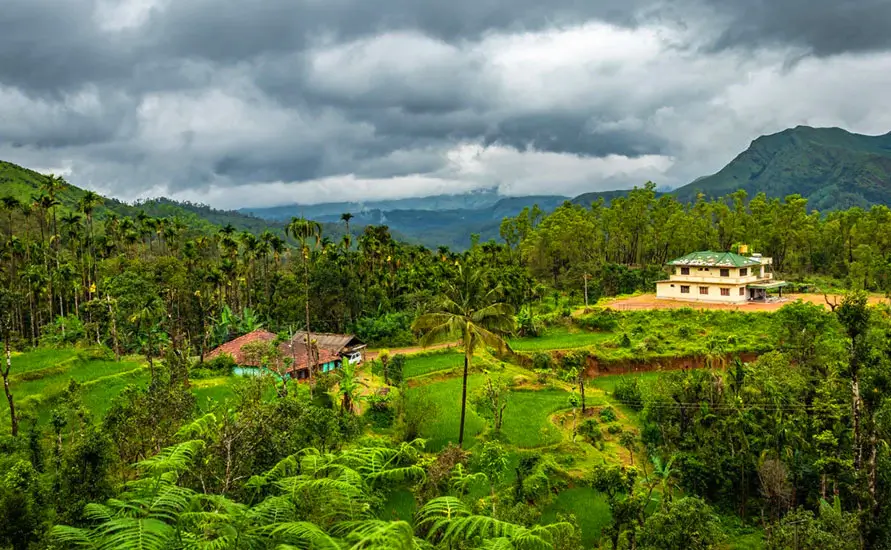
Once you are settled, the crew casts off and the boat noses into the Kuttanad wetlands, a rare district where paddy is cultivated beneath sea level protected by mud dikes. A lunch of meen curry soured with kudampuli, beetroot thoran, rice and crisp pappadam appears on the shaded dining table. Through the afternoon the scenery changes slowly: a white church reflected in a canal, a ferry crowded with schoolchildren, a man paddling a canoe stacked with green coconuts. If you ask, the skipper will nose into the bank beside a hamlet for a twenty-minute stroll along the dike.
By government rule the boats stop moving around dusk to give fishermen the water at night, and your skipper picks a calm mooring by the paddy fields. Tea arrives with pazham pori, the plantain fritters Keralites love, as herons settle into the palms and bats leave their roosts. Your cook prepares dinner fresh, mild or spicy as you prefer, with chicken, vegetable or fish dishes available. The air-conditioning in the cabins runs through the night, while the three-person crew rests in separate quarters near the engine. Out here the darkness is real, and clear skies fill with stars. Overnight on the houseboat.
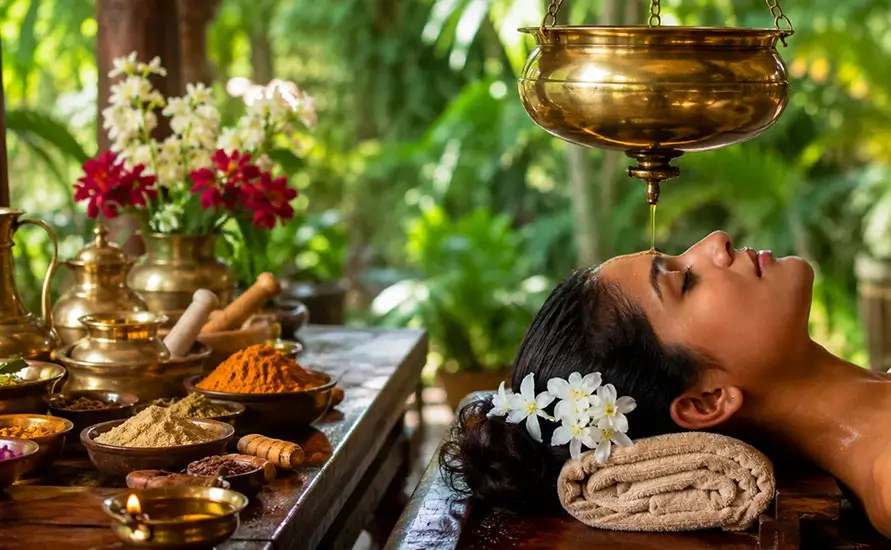
Dawn on the backwaters is the hour to be on deck: smoke curls from village kitchens, a fisherman throws a circular net, and the first canoes pass silently. After an appam-and-stew breakfast your crew steers back to the landing, where checkout comes around nine. Minutes later the car pulls up at a lakeside resort near Alleppey for the final night, typically a scatter of cottages under palms with a pool and an Ayurveda wing. If you fancy an abhyanga oil massage, book it at reception; it is an optional extra. Otherwise spend the late morning reading on the lawn by the water.
After lunch and a rest, a boatman collects you in a slim wooden canoe, poled or paddled, to slip down channels where a big boat would jam bank to bank. With no engine noise, you can hear kingfishers dart off branches and water hens chatter in the reeds. Houses come right down to the water, with banana plants, pepper vines and drying laundry in the yards, and children waving from the steps. On request, the boatman will pull in at a licensed toddy shop, a simple village bar serving fresh coconut sap, tapioca and fiery red fish curry, for those curious to try local flavors.
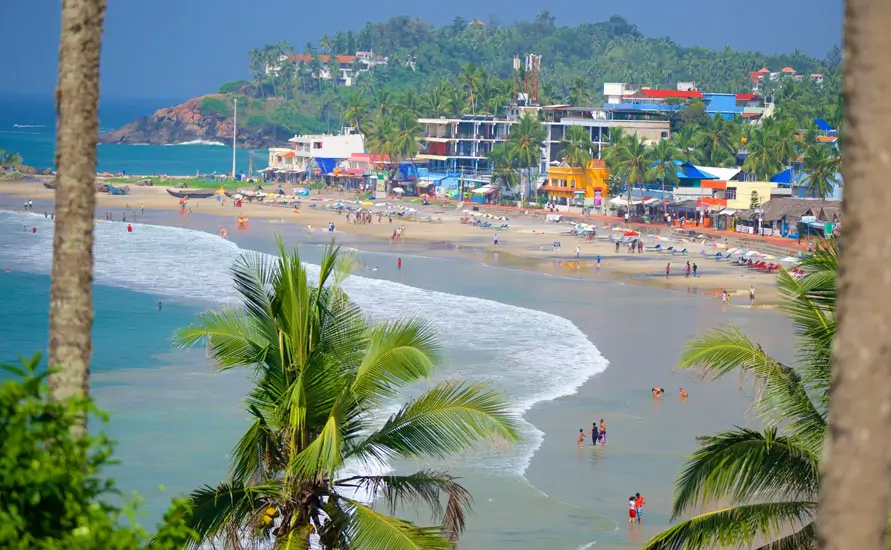
Close to sunset you can head for Alleppey's own seafront, where rusted iron posts mark the remains of a pier dating from the town's 19th-century port days, and a red-and-white lighthouse from 1862 rises behind the beach. Local families stroll the sand, peanut sellers push their carts, and the Arabian Sea swallows the sun. Your farewell dinner back at the resort might feature karimeen, the backwater pearl spot, coated in red spice paste and cooked wrapped in plantain leaf. Your driver confirms the airport timing with you before you retire. Overnight in Alleppey.
Following breakfast, the road north to the airport usually takes about two hours, and your driver allows for check-in, which for long-haul departures opens around three hours ahead. Kochi's airport, famous as the first in the world powered entirely by solar energy, has nonstop links to the main Gulf and Southeast Asian hubs, from where onward flights reach every continent. Flying late? Ask us about a paid late checkout, or have the driver stop at a spice cooperative in Ernakulam for vacuum-packed pepper, green cardamom and estate tea.
Across eleven days, this Taj Mahal with Mahabalipuram and Kerala route has linked Shah Jahan's marble with Pallava granite and the slow waterways of Kuttanad. Travelers who can stay longer often add Munnar's tea slopes, the spice farms of Thekkady or a few beach days at Varkala. Should anything change before your plane takes off, call our duty manager, day or night, and we are glad to help with any final arrangements.
Your Journey
N.S. Rathore & Mrs. Omlata Rathore · Managing Director
We still read every enquiry ourselves. Tell us the places you liked and our planners will send a day-by-day route with drive times and a clear price.
No ready-made packages and no pressure to book. A planner from our Kochi office replies within 24 hours with a route written for your group.
Fill this in and your planner will send a first draft itinerary.
Explore more
Kerala Backwaters Escape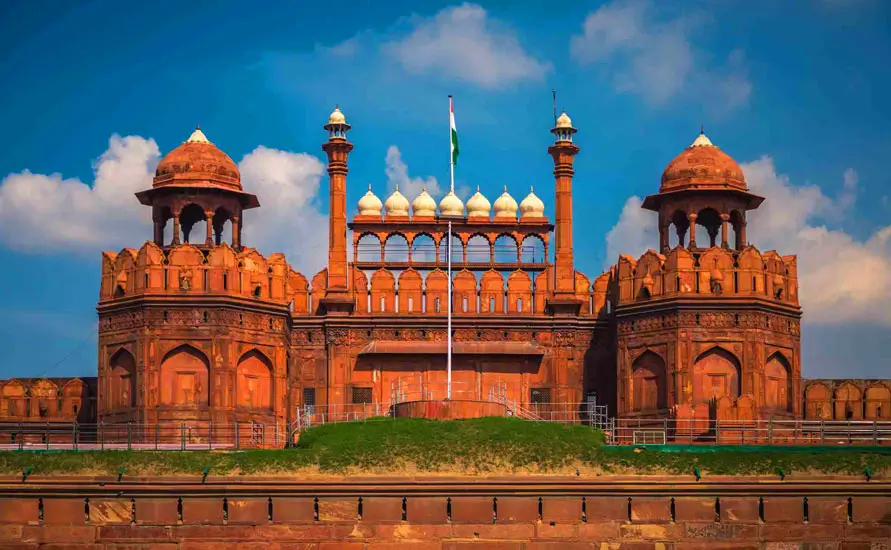 Kerala Backwaters Escape
 Kerala Backwaters Escape
 Kerala Backwaters Escape
 Kerala Backwaters Escape
 Kerala Backwaters Escape
 Kerala Backwaters Escape
 Kerala Backwaters Escape
 Kerala Backwaters Escape
 Kerala Backwaters Escape
 Kerala Backwaters Escape
 Kerala Backwaters Escape
 Kerala Backwaters Escape
 Kerala Backwaters Escape
 Kerala Backwaters Escape
 Kerala Backwaters Escape
 Kerala Backwaters Escape