 Kerala Backwaters Escape
Golden Triangle Tour With South India
Delhi – Agra – Fatehpur Sikri – Abhaneri – Jaipur – Chennai – Mahabalipuram – Pondicherry – Chidambaram – Tanjore – Trichy – Madurai
At a glance
Hands built India's great monuments, and the Golden Triangle with Tamil Nadu Tour follows the craftspeople as much as the kings. In the north you watch marble inlayers in Agra cut stone flowers the way their ancestors did for the Taj Mahal, and block printers near Jaipur stamp cotton with carved teak. After a flight south, the material changes to granite: the shore carvings of Mahabalipuram, the Chola-era vimana soaring over Tanjore and the painted gateways of Madurai. Few routes show so clearly how two halves of one country solved the same problems with different tools.
Thirteen days give each stop room to breathe. Delhi, Jaipur, Pondicherry and Madurai each get two nights, the hop from Jaipur to Chennai is a nonstop domestic flight, and the train to Agra saves you a morning on the highway. South of Chennai, no road leg runs longer than about five hours, and the busiest drive is broken by temple stops at Chidambaram and Gangaikondacholapuram. Across all thirteen days of the Golden Triangle tour with South India we arrange, your own car and driver, and at each big site a licensed local guide takes over.
Our travelers are mostly Americans, Canadians, Europeans and Australians on a first or second visit, along with NRI parents keen for their kids to see both the Mughal north and the Tamil south. The Golden Triangle with Tamil Nadu Tour is planned around closures like the Friday shutdown of the Taj Mahal, and it suits the cooler months from October to March. Hotels, pace and the balance between monuments, markets and food can all be set to your taste.
Delhi's Terminal 3 arrivals hall is large and noisy, so we station someone right by the exit doors with a sign; he takes your trolley and leads the short walk to the parking bay. Many flights from the Americas and Europe land between midnight and dawn, so the plan for the first day starts only in late afternoon. We will have given your hotel your arrival time, and if you want the room at sunrise rather than mid-afternoon, booking it from the previous night is the only sure way. During the drive into the city the driver hands over an envelope with vouchers, your train ticket for Day 3 and a direct line to our office.
Once you feel rested, the guide comes by and takes you to Lodhi Garden, a large park where joggers, yoga groups and retired gentlemen on benches share the lawns with the domed mausoleums of two short-lived sultan dynasties, the Sayyids and the Lodis. It is a calm introduction to the city, and the stone of these tombs, gray quartzite trimmed with blue tile, gives a first lesson in the craft traditions you will follow for the next twelve days. Your guide points out where the glazed tiles survive and how the Lodi builders shaped the domes long before the Mughals arrived.
At dusk the guide leads you on foot through the alleys of an old Muslim neighborhood to the marble dargah, or shrine, of Hazrat Nizamuddin Auliya, the Chishti mystic who died in 1325. Rose petals, incense and the smell of kebabs from the stalls fill the alley, and most nights, Thursday above all, musicians gather in the courtyard to perform qawwali, devotional songs set to harmonium and hand clapping. Visitors sit on the marble floor at the edge of the crowd; heads should be covered and women are not allowed into the inner tomb chamber, though they can watch from the screens. Dinner is free tonight. Overnight in Delhi.
Old Delhi wakes up early, and so do its traders, so straight after breakfast you set off on foot into Khari Baoli, a spice wholesale district trading since the 17th century and often called Asia's biggest. Laborers balance hessian bags of dried chilies, turmeric root and green cardamom on their heads through lanes where the dust makes everyone sneeze, and a steep, worn staircase climbs to the roof of an old trading house overlooking the jumbled old city. From there a cycle rickshaw winds toward Jama Masjid, Shah Jahan's great mosque. Climbing its red sandstone steps, you see the domes and minarets the emperor finished in 1656. Remove shoes and cover legs and shoulders.
A short stop on the parathe lane behind Chandni Chowk lets you taste stuffed flatbreads fried in ghee, served with pickles and potato curry, before the car takes you south to the National Crafts Museum, a cluster of village-style buildings filled with folk paintings, carved temple chariots, tribal bronzes and textiles from every Indian state. Craftspeople from different regions are often in residence on the grounds, weaving or painting. On Mondays the museum shuts, so that day we substitute Humayun's Tomb instead, the garden mausoleum that taught the Taj Mahal's builders much of what they knew.
Toward evening the car reaches the Qutub Minar, a tower of red and buff sandstone raised by the first sultans of Delhi from the 1190s onward. Look closely at the bands of carved inscriptions and you can see where later rulers added stories in a different stone after lightning damage. The mosque beside it reused columns from earlier Hindu and Jain temples, and their carved bells and garlands are still visible. Your guide shows you the unfinished Alai Minar, a much larger tower whose builder died before it rose beyond the first story. Overnight in Delhi.
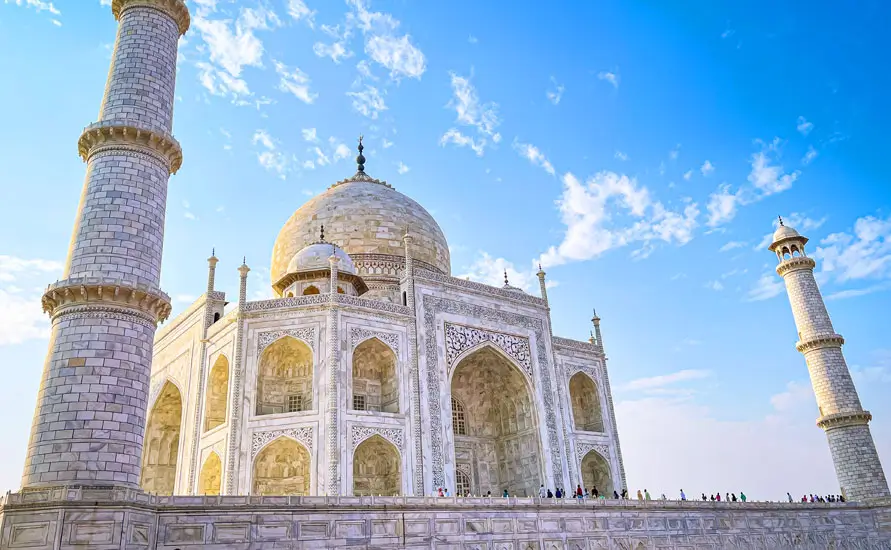
An early start takes you to Hazrat Nizamuddin railway station for the Gatimaan Express, a semi-high-speed service that reaches Agra, 188 km away, in roughly one hundred minutes. Your seats are booked in the cooled chair-car coach, and staff bring round a simple breakfast tray. Your driver takes the car down the expressway with your main luggage, so you travel with only a day bag. At Agra Cantonment station the local guide is waiting beside your coach door. Please note that the Taj Mahal closes on Fridays; your dates are set so tomorrow's sunrise visit falls on another day, and in the rare case your Agra day is a Friday, we reorder the two Agra mornings so the mausoleum comes first.
First comes Itimad-ud-Daulah, the riverside tomb that Empress Nur Jahan built in the 1620s for her father. Locals call it the Baby Taj, and for craft lovers it may be the more rewarding of the two, because it is the first Mughal building faced entirely with white marble and decorated with pietra dura, colored stones set into carved channels. Your guide shows how the patterns evolved from simple geometric shapes here to the flowing flowers of the Taj. Afterward you visit a family workshop where inlayers shape tiny pieces of carnelian and malachite on hand-turned grinding wheels, then fit them into marble by eye.
The afternoon belongs to Agra Fort, a crescent of red sandstone ramparts tracing a curve of the Yamuna for roughly 2.5 km. Akbar began it as a military stronghold, Jahangir added palaces, and Shah Jahan replaced many of them with marble pavilions, including the Diwan-i-Aam, where the emperor heard petitions from his subjects. In the octagonal tower at the river side, the guide points out marble screens carved so finely that they look like lace. Agra evenings are quiet, and dinner can be the city's famous petha sweets after a tandoori meal. Overnight in Agra.
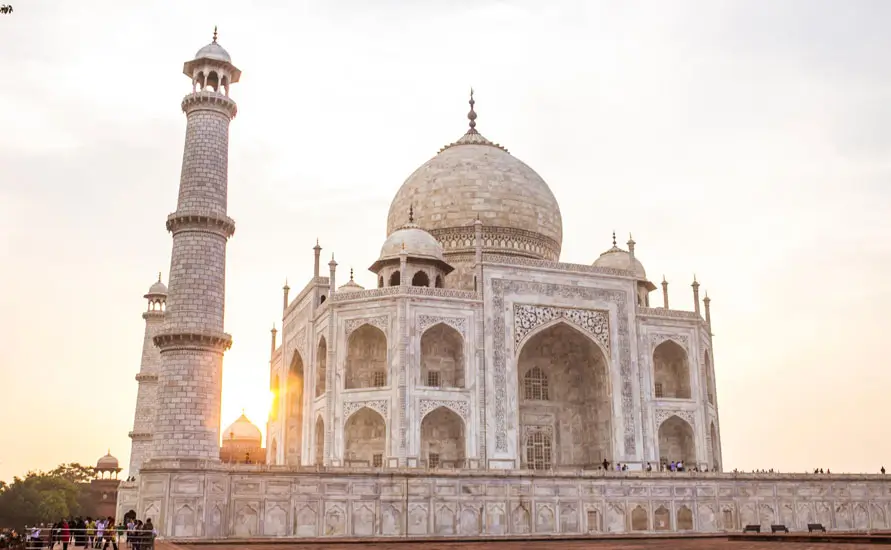
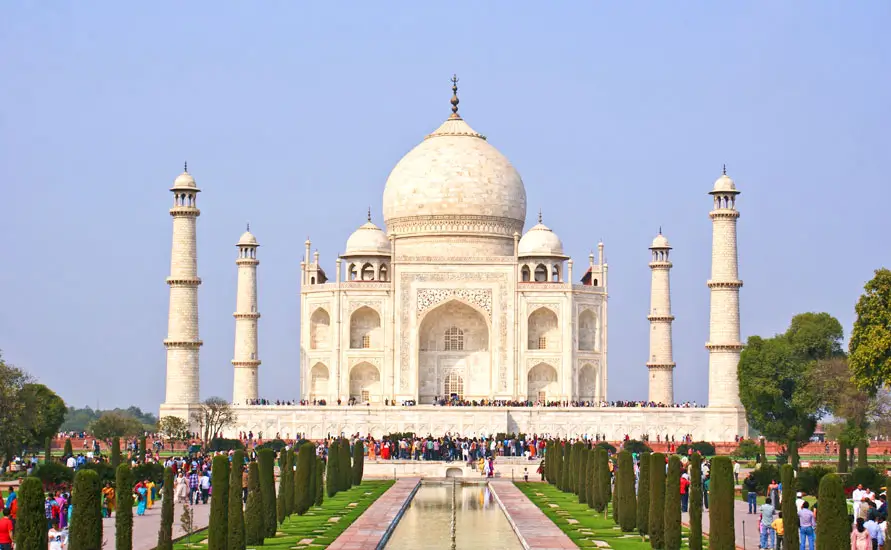
Before the first light, the car leaves you at the parking zone east of the Taj Mahal, and a battery cart rolls you up to the ticket gate. When the main gate frames the tomb, the marble is still blue-gray, and over the next half hour it warms to cream and then white. This is the moment to look for the craftsmanship you saw yesterday at the workshop: up close, the flowers in the panels have petals made of several shades of the same stone, each piece smaller than a fingernail. Shoe covers are provided for the main platform, and bags should be small, with no food, drones or tripods.
After breakfast and check-out you drive west for about an hour to Fatehpur Sikri, Akbar's red sandstone capital of the 1570s, abandoned within a generation. Its builders carved stone as if it were wood, and your guide shows you the brackets of the Diwan-i-Khas, the screens of the Jodha Bai palace and the Buland Darwaza, a gateway about 54 meters high. Inside the mosque courtyard, the white marble tomb of the saint Salim Chishti is decorated with screens of such delicacy that visitors stop just to look at the patterns. Women and men tie red threads to them in hope of a wish granted.
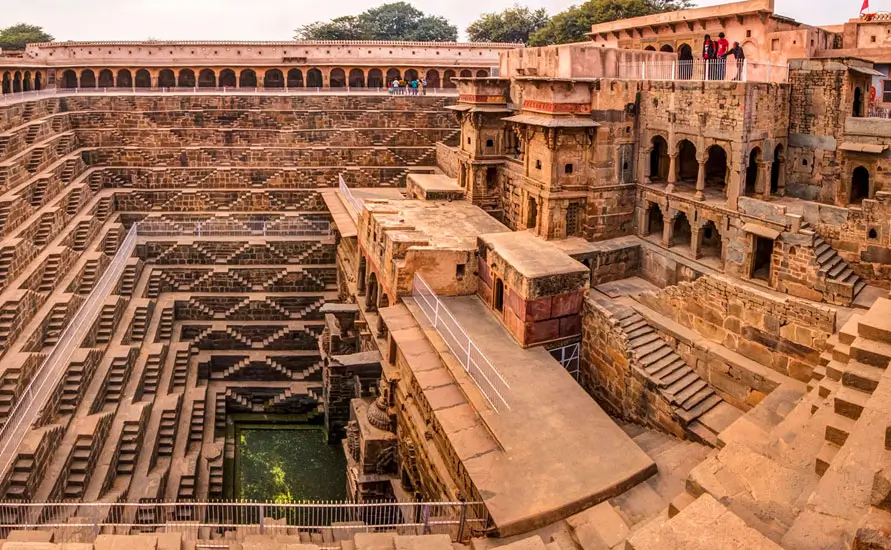
Crossing into Rajasthan, the road brings you to the village of Abhaneri and Chand Baori, a stepwell dug about 1,200 years ago and plunging about thirty meters. Around 3,500 narrow steps descend thirteen levels in a perfect zigzag pattern to the water, an extraordinary piece of geometry that local communities once used to save rainwater through the dry months. A short drive later you reach the highway again and pull into Jaipur around dusk, about five and a half hours of driving in total from Agra. After check-in the night is yours. Overnight in Jaipur.
Rajput rulers kept their stronghold on the hills north of the modern city, and that is where your morning starts at Amber Fort. You go up the ramp by jeep or on foot, never on elephants, and enter through the Sun Gate. Inside, the Ganesh Pol is painted with floral patterns in natural colors, and the Sheesh Mahal sparkles with glass work brought from Belgium. Your guide shows you the Sukh Niwas, where water once ran through channels in the walls to cool the rooms before air-conditioning existed, a clever solution to desert heat. Downhill, the little Panna Meena ka Kund stepwell offers a photograph of crisscrossing staircases.
Back in the walled city you visit the City Palace, built by Sawai Jai Singh II after he founded Jaipur in 1727. The courtyards display textiles, weapons and royal costumes, including the robes of a ruler who was said to be over two meters tall and to weigh about 250 kilograms. Across the street, the stone and marble instruments of the Jantar Mantar observatory show how carefully the king studied the sky; the guide explains how the sundial, the zodiac instruments and the great hemispheres were used. Both sites sit within walking distance of each other.
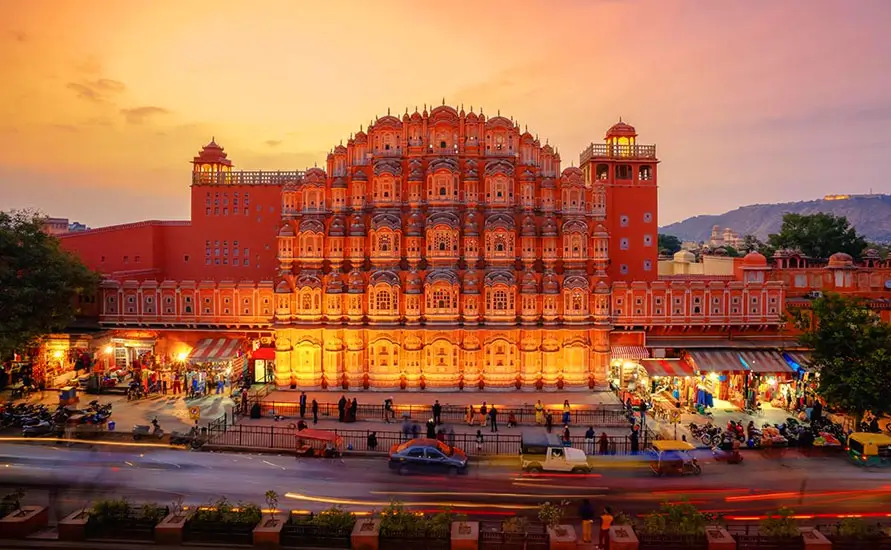
In the late afternoon you stand in front of Hawa Mahal, where the low sun lights the pink sandstone, and then walk into the bazaars of the walled city. Each street is named for the trade it once housed: Johari Bazaar for jewelers, Tripolia Bazaar for brassware and bangles of lacquer, and Kishanpole Bazaar for textiles. Your guide shows you a lac bangle maker heating colored resin over a small flame and pressing in glass beads by hand. For dinner, desert favorites like baked wheat baati with lentils and fiery laal maas mutton make a filling end to the day. Overnight in Jaipur.
Before the flight south you spend the morning at Sanganer, a craft town about 15 km south whose dyers have stamped cotton by hand for some five hundred years. In a family workshop you watch the carver chisel teak blocks with patterns of flowers and paisleys, then follow the printer as he dips each block in dye and presses it onto long tables of cloth with a sharp thump of his palm. Each color needs a separate block, and a single bedcover can take dozens of impressions lined up by eye. Most workshops will let you print a small piece of cloth yourself and take it home.
Around midday your driver drops you at Jaipur airport for a nonstop domestic flight to Chennai, about two and three quarter hours long. A meal can be bought on board, though many travelers eat at the airport before departure. From the window, the arid hills of Rajasthan give way to the green plains of the Deccan and finally the red soil and coconut groves of Tamil Nadu. At Chennai, our southern team meets you outside the arrivals hall with a new car and a driver who remains at your side right down to Madurai, and the drive to the hotel takes about forty minutes.
Chennai is the largest city in South India, and its people are proud of their classical music, Carnatic dance and filter coffee. This evening, if you feel like a stroll, the car can drop you at Elliot's Beach, the seafront of the Besant Nagar suburb, where families come to walk on the sand after dark and food stalls sell spicy sundal, a snack of boiled chickpeas with coconut and mustard seed. The small Velankanni church nearby is lit up in the evenings. Back at the hotel, try a South Indian dinner of rice, sambar and rasam served on a banana leaf. Overnight in Chennai.
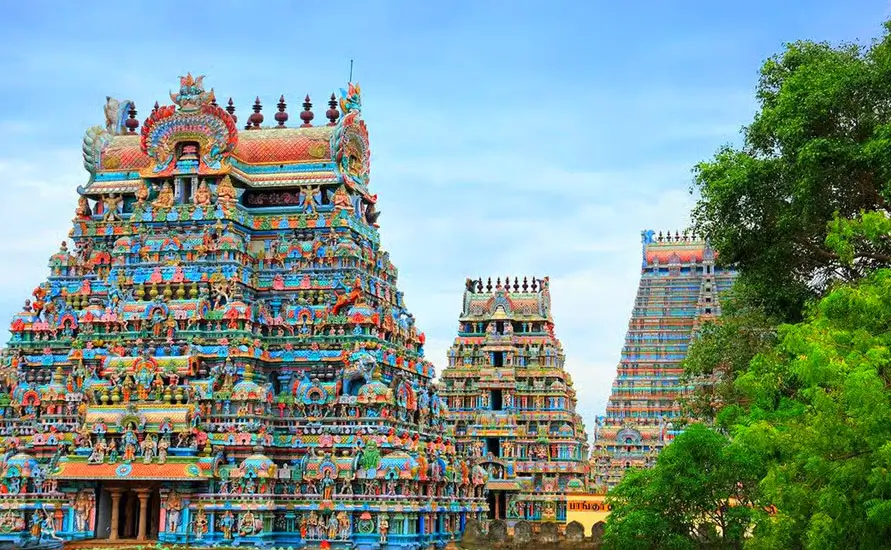
Start in Mylapore, Chennai's old temple quarter, at the Kapaleeshwarar Temple, where the painted gopuram swarms with gods, demons, sages and musicians in bright enamel colors. Early morning brings priests in white veshtis, housewives sketching white kolam designs in front of their homes, and flower sellers threading jasmine for the day's offerings. Next you visit the Government Museum in Egmore; its dedicated bronze gallery displays hundreds of Chola metal images; among them are several dancing Shiva images made in the lost-wax technique under the Chola kings. The museum is closed on Fridays, when we spend extra time in Mylapore instead.
Leaving the city, the car follows the coastal highway to DakshinaChitra, a heritage village museum about 25 km from the center. Eighteen or so traditional homes from four southern states were moved here piece by piece and rebuilt, and inside them potters, weavers and basket makers work at traditional crafts. You can try your hand at a potter's wheel or have a henna design applied. The museum is closed on Tuesdays, and on those dates we stop at the Cholamandal artists' village instead, a cooperative of painters and sculptors founded in the 1960s.
In the late afternoon you reach Mahabalipuram, the seaside town where the Pallava kings carved temples out of solid rock in the 7th and 8th centuries. You check in at a beach hotel and stroll to the Shore Temple, whose twin granite spires stand right where the sand meets the sea, with rows of Nandi statues along the compound wall. Sea spray has softened the carvings, but in the low evening light you can still trace the figures of Shiva and Vishnu inside. Fishing crews drag their wooden boats up the beach nearby as the sun sets behind you. Overnight in Mahabalipuram.
Breakfast is early so you can reach the hillside monuments before the heat. Arjuna's Penance, a huge granite boulder covered with over a hundred carved deities, hunters, sages and beasts, may be the largest open-air relief in the world. Your guide shows you the life-size elephants, a cat imitating a holy man and the natural crack that the carvers turned into the sacred Ganga flowing down from the Himalayas. Close by, the cave temples and a balanced boulder known as Krishna's Butterball draw crowds of local schoolchildren who try, without success, to push it over.
The Pancha Rathas, five monolithic shrines that locals named for the Pandava brothers and their wife Draupadi, show the different temple styles that Pallava architects tested before they ever built in stacked stone. Each is cut from a single rock, and the life-size animals sculpted beside them are among the best sculptures of the period. Mahabalipuram still lives by stone: along the main road, sculptors chip granite statues for temples around the world, using tools much like those of their ancestors. You visit one of these workshops before setting off south along the coast.
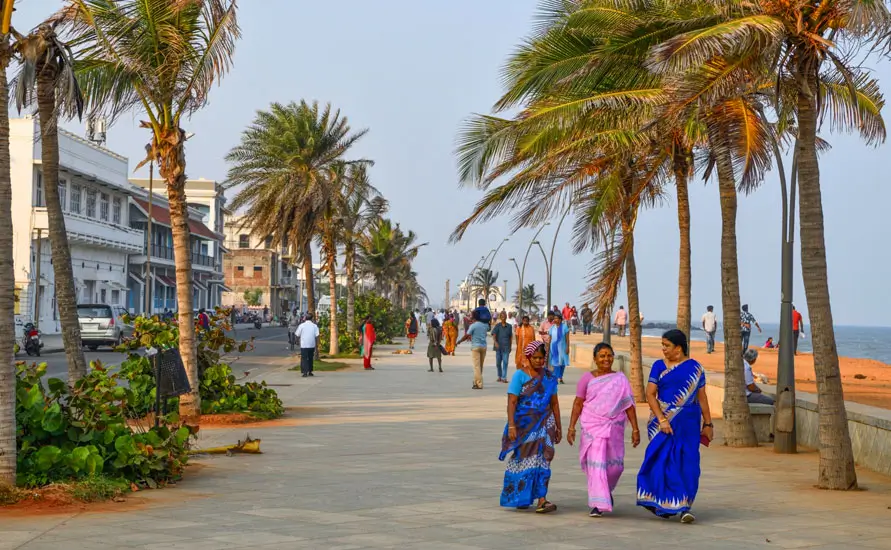
Two and a half hours of coastal road bring you to Pondicherry, with shrimp farms, casuarina windbreaks and boatyards along the way. France held Pondicherry until 1954, and the old town is still divided by a canal into the White Town, with its mustard and white colonial villas, and the Tamil Town, with its pillared verandas. Once settled, head for Goubert Avenue, the seafront road that becomes car-free in the evening, where families munch roasted peanuts near the tall Gandhi statue. Sea breezes make it the most pleasant hour of the day, and the old lighthouse and the French war memorial stand along the same stretch. Overnight in Pondicherry.
Morning light is best for the French Quarter, and you walk with your guide down the old French streets around rue Dumas, where bougainvillea hangs over the gates of colonial villas painted yellow and white. Landmarks along the way include the town hall, the French consulate and a pastel-fronted church from 1855 dedicated to Our Lady of the Angels. At the Sri Aurobindo Ashram, visitors enter in silence, and the white marble tomb of the founder and the Mother is covered every day with flowers arranged in new patterns. Phones should be switched off inside.
Late morning you drive about twenty minutes north to Auroville, the international township begun in 1968 with the aim of a shared community for people of every nationality. At the visitor center, an exhibition and a short film introduce the project, and from there it is a ten-minute walk under trees to the lookout for the Matrimandir, a huge sphere wrapped in golden discs. Going inside the inner chamber needs booking well in advance, since slots are scarce, so tell us early if you want us to apply. The cafe and craft shops near the visitor center sell local pottery, handmade paper and incense.
Back in town, spend the free afternoon wandering the Tamil Quarter, where traditional houses have raised verandas called thinnai, on which passing travelers were once allowed to rest. Pondicherry's food mixes French bakeries with Tamil and Creole cooking, and we keep a short list of good kitchens for prawn curry or a fish dish cooked with coconut and tamarind. Before dinner, the Manakula Vinayagar Temple to Ganesha is a lively stop, its interior walls covered in gilded panels showing his many legends. Evenings here are relaxed, ideal for a final stroll along the sea. Overnight in Pondicherry.
No southern road day is longer than this one, so you are on the road by eight, rolling south across the Kollidam delta, a region of rice fields, coconut palms and village ponds where buffaloes bathe. Ninety minutes on, Chidambaram appears, with its Nataraja Temple, where Shiva is honored as Nataraja, king of dancers. Its roof over the inner shrine is covered with gold tiles, and its gopurams carry carvings of the 108 poses of classical Bharatanatyam dance. Visitors who are not Hindu stay in the outer halls, away from the sanctum, and men may need to remove their shirts.
A further hour inland brings you to Gangaikondacholapuram, the capital founded by the Chola king Rajendra I after his generals carried his banner all the way north to the Ganga. Its great temple is a UNESCO site and a near twin of the one at Tanjore, but here you will often have the lawns almost to yourself. Your guide shows you a celebrated panel showing Shiva garlanding his devotee Chandesha, carved with remarkable tenderness, and the enormous Nandi that faces the temple from the courtyard. A roadside meals hotel serves a rice lunch on banana leaves.
Late in the afternoon you check in at Tanjore (Thanjavur), the capital of the Chola Empire at the height of its power. The town is still known for its art: Thanjavur paintings with raised gold leaf, bronze statues cast in nearby Swamimalai and the bobbing dolls sold in every market. After check-in, take a walk through the old palace of the later Nayak and Maratha rulers, whose Saraswathi Mahal collection preserves rare palm-leaf texts, and the art gallery displays some of the finest Chola bronzes in South India. Overnight in Tanjore.
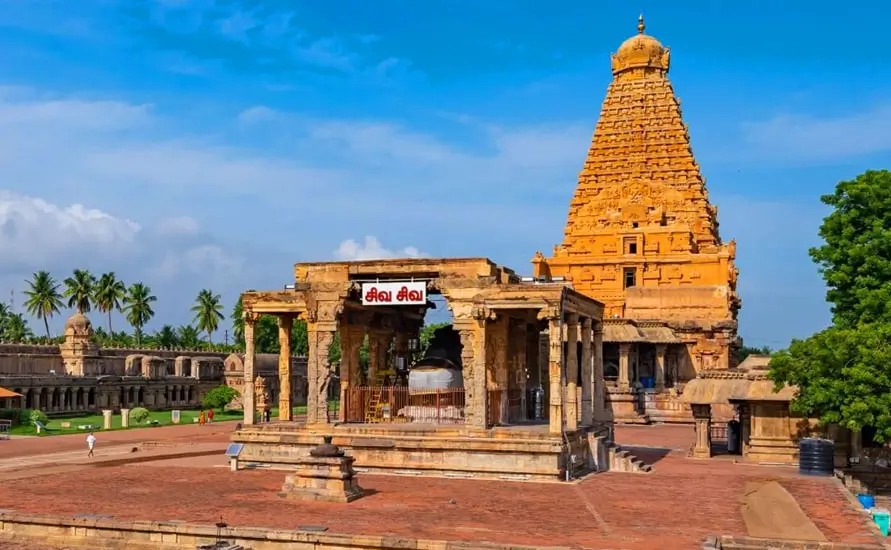
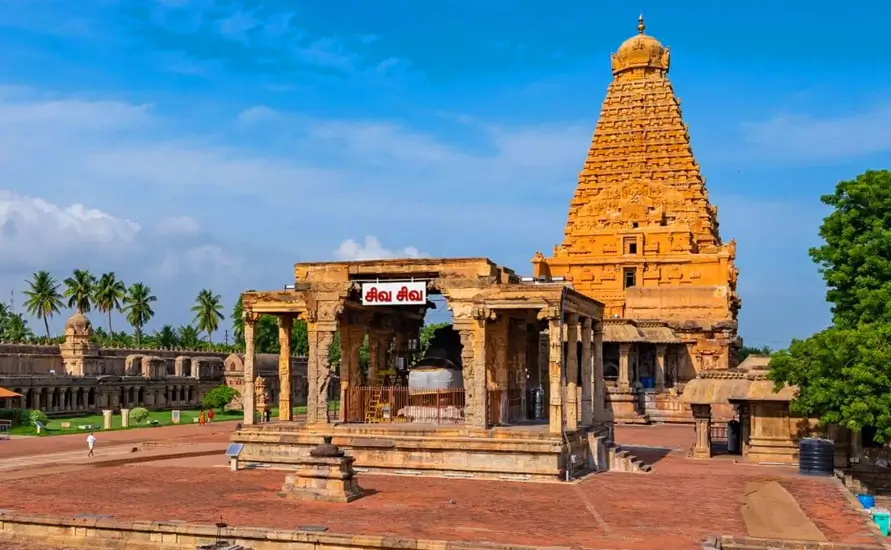
Arrive at the Brihadeeswarar Temple at opening time, while the granite courtyard is still cool and quiet; Raja Raja Chola I consecrated it in 1010, and it heads UNESCO's group of Great Living Chola Temples. The vimana over the sanctum climbs some 66 meters, and its crowning dome-shaped stone is believed to weigh around 80 tons, a weight that has made engineers wonder for centuries how it was lifted. Your guide shows you the frescoes in the corridors, the giant Nandi carved from one stone and the inscriptions listing temple dancers, musicians and their salaries. Non-Hindus may visit the complex, but the inner sanctum is for Hindus only.
About an hour west you reach Trichy, where the Sri Ranganathaswamy Temple on the island of Srirangam is a temple town so big that people live, shop and work inside its walls, with seven concentric walls and twenty-one gopurams. The outer rings hold markets, houses and shops, so walking inward is like passing through a town. Non-Hindus can visit up to the sixth enclosure and climb to a rooftop viewpoint with views of the golden roof over the main shrine. If time allows, you can also see the Rock Fort temple, carved into a massive rock outcrop in the center of the city.
The last stretch to Madurai, about two and a half hours, crosses dry plains with palmyra palms and small villages. Greek and Roman writers knew of Madurai, the Pandya capital, and people have lived here continuously for more than two thousand years. Evenings bring an optional sound and light show staged in the great open court of the 1630s Thirumalai Nayak Palace, framed by massive pillars and stucco arches. Afterward, try a street favorite before bed: jigarthanda, a chilled glass of reduced milk, almond resin and cream, or a plate of soft parotta with mutton salna from a busy corner stall. Overnight in Madurai.
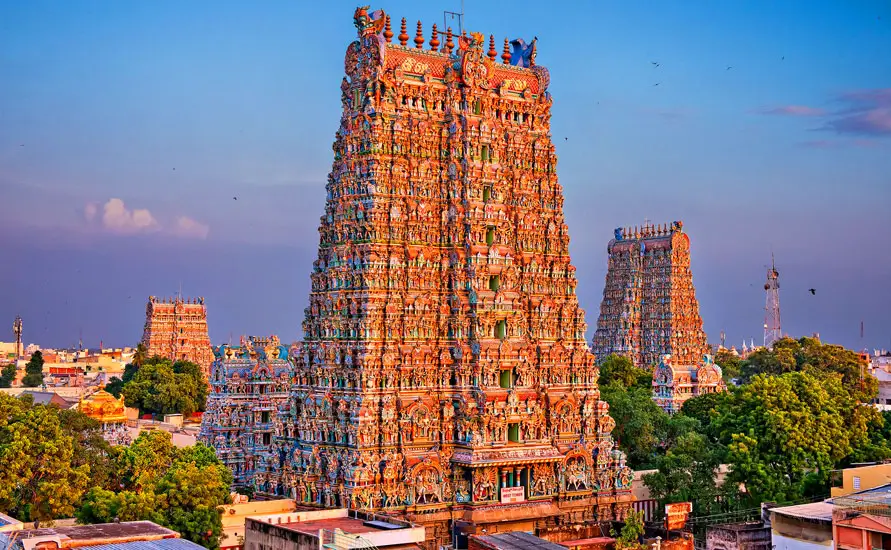
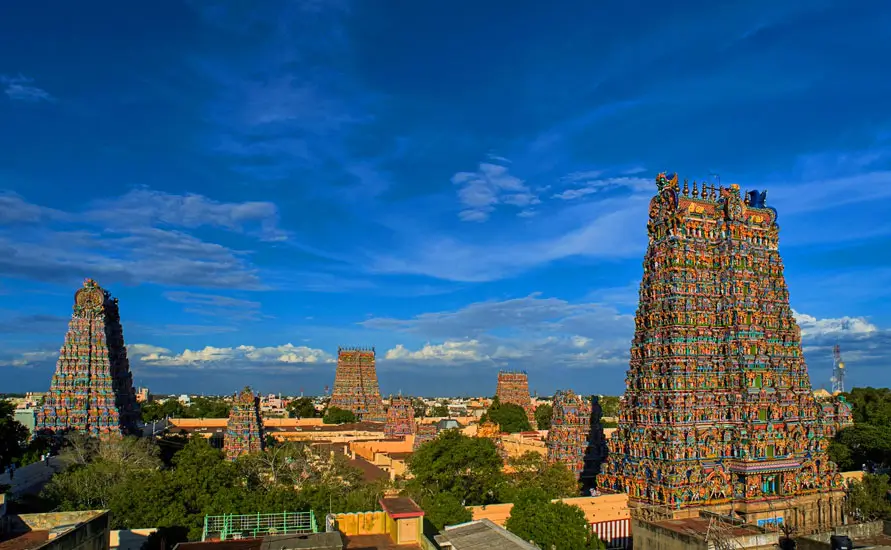
Your guide meets you early for the Meenakshi Temple, the shrine at the center of Madurai devoted to Meenakshi, the fish-eyed goddess, and Shiva as Sundareswarar. The fourteen towers of the complex are visible from every rooftop, each covered with thousands of painted figures. Phones and cameras must be checked in at the outside counters, and the two sanctums are open to Hindus only, yet plenty remains: the Golden Lotus Tank, a pillared hall that now serves as the temple museum, and a row of slim pillars that each sound a different note. Your guide tells the legends carved on the pillars and describes the city's annual festival celebrating the wedding of the goddess.
After the temple you walk through the surrounding markets, where tailors in the Pudhu Mandapam sit at sewing machines between carved pillars and stalls sell brass lamps, cotton saris and temple jewelry. In the afternoon, the Gandhi Memorial Museum, set in Rani Mangammal's 17th-century Tamukkam palace, covers the independence movement and preserves the dhoti Gandhi was wearing when an assassin killed him in January 1948. Madurai was where Gandhi first decided to dress only in a simple loincloth, a choice that became a symbol of his movement. The afternoon is then free for rest at the hotel.
Around 9 pm, after dinner, you head back to the temple for palliyarai: every night the image of Sundareswarar travels by palanquin to the goddess's sleeping chamber. Priests lead the procession with drums, nadaswaram pipes and oil lamps, and worshippers press along the passage to see it pass. Non-Hindus can watch from the outer corridors, and the atmosphere, with incense, music and the gleam of brass lamps, makes a fitting end to the trip. Your guide picks a spot by a pillar where you can see clearly without blocking the worshippers, and explains each stage of the rite as it unfolds. Overnight in Madurai.
A final morning allows time for a last walk or some shopping, and then the car heads for Madurai Airport, about twenty-five minutes from the city center. From Madurai there are domestic flights to Chennai, Bangalore, Mumbai and Delhi, for the onward long-haul flight, and a few direct international routes to the Gulf, Singapore and Colombo. We plan your flight times so there is a comfortable buffer before your long-haul departure, and a transit hotel in Chennai or Delhi can be added if your connection is late at night.
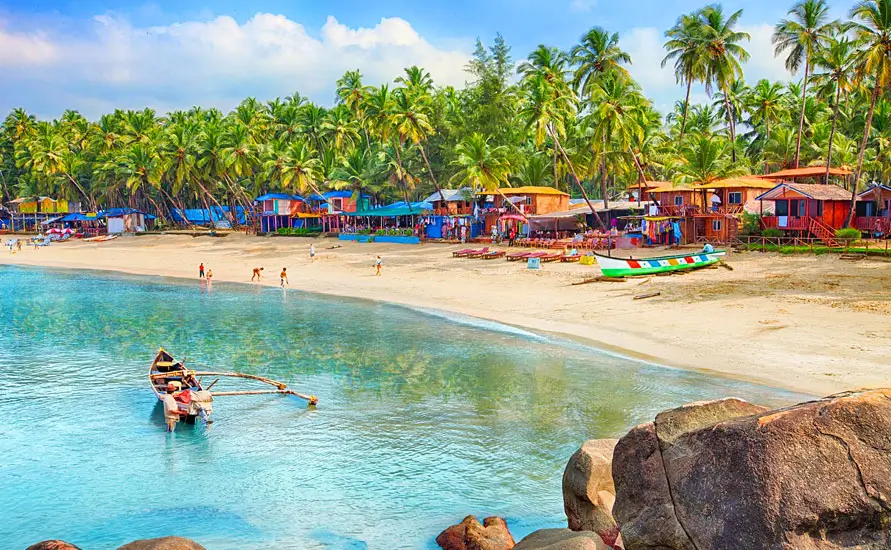
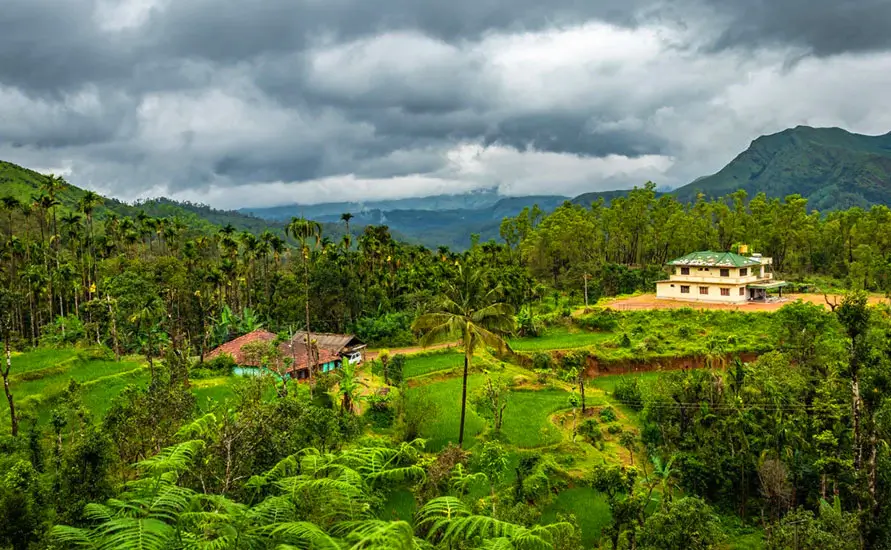
Twelve nights have taken you from Mughal marble to Chola granite, and we hope the craftspeople you met along the way, from the inlayers of Agra to the stone carvers of Mahabalipuram, stay in your memory. Until the cabin doors close, our office is a phone call away. Kerala's backwaters, the Nilgiri hill stations and the Goan coast are all waiting for a second visit, and planning it with you would be a pleasure.
Your Journey
N.S. Rathore & Mrs. Omlata Rathore · Managing Director
We still read every enquiry ourselves. Tell us the places you liked and our planners will send a day-by-day route with drive times and a clear price.
No ready-made packages and no pressure to book. A planner from our Kochi office replies within 24 hours with a route written for your group.
Fill this in and your planner will send a first draft itinerary.
Explore more
Kerala Backwaters Escape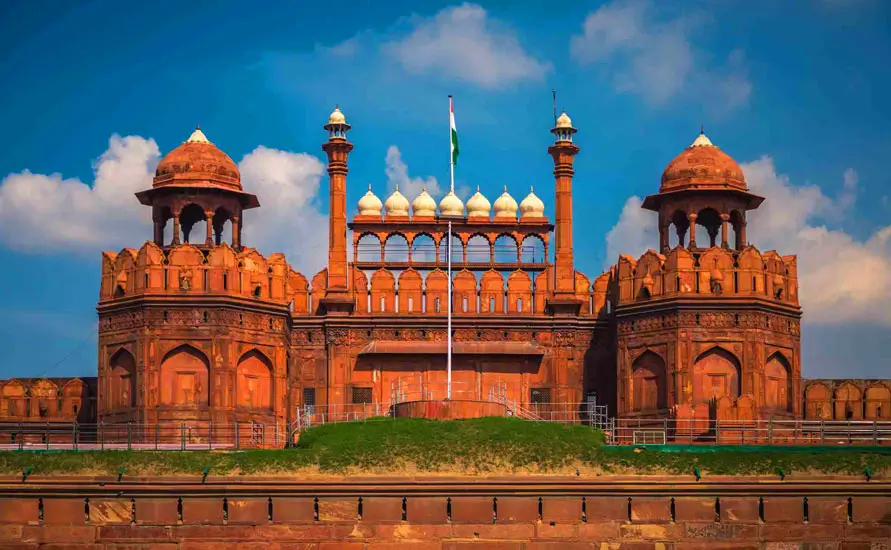 Kerala Backwaters Escape
 Kerala Backwaters Escape
 Kerala Backwaters Escape
 Kerala Backwaters Escape
 Kerala Backwaters Escape
 Kerala Backwaters Escape
 Kerala Backwaters Escape
 Kerala Backwaters Escape
 Kerala Backwaters Escape
 Kerala Backwaters Escape
 Kerala Backwaters Escape
 Kerala Backwaters Escape
 Kerala Backwaters Escape
 Kerala Backwaters Escape
 Kerala Backwaters Escape
 Kerala Backwaters Escape