 Kerala Backwaters Escape
Golden Triangle Tour With South India
Delhi – Agra – Jaipur – Bangalore – Mysore – Coorg
At a glance
Royal courts link every stop on this route, from the Mughal emperors of the north to the Wodeyar maharajas of Mysore and the Kodava planters of the Western Ghats. Our Golden Triangle with Mysore and Coorg begins with five nights in Delhi, Agra and Jaipur, where Red Fort audience halls, a dawn visit to the Taj and Amber's mirrored rooms set the scene. A flight then carries you a full 2,000 km south to Bangalore, and the second half follows the road through Tipu Sultan's island fortress to Mysore and up into the cool coffee hills of Coorg.
Pacing matters on a two-region trip, so drives are kept to sensible lengths. Delhi gets two nights for jet lag and sightseeing, Agra one night timed so the Taj Mahal at sunrise never lands on its Friday closure, and Jaipur two nights. In Karnataka, one night in Bangalore breaks the travel day, one night in Mysore puts you beside the palace and the evening market, and two nights on a coffee plantation in Coorg give you a slower finish among pepper vines and shade trees. Licensed guides join you in every major town.
This Golden Triangle and Karnataka tour suits travelers from the US, Canada and Europe who have seen photographs of the Taj and want a second, quieter India alongside it, and NRI families with roots in the south who want children to see both halves of the country. Food changes sharply along the way, from Mughlai kebabs and Rajasthani thalis to crisp dosas and Kodava pork curry. October to February brings the most comfortable weather in both the north and the Western Ghats.
Your flight lands at Delhi's Indira Gandhi International Airport, and once you clear immigration, look for our representative near the exit with a sign carrying your surname. A few practical items are handled straight away: cash from an ATM in the arrivals area, a phone connection and ten minutes of plain-spoken advice about the coming week. The car ride into the city, past the embassies and wide tree-lined avenues of Lutyens' New Delhi, gives a first impression of how green the capital is. Your room is ready from the standard afternoon check-in time, and we can reserve it from the previous night if you are landing before dawn.
After some sleep, your guide collects you in the late afternoon for one of the most welcoming places in the city. Gurdwara Bangla Sahib, the principal Sikh house of worship in Delhi, is open to people of every faith, and visitors are asked only to cover their hair with a scarf, remove their shoes and wash their feet at the entrance. Musicians inside sing kirtan from the Sikh scripture almost without pause from dawn until late evening. The large rectangular pool, the sarovar, reflects the gilded domes, and the water is believed to have healing properties linked to the eighth Sikh Guru, Har Krishan.
What stays with most guests is the langar: an enormous free canteen run entirely by volunteers, feeding anyone who walks in, rich or poor, Sikh or not, on a scale that can reach tens of thousands of plates daily. Join the long rows seated cross-legged on floor mats for a simple plate of dal, rice and chapati, or to spend a few minutes helping roll dough in the kitchen. Afterward, a short drive takes you down Rajpath, now called Kartavya Path, to India Gate, the war memorial arch lit up in the evening while local families stroll and buy ice cream. Overnight in Delhi.
Shah Jahan moved the Mughal capital from Agra to Delhi in the 1640s, and the walls of the Red Fort still dominate the old city he founded, Shahjahanabad. Your guide enters with you through the Lahori Gate, then leads you along the covered Chhatta Chowk arcade, where court jewelers and silk merchants once traded, to the Diwan-i-Am, whose arcade of scalloped arches once framed the emperor's marble throne canopy as he listened to public complaints. Mondays are a closing day at the fort, so if your second day falls on a Monday, we view the ramparts from outside and spend extra time in the old city instead. Sturdy walking shoes are a good idea for the uneven paving.
From the fort gate, a cycle rickshaw carries you into Chandni Chowk, Old Delhi's main street since the 17th century, and your guide leads a tasting walk through its side lanes. Expect thick-crusted stuffed paranthas fried in ghee, crisp jalebis coiled straight into hot sugar syrup, and creamy kulfi set in clay cups. Each stop is chosen for hygiene as much as flavor, and portions are small so you can try several things. Between snacks you pass silver shops in Dariba Kalan, wedding-card printers and a Jain temple with a hospital for injured birds, all within a few hundred meters.
Following a siesta, your guide brings you to Humayun's Tomb, ready by about 1570 on the orders of Bega Begum, the grieving widow of Akbar's father. Its double dome, char bagh garden and use of red sandstone with white marble borders set the pattern that later shaped the Taj Mahal, which is why the site is listed by UNESCO. Late afternoon is the ideal time to visit, when the sandstone turns deep orange and parakeets gather in the trees. On the way back, your driver passes Raj Ghat, the simple black platform marking the spot where Mahatma Gandhi's cremation took place after his assassination in January 1948. Overnight in Delhi.
Leave the capital after an early breakfast while traffic is still light. Your driver uses the Yamuna Expressway, and the four-hour ride to Agra passes sugarcane fields, roadside dhabas and the occasional camel cart, with a stop for chai at a highway food court around the midpoint. Bags dropped, you can stretch out for an hour before lunch. Agra was the main Mughal capital for much of the 16th and 17th centuries, through the reigns of Akbar, his son and his grandson, so your guide sets out the family story before the afternoon visit, because it makes both the fort and tomorrow's Taj much easier to follow.
Built mostly in red sandstone by Akbar from 1565, Agra Fort grew over three generations into a walled palace city on a bend of the Yamuna. Inside the Amar Singh Gate, your guide points to the Jahangiri Mahal, a sandstone palace whose bracketed eaves and carved balconies borrow freely from Rajput building, and the white marble halls that Shah Jahan added later. The most moving corner is the Musamman Burj, an octagonal tower where Shah Jahan was held for his final eight years after his son Aurangzeb seized the throne. From its latticed windows he could look downstream at the Taj Mahal, where his wife Mumtaz was buried.
In the early evening, your guide walks with you through Kinari Bazaar, the old market around Agra's Jama Masjid. The name refers to the gold and silver trim used on wedding saris, and the lanes are still full of shops selling sequined borders, turbans, bangles and bridal accessories. Sweet sellers fry dalmoth, a spicy lentil snack, and stack boxes of petha, Agra's candied ash gourd in flavors from plain to rose and saffron. Dinner is back at the hotel, and bed comes early because tomorrow starts in the dark. Overnight in Agra.
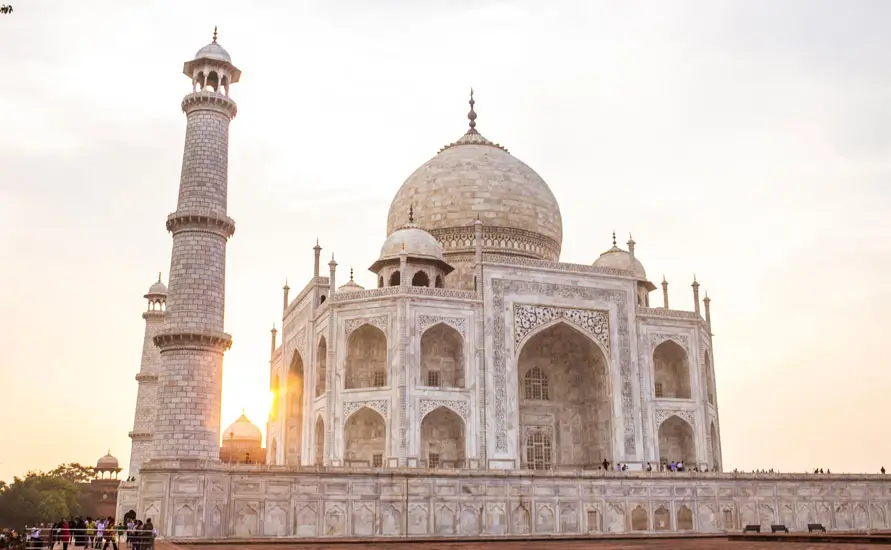
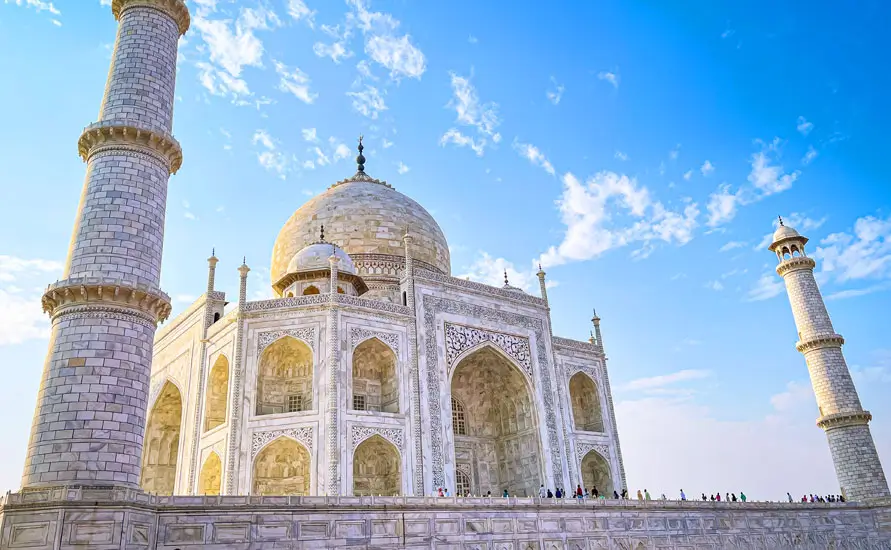
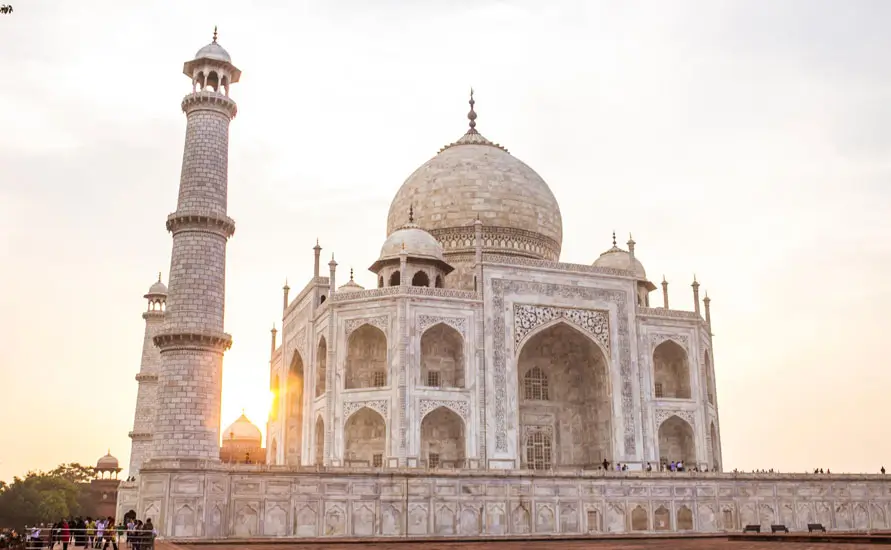
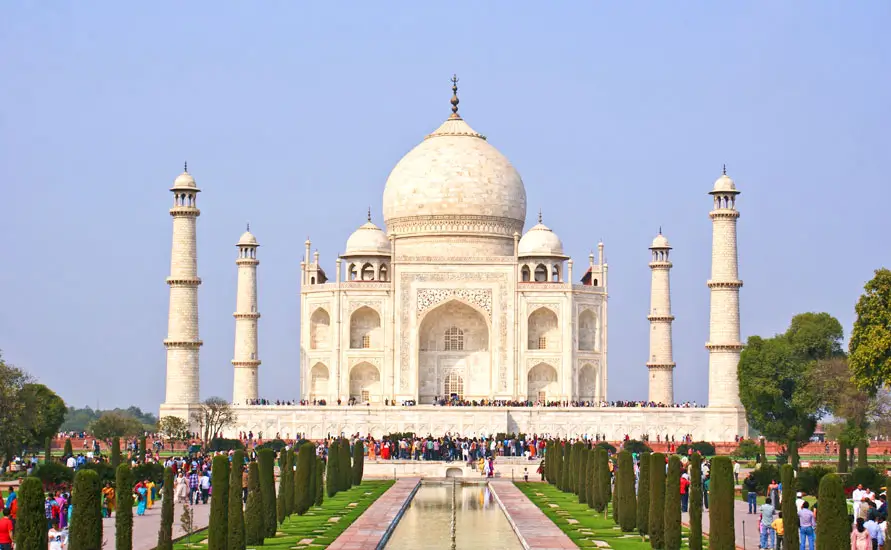
Well before daybreak your guide is waiting downstairs, and within minutes you are standing in line for the first entry of the day at the Taj Mahal. The mausoleum is shut on Fridays for prayers at its mosque, so this morning is never planned for a Friday; if a change of flights shifts your dates, we swap the order of the Agra sightseeing to fit. Sunrise brings the most even light on the white marble and the fewest crowds. Inside the tomb chamber, the cenotaphs of Mumtaz Mahal and Shah Jahan are surrounded by a marble screen so fine it looks like lace.
Your guide points out details most visitors miss: the inlaid flowers made from up to sixty separate pieces of stone, the calligraphy of the poet Amanat Khan, and the mosque and its mirror-image guest hall that frame the tomb on either side. Return for breakfast and checkout, then drive west into Rajasthan. Around 40 km from Agra is Fatehpur Sikri, the royal city Akbar built to honor Salim Chishti, the Sufi mystic whose blessing he credited for the son he had long prayed for. Its huge Buland Darwaza gate, built to mark a military victory, rises 54 meters above the steps of the Jama Masjid.
The palace area includes the Panch Mahal, a five-level open pavilion used to catch the breeze, and the house of Jodha Bai, with its blue glazed roof tiles. After an hour or so, continue to Jaipur, a drive of around four hours along a road that runs past mustard fields, small temples and rocky hills topped with old watchtowers. You reach the Pink City in the late afternoon. If you still have energy, the white marble Birla Mandir lights up at dusk and is a calm place to watch evening prayers before dinner at the hotel. Overnight in Jaipur.
The best view of Hawa Mahal is from the rooftop cafes across the road at around seven in the morning, when the low sun turns its pink sandstone facade almost coral. Built in 1799 by Maharaja Sawai Pratap Singh, this five-story screen pierced by 953 small casements let the women of the palace follow street processions without being seen. In parts the building is just a single room thick, and from behind it looks more like a stage set than a palace. Your guide explains how the latticework also kept the rooms cool by funneling breezes, giving the building its name, the Palace of Winds.
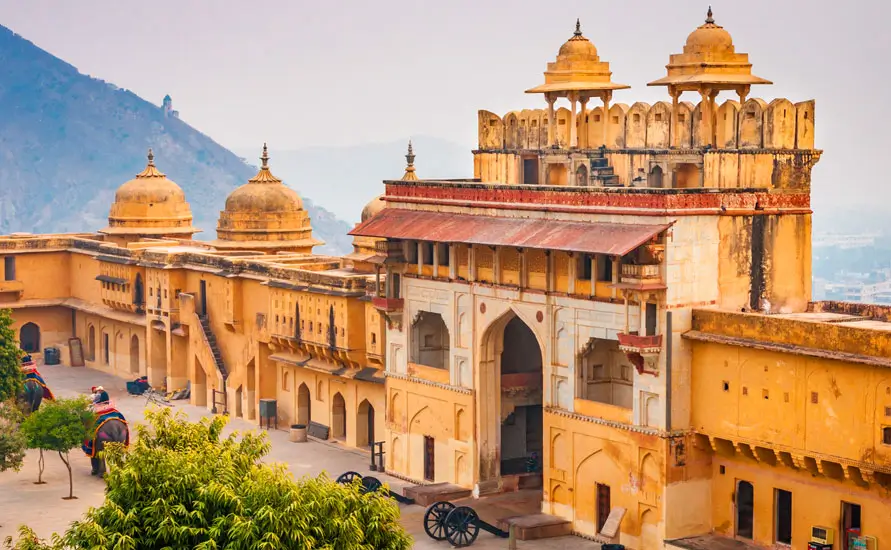
Next, drive north to Amber Fort, the Kachwaha stronghold that was the capital before Jaipur was built in 1727. A jeep climbs the switchback ramp to Jaleb Chowk, the main courtyard, and on foot your guide moves through the Diwan-i-Am, the Sukh Niwas, where water once flowed through channels to cool the rooms, and the glittering Sheesh Mahal, whose ceiling is set with small mirrors and colored glass. Take a moment at the ramparts to see how the fort's walls continue for miles along the ridge. Lunch is at a restaurant in the old city, where laal maas, a fiery mutton curry, is the local specialty.
In the afternoon you visit a blue pottery studio, where the craft arrived from Persia via the Mughal courts and was revived in Jaipur in the 20th century. Unusually, it uses no clay; the body is made from ground quartz, glass and Multani mitti, which makes each piece brittle but gives the glaze its bright cobalt and turquoise color. You can watch artisans paint birds and flowers by hand and choose a small tile or bowl to take home. After dark, a short drive past the Albert Hall Museum, lit up in gold, rounds off your last evening in Rajasthan. Overnight in Jaipur.
A slower morning gives you time to pack, have breakfast and perhaps walk around the hotel garden before the drive to the airport at Sanganer. Your Jaipur flight to Bangalore is usually nonstop and lands about 150 minutes after takeoff, crossing almost the entire width of central India. The terrain below shifts from the dry plains of Rajasthan to the flat Deccan plateau, and the temperature on arrival is often several degrees cooler because Bangalore sits around 900 meters above sea level. Our Karnataka representative meets you at Kempegowda International Airport, in the north of the city.
Expect an hour or so on the road into central Bangalore. India's technology capital is famous for software parks and traffic, but its center still has the leafy feel of a 19th-century British garden city. After checking in, your local guide takes you to Cubbon Park, 120 hectares of bamboo groves, flowering trees and colonial-era buildings, including the brick-red Seshadri Iyer Memorial Hall that now houses the state library. In the evening the park fills with joggers, families and dog walkers, and it shows how residents actually spend their time beyond its tech offices. Your guide also shares stories about the founding chieftain, Kempe Gowda, who built a mud fort here in 1537.
Facing the park, the Vidhana Soudha houses Karnataka's state legislature in pale granite, built in a grand Neo-Dravidian style in the 1950s and lit up on Sunday evenings and public holidays. Afterward, your guide takes you for dinner at one of Bangalore's old vegetarian restaurants, where you can try a crisp masala dosa, a rava idli and a frothy filter coffee cooled by pouring it from steel cup to steel saucer. If you prefer something livelier, the city is also known for its craft brewpubs, many of which serve good food on open rooftops. Overnight in Bangalore.
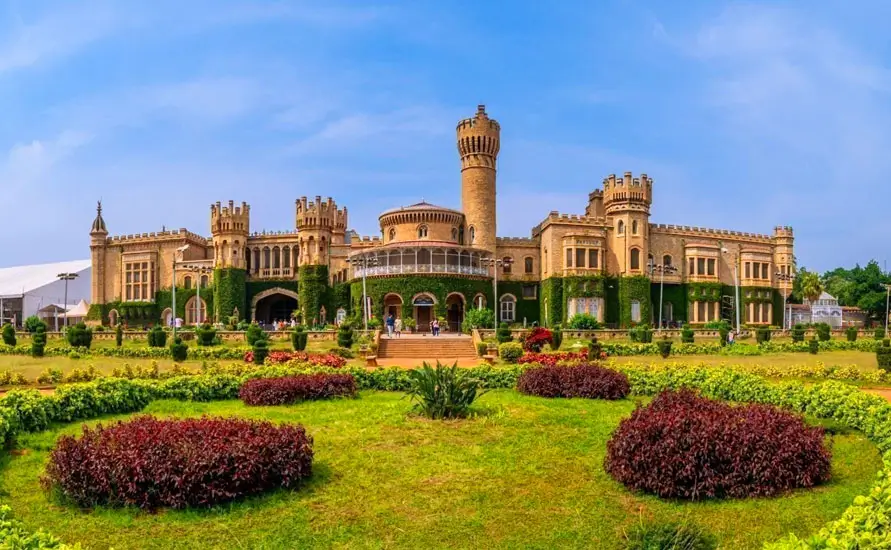
Before leaving, a short stop at Bangalore Palace, the Wodeyar family's Tudor-style residence completed in the late 1880s, said to echo Windsor Castle, shows a very English side of Indian royalty, with turrets, wood-paneled halls and hunting trophies. From there, the expressway to Mysore takes you past paddy fields and coconut groves, and in under three hours a bridge over the Kaveri delivers you to the island town of Srirangapatna. Tipu Sultan, the Tiger of Mysore, ruled from this island and fought the Company's armies again and again, a struggle that ended with his death at the fort's breach in 1799.
First comes Daria Daulat Bagh, the ruler's teak-pillared summer retreat, and set in a formal garden. Floor-to-ceiling murals cover the outer walls, among them a famous scene of the 1780 Battle of Pollilur, in which Tipu's forces defeated a British army. Nearby are the spot where his body was found inside the fort walls, and the Gumbaz, the domed tomb of Hyder Ali and his queen, where Tipu was buried next to his parents. Before moving on, step into the large Ranganathaswamy Temple, an important Vishnu shrine whose name the town shares.
The final 20 km brings you into Mysore by mid-afternoon. After checking in, your guide takes you to Devaraja Market, a market hall from the 19th century where stalls are stacked with jasmine garlands, mounds of colored kumkum powder, betel leaves, bananas and the local Mysore sandalwood soap and incense. It is a lively, friendly place, and stall holders are used to curious visitors. On Sunday and public-holiday nights, the facade of the palace is lit with nearly 100,000 bulbs for about forty-five minutes after seven, a sight worth planning dinner around. Overnight in Mysore.
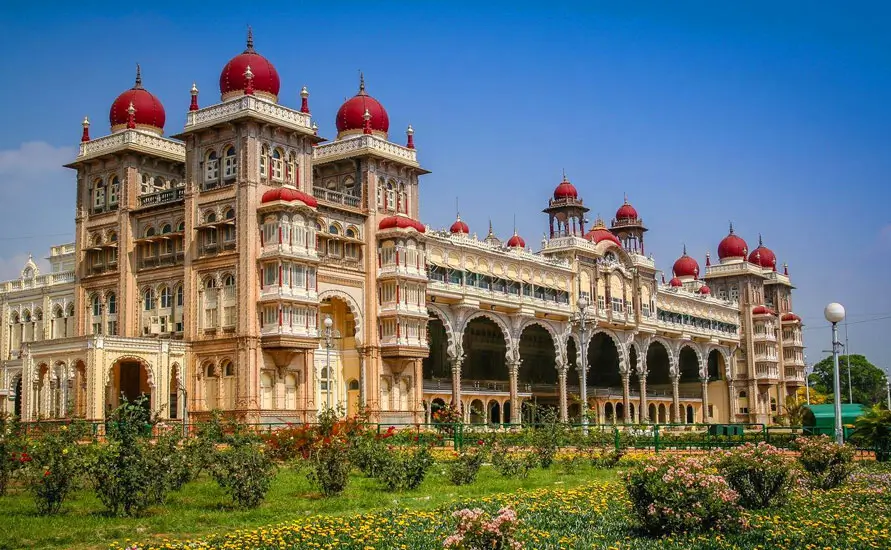
Open from morning, Mysore Palace went up in stone between 1897 and 1912, after flames consumed its timber forerunner during a royal wedding, and it remains the seat of the Wodeyar family. Footwear goes into a cloakroom and cameras stay in your bag in most halls, which keeps the focus on the craftsmanship: the octagonal Kalyana Mantapa with its peacock-patterned glass ceiling, the gold-leaf columns of the Durbar Hall and silver-plated doors decorated with images of gods. Your guide explains how the royal family still hosts the Dasara festival every autumn, when the palace grounds fill with a procession of decorated floats and music.
Next your car climbs to the summit of Chamundi Hill, where the temple of the goddess Chamundeshwari overlooks the city. Partway down the slope sits the giant granite Nandi, Shiva's bull, cut from one boulder around 1659 and still dressed with garlands by local worshippers. Then you turn west, the land rising steadily toward the Western Ghats, with coconut and areca groves giving way to tobacco fields and forest. Two hours west, prayer flags announce Bylakuppe, where Tibetan exiles were given forest land by the Mysore state government in 1961 and, over the following decades, turned it into maize fields, schools and monasteries.
Its centerpiece is the Namdroling Monastery, known as the Golden Temple, home to thousands of monks and nuns. Three gilded figures, each roughly 18 meters high, fill the main hall: Shakyamuni Buddha flanked by Padmasambhava and the long-life Buddha, Amitayus, and an afternoon visit can coincide with young monks chanting to the sound of long brass horns. Be quiet and respectful, and ask before photographing people. From here, it is about an hour more up winding roads into Coorg, also called Kodagu, where you check in to your coffee-estate resort in time to watch the mist settle over the hills. Overnight in Coorg.
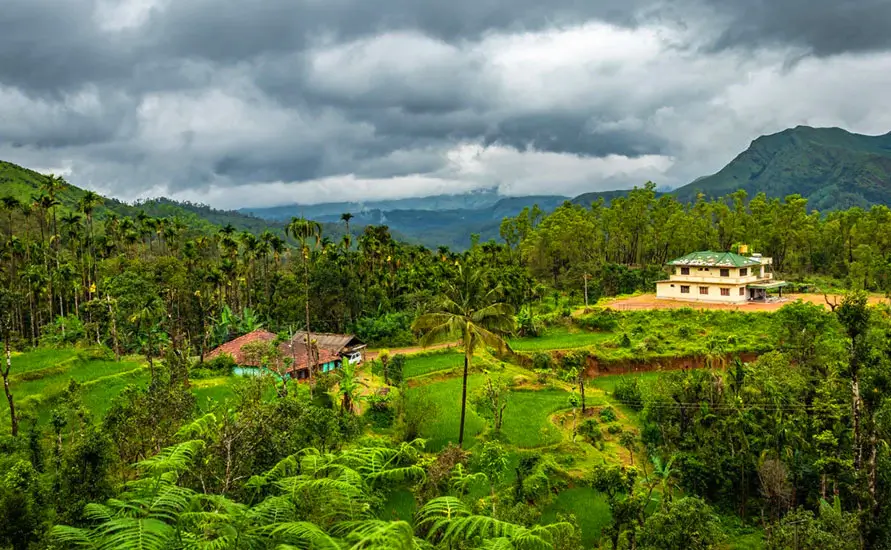
Kodagu district grows more coffee than any other in the country, and the morning begins with a walk through the plantation with an estate manager or one of the long-serving pickers. Arabica and robusta bushes grow beneath tall silver oaks and native forest trees, and black pepper vines climb the trunks, giving the estates a second crop. You learn how the red cherries are hand-picked between December and February, pulped, fermented and sun-dried, and how a single blossom shower in March can decide the next season's harvest. Back at the bungalow, a fresh pot made with beans roasted on the property arrives with cardamom biscuits baked in the estate kitchen.
Around eleven, your driver heads for Abbey Falls on the edge of Madikeri, a cascade that tumbles over black rock in a ravine lined with cardamom and tree ferns. The cascade is fullest from late monsoon through autumn, and a short walk and steps lead down to a hanging bridge with a good view. Lunch is a traditional Kodava meal: pandi curry, the dark pork dish flavored with kachampuli vinegar, served with kadambuttu rice balls, akki otti flatbread and bamboo-shoot curry. Vegetarian alternatives are always available, and your guide explains the Kodava community's martial traditions and distinctive dress.
The afternoon takes you into Madikeri, Coorg's small hill town, where Tipu rebuilt the older ramparts in stone, walls that the British later turned into offices and a jail. Next to it, the Omkareshwara Temple blends Islamic domes with Kerala-style roofs. Sunset is best from Raja's Seat, a flower garden on a cliff edge that local tradition links to the Kodava rulers, with long views over the folded green ridges of the Western Ghats. Children enjoy the small toy train in the gardens. Returning to the plantation, you find the evening quiet, with dinner on the veranda and the sounds of crickets and frogs from the forest. Overnight in Coorg.
Your last morning on the plantation starts with a cup of estate coffee and, if you wish, a short birdwatching walk to spot Malabar parakeets, hornbills or racket-tailed drongos before breakfast. Bags in the car, your driver then sets off for Kempegowda International Airport, around six hours away via Mysore and the expressway, with stops for lunch and rest. This route works best for evening or late-night international departures, which are common for flights to Europe, the Gulf and the US. For a morning or midday departure, plan on an extra Bangalore night instead, so the drive never becomes a race.
Before you leave Coorg, the shops in Madikeri sell estate coffee beans, local wild honey, homemade wines and spices, which are easy to pack and make good souvenirs. On the drive, your driver can stop again at Srirangapatna or Mysore if you would like a final look or a few more photos. Our timing builds in a three-hour buffer for check-in, and someone from our office keeps their phone on until you confirm you are airside, so you can settle into the long flight home without any last-minute worry.
Your Journey
N.S. Rathore & Mrs. Omlata Rathore · Managing Director
We still read every enquiry ourselves. Tell us the places you liked and our planners will send a day-by-day route with drive times and a clear price.
No ready-made packages and no pressure to book. A planner from our Kochi office replies within 24 hours with a route written for your group.
Fill this in and your planner will send a first draft itinerary.
Explore more
Kerala Backwaters Escape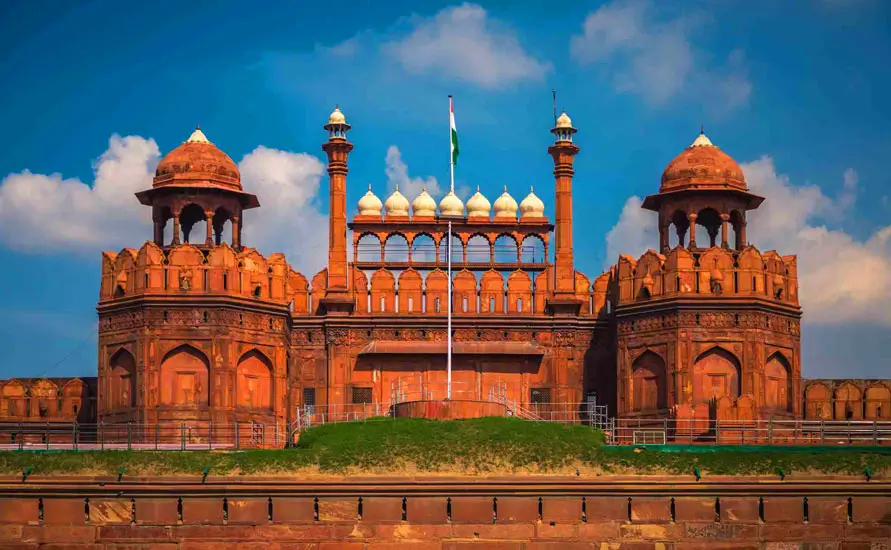 Kerala Backwaters Escape
 Kerala Backwaters Escape
 Kerala Backwaters Escape
 Kerala Backwaters Escape
 Kerala Backwaters Escape
 Kerala Backwaters Escape
 Kerala Backwaters Escape
 Kerala Backwaters Escape
 Kerala Backwaters Escape
 Kerala Backwaters Escape
 Kerala Backwaters Escape
 Kerala Backwaters Escape
 Kerala Backwaters Escape