 Kerala Backwaters Escape

South India Tour with Rajasthan
Delhi – Jaipur – Udaipur – Chennai – Mahabalipuram – Pondicherry – Tanjore – Madurai
At a glance
Rajput kings built upward, onto ridges and cliffs, while Tamil dynasties built temple towers that rise from flat rice country. Our Rajasthan and Tamil Nadu Tour sets those two ideas of power side by side over seventeen days, with plenty of time at each. Up north you get Delhi, the ridge forts and star-measuring instruments of Jaipur, and Udaipur, whose palaces sit with their feet in the water. A connecting flight then lands you in Chennai, and the road runs south past the Pallava shore carvings of Mahabalipuram, French Pondicherry, the Chola capital of Tanjore and finally the gopurams of Madurai.
Nights are split so that no hotel feels like a one-night stop where it matters: three in Jaipur, two each in Delhi, Udaipur, Chennai, Pondicherry, Tanjore and Madurai, and one by the sea at Mahabalipuram. The longest drives, Jaipur to Udaipur and Pondicherry to Tanjore, are broken with meal stops or a temple visit on the way. North and south each get their own chauffeur, who speaks English and sticks with your private air-cooled vehicle throughout that half, and licensed local guides handle the sightseeing, so this Rajasthan and Tamil Nadu Tour moves at whatever pace suits your group.
It appeals to North American, British, European and Australian visitors who have already done, or simply want more than, the standard Golden Triangle, and for NRI families who know one part of India and would like their children to see the other. Food changes as much as architecture: dal baati and laal maas in the north, banana-leaf meals and filter coffee in the south. Travel between October and March for the most comfortable weather. Want to stretch it? This South India tour with Rajasthan takes extra days in Agra, Jodhpur or Kerala without fuss.
Whatever time your plane touches down, a representative from our Delhi office is standing in the arrivals hall with a printed name board, and your air-conditioned car is parked a few steps away. The ride to a centrally located hotel in New Delhi usually runs between forty-five and seventy minutes. Many guests arrive from North America or Europe in the small hours, so today has no sightseeing at all; sleep is the only thing on the agenda. Share your flight number and we book the room from the evening before your arrival, so nobody waits in a lobby at dawn.
In the afternoon or evening our tour coordinator stops by for a short meeting, hands over your vouchers, a phone number that is answered around the clock and a few tips on tipping, bottled water and dressing for temples in both north and south India. If you still have energy, a walk around the Georgian colonnades of Connaught Place or a simple dinner of butter chicken and garlic naan near the hotel is an easy first taste of the capital. Overnight in Delhi.
A licensed Delhi guide collects you after breakfast and heads first for the old walled city that Shah Jahan called Shahjahanabad. Seated two to a seat on a cycle rickshaw, you squeeze between handcarts and delivery scooters along the side lanes of Chandni Chowk, where an entire lane trades in nothing but printed wedding cards and the next one over is lined with silversmiths. Your rider pulls up beside the red stone stairs of Jama Masjid, whose courtyard fills for Friday prayers, and you climb up for a view across its three marble domes. Modest clothing is needed, and shoes are carried or left with the attendant.
Leaving the crowds behind, you continue to Raj Ghat, a simple square of black marble near the Yamuna where Gandhi's body was cremated on the last day of January 1948. Visitors walk barefoot across the lawn, and an eternal flame burns at one end. Lunch is at a restaurant your guide trusts, and then you head for Humayun's Tomb, the garden mausoleum his widow commissioned for the second Mughal emperor. Its double dome, char bagh layout and water channels became the template for later Mughal tombs, and in the slanting afternoon sun the sandstone turns almost orange.
Your final major stop is the Qutub Minar complex in the south of the city, where the tall fluted tower of red and buff stone rose in stages under the early Delhi sultans, starting with Aibak around 1193 and finished by Iltutmish and later rulers. Scattered at its foot is the Quwwat-ul-Islam mosque, put together partly from the pillars of demolished temples, and your guide points out Hindu and Jain carvings still visible on the columns. On the drive back, the car circles India Gate at dusk, when Delhi families gather for ice cream on the lawns. Overnight in Delhi.
Breakfast early, then the car turns southwest onto the national highway toward Jaipur, the capital of Rajasthan. Allow a little over five hours including a tea stop, though Friday afternoons and festival weekends can add time leaving Delhi. Once the industrial belt of Gurugram is behind you, the scenery turns rural: brick kilns with tall chimneys, wheat and mustard plots, camel-drawn carts piled high with straw and truck-stop cafés where drivers lounge on charpoys. Your driver knows which highway restaurants keep clean kitchens and decent coffee, and is happy to stop more often if you like.
Your Jaipur base, either a converted haveli or a modern property depending on the category you choose, gives you an hour to rest. Around four o'clock your Jaipur guide arrives to show you a first slice of the pink city. Standing in gleaming white marble, the Birla Mandir honors Vishnu and Lakshmi; it was completed in 1988 below the small Moti Dungri fortress, shows how Indian temple building continued into the twentieth century; its stained glass and carved figures of saints from many faiths often surprise visitors. Shoes stay outside, and cameras must stay put away once you are in the main hall.
Ten minutes away waits the Albert Hall Museum, designed by Samuel Swinton Jacob and named for the Prince of Wales, who laid its first stone during his 1876 visit. Its galleries mix Mughal-era carpets, court miniatures, pottery and an Egyptian mummy that school groups adore, but the exterior is just as striking once the floodlights come on in the evening and pigeons circle the domes. Dinner tonight could be laal maas, the fiery Rajasthani mutton curry colored by Mathania chilies, or a milder vegetarian thali if you are easing in. Overnight in Jaipur.
An early departure takes you north toward Amber Fort, where yellow-and-pink ramparts follow the ridge above Maota Lake. We never book elephant rides; a shared jeep carries you up a back lane, or anyone keen on a climb can walk the stone ramp in about twenty minutes. Inside, the guide walks you from the public courtyard to the private apartments, showing how the Kachhwaha rulers mixed Rajput and Mughal styles. Look up in the Jai Mandir to see mirror mosaics and glass inlay, and down from the zenana quarters to the saffron garden laid out in the lake.
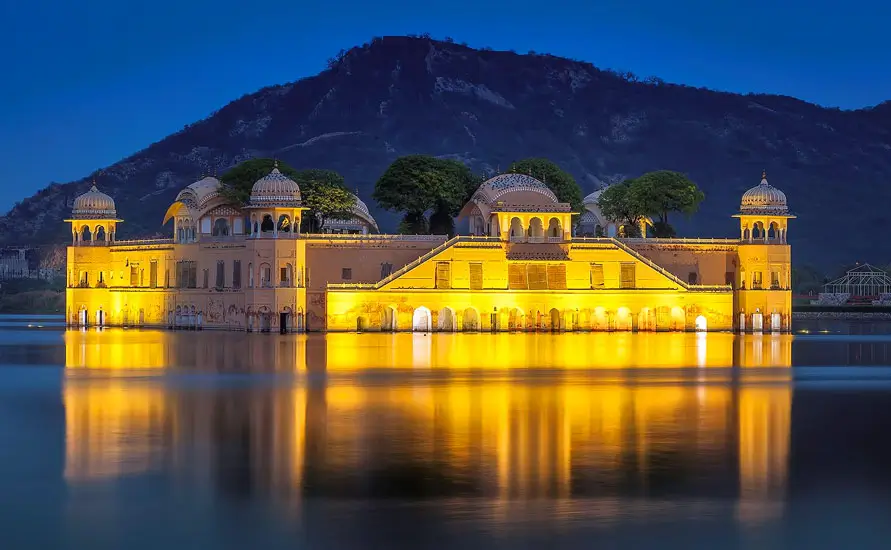
Just downhill, the stepwell of Panna Meena ka Kund is a deep square of crisscross staircases that drop symmetrically on all four sides to a pool of green water. In summers past, villagers drew water here and sheltered on the cool lower steps, and today it makes one of the best photographs in Jaipur, although walking on the steps is no longer allowed. Driving back toward town, your car halts on the lakeside promenade facing Jal Mahal, a five-story pleasure palace whose lower floors are submerged in Man Sagar, with flocks of ducks on the water in winter.
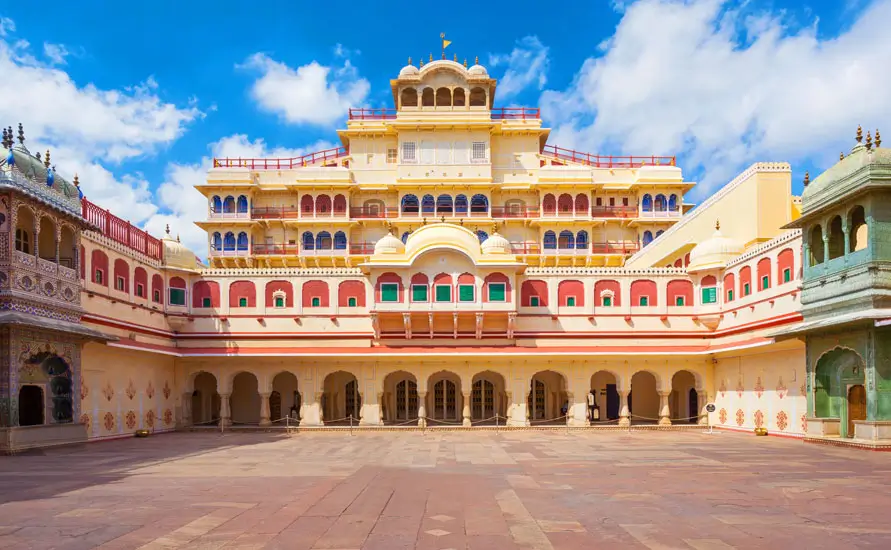
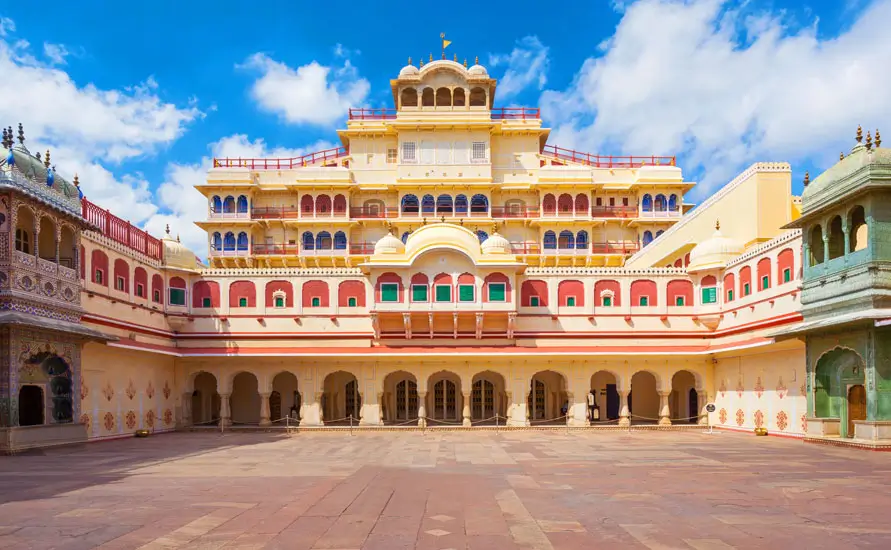
After lunch the afternoon goes to the City Palace, whose courtyards are still used by the former royal family for festivals and weddings. In the Pritam Niwas Chowk, four painted gateways represent the seasons, with a peacock door for autumn and a lotus door for summer, and the textile gallery holds robes once worn by a maharaja said to have weighed well over two hundred kilos. Your guide also explains the palace's role in Jaipur's planning, since the founders drew the walled town in 1727 as nine square blocks based on ancient planning texts. Overnight in Jaipur.
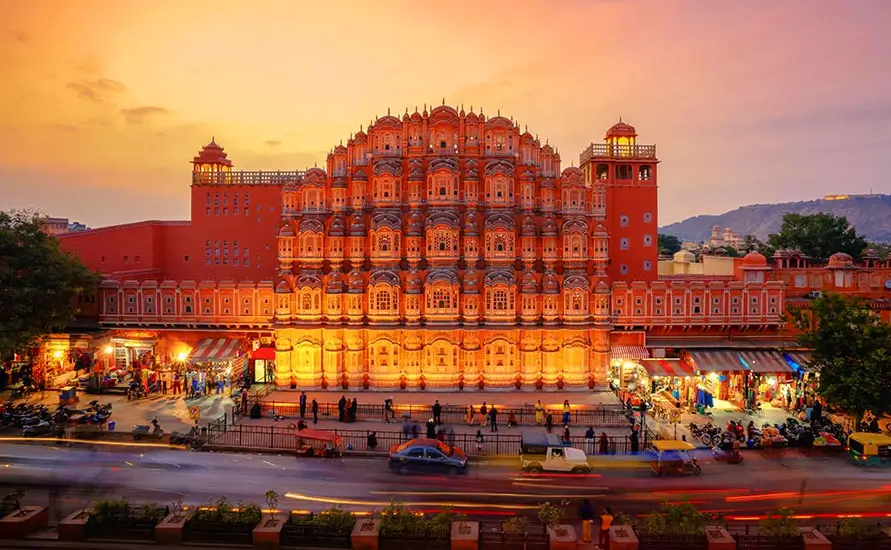
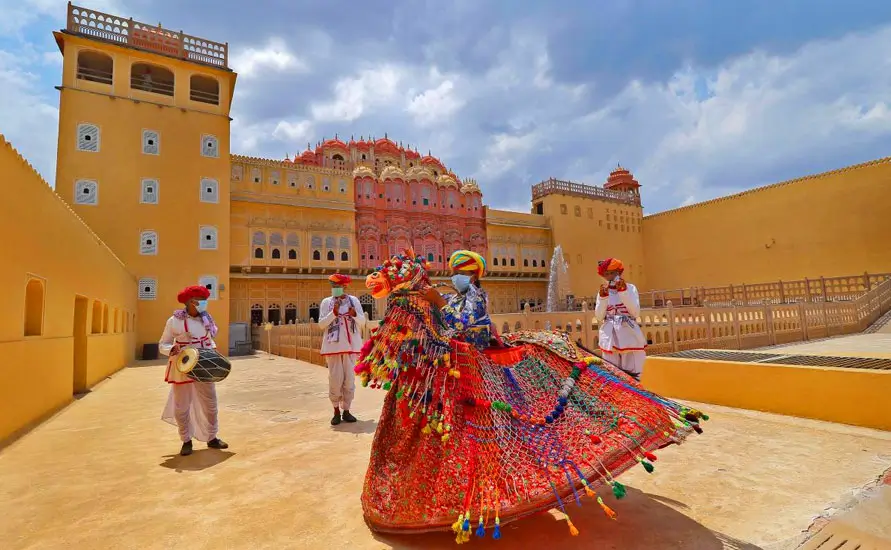
Sunrise is the moment to stand facing Hawa Mahal, Jaipur's honeycomb-fronted wind palace, when the light catches its 953 small windows and the street below is still empty. Built from pink sandstone, the facade is only about one room deep, and the guide explains how its latticed windows kept a breeze flowing through the building. Next comes Jantar Mantar, the UNESCO-listed observatory built by Sawai Jai Singh II, where you walk among masonry instruments for tracking stars, measuring the sun's height and casting horoscopes. Jaipur's priests still consult it before the monsoon to predict the rains.
Later in the morning the car takes you about an hour west to Bagru, a village where Chhipa families have printed cloth by hand for some three centuries. Unlike the larger workshops of Sanganer, Bagru prints use natural dyes and a resist paste of clay, lime and wheat husk called dabu, which leaves soft white patterns after the cloth is dipped in indigo. Your host shows you the carved teak blocks, the vats of iron rust and jaggery used for black, and the riverbank where fabric dries in the sun. You can print a small piece yourself before lunch in the village.
Back in Jaipur, the late afternoon is free to rest, swim or shop for textiles at fixed-price government emporiums. As the light softens, your driver tackles the hairpin road to Nahargarh Fort, begun in 1734 as a lookout guarding the northern approach to the capital. Lean on the parapet and watch street lights switch on across the old town, one neighborhood at a time. Some guests stay for dinner at the fort's café; others prefer to head down for a final evening at a rooftop restaurant in town. Overnight in Jaipur.
Expect the most hours behind the wheel of anything in Rajasthan today, about six hours on a well-surfaced four-lane highway that cuts south through Ajmer and Bhilwara districts into the old kingdom of Mewar. Leaving after breakfast puts you in Udaipur by mid-afternoon with a comfortable lunch break on the way. The land becomes greener and hillier as you go, with marble yards, lakes and small shrines on rocky outcrops. If you prefer to fly, a short flight from Jaipur to Udaipur, often connecting via Delhi or Mumbai, can replace the drive at an extra cost.
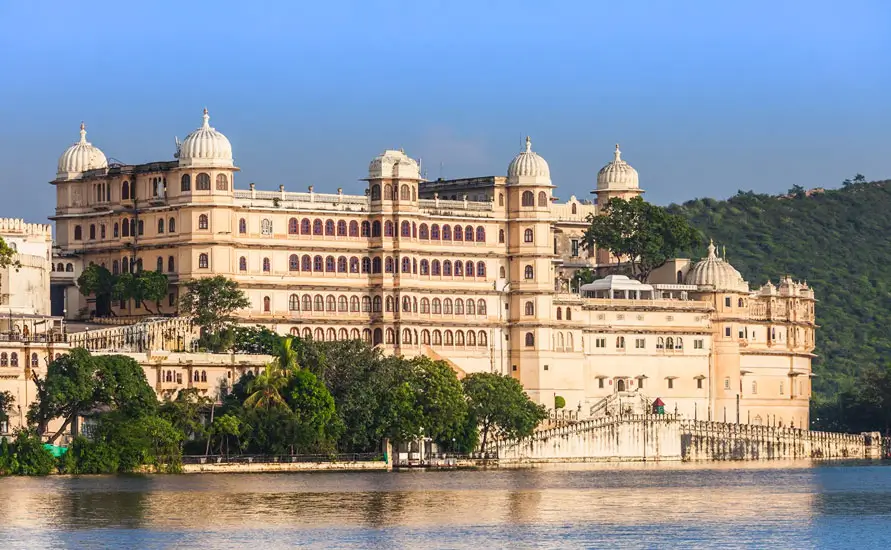
Your Udaipur room is in a lakeside hotel, either in the old city along Lake Pichola or on Fateh Sagar, and the evening is left open. A walk to Gangaur Ghat at sunset is short and easy; this is where local women gather during the spring Gangaur festival, and on most evenings you will find boys diving into the lake and families feeding fish. Many rooftop restaurants nearby look across the water to the lit-up palaces, and some still screen a famous 1983 spy film that was partly shot in the city. Overnight in Udaipur.
Your Udaipur guide begins at the Jagdish Temple, a three-story Indo-Aryan shrine to Vishnu raised in 1651, where a bronze Garuda faces the entrance and devotees ring bells as they climb the steep front stairs. Climbing a short lane from there leads to the City Palace, the largest royal complex in Rajasthan, which grew over several centuries as each Maharana added his own wing. Inside are the glass-inlaid Mor Chowk, with its peacocks made from thousands of colored glass pieces, a crystal gallery and balconies that look straight down onto Lake Pichola.
After lunch in the old city, a boat from the palace jetty takes you out on the lake for about an hour. You glide past laundry ghats, temples and havelis painted white and ochre, and the boat circles the walls of the Lake Palace before stopping at Jag Mandir, an island pavilion of the seventeenth century guarded by a row of stone elephants. There is time to wander its courtyards and enjoy a cold drink on the terrace while the hills reflect in the water. Back on shore, the narrow lanes near Lal Ghat are good for miniature paintings and leather-bound notebooks.
Before dinner, walk down to Bagore ki Haveli, an eighteenth-century prime minister's mansion on the waterfront, where an hour-long folk program is staged most evenings. Rajasthani dancers perform the swirling ghoomar, a puppeteer brings wooden kathputli figures to life, and the finale features a performer dancing with a growing tower of clay pots balanced on her head. Nobody reserves seats here, so arriving twenty minutes early helps. Afterwards, ride back with your driver or wander home along the lamp-lit ghats, where late-night tea stalls serve ginger chai in clay cups. Overnight in Udaipur.
After a slow breakfast with a lake view, your driver takes you to Maharana Pratap Airport, about forty minutes east of the city. There are rarely nonstop services from Udaipur to Chennai, so we reserve the smoothest connection we can find, usually changing planes in one of the big hubs, and door-to-door travel takes around six to eight hours. If the flight leaves in the afternoon, there is time in the morning for the fountains and lotus pools of Saheliyon ki Bari, laid out in the eighteenth century for the queen and her companions.
At Chennai airport our Tamil Nadu representative greets you and introduces your driver for the south. Sticky sea air hits you first, followed by the sound of Tamil on the radio and the smell of jasmine sold at traffic lights. The ride to your hotel in central Chennai takes thirty to sixty minutes. Nothing more is planned tonight, though a first plate of crisp dosa with coconut chutney and sambar at the hotel makes a fine first southern dinner. Overnight in Chennai.
Chennai, called Madras until 1996, grew around a 1639 English trading settlement, so the logical first stop is Fort St. George, the earliest English fortress built on Indian soil. Within the walls stands St. Mary's Church, consecrated in 1680, whose register records the wedding of Robert Clive, while the little fort museum shows regimental swords, East India Company coins and stern officers in oil paint. Today the fort houses the Tamil Nadu state assembly, so security checks are routine and some areas are off limits. Your guide also points out the High Court nearby, a red Indo-Saracenic building with minaret-like domes.
Late morning goes to Egmore and the Government Museum, founded in 1851, where a dedicated gallery displays hundreds of Chola bronzes, including several dancing Nataraja figures cast nearly a thousand years ago. Seeing these sculptures first will help you recognize the same poses in the temples of Chidambaram and Tanjore later in the trip. On Fridays its doors stay shut, so if your Chennai day lands on one we switch the order and visit DakshinaChitra or a Bharatanatyam school instead. Lunch is a traditional Chettinad meal, rich with black pepper and fennel.
Once the heat eases you drive to Mylapore for the Kapaleeshwarar Temple, a living Shiva temple with a towering painted gopuram and a large stepped tank where festivals take place. Arriving around the evening puja, you will hear nadaswaram pipes and drums and see oil lamps carried around the shrines. Non-Hindus can walk the outer corridors, and your guide explains what is happening inside. The day closes at Marina Beach, a long urban beach where families stroll in the sea breeze, eat chili-dusted mango slices and ride small ponies on the sand. Overnight in Chennai.
Checking out after breakfast, you drive the East Coast Road, never far from the shoreline, past fishing hamlets, salt pans and beach resorts. Roughly halfway, about an hour south of the city, sits DakshinaChitra, an open-air museum where old homes from the five southern states were taken apart in their own villages, numbered piece by piece and rebuilt on this coastal campus. You can wander through a Chettiar trader's mansion, a Tamil weaver's home and a tiled Kerala farmhouse, and craftspeople often work on site. DakshinaChitra is closed on Tuesdays, so on that day we reverse the timing.
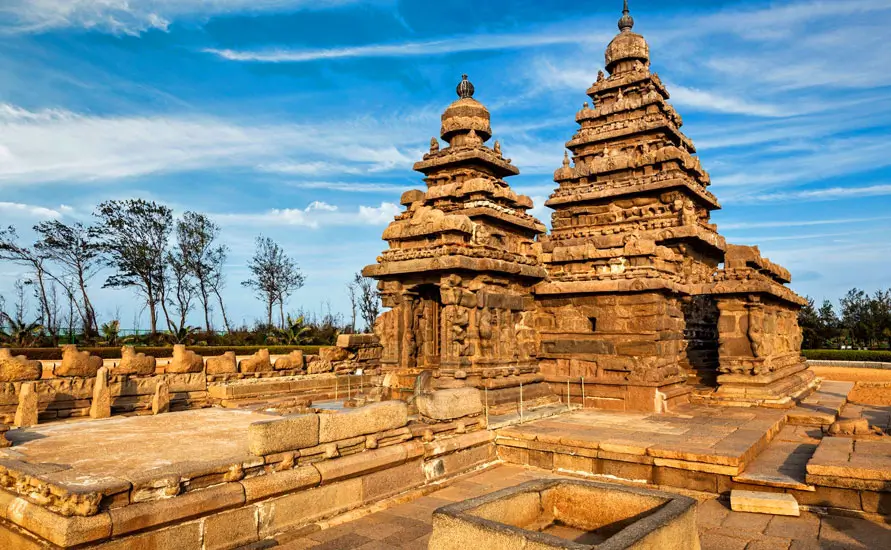
After a simple South Indian lunch at the museum café, the drive continues to Mahabalipuram, the old Pallava seaport now known as Mamallapuram. A beach hotel is your base, and the hottest hours are for the pool or a nap. Around four o'clock your guide takes you to the Shore Temple, two granite shrines to Shiva and one to Vishnu built in the early eighth century by King Rajasimha, practically in the surf. A protective wall keeps the waves back today, and the weathered Nandi bulls lining the compound wall have been softened by salt air.
As the sun sets behind the temple, walk along the beach where fishermen haul catamarans onto the sand and sell crabs and prawns straight from the boats. The village behind the beach is full of sculptors' workshops, and the tap of hammers on stone rings through the streets until dark, as artisans still carve deities, animals and temple panels in the Pallava style for buyers around the world. Dinner can be a grilled fish at one of the small seafood shacks on the beach road, where you choose your catch and say how spicy you like it. Overnight in Mahabalipuram.
Cool morning air makes this the right time to cover the remaining Mahabalipuram monuments, which UNESCO lists together as a single World Heritage Site. Your guide starts at Arjuna's Penance, an enormous relief carved across two adjoining boulders, where elephants, cats, sages, river spirits and gods all face a natural cleft that once channeled rainwater like a sacred river. Close by stand the cave temples of the hillside, including the Mahishasuramardini Mandapa, whose side wall carries a battle relief in which an eight-armed Durga, mounted on a lion, routs the demon Mahisha and his army, and the precariously balanced rock nicknamed Krishna's Butter Ball.
Five minutes by car to the south are the Pancha Rathas, five temple forms each carved from a single outcrop of rock and never consecrated. Your guide explains how the Pallava craftsmen worked from the top down, and why each ratha is named after one of the Pandava brothers or their wife Draupadi even though they have no connection to the epic. Beside them stand a life-size stone elephant, a lion and a Nandi carved from the same granite. If time allows, a detour north to the Tiger Cave adds a shrine framed by carved yali heads.
After lunch the East Coast Road takes you farther south to Pondicherry, around 100 km of coastal villages, casuarina windbreaks and cashew groves. Your heritage hotel or guesthouse stands in or beside the old French Quarter, whose straight streets still carry signs reading Rue this and Rue that. At dusk, join locals on Goubert Avenue, where cars are barred from the beachfront each evening, strolling between the 1836 lighthouse, the French war memorial and a Gandhi statue ringed by tall stone columns. Dinner can be a Franco-Tamil fish curry. Overnight in Pondicherry.
Pondicherry, officially Puducherry, was the main French possession in India until 1954, and on foot with your guide it quickly becomes clear how much of that era survives. In the French Quarter, tall-shuttered villas in yellow and white face Rue Dumas and Rue Romain Rolland, the French Institute studies Indian languages and ecology, and gendarmes once wore the same kepis as their counterparts in Paris. You also pass the Notre Dame des Anges church, built in 1855, and then cross the old canal into the Tamil neighborhood, where houses keep shaded thinnai benches and carved doors.
At the Sri Aurobindo Ashram you join visitors filing quietly past the samadhi, a flower-covered marble tomb under a frangipani tree holding the remains of Sri Aurobindo and his collaborator, the Mother. People keep silent, phones go off, and cameras are not used anywhere inside. Nearby, the Manakula Vinayagar Temple to Ganesha draws a steady crowd, its walls lined with gilded friezes and painted panels showing the god in dozens of forms. Lunch is free to choose, with plenty of bakeries and cafés serving crêpes, quiche and South Indian thalis.
After lunch your car covers the short road north to Auroville, a township started in 1968 by people from 124 nations who wanted to live beyond borders. At the visitor center you watch a short introductory film, then walk a shaded forest trail of about a kilometer to the lookout facing the Matrimandir, a giant golden globe clad in gilded discs. Getting inside its meditation chamber is a separate matter: places are few and must be requested in advance, so flag your interest at the time of booking and our Pondicherry staff will try for a slot. Back in Pondicherry, the shops of the old town sell handmade paper, incense and Auroville pottery until late. Overnight in Pondicherry.
Leaving Pondicherry after breakfast, you run down the coast for ninety minutes or so to Chidambaram, a temple town that Shaivites consider among the holiest places on earth thanks to its Thillai Nataraja Temple. Shiva is honored in this shrine as Nataraja, lord of the dance, and the shrine represents the element of space among the five elemental Shiva temples. Its eastern and western gopurams carry carvings of all 108 karanas, the basic dance poses described in the ancient Natya Shastra, and Bharatanatyam dancers still perform here during the Natyanjali festival around Mahashivratri.
The temple's priests, known as Dikshitars, follow a hereditary tradition, and your guide explains the Chidambara Rahasyam, the secret behind a curtain that represents formless space. Non-Hindu visitors can usually walk the outer halls and corridors, while access to the inner sanctum follows the rules set by the temple; in some halls the priests ask men to take off their shirts. Morning visits are calmer, and the temple closes for several hours around midday. You have lunch at a simple vegetarian restaurant in town, a place where your meal comes on a banana leaf and locals eat with their right hand.
In the afternoon the drive continues inland for about three hours through the Kaveri delta, where paddy fields, coconut palms and irrigation channels cover the land. Village shrines with clay horses guard the edges of fields, and you may see rice being dried on the road surface during the harvest. Late in the afternoon the towers of Tanjore, also known as Thanjavur, appear above the trees, and you settle in for two nights. Fancy some air after the drive? An evening stroll through the town center, with its silk shops and coffee houses, gives you a feel for this old royal city. Overnight in Tanjore.
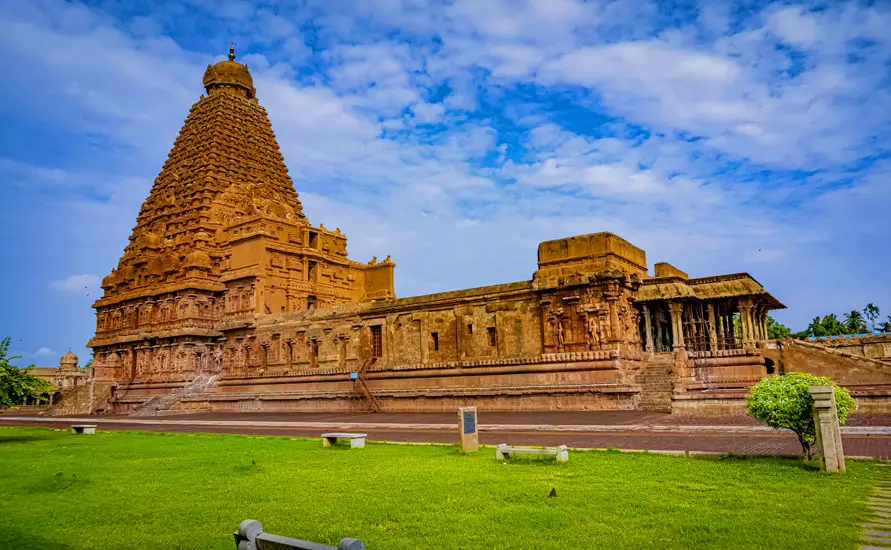
The Brihadeeswarar Temple, completed by the Chola king Rajaraja I around 1010, is the reason most travelers come to Tanjore, and UNESCO groups it with two others as the Great Living Chola Temples. Its tapering vimana tower, roughly sixty-six meters high and built without mortar according to local belief, carries a crowning capstone that tradition says was cut from one granite block. Facing the sanctum, a colossal monolithic Nandi bull, polished smooth by centuries of devotees' hands, and the walls carry inscriptions describing temple dancers, musicians and donations. Early morning, when the granite turns pale gold, is the best time for photographs.
Your guide continues to the Thanjavur Palace, a rambling royal compound of the sixteenth to nineteenth centuries, where an art gallery adds more Chola bronzes and the Saraswathi Mahal Library preserves thousands of palm-leaf texts in Tamil, Sanskrit and Marathi. After lunch you drive about forty kilometers to Darasuram, where the Airavatesvara Temple, also UNESCO-listed, is smaller but more delicately carved than the great temple. Tap the stone steps near the entrance and they ring with different notes, and the porch at the front is carved as a temple car rolling on wheels behind prancing horses.
Returning toward Tanjore, you call in at Swamimalai, a village where families of sthapathis still cast bronze idols using the lost-wax method described in old texts. You watch an artisan shape a figure in beeswax and resin, coat it in fine clay from the Kaveri riverbank, then heat it so the wax runs out and molten metal can be poured in. Finishing a single large piece can take weeks. Buying is optional, and genuine pieces come with a certificate for customs. You return to Tanjore in the early evening for dinner. Overnight in Tanjore.
Around four hours on the road south deliver you to Madurai, where Pandya kings held court and Tamil poets met in literary assemblies called sangams some two thousand years ago. The road passes granite hills, tamarind trees and small market towns where jasmine sellers string flowers on the roadside and farmers spread chilies to dry. Your driver stops for coffee halfway, and you reach the hotel in time for lunch. The city is known for its food, from jigarthanda, which translates roughly as 'cool heart' and mixes reduced milk, sarsaparilla syrup and ice cream, to the soft parottas served at roadside stalls late into the night.
Around five, walk with your guide into the Thirumalai Nayak Palace, the seventeenth-century residence of Madurai's best-known Nayak king. A grandson dismantled large parts of it, yet the surviving courtyard with its massive white columns, stucco arches and painted domes gives a strong sense of its scale. The palace mixes Dravidian and Islamic elements, and an evening sound and light program narrates the dynasty's rise, generally with separate English and Tamil sessions. Afterwards there is time for dinner near the temple before the evening ritual; your guide can suggest a vegetarian mess where idlis arrive steaming from brass vessels.
Around nine o'clock head back to the Meenakshi Temple for palliyarai, the nightly ritual in which priests bear an image of Sundareswarar, Shiva in his Madurai form, on a palanquin so he can rest beside the goddess until dawn. Priests chant, drums beat and devotees crowd the corridor as the procession passes. By temple rule, only Hindus go into the innermost shrines, but the procession passes through corridors open to all visitors. Counters by each gate take your phone and camera for safekeeping, so bring as little as possible. You return to your hotel shortly after. Overnight in Madurai.
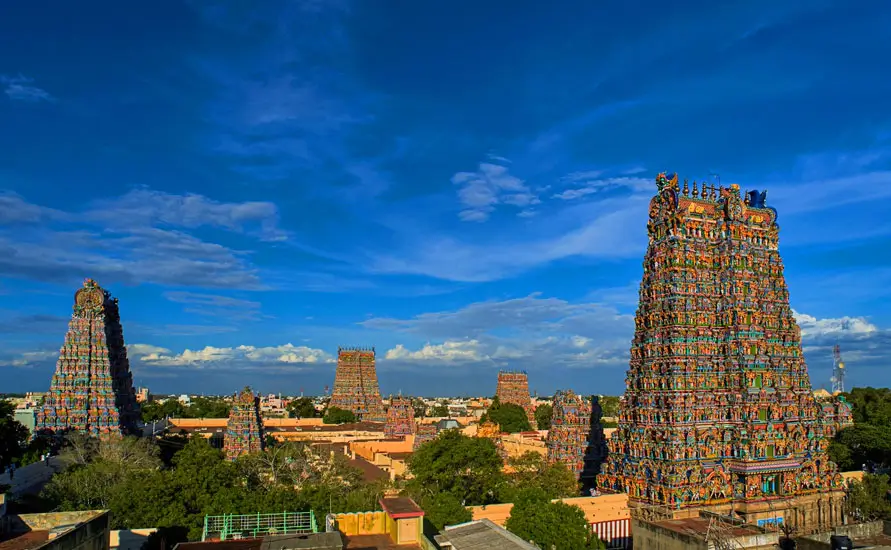
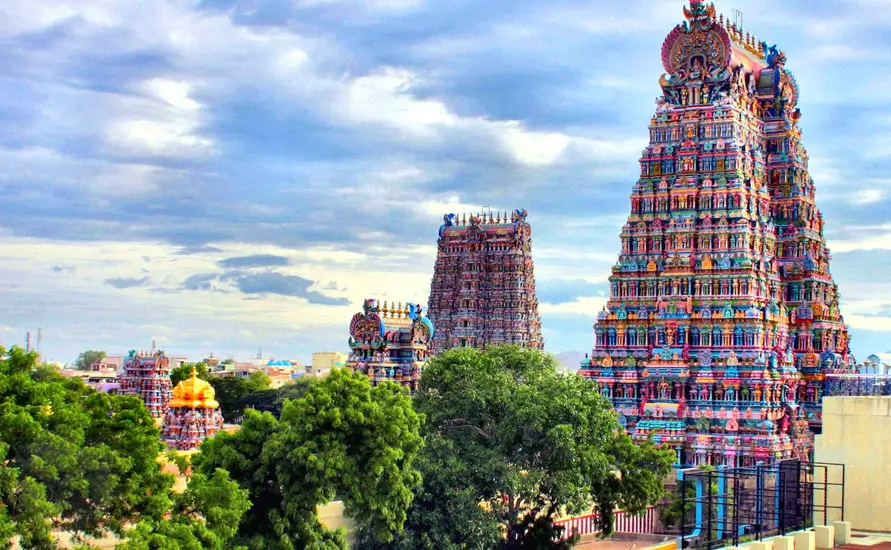
In daylight the Meenakshi Temple looks completely different. Your guide leads you through the gate under one of the fourteen gopurams, the tallest topping fifty meters, every tier crowded with brightly painted plaster deities, guardians and beasts. Within the walls, the Thousand Pillar Hall, where every column is carved differently, now displays temple art, the Golden Lotus Tank reflects the southern tower, and long corridors are filled with shops selling bangles, brass lamps and religious pictures. Leave cameras and phones at the gate as you did last night, and keep shoulders and knees under cloth.
Next comes the Mattuthavani flower market, a vast wholesale shed where traders sell jasmine, marigold, rose and tuberose by the kilo and women thread garlands at lightning speed. The scent of Madurai malli, the local jasmine, fills the hall. Lunch can be a full Madurai meal of mutton chukka, kola urundai meatballs and kari dosa, or a vegetarian thali with half a dozen small dishes and buttermilk. After lunch, Rani Mangammal's former Tamukkam palace, open since 1959 as the Gandhi Memorial Museum, lays out India's freedom movement through photographs and letters; among its exhibits is the stained dhoti from the day of his assassination.
Late in the day, choose between Thiruparankundram, a rock-cut cave temple to Murugan on the edge of the city and the first of his six sacred abodes, and the vast tank of Vandiyur Mariamman Teppakulam, where a float festival is held each January or February. Your final evening has no plan beyond a last Tamil dinner, perhaps with jigarthanda for dessert, and time for packing the silk, bronze and block-printed cotton you collected along the way. Your guide gives a final briefing on the next day's flight timings and airport procedures. Overnight in Madurai.
Madurai's small airport is roughly half an hour from the center, and from there a domestic hop to one of India's international hubs links up with your long-haul flight. A few airlines also fly from Madurai straight to Colombo and the Gulf. We plan the timings so that the connection is comfortable, and on request we can book a hotel room near Chennai airport for late-night departures. With an afternoon departure, a last half hour can be spent watching Sungudi tie-dye being knotted by hand in a family workshop.
Over seventeen days you have climbed Rajput forts, watched printers in Bagru and bronze casters in Swamimalai, and stood before the Chola and Pandya temples of the south. The two regions share little in language, food or architecture, and that contrast is what makes the trip worth the distance. Jodhpur, Jaisalmer and the Kerala backwaters remain for another year, and we would gladly sketch that route too. We wish you a safe and pleasant flight home.
Your Journey

N.S. Rathore & Mrs. Omlata Rathore · Managing Director
We still read every enquiry ourselves. Tell us the places you liked and our planners will send a day-by-day route with drive times and a clear price.
Every package can be customised and no pressure to book. A planner from our office replies within 24 hours with a route written for your group.
Fill this in and your planner will send a first draft itinerary.
Explore more
Kerala Backwaters Escape Kerala Backwaters Escape
 Kerala Backwaters Escape
 Kerala Backwaters Escape
 Kerala Backwaters Escape
 Kerala Backwaters Escape
 Kerala Backwaters Escape
 Kerala Backwaters Escape
 Kerala Backwaters Escape
 Kerala Backwaters Escape
 Kerala Backwaters Escape
 Kerala Backwaters Escape
 Kerala Backwaters Escape
 Kerala Backwaters Escape
 Kerala Backwaters Escape
 Kerala Backwaters Escape
 Kerala Backwaters Escape