


 Kerala Backwaters Escape

South India Tour with Rajasthan
Delhi – Jaipur – Jodhpur – Ranakpur – Udaipur – Goa
At a glance
Desert forts and a Portuguese-era coast rarely share one trip, yet the pairing works better than most people expect. Our Rajasthan and Goa tour spends eight nights moving through Delhi, the pink sandstone of Jaipur, the indigo lanes below Mehrangarh Fort in Jodhpur and the waterside palaces of Mewar's capital, Udaipur, before handing you four slow nights on the Arabian Sea. The first half is busy with guides, bazaars and Rajput history; the second half asks very little of you beyond choosing a beach, a seafood shack and a time to wake up. Sand and stone first, salt water second: that swing in mood is what this Rajasthan and Goa tour sets out to give you.
The road sections are planned around realistic driving times rather than the shortest map line. Delhi to Jaipur takes about five hours, Jaipur to Jodhpur close to six, and the Jodhpur to Udaipur day pauses at Ranakpur's marble Jain sanctuary so nobody sits in the car for long without a break. From Udaipur a domestic flight, usually with a connection, carries you south to Goa. Two nights in each Rajasthan city give you one full sightseeing day per stop, and the same chauffeur, who speaks English, handles every Rajasthan road leg in a private air-conditioned car while licensed city guides take over at each fort and palace.
This 13-day Rajasthan and Goa itinerary suits visitors flying in from America, Canada, Britain, mainland Europe or Australia, plus NRI families who know Mumbai or Delhi well yet have never set foot in Marwar or Mewar. Plan for October through March if you can: Rajasthan days are warm and dry, nights are cool, and the Goa sea is calm enough for swimming. Hotel category, pace and the length of the beach stay can all be changed, because the whole Rajasthan Goa tour package is private and runs on your own dates.
Your first steps in India are at Delhi's Terminal 3, where someone from our local office waits beyond the customs exit with your surname written on a card. Overnight flights from New York, London or Frankfurt tend to land either very early in the morning or around midnight, so the opening hours are kept free. Your driver loads the luggage into the car and takes you to your hotel, which is usually forty minutes away depending on traffic. Standard check-in is mid-afternoon; for a dawn landing, holding your room from the evening before costs extra but means a hot shower and a bed the moment you arrive.
Once rested, you head into New Delhi, the British-era capital whose avenues and domes were drawn up by the architects Lutyens and Baker between the two world wars. The drive runs along Kartavya Path, the broad parade route linking Rashtrapati Bhavan on Raisina Hill with India Gate, an arch whose stone carries the engraved names of Indian troops lost in the 1914–18 war and on the Afghan frontier. Evening is a good time to stop here: the lawns fill with Delhi families eating ice cream, children chase balloons, and the arch is lit up after dark. Your driver waits nearby while you walk around at your own pace.
A short ride away, Gurdwara Bangla Sahib welcomes visitors of all faiths into one of the most important Sikh shrines in the city. Heads must be covered, and orange scarves are handed out at the entrance if you do not bring one; shoes are left at a free counter and feet are rinsed in a shallow channel of water. Inside, hymns from the Guru Granth Sahib play all day. Do look into the community kitchen, where volunteers cook simple dal and chapati for thousands of people every day, free to anyone who sits on the floor to eat. Dinner back at the hotel is up to you. Overnight in Delhi.
Seven centuries of Delhi fit into today, and your guide collects you after breakfast. The morning starts in Shahjahanabad, the walled Mughal city completed for Shah Jahan around 1648, where the car slows beside the crenellated walls of Shah Jahan's Red Fort (closed on Mondays, so the outer view is all you need on that day). Next comes Jama Masjid, whose red sandstone courtyard can hold roughly 25,000 people at Friday prayers. Shoes come off at the steps, legs and arms should be covered, and a loose gown can be borrowed at the entrance if your clothes fall short. From the steps you can watch pigeons wheeling over the rooftops of Chandni Chowk.
Then the guide puts you on a cycle-rickshaw for the narrow lanes behind the mosque, which is the only practical way to move through Old Delhi. The rider weaves past the sacks of Khari Baoli, Asia's biggest spice market, where dried chili makes everyone sneeze, silver jewelers in Dariba Kalan and paper wedding-card printers in Chawri Bazar. It is noisy, crowded and wonderful for photographs, and the guide keeps an eye on bags in the tight spots. A stop for jalebi or a plate of stuffed paratha at a century-old stall is part of the plan if your stomach is ready for street food on day two.
After lunch the car heads to Humayun's Tomb, commissioned by Empress Bega Begum for her husband Humayun and often described as the first draft of the Taj Mahal. The gardens are divided into four by water channels, a charbagh plan the Mughals brought from Persia and Central Asia. The last stop is Qutub Minar, a fluted shaft of five tapering stories that the Delhi Sultanate began in the late 12th century; beside it stands a 4th-century iron column that has resisted rust for more than 1,600 years. Both sites are UNESCO-listed, and late light makes the stone glow warmly. Overnight in Delhi.
Leaving early is the trick on this day, because Delhi traffic thins out before eight and the expressway toward Rajasthan is far easier then. Breakfast can be packed if you prefer to eat in the car. The route crosses Gurgaon's glass towers and then runs through farmland of mustard and wheat, with camel carts sharing the slow lane as you near the state border. Around the halfway point there is a pause at a tidy roadside restaurant for coffee and the restroom. Most guests reach Jaipur a little after lunchtime, so the hours after check-in can go to sleep, a swim or simply sitting still before a light first evening in the city.
Sawai Jai Singh II, a Kachwaha king fascinated by astronomy and geometry, moved his court down from the hills in 1727 and built a new capital. Unlike most old Indian cities, his city followed a planned grid of wide bazaars and walled blocks, and in 1876 the whole old town was painted a terracotta pink to welcome the Prince of Wales. The color remains a local rule today. Toward sunset you stop outside Albert Hall, the Indo-Saracenic museum building in Ram Niwas Garden, whose façade is lit after dark. Its galleries mix Persian carpets, Rajput armor and miniature paintings with, oddly, an Egyptian mummy.
From there it is a short ride to Birla Mandir, a white marble Lakshmi Narayan temple below the small Moti Dungri fort, with stained-glass windows and carved figures of saints and thinkers from several religions. Evening prayer brings bells, lamps and local families, and outsiders may join quietly from the rear of the hall. Ask the driver about a rooftop restaurant facing the illuminated Nahargarh walls, where dal baati churma, the baked wheat dumplings of Rajasthan served with lentils and sweet crumble, is an easy first local dish to order. Shoes off inside the temple, as always. Overnight in Jaipur.
Morning is the right time for Amber Fort, eleven kilometers north of the city, before tour buses arrive and the sun reaches the courtyards. A jeep or a walk up the ramparts gets you to the gate, and we do not book elephant rides. Kachwaha kings ruled from here long before Jaipur was built, and the decoration grows richer with every level, from the pillared hall of public audience up to the royal apartments. In the Sheesh Mahal, your guide shows how a mosaic of convex mirror chips multiplies a single candle flame across the ceiling, and the latticed screens that let royal women watch court life unseen.
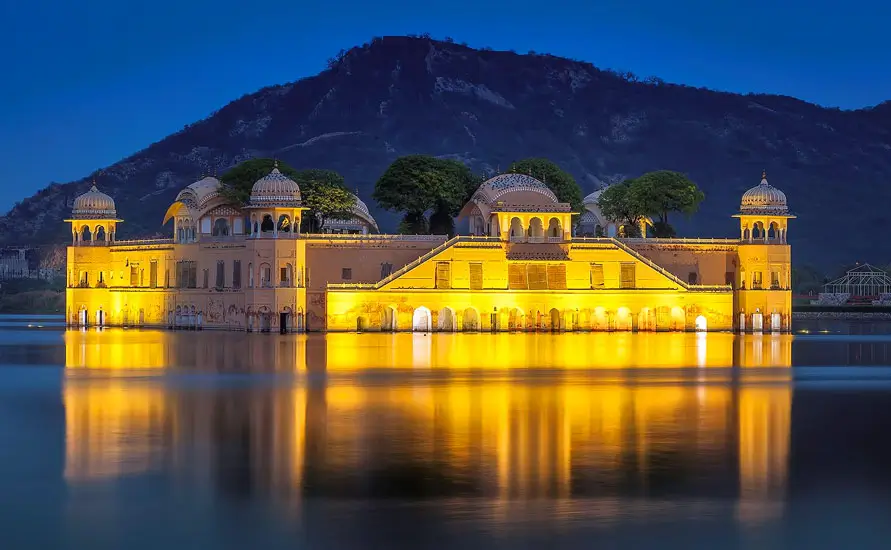
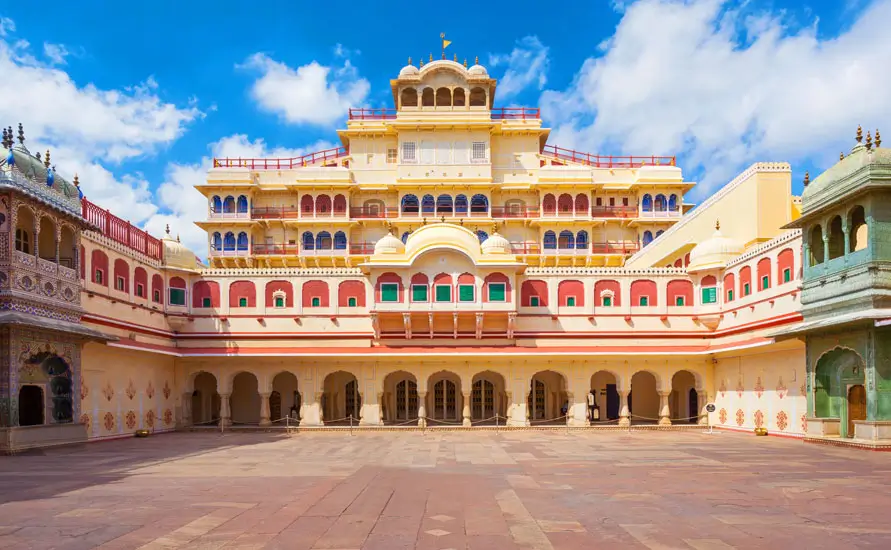
On the way back you pause by Man Sagar Lake for a photograph of Jal Mahal, a low palace that appears to float on the water. Next is the City Palace, where the descendants of the Jaipur rulers still occupy one wing and the Pritam Niwas courtyard has four painted doorways linked with the seasons. Look in the textile gallery for the giant robes of Madho Singh I, a famously large and heavy king. Next door stands Jantar Mantar, a UNESCO-listed set of nineteen stone astronomical instruments, including the Samrat Yantra, a huge sundial whose shadow moves visibly across the scale in a minute.
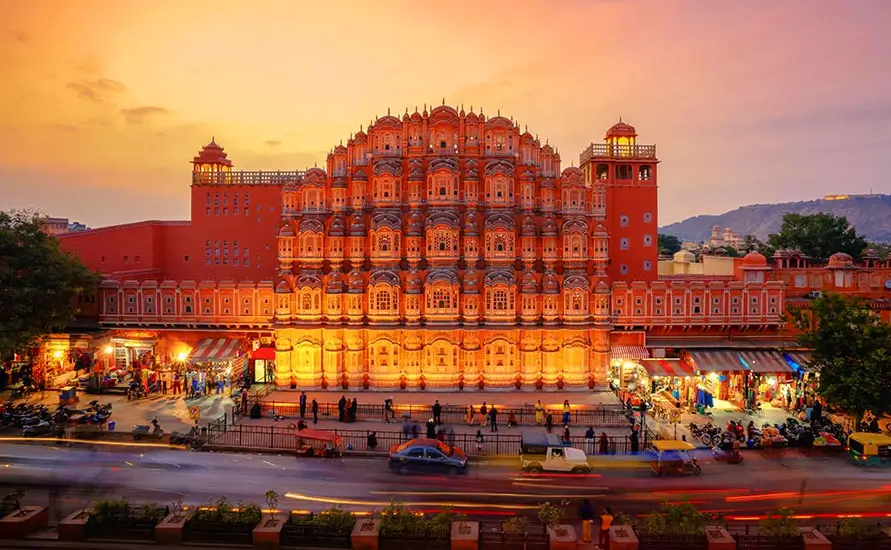
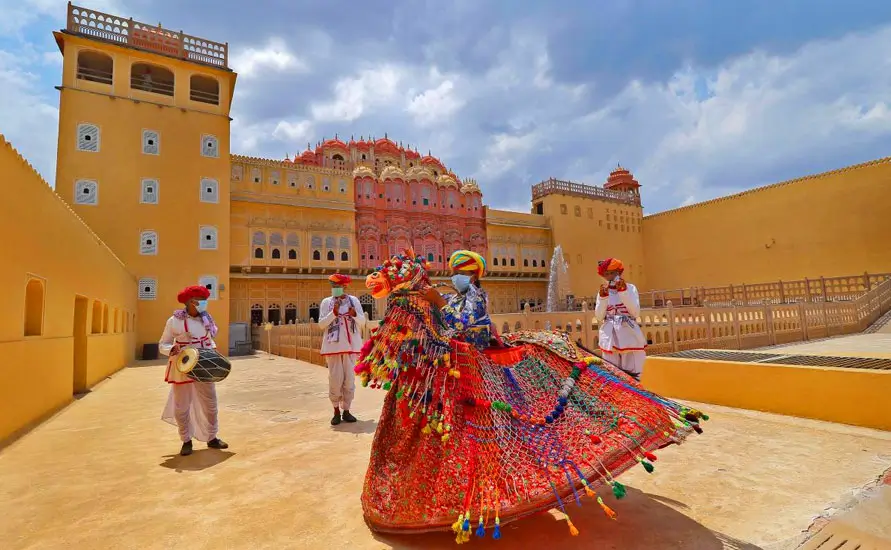
The last sight of the day is the honeycombed front of Hawa Mahal, raised in 1799 so that women of the court could look down on street processions through 953 small windows. A rooftop café facing it gives the clearest angle, and a masala chai there lets you watch the pink stone turn orange as the sun drops. Your guide then walks you through Johari Bazaar for jewelers and silver, or Bapu Bazaar for embroidered slippers and printed cotton. Bargaining is normal, and no one will be offended if you smile and walk away. Overnight in Jaipur.
No other Rajasthan road leg is as long as this one, so departure follows an early breakfast and two unhurried breaks are built in. The road heads west through the Aravalli foothills and then into flatter, drier country where khejri trees dot the fields and women in bright odhnis walk beside the road with water pots. Around the midpoint near Ajmer, your driver can take a short detour for a quick look at the holy town if you wish, or simply stop for tea at a dhaba with a clean washroom. Comfortable shoes and a light scarf against the dust are useful today.
The landscape grows more open as you near Marwar, the old kingdom whose name is often explained as land of death because of its harsh desert climate. You start to see stone-walled farms, herds of goats, and now and then a camel turning a well wheel. Your driver, often from this region himself, is a good person to ask about local customs, food and the turbans that change color and style from district to district. Expect to arrive in Jodhpur in the middle of the afternoon, when the great fort on its rocky ridge appears suddenly above the rooftops.
Once your bags are in the room, spend the evening around the clock tower, the Ghanta Ghar, whose square fills with spice traders, tie-dye stalls and vegetable carts under old stone gates. The car can leave you at the square and return in an hour. Jodhpur is known for pyaaz kachori, a fried pastry stuffed with spiced onion, and mirchi vada, a large green chili wrapped in potato and chickpea batter; both are sold hot around the tower. An omelet shop near the north gate has become a minor local legend. Rooftop restaurants nearby look straight up at the floodlit fort. Overnight in Jodhpur.
Mehrangarh Fort sits on a sandstone cliff high over the rooftops, and its walls look as though they grew out of the rock. Rao Jodha laid its foundations in the mid-15th century, and today the trust that runs it keeps one of the best-managed museums in the country, with a good audio guide in English. Your local guide leads you up through seven gates, one still marked by cannonball scars and another by the small handprints of royal widows. Inside, the palace rooms hold howdahs, palanquins, painted ceilings and an armory with jeweled daggers. From the ramparts, the old city spreads below in shades of blue.
Next you walk down into Brahmpuri, the cluster of indigo-washed houses below the fort that gave Jodhpur its nickname, the Blue City. Your guide explains the different stories behind the color, from caste markers to insect-repellent lime wash, and introduces neighbors who are used to friendly visitors. Afterward you drive to Jaswant Thada, the royal memorial of white Makrana marble that the family raised in the late 1890s, its panels so thin they glow with sunlight. If time permits, add the public museum section of Umaid Bhawan, an Art Deco palace finished in the 1940s and still partly lived in by the royal family.
Late in the afternoon a jeep drive takes you out to a Bishnoi village on the desert fringe. The Bishnoi community follows twenty-nine principles set out by the saint Jambheshwar in the 15th century, including protecting trees and wild animals, and blackbuck and chinkara antelope often graze near their fields without fear. You meet a potter at his wheel, see a family weaving durrie rugs, and sit with the elders for a traditional tea ceremony made with jaggery. It is a gentle contrast to the fort and gives real context to rural Rajasthan. Sightings of wildlife depend on the season and are never guaranteed. Overnight in Jodhpur.
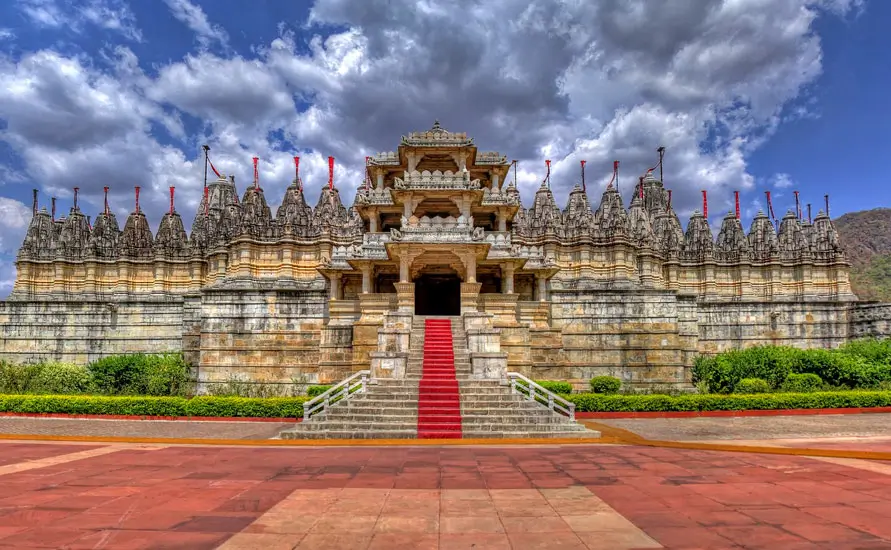
The drive south toward Mewar crosses the Aravalli hills, and the scenery changes from flat desert scrub to green valleys, small lakes and fields of maize. Leaving mid-morning puts you at the Ranakpur Jain temple a little after midday, when non-Jain visitors are usually admitted. Belts, purses, wallets and watch straps made of leather stay in the vehicle, and shorts or sleeveless tops are not allowed. Women who are menstruating are asked by the temple not to enter, a rule your guide will mention discreetly. A simple lunch is available at a resort or the temple dining hall nearby.
Built in the 15th century and dedicated to Adinath, the first Tirthankara, the temple is a forest of carved white marble. It has 1,444 pillars, and local tradition holds that no two are alike. A priest or temple attendant may show you how a single sculpted elephant appears to change position as you walk around it, or point to the knot of 108 carved snakes on one ceiling panel. Light enters through openings in the domes and moves slowly across the pillars as the afternoon goes on. An audio guide is often available at the entrance, and photography rules vary from year to year.
The last two hours of the drive wind through hill country to Udaipur, a city of lakes framed by ridges and old palaces. You reach the hotel in the early evening, and many guests simply sit with a drink and watch the lights come on across the water. If you still have energy, a lakeside walk to Gangaur Ghat is easy from most of the old-city hotels, and you can hear temple bells from the Jagdish Temple a few lanes away. Dinner on a rooftop facing Lake Pichola is the natural choice tonight, with laal maas or gatte ki sabzi on most menus. Overnight in Udaipur.
Udai Singh II shifted his seat of power to this valley in the mid-16th century, away from the exposed hill fort at Chittorgarh, and his descendants were proud of never giving daughters in marriage to the Mughals. The morning opens at the City Palace, a long chain of palaces added by successive Maharanas over about four hundred years on the eastern side of the lake. Inside the museum you see rooms lined with colored glass, peacock mosaics in the Mor Chowk courtyard, and miniature paintings of royal hunts and festivals. Shoes stay on in the palace, and photography with a phone is usually allowed for a small fee.
A short walk uphill brings you to the Jagdish Temple, an Indo-Aryan Vishnu temple from 1651, its steps flanked by two stone elephants and its walls carved with dancers, musicians and horsemen. Morning worship can be lively, with women singing devotional songs, and quiet visitors are welcome inside. After lunch you head north to Saheliyon ki Bari, a walled garden of fountains made for the royal women and named after the princess's companions. It has lotus pools, marble elephants and fountains fed by gravity from Fateh Sagar Lake, which still work without any pumps.
Late in the day a motorboat takes you onto Lake Pichola for the view everyone pictures: the palace walls rising straight from the water, laundry and bathing ghats along the shore, and the white shape of the Lake Palace hotel in the middle. You step ashore at Jag Mandir, an island pavilion that sheltered Prince Khurram, the future Shah Jahan, when he rebelled against his father. Back on land, an hour-long evening program of Rajasthani folk dance at Bagore ki Haveli ends with a dancer balancing a tall tower of pots on her head. Tickets are optional and paid locally. Overnight in Udaipur.
A relaxed breakfast by the lake is the last Rajasthan meal of the trip, and then the car heads out to Udaipur's Dabok airport, roughly forty minutes away. Flights from Udaipur to Goa usually involve a connecting flight through Mumbai, Delhi or Bangalore, so departure time and the length of the layover decide how much of the day is spent in transit. If your flight leaves after lunch, there is time for a short morning stop at a miniature-painting workshop, where artists still use squirrel-hair brushes and pigments ground from stone.
Goa is served by Dabolim near Vasco and the newer Mopa airport in Pernem, and we choose your flight according to where your beach hotel is. A Goa-based driver waits at arrivals for the run through coconut palms and red laterite villages to the coast, anywhere from half an hour to ninety minutes. The difference in climate is immediate: humid sea air, rice fields and whitewashed churches replace desert dust. Dinner tonight is your choice, and fresh kingfish or prawns cooked in Goan masala are an easy first order. Overnight in Goa.
Portugal held Goa from 1510 until Indian troops arrived in December 1961, and the clearest trace of that period is Old Goa, a short drive up the Mandovi River from Panjim. First on the list is the Basilica of Bom Jesus, a Jesuit church of 1605 whose rust-colored stone has never been whitewashed; inside, a silver casket on a Florentine marble base holds the relics of the Jesuit missionary Francis Xavier. The church is still in use, so shoulders and knees must be covered. Across the lawns, Se Cathedral was built for the archbishop over most of the 17th century, and its Golden Bell once rang for the Inquisition's public sentences. Both belong to a UNESCO World Heritage site.
Near the cathedral, the ruined tower of St Augustine's church survives from a vast Augustinian monastery, and it makes a quiet, photogenic stop away from the crowds. The guide talks about the rise and fall of the city, which was abandoned in the 18th century because of epidemics and the silting of the river. From here you drive back to Panjim, the small, walkable state capital. Lunch at a family-run place serving xacuti, a coconut and roasted-spice curry, or a Goan fish thali, is an easy way to try local cooking before the afternoon walk.
The afternoon belongs to Fontainhas, Panjim's old Latin Quarter; its houses are painted ocher, blue and green, with tiled roofs, carved balconies and hand-painted azulejo house names. Your guide shows you the chapel of St Sebastian, a bakery still making poi bread, and shops selling Portuguese-style tiles. The walk finishes below the zigzag white staircase of Panjim's Immaculate Conception Church, rebuilt in its present form in the early 17th century. You then return to your beach hotel, with the evening free for a sunset drink by the sea. Overnight in Goa.
Inland Goa looks very different from its beaches, and this half day shows you that side. Drive east toward Ponda, through cashew orchards and paddy fields, to a working spice plantation in the forested hills. A farm guide takes you along shaded paths to see cardamom, black pepper vines climbing areca palms, vanilla, cinnamon bark and nutmeg with its bright red mace. Children often enjoy being shown how a cashew fruit grows with the nut hanging below it. A home-style Goan lunch on banana leaves follows the walk, and it is included in this package.
On the return you stop at the Mangueshi Temple, a Shiva shrine with a white lamp tower and a striking mix of Hindu and Portuguese-style architecture. The temple was moved inland in the 16th century to protect it during the period of forced conversions on the coast, which gives the place a strong sense of continuity for local Hindu families. Visitors are welcome in the courtyard but should remove shoes and dress modestly; the inner sanctum is for worshippers. Your guide explains the Saraswat community's history and their role in Goan trade and culture over the centuries.
Late in the day you reach Fort Aguada, a 17th-century Portuguese fort on a headland at the mouth of the Mandovi. The 1864 lighthouse inside is among the oldest in Asia, and the ramparts look along the beach strip toward Candolim and Calangute. Agua is Portuguese for water, and passing ships once refilled their casks from the large cistern inside. The guided part of the Goa stay ends here as the light fades over the open water. If it is a Wednesday in the dry season, the flea market at Anjuna is an easy evening detour. Overnight in Goa.
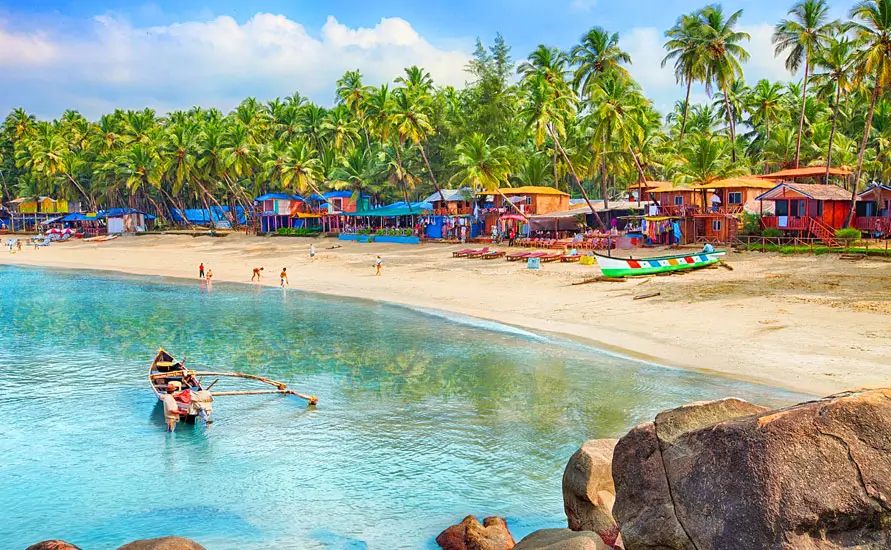
After eleven days of forts, temples and markets, today has no plan at all, and that is intentional. Breakfast can be as late as the hotel allows, and the beach is a few minutes' walk from most of the properties we use. The water along the Goa coast is warm, with gentle waves from November to March, though you should always swim between the lifeguard flags and avoid the sea during the monsoon. Sunbeds and umbrellas are usually available at the beach shacks for the price of a drink or lunch, and many shacks serve grilled fish within sight of the waves.
If you feel restless, our team can book optional activities directly with trusted local operators. Dolphin-spotting boats leave Sinquerim or Palolem early, while the sea is still glassy, though sightings are never certain. Kayaking through the mangroves of the Sal River, a cooking class in a Goan home, or a jeep trip to Dudhsagar Falls (best after the monsoon and usually closed during it) are other choices. None of these is included in the package price, and you can decide on the day. Spa treatments at the hotel are another easy way to pass the hottest hours.
For the final evening of your Goa beach holiday, we can book a seafront table for you or help you find live music at one of the bars along the north coast. Many guests choose a cliff-top sunset at Chapora Fort, which looks out over Vagator Beach and the river mouth, before dinner. Remember to pack the evening before if your flight leaves early tomorrow, and keep passports and printed e-tickets in hand luggage. Your driver confirms the pick-up time at dinner, and our 24-hour line stays available if anything changes. Overnight in Goa.
Breakfast is followed by check-out at the usual hotel time, and your driver takes you to Dabolim or Mopa airport according to your onward booking, with a three-hour buffer for an international flight. If your flight home connects through Mumbai, Delhi or a Gulf hub, we arrange the transfer to match the first leg. Guests flying late in the evening can ask for a room until later in the day, subject to availability and at extra cost, so there is time for a last swim and a shower before the long flight.
This brings the Rajasthan and Goa tour to a close, from the crowded lanes of Old Delhi and the desert forts of Marwar to the whitewashed churches and quiet beaches of the Konkan coast. We hope the contrast between the two regions shows you two sides of India that rarely appear in one trip. If you would like to return, Jaisalmer and the Thar dunes or the backwater canals of Kerala could anchor a second trip, and we will gladly draft that route when the time comes.
Your Journey

N.S. Rathore & Mrs. Omlata Rathore · Managing Director
We still read every enquiry ourselves. Tell us the places you liked and our planners will send a day-by-day route with drive times and a clear price.
Every package can be customised and no pressure to book. A planner from our office replies within 24 hours with a route written for your group.
Fill this in and your planner will send a first draft itinerary.
Explore more
Kerala Backwaters Escape Kerala Backwaters Escape
 Kerala Backwaters Escape
 Kerala Backwaters Escape
 Kerala Backwaters Escape
 Kerala Backwaters Escape
 Kerala Backwaters Escape
 Kerala Backwaters Escape
 Kerala Backwaters Escape
 Kerala Backwaters Escape
 Kerala Backwaters Escape
 Kerala Backwaters Escape
 Kerala Backwaters Escape
 Kerala Backwaters Escape
 Kerala Backwaters Escape
 Kerala Backwaters Escape
 Kerala Backwaters Escape