
 Kerala Backwaters Escape

South India Tour with Rajasthan
Delhi – Jaipur – Pushkar – Jodhpur – Jaisalmer – Udaipur – Chennai – Pondicherry – Madurai – Munnar – Alleppey – Kochi
At a glance
Few holidays give India the time it asks for. Our Grand Rajasthan and South India Tour 4 Weeks does, spending close to a month on the road between the sandstone forts of the Thar Desert and the coconut-lined canals of Kerala. Fifteen nights go to the north: Delhi, Jaipur, the lake town of Pushkar, blue Jodhpur, a dune camp beyond Jaisalmer and three slow nights by the lakes of Udaipur. A flight then switches you to the Tamil coast, and the second half moves through Chennai, Pondicherry and temple-crowned Madurai before climbing to Munnar's tea slopes and ending in Kochi.
Pace is what separates a four-week trip from a sprint. Two or three nights in nearly every town means laundry can be done, a morning can be left blank and a favorite café can be visited twice. Road legs mostly run three to six hours, the Jaisalmer return goes via Jodhpur rather than over a punishing desert crossing, and the long jump from Udaipur to Chennai is made by air. Our Grand Rajasthan and South India Tour 4 Weeks keeps one private car and English-speaking chauffeur in each region, with licensed local guides joining for every major site.
Retirees from the US and Canada, career-break couples from the UK and Europe, Australians escaping their winter and NRI families showing grandparents' home regions to a younger generation all fit this South India tour with Rajasthan. Aim for late October through mid-March, when desert nights are crisp, Kerala's monsoon has passed and Tamil Nadu is warm rather than fierce. Because nothing is shared, we can trade a night in one place for another, upgrade to palace hotels in Rajasthan or slow the Kerala section further.
Customs cleared and bags collected, step into the arrivals hall at Indira Gandhi International Airport and scan the crowd for a board carrying your family name. Our Delhi representative behind it loads the luggage into a chilled private car and handles the drive to your hotel, forty-five minutes on a quiet night, much longer at rush hour. Because international flights tend to land around midnight or dawn, paying for an extra night up front guarantees sheets turned down when you stagger in. A folder with vouchers, contact numbers and a printed plan for all twenty-seven days is handed over during the transfer.
Day 1 carries no sightseeing at all, on purpose. Four weeks is a long run, and the first twenty-four hours set the tone, so sleep, take a dip where there is a pool, and keep meals plain. Should energy return by late afternoon, a taxi ride to Khan Market offers bookshops, a few good cafés and a calm introduction to Delhi street life without the chaos of the old city. Expect a phone call around seven to fix the morning start and to answer any questions about money, SIM cards or what to wear at religious sites in the days ahead.
Some practical notes for a month in India: carry a light scarf for temples, mosques and gurdwaras, where heads or shoulders may need covering; keep small notes for tips and rickshaws; and drink only sealed or filtered water, which we keep stocked in every vehicle. Rajasthan evenings from December to February can drop close to 5 °C, while Tamil Nadu and Kerala stay in the high twenties, so pack layers rather than heavy coats. Footwear that slips on and off easily saves time at every shrine on the route. Overnight in Delhi.
Start in Shah Jahan's walled city, where your guide meets you near the Red Fort (it does not open on Mondays) for a look at the Lahore Gate and the long sandstone walls that once enclosed the Mughal court. Jama Masjid comes next, the great congregational mosque of 1656, reached by a broad flight of steps that hawkers and pigeons share all day. Visitors need covered legs and shoulders, and gowns are offered at the gate. Climb to the courtyard, then leave shoes with the attendant, and stand under one of the domed arcades to take in the scale of the place.
Next, hop into a pedal cycle-rickshaw and bump along Chandni Chowk, once a moonlit canal-side promenade and now a jam of bicycles, porters and shoppers. Lanes branch off it by trade: paper and wedding cards in one, silverwork in Dariba Kalan, spices in Khari Baoli, where the air stings your nose with chili dust. A pause at Gurdwara Sis Ganj, marking the spot where Guru Tegh Bahadur was beheaded in 1675, shows the calm that lies just off the shouting street. Lunch could be stuffed parathas from a family stall that has fried them for over a century.
Afternoon belongs to New Delhi. Humayun's Tomb, Mughal Delhi's first great garden tomb and a clear forerunner of the Taj, rises from calm lawns divided by water channels, with smaller tombs of the emperor's courtiers around it. Further south, the 73-meter Qutub Minar rises from the ruins of Delhi's first sultanate mosque, its fluted stone carved with Quranic bands and the iron pillar standing rust-free nearby after some sixteen centuries. On the return the car runs along Kartavya Path beside India Gate toward the domed secretariat blocks planned by Lutyens and Baker in the 1920s. Overnight in Delhi.
Leave after breakfast, ideally by nine, to clear Gurgaon's traffic before it builds. The highway to Jaipur is a four- to six-lane road, smooth for most of its length, and expect roughly five hours plus a lunch break at a highway stop known to our drivers for clean washrooms and decent thalis. Along the way the land dries and lifts, and near Shahpura the earliest rocky Aravalli outcrops show up. Expect to see camel carts, trucks painted with peacocks and slogans, and village women carrying brass pots on their heads.
Sawai Jai Singh II drew up Jaipur in 1727 as a gridded town of wide streets and market blocks, unusual in India at the time. The pink-terracotta color came later, in 1876, when the city was painted to welcome the Prince of Wales, and a local law still keeps the old town that shade. Your hotel may be a converted noble's mansion inside the walls or a modern property near the station, depending on your booking. Check-in is usually around mid-afternoon, which leaves time for tea on a terrace and a short rest after the drive.
As the light goes, take a short walk or tuk-tuk ride to Albert Hall Museum, Jaipur's oldest museum, whose Indo-Saracenic exterior glows under floodlights, a handsome backdrop for photographs. Inside, if you arrive before closing, there are Egyptian mummies, carpets, miniature paintings and armor. A first dinner in the Pink City might be laal maas, the fiery mutton curry of Rajput hunters, or the milder ker sangri made from desert beans and berries. Your guide for the next two days will call this evening to agree a start time. Overnight in Jaipur.
An early start is worth it at Amber Fort, which sits on a ridge some 11 km north of the old city and grows crowded by mid-morning. Instead of the elephant rides offered by some operators, we use a jeep to climb the final hill, or you can walk the zigzag path in about twenty minutes. Inside, your guide explains how Raja Man Singh, a general of Emperor Akbar, began the palace in the late 16th century, and leads you through the Ganesh Pol gateway with its painted frescoes into the private apartments and the mirrored Sheesh Mahal.
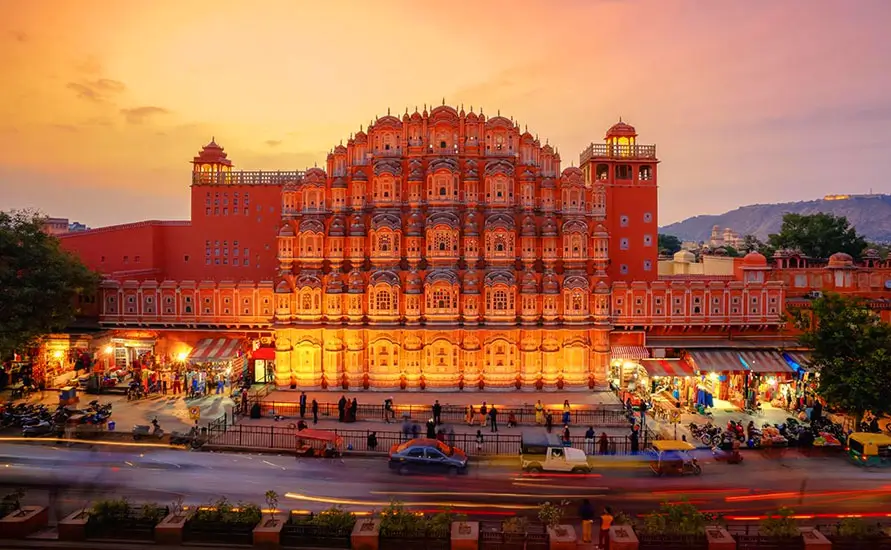
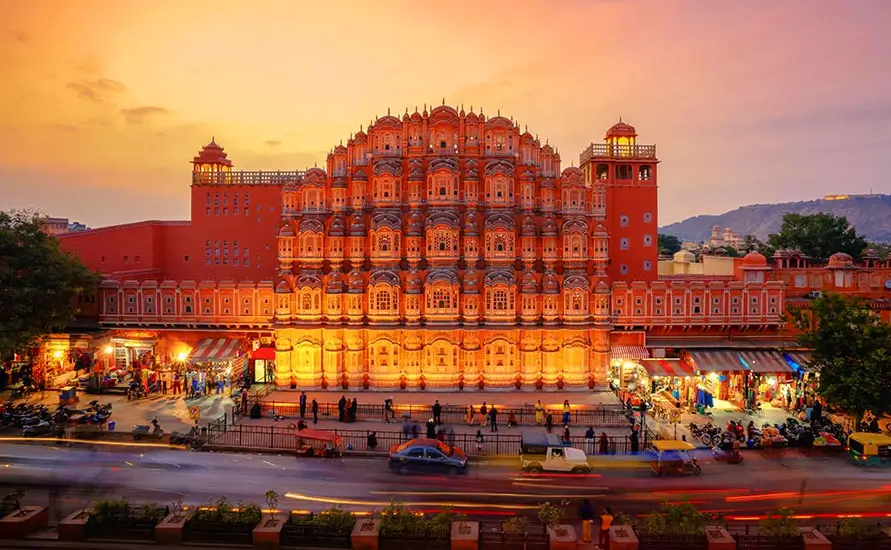
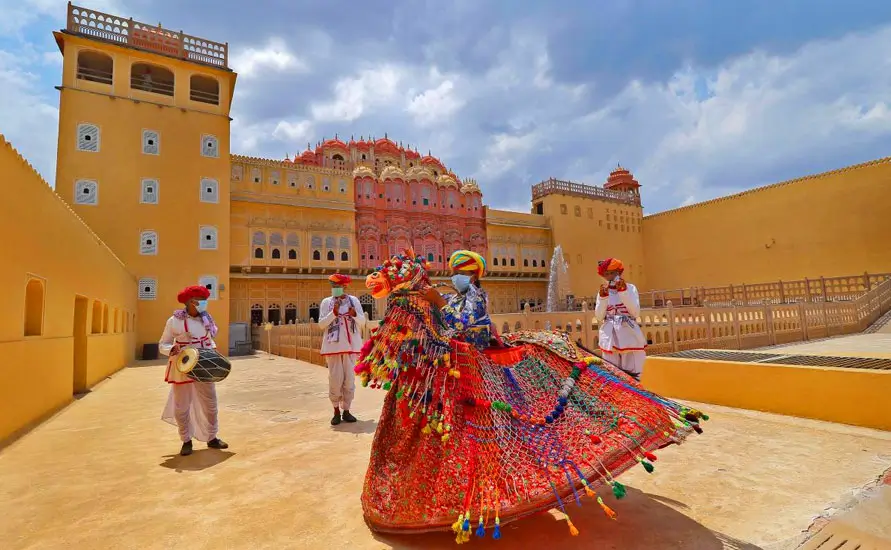
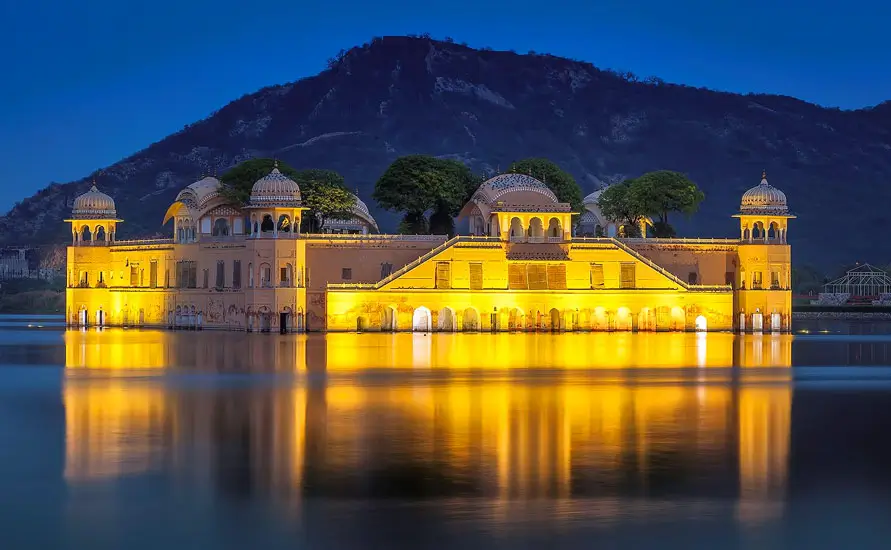
Below the ramparts, Panna Meena ka Kund is a 16th-century well where zigzag flights of stairs form a geometric pattern that photographers love; descending the steps is no longer allowed, but the view from the edge is the point. A few minutes away, the narrow streets of Amer town hold small temples and havelis that most visitors drive straight past. Heading back toward town, the car pauses at Jal Mahal, a palace floating in the middle of Man Sagar Lake, and then pulls up opposite the Hawa Mahal, the pink honeycomb screen built in 1799 for the royal women to watch processions.
The afternoon is unstructured. Many guests use it for a lie-down, others for a walk through Johari Bazaar, where jewelers sell silver, colored stones set in gold and lac bangles stacked in rainbow towers. Ask the guide how to spot genuine silver and fair prices for cotton quilts, but there are no commission shops on our itinerary. Toward sunset a drive up to Nahargarh Fort gives the finest view of the old city as its lights come on, and a small terrace café up there sells chilled sodas and pakoras. Overnight in Jaipur.
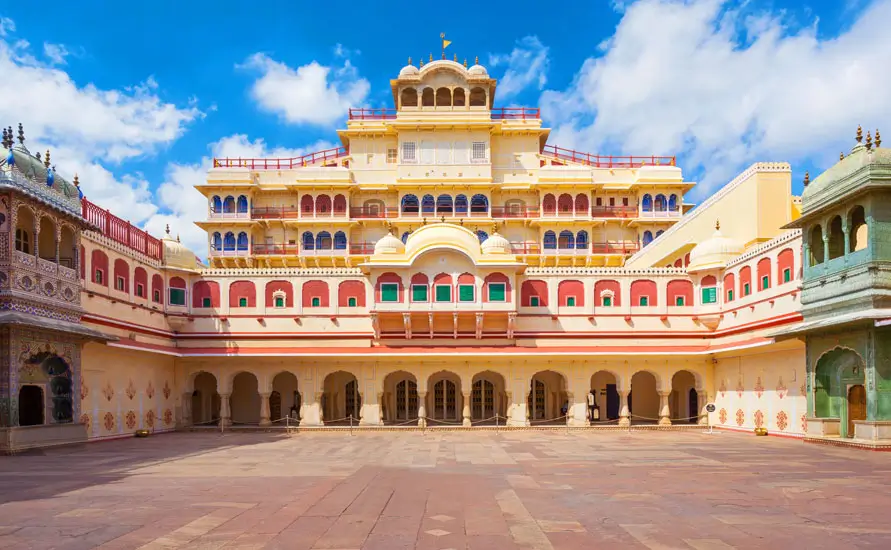
Morning is spent in the core of Jai Singh's city. The City Palace complex blends Rajput and Mughal styles; a section is still the residence of the former royal family, and the rest houses textile and arms galleries, a hall of public audience and the two giant silver urns that carried Ganges water to England for a royal coronation. In the Pritam Niwas Chowk, four doorways painted for the four seasons are among the most photographed spots in Rajasthan. The guide explains how court protocol, marriage alliances and treaties with the Mughals shaped Jaipur's fortunes.
Next door is Jantar Mantar, the open-air observatory the same astronomer-king raised between about 1724 and 1734, now a UNESCO World Heritage Site. Its instruments are huge masonry structures built of stone and lime: the Samrat Yantra sundial is about 27 meters tall and casts a shadow sharp enough for readings accurate to roughly two seconds. Your guide shows how astronomers used other instruments to track stars, predict eclipses and plot horoscopes. Visit around midday for the clearest shadows, and wear a hat, since there is very little shade on the site.
After lunch you drive to Sanganer, roughly half an hour south, a town known for hand-block printing since the 16th century. In a small workshop, artisans carve designs into wooden blocks, mix natural and chemical dyes and press patterns onto cotton with a firm slap of the hand, layer after layer, each color needing its own block. You can try printing a scarf or a napkin yourself. The workshop also explains handmade paper, another Sanganer craft. Back in Jaipur, dinner might be a home-style meal with a local family, which we can arrange on request. Overnight in Jaipur.
Today's road leg is short and easy, running west across farmland and past Kishangarh, a town known for marble yards and a school of miniature painting famous for its almond-eyed portrait of Radha, the Bani Thani. The road climbs over a low pass from Ajmer and drops into Pushkar, a small pilgrim town ringed by hills around a holy lake. Arrival is around lunchtime, at a small heritage property or a garden resort on Pushkar's outskirts, picked because it is quiet after dark. Meat, eggs and alcohol are not served in the town center, out of respect for its religious status.
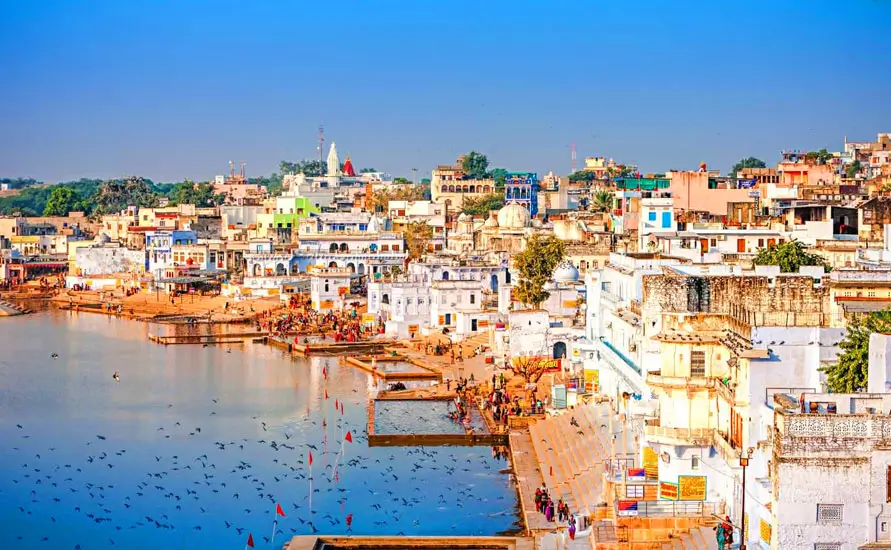
Pushkar's legend says the lake formed where a lotus fell from the hand of Lord Brahma, and the town holds one of the few temples in India dedicated to him. Fifty-two ghats step down to the water, used for bathing, prayers and cremation rites. Photography of people bathing is not welcome, and some men may offer flowers and a blessing at the lakeside and then ask for a large donation; your guide will help you decline politely or agree to a modest amount. Shoes come off well before the steps. The calm of the lake in the afternoon light is worth slowing down for.
At sunset, find a rooftop café overlooking the ghats, where the sound of bells, conch shells and chanting rises from the water as the evening aarti begins. Pushkar's main bazaar is a long lane of shops selling silver jewelry, embroidered bags, rose-scented products and the town's famous malpua, a sweet pancake fried in ghee. If your dates fall in the month of Kartik, roughly October or November, the Pushkar camel fair brings livestock traders, folk performers and enormous crowds to the dunes behind town; we can adjust plans to see it or avoid it. Overnight in Pushkar.
Dawn is the best time at the lake, when pilgrims come to bathe and the water reflects the white temple domes. Post-breakfast, walk with your guide to the Brahma Temple, a 14th-century structure rebuilt many times, with a red spire and a silver turtle set into the floor. Inside, a four-faced image of Brahma sits beside his consort Gayatri. Belts, wallets and anything else made of leather stay outside, and cameras are usually not allowed in the inner hall. The guide explains why Brahma, the creator, has so few temples compared with Vishnu and Shiva.
Mid-morning, ride the ropeway up Savitri hill, where a temple to Brahma's first wife stands above the town; the ride takes a few minutes and saves a steep climb of around an hour. From the top you see the lake, the white town and the sand dunes stretching toward the Thar. Legend says Savitri, angered that Brahma married Gayatri in her absence, cursed him to be worshipped only in Pushkar. Come down the same way, and spend the late morning browsing the lanes or relaxing over a lassi from one of the stalls near Varaha Ghat.
Late in the afternoon, a walk with a local guide through a village on the edge of Pushkar shows a different face of Rajasthan. Families here farm millet, chickpeas and roses for the perfume and gulkand trade, and keep goats and camels in mud-walled yards. You may see women grinding flour, children herding animals home and men smoking a hookah under a neem tree. Visits are low-key and arranged with the village through our guide, and we ask guests to always request permission before photographing people. Dinner tonight could be a simple Rajasthani thali back in town. Overnight in Pushkar.
The road west from Pushkar crosses a flat, sandy plain, the true beginning of the Marwar region, which means "land of death" in some old translations because of its harsh climate. Reckon on four hours at the wheel, plus chai at a dhaba full of long-haul truckers. Watch for Rabari herders in bright red turbans driving goats and camels along the shoulder, and for ladies in mirror-work skirts carrying firewood. Arrival in Jodhpur is around lunchtime, in time to check in and rest before an easy afternoon on foot in the old city.
Jodhpur was founded in 1459 by Rao Jodha, chief of the Rathore clan, who built a fort on a rocky outcrop and moved his capital there from nearby Mandore. The city grew below the fort walls, and many houses in the old Brahmin quarter were painted blue, a color said to mark priestly families and to help keep homes cool. Today the city is Rajasthan's second largest, but the old town still has the narrow lanes and stepwells of earlier centuries. Your hotel may look up at the fort or sit in the newer city near the Umaid Bhawan Palace.
Late in the afternoon, take a walk to Toorji ka Jhalra, an 18th-century stepwell built by a queen, recently cleaned and restored, and now surrounded by cafés and small design shops. A five-minute stroll from there leads to the clock tower and the stalls of Sardar Market, a jumble of shops for spices, textiles, silver and vegetables. Before dinner, try a pyaaz kachori, the onion-filled pastry that Jodhpur claims as its own, or a fiery mirchi vada with a glass of thick saffron lassi from the stall by the market gate. Overnight in Jodhpur.
Mehrangarh Fort dominates Jodhpur from a cliff some 120 meters above the city, and the morning visit with your guide starts at the Jai Pol gateway, still marked by cannonball scars. Inside, the palaces of Moti Mahal, Phool Mahal and Sheesh Mahal display painted ceilings, gold leaf and stained glass, while the museum holds palanquins, elephant howdahs, cradles and weapons. The audio guide here is excellent and worth borrowing. Near the Loha Pol gate, small handprints in stone record the queens who committed sati in the 18th century, a sobering reminder of the fort's past.
From the fort a short drive leads to Jaswant Thada, a white marble memorial put up in 1899 after the death of Jaswant Singh II, with thin marble panels that glow when the sun shines through them. The garden terraces look across a small lake to the fort. Your guide then leads you down into Brahmpuri, the blue quarter beneath the walls, along lanes so narrow that only scooters can pass. Doorways are framed with blue-washed plaster, laundry hangs from balconies and families sit outside their homes. The lanes are quiet residential streets, so keep voices low and ask before taking photos.
In the afternoon, visit the museum wing of Umaid Bhawan Palace, one of the world's largest private homes, built in the 1930s and 1940s in an Art Deco style. Part of it is a luxury hotel, part is the residence of the former royal family, and the small museum displays vintage cars, clocks and photographs of the royal family across the decades. The palace was built partly as a famine relief project to give work to local people. Rest at the hotel afterward, or make an evening stroll back into the old city to see the fort lit up. Overnight in Jodhpur.
Morning brings the longest stretch of open desert driving on the trip, about five hours west across the Thar toward Jaisalmer, near the border with Pakistan. The road is good, the traffic thin, and the landscape gradually changes from scrub and thorny khejri trees to wide sandy plains dotted with windmills and the occasional village of round mud huts. Your driver will stop at Pokaran or a roadside dhaba for tea and lunch. You may notice army trucks, as the region near the border is a military area, and occasional checkpoints are routine.
Arrival in Jaisalmer is in the mid-afternoon. The town rises from the desert like a mirage, its fort walls of honey-colored sandstone standing on Trikuta hill and glowing gold in the evening light. Jaisalmer was founded in 1156 by Rawal Jaisal, a Bhati Rajput, and became rich from the caravan trade between India and Central Asia, carrying spices, silk and opium. Its merchants spent their profits on elaborately carved havelis, many of which still stand. Your hotel may be a heritage property built of the same yellow stone, with views of the fort.
Shortly before dusk, head with your guide to Gadisar Lake, a reservoir built in the 14th century that once supplied the town with water. Its banks are lined with small temples, chhatris and a carved stone gateway, the Tilon ki Pol, said to have been built by a royal courtesan. Boats are available for a short paddle, and the setting sun turns the water and the stone gold. Return to the hotel through the lanes of the old town, where you can stop for a cup of chai and a plate of local sweets. Overnight in Jaisalmer.
Jaisalmer Fort, also called Sonar Qila or the Golden Fort, is one of the few "living" forts in the world, with around three thousand people still living inside its walls. Your guide walks you up through four gateways to the main square, then on to the seven-story royal palace and the Jain temples, a group of 12th to 16th-century shrines carved from yellow sandstone, open to visitors in the morning. Inside the temples, leather items and photography may be restricted. The guide will also explain the strain that modern plumbing and tourism put on the fort's old foundations.
Below the fort, the town's merchant mansions show the wealth of the caravan era. The best known is Patwon ki Haveli, a cluster of five mansions commissioned from around 1805 by a family of brocade and jewel traders, with stone facades carved into lace-like screens and balconies. Inside, one house is a museum displaying furniture, costumes and household objects. Nearby, Nathmal ki Haveli was carved by two brothers, each working on one half, which explains why the two sides do not quite match. After lunch, check out and pack an overnight bag for the camp.
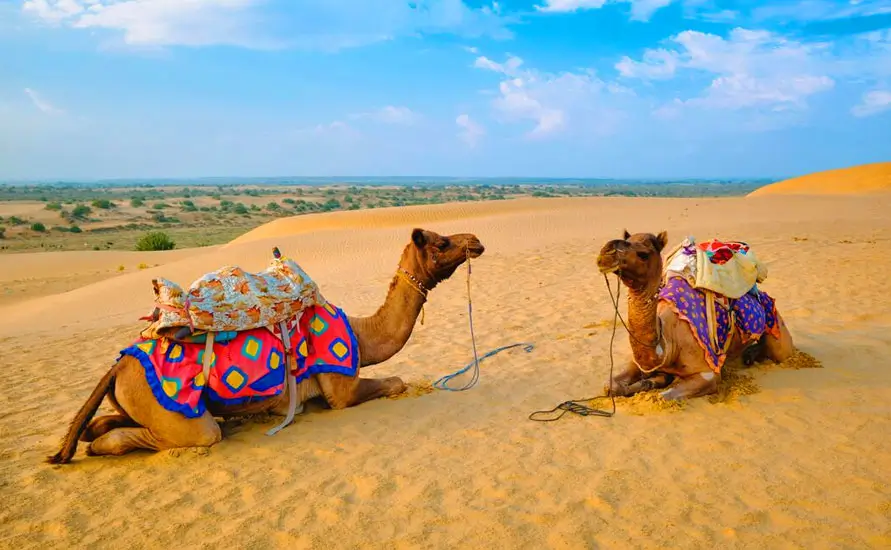
Late in the afternoon, a jeep carries you about 45 km west to the Sam sand dunes, where wind-shaped ridges of sand roll toward the horizon. Ride the jeep up and down the dunes for the sunset, or take an optional short camel ride if you wish; there is no pressure either way. Your Jaisalmer desert camp for tonight is a set of permanent tents with beds, private bathrooms and electricity. In the evening, Manganiyar and Langa musicians play folk songs by the fire, and dancers perform the swirling Kalbelia dance while dinner is served in the open. Overnight in the desert camp.
Set an alarm for first light, step out of the tent with a cup of chai, and watch the dune crests shift from slate grey to apricot while the camp is still asleep. Breakfast is cooked over gas in the camp kitchen. Afterward, the car stops at Kuldhara, roughly 25 km short of Jaisalmer, a village of roofless sandstone homes left behind by Paliwal Brahmin farmers around the early 1800s. Local storytellers insist the whole community vanished overnight and laid a curse on the place; your guide weighs that tale against the likelier causes, such as heavy taxes, drought and wells running dry.
Eastbound now, the car retraces the desert highway toward Jodhpur, a five-and-a-half to six-hour run with a lunch halt at Pokaran or a dhaba our drivers trust. Why go back through Jodhpur instead of straight to Udaipur? Flights out of Jaisalmer are rare and erratic, and a direct road run to the lake city would mean nine or ten grinding hours, so breaking the trip here keeps tomorrow manageable. Long empty stretches suit reading, a nap or a playlist, and windmill farms, gazelle-colored scrub and lonely shrines under khejri trees punctuate the view.
Roll into Jodhpur by late afternoon and settle into the same hotel or one close to it. With energy left, wander back to the lanes ringing the clock tower for round two of street snacks: mawa kachori, the sweet cousin of the onion version, comes dripping with sugar syrup, and makhaniya lassi is so thick it needs a spoon. Shri Mishrilal's corner near the market gate is always busy. Prefer a quiet night instead? The hotel kitchen can serve a light dal and rice meal, because tomorrow's drive to Udaipur, with two stops, starts early. Overnight in Jodhpur.
Roll out shortly after breakfast for a brief call at a Bishnoi village just south of Jodhpur, off the Pali road. Since the 15th century the Bishnoi have kept twenty-nine rules laid down by Guru Jambheshwar, two of which forbid felling green trees and harming animals, so blackbuck and peafowl wander their fields with little fear. A family might offer tea brewed on a dung-fired stove, and neighboring hamlets have potters at their wheels and weavers making cotton dhurrie rugs on pit looms. An hour is plenty here before the long day continues.
Climbing into Aravalli forest, the road reaches Ranakpur after roughly three hours, and the 15th-century Ranakpur Jain temple appears in its valley like a carved white ship. Built for Adinath, first of the twenty-four tirthankaras, it rests on 1,444 marble columns, and visitors are told that no two match. Non-Jain guests are usually admitted from about midday; leather belts, bags and shoes, food and bare legs must stay outside, and the free audio guide is worth taking. Look up: the ceiling domes are cut into concentric rings of dancers and lotus petals as fine as paper.
Lunch is a simple thali at the temple dining hall or a nearby restaurant, then a further two hours or so on winding hill road, past terraced wheat fields and villages of whitewashed shrines, bring you to Udaipur. Maharana Udai Singh II of Mewar moved his court here in 1559, after repeated attacks on Chittorgarh, and built his palace above Lake Pichola. Your hotel sits close to the lake for three nights. Tonight, find a rooftop table in the old city, order a cold drink and watch the lit palace walls ripple across the dark water. Overnight in Udaipur.
Mewar's rulers kept adding wings to the City Palace for some four hundred years, which is why it now stretches over a kilometer along the eastern shore of Pichola. Your Udaipur guide walks you through its museum section: the Mor Chowk courtyard with peacocks made of glass mosaic, little chambers faced in blue Dutch and Chinese tile, and rooms of court miniatures showing hunts, festivals and durbars. Expect stories of Maharana Pratap, whose forces met the Mughal army at Haldighati in 1576, and of Chetak, the horse that carried him wounded from the field, still a local hero in bronze across the city.
Steps from the palace gate, the Jagdish Temple of 1651 sits atop a steep stone stairway, its outer walls crowded with carved musicians, elephants and celestial dancers. Within, a black stone Vishnu receives offerings at morning and evening prayers, and visitors of all faiths may usually enter in modest dress. Later, board a boat ride on Lake Pichola, which calls at Jag Mandir, the island palace where tradition says Prince Khurram, later the emperor Shah Jahan, hid for a while after quarreling with Jahangir. Nowhere gives a better look at the palace facade than the water.
Evening brings the Bagore ki Haveli folk program, staged in the courtyard of an 18th-century prime minister's mansion at Gangaur Ghat. For about an hour, dancers spin in mirror-work skirts, one woman dances with a stack of brass pots climbing above her head, and the show closes with a cheeky puppet act in Rajasthani style; seats fill quickly, so we send you early. Afterward, cross the little pedestrian bridge to Ambrai Ghat, where several restaurants line the water facing the illuminated palace. Order laal maas if you like heat, or paneer in a mild cashew gravy if you do not. Overnight in Udaipur.
Today runs at half speed. Begin at Saheliyon ki Bari, an 18th-century garden designed as a pleasure garden for the queen and the forty-eight maids who came with her dowry. Its fountains were designed to play without any pump, using only the drop in height from Fateh Sagar, and marble elephants spout water into a lotus pool. Late morning, the car follows the embankment of Fateh Sagar Lake, where Udaipur families buy roasted corn and coconut water on weekends. A boat to Nehru Park island in the middle is optional and takes about half an hour.
Afterward, climb the stairs of an old-city studio where miniature painters still grind pigment from lapis, malachite and red ochre, and use brushes of just a few squirrel hairs. Watch one artist outline an elephant procession with a single stroke and another lay gold leaf on a palace dome no larger than a fingernail; a single page can occupy them for several weeks. Ask questions freely and buy only if something speaks to you. Use the free hours after lunch for the leather and textile shops around Jagdish Chowk, or for a siesta by the hotel pool.
An hour before dusk, drive the switchback road up to Sajjangarh, the Monsoon Palace, about 5 km west of town, which Maharana Sajjan Singh began in 1884 so the court could see monsoon storms gathering above the lakes. Its rooms are largely bare now, but the wraparound view over Pichola, Fateh Sagar and the folded Aravalli ridges at sunset beats any other in Udaipur. Return for your last dinner in Rajasthan, a fitting moment for dal baati churma, crumbly wheat balls with lentils and sweetened crumbs, before flying south in the morning. Overnight in Udaipur.
Udaipur's airport, named for Maharana Pratap, sits some 25 km east of the city, and the flight to Chennai almost always involves a change of plane in Delhi, Mumbai or Bangalore. Door to door, allow five to seven hours; we avoid tight connections so luggage and nerves arrive together. This is goodbye to your Rajasthan chauffeur after two weeks on the road, and a tip in an envelope is the usual thank-you. Woolens can be buried deep in the suitcase from here on.
Arrivals at Chennai bring a fresh face from our southern team and a forty-minute to one-hour drive to the hotel, depending on the traffic on Anna Salai. Even in January the coast feels humid after the desert, so cotton, a sun hat and sunscreen become daily kit. Nothing is planned tonight beyond a first Tamil meal, perhaps a crisp ghee roast dosa with three chutneys and a steel tumbler of frothy filter coffee. Overnight in Chennai.
Madras grew from a strip of sand where the East India Company raised Fort St. George in 1639, and a local guide starts the city tour inside its walls, which today enclose Tamil Nadu's legislative assembly. Here stands St. Mary's Church, whose 1680 consecration makes it the senior Anglican building anywhere east of Suez; Clive wed Margaret Maskelyne here in 1753, and Elihu Yale, later patron of the American university, once served on its vestry. A small fort museum keeps company coins, regimental colors and a statue of Lord Cornwallis that once stood in the open.
Next is the 1851 Government Museum in Egmore, for one gallery above all: the Chola bronzes. Poured in molten metal by the lost-wax process during the Chola centuries, these figures include several Natarajas, Shiva dancing inside a ring of flame, so balanced that they seem about to move. Check opening days with your guide when planning the morning. Around Egmore and Parry's Corner, red-brick buildings such as the High Court mix domes, minarets and Gothic arches in the Indo-Saracenic style the British loved. Break for lunch at a vegetarian mess where meals arrive on a banana leaf and refills are free.
Toward evening the car crosses town to Mylapore, Chennai's oldest quarter, where the Kapaleeshwarar Temple to Shiva raises a tall gopuram crowded with painted stucco figures. Non-Hindu visitors can generally walk the outer courtyards and the big temple tank, while the inner shrine is reserved for worshippers. A few minutes away, white spires mark the San Thome Basilica, whose 1896 neo-Gothic rebuild stands above the grave tradition attributes to St. Thomas the Apostle. Finish on Marina Beach around sunset among kite flyers and sundal sellers ladling spiced chickpeas into paper cones; the surf is dangerous, so paddling is not advised. Overnight in Chennai.
South along the East Coast Road, with casuarina plantations and fishing hamlets on the left, the car pulls into Mahabalipuram some ninety minutes later. Seventh- and eighth-century Pallava rulers traded from this harbor, and their sculptors left behind the granite shrines and reliefs UNESCO now protects. Begin at the Shore Temple, two salt-scoured towers standing guard over the surf since Pallava times, then stand before Arjuna's Penance, a relief the width of a tennis court where a cat mimics a meditating sage, a detail many visitors miss until a guide points it out.
Walk on to the Pancha Rathas, five temples carved top to bottom from single granite outcrops, each linked by name to a Mahabharata hero or to Draupadi, with a full-size stone elephant parked beside them as if waiting. Krishna's Butterball, a round boulder resting on a slope at an impossible angle, makes a popular photo stop; legend says a British governor once tried to shift it with seven elephants and failed. Before lunch, look in at a sculptors' yard, where chisels ring on granite and craftsmen copy temple deities exactly as their grandfathers did, using measurements set out in old Sanskrit texts.
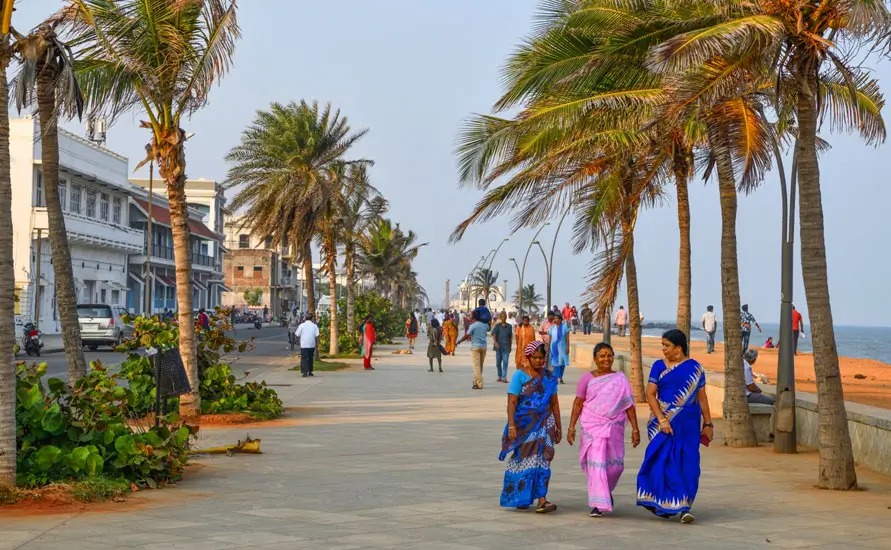
With lunch done, perhaps grilled kingfish at a shack near the beach, another 100 km, a little over two hours, brings you to Pondicherry, past salt pans and the lagoons of Kaliveli. France governed this enclave until 1954, and its street signs, police caps and bakeries still show it. Your heritage hotel sits in the old French Quarter, and once settled, head to the Promenade, the sea road closed to vehicles each evening, for a slow walk among joggers, couples and sellers of roasted peanuts. A dinner of Creole prawn curry with crusty bread rounds off the day. Overnight in Pondicherry.
Locals call the seaward grid White Town, and this morning your guide leads a walk across it: colonial villas washed in mustard and cream, green louvered shutters, high garden walls dripping with bougainvillea. Signs read rue Suffren and rue Dumas in French with Tamil beneath. Landmarks include the consulate of France, the old lycée and Notre-Dame des Anges, a seafront church in pastel pink. Crossing the old canal into the Tamil Quarter, homes change character, with carved teak doors and thinnai, raised porches flanking the entrance where neighbors used to sit through the evening chatting with passers-by.
Late morning, step into the Sri Aurobindo Ashram, set up in 1926, where devotees sit in complete silence around the flower-strewn tomb that Aurobindo shares with the Mother, covered each day in a new pattern of fresh petals. Phones stay in pockets and cameras are not permitted. Nearby, Ganesha's Manakula Vinayagar Temple, older than the French town around it, covers its inner walls with painted panels of the god in many guises. Lunch offers a choice between a French bistro serving quiche and salad and a Tamil restaurant serving a full meals plate with rasam, kootu, poriyal and curd rice.
After lunch the car heads 12 km north to Auroville, an international township begun in 1968, where residents from more than fifty nations run farms, schools, workshops and research projects. The visitor center screens an introductory film, and then a shaded trail of about a kilometer leads to a viewing point facing the Matrimandir, the large gold-disced sphere at the township's center. Going inside to the meditation chamber needs a reservation made well ahead and spots are scarce, so mention it while we are still planning. Evening in Pondicherry is free. Overnight in Pondicherry.
Today brings the one long road day of the southern half, roughly 330 km and close to seven hours inland to Madurai via Villupuram and Trichy on a well-kept national highway. We leave by eight and stop for idli and coffee midmorning, then for lunch in Trichy, where the Rock Fort Temple sits on its 83-meter granite hump above the bazaar; a quick look from the car or a short photo stop is all time allows. Outside the windows, paddy, sugarcane and banana plantations alternate with small towns and brightly painted village shrines guarded by clay horses.
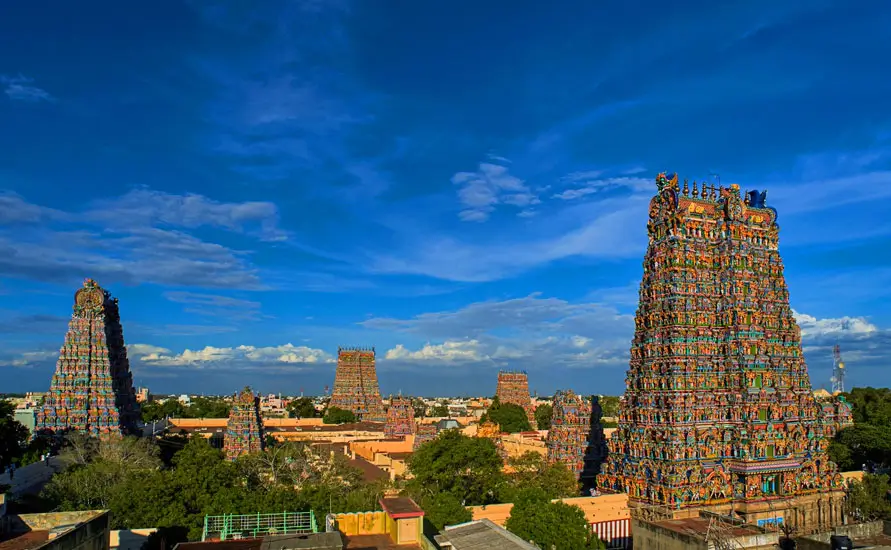
Madurai greets you in the late afternoon. Capital of the Pandya kings and seat of the ancient Tamil Sangam poets, it has been inhabited for well over two millennia, and its streets still circle the great temple in concentric rings named after Tamil months. Gopurams of the Meenakshi complex poke above the rooftops from almost every corner. After check-in, nothing more is planned; a rooftop restaurant looking at the lit towers is a soothing end to a day mostly spent seated. Overnight in Madurai.
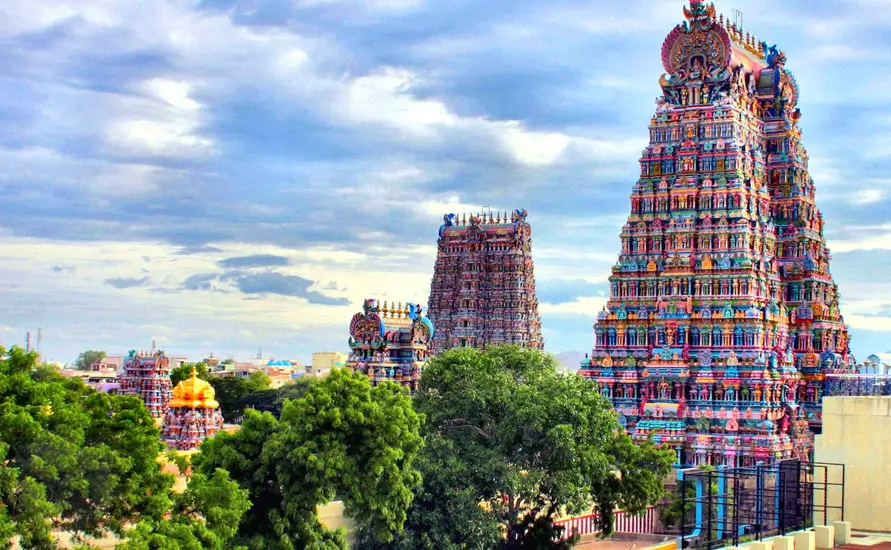
Arrive early at the Madurai Meenakshi Temple, dedicated to Meenakshi, the goddess with fish-shaped eyes, and her husband Sundareswarar, a form of Shiva. Fourteen towered gateways ring the compound, the highest about 52 meters, every tier packed with painted plaster gods, demons, lions and dwarfs. Phones and cameras go into lockers outside; the twin inner shrines admit Hindus only, while halls and corridors welcome every visitor. Your guide leads through the Thousand Pillar Hall, now a small art museum, and around the Golden Lotus Tank, where poems of the Sangam era were supposedly tested.
Following lunch, the guide continues to a palace finished in 1636, the Thirumalai Nayak Palace, home of the ruler who also shaped much of the temple, mixing Dravidian and Islamic forms in its massive white columns and arched courtyard. Most of the original palace was pulled down long ago, yet what remains is enormous. After that, a 17th-century palace of Rani Mangammal holds the Gandhi Memorial Museum, whose most moving exhibit is the stained cloth he had on when shot in January 1948. Madurai holds a special place in his story, since in September 1921 he chose this city to start wearing only a simple loincloth.
Rest at the hotel through early evening, then head back to the temple around nine for the palliyarai ritual. Lifted onto a silver palanquin, Sundareswarar's image is borne by priests to the goddess's chamber, escorted by nadaswaram pipes, drums and chanted hymns, and visitors may watch quietly from the outer corridor. Before it begins, try a glass of jigarthanda at a stall near the east tower, a chilled Madurai drink of reduced milk, almond gum, rose syrup and ice cream, or a late plate of kothu parotta, shredded flatbread clattered on a hot tawa with egg and spices. Overnight in Madurai.
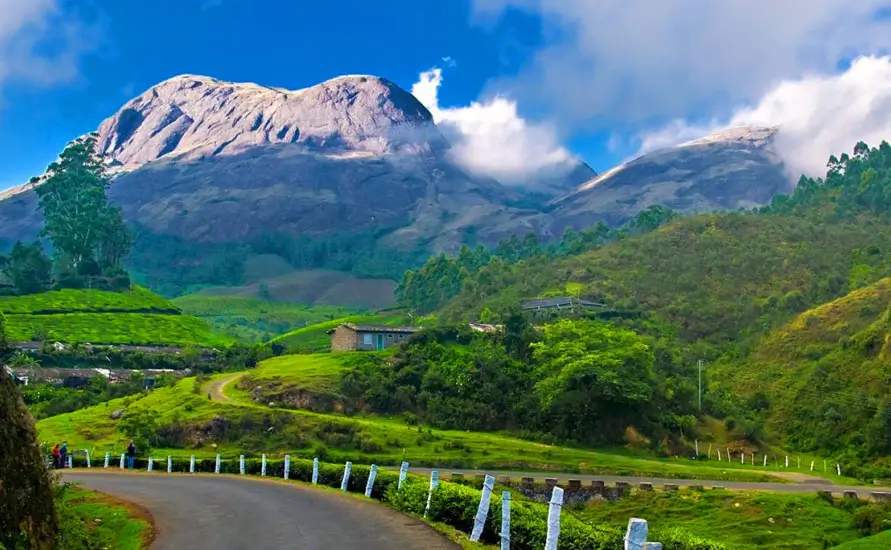
Westward after breakfast, the car crosses the Tamil plain toward the Western Ghats through Theni, a district of vineyards, banana groves and cardamom auction houses, before the climb begins. The Bodimettu ghat road twists through dozens of hairpin bends to cross the state line into Kerala, and somewhere around the top the air turns cool, the scrub turns to forest, and the first tea bushes appear in tidy rows that follow every contour. Lookouts dot the climb, and at one of them a tin-roofed stall sells sugary chai alongside hot banana fritters.
Lunchtime brings you into Munnar, sitting around 1,600 meters at the junction of three rivers. Scottish and English planters cleared these hills in the 1880s and 1890s, and today green tea slopes surround the town on every side, broken by workers' line houses, small churches, a mosque and Hindu shrines. Home for two nights is a planter-style resort or a hillside property with a valley view. Over the afternoon tea poured on arrival, notice how fresh and light the local leaf tastes compared with supermarket teabags, then rest for an hour after the morning's winding road.
Later, a local walker leads a gentle stroll through the bushes near your hotel, explaining how tea is pruned to waist height, why pickers take just a bud and its two youngest leaves, and how pickers, mostly women, can gather many kilos a day carrying baskets strapped to their heads. If they are working, some may stop to chat through your guide about life on the estates, where families have lived for three or four generations. Evening is chilly by South Indian standards, so a fleece or shawl helps. Dinner might include a Kerala chicken stew with appam. Overnight in Munnar.
Morning belongs to Eravikulam National Park, set aside to protect the Nilgiri tahr, an agile mountain ungulate found only along the Western Ghats. At the entrance you swap your car for a park shuttle bus that climbs to Rajamalai, and from there a walking road wanders across rolling grassland under the slopes of Anamudi, at 2,695 meters the highest peak south of the Himalayas. The park shuts for the calving season, roughly February to March, and we rearrange the day if your dates overlap. Tahr frequently feed beside the path, but no encounter is ever guaranteed.
Around midday, the KDHP Tea Museum in town traces a century and more of High Range planting through old photos, a century-old rolling machine and a short film. Better still is the working factory corner, where fresh leaf is withered, rolled, oxidized and dried before your eyes, and the smell of drying tea fills the room. A tasting compares orthodox and CTC grades, and you can buy packs at the counter to carry home. For lunch, choose a local restaurant serving a Kerala meals plate, or a café selling sandwiches and homemade chocolate, a Munnar specialty.
Afternoon brings a drive of roughly 13 km to Mattupetty Dam, a reservoir wrapped in eucalyptus, shola forest and tea, where pedal or motor boats can be hired. On the way, pause at the Indo-Swiss dairy farm, begun with Swiss help in the 1960s to improve local cattle breeds, and at Echo Point, where kids yell over the water and laugh at the answer. Back in town, an optional Kathakali or Kalaripayattu show runs most evenings at small local venues. Otherwise, a quiet dinner at the resort with mist settling on the valley is reward enough. Overnight in Munnar.
Leave Munnar by about seven, with breakfast packed or eaten early, so you can make the noon boarding time in Alleppey. The road drops off the hills through cardamom and pepper gardens, past the small waterfalls at Cheeyappara and through rubber country around Kothamangalam and Kottayam. You can feel the temperature and humidity climbing as you lose height. Coffee is taken at a roadside stop, and by the end the car is driving between flat green paddy fields and canals lined with palms, a total change of landscape inside one morning.
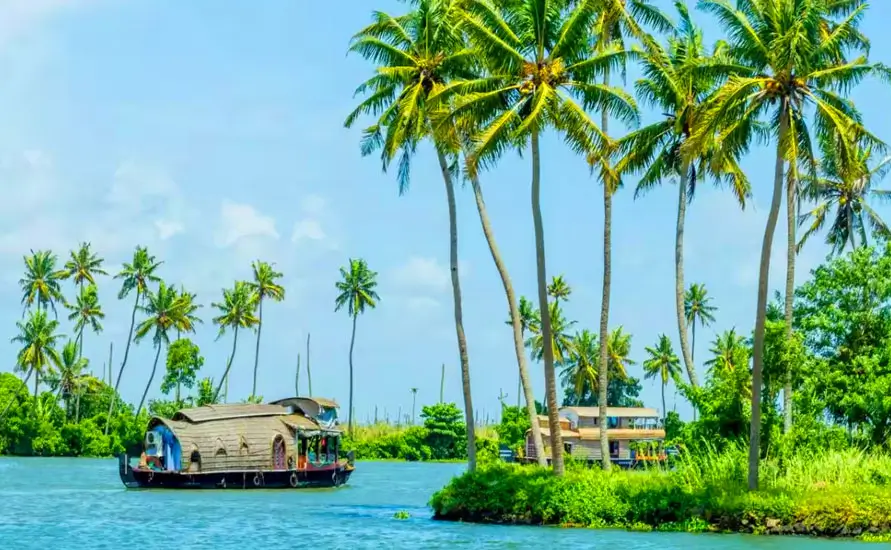
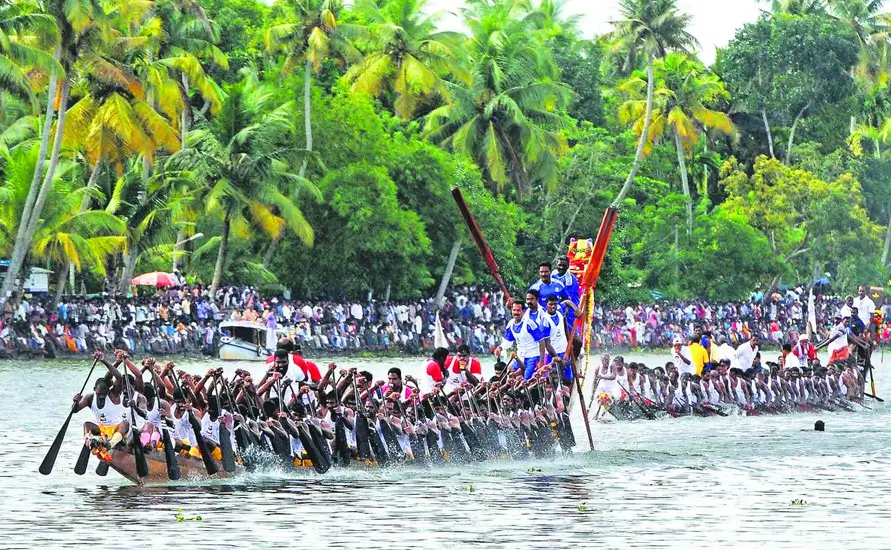
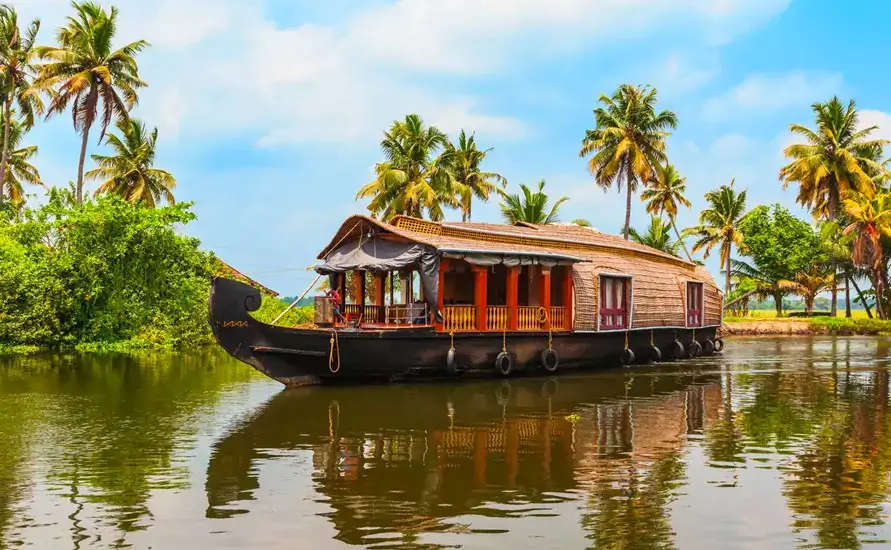
At the jetty three crew members, captain, cook and deckhand, greet you onto your private Alleppey houseboat with a tender coconut, straw already in it. These boats are adapted kettuvallam, old rice barges whose planks were once lashed with coir, not nailed, and yours carries a bedroom with attached bathroom, a dining table and an open front deck with cane chairs. Lunch comes soon: Kerala red rice, a tangy fish curry sharpened with kodampuli, cabbage thoran, sambar, papadam and pickle. Then the crew unties the ropes and the boat pushes slowly out into the canals of Kuttanad.
Hours drift by on the water. You glide along narrow channels and across wide lagoons past chapels, small temples, schoolhouses and front yards that end in stone steps at the waterline, while ducks scatter ahead of the bow and men cast nets from dugout canoes. Fields here lie below the level of the canals, held back by mud dikes. By law houseboats must stop moving at dusk, so the boat anchors early beside a quiet village, and tea with fried banana slices is served while the light fades. The cook then brings dinner to the table on deck. Overnight on the houseboat.
Early risers get the backwaters at their best, with low mist, egrets on the dikes and the first ferries chugging past. Breakfast, perhaps appam with egg roast, is served as the boat cruises back, and the gangplank goes down at about nine. Ninety minutes up the coastal highway lies Kochi, the road threading through towns with large churches, roadside fish stalls and shops selling gold for weddings. Your hotel is in Fort Kochi, the colonial harbor district, so spend the hot middle of the day resting, swimming or reading in the shade.
At about four, amble along the seafront where the Chinese fishing nets start their afternoon shift. Kochi lore credits traders from the Chinese court with bringing the design in the 14th century, and each net, hung from a teak frame, is lowered and raised by a team of men pulling on ropes weighted with stones. Catches are modest and sold on the spot, and small kitchens nearby will fry whatever you buy. Stroll the beach path past old warehouses and watch container ships and fishing boats slide into the harbor channel while the western horizon glows orange.
Tonight brings a Kathakali performance in a small Fort Kochi theater. Get there an hour early, as the make-up session is half the show: actors grind colored stone into paste, outline their eyes in black and build out their jaws with white rice-paper borders while you watch. Before curtain, a presenter walks through the nine emotional states, the hand gestures and the color codes of heroes and demons. The main act, a scene from the epics, is played out to booming chenda drums and a singer. A seafood dinner near the theater ends a full day. Overnight in Kochi.
Your final full day starts on foot with a Kochi guide, who sets the scene with the spice trade that once lured Arab dhows, Chinese junks and finally European fleets here. At St. Francis Church, the earliest European church in India, a tombstone marks where Vasco da Gama was laid to rest in 1524 before his remains went home to Portugal. The walk continues past Dutch-era houses and the old parade ground to Santa Cruz Basilica, whose painted ceilings show the Last Supper and the Passion of Christ in bright Italianate color.
A short car ride later you enter Mattancherry Palace, built by the Portuguese around 1555 and handed to the Raja of Kochi, then repaired by the Dutch. Its upstairs chambers hold some of Kerala's finest temple murals, Ramayana scenes painted with natural pigments. The palace closes on Fridays. Farther along in Jew Town is the 1568 Paradesi Synagogue, shut each Friday and Saturday and over Jewish festivals; its floor is paved in hand-painted Canton porcelain and its ceiling hung with Belgian glass. Our team arranges these stops so they fall on open days.
The afternoon is unplanned, ideal for gathering gifts: whole pepper, cardamom, Munnar tea and coffee from the old godowns, or handloom kasavu cloth with its gold border. Art lovers might seek out galleries along Bazaar Road, while others settle into a café over a salted lime soda. For a farewell dinner, book a waterfront table for karimeen pollichathu, pearl spot fish coated in spice paste and slow-cooked in a leaf parcel, with a coconut-rich prawn moilee. It is a quiet way to close nearly a month on the road across India. Overnight in Kochi.
Breakfast is unhurried, and the car collects you at a time set by your flight, allowing roughly ninety minutes for the road to Cochin International Airport and three hours at the terminal for an international check-in. Late flyers may hold a room till evening or add a short morning drive to Cherai beach, both by prior request and at extra cost. A member of our Kerala team accompanies you up to the departure entrance. Onward connections from Kochi run via Doha, Dubai, Abu Dhabi, Singapore and Colombo to most Western cities.
Four weeks back you touched down in Delhi; in between you slept among Jaisalmer's dunes, watched Udaipur's palace from the water, listened to temple drums in Madurai and drifted through Kerala's paddy canals. Few trips cover so much of India at such a humane pace. When a sequel tempts you, perhaps the Chettinad mansions, Hampi's boulder ruins or the Andaman beaches, our planners will happily start sketching it with you. Until that day, safe travels and an easy flight.
Your Journey

N.S. Rathore & Mrs. Omlata Rathore · Managing Director
We still read every enquiry ourselves. Tell us the places you liked and our planners will send a day-by-day route with drive times and a clear price.
Every package can be customised and no pressure to book. A planner from our office replies within 24 hours with a route written for your group.
Fill this in and your planner will send a first draft itinerary.
Explore more
Kerala Backwaters Escape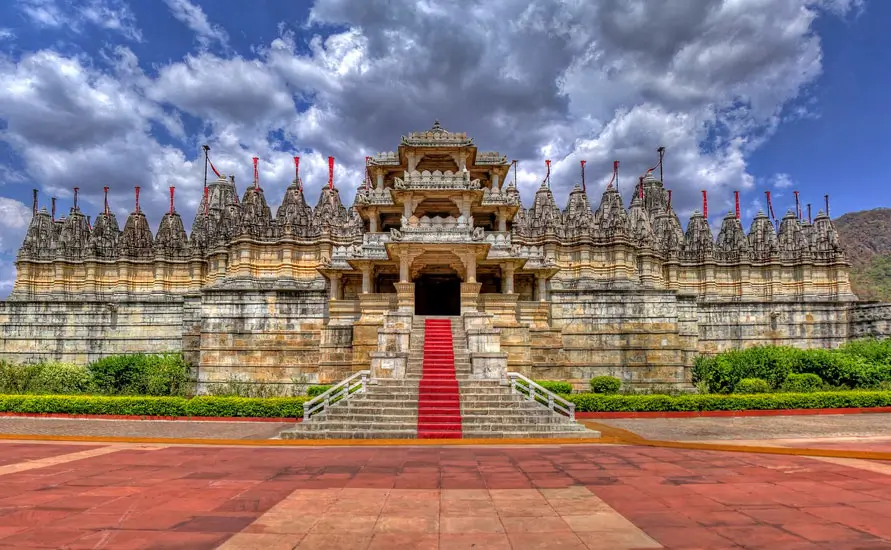 Kerala Backwaters Escape
 Kerala Backwaters Escape
 Kerala Backwaters Escape
 Kerala Backwaters Escape
 Kerala Backwaters Escape
 Kerala Backwaters Escape
 Kerala Backwaters Escape
 Kerala Backwaters Escape
 Kerala Backwaters Escape
 Kerala Backwaters Escape
 Kerala Backwaters Escape
 Kerala Backwaters Escape
 Kerala Backwaters Escape
 Kerala Backwaters Escape
 Kerala Backwaters Escape
 Kerala Backwaters Escape