
 Kerala Backwaters Escape

South India Tour with Rajasthan
Delhi – Jaipur – Jodhpur – Jaisalmer – Kochi – Alleppey – Varkala
At a glance
Golden sand on one side of the country, coconut palms and a warm sea on the other: our Rajasthan Desert and Kerala Beach Tour strings the two together over eighteen unhurried days. The first half follows the old caravan country of the Thar, from the pink lanes of Jaipur to the blue houses below Mehrangarh in Jodhpur and the yellow sandstone fort of Jaisalmer, with a night under canvas among the dunes at Sam. The second half drops you on the Malabar coast, with spice-trade history in Kochi, a night afloat in Alleppey and three slow days on the red cliffs of Varkala.
Distances in Rajasthan are long, so the plan keeps each drive between five and six hours and gives every main city at least two nights. Jaisalmer has very few flights, so instead of a tiring dash to an airport you return by road to Jodhpur for one night and fly south the next morning on a connecting flight. In Kerala the legs shrink to an hour or three. Each region has its own cooled private vehicle and English-speaking chauffeur assigned to your party alone, and licensed local guides handle the forts, palaces and old quarters.
Guests writing to us from Boston, Toronto, Manchester, Munich or Melbourne often say they want both the desert and the beach but fear that one trip cannot hold them; this Rajasthan and Kerala tour package is our answer, and it suits NRI families showing children two very different Indias too. Aim for the stretch between November and March, when desert nights turn crisp and Kerala's monsoon has cleared. Ending at Varkala means the last days are genuinely restful, with a long flight home from Trivandrum rather than a final rush of sightseeing.
Whatever hour your plane lands at Indira Gandhi International Airport, one of our Delhi staff stands by the arrivals exit with a printed sign, ready to help with the luggage trolley and walk you to the car. The terminal lies toward Gurugram on the city's south-western fringe, and outside rush hour most central New Delhi addresses are less than sixty minutes away. A short briefing on the way covers the eighteen-day plan, the flight south, local cash and SIM options and a contact number that answers day and night. Rest is the priority, so nothing is fixed before evening.
Around sunset, if you are awake and curious, the driver can take you to India Gate, a 42-meter sandstone arch carved with the names of Indian Army men lost in 1914–1918. Nearby stands the National War Memorial, opened in 2019, where an eternal flame burns for those lost in later conflicts. Families from every corner of the country come here in the cool of the evening, children chase balloons on the lawns and vendors sell ice cream and spiced roasted peanuts. It is an easy, low-effort first look at the capital and a chance to stretch legs after the flight.
Dinner on day one is best kept gentle on the stomach. Many hotels offer a mild Indian buffet alongside continental dishes, and if you want to go out, the restaurants of Connaught Place serve North Indian classics such as palak paneer, chicken tikka and fluffy naan bread without heavy spice. Drink only bottled or filtered water, skip ice in street drinks for the first few days, and keep a light scarf or shawl handy for tomorrow's visits to religious sites. Our team phones to confirm the morning start. Overnight in Delhi.
Chandni Chowk wakes slowly, so an eight o'clock start lets you see shopkeepers raising their shutters and chai sellers lighting stoves before the crowds arrive. Your guide begins at Jama Masjid, the great Friday mosque completed for Shah Jahan in 1656, where a modest ticket buys a climb up the tight spiral of the southern minaret, rewarded by a panorama across rooftops toward the Red Fort (shut every Monday). Modest clothing is required, shoes are removed at the steps, and women are asked to cover their heads. A cycle-rickshaw then threads through the jewelers' lane of Dariba Kalan and the dried-fruit stalls of Khari Baoli.
After a late breakfast of jalebi and hot puris at a century-old sweet shop, or a more familiar café lunch, you cross into New Delhi. Near the Yamuna, Raj Ghat marks Gandhi's cremation site of 1948 with nothing more than a square of black stone and an eternal lamp, and it makes a reflective pause. Then comes Humayun's Tomb, where Persian-trained architects created the first great garden tomb in India in the 1560s. Your guide points out the water channels dividing the garden into squares, the double dome and the smaller tombs in the grounds, including that of Isa Khan, which is older than the main building.
As the light fades you walk through the narrow lanes of Nizamuddin Basti to the Hazrat Nizamuddin dargah, the shrine of a 14th-century Sufi saint. On most Thursday evenings and on many other nights, qawwali singers sit in the marble courtyard and perform devotional songs to harmonium and tabla, and visitors of every faith sit on the floor to listen. Women keep their hair covered and stay outside the saint's inner chamber by custom, yet the music in the courtyard is open to all. Your guide stays close in the crowd, and dinner can be kebabs from the lanes outside or a quieter meal back at the hotel. Overnight in Delhi.
An after-breakfast departure beats most of the lorries that crowd the Delhi–Jaipur highway later in the morning. Five hours or a little more is normal, including one long break, and the car is stocked with water and tissues for the drive. A good place to halt is one of the large highway food plazas near Behror or Kotputli, where clean washrooms, sweet lassi and freshly fried samosas make a welcome pause. Watch for the change in clothing and landscape as you enter Rajasthan: brighter turbans, sandier soil, flat-topped acacia trees and the low brown spine of the Aravalli range.
By early afternoon you arrive in Jaipur and have time to settle into your hotel and rest before the evening. Jaipur's founder, Maharaja Sawai Jai Singh II, shifted his court down from Amber in 1727, when the hill site could no longer supply enough water or room for its swelling population. Unlike older Indian cities that grew organically, his capital was planned according to Hindu architectural texts and divided into blocks with wide main roads and straight lanes, a layout your guide will explain properly over the next two days. A short nap now makes the evening more enjoyable.
Toward dusk, Birla Mandir, a 1980s temple of pure white marble honoring Lakshmi and Narayan at the foot of Moti Dungri hill, gives a calm introduction to Hindu worship in Rajasthan. The evening aarti, when priests wave lamps before the deities to the sound of bells, is usually held around sunset, and visitors of all faiths may watch quietly. The stained-glass windows show scenes from Hindu scriptures, and the outer walls carry figures of saints and thinkers from different religions. Leave footwear at the counter by the gate; cameras must stay off once you enter the sanctum hall. Overnight in Jaipur.
First light is kind to Amber Fort, and arriving before nine means you share the Jaleb Chowk courtyard with pigeons and guards rather than tour groups. Getting up from the road means either a fifteen-minute walk on the cobbled ramp or a seat in a shared jeep, as we never book elephant rides. Begun by Raja Man Singh in the late 16th century, the palace inside blends Rajput and Mughal design, and your guide shows you the carved marble panels of the Jai Mandir, the cooling water channels of the Sukh Niwas and the zenana quarters where the queens' rooms were linked by hidden corridors.
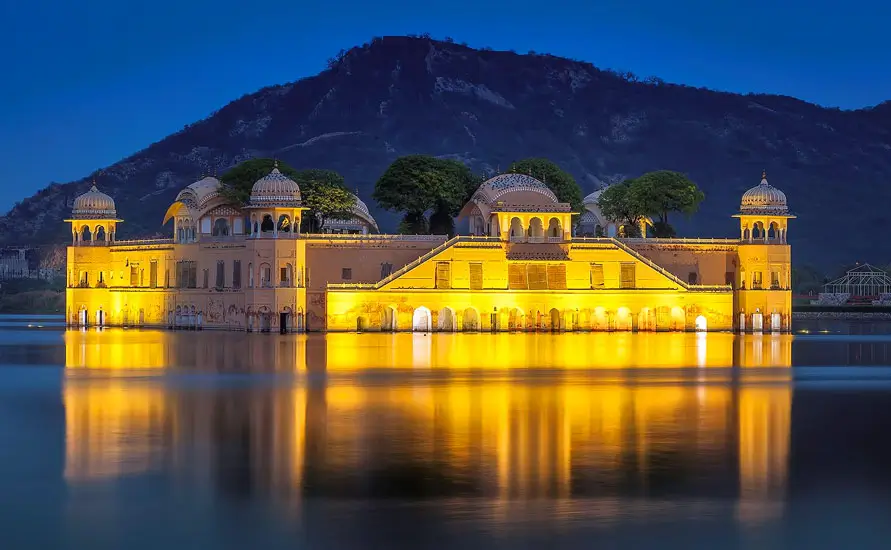
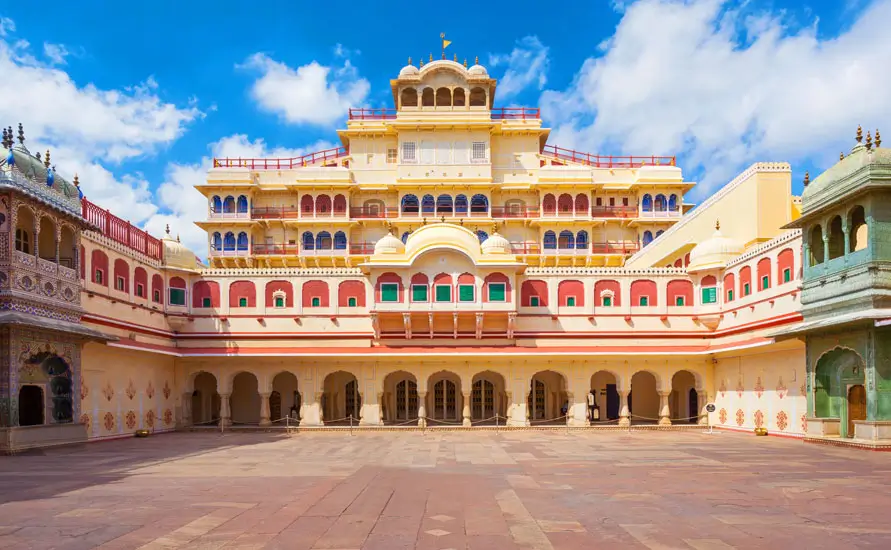
Tucked behind the fort on the village side sits Panna Meena ka Kund, a stepwell from the 1500s whose criss-cross staircases form a geometric pattern around a square pool. Generations of Amber villagers drew water and gossiped on these cool steps through the summer, and the steps make a good photograph from any of its four sides; climbing down the steps is no longer allowed. On the drive back you stop at Jal Mahal for a view of the water palace, then continue to the City Palace in the old town, where the Mubarak Mahal now houses a textile museum with royal robes, shawls and a huge quilted gown said to belong to a very large maharaja.
After lunch comes Jantar Mantar, the astronomer-king's open-air observatory, raised over roughly a decade from 1728 and placed on the UNESCO list in 2010. Its nineteen instruments, some as tall as a house, were fashioned from masonry and brass for timekeeping, star positions and eclipse forecasts, and your guide demonstrates how the shadow on the giant Samrat Yantra moves several millimeters every minute. Afterwards the evening is free in the lanes of Tripolia Bazaar, known for brass utensils and lac bangles, or for a Rajasthani dinner of laal maas, a fiery mutton curry, or a milder vegetable thali. Overnight in Jaipur.
About 30 km west of Jaipur, the small town of Bagru has been printing cloth by hand for several centuries, and a morning here shows a craft that still supports hundreds of families. In a courtyard workshop, a printer dips carved teak blocks into natural dyes made from indigo, pomegranate peel, iron rust and clay, then stamps them onto cotton in careful rows. You can try a few blocks yourself on a small piece of fabric to take home. Bagru prints are known for their earthy colors and a resist technique called dabu, where mud paste keeps parts of the cloth undyed.
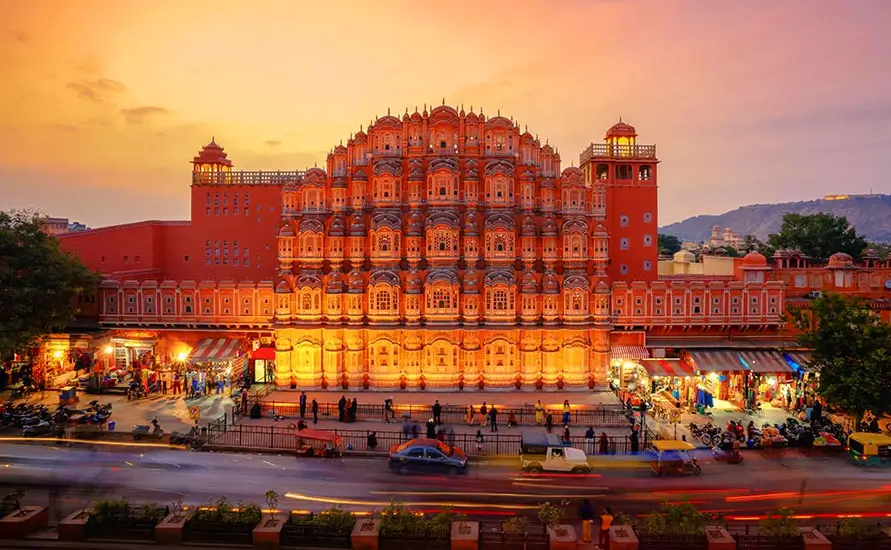
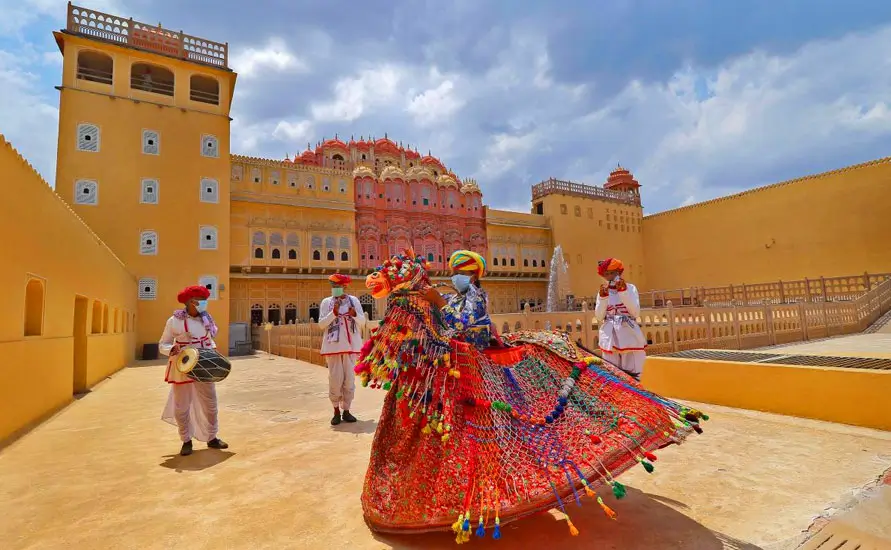
Back in Jaipur after a lunch of your choice, you stop at the Hawa Mahal, raised in 1799 under Sawai Pratap Singh, a poet king, as a screen from which royal women could watch life on the main street. From the back you can enter and climb its narrow ramps, rather than stairs, to the upper floors, where small balconies look out over Siredeori Bazaar and the City Palace. Afterwards, the Albert Hall Museum, set amid the lawns of Ram Niwas Bagh, deserves an hour for its collection of pottery, metalwork, musical instruments and miniature paintings, all in a grand building designed by Samuel Swinton Jacob.
To finish your time in the Pink City, the car climbs a looping ridge road to Nahargarh Fort, a royal hill retreat from 1734 overlooking the old town. Inside, a later palace wing holds nine matching apartments for the queens, linked by a hidden passage that let the ruler reach each one without being seen. As the sun drops, the whole city spreads out below, and the lights begin to come on across the walled quarter. Several terraces near the fort serve tea and snacks, and the drive down takes about thirty minutes. Pack tonight for tomorrow's drive west. Overnight in Jaipur.
Heading west from Jaipur the land gets drier by the hour, and by mid-morning you are crossing open country of dry grass, thorny khejri trees and herds of goats led by men in white dhotis and bright turbans. Routed via Ajmer on a largely smooth highway, the run lasts close to six hours once breaks are counted. Your driver will suggest a halt for tea at a dhaba where the cook makes ginger chai in a battered pan and serves mirchi vada, a large green chili stuffed with spiced potato and fried in batter.
Lunch happens near Beawar, at a dhaba-style restaurant or an old heritage property, depending on your timing and appetite, and the scenery from here on carries more and more signs of desert life. Watch for village wells with wooden pulleys, women gathering firewood, stepped water tanks beside small temples and the occasional peacock crossing the road. The car's air-conditioning keeps the cabin cool, but the dry heat outside can surprise you even in winter, so keep sunglasses and a hat close by for photo stops. Rest breaks are flexible, and the driver can pull into any decent stop you like.
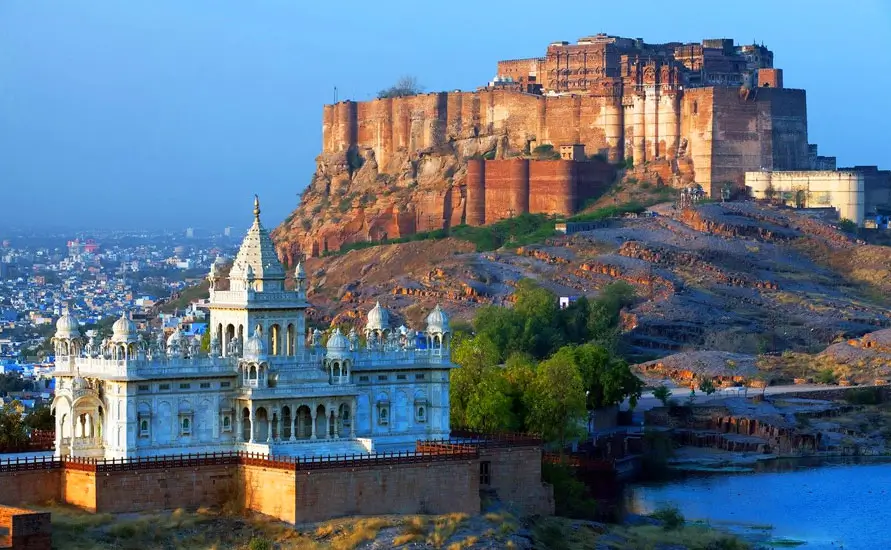
Arriving in Jodhpur in the late afternoon, you see Mehrangarh Fort towering on its rock cliff above the city long before you reach your hotel. Founded in 1459 by Rao Jodha, the Rathore chief, Jodhpur was a major stop on the trade routes that carried opium, copper, silk and sandalwood across the desert. Come evening, wander out to the clock tower rising over Sardar Market, a busy square of spice, textile and silver shops lit up after dark. Jodhpur is famous for pyaaz kachori and a sweet called mawa kachori, and a shop near the tower sells both piping hot. Overnight in Jodhpur.
A lift carries you up the first steep section of Mehrangarh Fort, though walking up through the seven gates is more rewarding if your knees allow it. On the walls of the Loha Pol you will see small handprints left by royal widows on their way to sati, a sobering detail your guide explains with care. Inside, the museum is one of the best run in Rajasthan, with an audio guide included in the ticket and galleries of howdahs, palanquins, weapons and turbans. The Phool Mahal, with its gold-leaf ceiling, and the mirrored Sheesh Mahal show how wealthy the Rathore rulers became.
Below the fort's eastern walls, Jaswant Thada honors Maharaja Jaswant Singh II with a marble cenotaph finished in 1899, its thin marble panels glowing when the sun shines through them. From here your guide leads you on foot down into Brahmpuri, the old Brahmin quarter, where house after house is washed in indigo and sky blue. Locals give several reasons for the color, from caste identity to keeping homes cool and repelling insects, and nobody fully agrees. Some alleys tilt sharply downhill, so grippy soles help, and so does a little change for chai at a corner stall.
In the afternoon you take a jeep into the countryside south of Jodhpur to visit a Bishnoi village. The Bishnoi community follows 29 principles laid down by the 15th-century guru Jambheshwar, which forbid felling living trees or hurting wild creatures, and blackbuck and chinkara wander fearlessly at the edges of their millet plots. You may share sweet tea with a family in their mud-walled courtyard, watch a potter at his wheel and see durrie rugs being woven on simple frame looms. Back in town, the Umaid Bhawan museum wing is an option for those still curious. Overnight in Jodhpur.
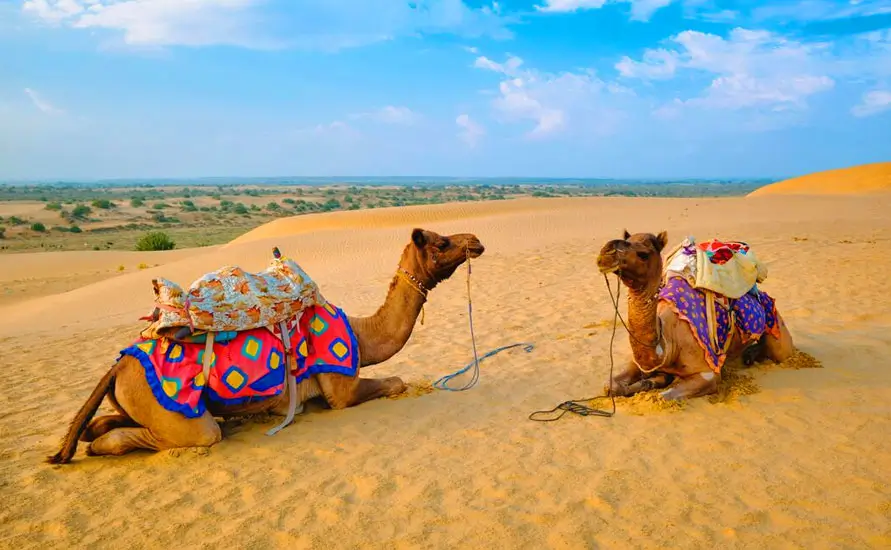
West of Jodhpur the true Thar Desert begins, and the drive to Jaisalmer is one of the most memorable roads in Rajasthan. For about five hours you pass sand-blown villages of round mud huts with thatched roofs, wind farms turning on low ridges and long stretches with nothing but scrub and sky. The highway is good and lightly used, with a midday halt near Pokaran where a dhaba fries fresh rotis to go with a pot of yellow dal. Camels are a common sight along the verge, sometimes pulling carts loaded with water drums.
As you get closer to Jaisalmer, a city founded in 1156 by the Bhati Rajput ruler Rawal Jaisal, the fort appears on the horizon like a sandcastle rising from the plain. Its walls are made of yellow sandstone that turns golden in the afternoon light, which is why it is also called Sonar Qila, the golden fort. Rooms at your town hotel are ready on arrival, leaving two free hours for a shower and a lie-down. In winter the desert evenings cool down quickly, so bring a warm layer for after sunset, along with lip balm and moisturizer for the very dry air.
For your first evening, a walk around Gadisar Lake is the right introduction. Dug in the 14th century as the city's main water source, the lake is lined with stone ghats, small shrines and the carved Tilon ki Pol gateway, which legend credits to a wealthy court dancer. Catfish come right up to the steps when visitors throw bread, and small pedal boats are for rent at the ghats. At sunset the fort walls glow on the hill above, and the reflections on the lake make good photographs. Dinner can be on a rooftop facing the lit-up fort. Overnight in Jaisalmer.
Unlike most forts in India, Jaisalmer Fort is still lived in, with several thousand residents, shops and guesthouses packed inside its ramparts. Your guide walks you through its winding lanes to the royal palace and then to the group of Jain temples, built between the 12th and 16th centuries in pale yellow stone and carved so finely that the ceilings look like lace. No leather may be carried into these shrines, so leave belts and purses with the guide, and visiting hours for non-Jains are usually limited to the morning. Plan to spend about two and a half hours inside the fort walls.
Down in the old town, Patwon ki Haveli is a group of five merchant houses built in the 19th century by a wealthy brocade trader and his sons. Every façade is covered in carved balconies, screens and arches, and one of the houses has been restored as a museum with painted ceilings and period furniture. Following lunch and checkout, the road leads south-west to Kuldhara, an abandoned village of the Paliwal Brahmins, who are said to have left their homes in a single night about two centuries ago. Roofless houses, a small temple and silent streets make it a strange, thoughtful stop.
From Kuldhara you continue to the Sam sand dunes, about 40 km west of Jaisalmer, for sunset on the sand. A jeep ride over the dunes is included, and camel rides are on offer only for those who want one, so there is no pressure either way. As the light goes, you check in to your Jaisalmer desert camp, a set of comfortable tents with attached bathrooms, where the evening brings Manganiyar musicians, Kalbelia dancers and a simple Rajasthani dinner around a fire. Away from the city lights, the stars are usually very bright. Overnight at the desert camp near Sam.
Wake early for the desert sunrise, when the dunes turn from grey to pink to gold in a few minutes and the only footprints on the sand are those of beetles and foxes from the night. Tea is served outside the tents, and after breakfast you leave the camp for the long drive back east. Jaisalmer has very few flights, so the sensible plan is to head back to Jodhpur, whose airport has steady connections south. The car rejoins the highway near Jaisalmer, and the driver plans breaks so that no stretch lasts more than about two hours.
Somewhere around Shergarh you stop to eat, and the scenery gradually changes back from sand to scrub and farmland as you approach Jodhpur. This is a good day to rest in the car, look through photos or read about Kerala, where you will be tomorrow. Your guide's notes and our printed plan include a brief introduction to Kerala's history, food and etiquette, from removing shoes in homes to eating with your right hand. Should you want a leg stretch with a purpose, the driver can pull into a village to see how water is stored in round underground tanks called tankas.
Late afternoon brings you into Jodhpur again, this time to a hotel near the airport road for an easy start tomorrow. If you still have energy, the Toorji ka Jhalra, a restored 18th-century stepwell near the clock tower, is lit up in the evening and surrounded by cafés and craft shops. Steps of rose-red sandstone zigzag down to a deep tank, and local boys sometimes jump in from the lower steps. Dinner can be a farewell Rajasthani meal of gatte ki sabzi, ker sangri and bajra roti. Repack your bags tonight, keeping liquids within domestic flight rules. Overnight in Jodhpur.
After breakfast the car takes you to Jodhpur Airport, about 5 km from the center, for your connecting flight to Kochi. There are no direct flights, so the route usually goes through Delhi, Mumbai or Bengaluru, and the full travel time is around six to eight hours including the stopover. We choose connections with enough time to change planes without stress, and where possible your bags are checked through. Keep a light layer handy, since airport terminals and planes are cool, while Kerala's humid heat will meet you the moment you step outside.
Waiting at Cochin International Airport is our Kerala chauffeur, who handles the ninety-minute road trip to Fort Kochi, the old port area at the tip of the peninsula. The change from the desert is striking: green palms, wet monsoon-stained walls, churches, canals and the smell of salt water. If you arrive before sunset, an amble beside the cantilevered nets on the seafront is a soft finish to a day spent in airports. Otherwise, rest and enjoy a first Kerala meal, perhaps appam with vegetable stew. Overnight in Kochi.
Start early at the waterfront, when fishermen haul up the Chinese fishing nets with the morning catch and auction it on the spot to traders and restaurant owners. The nets, held up by wooden poles and balanced with large stones on ropes, probably arrived with Chinese or Arab sailors many centuries back, and they are still worked by hand. From here your guide walks you to St. Francis Church, a plain whitewashed nave of the early 1500s. Set into the floor is a worn tombstone, the original grave of da Gama, whose remains stayed here from 1524 until they were shipped to Portugal fifteen years later. The walk then follows Burgher Street and Princess Street, lined with gabled Dutch and colonial British homes.
By mid-morning a five-minute ride brings you to Mattancherry Palace, handed over as a Portuguese present to the raja around 1555 and patched up later by Dutch engineers, whose bedrooms and coronation hall carry wall paintings in ochre and green that retell the Ramayana and stories of Krishna. The palace closes on Fridays. Three lanes on, the Paradesi Synagogue, standing since 1568, draws visitors for its blue-and-white Cantonese floor tiles, each painted differently, and its hanging Belgian lamps; since it shuts each Friday and Saturday as well as for Jewish festivals, we shuffle the morning to suit your dates. The small community of Kochi Jews has shrunk to only a handful of people today.
The afternoon is free to wander through Jew Town, where old spice warehouses now hold antique shops, art galleries and cafés. Ginger is still dried and sorted in some of the warehouses, and you can buy fresh black pepper, cardamom and cloves to take home. Tonight a Kalaripayattu demonstration, in which young fighters trained in Kerala's martial tradition leap, spin and clash sword on shield in a small earthen arena, makes a lively contrast to yesterday's quiet travel. Supper might be at a simple beachside fish grill, where the day's snapper, squid and tiger prawns sit on ice and you point at whatever looks best. Overnight in Kochi.
Today's excursion heads north of Kochi to the area of ancient Muziris, a port that traded pepper with Rome, Greece and the Middle East more than two thousand years ago. An hour up the road, the Paravur synagogue now serves as a Muziris Heritage Project museum, with displays about the Jewish families who once lived along this coast. Nearby Chendamangalam is remarkable for a hill where a church, a mosque, a temple and an old synagogue stand only minutes apart on foot, a picture of Kerala's long history of different faiths living side by side.
At Chendamangalam you also visit Paliam palace, once the seat of the Paliath Achans, who served the Kochi rajas as chief ministers for generations, now a museum about the family and the region. Then the road continues to Kodungallur, whose Cheraman Juma Masjid is honored locally as the first mosque built on Indian soil. Long sleeves and covered legs are expected, and women visitors may be shown to a separate viewing space. Midday food is local: tangy Kerala fish curry with red rice, or a vegetarian spread on a banana leaf. Since several museums on the trail close on Mondays and holidays, we check the timings before your date.
Returning to Fort Kochi around four, there is a break at the hotel ahead of tonight's Kathakali. Unlike a hurried visit, arriving early lets you sit through the full make-up session, when the actors grind colors from rice paste, lime and natural pigments and build up green, red and white faces stroke by stroke for well over an hour. A short introduction explains the nine facial expressions, or navarasas, and the hand gestures used to tell stories from the Mahabharata. Once the curtain is pulled aside, roughly ninety minutes of drama follow, driven by chenda drums and two singers. Overnight in Kochi.
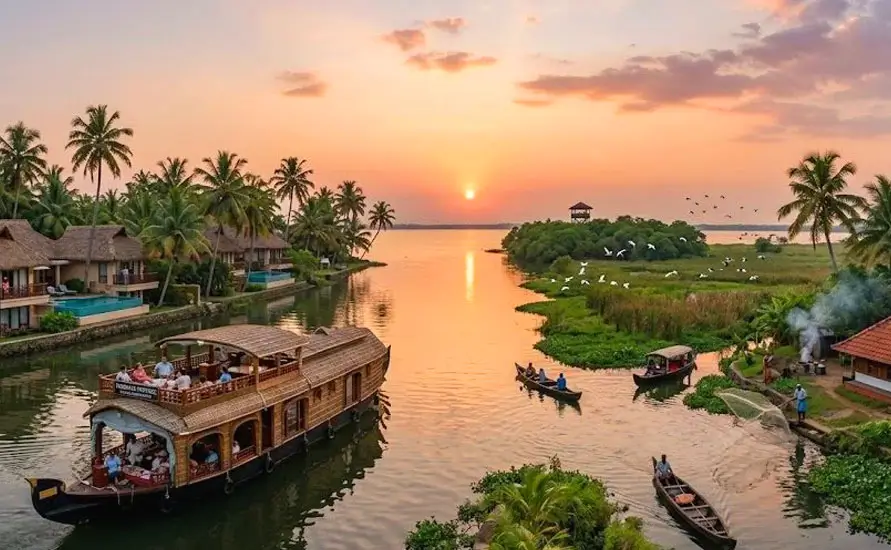
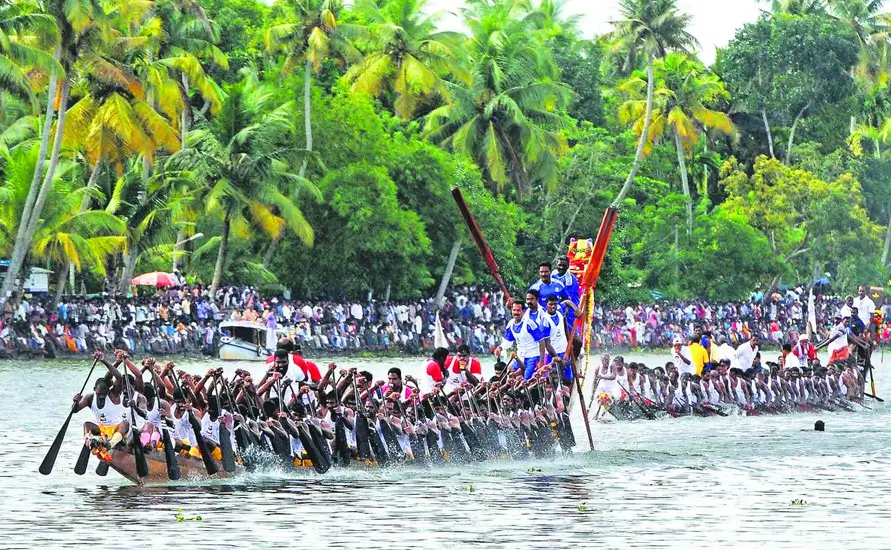
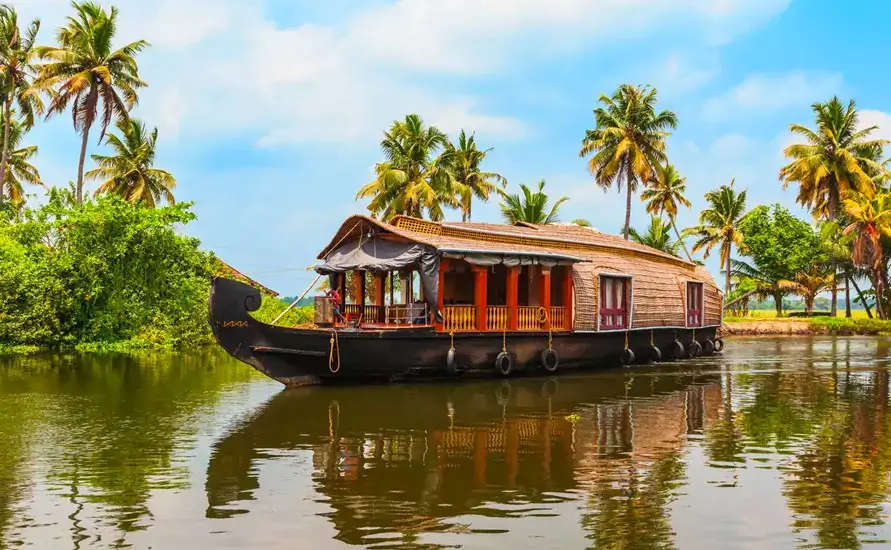
A short drive south takes you to Alleppey, where your private Alleppey houseboat waits at the jetty around noon. Built in the shape of the old kettuvallam rice barges, the boat has wooden floors, cane furniture, one or more air-conditioned bedrooms and an open deck at the front. The crew of three prepares your lunch while the boat sets off, usually with Kerala rice, fish fry, beetroot pachadi and avial, a gentle medley of vegetables in coconut and curd. Vegetarian, vegan and child-friendly menus can all be arranged if you tell us before the trip.
All afternoon the hull slides through the waterways of Kuttanad, whose paddy is farmed below the level of the sea behind slim earthen bunds. Village life passes close to the boat: a boy fishing with a bamboo rod, schoolgirls in uniform queuing for a ferry, a man repainting a canoe, churches and temples standing side by side. Kingfishers, egrets and cormorants are common, and the crew can point out the different kinds of boats that still carry goods and people. A stop at a small village shop or toddy stall is possible if you are curious.
Rules for houseboats require them to stop cruising around sunset, so the boat is moored by early evening beside a calm bank. Evening tea is served with banana chips or fried snacks, and the cook will happily show you how to make a fish curry or a coconut chutney in the small galley. Cabins come with nets or plug-in repellent, and the generator usually runs for the air-conditioning during the night. Dinner arrives on deck by lamplight, and afterwards frogs and crickets take over the soundtrack. Overnight on the houseboat.
Steamed puttu with small bananas comes to the table as the captain steers for the landing, where you disembark around 9 am. The drive south to Varkala takes about three hours along the coastal highway, passing small fishing towns, bright churches and the long green line of coconut groves. If you would like to break the drive, the driver can stop at the Krishnapuram Palace near Kayamkulam, an 18th-century palace with one of the largest mural paintings in Kerala, the Gajendra Moksham. Note that most state museums in Kerala close on Mondays, so we check this stop against your date.
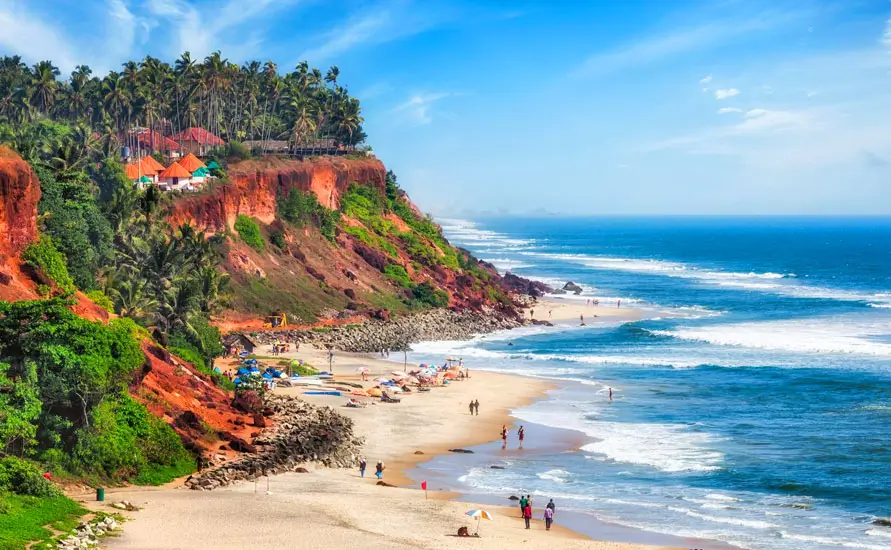
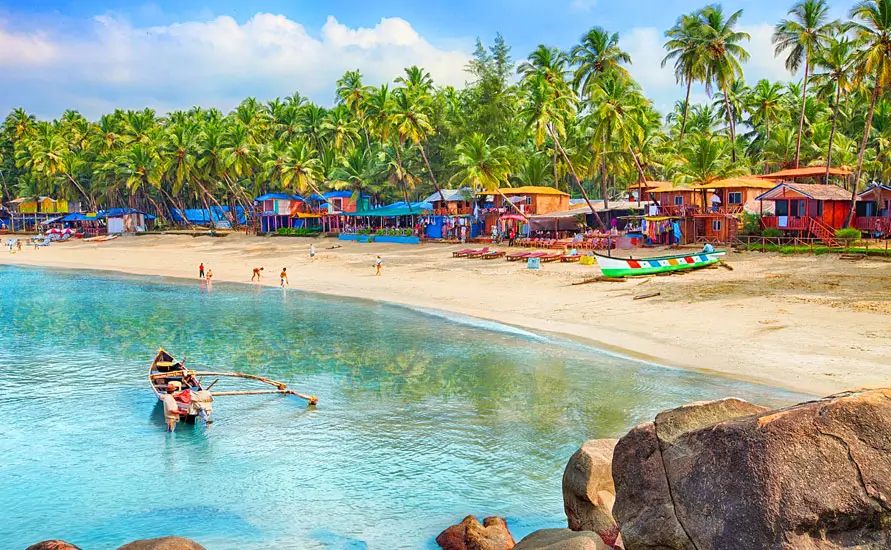
Early afternoon finds you settling into a beach hotel close to the North Cliff, where rust-colored laterite walls fall sheer into the Arabian Sea. Varkala is unique in Kerala for this setting, and a cliff-top footpath crowded with juice bars, yoga shalas and tiny boutiques runs for about a kilometer along the edge. After the long Rajasthan drives and two busy days in Kochi, the pace from now on is your own. Take a nap, sit by the pool or walk the path to see the waves breaking below, and let the long days on the road fade.
At sunset follow the stairway to Papanasam Beach under the cliff, a strand that is also a sacred site where Hindu families gather at dawn to offer rice balls and prayers for relatives who have died. In the evening the cliff cafés serve grilled seafood, Kerala curries and international dishes, and many have open terraces facing the sea. Rip currents are common here; swim between the lifeguard flags and nowhere else, and keep children within arm's reach even in shallow water. A phone flashlight is handy on the cliff after dark, because some stretches have no lamps. Overnight in Varkala.
Begin the day with an optional sunrise yoga class on a cliff-top terrace, one of the many offered by local teachers for beginners and regular practitioners alike. Classes usually last about ninety minutes and focus on gentle stretching, breathing and relaxation rather than difficult postures. Afterwards, a short walk from the beach leads uphill to the Janardhana Swamy Temple, which local belief dates back some two millennia. Access is a matter for the temple authorities, and non-Hindus generally admire it from outside, but the setting on a small hill above the sea is worth the walk.
Before noon, a ten-minute ride inland reaches Sivagiri Mutt, the place where the social reformer Sree Narayana Guru, who fought untouchability and opened temples to all castes a century ago, spent his last years and is buried. The simple white buildings and the hilltop samadhi are peaceful, and the monks welcome visitors who wish to learn about the Guru's message that all people share one caste, one faith and one god. Lunch can be a traditional Kerala sadya, two dozen little vegetarian dishes ladled onto a banana leaf in a family-run eatery.
Later, drive roughly 10 km up the coast to Kappil, where a thin bar of sand is all that holds the lagoon back from the ocean. A short country boat or canoe ride on the lake shows you mangrove banks, fishermen casting nets and the quiet side of Kerala village life. Returning to Varkala, you may still fit in a dip or a stroll on the less crowded Black Beach at the north end of the cliff. Varkala has many Ayurveda centers, and a simple oil massage can be booked for the evening if you like. Overnight in Varkala.
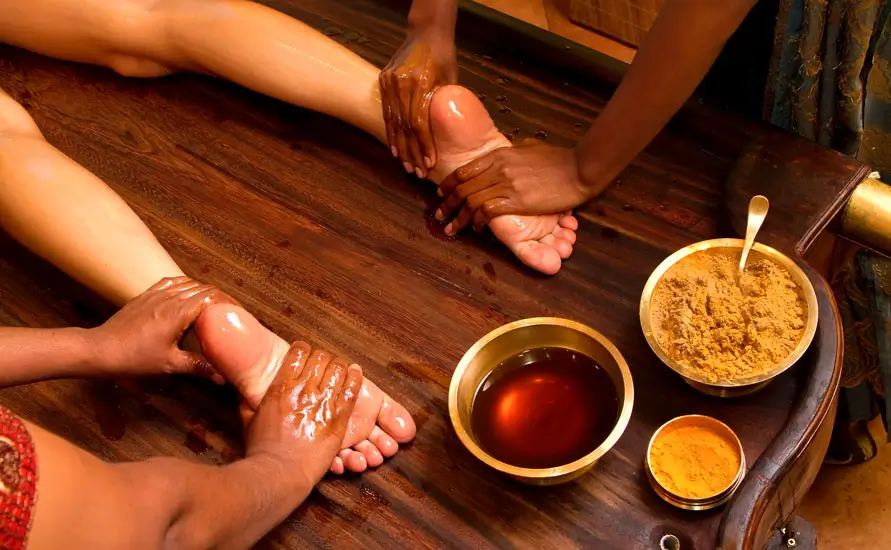
Nothing is scheduled today, which most guests welcome after a long trip. Curious about Ayurveda, the classical Indian system of health care so closely tied to Kerala? The free day suits a session such as abhyanga, a full-body warm oil massage, or shirodhara, where warm herbal oil is poured in a gentle stream onto the forehead. Before the first stroke of oil, a qualified Ayurveda doctor takes a short history, and the oils are chosen to suit you. Many guests report feeling loose and rested afterwards, but a massage never stands in for your own doctor's advice.
Restless already? A half-day outing to Trivandrum, Kerala's capital, some 50 km down the coast, covers the Napier Museum and its colorful Indo-Saracenic building, the Kuthiramalika palace museum and the outer walls of the Padmanabhaswamy Temple, which admits only Hindus inside and keeps a strict dress code. Another option is the beach at Kovalam, with its lighthouse and crescent bays. Both trips can be arranged with your driver at short notice, and we will tell you which museums are closed on the day, since several state galleries shut on Mondays. Either outing leaves you back in Varkala by mid-afternoon.
In the afternoon, the cliff path offers a final chance for shopping, with stalls selling Kashmiri shawls, Tibetan jewelry, cotton beach clothes and Kerala spices. For your farewell dinner, many guests choose a sunset table at one of the cliff-top restaurants, ordering grilled kingfish, tiger prawns or a vegetable curry with fluffy Kerala parotta. Our team will confirm your airport transfer time and remind you of check-in rules for your international flight. Spend the last evening listening to the waves from your balcony, perhaps writing postcards or sorting the photos from the desert camp. Overnight in Varkala.
Once you have checked out, the car sets off south for Trivandrum International Airport, which normally takes about ninety minutes. Departures from here serve Dubai, Doha, Abu Dhabi, Singapore, Colombo and the main Indian hubs, from where you can fly on to Europe, North America and Australia. Late-night departures can be paired with extra hours in your room, so you leave showered and rested. Our representative will see you safely to the terminal.
Over eighteen days you have traveled from the Mughal monuments of Delhi through the forts and desert of Rajasthan to the backwaters and cliffs of Kerala, two regions as different as any two countries. We hope the desert nights and the slow beach days both stay with you. Tamil Nadu's temples, Kerala's tea hills and the lakes of Udaipur would make a fine reason to return, and we would enjoy shaping that trip with you. Have a safe flight home.
Your Journey

N.S. Rathore & Mrs. Omlata Rathore · Managing Director
We still read every enquiry ourselves. Tell us the places you liked and our planners will send a day-by-day route with drive times and a clear price.
Every package can be customised and no pressure to book. A planner from our office replies within 24 hours with a route written for your group.
Fill this in and your planner will send a first draft itinerary.
Explore more
Kerala Backwaters Escape Kerala Backwaters Escape
 Kerala Backwaters Escape
 Kerala Backwaters Escape
 Kerala Backwaters Escape
 Kerala Backwaters Escape
 Kerala Backwaters Escape
 Kerala Backwaters Escape
 Kerala Backwaters Escape
 Kerala Backwaters Escape
 Kerala Backwaters Escape
 Kerala Backwaters Escape
 Kerala Backwaters Escape
 Kerala Backwaters Escape
 Kerala Backwaters Escape
 Kerala Backwaters Escape
 Kerala Backwaters Escape