 Kerala Backwaters Escape

South India Tour with Rajasthan
Delhi – Jaipur – Jodhpur – Bangalore – Mysore – Hampi
At a glance
Few itineraries let you compare two Indian royal traditions side by side, and that is the whole idea behind our Rajasthan and Karnataka Heritage Tour. The first week follows the Rajput kings across hilltop forts in Jaipur and Jodhpur, where sandstone walls rise straight out of the desert scrub. A flight then carries you south to Bangalore, from where the road leads on to the Wodeyar court at Mysore and the boulder-strewn capital of the Vijayanagara empire at Hampi. Over fourteen days you see how rulers a thousand miles apart built power, faith and beauty in stone.
Pacing was the main concern when we planned the route. You unpack for two or three nights almost everywhere, the longest drive in Rajasthan is about six hours on a good highway, and the jump from Jodhpur to Bangalore is covered by air. Between Mysore and Hampi you ride the overnight Hampi Express in an air-conditioned sleeper berth, which spares you a full day of highway and adds a slice of Indian rail life. Your own chauffeured car and a different licensed guide in each city take care of the sightseeing on every day of this Rajasthan and Karnataka Heritage Tour.
We had two kinds of guest in mind: guests from America, Canada, Britain, continental Europe and Australia who have seen enough Taj Mahal postcards and want a trip with more history in it, and NRI parents raised on tales of the Mysore Dasara or Rajput battles who now want their kids to stand in those courtyards. Everything is private, so hotels can be upgraded to heritage palaces and the pace slowed for older guests. Plan this Rajasthan with South India tour between October and March for dry, sunny days in both regions.
Landing at Indira Gandhi International Airport is usually the most tiring part of the trip, so we keep the first day simple. When the immigration stamp is in your passport and the suitcases are off the belt, walk out past customs and find our staff member holding a white board that shows your surname. The cooled car then reaches central Delhi in anything from three quarters of an hour to ninety minutes, since traffic here follows no timetable. Your welcome folder contains printed vouchers, your guide's phone number and a local SIM if requested; the representative will go through the next two weeks with you on the drive.
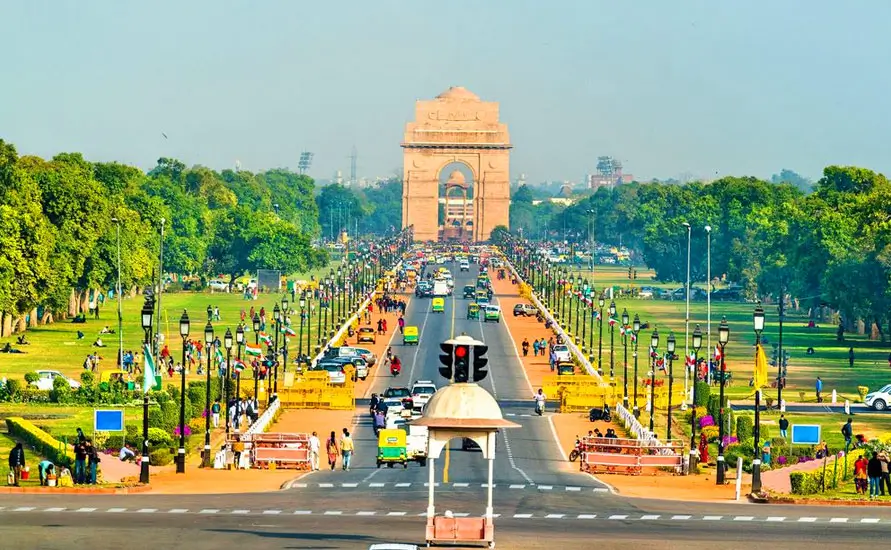
Rooms are usually released in the middle of the afternoon, so for dawn landings we can book the room one night early at extra cost and a made-up bed is ready the minute the porter opens the door. After a rest, a gentle late-afternoon drive follows Kartavya Path, the old Rajpath and the wide ceremonial avenue that the British architect Edwin Lutyens designed for the imperial capital in the 1920s. At its eastern end stands India Gate, a sandstone arch inscribed with over 13,000 names, soldiers of the old Indian Army who fell in France, Mesopotamia, Gallipoli and on the Afghan frontier.
As the light fades, families from across the city fill the lawns around the arch, children chase balloons and ice-cream carts do brisk business. It is a relaxed, unscripted look at how Delhi residents spend their evenings, and it helps you hold out against jet lag until a normal bedtime. Your driver can then stop at a restaurant known for butter chicken, slow-cooked black dal and tandoori roti straight from the clay oven, the North Indian classics that many overseas visitors already know from home but rarely taste at this level. Ask for medium spice on the first night until your stomach settles in. Overnight in Delhi.
Morning is the right time for Old Delhi, before the lanes become fully jammed with carts and scooters. After an early breakfast your guide collects you and heads to the edge of Shahjahanabad, the walled city that Emperor Shah Jahan founded in the 1640s. From there a cycle rickshaw threads through Chandni Chowk and its side alleys, each one once given over to a single trade: silver, wedding cards, spices or dried fruit. You pass the walls of the Red Fort on this ride; going inside is possible any day but Monday, its weekly closing day.
Next you climb the red sandstone steps of the Jama Masjid, completed in 1656 for Shah Jahan, whose paved courtyard fills shoulder to shoulder at Friday noon prayers. Shoes are removed at the gate, and loose robes are provided for anyone wearing shorts or sleeveless tops. A short walk away, the spice market of Khari Baoli lets you watch porters carrying sacks of chili and turmeric on their heads. Later the car takes you to Gurdwara Bangla Sahib, where volunteers serve free meals to all comers every day, and visitors may watch rotis being rolled by the hundred in the community kitchen.
After lunch, the afternoon moves to the Mughal and Sultanate monuments of the south. Humayun's Tomb, finished around 1572, is a UNESCO site whose garden layout and double dome later shaped the design of the Taj Mahal. Its restored water channels make it a calm place to sit for a while. The day ends at the Qutub Minar, a ribbed sandstone tower of victory started around 1199 and rising about 73 meters, surrounded by the ruins of the first mosque in Delhi and a 4th-century iron pillar with hardly a trace of corrosion. Evening is free. Overnight in Delhi.
Leave Delhi soon after breakfast so the outbound traffic is still light, heading southwest on the national highway toward Rajasthan. The first hour runs through the glass towers of Gurugram, after which the landscape opens into farmland, smoking brick-kiln chimneys and the low rocky ridges of the Aravalli hills. Around the halfway mark your driver pulls in at a reliable highway eatery with clean restrooms, and many guests enjoy a plate of hot aloo paratha with yogurt here. Camels pulling carts start to appear on the roadside as you cross the state border, a sure sign that you are entering desert country.
In 1727 the stargazing Kachwaha ruler Jai Singh II moved his court down from Amber to Jaipur and planned it on paper as a grid of broad, straight streets divided into nine rectangular blocks, a rare thing in 18th-century India. The walled town got its terracotta coat in 1876, when the Prince of Wales came calling, and local rules still require owners to keep the facades that color. Late lunch is at the hotel, and after check-in your guide leads a light orientation drive past the city gates and the main bazaars so you get your bearings before the full day tomorrow.
Toward five o'clock you call at the Albert Hall Museum in the Ram Niwas garden, a domed building designed by Samuel Swinton Jacob whose galleries hold Persian carpets, armor, pottery and, oddly, a mummy brought from Egypt. As evening falls, its domes and arches are lit up and pigeons settle on the cornices, which makes the square in front a pleasant place to linger. For dinner, order a Rajasthani thali: baked wheat balls with lentils, gatte, which are gram-flour dumplings simmered in spiced curd, and a crumbly sweet of ghee and jaggery known as churma. Your guide will explain the next morning's timings, since Amber Fort is best seen early, before the coach groups. Overnight in Jaipur.
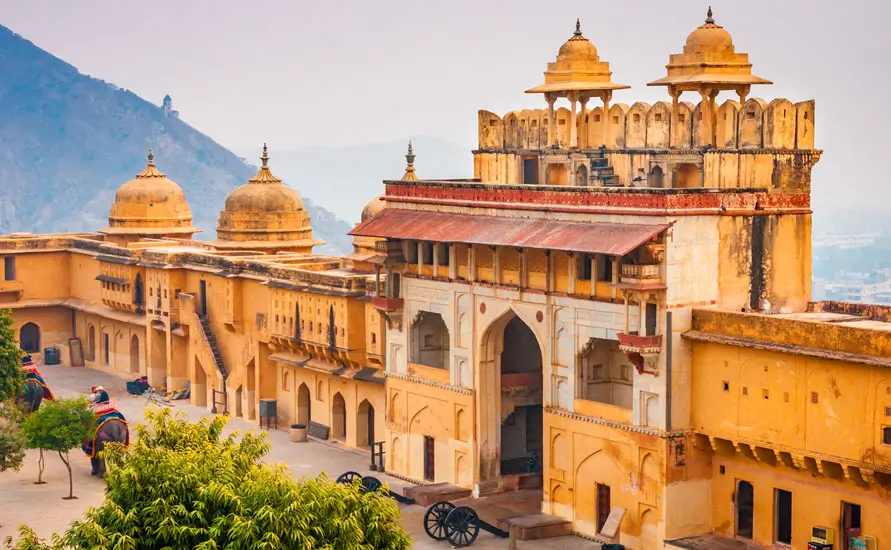
Eleven kilometers north of town sits Amber Fort, the ridge-top seat of the Kachwaha rulers before they moved down to Jaipur. You ride up the steep ramp in a jeep, or walk if you prefer, passing the stone ramparts that snake along the ridge above Maota Lake. In the Sheesh Mahal, the Mirror Palace, every wall and ceiling holds thousands of small convex mirrors set in white plaster, designed so that a single candle could light the whole room. Your guide also points out the cooling channels and screened balconies that kept royal women out of sight but able to watch the courtyards below.
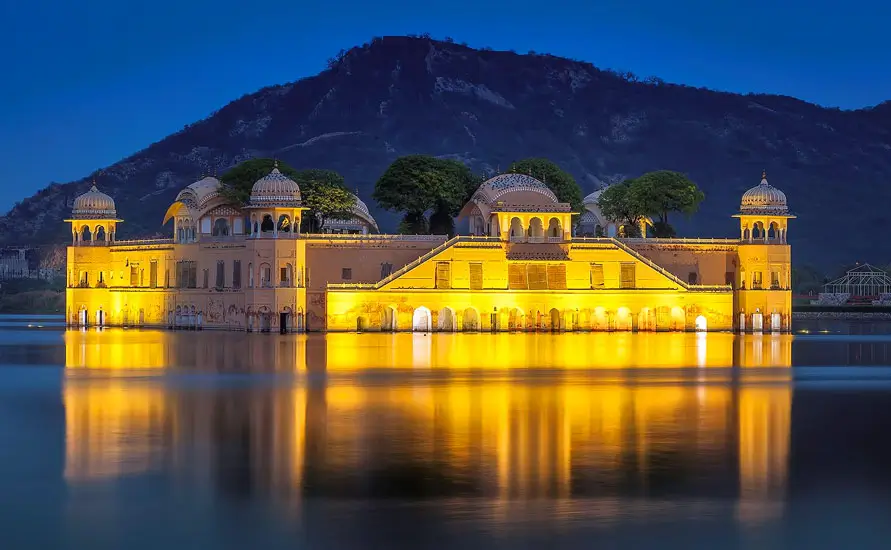
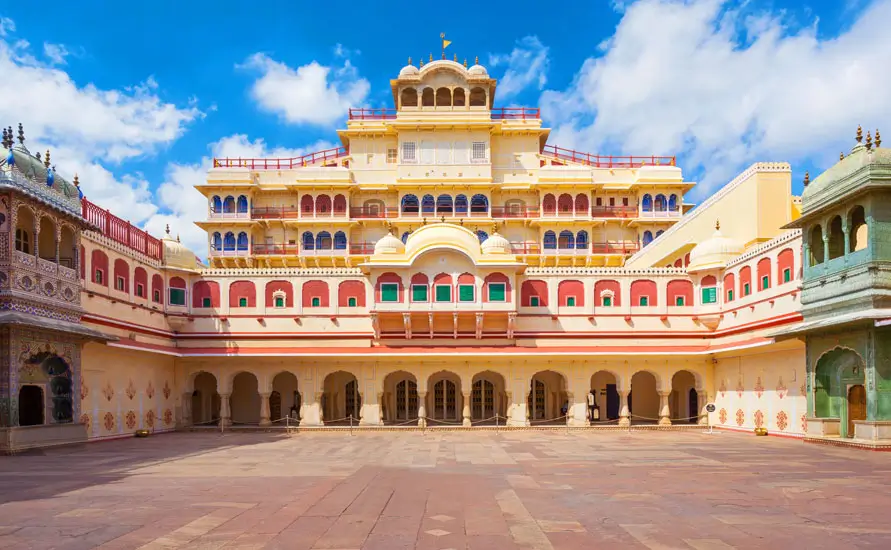
On the way back you pause for photos of the Jal Mahal, the water palace whose lower floors are submerged when Man Sagar Lake is full. Back in town, the City Palace is still partly lived in by the former ruling family, and its Peacock Gate and lotus doorways and open onto a textile gallery and an armory full of jeweled daggers. Two enormous silver urns stand in one hall; they were made to carry Ganges water for a maharaja who traveled to London in 1902 and refused to drink anything else. Lunch is at a café inside the palace grounds or nearby.
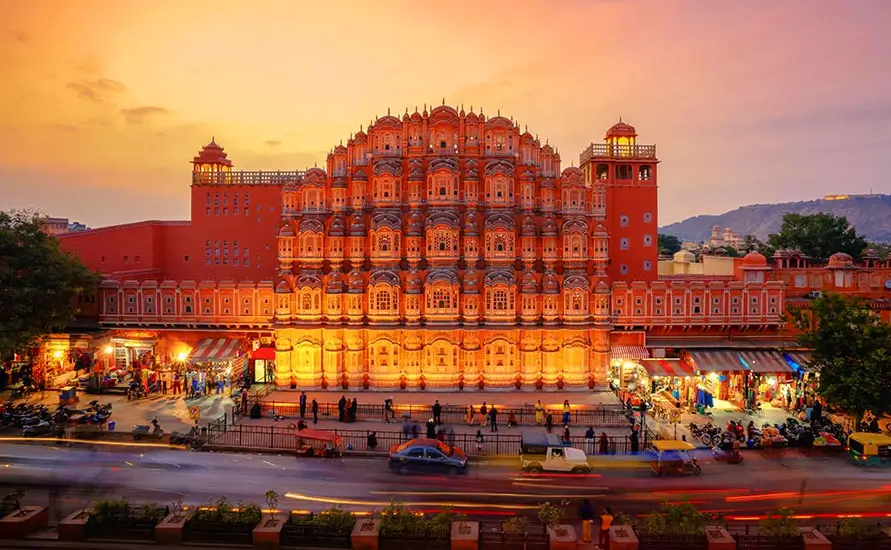
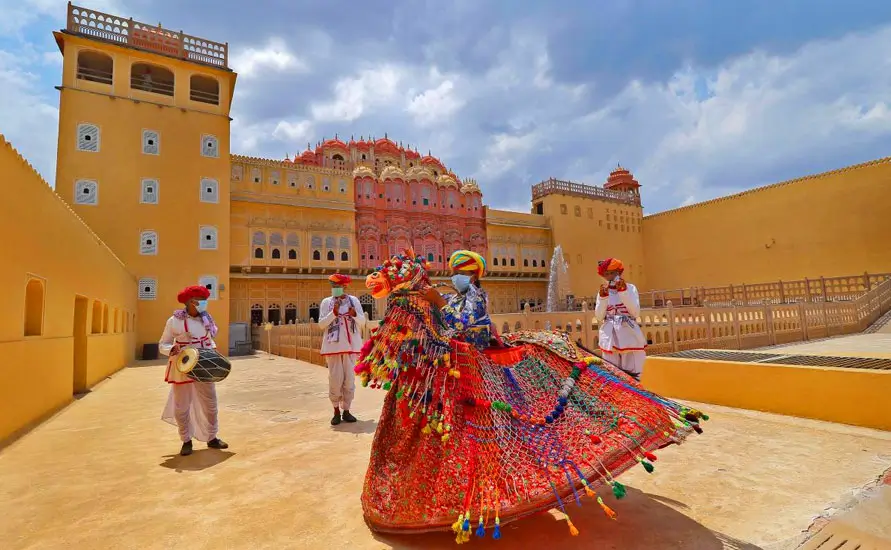
Beside the palace walls lies the Jantar Mantar, a UNESCO-listed field of nineteen stone and brass instruments that the founder of Jaipur had built to track stars and planets. Its giant sundial, the Samrat Yantra, is 27 meters tall, and if you watch its edge closely you can see the shadow creep along the marble scale, accurate to about two seconds. Afterwards, a stroll past the honeycomb facade of the Hawa Mahal gives you the classic Jaipur photo, best from the rooftop cafés across the road. The evening is yours, perhaps for bangles and textiles in Johari Bazaar or a quiet dinner at the hotel. Overnight in Jaipur.
Today slows down and looks at the crafts that made Jaipur rich. About 30 km southwest of the city lies Bagru, a village of the Chhipa community, whose families have printed cotton by hand with carved wooden blocks for around three centuries. Here the colors still come largely from natural sources: indigo for blue, pomegranate rind for yellow and iron mixed with jaggery for black. A printer shows you how a single motif can take four or five separate blocks, each lined up by eye, and you get to try a simple pattern on a scarf that you can keep as a souvenir.
You also see the long fields where fabric dries in the sun and the open vats where it is washed in the village stream. Ask how Bagru prints differ from those of Sanganer near the airport, and why buying from cooperatives helps the families who still work by hand. Nobody will press you to shop, and prices are fixed at the cooperative. On the way back, stop for lunch at a roadside dhaba where you might try ker sangri, a tangy dish made from desert beans and berries, with bajra roti and a glass of buttermilk.
Following a siesta, the car climbs the winding road to Nahargarh Fort, perched on the crest overlooking the old city. Built in 1734 as a retreat and defensive post, it has a series of identical apartments that a later maharaja built for his nine queens, linked by corridors so he could visit any of them without being seen. Most people come for the panorama, though: as the sun drops, the whole pink grid of Jaipur spreads out below and the city lights come on one by one. Dinner tonight can be on a rooftop near the fort walls. Overnight in Jaipur.
Today is the longest road day in Rajasthan, so we start soon after breakfast with snacks and water in the car. The highway heads west past Ajmer, and the countryside becomes drier with every hour, with khejri trees, sand-colored villages and herds of goats moving slowly beside the road. If everyone fancies a longer stop, the car can make a short detour to see the lake and ghats at Pushkar, or simply stop at a roadside dhaba for chai and a fresh mirchi vada, the large chili fritter that this part of the state is known for.
Women in bright red and orange odhnis, men in tall turbans and old stepwells by the road give the drive plenty of interest, and your driver can explain the turban styles that show a man's community and region. You reach Jodhpur, the second-largest city in Rajasthan, in the middle of the afternoon. The Rathore clan founded it in 1459 under Rao Jodha, and for centuries it controlled the caravan route between Delhi and Gujarat. Check in at your hotel, which can be a restored haveli in the old city if you prefer staying close to the fort.
Toward sunset, walk with your guide around the clock tower market at Sardar Bazaar, where stalls sell spices, silver, tie-dyed fabric and the tasty local sweets. Jodhpur is famous for its onion kachori and makhaniya lassi, a thick saffron-scented yogurt drink, and a couple of legendary shops near the tower have been making them for generations. From the edge of the square you can see Mehrangarh glowing on its cliff above the rooftops. Dinner is at leisure, and the guide will confirm tomorrow's early start to beat the heat at the fort. Overnight in Jodhpur.
Rudyard Kipling once described Mehrangarh Fort as the work of giants, and standing at its base you can see why. The walls climb about 120 meters above the plain and still show cannonball marks from an 18th-century siege. Inside, an excellent museum run by the royal trust displays palanquins, howdahs, painted cradles and a tent captured from the Mughals. The Phool Mahal and Moti Mahal show how lavishly the Rathore kings decorated their private rooms with gold leaf and colored glass. A good audio guide is available, though your local guide adds the family stories that the panels leave out.
From the ramparts you look straight down on Brahmpuri, the old Brahmin quarter whose houses are painted in shades of indigo, which is why Jodhpur is called the Blue City. After the fort, walk down through these lanes with your guide, past tiny temples and doorways where women sit chatting. The car then takes you to Jaswant Thada, a memorial to Maharaja Jaswant Singh II that his son completed in 1899 from pale Makrana stone. Its marble is cut so thin in places that morning light passes right through, and the small lake beside it is a quiet place to rest.
Later you head roughly 25 km out of town to a Bishnoi village. The Bishnoi community follows 29 rules laid down in the 15th century that forbid cutting green trees and harming animals, and blackbuck and chinkara deer often feed close to their fields, though sightings can never be guaranteed. A family welcomes you for tea, explains the old custom of welcoming guests with a ceremonial drink, and serves a simple home-cooked meal. You can also watch a potter or dhurrie weaver at work before returning to Jodhpur. Overnight in Jodhpur.
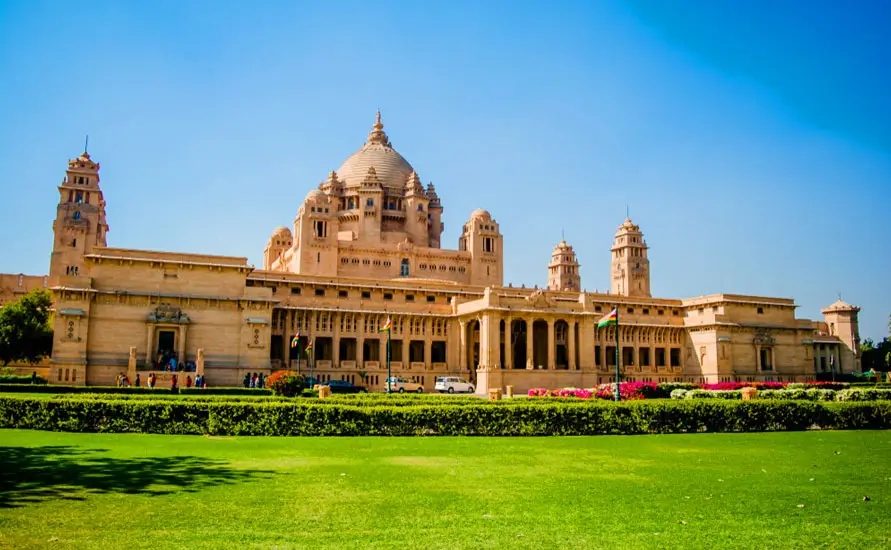
Morning is free for a final walk in the Blue City or a look inside the public museum at Umaid Bhawan Palace, the art deco residence finished in 1943 where the royal family still lives. Vintage cars and clocks are on display in the part open to visitors. Your driver then takes you to Jodhpur airport for the flight south to Bangalore, either direct or via a connecting flight through Delhi or Mumbai, depending on which routes are operating that season. We choose timings that avoid very early starts.
In Bangalore our Karnataka team waits at Kempegowda airport, some forty kilometers from downtown, so expect an hour or more in the car. The change of climate is easy to notice: Bangalore sits at about 900 meters, so evenings are mild even when Rajasthan is hot. After check-in you can rest or visit a local craft brewery, part of the modern tech-city culture that sets Bangalore apart from the rest of the region. Overnight in Bangalore.
Bangalore today is known mostly for software parks and traffic, but your guide shows you the older city underneath. The morning begins at Lalbagh, a 240-acre botanical garden that Hyder Ali began and Tipu Sultan enlarged, bringing in plants from as far as Kabul and Mauritius. You walk under huge rain trees, past a rock outcrop said to be around three billion years old, and up to one of the four boundary towers linked to Kempe Gowda, the 16th-century chieftain credited with founding the city. Early morning walkers and yoga groups give the park a friendly local feel.
A few minutes away, Tipu Sultan's Summer Palace is a two-story teak building finished in 1791, with carved pillars, balconies and painted arches. Tipu called it the envy of heaven, and the ground-floor displays cover his long fight against the East India Company, which finally defeated him at Srirangapatna in 1799. Close by stands the Bull Temple in Basavanagudi, with a large granite Nandi carved from a single rock and blackened by centuries of oil offerings. Lunch is a classic Bangalore meal of crisp masala dosa and frothy filter coffee in an old vegetarian canteen that has fed office workers since before independence.
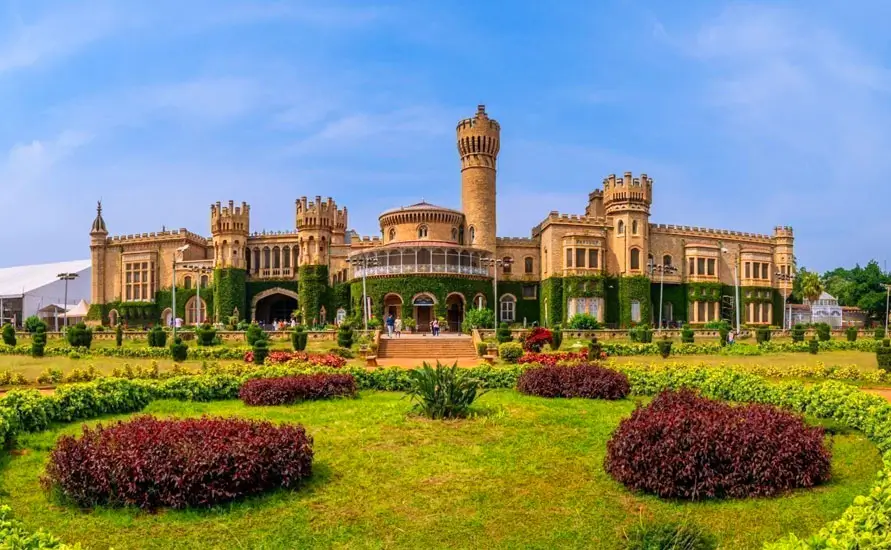
The afternoon brings you to Bangalore Palace, built in the 1880s by the Wodeyar family with turrets and battlements said to echo Windsor Castle, plus battlements, turrets and Gothic windows that feel surprising in the tropics. Inside you see hunting trophies, family portraits and a ballroom. Afterwards you drive past the massive granite seat of the state government, the Vidhana Soudha, and along the shaded edges of Cubbon Park. The evening is free to visit Commercial Street for silk and sandalwood, or to enjoy dinner in one of Indiranagar's busy restaurants. Overnight in Bangalore.
The new access-controlled expressway has cut the Bangalore to Mysore drive to well under three hours, so there is plenty of time to break the trip. About 125 km from Bangalore you reach Srirangapatna, an island in the Kaveri river that was Tipu Sultan's capital. Your guide starts at Daria Daulat Bagh, his summer palace, where the outer walls are covered with murals showing the 1780 rout of a Company army at Pollilur by Tipu and Hyder Ali. The colors are still remarkably bright, and the small museum holds Tipu's clothes and coins.
Two kilometers on, Tipu rests beside both his parents under the white dome of the Gumbaz, with tiger-stripe patterns painted on the inner walls. If time allows, you also step into the Ranganathaswamy Temple, the reclining-Vishnu shrine after which Srirangapatna is named, and the spot where Tipu's body was found after the final British assault. The river landscape around the island is green and full of coconut palms. Lunch is at a riverside restaurant on the way, and afterwards you continue another twenty minutes into Mysore, with check-in done by about three.
Around five, when the heat eases, your guide walks you into the Devaraja Market, a 19th-century arcade of stalls with pyramids of colored kumkum powder, jasmine garlands, betel leaves and bananas of many sizes. Buy a box of Mysore pak, the dense sweet made with gram flour and ghee that was first cooked in the palace kitchens. If tonight is a Sunday or public holiday, you go back to the palace in the evening when the outline of every dome and arch lights up in yellow bulbs for a short spell after seven. Overnight in Mysore.
Mysore Palace opens in the morning, and arriving early means fewer crowds in the main halls. A fire in 1897 burned the earlier timber palace, and Henry Irwin, a British architect working in Madras, drew up the present Indo-Saracenic building, completed in 1912. Footwear goes into a cloakroom by the entrance, and phones stay in pockets because indoor photos are not permitted. Inside, look up in the eight-sided marriage hall, the Kalyana Mantapa, at the glass ceiling made in Glasgow with peacock designs, the long murals of the Dasara procession, and the Durbar Hall where the king held court. Your guide explains how the Wodeyar dynasty ruled here, with one short break, for about five centuries.
Next the car winds up Chamundi Hill to the shrine of Chamundeshwari, the goddess the Wodeyars worshipped as their protector. Halfway down you halt beside the hill's great Nandi, a bull about five meters long carved from a single black rock in the 17th century and still decorated with garlands by local devotees. Lunch is back in town, and you might also visit St. Philomena's Cathedral, whose two Gothic Revival towers were inspired by Cologne Cathedral. The afternoon includes a rest at a day-use room or the hotel so you are fresh for the night ahead.
After an early dinner you are dropped at Mysore Junction for the Hampi Express, which leaves in the early evening and runs north through Bangalore toward Hosapete. You travel in an AC two-tier sleeper coach, where berths are made up with sheets, blankets and pillows supplied by the railway, and curtains give some privacy. Pack a small overnight bag with a torch, earplugs and snacks, since food on the train is basic. Your guide makes sure you are settled in the right coach, and the main luggage is stowed under the lower berths. Overnight on the train.
The train pulls into Hosapete in the morning, where our local team is waiting on the platform with a car. Hampi is about 13 km away, so within half an hour you are at your hotel to shower, have breakfast and rest for an hour or two. The landscape here is unlike anything else in India: granite boulders the size of houses are piled up in strange stacks across the plain, with banana plantations and rice paddies in the valleys between. Geologists say the rocks are among the oldest on Earth, worn into these shapes over billions of years.
Between about 1336 and 1565 this was Vijayanagara, capital of the kings who ruled much of the peninsula and impressed Portuguese and Persian visitors with its markets and wealth. Following the battle of Talikota the victors spent months plundering the city, after which people left it, which is why so much survives. Late in the morning your guide leads you through the sacred center, beginning at the Virupaksha Temple, where pujas have carried on for centuries and the eastern tower rises about 50 meters. Inside, a small hole in a wall throws an inverted picture of the tower onto a facing wall, like a pinhole camera.
After lunch and a midday rest, the walk continues to the giant one-stone Lakshmi Narasimha figure and, a few steps away, the Badavilinga, a Shiva lingam roughly three meters high that always stands in a channel of running water. In the late afternoon you climb the sloping granite of Hemakuta Hill among clusters of small early shrines to watch the sun sink behind the boulders and the Virupaksha tower. It is one of the most loved sunset spots in Karnataka, so get there early to claim a flat rock. The ruins of the Hampi Bazaar street lie below. Overnight in Hampi.
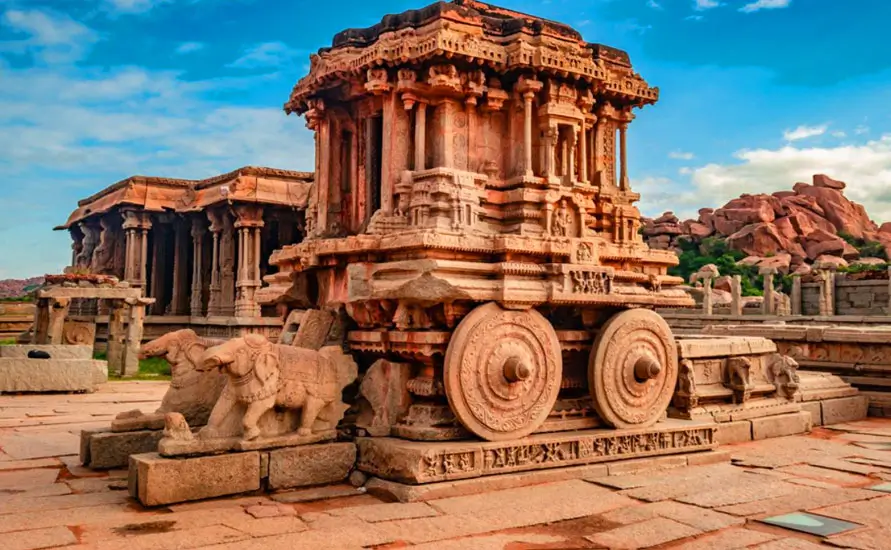
Start early at the Vittala Temple, the best-known site in this UNESCO World Heritage area. Electric buggies carry you along the last stretch, and the morning light shows off its carvings at their sharpest. The famous stone chariot stands in the courtyard, a shrine for Garuda shaped like a temple car with stone wheels that once turned. Inside the main hall, the slender granite columns were carved to give off different notes when struck, but barriers now keep hands off them so they survive. Your guide explains the Vijayanagara style of carved horses, dancers and mythical beasts on the columns.
Next you drive to the royal enclosure, where the king and his court lived. The tall carved terrace called the Mahanavami Dibba served to watch the nine-day festival of Dasara, the same festival still celebrated in Mysore today, which links the two halves of this trip. Nearby you see a perfect stepped water tank, the Queen's Bath, the plaster-arched Lotus Mahal in the zenana enclosure, and the long domed stables where the royal elephants were once kept. Friezes of horses, dancers and parades run around the walls of the Hazara Rama Temple, once the private shrine of the kings. Lunch is at a local restaurant.
Toward evening you walk down to the Tungabhadra river, where a boatman launches a coracle, a woven bamboo bowl sealed with tar, and steers it with one short oar. The boat spins slowly past bathing steps and rock faces carved with deities, and your boatman may point out the area across the water at Anegundi, which is linked by legend with the monkey kingdom of the Ramayana. Back on land, celebrate your last night with a farewell dinner of the region's sorghum flatbread, jolada rotti, with fiery stuffed brinjal. Overnight in Hampi.
Bags go into the car right after breakfast for the long run south to the international airport in Bengaluru, a highway trip of about six hours with breaks for lunch and tea. The road passes the old fort town of Chitradurga, and a short halt for a look at its walls is possible if time allows. If you would rather avoid the long drive, we can arrange a flight from Hubballi or the small Jindal Vijayanagar airport near Hampi instead, or add an extra night in Bangalore before your international flight.
We time the drive so you reach the terminal three hours before a long-haul departure. Over two weeks you have seen how the Rajput clans of the desert and the Vijayanagara and Wodeyar kings of the Deccan each left their mark, from Mehrangarh to Mysore and the boulder fields of Hampi. When you feel ready for Kerala, Goa or the Tamil temple towns, just send a message and our planners will draft a second route. Safe travels home.
Your Journey

N.S. Rathore & Mrs. Omlata Rathore · Managing Director
We still read every enquiry ourselves. Tell us the places you liked and our planners will send a day-by-day route with drive times and a clear price.
Every package can be customised and no pressure to book. A planner from our office replies within 24 hours with a route written for your group.
Fill this in and your planner will send a first draft itinerary.
Explore more
Kerala Backwaters Escape Kerala Backwaters Escape
 Kerala Backwaters Escape
 Kerala Backwaters Escape
 Kerala Backwaters Escape
 Kerala Backwaters Escape
 Kerala Backwaters Escape
 Kerala Backwaters Escape
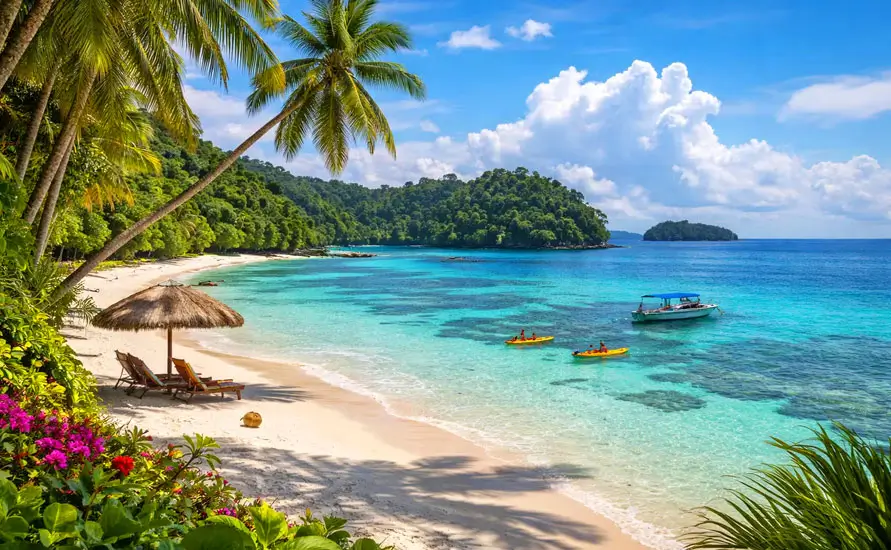 Kerala Backwaters Escape
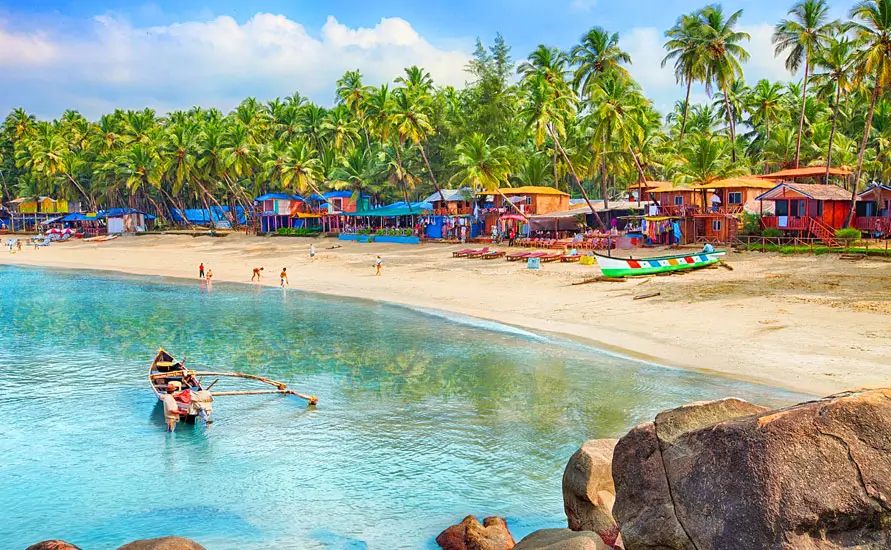 Kerala Backwaters Escape
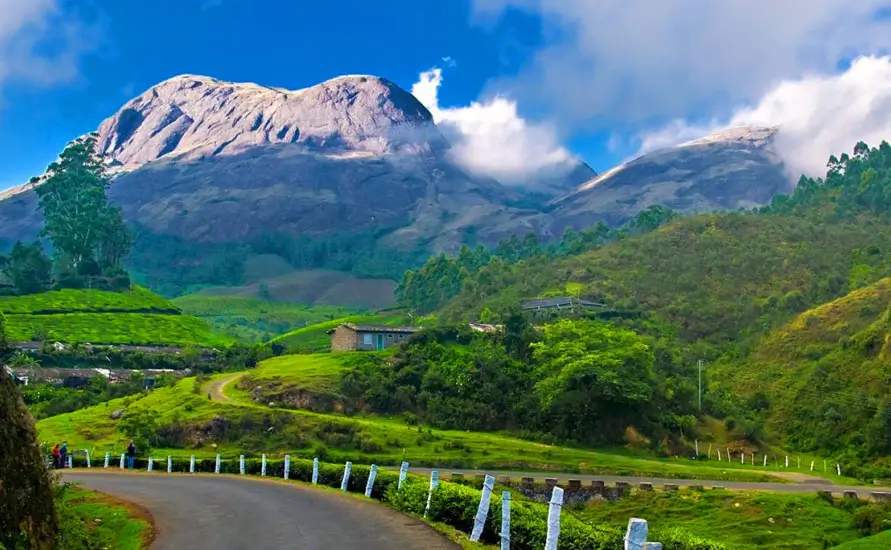 Kerala Backwaters Escape
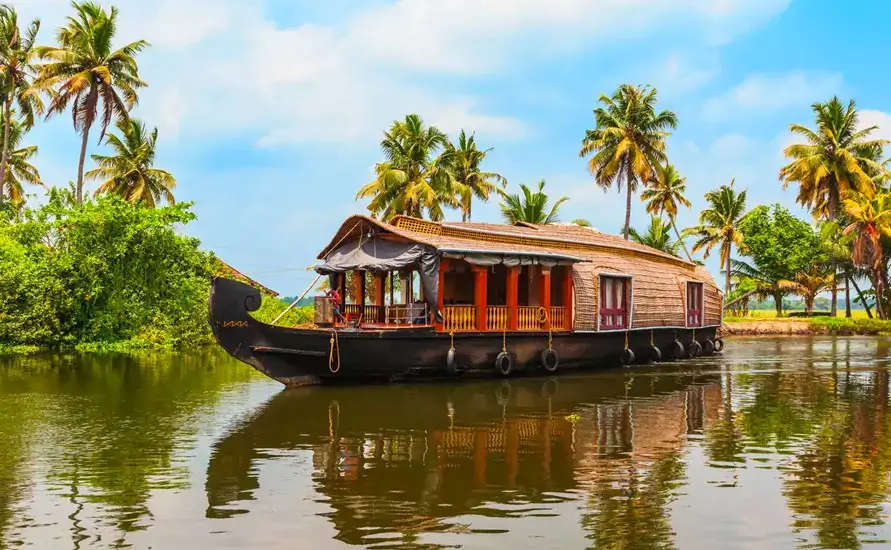 Kerala Backwaters Escape
 Kerala Backwaters Escape
 Kerala Backwaters Escape
 Kerala Backwaters Escape
 Kerala Backwaters Escape
 Kerala Backwaters Escape