 Kerala Backwaters Escape

LGBTQ+ Friendly South India Tours
Chennai (Chennai Pride March) – Mahabalipuram – Pondicherry – Srirangam – Madurai – Munnar – Kochi
At a glance
Few things tell you more about a city than walking through it with its own queer community. Our Chennai Pride Tour with Tamil Nadu and Kerala is built around the Chennai Pride March, held since 2009 and usually on the last Sunday of June, with dates confirmed each year by the local organizers. You spend four nights in Chennai, with the march day kept completely free, then travel south through Pondicherry and the temple city of Madurai before crossing the hills into Kerala for the tea estates of Munnar and the old port of Kochi.
Pride in India is part celebration and part statement. A 2018 Supreme Court judgment removed the colonial-era ban on gay sex, but the law still offers no marriage for gay and lesbian couples, and many marchers carry placards on family acceptance, housing and work. Joining in is a way of showing support, and our team makes the day easy: drop-off near the assembly point, a briefing the night before, water, and a car waiting afterwards. Big cities such as Chennai and Kochi are relaxed, while temple towns are more traditional, so discretion in public there is wise for any couple.
Late June is monsoon season in Kerala, and we see that as a reason to go. Munnar's tea slopes turn an intense green, waterfalls are full and hotel rates are lower, while Tamil Nadu stays mostly dry. Every hotel on this LGBTQ+ tour of Chennai and the south has been checked for same-sex couples, double beds are booked as standard and guides are briefed to be respectful. Solo travelers, couples and groups of friends each get their own vehicle and a driver who speaks good English.
Touching down at Chennai International Airport, you are met just past customs by our host, who greets you by name and leads the way to a waiting air-conditioned car. Most long-haul arrivals reach the city around midnight, so the first hours are simply about getting to your room and sleeping off the flight. Your hotel sits in one of the quieter southern districts, close to restaurants and the sea, and has been chosen because it treats same-sex couples and solo LGBTQ+ guests exactly like everyone else. We can confirm early check-in when you book if you prefer not to wait until the afternoon.
Around the middle of the day our host comes by for a relaxed chat over coffee. You go through the week ahead, the expected date and assembly point of the Chennai Pride March, and any community events announced for the coming days. Through June, local collectives often organize talks, art shows, film screenings and fundraisers that welcome visitors, though the program changes each year and some events are invitation-only. We share what is public and safe to attend and keep the rest of your days flexible, so you can say yes to something that comes up at short notice.
As the afternoon heat breaks, head down to the sand at Elliot's Beach, in Besant Nagar, for your first look at the Bay of Bengal. Late June in Chennai is hot and humid, with the heaviest rain of the year still months away, so evenings by the water are the most comfortable part of the day. Young people stroll along the sand, snack sellers push carts of sundal and roasted peanuts, and the Ashtalakshmi temple stands at the far end of the beach. Dinner can be close by, perhaps a plate of crisp dosa or a fish fry. Overnight in Chennai.
Modern Chennai began in 1639 when the British East India Company set up a trading post on a strip of beach, and your guide starts the day where that story starts, at Fort St. George. Within its ramparts is St. Mary's Church, from 1680, said to be the oldest Anglican church still standing anywhere east of Suez, with memorial tablets to soldiers, clerks and their families. The small Fort Museum displays coins, uniforms and portraits from the Company years. Government offices still occupy much of the fort, so some areas are off limits and photography is restricted near official buildings.
From the fort you walk north into George Town, the crowded merchant district that colonial maps once labeled 'Black Town', home to Tamil and Telugu traders, Armenians and Portuguese traders once lived. Its narrow streets are still organized by trade, with one lane for paper, another for brass, another for flowers or spices, and the noise of handcarts never stops. The red domes and minarets of the Madras High Court rise at the edge of the district, and close by is the Armenian Church, a quiet courtyard built by a community that has almost vanished from the city. Lunch is a simple local meal in a traditional 'mess', where servers walk the rows ladling rice, rasam and vegetables onto banana leaves for anyone who raises a hand.
After a break at the hotel, you head for Mylapore, the old Tamil neighborhood around the Kapaleeshwarar Temple. Visiting at dusk shows the temple at its liveliest, with oil lamps lit in the shrines and families arriving after work. Your guide explains how to dress and behave: covered shoulders and knees, shoes left outside, inner shrines open only to Hindus and affection kept for later, as in any place of worship. Afterwards, walk the market streets around the temple tank for jasmine, brass lamps and filter coffee. Your guide can also point out the bookshops and cafés where Chennai's younger, more liberal crowd tends to gather. Overnight in Chennai.
With the march still two days away, today takes you out of the city on a day trip to Mahabalipuram, the Pallava port where some of India's earliest stone temples were carved. Starting soon after breakfast puts you on the coast road ahead of the traffic, and your guide begins at the Varaha Cave, a small hall with powerful panels showing Varaha, the boar form of Vishnu, rescuing the goddess Bhudevi from the sea. Nearby, the Krishna Mandapa shows cowherds milking cows and the god holding up a hill like an umbrella to shelter his village from a storm.
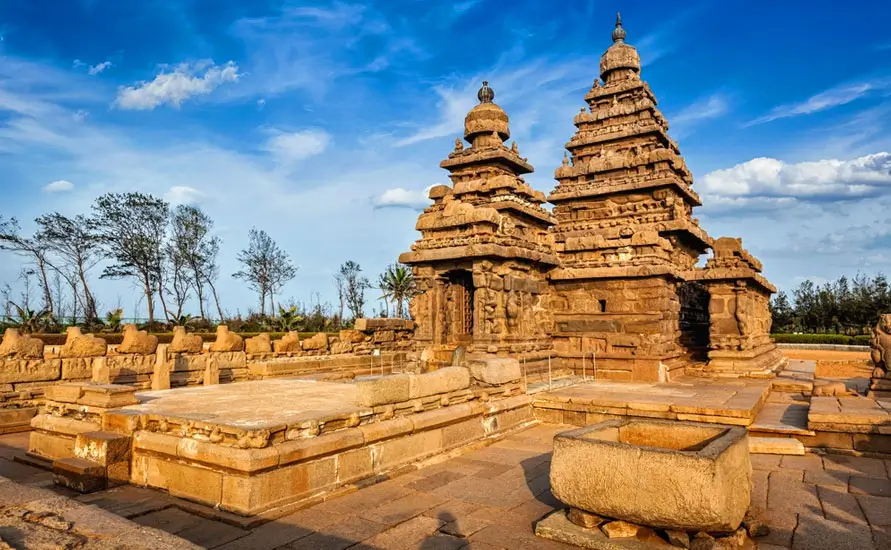
Around the corner, the relief called Arjuna's Penance covers two whole boulders with gods, hunters, sages and a family of elephants walking toward a central channel. You continue to the Shore Temple, where sea spray has softened the carved lions on the outer wall, and then to the Pancha Rathas, five shrines cut from one granite ridge and left unfinished when the Pallava dynasty lost interest or power. A seafood lunch follows in the small town, with fish from the morning boats usually grilled with a light Tamil spice rub.
Before heading back, you can stop at a stone carving workshop where sculptors shape granite with hammers and chisels, or at the lighthouse for a view across the temples and the sea. You return to Chennai in the late afternoon, with time to rest before an evening that may include a pre-Pride gathering, a talk or a film screening if one has been announced. Many visitors also use this evening to pick up a T-shirt, a flag or face paint from local stalls. Your host confirms tomorrow's timings and assembly point and answers any last questions. Overnight in Chennai.
Today belongs to the Chennai Pride March, organized each year by the Tamil Nadu Rainbow Coalition, a group of queer collectives, NGOs and allies. In recent years marchers have gathered in Egmore, near the Rajarathinam Stadium, and walked a route of a few kilometers through the neighborhood, though the date, route and timing are confirmed only shortly before each event. You keep the morning gentle, with a lazy breakfast and time by the pool. Your driver takes you to a drop-off point near the assembly area in the afternoon and stays on call, so you can leave whenever you like.
Expect color, drums and a mix of people you rarely see together in India: students, transgender and Aravani communities, parents holding placards of support, activists, artists and a growing number of visitors from abroad. Speeches often touch on equal rights at work, housing, family acceptance and marriage equality, and many signs are in Tamil, which locals are usually happy to translate. Wear light cotton, carry water and a hat, and keep valuables to a minimum. Media and photographers attend in large numbers, so if you would rather not appear in photos, a cap and sunglasses help and you can stay near the edges.
After the march, some groups head off to cafés or private after-parties, and events change every year, so tickets and entry are paid separately and arranged by you. Our team can suggest relaxed places nearby for an early dinner and will collect you from wherever you end up, as late as you need. If you prefer something quieter, your hotel restaurant or a beachside café in the south of the city is an easy option. Chennai Pride day is long and hot, and with an early start tomorrow, many guests decide to finish the evening by ten. Overnight in Chennai.
The car rolls out of Chennai on the East Coast Road, which hugs the shore toward Pondicherry, after a late breakfast to recover from yesterday's celebrations. The first stop is DakshinaChitra, a living museum of South Indian homes and crafts where you can step into a weaver's cottage, an Andhra farmhouse or a wooden Kerala manor in the space of an hour. Artisans often work on site, painting pottery, weaving palm leaves or making leather shadow puppets. Tuesday is its weekly closing day, so we adjust the plan if you pass by then. The café is a useful place for coffee and a snack.
Farther down the coast, a short detour leads to the ruins of Alamparai Fort, a brick fortress that once guarded a busy trading port and later changed hands between local rulers, the French and the British. Only broken walls and gateways remain, half covered by sand and casuarina trees, and the backwater behind it is popular with local fishermen. Few tourists come here, and it is an easy spot to stretch your legs and look out over the water. Your driver can suggest a roadside stop for tender coconut or a simple lunch of fish curry and rice.
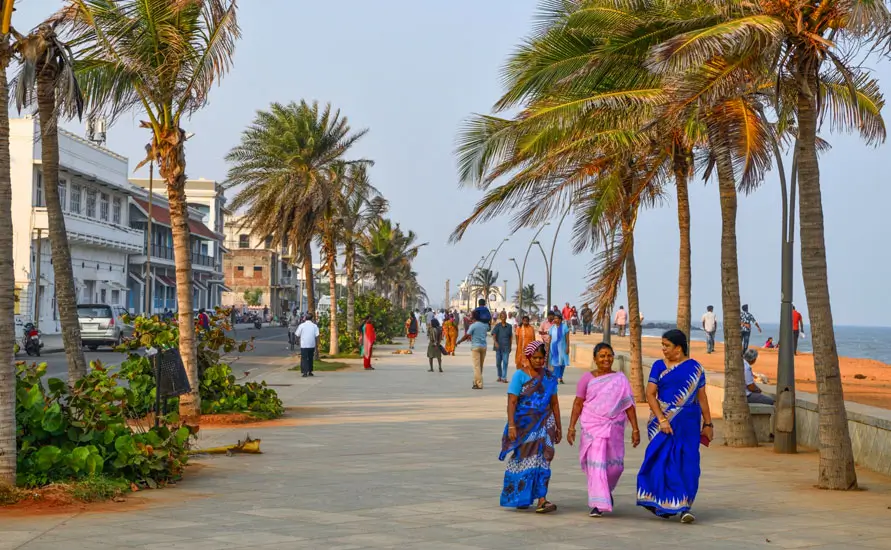
Around mid-afternoon you reach Pondicherry, where a boutique hotel in the old town is ready for you. The former French territory has a relaxed, cosmopolitan feel that many LGBTQ+ visitors enjoy after the intensity of Chennai, and a growing number of its small hotels and cafés are run by people who have chosen to live here from other parts of India and the world. Take an early evening walk along the seafront Promenade, closed to traffic after dark, where the statue of Gandhi faces the sea. Dinner might be a French-Tamil fusion menu in one of the restored villas nearby. Overnight in Pondicherry.
Slow mornings suit Pondicherry, and today's walk starts after breakfast at the Sri Aurobindo Ashram; people come to sit without a word beside a marble samadhi heaped each day with fresh flowers. Cameras stay in your bag here, and the mood is quiet and reflective. From there you wander the grid of White Town, where many former colonial homes are now guesthouses, galleries and design shops. Your guide explains how the French built this neat street plan in the 18th century and how the town changed after 1954, when it became part of independent India.
Next you visit the Pondicherry Museum, a small collection of Chola bronzes, Roman pottery from the nearby trading port of Arikamedu and French colonial furniture. Your guide links the pottery finds to the old trade between Rome and South India, which brought wine and glass here in exchange for pepper and cotton. Afterwards, the Manakula Vinayagar Temple shows the Tamil side of town, with its gold-covered tower and painted walls of Ganesha legends. Lunch is in one of the old town's many cafés, where vegan bowls, wood-fired pizza and South Indian thalis appear on the same street.
In the late afternoon you drive north to Auroville, an international township of residents from around fifty countries. The visitor center explains how it was founded and how residents run their own schools, farms and businesses, and a shaded trail through planted forest ends at a viewing spot facing the Matrimandir, the golden globe at its center. Entering the inner chamber needs a separate advance booking with only a few places each day, which is why we ask you to tell us in advance if it interests you. Before returning to town, a township café or craft shop makes a good pause. Overnight in Pondicherry.
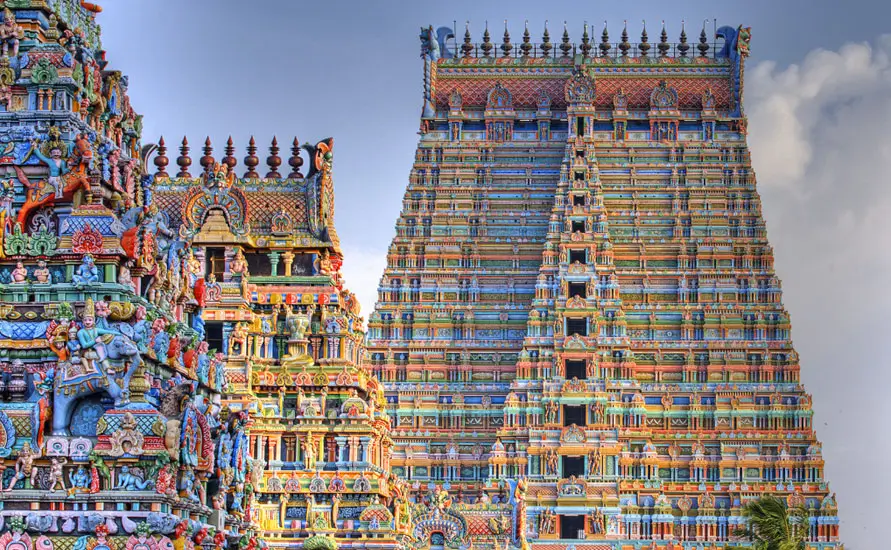
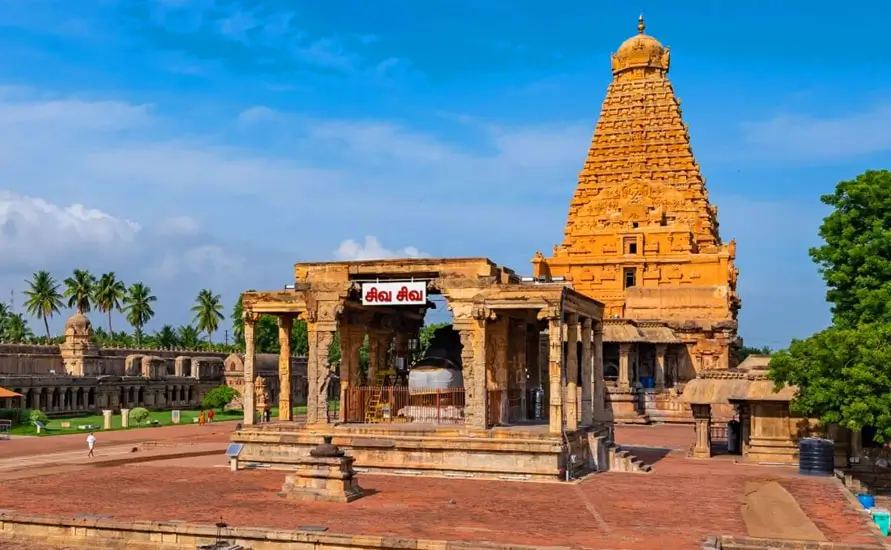
With the longest road day of the whole trip ahead, the car leaves early with snacks, water and a comfortable seat in the back. The road crosses the Kaveri delta, flat and green with rice fields, sugarcane and banana groves, and after about four and a half hours you reach Srirangam, an island between two branches of the Kaveri near the city of Tiruchirappalli. Its Ranganathaswamy Temple covers a vast area inside seven rings of walls, still home to working streets and families, and its tall southern tower is visible from far down the road.
Your guide walks you through the outer courtyards, which are full of shops, homes and pilgrims, to the pillared halls and the rearing carved horses of the Sesharaya Mandapa. Only Hindus may go into the central shrine, and covered shoulders and legs are expected in every part of the complex. A late lunch in Tiruchirappalli breaks the day, and a further two to three hours of road bring you to Madurai for check-in around dusk. The rest of the night is free for dinner and rest after a long but varied day. Overnight in Madurai.
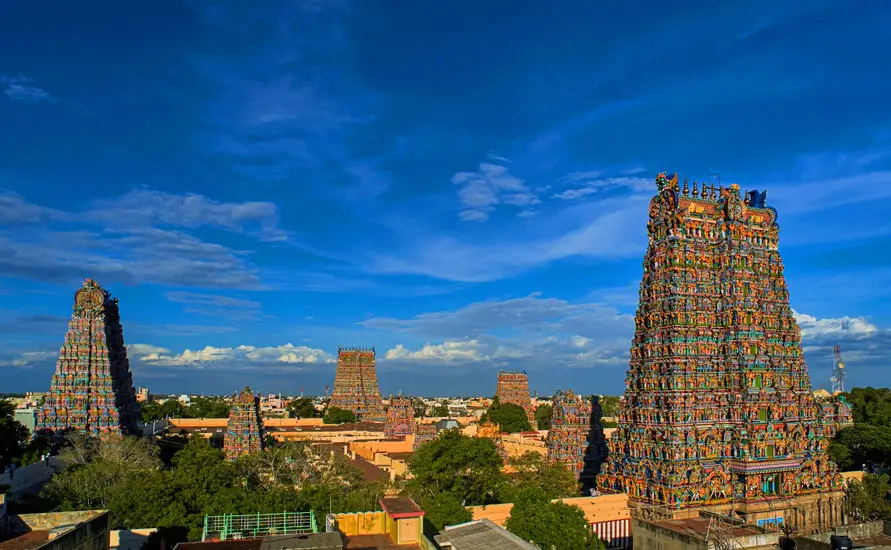
Before the heat builds, your guide takes you to the Meenakshi Amman Temple, the sacred heart of Madurai and the subject of more legends than any other temple in the south. You leave phones and cameras at the counters by the gate, then walk through corridors with brightly painted ceilings, past the Golden Lotus Tank and into the Thousand Pillar Mandapam, which now houses a small art museum. Hindu devotees alone may pass into the inner sanctums, though there is plenty to see in the outer halls, where devotees offer flowers, sing and tie small threads to pillars for good luck.
Your next stop is the Thirumalai Nayak Palace, whose courtyard is surrounded by massive round pillars and decorated arches. Your guide explains how the palace was once four times larger and how parts were removed in later centuries. Following lunch, you visit the Gandhi Memorial Museum, which occupies the former palace of Rani Mangammal and keeps the blood-stained cloth Gandhi wore when he was shot in 1948. It is a sobering, well-presented museum. In the afternoon you can rest at the hotel or visit the textile shops on Town Hall Road.
Evening in Madurai is about the temple again. At around 9 pm, the palliyarai ceremony begins as priests shoulder Shiva's palanquin and bring him to his consort's bedroom, accompanied by the sound of nadaswaram pipes and drums. Watching from the side, you see one of the most intimate rituals in Hindu worship, and your guide will explain what happens and where to stand. Beforehand, eat early at one of the city's popular non-vegetarian kitchens, where mutton chukka and biryani draw long queues. It is a long, full day, and the drive into the hills tomorrow starts mid-morning. Overnight in Madurai.
Leaving Madurai's heat behind, you drive west across farmland and into the foothills of the Western Ghats, passing small towns where cotton, coconut and cardamom are traded. After Bodinayakanur the road begins to twist upward in tight switchbacks, and at the state border you cross into Kerala. In late June the southwest monsoon is in full swing here, so expect cloud, mist and showers on the way up, with sudden bright spells that light up the valleys. Your driver is used to these roads and takes them slowly, with stops for photos, tea and a stretch.
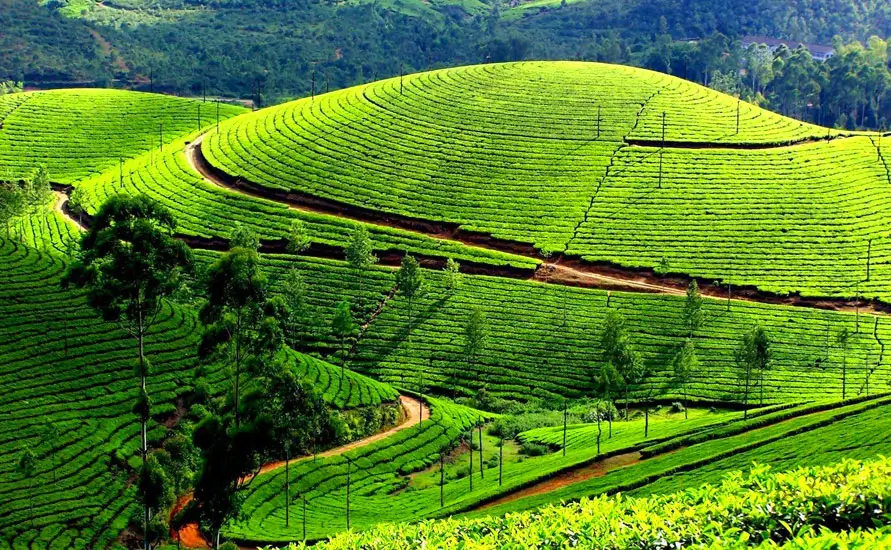
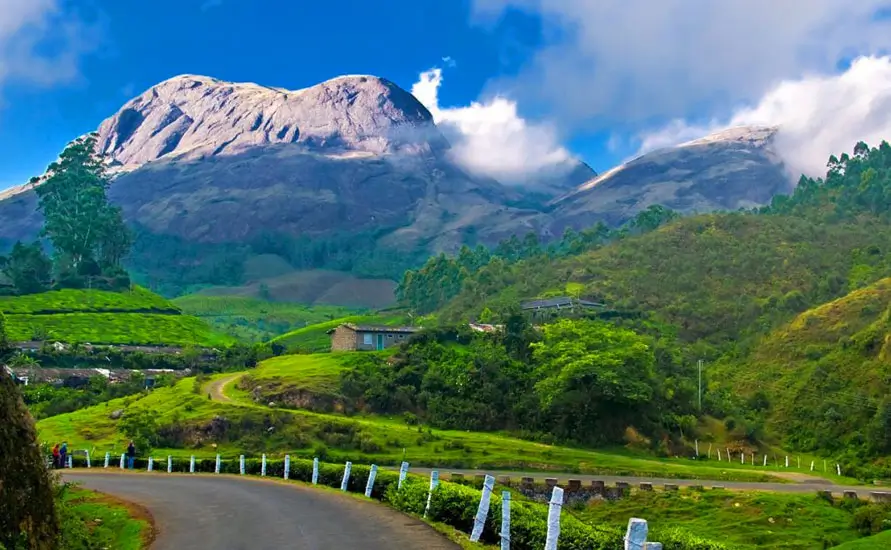
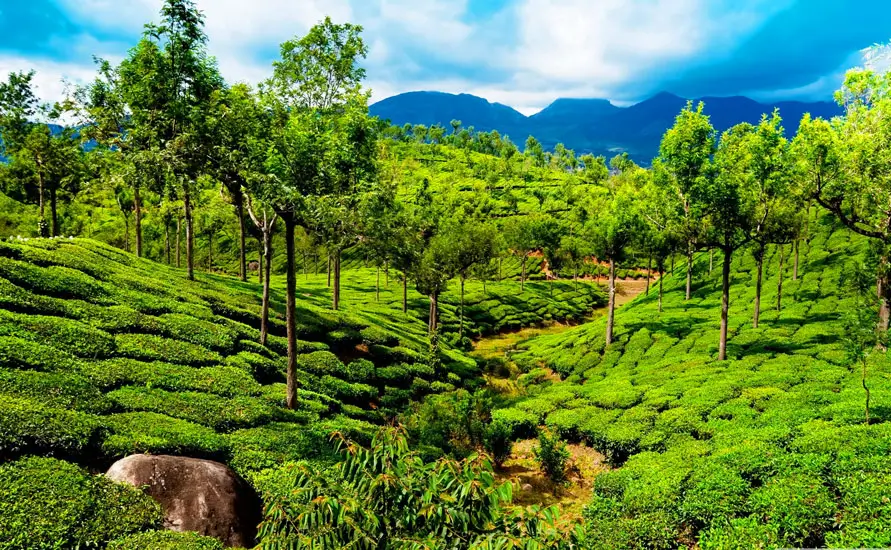
As you climb, cardamom plantations give way to the first tea gardens around Bodimettu and Poopara, their neatly clipped bushes covering every slope. Your guide explains why British companies began planting tea here near the end of the 1800s and why most estates are still run by large companies with their own villages, schools and hospitals. A roadside eatery near the top serves Kerala meals with fat red rice, avial in coconut and a sour fish curry tinted with kudampuli, which make a nice change from the Tamil food of the past week.
By afternoon the car turns into the driveway of your tea estate resort above a Munnar valley, where large windows and fireplaces make the cool, damp climate pleasant. Nothing is planned until dinner, leaving time for a walk through the estate if the rain allows, a cup of local tea on the veranda or a session at the resort spa. Monsoon is the traditional season for Ayurvedic treatments in Kerala, and many resorts offer massages and herbal steam baths. Evening temperatures fall to around 15 to 18 degrees, so pack a light sweater. Overnight in Munnar.
Monsoon mornings in Munnar are usually the clearest part of the day, so your guide starts early at the Tata Tea Museum on the Nallathanni estate, which tells the story of tea in these hills through old photos, machinery and a short film. A guided tour of the factory follows the leaf from the withering troughs to the rolling machines and drying ovens, ending at the tasting counter. It shuts on Mondays, which we take into account when fixing this day. Afterwards, the drive toward Mattupetty passes rows of tea pickers working in brightly colored raincoats.
The reservoir at Mattupetty Dam is surrounded by forested hills and tea slopes, and on clear days you may see wild elephants grazing on the far banks. Nearby, the Kundala Lake is calm and quiet, with paddle boats for hire when the weather is good. At Echo Point, a short stop on the way, families take turns calling out over the lake and laughing as the hills answer. Lunch is at a small restaurant in town or back at your resort, depending on the rain and how much walking you want to do.
In the afternoon, you can visit the Attukal Waterfalls or the Lakkam Falls, both full and loud during the monsoon. Paths can be slippery, so sturdy shoes with grip are useful, and your guide will choose the safest viewpoints. Later, a short walk in the town market shows you spices, homemade chocolate, tea and local honey for sale. Munnar is a small, family-oriented town, and while it is used to foreign visitors, it is more conservative than Kochi or Chennai, so keeping affection private in public places is sensible. Dinner tonight is at your resort. Overnight in Munnar.
After a last cup of estate tea, you descend from the hills toward the coast on a road that winds past rubber plantations, pineapple farms and small Kerala towns with brightly painted churches and mosques. In the monsoon, the Cheeyappara and Valara waterfalls beside the road are at their fullest, and your driver stops for a few minutes so you can see the water crashing down the rocks. The temperature rises steadily as you drop toward sea level, and by midday the cool mountain air has turned warm and humid.
Early afternoon brings you into Kochi, and you settle into a restored colonial-era hotel in Fort Kochi, a harbor quarter shaped in turn by Portuguese, Dutch and British rule. The town has a long tradition of openness, with Jewish, Christian, Muslim and Hindu communities living side by side for centuries, and LGBTQ+ visitors tend to find it easy, friendly and unfussy. Kerala also holds its own Queer Pride, held in a different Kerala city in different years, with dates confirmed each year. Our team can share news if anything is planned while you are here.
Late in the afternoon, walk along the waterfront past the Chinese fishing nets to watch the boats return with the day's catch, even in the rain. Fishermen often sell their fish right on the beach, and nearby kitchens will grill it for you with garlic and chili. The Fort Kochi art scene is lively, with galleries, street murals and cafés in old warehouses that stay open into the evening. For dinner, pick a table above the harbor, where prawns, crab and seer fish cooked in coconut milk are local favorites. Overnight in Kochi.
Your guide's morning route opens at the Mattancherry Palace, a 16th-century Portuguese gift to the local Raja, with mural paintings of the Ramayana in the royal bedchamber that are among the best preserved in Kerala. The palace is closed on Fridays. A few steps on in Jew Town, the Paradesi Synagogue, built in 1568, is famous for hand-painted Cantonese floor tiles and a small clock tower; visitors are turned away on Fridays, Saturdays and Jewish holidays. Your guide adjusts the plan so you can see both on the right day.
Spice warehouses still line the lanes of Jew Town, and the smell of ginger and turmeric drifts from open doorways as workers sort and pack them by hand. Many of these old buildings are now art galleries, design shops and cafés, part of the creative scene that grew around the Kochi-Muziris Biennale, an international contemporary art event held every two years. Even outside the Biennale season, some venues show work by local and visiting artists. Lunch is up to you, and the hours after it are open: browse the shops, sleep, or look in at the Indo-Portuguese Museum's church silver.
Tonight's plan is Kathakali, staged in a compact theater in Fort Kochi. Come at least an hour before curtain to see the painting of faces, a slow process of colored pastes and rice-paper frames that turns them into gods, heroes and demons. In traditional Kathakali, all roles, including female characters, were played by men, and it is interesting to hear how the form has shifted in recent decades, with women and new voices now on stage. After the show, walk back through the quiet lanes for a final dinner in Kochi. Overnight in Kochi.
Depending on your flight, you might still fit in a final stroll on the Fort Kochi seafront or a coffee in one of the old warehouse cafés before you check out. Your driver handles the transfer to Cochin International Airport, normally an hour and a half on the highway, leaving a good margin for monsoon rain and check-in. Most long-haul guests connect through Doha, Dubai, Abu Dhabi or Singapore, and a late departure is no problem, since a day-use room close to the terminal can be added.
From the Pride March in Chennai to the mist of Munnar and the old trading lanes of Kochi, this trip has shown you both the celebration and the everyday life of South India. We hope you felt welcome and safe at every step, and that you leave with new friends as well as memories. Our team watches your flights until you take off. If you want to come back for Namma Pride in Bangalore or a quieter winter trip to Kerala, just let us know.
Your Journey

N.S. Rathore & Mrs. Omlata Rathore · Managing Director
We still read every enquiry ourselves. Tell us the places you liked and our planners will send a day-by-day route with drive times and a clear price.
Every package can be customised and no pressure to book. A planner from our office replies within 24 hours with a route written for your group.
Fill this in and your planner will send a first draft itinerary.
Explore more
Kerala Backwaters Escape Kerala Backwaters Escape
 Kerala Backwaters Escape
 Kerala Backwaters Escape
 Kerala Backwaters Escape
 Kerala Backwaters Escape
 Kerala Backwaters Escape
 Kerala Backwaters Escape
 Kerala Backwaters Escape
 Kerala Backwaters Escape
 Kerala Backwaters Escape
 Kerala Backwaters Escape
 Kerala Backwaters Escape
 Kerala Backwaters Escape
 Kerala Backwaters Escape
 Kerala Backwaters Escape
 Kerala Backwaters Escape
 Kerala Backwaters Escape
 Kerala Backwaters Escape
 Kerala Backwaters Escape