 Kerala Backwaters Escape

South India Honeymoon Tours
Chennai – Kanchipuram – Mahabalipuram – Pondicherry – Thanjavur – Chettinad – Madurai – Kodaikanal
At a glance
Not every couple wants a beach-and-spa honeymoon. Our Tamil Nadu Heritage Honeymoon Tour is built for two people who would rather stand together under a thousand-year-old temple tower, share a twelve-course Chettinad banana-leaf lunch and sleep in a merchant's mansion with Burmese teak pillars and Italian marble floors. Over twelve days you travel from Chennai and the Pallava shore at Mahabalipuram to the Tamil side of Pondicherry, the great Chola temple at Thanjavur, three nights in Chettinad, the temple city of Madurai and finally the cool lake town of Kodaikanal.
The order follows history rather than geography alone. You begin with the earliest stone temples of the Pallavas, move on to the Cholas, then the Nayak rulers of Madurai, so each site makes more sense than the one before. Drives are kept short wherever possible, with the longest leg broken by the visit to Thanjavur. Three nights at a restored Chettinad mansion give you time to slow down between temple days, and the hill station at the end lets you finish the Tamil Nadu honeymoon package in sweaters instead of sunhats.
Couples from Britain, Europe, the Americas and Australia book this Tamil Nadu Heritage Honeymoon Tour with us, along with NRI couples keen to see the temples their grandparents spoke about. Guides are chosen for their knowledge of temple history and Tamil culture, and the private car stays with you throughout. We add a few quiet touches for two, such as a private cooking session in the mansion kitchen, a lakeside picnic in Kodaikanal and room upgrades where available. The best months are November to March.
Your landing in Chennai, once Madras, opens twelve days spent among the temples, palaces and mansions of the Tamil country. Past the baggage belts, a familiar face from our office drapes jasmine garlands over you both, the customary Tamil welcome, and leads the way to the car waiting at the curb. Since many overseas flights touch down late at night, nothing is planned before lunch, and early access to your room can be arranged for a dawn arrival. Breakfast can be as late as you like, and a swim or a nap fills the warm middle of the day nicely.
Around four, the guide arrives for a first taste of temple life in Mylapore, a neighborhood that existed long before the British founded Madras in the 17th century. The Kapaleeshwarar Temple comes alive at dusk, when priests light rows of brass oil lamps, bells ring through the halls and families arrive with flowers and coconuts as offerings. Your guide walks you through the logic of a South Indian temple plan, from the towering gopurams to the shrines of the inner courtyard, and teaches you the basic etiquette you will use for the rest of the trip, including dress, shoes and photography.
Afterwards you wander the lanes around the large stepped temple tank, where stalls sell everything from brass lamps and silk saris to bunches of marigolds and strings of jasmine. Your guide can show you a small shop selling Carnatic music recordings and hand-made veenas, and a family-run sweet shop where mysore pak and ghee-rich halwa are made fresh every afternoon. Dinner tonight is at a traditional Tamil vegetarian restaurant, where meals are served on a banana leaf and refilled until you say stop. It is a fitting start for a trip built around Tamil culture. Overnight in Chennai.
Leaving the city after breakfast, you travel inland to Kanchipuram, a temple town that the Pallava dynasty made its capital and that later Chola and Vijayanagara rulers kept adding to. People here like to say the town has a thousand shrines, and while that number is an exaggeration, there are enough here to fill weeks. Your guide focuses on two that show different chapters of Tamil temple building. The drive west from Chennai takes around two hours, much of it through rice fields, small market towns and stretches lined with tamarind and neem trees planted generations ago to shade travelers on the road.
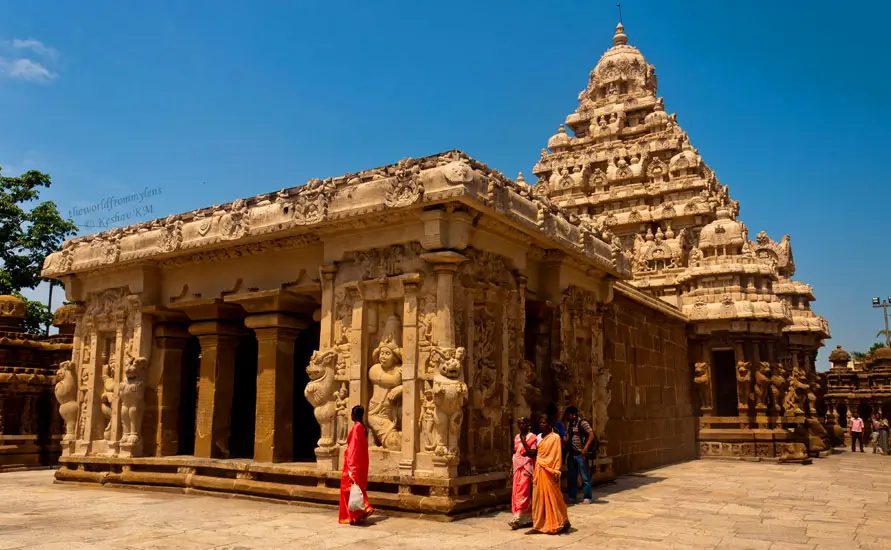
The compact Kailasanathar Temple, raised in sandstone in the early 8th century, is the oldest structure in town and still shows traces of the colored plaster that once covered its carvings. Your guide points out the rearing lion pillars that became a Pallava signature, and the small cell-like shrines around the courtyard where you can still see faint painted figures. Your second stop, the Varadharaja Perumal Temple, is dedicated to Vishnu, and its pillared mandapam shows off a carver's party trick: linked stone chains hanging from the roof, each ring cut out of one piece of granite. Temples here usually close around midday, so both visits fit neatly into the morning.
Kanchipuram silk is woven on hand looms in hundreds of family homes, and a visit to one of them is a good way to see how a heavy wedding sari is made thread by thread over many days. Many Tamil brides still wear one at their wedding, which gives the visit a special meaning for honeymooners. After lunch the car heads east to Mahabalipuram, roughly an hour and a half away, where a beach resort is booked for the night. Lazy hours by the water or a quiet stroll on the beach fill the time before dinner. Overnight in Mahabalipuram.
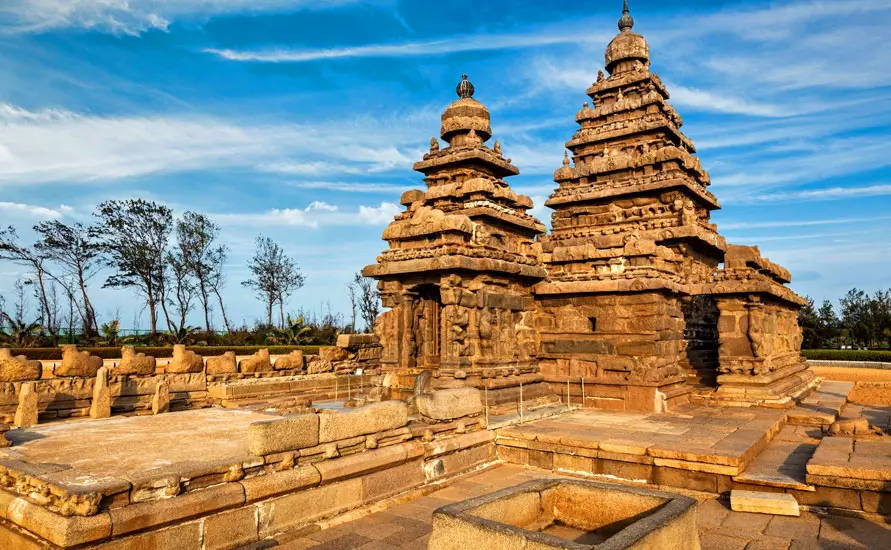
Set the alarm for half past five, because the Shore Temple is at its finest when the sun rises out of the Bay of Bengal right behind it. The monuments open at sunrise, and in the first hour you may share the site only with a few local walkers and a guard. Your guide explains how the Pallava ruler Rajasimha built these twin shrines around the year 700 as a landmark for ships entering the harbor, and why the waves and salt have softened the carvings so much. The rows of seated bulls along the compound wall make a lovely frame for a photograph of the two of you at dawn.
After breakfast back at the resort, you continue to the main group of monuments in the town. The great open-air relief known as Arjuna's Penance fills two huge granite boulders with gods, sages, elephants, monkeys and a sly little cat posing as an ascetic to fool the mice, a joke in stone your guide will show you. Nearby, the Varaha cave temple has a panel of Vishnu in his boar form raising Bhudevi out of the cosmic waters, and the five Rathas stand in a row at the southern end of town, each one carved from solid rock in the shape of a different temple style.
Around midday you take the coastal highway south for about two and a half hours to Pondicherry, stopping on the way for lunch. Two nights follow in a restored Tamil townhouse now run as a heritage hotel, with a courtyard, carved wooden doors and high ceilings that keep the rooms cool. Instead of the busy seafront, spend the evening walking the quiet streets around your hotel, where women draw kolam patterns in rice flour on the doorsteps and the smell of evening cooking drifts out of open windows. Dinner is at a small family restaurant serving Tamil and Creole dishes. Overnight in Pondicherry.
White Town gets the postcards, yet Pondicherry also has a long Tamil story, and that is where your heritage guide starts this morning. The Tamil Quarter lies west of the old drainage canal and is laid out in a tidy grid of streets lined with townhouses that have deep thinnai verandas, where neighbors once sat to talk and travelers could rest. Some houses mix Tamil and French details, with carved wooden doors set behind European-style balconies. Your guide describes nearly three hundred years of French and Tamil neighbors sharing one small town and how families still keep many of the old customs.
Next you cross into the French side to see two very different churches. Notre Dame des Anges, painted in soft pink and white, faces the sea and holds an oil painting said to have been a gift from Napoleon III. The larger Immaculate Conception Cathedral on Mission Street dates back to the 18th century and has a plain, dignified façade. In between come the Sri Aurobindo Ashram, whose courtyard memorial is heaped with fresh flowers each day and asks for complete quiet, and the Manakula Vinayagar Temple, a Ganesha shrine with brightly painted panels on every surface.
The afternoon is free for a rest, and in the evening you may like to visit the Pondicherry Museum, which holds Roman pottery fragments found at nearby Arikamedu, evidence of trade between the Tamil coast and the Mediterranean two thousand years ago. A walk along the seafront after dark shows the town at its most relaxed, with families eating ice cream and couples sitting on the rocks. For dinner we suggest a restaurant in a restored colonial house, where many chefs combine French cooking techniques with local spices and seafood. Overnight in Pondicherry.
With the longest road day ahead, you leave Pondicherry soon after an early breakfast and head inland across the fertile Kaveri delta, where most of the state's rice is grown. The land here is crossed by irrigation channels, coconut groves and villages where tall clay horses stand guard outside small shrines to the local guardian deities. Your driver takes regular breaks and knows good places for a coffee on the way. By late morning you reach Thanjavur, once the capital of the Chola empire, which at its peak controlled much of South India and sent naval expeditions as far as Sri Lanka and Southeast Asia.
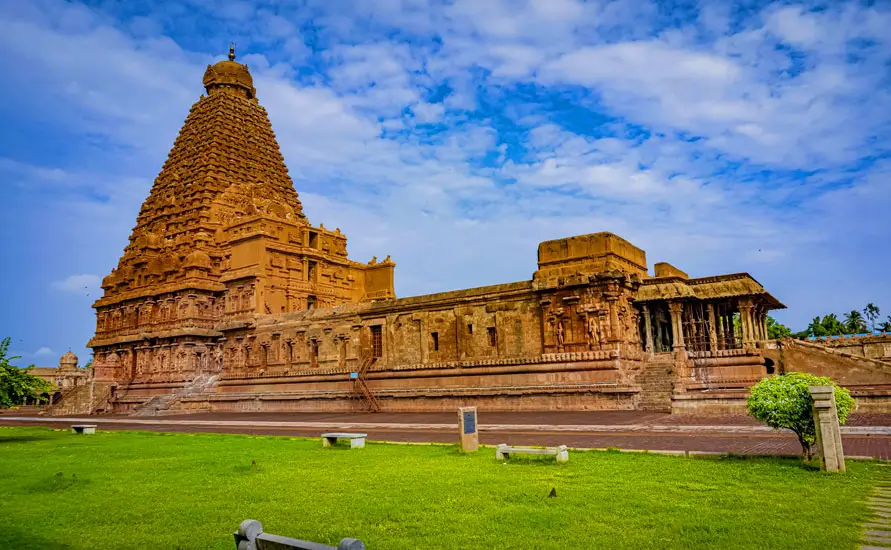
The Brihadeeswarar Temple, completed by King Rajaraja I in 1010 and listed by UNESCO among the Great Living Chola Temples, is the reason for the detour. Its main tower rises around 66 meters and is topped by a capstone weighing many tons, and historians still debate how it was lifted into place. Your guide walks you around the vast courtyard, past the giant monolithic Nandi bull, and points out the Chola frescoes and inscriptions that record donations to the temple. Late morning light is good for photos, though the stone gets hot underfoot, so carry socks for the walk.
After lunch in Thanjavur you drive south for about two hours to Chettinad, a dry region of small towns where wealthy Nattukottai Chettiar merchants poured fortunes into huge family mansions between about 1850 and 1940, funded by profits from trade and banking in Burma, Malaya and Ceylon. You settle into a restored Chettinad mansion run as a heritage hotel for three nights, with pillared courtyards, colored glass windows and rooms opening onto long verandas. The welcome includes a glass of cool buttermilk spiced with ginger and curry leaves. Dinner is served in the dining hall, with dishes cooked in the local style. Overnight in Chettinad.
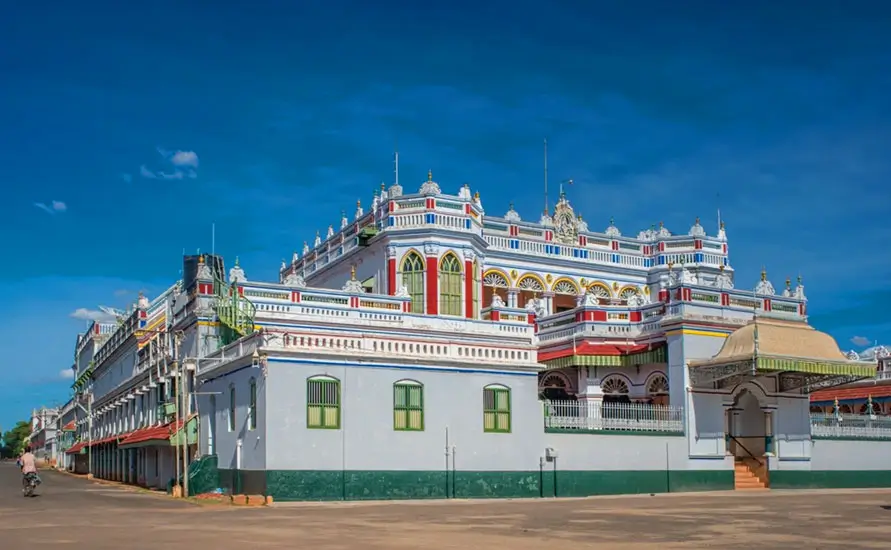
Mornings in Chettinad start slowly, with coffee on the veranda as peacocks call from the scrubland behind the mansion walls. After breakfast your local guide walks you through the village of Kanadukathan, where whole streets of grand houses stand side by side, some lovingly restored and others slowly falling apart behind locked gates. The Chettiar families built these homes to impress, importing Burmese teak, Belgian mirrors, Italian marble and Japanese tiles, and many houses have several inner courtyards that lead one into the next. Your guide arranges entry to at least one family-owned mansion where relatives still live, depending on who is at home.
Later in the morning you visit Athangudi, a village known for its handmade floor tiles. The craftsmen pour colored cement into molds placed on glass, let it set, and then cure the tiles in water for several days, producing the bright floral and geometric patterns found in mansion floors across the region. You can try making a tile yourself under the craftsmen's guidance, and the finished piece is yours to keep once it has dried. Nearby, a few workshops also produce handloom Kandangi cotton saris in bold checks and stripes, woven on traditional looms and sold at fair prices.
Return to the mansion for a long lunch and an afternoon rest, which is the local habit during the hottest hours. In the late afternoon a guide can take you to the antique shops of Karaikudi, where the contents of old mansions end up for sale: carved doors, brass lamps, wooden toys, enamelware and old photographs. Even if you do not buy, browsing these dusty storerooms is fascinating. Back at the hotel, dinner tonight is served in the inner courtyard under the open sky, with lanterns placed along the pillars and a table set just for the two of you. Overnight in Chettinad.
Chettinad cuisine is famous across India for its bold use of spices such as black stone flower, star anise, dried red chilies and freshly ground pepper, and this morning you learn its secrets from the mansion cook in a private session for two. You start in the kitchen garden, picking curry leaves and herbs, then move to the old kitchen, where spices are roasted and ground on a stone. Side by side you cook a chicken pepper fry, a vegetable kootu and sweet paniyaram, and the result becomes your lunch, served on banana leaves at a low table.
In the afternoon you visit the Pillaiyarpatti Karpaga Vinayagar Temple, one of the most important Ganesha temples in Tamil Nadu, where the main image is carved directly into the rock of a low hill. The temple is busy with local pilgrims, and your guide explains the rituals as they happen. Next you drive to a smaller village temple guarded by colorful clay figures of horses and warriors, a style of folk shrine very different from the grand temples seen so far. Heading home, pause at a village pond where water buffaloes wallow and children play cricket in the dusty lanes.
Before sunset, the mansion can arrange a short ride in a traditional bullock cart through the village lanes, a slow and gently bumpy trip that local children find as amusing as you do. It is a lovely way to see the mansions in the soft evening light, when the facades glow golden and the streets are quiet. Back at the hotel, there is time for a drink on the terrace or a swim in the pool before dinner. If you prefer, the hotel spa offers simple Ayurvedic treatments, which can be booked at extra cost. Overnight in Chettinad.
After a late breakfast and a final walk around the mansion courtyards, you leave Chettinad for Madurai, a city with more than two thousand years of recorded life and for centuries a center of Tamil poetry and learning. The drive takes about two hours through flat farmland dotted with palmyra palms. You check in to a hotel on the edge of the city with views toward the temple towers, and the hot hours are yours to rest. Madurai can be hot, so we suggest staying indoors until about five, when the sun loses its strength and the city comes back to life after the afternoon lull.
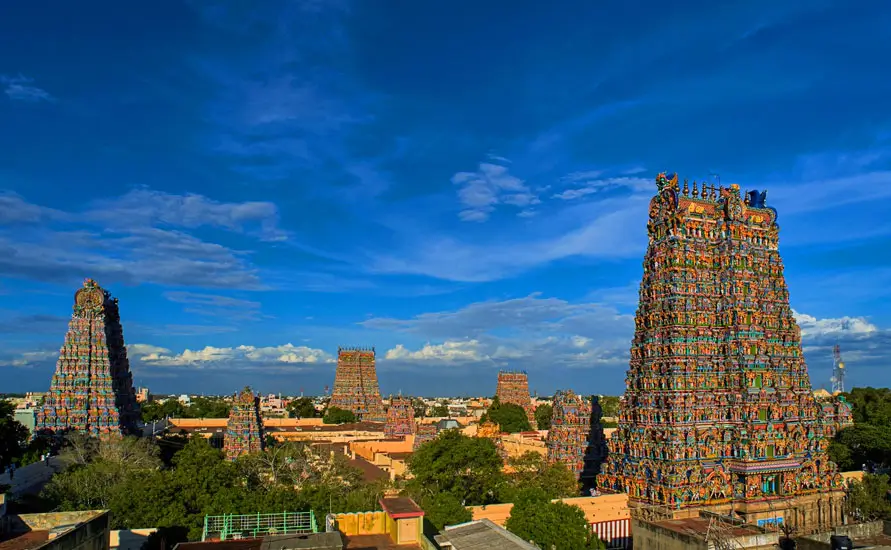
Your guide collects you in the early evening for the Meenakshi Amman Temple, the city's spiritual heart and a walled temple town in its own right. Its fourteen gopurams are covered with thousands of painted figures, and inside, the halls are full of pilgrims, musicians and priests. You hand in phones and cameras at the deposit counters before entering, and the two innermost sanctums are reserved for Hindus, yet the long corridors, the pillared halls and the Potramarai Kulam tank give you more than enough to look at. Listen for the legend of Meenakshi's wedding to Sundareswarar, which makes this temple special for newlyweds.
Around nine o'clock you witness the palliyarai ceremony, the nightly ritual when priests bear the Sundareswarar idol on a palanquin to Meenakshi's shrine for the night, with nadaswaram pipes, drums, chanting and drifting camphor smoke. Devotees crowd the corridors to watch, and the atmosphere is intense and moving. Your guide will position you to see the procession without getting in the way. A late dinner waits at the hotel afterwards, and there is no early start tomorrow, so sleep as long as you like. Many couples say this quiet, crowded half hour is the moment they remember most from the whole trip. Overnight in Madurai.
If you can face an early start, the Mattuthavani flower market is worth the effort, because the trading starts well before dawn and is at its busiest by six. Farmers arrive with sacks of jasmine, roses, marigolds and tuberoses, and traders sell them by weight for temple offerings, weddings and garlands. Madurai jasmine is so famous in India that it carries its own geographical indication label. Your guide helps you buy a small string of jasmine for your hair or wrist, which is the local way to start a day, before heading back to the hotel for breakfast.
Mid-morning brings you to the Thirumalai Nayak Palace, raised around 1636 for the best remembered of the Nayak kings, who ruled Madurai after the fall of the Vijayanagara empire. Large sections of the complex have vanished over the centuries, but the courtyard with its giant white columns and the throne room with its ornate dome show how grand it must have been. Your guide explains the mix of Dravidian and Islamic design. Afterwards the Gandhi Memorial Museum, set in a former palace of Rani Mangammal, traces the freedom struggle in photographs and letters and keeps the dhoti Gandhi wore on the day of his assassination in 1948.
The afternoon is free, and many couples spend it with a nap or a swim at the hotel. In the evening, return to the palace for the sound and light show, which narrates the Nayak dynasty's rise with colored lights on the columns and a recorded narration in English. It is not the most modern show, but the setting is impressive at night. Alternatively, your guide can lead you to a tailor's shop near the temple, where you can have a simple cotton outfit made within a day. Dinner tonight is at a local restaurant famous for its biryani. Overnight in Madurai.
After the heat and crowds of the temple towns, the cool air of Kodaikanal comes as a relief. You leave Madurai after breakfast and drive west across the plains toward the Palani Hills, a range of the Western Ghats. The climb begins near Batlagundu, where the road starts to wind up in a long series of hairpin bends through forests of eucalyptus, pine and wattle. Your driver stops at the Silver Cascade, a waterfall right beside the road, and at a viewpoint where, if the haze allows, the plains are visible stretching back toward Madurai far below.
The first bungalows went up in the 1840s, built by American missionaries looking for relief from lowland summers, and the town keeps its old character, with stone churches, cottages and boarding schools. Your hotel is a colonial-style property above the lake or a cottage resort on the hillside, with a fireplace room and valley views requested for you. The temperature here often drops to around 10 degrees at night in winter, so pack a warm layer. Check in, have lunch and take the afternoon to rest after so many days on the move.
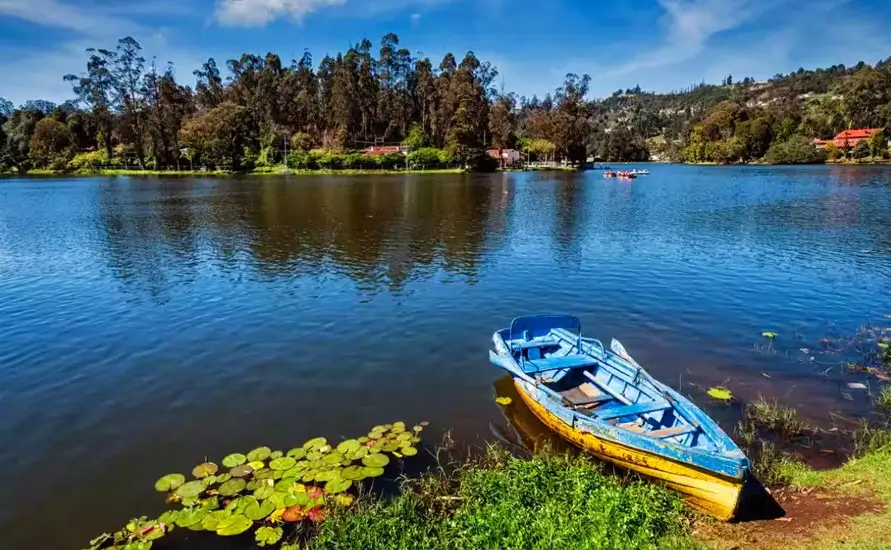
In the late afternoon, walk down to the star-shaped Kodaikanal Lake, created in the 1860s by damming a small stream, and hire a rowboat for an hour on the water. Paddling together across the lake as the mist rolls in from the hills is a lovely, simple pleasure. You can also walk the five-kilometer path around the lake or hire bicycles to ride it. In the evening, stop at one of the small shops in town selling homemade chocolate, a local specialty, before heading back for dinner by the fireplace. Overnight in Kodaikanal.
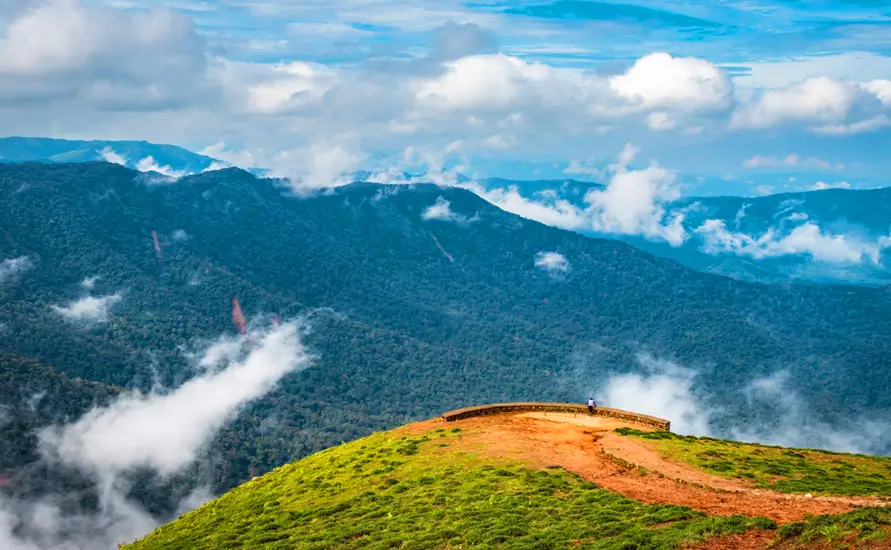
Coaker's Walk, a paved path along the edge of a steep ridge, offers some of the best views in the Palani Hills, and the clearest views come early, before the clouds rise from the valley. The walk is about a kilometer long and easy enough for anyone, with benches where you can sit and look out over the plains. On clear mornings you may see the town of Periyakulam and even the distant hills beyond. From there you drive to the Pine Forest, where tall straight trees planted in the early 20th century create a quiet, shaded place for a walk.
Late morning you continue to Guna Caves, a series of deep chasms between giant rocks named after a popular Tamil film shot here, and to Pillar Rocks, three huge granite columns rising out of the forest. The viewpoint is often wrapped in mist, which comes and goes in minutes, so be patient for the rocks to appear. For lunch the hotel prepares a picnic for two, which your driver sets up at a quiet forest viewpoint away from the crowds, with a blanket, a basket of sandwiches, fruit, cake and a flask of hot coffee. It is a peaceful moment after the busy temple cities.
The afternoon is free to return to the lake, visit the Kurinji Andavar Temple on the hillside, or simply stay at the hotel with a book. The kurinji plant, which gives the temple its name, flowers only once every twelve years, when whole slopes turn pale blue. In the evening the hotel can arrange a small bonfire on the lawn, with hot drinks and the stars overhead. Packing tonight saves a rush, since the airport drive follows breakfast, and the staff can wrap any fragile purchases from Karaikudi or Kanchipuram for the flight. Overnight in Kodaikanal.
After a final breakfast with mountain views, you check out and drive down the hairpin bends to the plains, then across to Madurai Airport, a trip of about three and a half to four hours depending on traffic in the hills. Your driver times the departure to give you a comfortable margin before your flight. From Madurai there are direct domestic flights to Chennai, Bengaluru, Mumbai and Delhi, plus a handful of international routes, so connecting to your flight home is straightforward. We can also arrange an overnight stay near the airport if needed.
Twelve days ago you landed in Chennai; since then you have seen Pallava shrines, Chola towers, Nayak halls and the fading glory of the Chettiar mansions, eaten some of the best food in India and finished in the cool hills of Kodaikanal. We hope this trip has given you both a lasting love for Tamil Nadu and its culture. Our office keeps an eye on your flights until you take off, and we would be happy to help you plan a future trip to Kerala or Karnataka. Safe travels home.
Your Journey

N.S. Rathore & Mrs. Omlata Rathore · Managing Director
We still read every enquiry ourselves. Tell us the places you liked and our planners will send a day-by-day route with drive times and a clear price.
Every package can be customised and no pressure to book. A planner from our office replies within 24 hours with a route written for your group.
Fill this in and your planner will send a first draft itinerary.
Explore more
Kerala Backwaters Escape Kerala Backwaters Escape
 Kerala Backwaters Escape
 Kerala Backwaters Escape
 Kerala Backwaters Escape
 Kerala Backwaters Escape
 Kerala Backwaters Escape
 Kerala Backwaters Escape
 Kerala Backwaters Escape
 Kerala Backwaters Escape
 Kerala Backwaters Escape
 Kerala Backwaters Escape
 Kerala Backwaters Escape
 Kerala Backwaters Escape
 Kerala Backwaters Escape
 Kerala Backwaters Escape
 Kerala Backwaters Escape
 Kerala Backwaters Escape
 Kerala Backwaters Escape
 Kerala Backwaters Escape