
 Kerala Backwaters Escape

South India Honeymoon Tours
Delhi – Jaipur – Udaipur – Kochi – Munnar – Kumarakom – Marari
At a glance
Two very different Indias meet in this trip. In the north, desert light falls on sandstone forts, marble lake palaces and painted havelis. In the far south, everything turns green and wet, with tea slopes, slow canals and a quiet fishing coast. Our Rajasthan and Kerala Honeymoon Tour links them over seventeen unhurried days. You begin in Delhi, move to the Pink City of Jaipur and the lakes of Udaipur, then fly down to Kochi, climb to Munnar, float on Vembanad Lake at Kumarakom and finish on the sand at Marari.
Each region gets enough nights to feel settled. Jaipur and Udaipur have three apiece, so the Lake Pichola boat at sunset, the City Palace terraces and a cooking session in a family kitchen never compete for the same afternoon. Kerala then slows the rhythm even further: two nights in the hills, a lakeside resort followed by a private houseboat, and two last nights at a beach where fishing boats still outnumber sunbeds. Wherever we can, you sleep in restored havelis and small heritage properties instead of large chain hotels.
The Rajasthan and Kerala honeymoon package is aimed at newlyweds flying in from London, Berlin, New York, Toronto or Melbourne on a first or second Indian trip, as well as NRI pairs who know Delhi but have never seen Udaipur at dusk. The Udaipur to Kochi flight normally includes one change of plane, and we pick timings that waste as little of the day as possible. The October to March window brings dry, mild weather in Rajasthan and calm seas along the Kerala coast. Private cars, local guides and every transfer are part of the Rajasthan and Kerala Honeymoon Tour.
When the immigration stamp is done and the luggage is off the belt at Indira Gandhi International Airport, look for our representative holding a card with your names. He loads the cases into a private air-conditioned car, hands over a folder with your vouchers and a printed plan, and rides with you to your hotel. We choose a boutique property in a leafy part of south Delhi rather than a large business hotel, and the front desk is told you are newly married. Overnight flights from Europe often land near dawn, so a room ready on arrival can be reserved ahead of time.
Today has no sightseeing at all. Jet lag is real, and starting a long honeymoon exhausted helps no one. Sleep, order a pot of masala chai to the room, and let your body get used to the time difference. If you feel restless in the late afternoon, the hotel can call your driver for a short trip to Hauz Khas Village, where a 14th-century water tank and the ruins of a madrasa sit beside a deer park and a strip of small cafés and design shops. Couples like the lakeside path at sunset, when peacocks call from the trees.
In the evening, our local manager stops by briefly to go over the next sixteen days with you, confirm flight times and make sure the honeymoon requests you sent are noted at each hotel along the route. You can also raise any questions about money, mobile data, dress codes or tipping. Dinner can be light, perhaps tandoori dishes and fresh naan at a well-reviewed North Indian restaurant nearby, or room service if you would rather stay in. Tomorrow's start is relaxed, around nine, so set the alarm accordingly. Overnight in Delhi.
Your guide arrives around nine and starts with the greenest corner of the capital. Humayun's Tomb, a UNESCO site completed in the 1570s, was commissioned by the emperor's widow and set the pattern for Mughal garden tombs that later led to the Taj Mahal. Morning light makes the red sandstone and white marble glow, and the four-part garden with its water channels is calm before the tour buses arrive. Next door lies Sunder Nursery, a restored 16th-century park with smaller tombs, flower beds and a lake, where Delhi couples come for photos and long walks.
Toward midday, you head north into the walled city of Old Delhi. Your guide leads you through the courtyard of Jama Masjid, then hands you over to a rickshaw rider for a short ride into the cramped bazaars beyond. The two of you sit close together on a narrow seat as shops selling wedding turbans, brass lamps and dried fruit slip past on both sides. Lunch is at a small, well-known place serving kebabs, butter chicken or vegetarian dishes, chosen by your guide for its cleanliness as much as its taste. Afterward, the car meets you on the edge of the market.
In the afternoon you stop at Agrasen ki Baoli, a stepwell from the 14th century hidden among the office towers near Connaught Place, where more than a hundred stone steps lead down to what was once the water level. It is cool, quiet and surprisingly little visited. A short drive past India Gate and the President's House along Rajpath, now Kartavya Path, gives you a sense of the grand British-era capital. The evening is free. Many couples walk around Khan Market or simply rest at the hotel before tomorrow's drive. Overnight in Delhi.
Breakfast over, the car swings south-west onto the main highway toward Rajasthan. Traffic on the edge of Gurgaon can be slow early on, but the road improves once you pass the state border, and the landscape opens into dry fields, low rocky hills and villages where women in bright odhnis carry water on their heads. Your driver stops at a highway restaurant for tea and snacks halfway. In winter, mustard fields along the route turn the land yellow. The total time on the road is about five to six hours, depending on traffic around Delhi and how many stops you take.
By early afternoon Jaipur appears, and home for three nights is a restored haveli, a traditional mansion with inner courtyards, carved jharokha balconies and rooms decorated with miniature paintings and antique furniture. These heritage stays have far fewer rooms than modern hotels, which means more privacy, more personal service and staff who quickly learn your names. We ask for one of the best rooms available at your category, often a suite with a private balcony or a view over the rooftops. After lunch, take an hour to settle in and rest before stepping out again.
As the afternoon cools, your driver takes you into the walled old city, built by Maharaja Sawai Jai Singh II in 1727 and washed in terracotta pink for a royal British visit in the 1870s. Johari Bazaar sells silver and enamel jewelry, Bapu Bazaar is full of block-printed fabric and leather slippers, and street vendors fry kachori and pyaaz pakoras on huge iron pans. Shops close fairly late, so there is no hurry. Back at the haveli, dinner is served in the courtyard by candlelight, often with a local folk singer playing nearby. Overnight in Jaipur.
Start early to beat the crowds at Amber Fort, the hilltop stronghold of the Kachwaha Rajputs that guarded Jaipur before the new city was built. From the parking area, you climb the ramp or take a jeep to the Sun Gate, and your guide walks you through the Diwan-i-Aam, the Ganesh Pol gateway painted with delicate frescoes and the cool, marble rooms of the private palace. The Sheesh Mahal is covered in small mirror pieces set into plaster, and your guide may light a match to show how the whole room sparkles. Views from the ramparts take in the long walls winding over the hills.
Just below the fort, a short walk brings you to Panna Meena ka Kund, an old stepped water tank with symmetrical flights of steps zigzagging down all four sides. It is one of the most photographed corners of Jaipur, so arrive before late morning for a quiet moment. Lunch is at a local restaurant on the Amber road or back in the city. In the afternoon, return to the haveli for a rest. The heat in Rajasthan can be strong even in winter at midday, and a nap under the ceiling fan is a smart part of any honeymoon schedule here.
Late in the afternoon, the car climbs the steep, twisting road up to Nahargarh Fort on the ridge north of Jaipur. Built in the 18th century as a retreat and defensive outpost, it has terraces overlooking the entire city, and as the sun sets, the lights of the old city switch on far below. Some couples stay for a drink at the café on the walls, while others prefer a quiet walk along the ramparts. Return to the haveli for dinner, perhaps a thali of Rajasthani dishes such as gatte ki sabzi and ker sangri. Overnight in Jaipur.
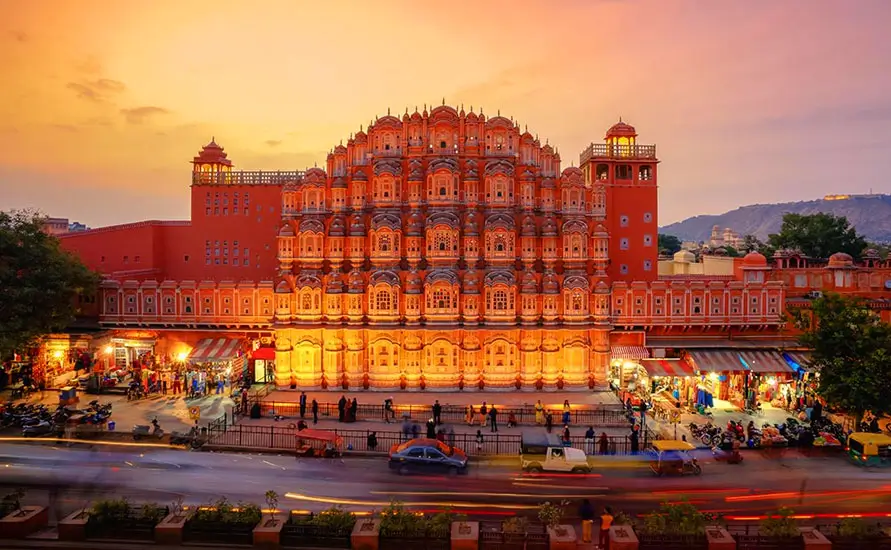
If you are up early, go first to Hawa Mahal, the Palace of Winds, before the traffic builds. Its pink honeycomb façade, with nearly a thousand small windows, faces east, so the morning sun lights it up beautifully. Across the road, rooftop cafés offer coffee with the best view of the building. Your guide then leads you through the City Palace, part museum and part royal residence, where you see the Peacock Gate in the Pritam Niwas Chowk, royal textiles and weapons, and two giant silver urns used to carry Ganga water to London in 1902.
Next door, Jantar Mantar is a garden of huge stone instruments built by Jai Singh II in the early 18th century to measure time, track stars and predict eclipses. The largest sundial casts a shadow that moves several centimeters every minute, and your guide explains how astronomers still use it to set dates for local festivals. Couples who prefer something more hands-on can visit a block-printing workshop on the edge of the city, where artisans show how carved wooden stamps leave patterns on cotton and you can print a scarf yourselves to take home as a souvenir.
After lunch, nothing is planned except a reservation for two massage tables at the haveli or a small spa nearby, usually a full-body treatment with warm oils that eases the tiredness from the past few days. In the evening, you are free to return to the bazaars or relax at the haveli with a drink on the rooftop terrace. If you happen to be in Jaipur in winter, ask about a hot air balloon flight at sunrise over Amber, which can be added as an optional extra. Tomorrow you fly to Udaipur, so pack lightly tonight. Overnight in Jaipur.
After an early breakfast, your driver transfers you to Jaipur airport for the short flight to Udaipur, which takes about an hour. Arriving by air spares you a long day on the road, and the views of the Aravalli hills as you descend toward the lakes give you a first idea of how different this part of Rajasthan is from the Pink City. A local driver collects you at Dabok, and the ride into town is about forty minutes. You check in to a haveli or a small heritage hotel close to Lake Pichola, where we request a lake-facing room.
After lunch, a guide leads you on foot up the lanes of the old city to the Jagdish Temple, a 17th-century Vishnu shrine reached by a steep flight of stone steps and carved with elephants, dancers and musicians. Locals come here throughout the day to pray, and visitors of all faiths are welcome in the outer areas, provided shoulders and knees are covered. A few minutes' walk downhill brings you to Gangaur Ghat, where stone steps lead into the lake and women wash clothes at the water's edge. The light here in the late afternoon is soft and golden.
Just above the ghat, Bagore ki Haveli is an 18th-century mansion that now houses a museum of costumes, puppets and old furniture. In the evening, its courtyard hosts the Dharohar folk dance show, with Rajasthani dancers balancing brass pots on their heads, puppet shows and dances from different regions of the state. The performance lasts about an hour, and the seats fill up quickly, so your guide arranges tickets in advance. Afterward, walk back through the lit-up lanes for dinner at a rooftop restaurant facing the lake. Overnight in Udaipur.
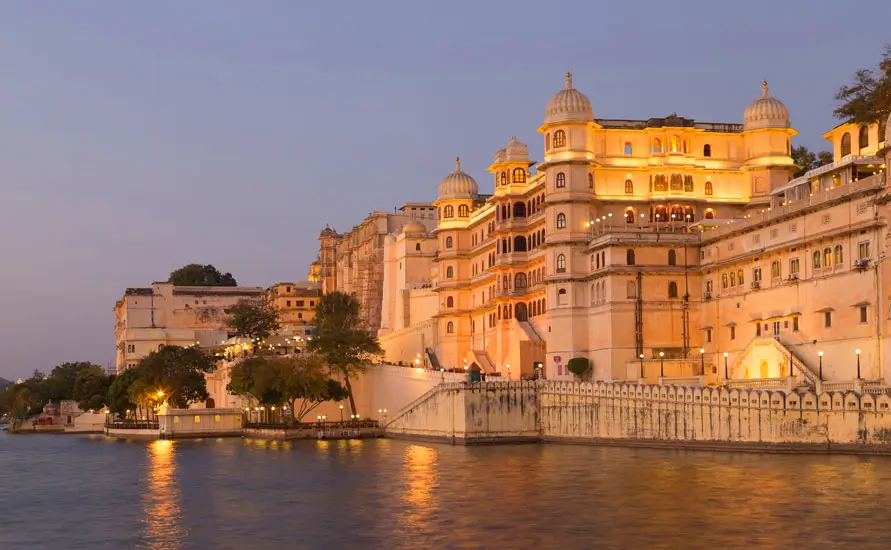
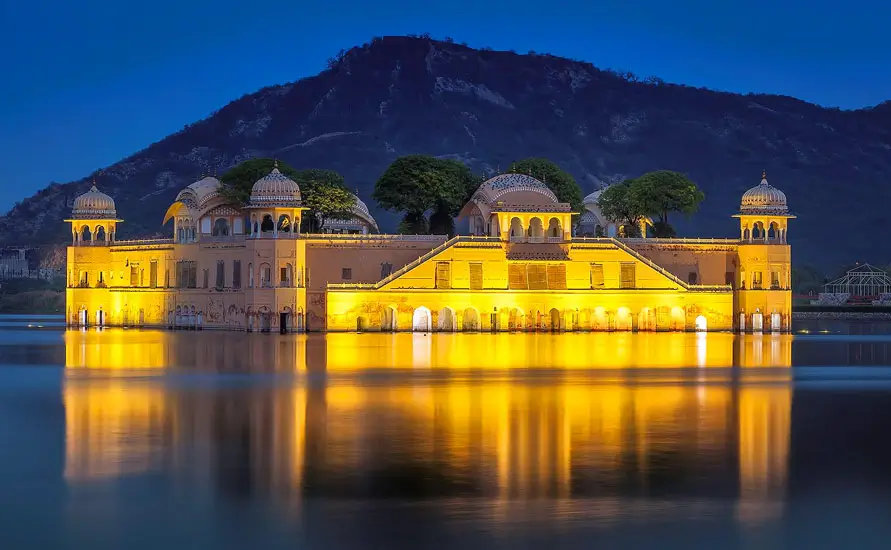
The City Palace of Udaipur dominates the eastern shore of Lake Pichola, a complex of courtyards, balconies and towers built over nearly four centuries by the Mewar rulers. Your guide leads you through the main museum, where the Mor Chowk courtyard is decorated with glass mosaics of peacocks, and through rooms full of portraits, mirrors and stained glass. From the upper terraces, you look straight across the lake to the white Lake Palace, now a hotel, sitting on its own island. Visit in the morning, when the air is cooler and the palace is quieter.
After lunch, take a short drive to Saheliyon ki Bari, a courtyard garden of fountains laid out in the 18th century for the royal ladies of Udaipur. Its fountains, marble elephants and lotus pools make a shaded stop in the afternoon, and your guide tells the stories behind the garden's design. Head back to the hotel for a siesta; nothing else is booked until the main event of the day, which starts about an hour before sunset. Wear something comfortable, and keep a light shawl handy in winter, as it can get breezy on the water.
Around five, a private boat picks you up from a jetty near the City Palace for a ride on Lake Pichola. The boat glides past bathing ghats, temples and the walls of the palace, and the low sun turns the whole waterfront amber and pink. Midway, you stop at Jag Mandir, an island palace from the 17th century with a garden and a café, where you can step ashore for a walk or a drink as the sky changes color. Return to the jetty in the dusk, when lights flicker on all around the lake. Dinner is at a lakeside restaurant. Overnight in Udaipur.
Today is slower. Late in the morning, a local family welcomes you into their home in the old city for a private Rajasthani cooking class. Over two to three hours, you learn to make rotis by hand, a dal, a vegetable curry and perhaps a sweet such as churma, using spices you buy together at a nearby market. The host explains how dishes vary from region to region, why certain recipes rely on ghee and dried beans in the desert, and what is typically cooked at weddings. You eat what you make as lunch, and the recipes are yours to keep.
The afternoon is free for you to spend as you like. Some couples wander the shops along Lake Palace Road for miniature paintings, silver and leatherwork, while others stay in their room with a book and the view over the lake. If you would like, your driver can take you to Fateh Sagar Lake, north of the old city, where there is a pleasant promenade along the shore and boats to Nehru Garden island. Fateh Sagar is popular with locals in the evening, and roadside stalls sell corn on the cob, chai and kulfi, a dense Indian ice cream.
Before sunset, you drive up to Sajjangarh, also called the Monsoon Palace, perched on a hilltop on the western edge of Udaipur. Built in the late 19th century, it was originally meant as an observatory to watch monsoon clouds, and today its terraces give the widest view of the lakes, the city and the surrounding Aravalli hills. On a clear evening, the sun goes down behind the ridges and the lakes reflect the last of the light. It is a lovely end to your time in Rajasthan, and tomorrow you head south to Kerala. Overnight in Udaipur.
Linger over a final breakfast on the haveli roof while the boatmen ready their launches below, then your Udaipur driver runs you out to Maharana Pratap Airport at Dabok. No regular nonstop service links Udaipur with Kerala, so expect a change of aircraft in Mumbai, Delhi or Bangalore and a travel day of six to eight hours. Where one carrier flies both sectors, we put them on a single booking so luggage is tagged through to Kochi. A paperback, charged phones and a snack for the second flight make the day pass easily.
Somewhere over the Deccan the brown hills of Rajasthan turn into a quilt of green, and when the cabin door opens at Cochin the warm, damp air tells you the second half of the honeymoon has begun. A Kerala representative is in the arrivals hall, and the car takes the coastal route over the bridges to Fort Kochi, ninety minutes or so. You sleep for two nights in an old trading bungalow with teak floors, tall shuttered windows and a garden courtyard. A light supper of appam and stew is enough tonight. Overnight in Kochi.
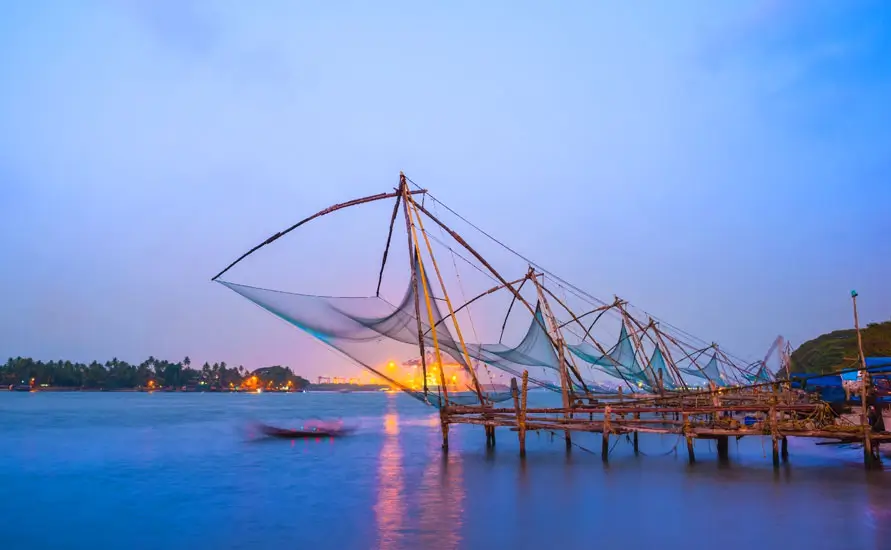
Set an alarm for half past six once, and the reward is Fort Kochi before anyone else is up. On Vasco da Gama Square the big cantilevered Chinese fishing nets creak as crews of five or six lean on the ropes and the mesh swings clear of the water, often with only a handful of silver sardines inside. Crows wait on the poles, the fish sellers lay out their mats, and a tea stall boils its first pan of milk. After breakfast, your guide walks you past Dutch-era houses to the Santa Cruz Basilica and the plain whitewashed St. Francis Church, dating from the early Portuguese years.
Late in the morning, the car crosses to Mattancherry. The two-story Mattancherry Palace was handed to the Raja of Kochi by Portuguese traders around 1555 and later repaired by the Dutch, which explains its other name. Upstairs, the bedchamber walls are covered in Kerala murals from the epics, painted in ochre, green and soot black. The palace is shut on Fridays. In Jew Town nearby, the Paradesi Synagogue of 1568 keeps its doors shut every Friday, Saturday and Jewish holy day, so your guide orders the morning around those days. Old ginger and pepper godowns still trade along the same street.
Spend the hot part of the day quietly, perhaps in one of the warehouse cafés where local artists exhibit, or back in the hotel courtyard with fresh lime soda. In the evening, couples who are curious about classical theater can watch a Kathakali performance, arriving early to see the green and red face paint built up layer by layer while a drummer warms up behind the curtain. If you would rather keep the night for yourselves, ask for a garden table at a seafood restaurant on Princess Street and order karimeen pollichathu, pearl spot fish steamed in banana leaf with a peppery masala. Overnight in Kochi.
The road east out of Kochi starts flat and busy, with pineapple farms around Muvattupuzha and rubber trees tapped in neat rows, then the climb begins near Adimali. Hairpin bends wind up through forest and cardamom plots, and the driver pulls over wherever a cascade falls close to the road so you can feel the spray. A small spice garden on the way lets you rub fresh cinnamon bark, smell green pepper on the vine and see vanilla pods hanging from their orchid stems. Expect around four hours of driving in total, with plenty of short breaks along the route.
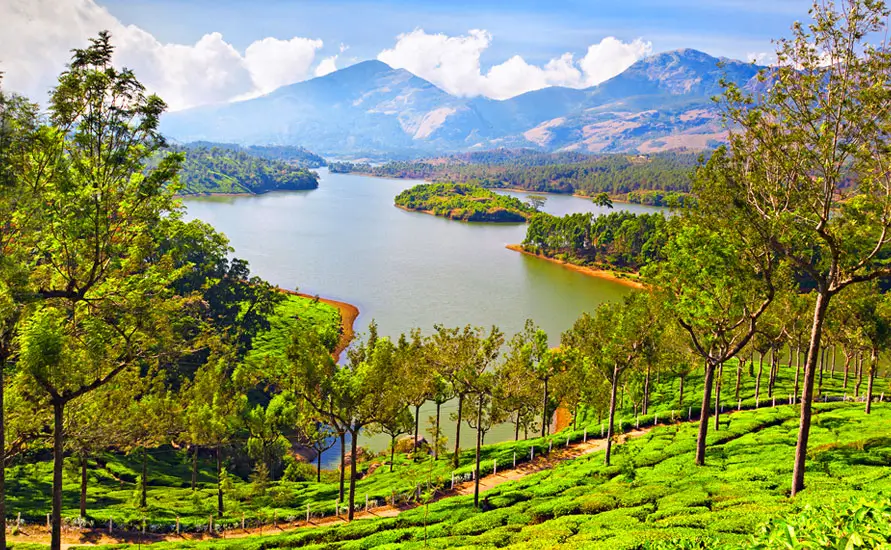
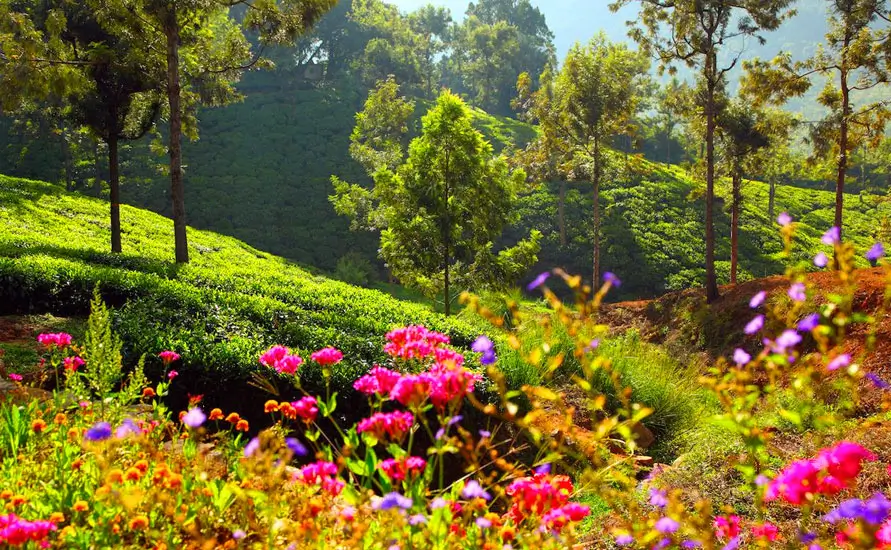
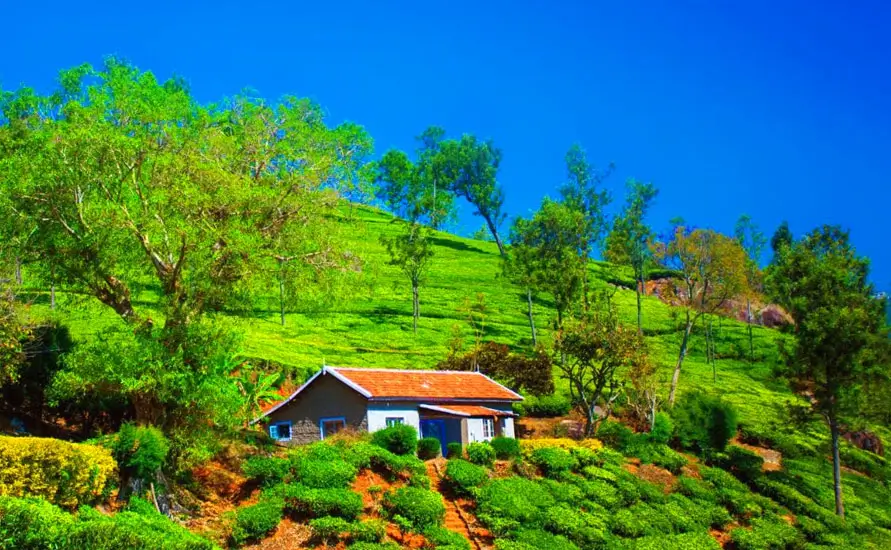
Around lunchtime the forest gives way to tea, clipped into waist-high hedges that follow every curve of the hills, with narrow paths for the pickers threaded between them. Munnar town is a busy junction of jeep stands and spice shops, but your resort sits a few kilometers outside among the estates, and we ask for a room that opens onto the valley. At around 1,500 meters the air is crisp, and evenings can feel chilly from December to February. A fleece or a warm shawl in your day bag makes the next two days far more comfortable for both of you.
Nothing more is on the program. After a late lunch, a gentle stroll along the estate road lets you watch women with baskets on their backs moving through the rows and hear them call to one another across the slopes. By five, clouds often slide down the ridges and cover the valley in grey, and the resort staff may light a fire in the garden. Order hot ginger tea to your balcony, wrap up in a blanket and enjoy having nowhere to be. A slow dinner of Kerala chicken roast or vegetable kurma follows. Overnight in Munnar.
An estate supervisor joins the two of you after breakfast for a private walk into a working garden. He shows the two of you how a bush is kept at picking height for decades, why pickers take just the tender tips of each shoot, and how shade trees protect the soil on steep ground. Workers' lines, a small school and an estate temple sit among the gardens, a reminder that whole families have lived on these hills for generations. The walk then ends at the Tea Museum at Nallathanni, where a tasting table sets out grades from dust to whole leaf.
Late in the morning, follow the road toward Mattupetty, where a dam holds back a long blue reservoir fringed by eucalyptus and shola forest. Wild elephants occasionally wander to the water's edge toward dusk, though midday sightings are rare. A little farther, Echo Point sits on another lake, and on clear days the drive can continue to Top Station, a cliff-top lookout at the very edge of Kerala where the ground falls away almost vertically. Lunch is at a simple Kerala restaurant on the lakes road, where rice and curries come on a banana leaf.
The afternoon belongs to the two of you. Some couples book a massage at the resort spa at extra cost, while others settle into the balcony chairs with a pot of high-grown tea and watch the valley change color as the sun drops. If you have a sweet tooth, ask the driver to stop at one of Munnar's homemade chocolate shops, which sell bars flavored with cardamom and local fruit. Dinner is back at the resort, and a cool, still night in the hills is ideal for sleeping well before tomorrow's drive down to the lake. Overnight in Munnar.
After an unhurried breakfast, the car winds back down the ghats, past the same waterfalls you saw on the way up, and then turns south toward Kottayam, a town known across Kerala for its newspapers, its churches and its rubber trade. Allow close to five hours behind the wheel, with a coffee break and a lunch halt to split it. As the land flattens, coconut palms crowd in again, canals start to appear beside the road, and the air grows warm and heavy. By mid-afternoon you reach Kumarakom, a string of villages where Vembanad's eastern bank meets the Kottayam canals, and a quieter base than Alleppey.
Your resort here is laid out like a Kerala village, with tiled-roof cottages reached by paths and small footbridges over lily-covered channels. We ask for one set back from the main walkways, ideally with its own garden or a private dip pool facing the water. Kumarakom has far fewer boats than the Alleppey side of the lake, and the loudest sound in the afternoon is often a kingfisher. Check in, change into something light and spend an hour by the infinity pool, where the edge seems to merge with the lake itself. Coconut water arrives without your having to ask.
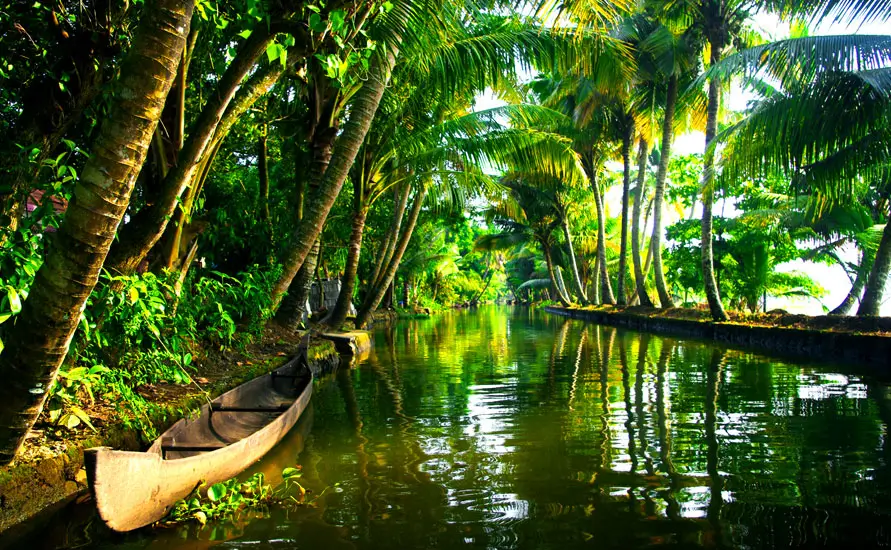
Just before sunset, a boatman in a slim wooden country canoe collects you from the resort jetty for a private paddle into the side canals. There is no engine, just the dip of the oar, so herons stay put on the bank and you can hear families talking in their courtyards as you slide by. The boatman points out toddy tappers climbing palms and the small shrines built at the water's edge. Back at the resort, dinner can be served on your veranda if you request it. Tomorrow brings the houseboat, so tonight is for an early, quiet evening. Overnight in Kumarakom.
Early risers can walk into the Kumarakom Bird Sanctuary next door to the resorts at first light, when darters dry their wings on dead branches, purple herons stalk the reeds and, between November and February, flocks of migrant ducks rest on the lake. A local guide with binoculars makes it easy to tell the species apart. Back at the resort, take breakfast slowly and pack a small overnight bag. Around midday the car runs you to a nearby jetty where your private Kerala houseboat is tied up, its woven bamboo roof and polished wooden deck freshly cleaned for you.
Once you are aboard, the boat swings out across Vembanad Lake, wide enough here that the far shore is only a line of palms. Lunch arrives at a table on the front deck: red Kerala rice, a coconut-based fish curry, cabbage thoran, crisp pappadam and a spoonful of lime pickle. Later in the afternoon the captain turns into narrower channels, where children dive off the steps of their homes and women scale fish on the banks. Your cabin has a big window and an attached bathroom, and the crew scatters flower petals on the bed as a quiet nod to the occasion.
Evening comes softly on the lake. By government rule, houseboats must stop moving before dark, so the captain picks a sheltered mooring beside a paddy dyke, ties up to a palm trunk and turns off the engine. Tea and pazham pori, ripe banana fried in batter, appear on deck while the sky shifts from apricot to indigo. The cook then serves dinner by lamplight, with the spice adjusted the way you like it. Fireflies sometimes blink along the bank, and the night is very still. For many couples, this is the evening they talk about most from the Rajasthan and Kerala Honeymoon Tour. Overnight on the houseboat.
Dawn on the backwaters is cool and nearly silent, apart from a rooster somewhere on shore and the splash of a man casting a net from his canoe. Sit out front with a cup of strong Kerala coffee while the captain starts the engine and turns back toward the jetty. Breakfast is puttu, steamed rice and coconut cylinders, with kadala curry made from black chickpeas, followed by fresh pineapple. You step ashore around nine, and your driver is waiting. The road to Marari skirts the Alappuzha side of the lake through small villages, roughly ninety minutes away.
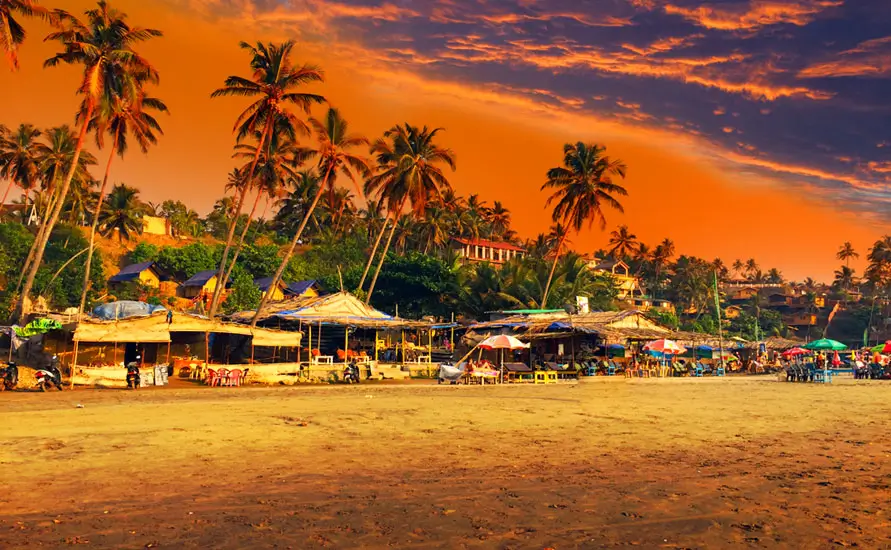
Marari Beach, near the village of Mararikulam, is the opposite of a party beach. There are no high-rise hotels and no loud bars, only a long, clean shoreline, coconut groves running down almost to the waterline and a working fishing community that launches its boats straight off the sand. Your beach resort has thatched or tiled cottages in a large garden, some with private pools or open-air showers, and we ask for one near the dunes. Check in, have lunch in the shade and then spend the afternoon reading, swimming or sleeping under the palms, entirely as you please.
Toward five, wander down to the waterline, where crews haul their long boats up the beach on wooden rollers and empty the nets into flat baskets. Mackerel, sardines and small prawns are sorted on the spot and sold to waiting traders and cycle vendors. Your arrival will probably attract a few curious children and polite questions about where you come from. As the sun sinks into the Arabian Sea, the beach empties quickly, and the light turns everything soft and coppery. Dinner tonight could be grilled seafood at the resort, served at a table under the palms. Overnight in Marari.
Borrow two bicycles from the resort soon after sunrise and follow the sandy lanes inland. The route passes coconut groves, small vegetable plots, a few coir yards where husks are soaked and beaten into fiber, and family homes with neatly swept front yards. Temples and churches stand side by side, and people on their way to work nod or ring their bells as you pass. The ground is completely flat, so the ride suits anyone, even if neither of you has cycled since school. A resort naturalist can ride along to explain what you see, and breakfast is waiting on your return.
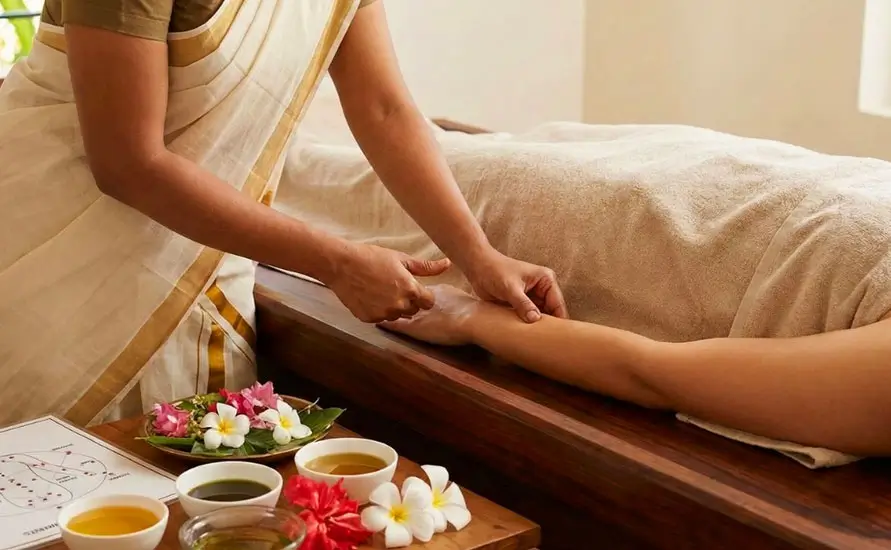
Late in the morning, the two of you have a couple's Ayurveda session at the resort, in a room where two treatment tables stand side by side. Most spas in this part of Kerala work with a qualified doctor, who asks a few questions about your health before choosing the oils. A typical session is a synchronized four-hand abhyanga massage followed by a short herbal steam, about ninety minutes in all. Afterward, you will feel slow and heavy in the best way, so the remainder of the day is left empty for the pool, the hammock and a late, light lunch.
For the last night of the trip, the resort lays a single table just above the tide line, with lanterns pushed into the sand around it. The resort chef plans the menu with you in advance, and a Kerala seafood spread with fish moilee, prawns in roasted coconut and soft appam is a popular choice, though vegetarian menus are just as good. Somewhere between the first course and dessert, conversation usually drifts back to that sunset boat on Lake Pichola and the haveli rooftop in Jaipur, which now feel a long way off. Overnight in Marari.
Take one last early walk on the sand while the fishing boats head out, then enjoy a long breakfast in the garden. Rooms usually need to be vacated by midday; for an evening flight, extra hours in the cottage can be bought from the resort if you let us know beforehand. The ride north to Cochin International Airport follows the coastal highway through Cherthala and the Kochi suburbs and normally takes between ninety minutes and two hours. Your driver can stop at a spice cooperative so you can pick up cardamom, tea or banana chips for family at home.
Kochi airport has frequent departures to the Gulf hubs and Singapore for onward connections to London, Frankfurt, Toronto or Sydney. Your driver unloads the bags at the terminal entrance, and our office stays reachable by phone until you are through check-in. Seventeen days ago you landed in Delhi; since then you have seen pink sandstone, a lake palace at sunset, misty tea slopes, a night moored on Vembanad Lake and a fishing beach almost to yourselves. Thank you for choosing us for your honeymoon, and safe travels home.
Your Journey

N.S. Rathore & Mrs. Omlata Rathore · Managing Director
We still read every enquiry ourselves. Tell us the places you liked and our planners will send a day-by-day route with drive times and a clear price.
Every package can be customised and no pressure to book. A planner from our office replies within 24 hours with a route written for your group.
Fill this in and your planner will send a first draft itinerary.
Explore more
Kerala Backwaters Escape Kerala Backwaters Escape
 Kerala Backwaters Escape
 Kerala Backwaters Escape
 Kerala Backwaters Escape
 Kerala Backwaters Escape
 Kerala Backwaters Escape
 Kerala Backwaters Escape
 Kerala Backwaters Escape
 Kerala Backwaters Escape
 Kerala Backwaters Escape
 Kerala Backwaters Escape
 Kerala Backwaters Escape
 Kerala Backwaters Escape
 Kerala Backwaters Escape
 Kerala Backwaters Escape
 Kerala Backwaters Escape
 Kerala Backwaters Escape
 Kerala Backwaters Escape
 Kerala Backwaters Escape