
 Kerala Backwaters Escape

South India Honeymoon Tours
Delhi – Agra – Fatehpur Sikri – Jaipur – Kochi – Munnar – Alleppey – Kovalam
At a glance
Most couples planning a first trip to India arrive with two pictures in mind: the white marble of the Taj Mahal, and a quiet boat drifting along green Kerala canals. Our Golden Triangle and South India Honeymoon Tour puts both in one fortnight without cramming. The first five nights cover Delhi, Agra and Jaipur, the classic northern circuit of Mughal tombs and Rajput forts. Then a flight carries the two of you south to Kochi, the cool tea slopes of Munnar, a private houseboat at Alleppey and three slow nights on the sand at Kovalam.
The order matters. North India is busy, loud and full of sights, so it comes first, while you are fresh and curious. Kerala follows as the reward: shorter drives, softer mornings and a beach at the end, so you fly home rested rather than worn out. The Taj Mahal is seen at sunrise, when the light is pink and the crowds are thinner, and we plan the dates so that your Agra morning never falls on a Friday, the one day the monument stays closed to sightseers.
This Taj Mahal and Kerala honeymoon runs entirely on a private basis: your own air-conditioned vehicle with an English-speaking chauffeur in each region, licensed guides at the main monuments and an assistant at every airport. The Jaipur to Kochi flight usually connects through Mumbai, Bangalore or Delhi, and we choose timings that leave you a relaxed evening. October to March is the ideal season for both halves of this Golden Triangle and South India Honeymoon Tour, with dry days in the north and calm seas in the south.
Indira Gandhi International Airport is where your fortnight together in India begins. A representative waits just outside the customs hall with a sign carrying both your names, takes care of the luggage and walks you to the car, which has cold water and a local SIM card ready if you asked for one. Reaching central Delhi can take anything from forty-five to seventy minutes, and the hotel will have been told that you are on your honeymoon. Early check-in can be prebooked for overnight flights, so you are not waiting in a lobby with jet lag.
The first afternoon is left open. Long-haul flights tend to leave couples tired and slightly disoriented, and Delhi is best faced after a rest. When you are ready, you might ask to be dropped at Lodhi Garden, a large public park where the domed tombs of 15th- and 16th-century Sayyid and Lodi rulers stand among lawns and old trees. Locals come here to jog, picnic and walk their dogs in the late afternoon, and it is a calm, green place to stretch your legs and get used to the noise, colors and warmth of an Indian city before the real sightseeing begins.
Back at the hotel, our team member goes through the plan for the next two weeks with you, explains how the flight connection to Kochi will work and answers any questions about money, dress codes or tipping. For dinner, stay in or try one of the restaurants in nearby Khan Market, where small cafés serve everything from North Indian kebabs to wood-fired pizza. Take it easy on the spices on day one if your stomach is not used to them. Tomorrow starts at a civilized hour, so the alarm can stay off. Overnight in Delhi.
Once breakfast is over, your guide arrives for a day split between the two faces of the capital. The morning goes to Old Delhi, the walled city founded as Shahjahanabad in the 1640s. You start at Jama Masjid, a red sandstone and marble mosque with three onion domes and a courtyard that fills with worshippers at Friday prayer. Shoes come off at the steps, and robes are lent at the gate to anyone whose arms or legs are uncovered. From the courtyard you can see across the rooftops toward the walls of the Red Fort, which you pass on the drive.
Then comes the part most couples remember: perched together on a cycle rickshaw, rolling into the alleys off Chandni Chowk. The two of you sit side by side as the rider weaves between handcarts, scooters and porters, past shops selling silver, wedding cards, saris and dried fruit. Your guide may stop at the spice market of Khari Baoli, where sacks of chili and turmeric line the pavement, or at a century-old sweet shop for a plate of jalebi. It is noisy, cramped and full of life, and it shows you a side of Delhi no shopping mall ever could. Hold on to your phone and bag.
After lunch, the pace slows. Humayun's Tomb, built in the 1560s for the second Mughal emperor, is a UNESCO site with gardens split into four quarters by water channels, and its red and white design is often described as a forerunner of the Taj Mahal. Later you visit Qutub Minar, a 73-meter tower of fluted sandstone started around 1200 by the first Delhi sultans, surrounded by the ruins of mosques and a famous iron pillar that has hardly rusted in sixteen centuries. Heading back, the car loops around India Gate and the sandstone ministries of Lutyens' New Delhi. Overnight in Delhi.
Leaving after breakfast, you join the six-lane Yamuna Expressway, and Agra is usually reached in less than four hours. The scenery is mostly flat farmland, mustard fields in winter and small brick kilns, and your driver stops at a clean highway restaurant for tea. On arrival, you check in to a hotel close to the Taj Mahal, where we request a room with a view of the dome where the property offers one. After lunch and a short rest, your local guide joins you for the afternoon, which is shaped around the evening light.
First comes Agra Fort, the red sandstone citadel of the Mughal emperors and a UNESCO site in its own right. Its walls run for about two and a half kilometers along the Yamuna, and inside are halls of public and private audience, marble pavilions and the octagonal tower of Musamman Burj. It was here, according to tradition, that Shah Jahan spent his last years under house arrest by his son Aurangzeb, looking down the river toward the tomb he had built for his wife Mumtaz Mahal. Your guide tells the story well, and the view gives you a first glimpse of the Taj.
As the sun sinks, you cross the river to Mehtab Bagh, the Moonlight Garden, laid out by Babur and later aligned with the Taj on the opposite bank. Few tour groups come here, and the lawns face the back of the mausoleum straight across the Yamuna, which turns gold and then pink as the light fades. It is one of the calmest spots in Agra for a couple to sit and talk. You eat at the hotel and turn in early, as tomorrow's alarm rings well before dawn. Overnight in Agra.
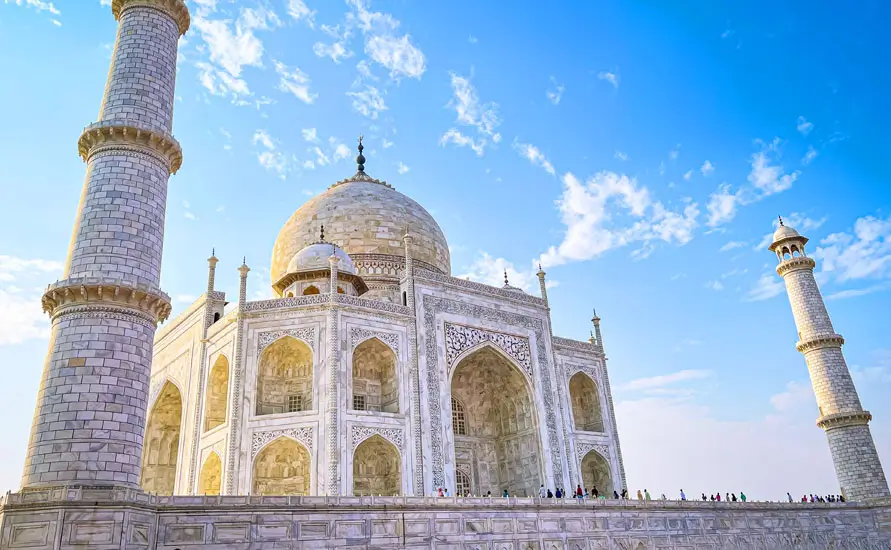
Entry to the Taj Mahal begins around first light every day except Friday, and being among the first visitors through them is worth the early start. Your guide has the tickets ready, leads you through security and out through the red sandstone Great Gate, where the white marble tomb suddenly appears at the far end of the long water channel. In the first light, the marble shifts from grey to blush to bright white. Your guide knows the quieter angles for photos and explains the inlay of semi-precious stones, the Quranic calligraphy and the deliberate symmetry. Couples can book a private photographer for this visit.
Back at the hotel, a late breakfast is waiting before you check out and drive west. After about an hour you stop at Fatehpur Sikri, the city built by Emperor Akbar in the late 16th century and left behind within a few decades, probably because of water shortages. Its palaces, courtyards and audience halls are almost perfectly preserved. Next door, the Jama Masjid complex holds the white shrine of Salim Chishti, the Sufi mystic who foretold Akbar's heir, where couples of every faith tie red threads to the screens and make a wish. Many honeymooners find this small ritual surprisingly moving.
The road continues through eastern Rajasthan, with camel carts, roadside temples and women in bright odhnis walking along the fields. You reach Jaipur, the Pink City, by late afternoon, where a heritage-style hotel awaits, many of them former mansions of the city's nobles. After a long day, there is nothing more planned. The hotel can arrange a light dinner on your room's terrace or in the courtyard, often with a musician playing softly in the background. Tomorrow you have a full day in the city, but the start is not early, so you can sleep in. Overnight in Jaipur.
Around nine, your guide accompanies you out of town to Amber Fort, a twenty-five-minute ride up the Delhi road. The fort rises up a hillside above Maota Lake, its honey-colored walls and gates protecting a series of courtyards built by the Kachwaha rulers from the late 16th century. You go up by jeep or on foot. Inside, the highlight is the Sheesh Mahal, a hall with walls and ceiling set with thousands of tiny mirrors, which once sparkled in candlelight like a starry sky. Arriving early in the day keeps you ahead of the heat and the busiest crowds.
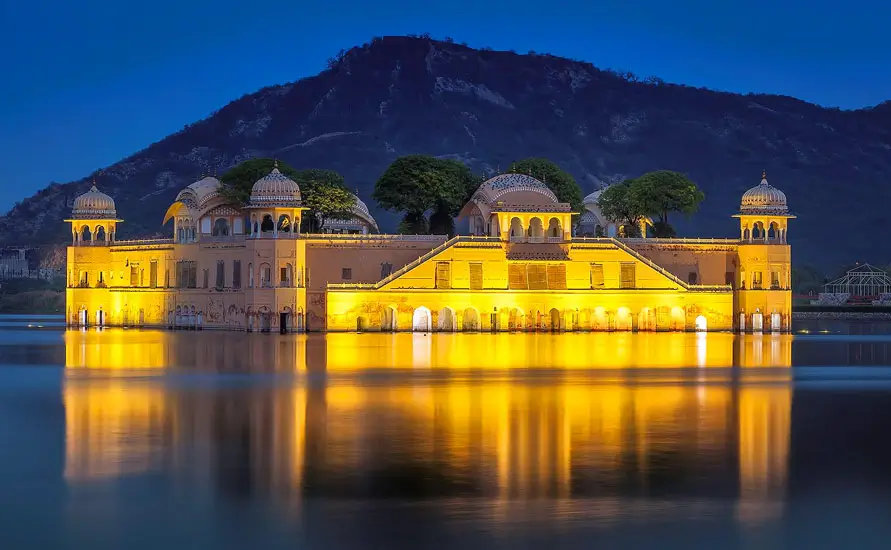
On the way back, you stop for photos at the Jal Mahal, a palace that seems to float in Man Sagar Lake, before visiting the City Palace, where descendants of the Kachwaha line still occupy one wing. Its museum holds royal costumes, weapons and two huge silver urns that once carried Ganges water to England. Opposite stands Jantar Mantar, an 18th-century observatory of giant stone instruments, including a sundial accurate to about two seconds. Finish with the five-story pink façade of Hawa Mahal, built so royal women could watch street processions unseen. Your guide also shows you a good place for block-printed textiles or jewelry only if you ask.
Late in the afternoon, you return to the hotel for some rest. In the evening, we reserve a corner on a roof terrace that looks up at Nahargarh Fort, whose ramparts are floodlit at night. The menu usually includes Rajasthani dishes such as laal maas, a fiery mutton curry, and dal baati churma, as well as milder choices. Use the evening to talk over the northern half of the trip before you fly south tomorrow, and to decide which of your Taj photos goes to the family group first. The car is parked close by for the short ride home. Overnight in Jaipur.
Today is mostly airports. Jaipur has few or no nonstop departures to Kerala, so the routing normally changes planes in Mumbai, Bangalore or Delhi and takes five to seven hours door to door, including the transfer. We book through-tickets on one airline wherever possible, so your bags are checked all the way and you do not have to collect them midway. The terminal waiting time is a good chance to sort photos from the Taj and Jaipur.
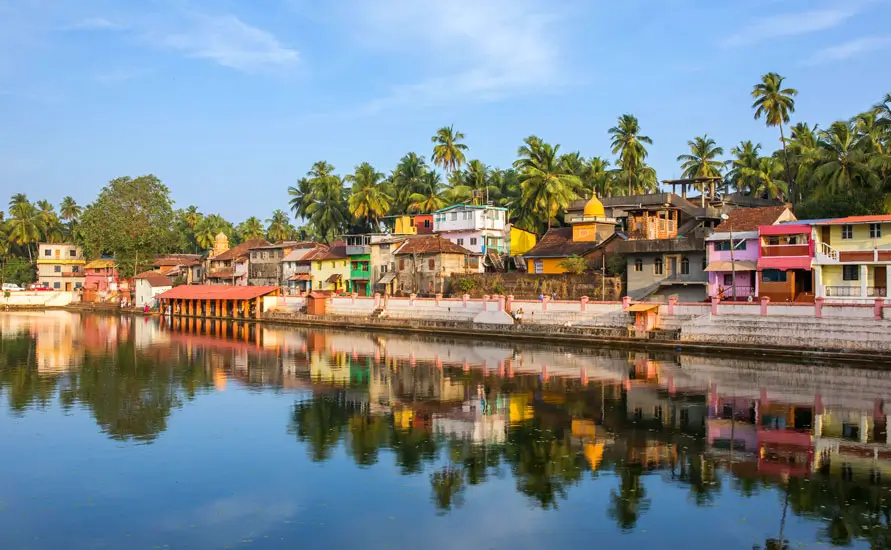
Our southern team is waiting in the Cochin arrivals hall, and the car reaches Fort Kochi in roughly ninety minutes. This is the old port district on the edge of the Arabian Sea. The air is warmer and more humid than in Rajasthan, and coconut palms replace the dry landscape of the north. Your room is in a converted colonial building, often with a courtyard pool. Dinner tonight is simple and early. Overnight in Kochi.
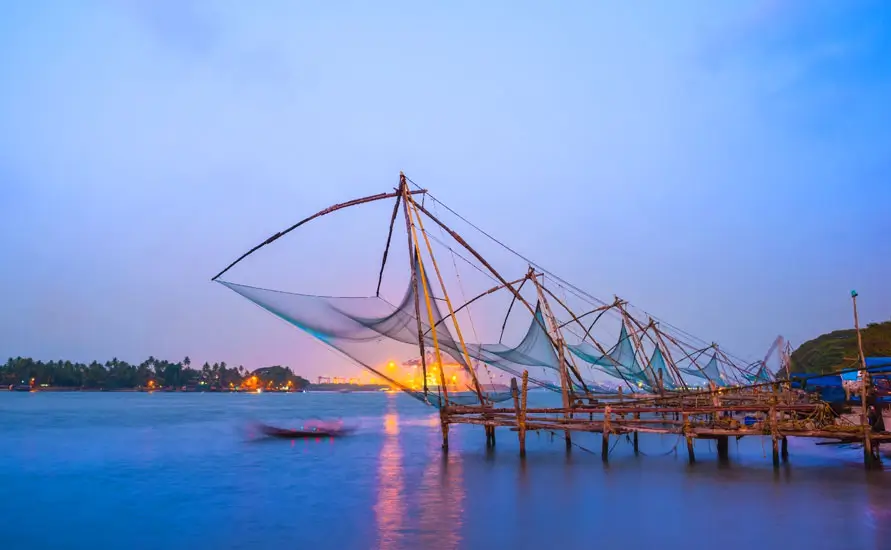
Start with a slow breakfast, then head out with your guide on foot. Fort Kochi is small enough to walk, and the morning begins along the seafront where the giant Chinese fishing nets rise and dip on wooden frames. Fishermen work in teams, hauling on ropes weighted with stones, and the catch is sold right there on the sand. From the shore, your guide leads you past the old Dutch Cemetery and to St. Francis Church, among the earliest European-built churches in India, with its simple whitewashed façade and wooden ceiling fans pulled by ropes.
Later you drive to Mattancherry. The Mattancherry Palace, also called the Dutch Palace, has some of the best preserved mural art in Kerala, including detailed Ramayana scenes in natural pigments. The palace is closed on Fridays. A few minutes' walk away in Jew Town, the 16th-century Paradesi Synagogue is floored with hand-painted Canton porcelain tiles in blue and white. Because its doors stay closed every Friday and Saturday as well as on Jewish holy days, your dates decide the order of this morning. Spice traders, antique shops and craft stores fill the surrounding lanes, and lunch can be in a cool café inside an old godown.
In the late afternoon, take some time at the hotel before the evening program. Kathakali, the masked-looking story theater of Kerala, is staged at small theaters in Fort Kochi, and arriving early lets you watch the artists paint their faces in green, red and white using rice paste and natural colors. The performance runs roughly sixty minutes, with drummers and singers telling an episode from the Mahabharata through gestures and eye movements. Afterward, walk back through the quiet streets for a seafood dinner at a garden restaurant. Overnight in Kochi.
After breakfast, you leave the coast behind and drive inland toward the Western Ghats. The first hour passes through towns and rubber plantations, and then the road begins to climb in long switchbacks past cardamom and pepper smallholdings. Two roadside cascades, Cheeyappara and Valara, spill over black rock beside the tarmac, and your driver stops so you can stretch your legs and take photos. Roadside stalls sell spiced tea, banana chips and fresh pineapple. Each bend brings cooler air, so keep a light jacket close at hand for the afternoon.
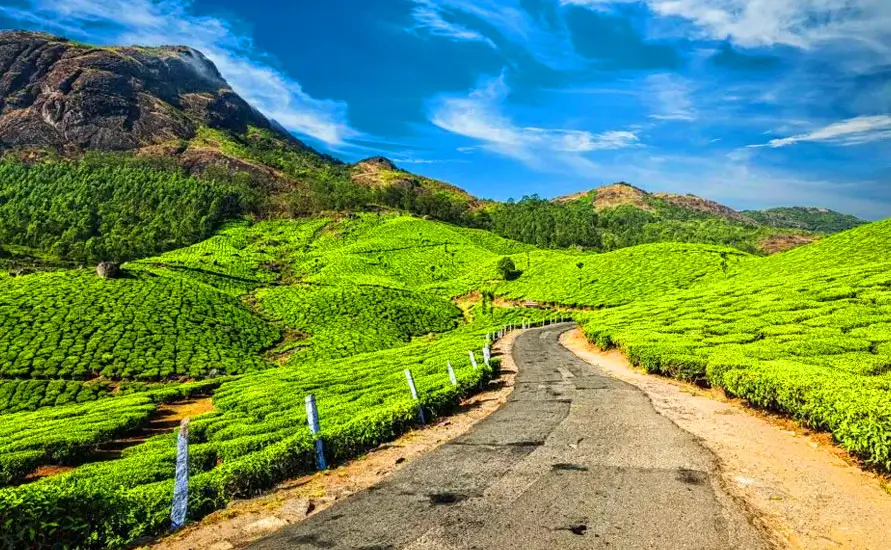
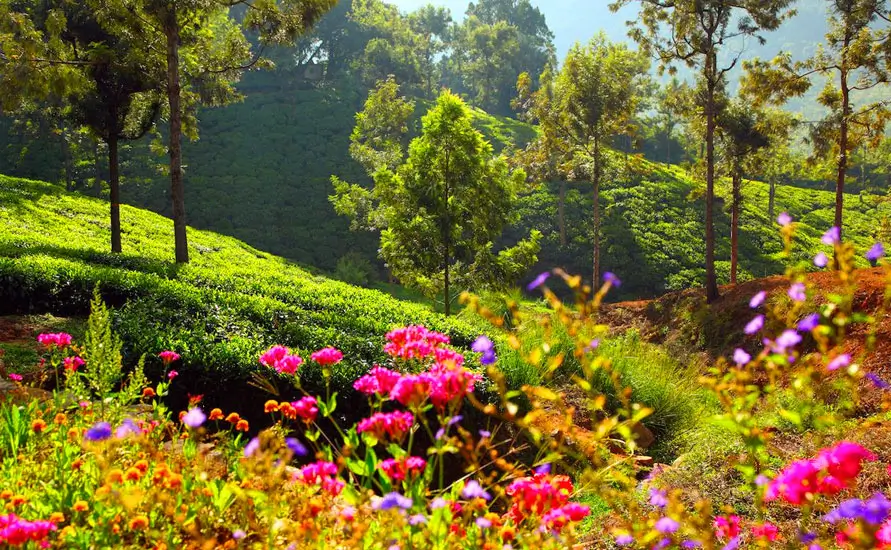
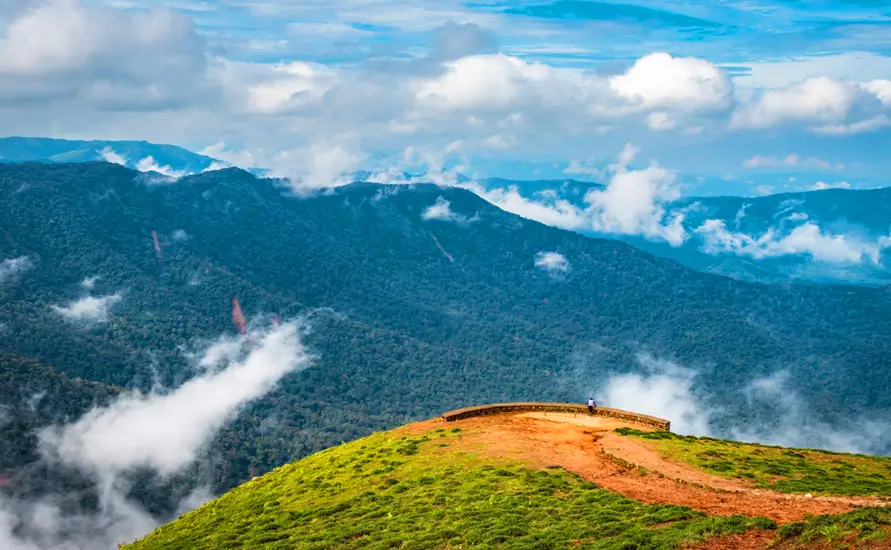
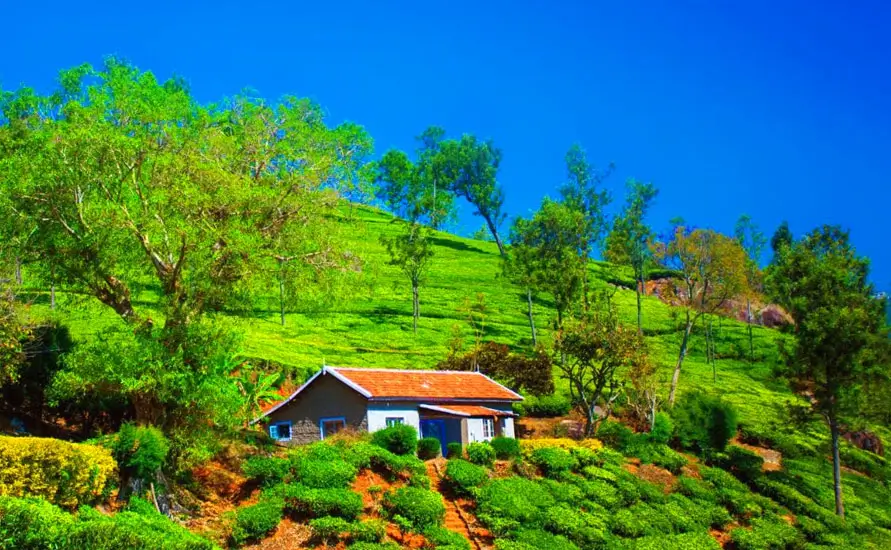
Around midday, the first tea gardens appear: rolling hills covered in neat rows of tea bushes, with tall silver oak trees standing in between for shade. Munnar takes its name from the Malayalam for three rivers, and Scottish and English planters turned these grasslands into tea gardens in the late Victorian era. The town itself is small and busy, but the estates around it stretch for miles. Your resort is set among the plantations, and we request a room with a valley-facing balcony, where you can watch the clouds move across the slopes, and the hills change color from emerald to dark blue as evening falls.
Following a late lunch, nothing else is booked. Most couples simply sit on the balcony with a pot of local tea and listen to the birds. For a little exercise, the resort can point you toward an easy trail through the estate, and in the evening the mist often rolls in over the ridges, making the air cool and fresh. Dinner tonight could be Kerala-style fish or chicken stew with appam. A cozy blanket, a hot water bottle if the night turns chilly, and a quiet room with the window open to the sound of crickets are all you need. Overnight in Munnar.
Your morning opens at Eravikulam National Park, where herds of Nilgiri tahr, a rare mountain ungulate with curved horns, graze the open grass above the cliffs. Forest department shuttles carry you uphill from the ticket gate, and from the drop-off point a paved path winds along the grassland slopes where tahrs often graze close to the road. Calving season brings an annual closure of several weeks, normally in late winter, so we confirm the dates when you book. The views from the top, over rolling hills and the flank of Anamudi, at roughly 2,695 meters the tallest mountain in the peninsula, are worth the trip.
Late in the morning, you visit the Tea Museum at Nallathanni, set up by a big planting firm. Old machinery, photographs and a short film tell the story of tea-growing here since the 1880s, and a small working line shows the leaf moving from withering troughs to rollers and hot-air dryers in a matter of hours. The tasting counter lets you try different grades side by side. After that, a naturalist leads you both on a stroll among the tea bushes and spice gardens, where cardamom, pepper and cinnamon grow side by side under the trees.
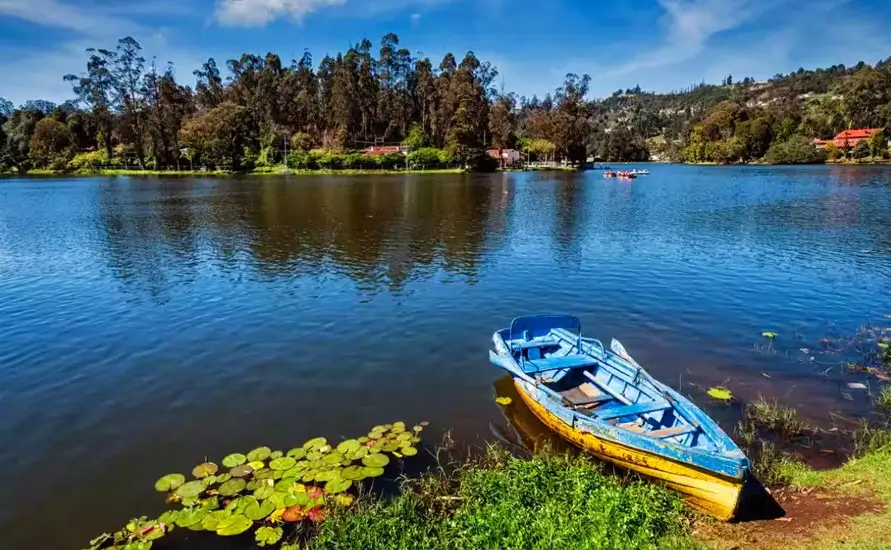
In the afternoon you drive up toward Top Station, about 32 km from town, or stop at Mattupetty Dam and the Echo Point lake for a short pedal-boat ride, depending on the weather and how much time you want to spend in the car. Both routes take you past small villages and more tea gardens, and on clear days the hills fall away to the plains of Tamil Nadu. Late afternoon is the best time for photos, as the sun lights up the rows of tea bushes from the side. Return to the resort for a quiet dinner. Overnight in Munnar.
An early start is needed today, as houseboats in Alleppey board at around midday. You leave Munnar soon after an early breakfast, following the ghat road down through spice country and rubber plantations to the flat coastal plain of central Kerala. The drive takes about five hours with a short stop for tea, and the change in scenery is striking, as hills give way to coconut palms, canals and endless rice fields. Your driver radios ahead to the boat operator so the crew is ready when you reach the jetty.
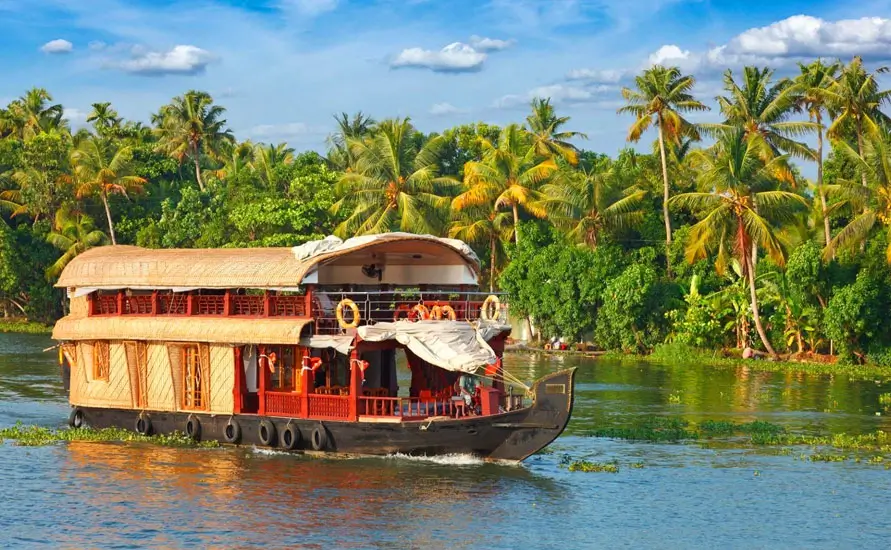
Your private Kerala houseboat is a roomy wooden boat with a thatched roof, a bedroom with an attached bathroom and a shaded sitting area up front. The three-person crew serves a welcome drink and then lunch as the boat moves out onto the backwaters. The menu usually features rice, sambar, avial (a mixed vegetable dish with coconut and yogurt), fried fish and a sweet payasam. For couples, the bed is decorated with flowers, and if you would like a small cake or a particular dish, just tell us ahead of time.
The afternoon is all about gliding along narrow canals and wide lakes, past villages where daily life happens at the water's edge. You might see coir being twisted by hand, ducks being herded along the bank or small churches and temples painted in bright colors. Boats must stop and anchor before dark, and once the engine is off, the only sounds are birds, frogs and the odd canoe. Tea and banana fritters are served as the sun goes down, followed by a home-style dinner on deck. Overnight on the houseboat.
Morning on the water is quiet and fresh. As the boat heads back to the jetty, the cook serves breakfast of puttu, a steamed rice cake, with chickpea curry, or idli with chutney. You disembark around nine, thank the crew and meet your driver for the trip south. The coastal road runs through Kayamkulam and Kollam, crossing several rivers and lagoons, and passes churches, temples and mosques side by side, reflecting Kerala's mixed history. A stop for fresh coconut water or a fish lunch at a roadside place breaks up the drive.
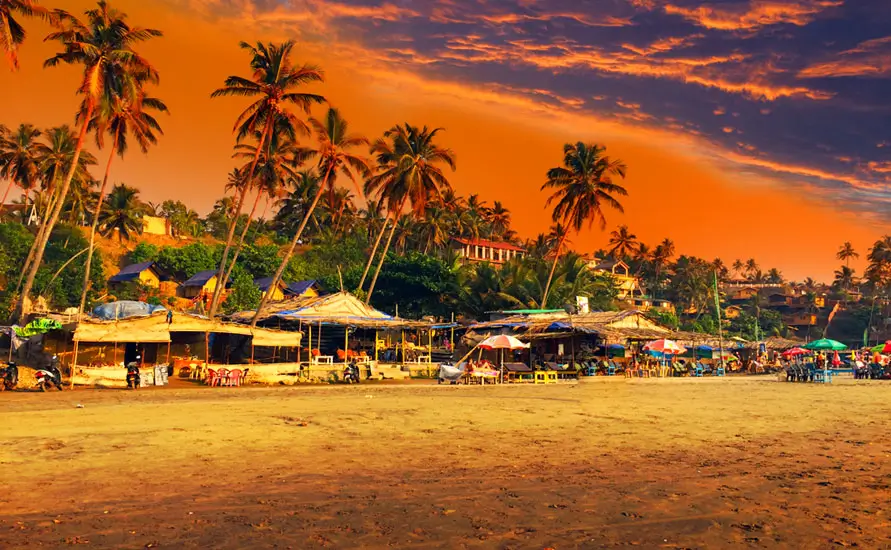
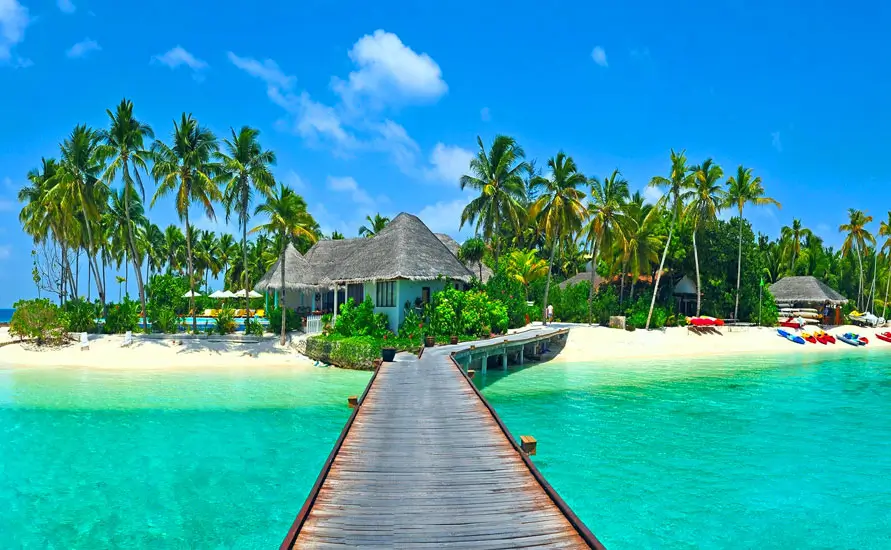
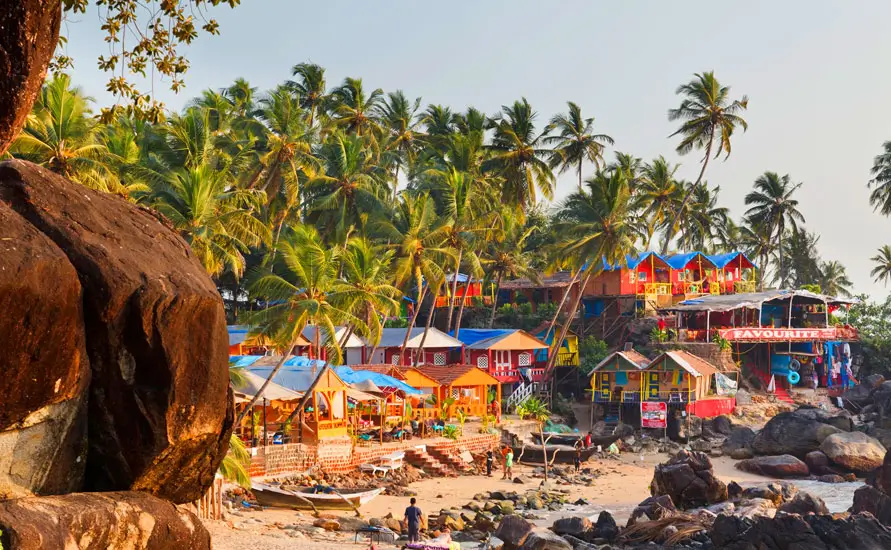
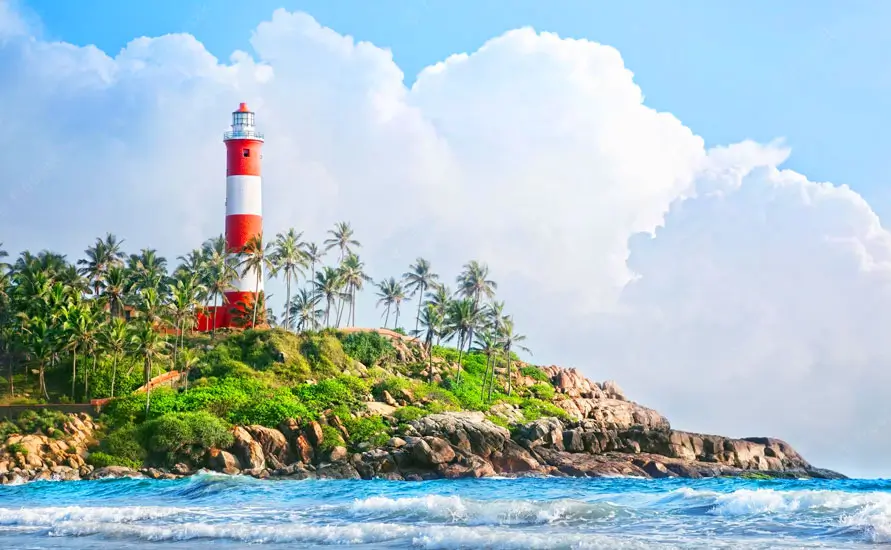
By early afternoon the car pulls into Kovalam, a short way below the state capital. This small beach town is made up of three crescent-shaped bays separated by rocky headlands. The southernmost, Lighthouse Beach, is the busiest, overlooked by a candy-striped lighthouse on the headland and a row of cafés along the sand. Your beach resort is set on a quieter stretch, where we request a sea-facing room or a cottage with a private terrace. For the next three nights, the pace is entirely up to you, whether that means long swims, lazy breakfasts on the terrace or simply doing nothing at all for hours.
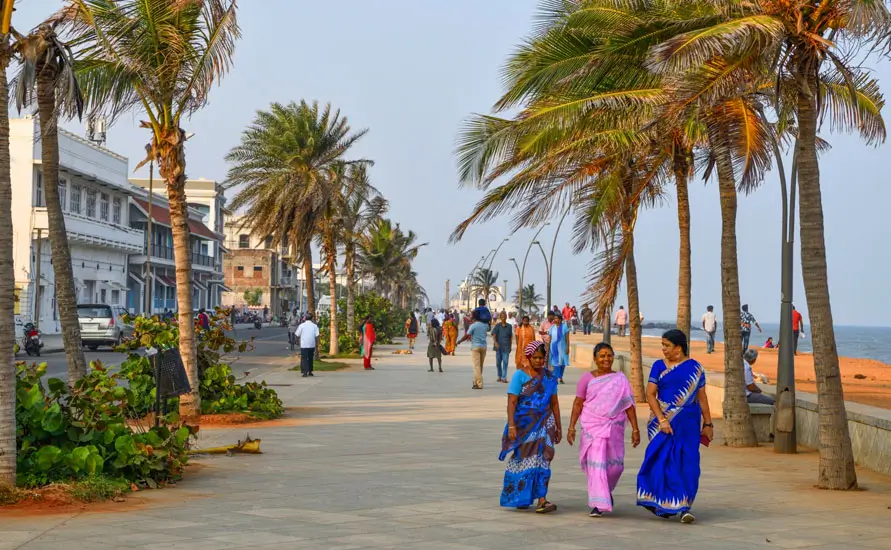
After settling in, take a walk along the sand as the sun goes down, when fishermen return in their wooden boats and the western horizon goes copper and rose. In the evening, the cafés on Lighthouse Beach set up tables right on the sand and display the catch of the day on ice, so you can point to the fish or prawns you would like grilled. There is no hurry and no schedule. The waves are calmer from November to March, but always swim only where lifeguards are on duty and the flags allow. Overnight in Kovalam.
Kerala is the home of Ayurveda, the traditional Indian system of medicine, and Kovalam has many trained practitioners. This morning, we book a couple's session at your resort spa or a reputable Ayurvedic center nearby. Most couples choose an abhyanga massage with warm herbal oils, often followed by shirodhara, in which a slow stream of oil is poured over the forehead. Wear old clothes to the session, as the oil lingers. A short consultation with the doctor before the treatment is common practice and helps choose the right oils for you.
No plans follow lunch. Lie by the pool, take a long swim in the calmer cove at Hawa Beach, or walk up the steps of the lighthouse in the late afternoon, when it opens to visitors, for a wide view along the coast. Small shops in the lanes behind the beach sell spices, handloom cotton and books. For lunch, try a Kerala fish curry with tapioca, a simple local combination that is surprisingly good. Couples who like being on the water can book a short paddle-board or kayak session through the resort.
As the evening comes, find a seat at one of the beach restaurants or have the resort lay a table for two at the edge of the garden, with a lantern and the sound of the waves. The light fades quickly near the equator, and soon fishing boat lamps appear on the horizon like a line of small stars. Kovalam is relaxed at night, with low music, a few bars serving beer and fresh lime soda, and couples strolling along the promenade. It is a fitting way to spend the final full days of your honeymoon. Overnight in Kovalam.
About 20 km south of Kovalam, the Neyyar River meets the sea at Poovar, where a narrow sandbar separates the backwaters from the ocean. This morning, after a relaxed breakfast, your driver takes you there for a private boat ride through mangrove channels lined with screw pines and coconut palms. Kingfishers, cormorants and egrets perch on branches over the water, and the boat eventually reaches the golden sand spit, where the river and the Arabian Sea are separated only by a few meters. It is a calm, scenic outing and very different from the houseboat area further north.
Return to Kovalam for lunch and an easy afternoon. If you have not yet seen Trivandrum, Kerala's capital, your driver can take you on a short drive past the Sree Padmanabhaswamy Temple with its tall gopuram and the old palace museum next door. Only Hindus may enter the temple, with a strict dress code, so many visitors simply view the exterior and stroll through the market streets nearby. Alternatively, stay at the resort, read by the pool and save your energy for the evening. Packing can wait until tomorrow morning.
For your last night, we arrange a private dinner on the beach or in the resort garden, set with lanterns and a menu you choose together with the kitchen. Seafood platters, Kerala-style chicken roast or a vegetarian thali are all good choices. Looking back over the past two weeks, from the lanes of Old Delhi and the Taj Mahal at dawn to the tea hills and the backwaters, most couples are surprised by how much they managed to see without feeling rushed. A final walk on the sand rounds off the Golden Triangle and South India Honeymoon Tour. Overnight in Kovalam.
Enjoy one last breakfast with a view of the sea and take your time packing. Rooms are normally vacated by midday; for a night flight, extra hours in the room can be bought from the resort. Trivandrum International Airport lies around fifteen kilometers up the coast, which makes this one of the easiest departures in India. Your driver picks you up at the agreed time, helps with the luggage and drops you at the terminal entrance.
Trivandrum has direct flights to several Gulf cities and good connections through Dubai, Doha, Abu Dhabi, Colombo and Singapore for the long legs to London, Frankfurt, Toronto or Sydney. Someone from our office remains reachable until your bags are dropped. Over these fourteen days, you have seen the Mughal capitals of the north, the forts of Rajasthan, the colonial port of Kochi, the tea hills, a houseboat evening and three lazy days on the Kovalam coast. Thank you for spending your honeymoon with us. Safe travels home.
Your Journey

N.S. Rathore & Mrs. Omlata Rathore · Managing Director
We still read every enquiry ourselves. Tell us the places you liked and our planners will send a day-by-day route with drive times and a clear price.
Every package can be customised and no pressure to book. A planner from our office replies within 24 hours with a route written for your group.
Fill this in and your planner will send a first draft itinerary.
Explore more
Kerala Backwaters Escape Kerala Backwaters Escape
 Kerala Backwaters Escape
 Kerala Backwaters Escape
 Kerala Backwaters Escape
 Kerala Backwaters Escape
 Kerala Backwaters Escape
 Kerala Backwaters Escape
 Kerala Backwaters Escape
 Kerala Backwaters Escape
 Kerala Backwaters Escape
 Kerala Backwaters Escape
 Kerala Backwaters Escape
 Kerala Backwaters Escape
 Kerala Backwaters Escape
 Kerala Backwaters Escape
 Kerala Backwaters Escape
 Kerala Backwaters Escape
 Kerala Backwaters Escape
 Kerala Backwaters Escape